By Mike Sain't Louis ·
Rodeo comes from rodear: «Boys from the Village», the words the vaquero took West and the Reno gay rodeo
There are words English speakers use every day without knowing they borrowed them from an Andalusian or Extremaduran herdsman. Rodeo is one. Ranch, another. Corral, lasso, stampede. The movie cowboy, the one galloping across Texas with his hat and his coiled rope, unknowingly speaks an English full of country Spanish.
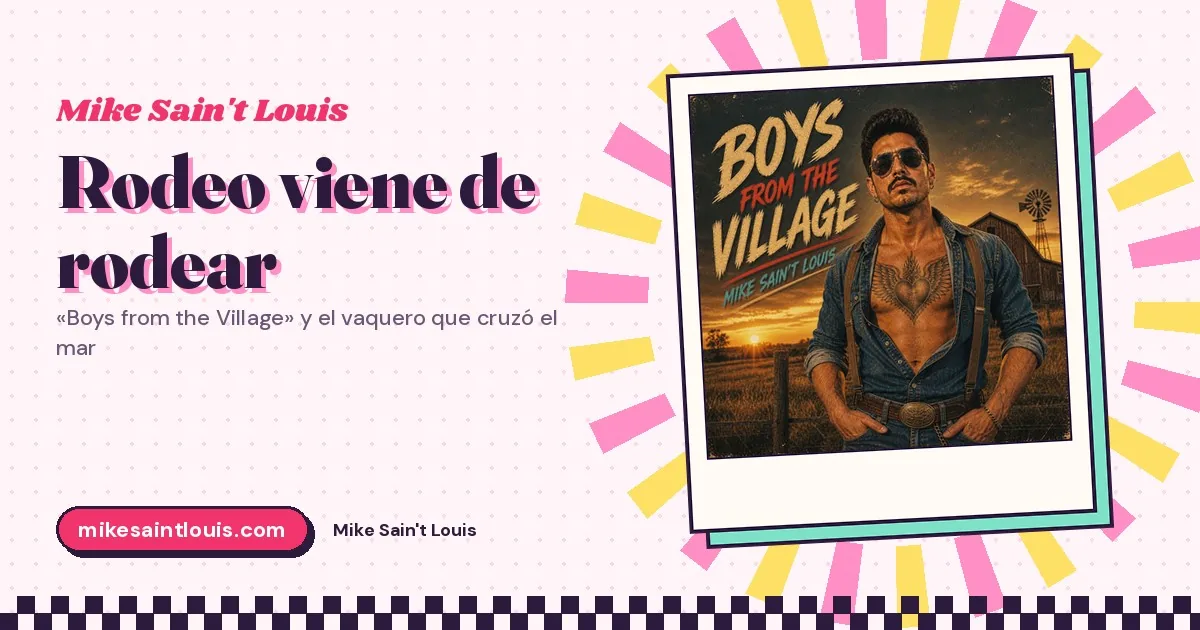
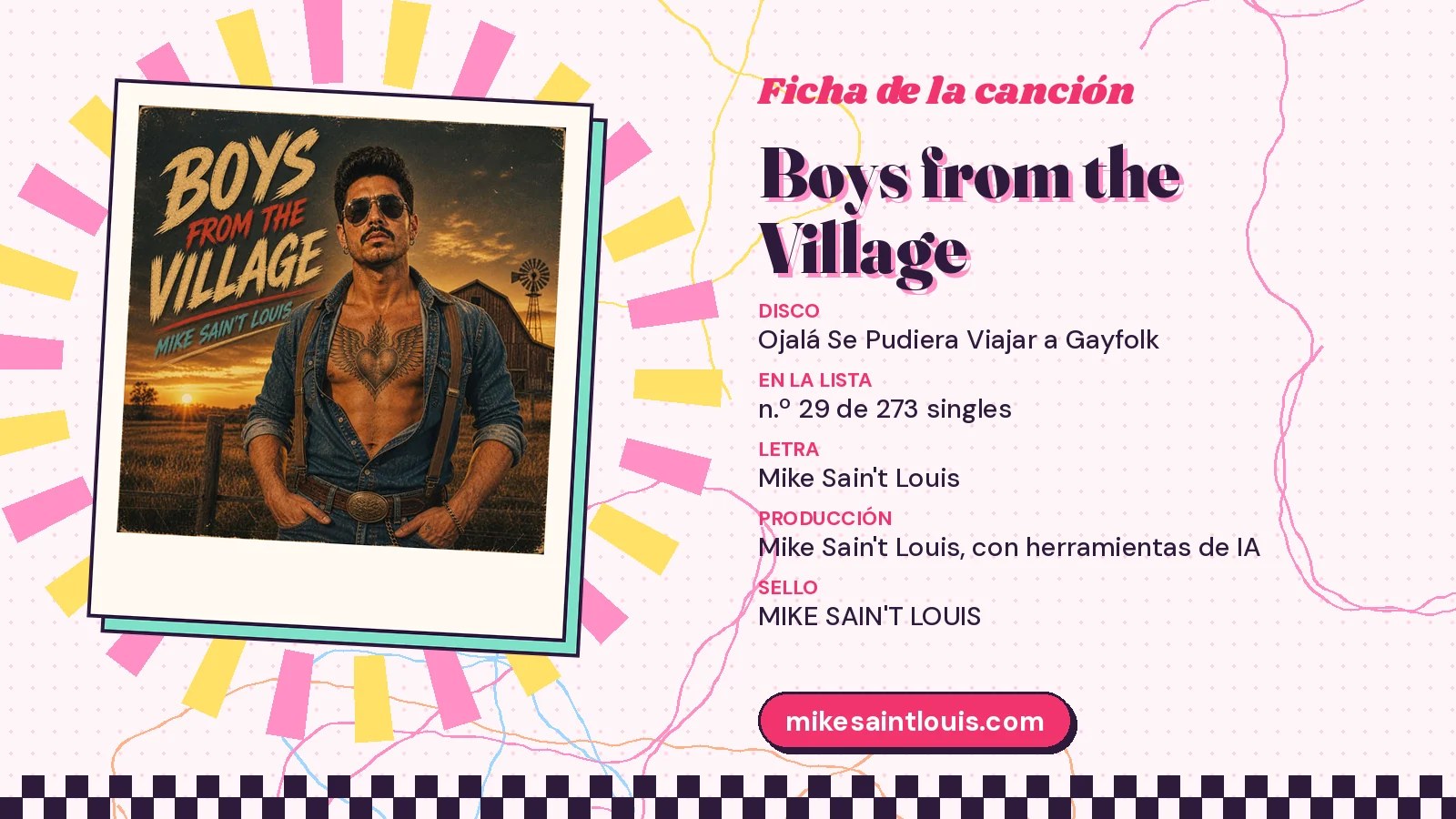
I remembered all that looking at the cover of «Boys from the Village». A young man in an open denim shirt, braces, a big-buckled belt and aviator sunglasses poses in front of a wooden barn with a windmill behind it. It's a textbook picture of the American West. And yet a good part of what he's wearing has roots much closer to home than it seems.
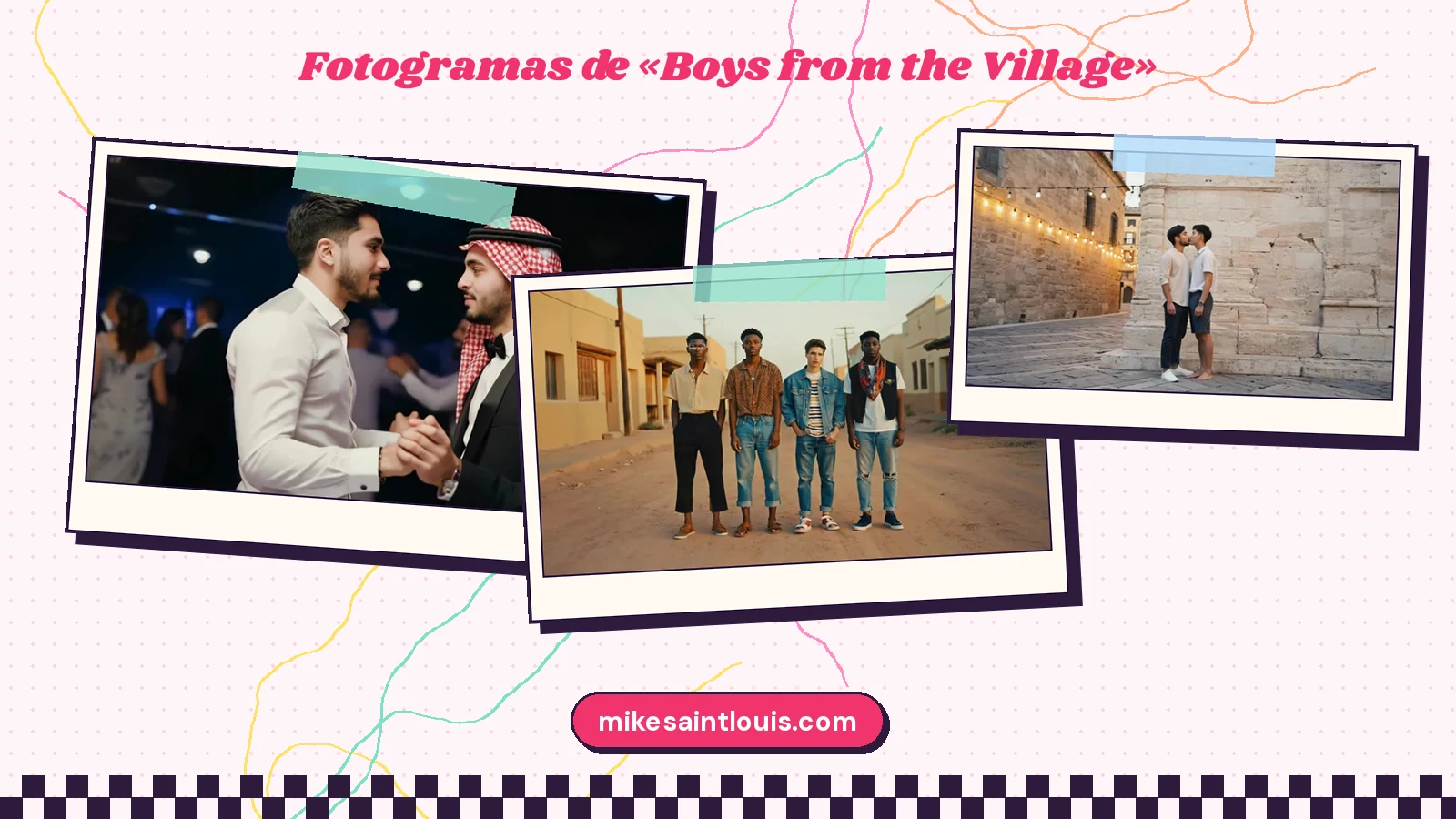
«Boys from the Village» is track 29 of the 273 in my catalogue. It sits between «Sunshine» and «Verde», belongs to «Ojalá se pudiera viajar a Gayfolk» and its official music video was published on YouTube on 3 July 2026.
What I'm not going to tell
The lyrics of this song aren't published yet. I'm not going to quote lines nobody can read or summarise what it's about, because that would be making things up. What I have is the title, the cover and everything they stir up. That's the material for this piece.
On the «Boys from the Village» page I already described the cover in detail, along with the obvious wink to a certain seventies group who dressed up as male icons. I don't want to repeat that reading here. I'd rather ask where that cowboy comes from, how he became a symbol of masculinity and what has happened when gay men have made him their own.
The young man on the cover looks straight ahead, hands in his pockets. Behind him, the sun sets over the fields. There are no horses or cattle in sight, just the set. And on a set you can tell almost any story.
The vaquero who crossed the sea
On his second voyage, in 1493, Columbus took livestock to the island of Hispaniola. In the following decades cows, horses and the techniques to handle them reached Mexico with the Castilian colonisers, and from there they spread north, through the territories that are today Texas, New Mexico, Arizona or California.
With the cattle travelled the people who knew how to look after them. The vaquero of New Spain, heir to the cattle traditions of the peninsula, spent three centuries developing a way of working on horseback, roping cattle and managing herds across huge open ranges. When Anglo-American settlers arrived in those lands in the nineteenth century, they learned the trade from those already there.
The Hollywood cowboy, then, didn't come out of nowhere. He's the English version of a job that was done in Spanish first. I find it very funny that the ultimate symbol of American masculinity has an accent so much like ours.
A dictionary in the saddlebags
Words are the best proof of that journey. «Rodeo» comes from «rodear», to surround, the task of gathering scattered cattle in a circle to count or brand them. «Ranch» is «rancho». «Corral» is «corral», without changing a letter. «Lasso» is «lazo» and «lariat» comes from «la reata», the rope used to tie animals.
There are more, and some are so disguised they're hard to recognise. «Mustang», the wild horse of the West, comes from «mesteño», the animal with no known owner. «Chaps», the leather leggings that protect the legs, comes from «chaparreras». «Stampede» is «estampida». «Bronco», the unbroken horse, is exactly that in Spanish.
My favourite is «buckaroo». It's used in the western United States for a type of cowboy, and it's a phonetic adaptation of the word «vaquero», pronounced the English way. And then there's «hoosegow», slang for jail, which comes from «juzgado». Even the «calabozo», as «calaboose», crossed the border.
Doma vaquera
In Andalusia, Extremadura and Salamanca a riding style that comes straight from that work with fighting cattle is still alive: doma vaquera. The rider wears the short suit, a wide-brimmed hat and leather leggings, and in fieldwork uses the garrocha, a long wooden pole for separating and driving the cattle.
Today doma vaquera is also a competitive discipline, with tests that reward precision, the horse's calm and the elegance of the whole. Seeing it live is suddenly understanding the link between the Andalusian countryside and Westerns.
I like imagining the young man on the cover at a ranch near Seville rather than in Texas. He'd swap the aviators for a flat-brimmed Cordoban hat and the denim shirt for a short jacket. The background, the sun setting over the fields, could stay exactly as it is.
The cloth that came from Nîmes
The young man's shirt is denim, and that has a history too. The word «denim» comes from the French «de Nîmes», the city where a tough twill was made. The word «jeans», for its part, is associated with Genoa, whose sailors wore trousers of a similar fabric.
Jeans as we know them were born in the United States. On 20 May 1873, tailor Jacob Davis and merchant Levi Strauss obtained a patent for reinforcing work-trouser pockets with copper rivets. The idea was for them to stand up to the rough treatment of miners, lumberjacks and cowboys.
A century later, that same work garment had become a uniform of youth rebellion, of rock and, in the seventies, of the style many gay men adopted in big cities: tight jeans, check or denim shirts, boots. Workers' clothes worn with intent.
Mark Twain's braces
The braces on the cover are another detail I love. In the nineteenth century they were the normal way to hold up trousers, which were usually high-waisted and had no belt loops. Later the belt displaced them, and they remained as formal wear, heavy-work gear or pure style.
There's an anecdote I can't not tell. In 1871, the writer Mark Twain registered a US patent for adjustable and detachable straps for garments, intended, among other things, to replace braces. The invention didn't make him rich, but it ended up being used in the fastenings of some bras.
On the cover the braces go over a shirt open to the navel, which strips them of any seriousness. They hold the trousers up, yes, but above all they frame the chest. They aren't there for usefulness. They're there to be looked at.
The windmill that pumps water
Behind the barn there's a windmill. It isn't Don Quixote's mill or Amsterdam's: it's the typical American farm windpump, with its wheel of metal blades and its tail to turn into the wind.
That model spread from 1854, when a Connecticut mechanic called Daniel Halladay designed a windmill able to turn itself towards the wind and regulate its speed so it wouldn't break in gusts. For decades, thousands of them drew water from underground for cattle on the Great Plains.
Without those windmills, much of the West's cattle-raising wouldn't have been possible. It's curious that in films they're always in the background, as scenery, when they were one of the most important pieces of that world.
A rodeo in Reno
In 1976, in Reno, in the state of Nevada, a rodeo unlike any other was held. It was organised by a group of gay men, led by Phil Ragsdale, as a charity event. There was bull riding, horse events and some more festive competitions, and what started almost as a joke became a tradition.
In the following years gay rodeo associations sprang up in several states, and in 1985 the International Gay Rodeo Association was founded, bringing together clubs from the United States and Canada. In those rodeos LGBTQ+ men and women compete, there are classic events and some of their own, and the atmosphere mixes sport, community and party.
For many people who grew up in rural areas, those rodeos were proof that you didn't have to choose between the countryside and who you are. You could be a real cowboy and be gay. You could ride, know about cattle, listen to country and love another man without giving anything up.
Country is queer too
For a long time country music was associated with conservative values, and in many ways it still is. But in recent years interesting things have happened. In 2010, Chely Wright became one of the first front-rank country stars to come out publicly.
In 2019, Lil Nas X's «Old Town Road» was removed from a country chart for not being «country enough», a version with Billy Ray Cyrus came out and it ended up spending nineteen weeks at number one on the main US chart, a record at the time. That same summer, during Pride month, Lil Nas X spoke publicly about being gay.
That same year, the musician Orville Peck, who always performs in a fringed mask, released his first album, «Pony», with a classic Western aesthetic and an openly gay outlook. Seeing him on stage with his hat and fringes is seeing the usual cowboy tell a different story.
The other Village
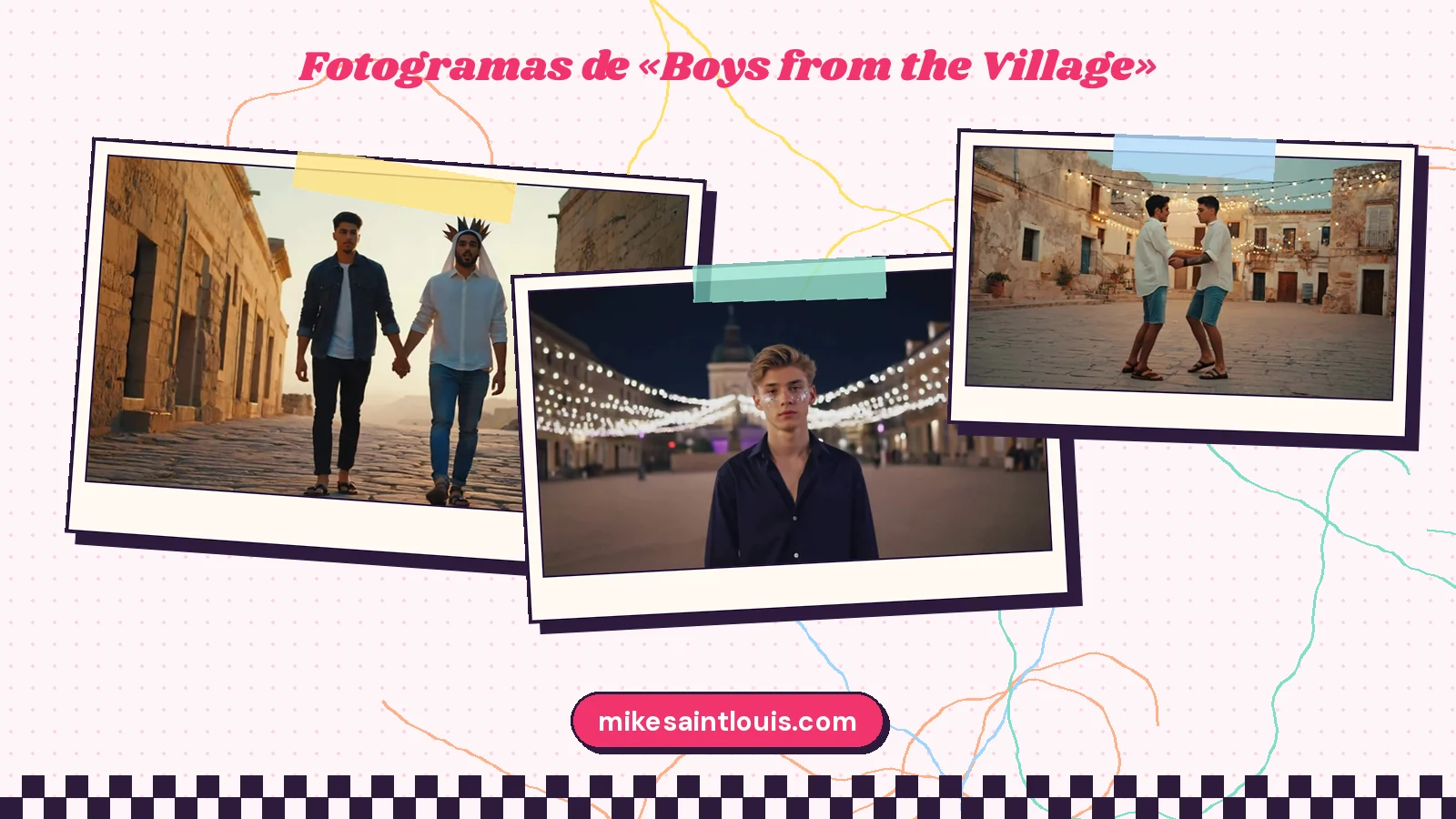
The song's title has a double meaning I really like. «Village» means a small town, and the cover plays with that: fields, barn, sunset. But in New York, when someone says «the Village», they almost always mean Greenwich Village, the neighbourhood in lower Manhattan where the Stonewall Inn is.
In the early hours of 28 June 1969, a police raid on that bar sparked several days of protests that are now considered the starting point of the modern LGBTQ+ movement. The anniversary of that night is the origin of Pride dates in half the world.
So the boys from the village can be two things: the country ones, with their barn and windmill, and the ones from the New York neighbourhood who stood up to the police. I like that the song doesn't have to choose between them.
The man in the adverts
If one image fixed the idea of the cowboy as a real man, it was a tobacco advert. In 1954, Leo Burnett's advertising agency created for Marlboro the figure of a weathered cowboy, with a distant gaze, smoking on horseback in a vast landscape. The brand, curiously, had previously been sold as a filter cigarette aimed at women.
The change worked spectacularly and the Marlboro cowboy became for decades one of the most recognisable advertising icons in the world. What few remember is the end of the story: several of the models and actors who played him died of smoking-related diseases, and one or two spent their last years campaigning against the habit they had helped to sell.
It seems to me a perfect parable about advert masculinity. The tough, lonely, silent man was a product. And like so many products, he came with small print. When on the cover of «Boys from the Village» the cowboy appears with his shirt open and an almost calendar-style pose, that image is turned around: the body is no longer there to sell tobacco but to be looked at with pleasure.
I already played with the night Western and its symbols in «Green Fire», the green bonfire and Wilde's carnation. That was a night of fire in the countryside. This is a sunny afternoon, with less mystery and more cheek.
From leather to lullaby
Work clothes get a second life when they change context. The denim shirt, the braces and the buckled belt are work gear on a ranch and something very different in a gay bar. The same goes for leather, which belonged to bikers and mechanics before becoming an aesthetic with its own codes.
I wrote about that apparent toughness hiding tenderness in the lullaby of the leather boy in «Holy Stillness». There, the boy on the cover was asking, deep down, to be tucked in. I like to think the cowboy in «Boys from the Village» also has something of that under the pose: someone who has put on the tough-man costume and hopes someone will see what's underneath.
I don't say it because of the lyrics, which aren't published, but because of the image. Hands in pockets are a gesture of confidence, but also of someone who isn't quite sure what to do with them.
Growing up far from everything
In Spain, the writer Sergio del Molino published «La España vacía» («Empty Spain») in 2016, an essay that gave a name to something many people felt: the huge interior territory that has been losing its inhabitants. Since then people talk of «emptied Spain», of villages with no school, no permanent doctor and no young people.
For LGBTQ+ people, growing up in those places has an added difficulty. There are no role models nearby, no associations, sometimes not even a decent internet connection. I already wrote about it in what will people say and growing up LGBTQ+ in a village, and also about village and capital clichés in «Mi novio de Albacete».
But the countryside isn't only a place to flee from. Many LGBTQ+ people have gone back, or never left, and live their lives in small villages. More and more rural town halls hang the rainbow flag in June, and not always without controversy. The image of the cowboy in front of his barn, looking at the camera without asking permission, makes me think of them.
The West as costume
On the song's page I talked about the wink to costumes of male icons. I want to add something: cowboy clothes have always had something of a costume about them, even for those who wore them seriously. Cinema, advertising and music turned them into a uniform of masculinity that very few real men wore the way they do in the movies.
Gay men in the seventies understood that perfectly. They put on cowboy, worker or biker clothes not to look straight, but to play with the very idea of the masculine. What in tobacco advertising was a tough, lonely man was, in a bar in the Castro or the Village, a wink between equals.
The cover of «Boys from the Village» draws on that tradition. There's exaggeration, there's pose, there's humour. And there's desire too. I don't think those things are at odds.
The boys, plural
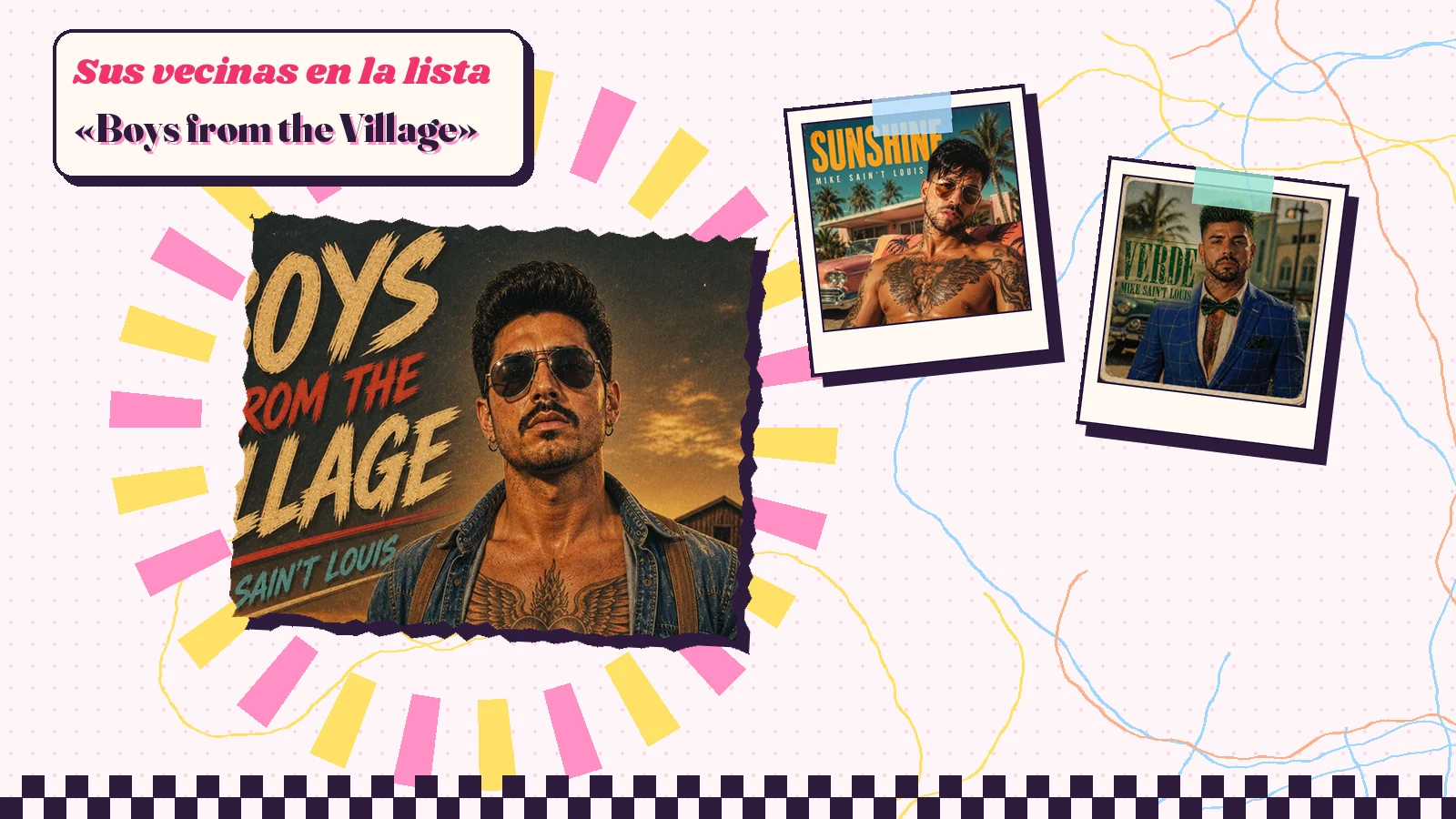
The title speaks of boys, plural, though only one appears on the cover. I like that difference. It suggests that behind that cowboy there are more, a gang who aren't in the photo but exist: the village friends, the ones who got together at the fiestas, the ones who covered for each other.
In my catalogue there's another song where the plural is everything. I told it in the Polaroid gang of «Boys Like Us»: sometimes what saves someone isn't a particular person, but knowing they're part of a group. In the countryside, where everything is further away, that group may be all there is.
And deep down this connects with the very idea of Gayfolk. Folk is people, community, what's passed on by word of mouth. I explained it in what's folk about Gayfolk: village, verbena and coplas in my lyrics. The boys from the village aren't an exception within the project. In a way, they're its origin.
What the album means
«Ojalá se pudiera viajar a Gayfolk» is an album about longing. I already explained in the piece about Gayfolk's second album and the grammar of longing that this «ojalá», «if only», colours everything: wishes, imagined trips, lives that might have been.
«Boys from the Village» fits into that map like a postcard from a place that mixes two worlds. Country and city, village and neighbourhood, work and costume. I don't know whether that place exists, but I'd like it to.
In the catalogue it's surrounded by songs of a very different mood: «Sunshine», luminous, and «Verde», with its rumba rhythm and guitars. Heard together they make a small triptych of light, countryside and party.
When the village weighs on you
Not every village story is pretty. There are young LGBTQ+ people who have a very hard time in small places, where everyone knows everyone and any difference shows. Sometimes isolation, comments and lack of support pile up until they become unbearable.
If you recognise yourself there, you're not alone. Talking about it with someone you trust, with your health centre or with an LGBTQ+ association, even if it's far away and by phone or online, can change a lot. If at any point you think of taking your own life or hurting yourself, in Spain you can call 024, free, confidential and available at any hour. If there's immediate danger, 112. Outside Spain, the local emergency number or the findahelpline.com directory will put you in touch with help.
In my mental-health-without-taboo series there are more phone numbers and pieces for anyone who needs them.
Who I imagine it for
For the young man who drives the tractor in the morning and at night looks in the mirror wearing braces he bought online. For the couple who live in a farmhouse and every June hang a flag on the balcony even though the neighbours mutter.
For whoever left the village for the city and now goes back in summer for the fiestas, with different-coloured hair and less fear. And for whoever has never set foot in a barn but knows what it's like to feel a stranger on their own street.
For all of them, a song named after a village and a neighbourhood at once. Let each one choose which is theirs.
Frequently asked questions
What is «Boys from the Village» about?
The lyrics aren't published yet, so I can't quote or summarise them. The cover shows a young man in an open denim shirt, braces and aviator sunglasses in front of a barn and a windmill at sunset. This post is about what surrounds that image: the cowboy, gay rodeo and LGBTQ+ life in the countryside.
What does «Boys from the Village» mean?
It means the boys from the village or small town. In New York, «the Village» is also Greenwich Village, the neighbourhood where the Stonewall Inn is.
Is it true that «rodeo» comes from Spanish?
Yes. Rodeo, ranch, corral, lasso and stampede passed into English from the Spanish of the vaqueros of Mexico and the south-western United States.
Which album is it on?
«Ojalá se pudiera viajar a Gayfolk», the second album of the trilogy. It's track 29 of 273 in the catalogue, between «Sunshine» and «Verde».
Who makes the music and the vocals?
Mike Sain't Louis, a lyricist, composer and music producer from Madrid. He writes, composes and produces; the vocals are made with artificial intelligence.