By Mike Sain't Louis ·
Who gets to keep the song: spite as a genre and the pound-shop Shakira
In every break-up, things get divided up. The furniture, the friends, the dog if there is one, the streaming subscription. But there's one split that's in no paperwork and that, in the long run, matters more than the sofa: who keeps the song. Who tells the story. Who gets the last word.
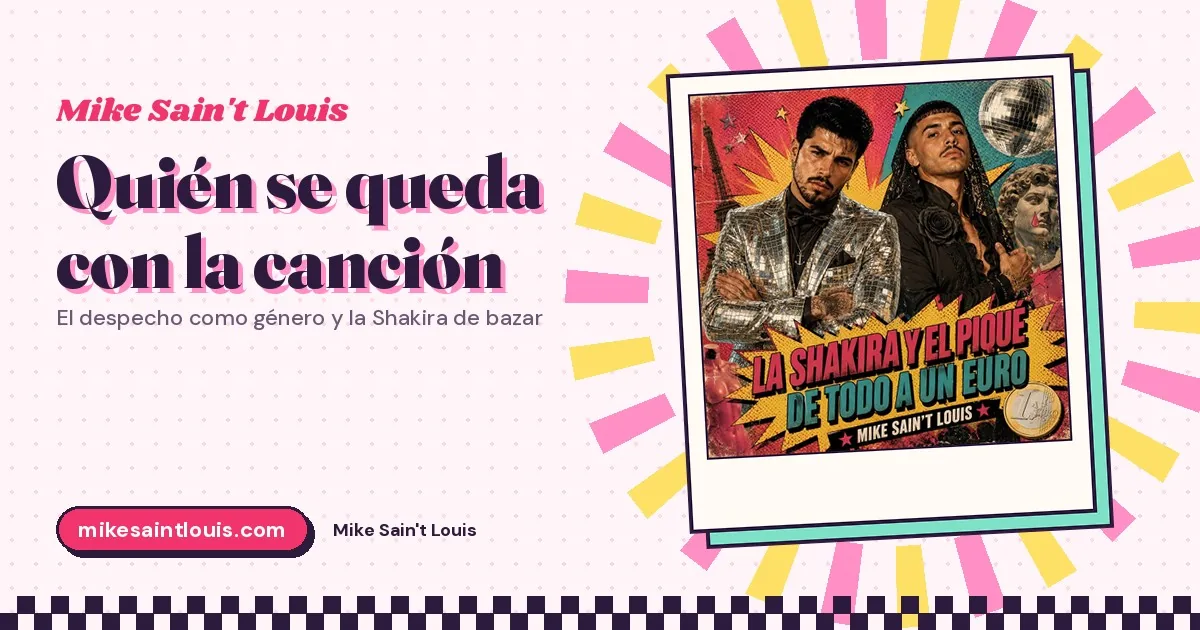
In «La Shakira y el Piqué de todo a 1 euro» («The pound-shop Shakira and Piqué») the narrator is crystal clear. He says it in the chorus, no anaesthetic:
«Lo siento, / a partir de ahora yo soy / la Shakira marica del Todo a un Euro / y tú eres el Piqué del excremento». («Sorry, / from now on I'm / the pound-shop queer Shakira / and you're the Piqué of excrement».)
He claims the diva's role. He leaves the other one whatever's left. The song's page already explains the gossip-magazine tone and the irony of that «sorry» that's not sorry at all. Here I want to come at it from another side: talk about spite as a musical genre, why I picked that particular famous couple as the mould and why the version had to be the pound-shop one.
A genre centuries old
Nobody this century invented the spite song. It's one of the oldest genres there is. There are whole coplas devoted to telling the one who left how little he's worth. There are rancheras that are score-settlings with a mariachi band. There are boleros where the elegance of the melody hides a razor-thin cruelty. And then there's pop, which has turned spite into an industry.
What sets spite apart from the sad break-up song is the direction. The sad song looks inwards: it hurts, I'm crying, I can't live without you. The spite song looks outwards: your loss, you were the problem, look how well I'm doing now. One is a wound. The other is a counter-attack.
I have songs of both kinds. In «Llorar» the permission is for the wound, for staying on the floor a while. In the Shakira one there's no wound in sight. There's a gentleman (or a lady, since the narrator claims her role) who's past the tears stage and onto the nicknames stage.
Why that couple
Shakira and Piqué's split was, for a while, what half of Spain was talking about. And not because of the split itself, everyone breaks up, but because of what came after: the song.
In January 2023, Shakira released a session with the Argentinian producer Bizarrap in which she settled scores with her ex explicitly, with names and brands all but pointing the finger. Her line about how women don't cry any more, they cash in («las mujeres ya no lloran, las mujeres facturan»), became a meme, a T-shirt and a battle cry. It made the evening news. The afternoon chat shows spent weeks taking it apart line by line.
What Shakira did was remind everyone of something very old: when a famous couple splits, the one with the microphone wins. She had the song. He had, at most, his statements to the press. And the song, as always, kept the story.
That's what my narrator understands. That's why he doesn't claim to be Shakira for her fame or her money. He claims to be Shakira because Shakira is the one who kept the song.
The couple on the telly
The song doesn't start with the break-up. It starts with the couple at their best, seen from outside, in a gossip's tone: look at them, how cute, how fashionable, how modern. They're the gay couple of the year. They're on Telecinco all the time. That opening is a little satire on how famous couples get consumed: first we adore them, put them on covers, watch them on chat-show sofas, and then, when they break up, we divide up the pieces.
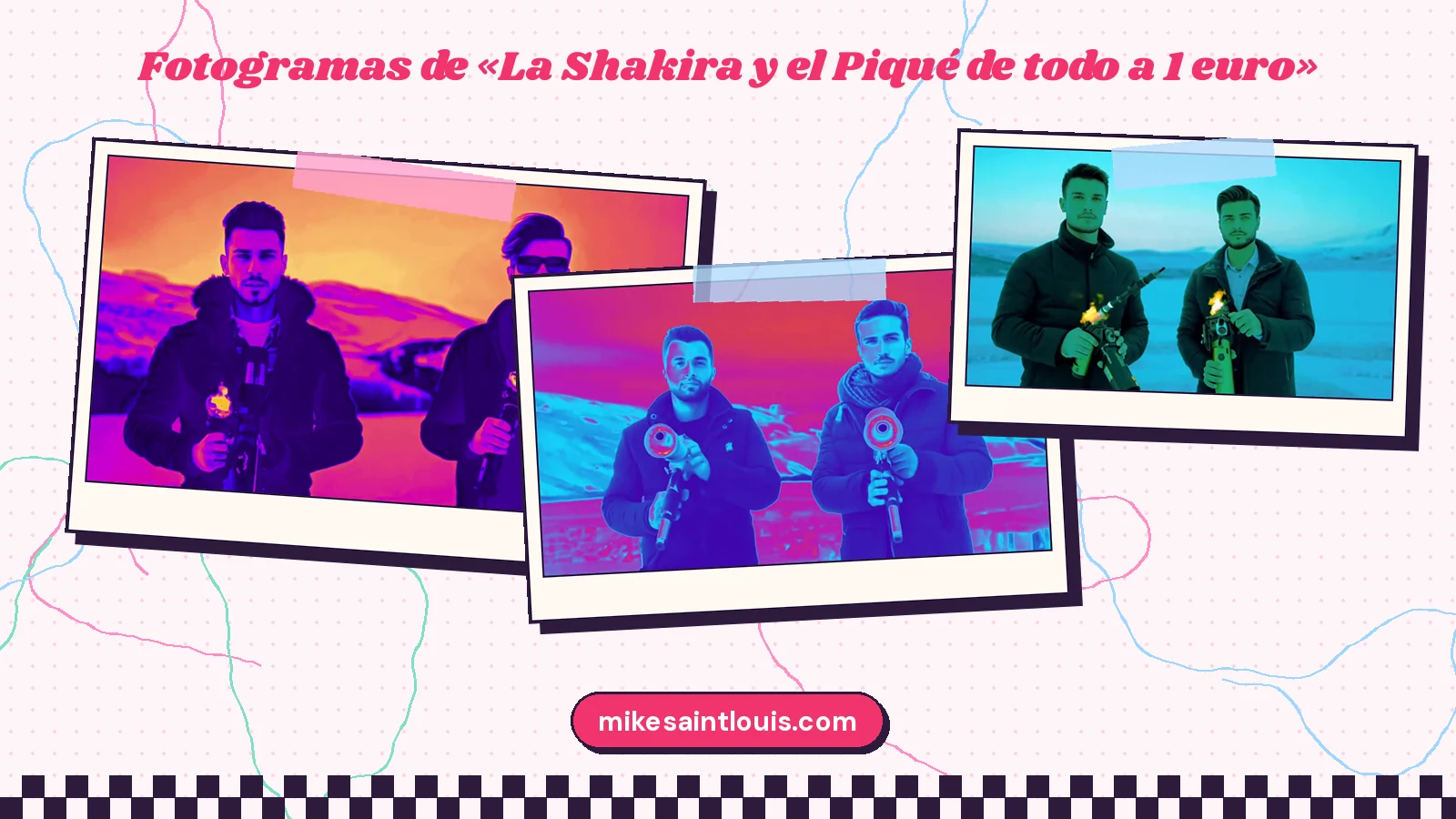
I like that it's a gay couple. Not so long ago, two men as a couple on an afternoon show were a novelty, and they were nearly always there to be laughed at. That they can now be «the gay couple of the year», with their exclusive and their photo spread, is a kind of normality. Debatable, because celebrity-press normality has its traps, but normality all the same. If gay couples can be in the magazines when they're in love, they can be in them when they're throwing crockery too.
That's the part of the song that gets talked about least and that amuses me most: the gossip press as a mirror of equality. We've now got the right to marry, to adopt and to have a front-page break-up.
I've written about another couple of the year, a more homely one, in «Mi novio de Albacete». That's the tender version of the same title. The Shakira one is the version with the knives out.
The pound shop
And now the part that makes the song mine and not just a joke about the news: the pound shop.
For anyone who doesn't know or doesn't remember, in the nineties Spain filled up with «Todo a 100» shops, where everything cost a hundred pesetas. When the euro arrived, lots of them became «Todo a un Euro», although fewer and fewer things actually cost a euro. They were the neighbourhood bazaars where you bought a fan, hair clips, a gold photo frame with glass that scratched if you looked at it. Truly cheap. Tacky and proud of it.
My narrator doesn't just claim to be Shakira. He claims to be the queer Shakira of the pound shop. The bazaar version. The one in plastic heels, earrings that turn your ears green and a blonde wig that's far too shiny. And that, for me, changes everything.
Because laughing at the ex is easy, and laughing at yourself while you do it is something else. The pound-shop Shakira knows she isn't Shakira. She knows she has neither the millions nor the talent nor the producer. All she has is the role, and she puts it on anyway, cheap glitter and all. That's where the camp lies: taking seriously a role that's too big for you, knowing full well it's too big for you.
The excrement
The other role, the ex's, gets no pound-shop adjectives. It gets a much more direct one: the Piqué of excrement.
It's the crudest line in the song, and I wrote it that way on purpose. Spite has no nuance. Nobody, mid-rage, says «my ex-partner had virtues and flaws like everybody». You say what you say, and in a chorus you have to say it with a word that lands.
Now, one thing matters, and I want it in writing. The Piqué in my song isn't Piqué. He's a fictional ex who earns the nickname inside the story. I have nothing to say about that gentleman's real life; I don't know him. The song uses the famous couple as a mould, like wearing a well-known costume at Carnival, because everyone recognises the costume and nothing needs explaining. What's inside the costume is something else.
I talk more slowly about laughter as a way of telling break-ups in why I laugh at my exes.
Her, not him
There's a gender detail in the chorus I don't want to skip. The narrator is a man, a marica, and he doesn't claim to be Piqué. He claims to be Shakira. The queer Shakira, says the lyric, just so there's no doubt.
I could have written a song where both were Piqués, or where the narrator was the handsome footballer and the ex the spurned star. No. The good role, the interesting one, is hers. Because in the original story she's the one who keeps the song, who turns humiliation into a hit, who comes out ahead in the split. He only appears as the one who left.
Among queer men, claiming the diva's role is a tradition. For decades, gay men have identified more with the heroines than the heroes of films and songs. With the one who suffers, the one who gets back up, the one who puts on her heels and walks out with her head high. The flamenco folk stars, the actresses of classic Hollywood, the pop divas of the eighties. It's no coincidence: they were the only characters expressing emotions we recognised, at a time when the men in songs didn't cry or get spiteful with any style.
The pound-shop queer Shakira is the latest in that long line. One more diva in the pantheon, even if she arrives with the price tag still on.
The famous mould
It's not the first time I've used someone famous as the mould for a song. My catalogue has quite a few names in it: Ojete Calor, Los Javis, Lola Flores, La Veneno in «Kaaa miga», Carmina Barrios in «Ojalá hubiera tenido de suegra a Carmina Barrios».
But there's an important difference between those cases and Shakira's. In the others, the famous name is a tribute: I'm talking about someone I admire, someone I'm grateful to or someone I'd have loved to have around. With Shakira and Piqué, the famous couple isn't the subject. It's the set. The song isn't about them. It's about two other people who see themselves in them.
That seems a very modern way of telling things. You don't need to explain feelings from scratch any more. You just say «we're like that couple» or «this is so that series» and everyone gets it. Popular culture has become a shared language, a repertoire of models we use to talk about our own lives. My narrator uses it shamelessly: he doesn't say «I'm hurt and I want to come out on top», he says «I'm Shakira». And that says it all.
«Sorry» as a weapon
There's one word in the song at the centre of everything, and it isn't Shakira or Piqué. It's «lo siento», sorry.
Normally, «sorry» is an apology. In the song it's the opposite: an announcement. «Sorry, from now on I'm…» means «fair warning, this is going to hurt». It's the game-show host's «sorry» when the contestant has got it wrong. Polite in form and devastating in substance.
I love turning polite formulas inside out. Spanish has loads of set phrases that mean the opposite of what they say. «Con todo el respeto», with all due respect, usually announces disrespect. «No es por nada», it's not that I'm saying anything, is always saying something. «Lo siento, pero», sorry, but, is hardly ever sorry. The language of spite is full of these formulas, and a spite song that doesn't use them misses half the fun.
I have an entire piece on the exaggeration of everyday speech, «Me muero». The fake «sorry» is first cousin to the «I'm dying» that never kills anyone.
Cashing in with what you've got
Shakira's line about cashing in had a very clear economic reading: turning pain into business, success, money. She could do it. She had a huge career, a worldwide audience and the producer of the moment.

And the one who has none of that? The one who doesn't cash in because there's nowhere to cash in? That's where the pound-shop Shakira comes in. She cashes in at the bazaar. Her revenge won't make the evening news or be heard by millions. It'll be in the friends' WhatsApp group, in an Instagram story with forty views, in a song a few people will hear.
But it's hers. And for someone who's just come out of a relationship that left them in pieces, having something of their own, even pound-shop, is a lot. The low-cost version of dignity is still dignity.
This connects with something I've always been interested in and have worked on in other songs, like «Ojete Calor en versión low cost»: low cost as an aesthetic. Not as something to be ashamed of, but as a place to speak from. Whoever can't afford the mansion builds one out of cardboard and glitter. And sometimes it comes out funnier.
The spurned lover's repetition
Something people notice when they listen to the whole song is the repetition. The chorus comes back again and again, almost unchanged, like a scratched record.
It isn't laziness. It's how spite talks. Someone who's just broken up repeats the same lines to everyone they bump into. To the friend over coffee, the colleague at work, the waiter if he'll put up with it. «Well, now I'm Shakira and he's Piqué.» Over and over, until they believe it. Repetition is how you convince yourself of your new role.
There's something of a mantra in that, as the song's page says. And something of home-made therapy. Repeating a line until the previous one stops hurting, the one they said to you when it ended, the one you can't get out of your head. If the new line is louder, the old one fades.
When spite goes off
Now, something I also want to say, because it isn't all a party.
Spite has a use-by date. For a while, giving the ex nicknames is healthy, gives you strength, gives you back control. But if two years later you're still talking about the Piqué of excrement at every dinner, it isn't spite any more, it's something else. It means the story still has you, instead of you having it.
That's why I like that the song is short and stays in the chorus. There's no second part where the narrator plots revenge or stalks the ex. There's an outburst, a swap of roles, and that's it. It's a song for the week after, not the year after. For the year after I have others, calmer ones, where you can look back without the nicknames.
There's a kind of humour that heals and another that poisons. The first helps you let go. The second ties you down. I've thought about it a lot in from other people's laughter to our own, and I think the pound-shop Shakira is on the right side, because she laughs at herself too. If she only laughed at him, it would be a score-settling. Because she laughs at both of them, it's a comedy.
Telecinco
One more note on that line «salen mucho ahora en Telecinco», they're on Telecinco all the time, because it isn't there by chance.
For years, Spanish afternoon and evening TV has been the great stage for break-ups. Celebrity chat-show sets have seen couples marry, split, make up and split again, all live and with the audience applauding. It was a weekly theatre of spite. Half the country learnt how to talk about their break-ups by watching TV celebrities talk about theirs.
That's why the narrator doesn't need to explain what a couple who are on Telecinco is. Everyone knows. It's the couple who sell their love in instalments and, when it's over, sell the ending too. My gay couple of the year being on there is a way of saying they've reached the top and the bottom at the same time. And that what comes next, the break-up, will have an audience.
Spite on the dance floor
Spite songs lead a curious life when they leave the headphones and reach a dance floor. At home, alone, they're confessions. In a club, they become something else: a collective yell from people who've never met but have been through the same thing.
Anyone who's been on a dance floor when a break-up anthem comes on has seen it. A hundred people pointing at the air, at an imaginary ex, with the same line in their mouths. Each one thinking of their own. Nobody knows who the person next to them is thinking of. And everyone feels less alone. Spite, a lonely emotion, turns into a shared party.
That's another reason the pound-shop Shakira's chorus is so repetitive and so easy to remember. It's built so you can yell it without having heard it before, on the second time round. «From now on I'm» is a phrase anyone can finish with their own role. On the dance floor, everyone picks their diva.
I wrote about what a dance floor needs to work, especially on days of celebration, in what a Pride dance floor asks for. One of the things it asks for, I think, is this: lines that let you settle scores without hurting anybody.
What a song like this is for
Back to the beginning. What's a pound-shop spite song for?
It's so that someone who's just broken up has a chorus to repeat in the shower. It's for laughing at the famous couple of the moment without having to take the gossip press seriously. It's a reminder that spite, so dramatic in big stars' songs, also belongs to ordinary people, the ones who shop at the bazaar round the corner. And it's, above all, for keeping the song.
Because in every break-up there's a moment when you decide who you're going to be in the story that gets told afterwards. My narrator chooses to be the diva, even if it's the clearance-rack one. Not a bad choice. There are worse.
Frequently asked questions
What is «La Shakira y el Piqué de todo a 1 euro» about? About a famous gay couple who break up and how one of them claims the role of the pound-shop Shakira and leaves the other the role of the Piqué of excrement. The full lyrics are at gayfolkplanet.com/letras.
Is it about the real Shakira and Piqué? No. It uses the famous couple as a recognisable mould to tell the break-up of a fictional couple.
What's the pound-shop bit about? «Todo a un Euro» is Spain's version of the pound shop. It's the bazaar version of the diva: someone who claims Shakira's role knowing he isn't Shakira, with humour and pride in the tacky.
Who makes the song? Mike Sain't Louis writes the lyrics, composes and produces. The music and vocals are made with artificial intelligence.