By Mike Sain't Louis ·
Pygmalion on the sofa: the made-to-measure boyfriend fantasy, told by someone who works with AI
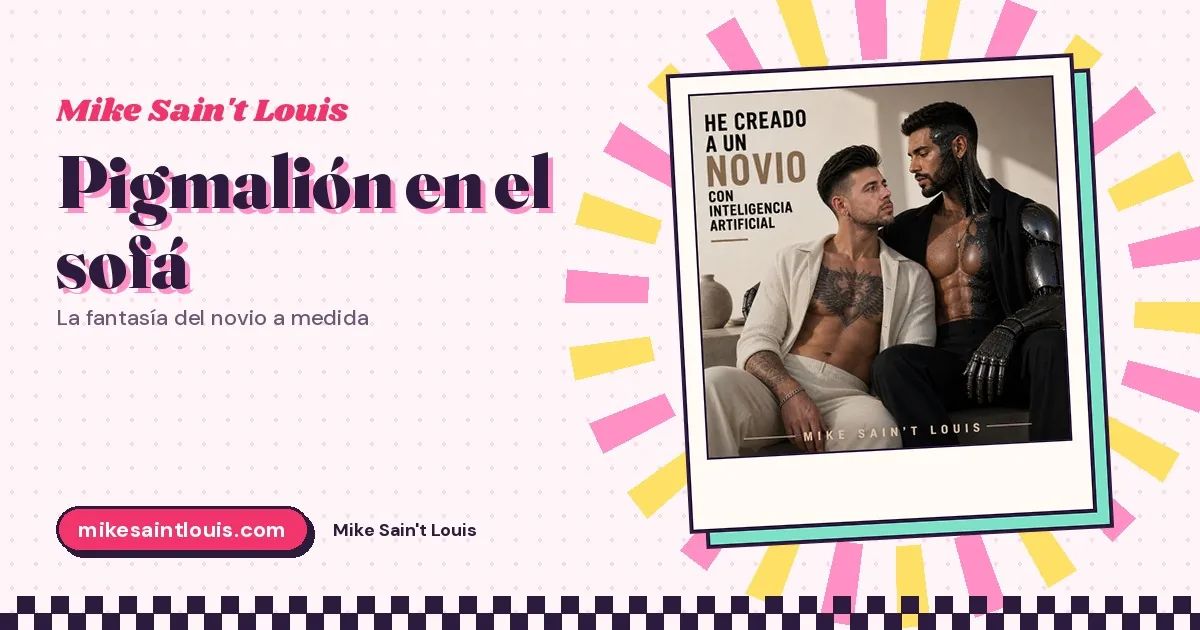
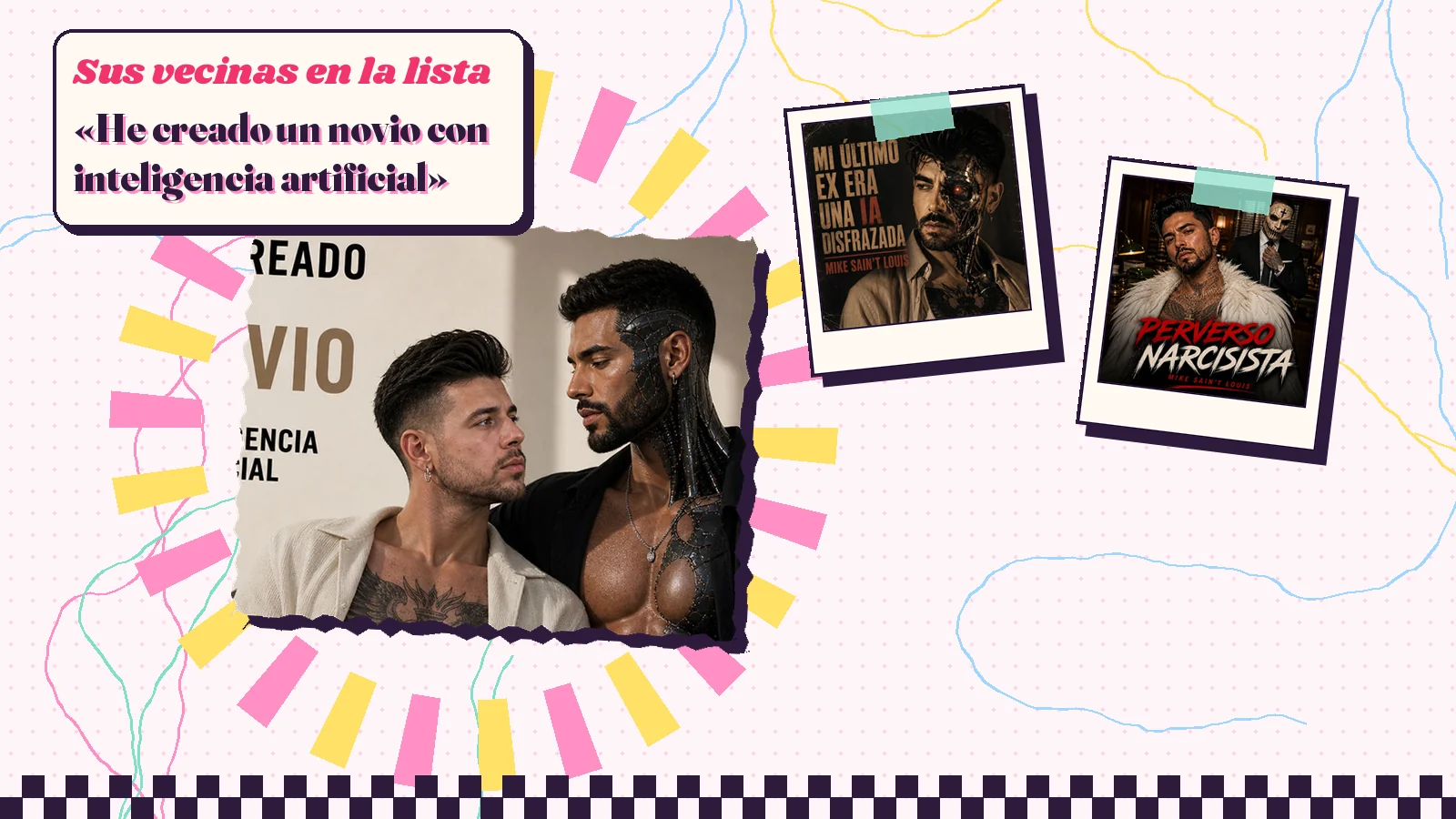
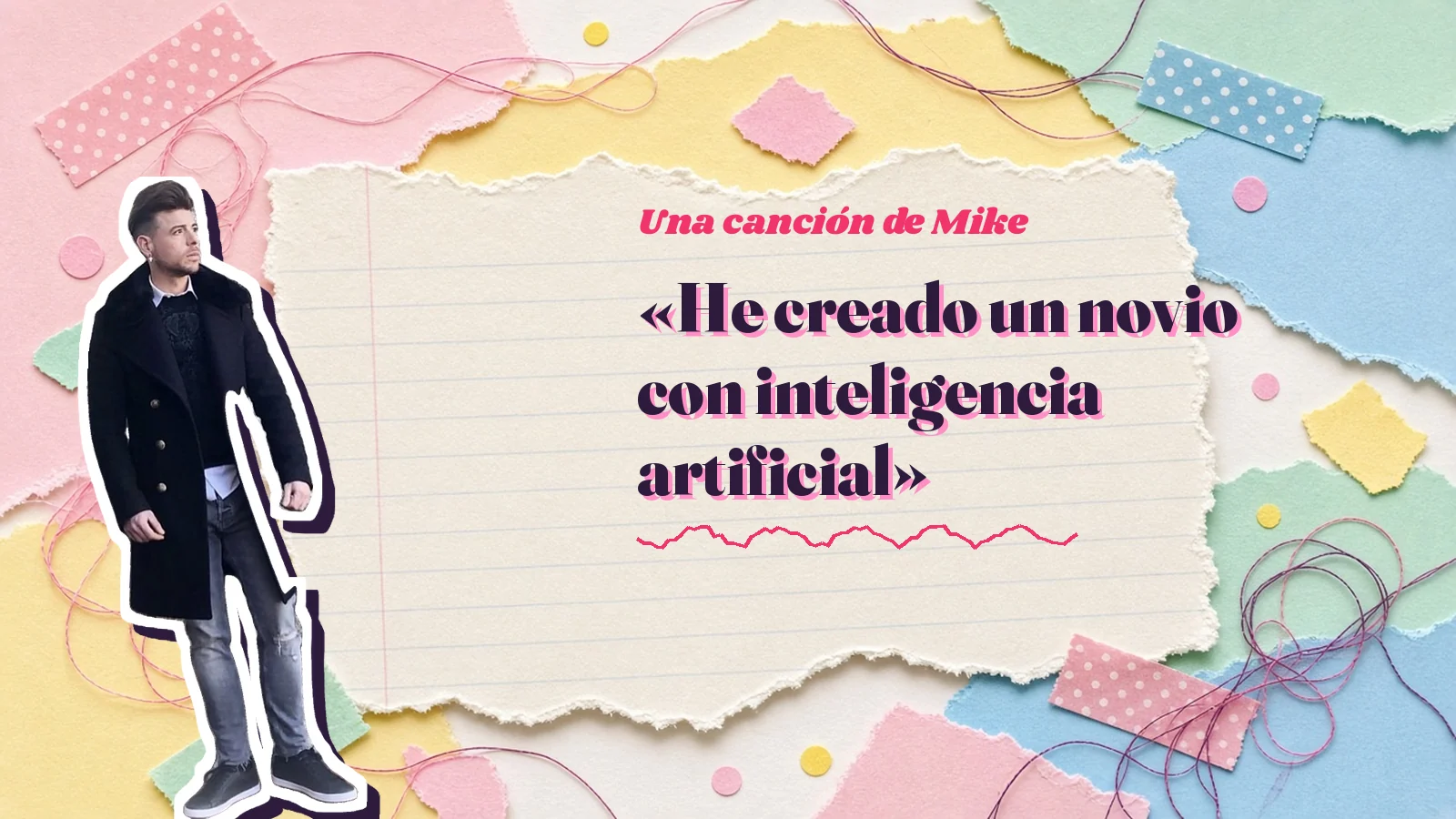
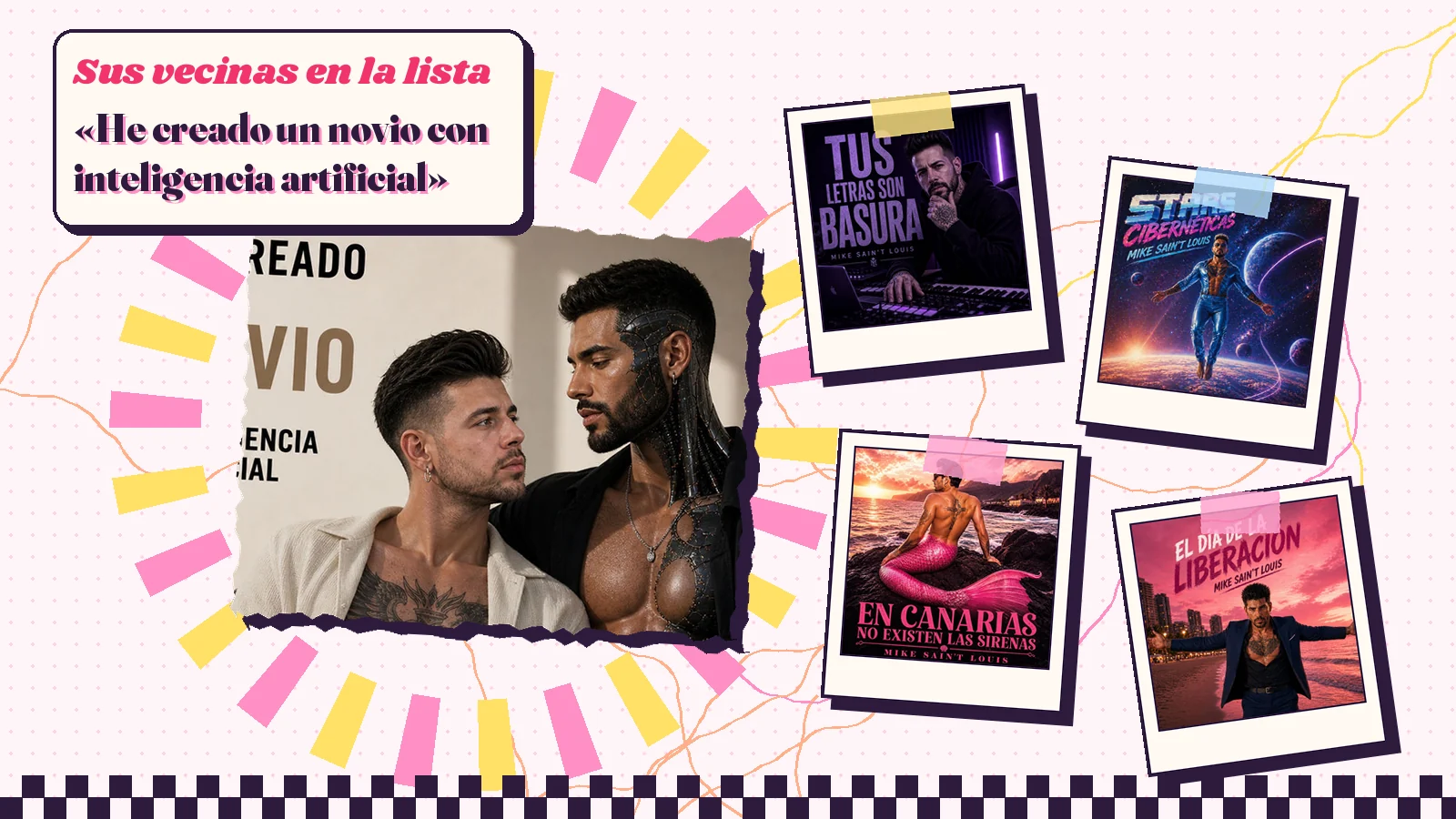
A living room from an interiors magazine. Bone-coloured sofa, linen cushions, a pair of ceramic vases that look like they cost more than my laptop. On the sofa, two boys looking at each other from a hand's breadth away. One in an open white shirt, chest tattooed. The other in a black shirt with half his face made of polished metal and a robotic arm poking out of his sleeve, resting, very properly, on the first one's knee.
Across the top, in furniture-catalogue lettering: «He creado un novio con inteligencia artificial». I've created a boyfriend with artificial intelligence.
If you tell people you make songs with AI, the joke writes itself: "And haven't you made yourself a boyfriend too?" Well, in a way, yes. I made a song with that title. This piece is about the fantasy behind it, and about why, despite working with those tools every day, I wouldn't trust a boyfriend with half a chrome face.
What I won't tell you
The lyrics of «He creado un novio con inteligencia artificial» aren't yet published on the site's lyrics page, so I won't spoil them or make them up. The song's page says that what happens once the boyfriend is built is best left to the song. I'll respect that. Here I'll talk about the title, the cover and the idea, which give plenty to chew on.
A shopping-channel title
The title deserves its own section, because it's almost a complete joke before you hear a note.
"I've created a boyfriend with artificial intelligence." It sounds like a clickbait headline. It sounds like a YouTube video with a shocked-face thumbnail and red arrows. Above all, it sounds like late-night shopping TV: "Tired of dates that go nowhere? Fed up with being left on read? Call now and get your artificial intelligence boyfriend, robotic arm included and two free vases!"
That advert tone is deliberate. The perfect-boyfriend fantasy is sold exactly like that, as a product. Apps sell us boyfriends in a grid, reality shows sell us couples in villas with pools, social media sells us the ideal couple life in filtered photos. The next step, buying one ready-made, seems almost natural.
And then there's the verb. «He creado», I've created. First person, present perfect, like someone announcing an achievement: I've finished the marathon, I've passed the civil service exams, I've created a boyfriend. It has a whiff of craft-class pride, of showing the family the clay figure you made at the community centre workshop. Look, Mum, a boyfriend. He's come out a bit wonky, but he's mine.
That mix of pride and pathos is very much my titles. I laugh at the narrator before anyone else can.
Pygmalion tried it first
The fantasy of building yourself the perfect partner is far older than computers.
In Ovid's «Metamorphoses» there's Pygmalion, a sculptor from Cyprus who, fed up with the women of his time, carves an ivory figure so perfect he falls in love with it. He dresses her, gives her flowers, talks to her. And Venus, moved or amused, brings her to life. Since then the myth has been retold a thousand ways: «My Fair Lady», with a professor who makes a lady out of a flower seller; «Weird Science», with two teenagers who create the girl of their dreams on a computer; «Her», with Joaquin Phoenix falling for an operating system voiced by Scarlett Johansson; «Ex Machina», with an android who has plans of her own.
Nearly all those stories have something in common: the creator is a straight man and the creature is a woman. My song's cover flips that casting. Here the creator is a boy, the creature is another boy, and the scene isn't a laboratory but a Pinterest living room.
Pygmalion, queer edition, with linen cushions.
And with one more change, no small one: in most of those stories the creature ends up rebelling, escaping or showing up the creator. Manufactured perfection always has small print. The statue wakes, and from that moment the story no longer belongs only to the sculptor. The android in «Ex Machina» locks up the man who wanted to free her. The operating system in «Her» turns out to be talking to thousands of people at once. None of them comes out the way the form promised.
Fed up with dates that go nowhere
The song's page raises the underlying question: what if, fed up with dates that go nowhere and apps that leave you on read, you built yourself a made-to-measure boyfriend? Handsome, attentive, no exes, no drama.
That question isn't science fiction. It's a lot of people's Tuesday night. Dating apps have turned love into an endless catalogue, and the endless catalogue has a curious side effect: nobody is enough. There could always be a better one two squares down. A bit taller, a bit nicer, a bit less complicated. After enough swiping, you end up with an ideal man in your head assembled from bits of many profiles. This one's abs, that one's smile, the other one's job, nobody's conversation.
The AI boyfriend is the logical end point of that way of searching. If you're already assembling the perfect man from spare parts, why not assemble him for real?
It's a very modern fantasy. And a very sad one, if you stop to think about it. That's why I enjoy telling it with a shopping-channel title.
The perfect-boyfriend order form
Imagine you could order a boyfriend the way you order a made-to-measure sofa. They hand you a form. What would you put?
Most people would start with the physical: height, eye colour, beard or no beard, discreet tattoos or neck tattoos. Then the textbook virtues: affectionate, funny, good conversationalist, cooks. And then, if you're honest, the real whims, the ones you never put on a profile. Knows Rocío Jurado's entire discography. Doesn't snore. Isn't squeamish about pulling hair out of the plughole. Can sit through a whole evening of «Pasapalabra» without checking his phone. Has no opinion on how you fold towels.
The trouble with the form is that everything you write is what you already know. Nobody writes down what would surprise them, because they don't know what it is. And the people we end up in love with hardly ever fit the form. They arrive with things you'd never have asked for: a ridiculous laugh, a habit of keeping receipts, a past in a village in Teruel, a way of saying your name nobody else has.
The AI boyfriend would be perfect according to the form. And for that very reason, I suspect, bored to tears by week three.
A Pinterest living room
The cover isn't set in a laboratory, a robotics workshop or a spaceship. It's set in a magazine living room: pale walls, soft-lined sofa, artisan ceramic vases, earth-toned cushions. The set of the perfect life we see online and almost nobody has at home.
That's part of the joke too. The artificial boyfriend doesn't come alone. He comes with the full fantasy pack: the pretty house, the afternoon light, the couple gazing into each other's eyes on a sofa with no tomato stains. It's an advert for a life that doesn't exist, starring a boyfriend who doesn't exist either.
If the cover were set in a forty-square-metre flat in Usera, with the clothes horse in the lounge and the TV on with the news, the robot boyfriend would be funny in a different way. Here the laugh is more uncomfortable, because the fantasy is complete. And you wonder how many things in that photo you'd want, besides the boyfriend.
The loneliness behind the joke
Time for the serious bit. I'll say it once.
The fantasy of a manufactured boyfriend is funny on a cover. In life, it's the symptom of something not funny at all: a lot of people are lonely, and loneliness pushes you to imagine absurd solutions. When the only thing answering you at two in the morning is an app, it's easy to end up thinking a machine that always answered would be better than nothing.
It wouldn't. But I understand why people think it. The loneliness of the middle-aged gay man, with the apps as his only shop window, is something rarely talked about, and it crops up often in my songs, even dressed up as a joke. This is one of them.
If you recognise yourself there, don't build yourself a boyfriend. Ring a friend, even if it's just to moan about how dire the market is. A flesh-and-blood friend answers worse than a machine, but he hugs you.
Always tell me the truth
In the sister song, the narrator wants an artificial boyfriend for a very specific reason: so he'll always tell her the truth, answer honestly, never deceive her. She doesn't ask for him to be handsome, or rich, or to cook. She asks him not to lie.
I find that wish very telling. It says far more about flesh-and-blood men than about machines. If the most desired virtue in a boyfriend is not cheating on you, the bar is on the floor. And in many people's experience, it is.
The funny thing is that machines don't always tell the truth either. Anyone who's worked with artificial intelligence knows it sometimes makes things up with breathtaking confidence. It cites a book that doesn't exist, gives you the wrong date, assures you a song says something it doesn't. So the AI boyfriend would, deep down, have the same flaw as the ex: he'd lie to you looking you in the eye. The difference is he'd do it without malice, through a miscalculation. I'm not sure that's a comfort.
What the machine can do
Here I have to put on my work apron, because I know this first-hand.
I use artificial intelligence every day as a production tool. The music and vocals of my songs are made with it, from lyrics I write and decisions I make. I've explained it in detail in what's mine in a song made with AI and in AI doesn't save me work, it moves it somewhere else.
And I know what it does well. It answers fast. It doesn't get tired. It doesn't take offence if you ask for the same thing twenty times. It doesn't pull a face in the morning. It gives you options, lots of options, and lets you choose. Tell it you don't like something and it changes it without a murmur.
Put like that, it sounds like the ideal boyfriend. Attentive, patient, accommodating. Always available.
Which is exactly why I wouldn't want it as a boyfriend.
What the machine doesn't know
There's a piece on the blog called AI has no exes, and the phrase sums up part of what I think. The machine can produce a technically perfect heartbreak song, but it doesn't know what it is to be left on read. It's never waited for the double tick to turn blue. It's never cried in a club loo. It's never deleted seven years of photos from several different clouds.
That's what I bring to the songs. The lyrics. The experience. The joke that only occurs to someone who's been there. The machine supplies the sound; the words are mine.
With a boyfriend it would be the same, but the other way round. A manufactured boyfriend could tell you everything you want to hear, in the perfect tone, at just the right moment. But he wouldn't have been there. He'd have no past weighing on him and no future frightening him. He couldn't truly surprise you, because everything he did would come from what you'd asked for. It would be like falling in love with your own reflection with a good haircut.
And for falling in love with your own reflection we already have Narcissus, and we know how he ended up.
Kisses, hugs and a damn good shag
In my catalogue there's another song that plays with the same idea from another angle, and that one does have published lyrics: «Mi último ex era una IA disfrazada», my last ex was an AI in disguise. There the narrator considers creating an artificial boyfriend because at least he'd always tell her the truth. And the problem appears at once, delivered by the lyric as casually as anything: «Porque lo único / que no / te podrá / nunca dar / serán besos / abrazos / y polvazos» («Because the only thing / he'll never / ever / be able to give you / is kisses / hugs / and a damn good shag»).
That list is, for me, the most honest answer to the AI boyfriend fantasy. No need for a philosophy treatise. Just the list of what's missing. The body. The smell. The weight of another person on the mattress. The hand that reaches for you at four in the morning without being asked.
And then the same song's punchline, a perfect joke about flesh-and-blood men: «¿Entonces mi último ex era una I A disfrazada?» («So was my last ex an AI in disguise?»). Because, come to think of it, some exes behaved exactly like a badly programmed machine. Automatic replies, zero empathy, the betrayal chip on the blink.
The arm on the knee
Back to the cover, because it has a detail that makes me laugh every time I look at it.
The artificial boyfriend's robotic arm is resting on the human boy's knee. It's an age-old couple's gesture, the hand on the knee while you're on the sofa watching a series. But done with an articulated metal limb, screws, joints and all. Tenderness from a car workshop.
And the gaze. The two look at each other very seriously, very close, like the second before a telenovela kiss. The song's page talks of telenovela tension between a human and a cyborg, and that's exactly it. It could be the poster for a Turkish afternoon soap, the kind with ten-second stares and violins. «Silicon Love», episode 47.
I like that the cover takes the romance seriously. It isn't mocking the boy who falls for a machine. It's a real love scene with one absurd element. Like nearly every love scene, if you look at it from outside.
Half a face
There's something unsettling about the artificial boyfriend having only half a metal face. The other half is human, handsome, with stubble and thick brows. As if the manufacturer ran out of budget halfway through. Or wanted it to show.
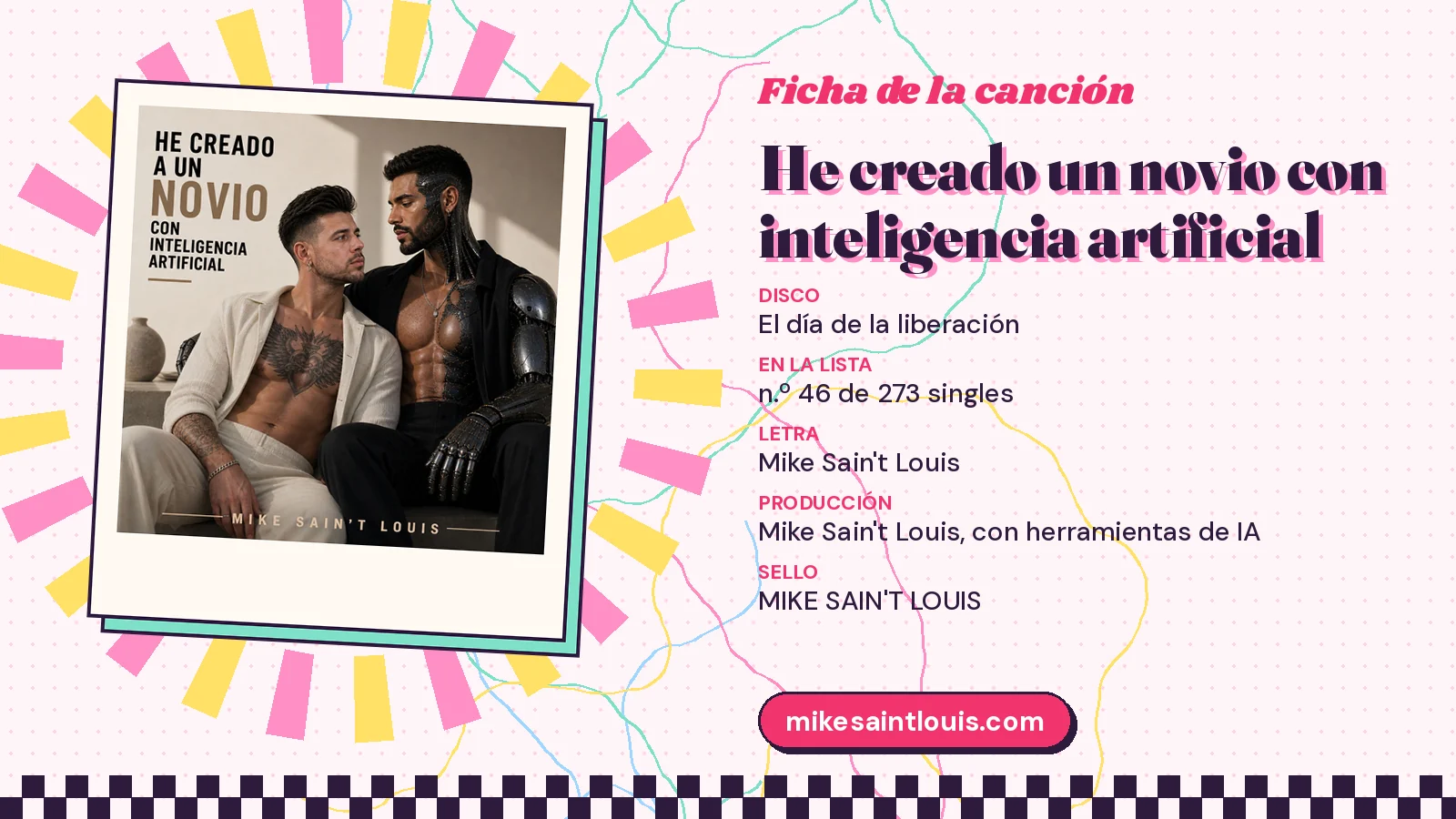
That half face strikes me as a good metaphor for how I use AI in my work. Part of the result is human: the lyrics, the idea, the direction, the decisions. Part is machine: the sound, the vocals, the arrangements. And I don't hide it. I explain it in why I say openly that I use AI: I'd rather my metal showed than pretend it's all flesh.
The boyfriend on the cover doesn't hide it either. There's his chrome half, in plain view. At least he's honest. More than some exes.
The shoddy version
Here comes a moment of self-parody, long overdue.
If I built myself a boyfriend with artificial intelligence, he wouldn't come out like the one on the cover. He'd come out with every flaw machines show when they get things wrong, which I know something about since my first stumbles with AI. Six fingers on one hand. A strange accent that changes mid-sentence. Answering "do you love me?" with a three-line paragraph that begins "As a language model...".
The boyfriend on the cover is the catalogue version. Mine would be the bargain-bin version, with a second-hand robotic arm off Wallapop and a software update pending since 2019. Loving me with lag.
Honestly, I'd rather have a flesh-and-blood man who's slow to reply because he's at the gym. At least I know he's at the gym. Or so he says.
No exes, no drama
The song's page mentions two advantages of the artificial boyfriend: no exes and no drama. And there, for me, lies the fantasy's biggest trap.
A man with no exes is a man with no history. A man with no drama is a man nothing matters to enough to make a drama about it. Those two things, which seem desirable in a moment of disillusionment, are what make a person interesting. Your partner's exes are proof he's loved, lost and learnt something. The dramas are proof he feels.
I live off drama. Literally. My songs come from it. A boyfriend with no drama would put me out of work, and with the cost of living in Madrid I can't afford that.
The final joke
I'll end with the joke from the start, the "and haven't you made yourself a boyfriend too?".
If someone asks, I've got my answer. I made myself a song. With an interiors-magazine cover, a shopping-channel title and a question inside I can't fully answer. Because the made-to-measure boyfriend fantasy isn't silly. It says a lot about how tired we are of searching, how lonely the apps leave us, how easy it would be to have someone always tell us what we want to hear.
And then there's the body. The kisses, the hugs and the rest of it, as the sister song puts it. Nobody manufactures that.
Yet.
Frequently asked questions
What is «He creado un novio con inteligencia artificial» about? The wish to build yourself a perfect partner when you're fed up with dates that go nowhere. The cover shows a boy on a sofa gazing closely at a boyfriend with half a metal face and a robotic arm.
Where can I read the lyrics? At the time of writing, the lyrics aren't yet published on the site. You can read those of the sister song, «Mi último ex era una IA disfrazada», at gayfolkplanet.com/letras.
Does Mike Sain't Louis use artificial intelligence? Yes, as a production tool: the music and vocals are made with AI from his lyrics. The lyrics, composition, production and art direction are his.
Which other stories tell something similar? The Pygmalion myth in Ovid's «Metamorphoses», and films such as «Her», «Ex Machina» and «Weird Science».