By Mike Sain't Louis ·
Biting your tongue: «La lengua equivocada», gossip, the kiss and the language that doesn't belong
Some words work in several places at once, like people with three jobs and no free afternoons. «Lengua» is one of them. In Spanish the tongue speaks, the tongue kisses, and the same word names an entire language. That's why a title like «La lengua equivocada» (The wrong tongue) can't be read just one way. Wrong for saying something? Wrong for kissing someone? Wrong for speaking the language that didn't belong there?
The song's lyrics aren't published yet, so I won't quote or imagine any lines here. What I have is the title, the cover, the album it's on and the date I uploaded its music video to YouTube, 19 June 2026. With that, and with what Spanish has been saying about the tongue for centuries, there's plenty to work with.
This post goes through the three possible tongues. The one that says too much, the one that kisses without thinking and the one that isn't yours. And it does so with that fuchsia-satin devil watching us from the cover, tongue out, as if he knew something we don't yet.
A devil with earrings
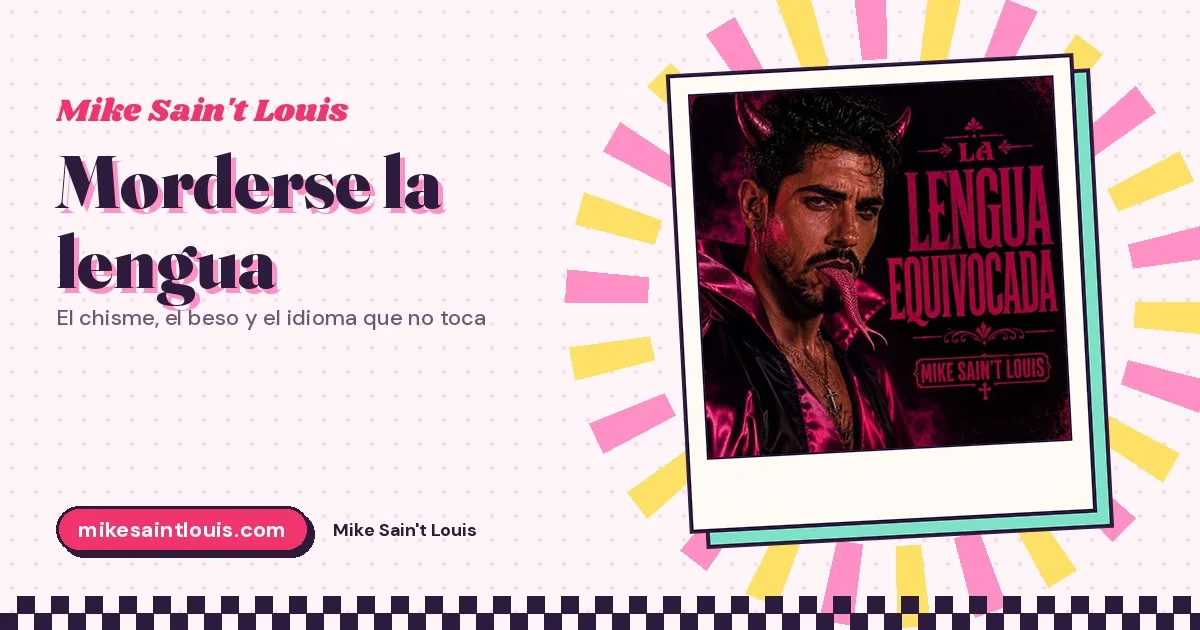
I'll start with the image, because it's in charge while the lyrics aren't visible. The cover is a devil, no half measures: horns, a fuchsia satin cape, the look of someone who knows he's tempting somebody. But he's a flirty devil. He wears earrings, chains and a little cross around his neck, as if it were perfectly normal for the devil to wear a religious symbol as an accessory.
That little cross makes me laugh. It's the detail that turns the image into a serious joke. The devil hasn't come to destroy the church; he's come to wear it as an accessory. It's the same move camp makes with everything sacred: it doesn't deny it, it dresses it up. Processions, the Virgins' mantles, holy cards, gilded altarpieces: all of that has fed the imagination of many village queers who grew up watching Holy Week with more aesthetic interest than devotion.
And then there's the tongue. Long, pink, with a snake's texture, sticking out of the mouth provocatively. It doesn't look entirely human. It's a tongue from somewhere else, from an old bestiary. The title's typography, an ornate old-poster style, finishes giving it all the air of a fairground print, a chapbook, a dark copla.
The serpent that spoke first
A serpent's tongue in a devil's mouth isn't a whim. It's the oldest iconography we have for bad speech. In the Genesis story, the first thing the serpent does in the garden is talk. It doesn't bite, attack or poison: it speaks. It persuades. And ever since, in the Christian tradition, crooked, persuasive speech has had the shape of a reptile.
In Spanish we call a hurtful tongue «viperina», viper-like. A viper's tongue belongs to someone who releases venom with every sentence, who criticises with surgical precision. A viper doesn't need to be big to kill; one drop is enough. Just like gossip, which with a single well-placed sentence can ruin a reputation built over years.
The cover brings both together, devil and serpent, in a single face. It's the wrong tongue par excellence: the one that tempts, deceives, says what it shouldn't at the exact moment to do the most harm. And yet the devil smiles, has put on earrings and dressed up. Evil, here, has a sense of humour.
The tongue that says too much
The first reading of the title is the most Spanish: the tongue that says too much. We have a whole proverb collection devoted to that sin. «Por la boca muere el pez» (the fish dies by its mouth). «En boca cerrada no entran moscas» (no flies get into a closed mouth). «Quien mucho habla, mucho yerra» (who talks a lot, errs a lot). Advice on prudence our grandmothers repeated like mantras, and almost never followed.

We also have a very rich vocabulary for the loosened tongue. «Irse de la lengua» is to let slip what you shouldn't. «Tener la lengua larga», a long tongue, is not knowing when to shut up. «Darle a la lengua» is talking non-stop. «Las malas lenguas», the wicked tongues, are that anonymous collective subject that always has something to say, never has a face and knows everything about everyone. «Morderse la lengua», biting your tongue, is the heroic effort not to say what you think, and we all know how long that lasts.
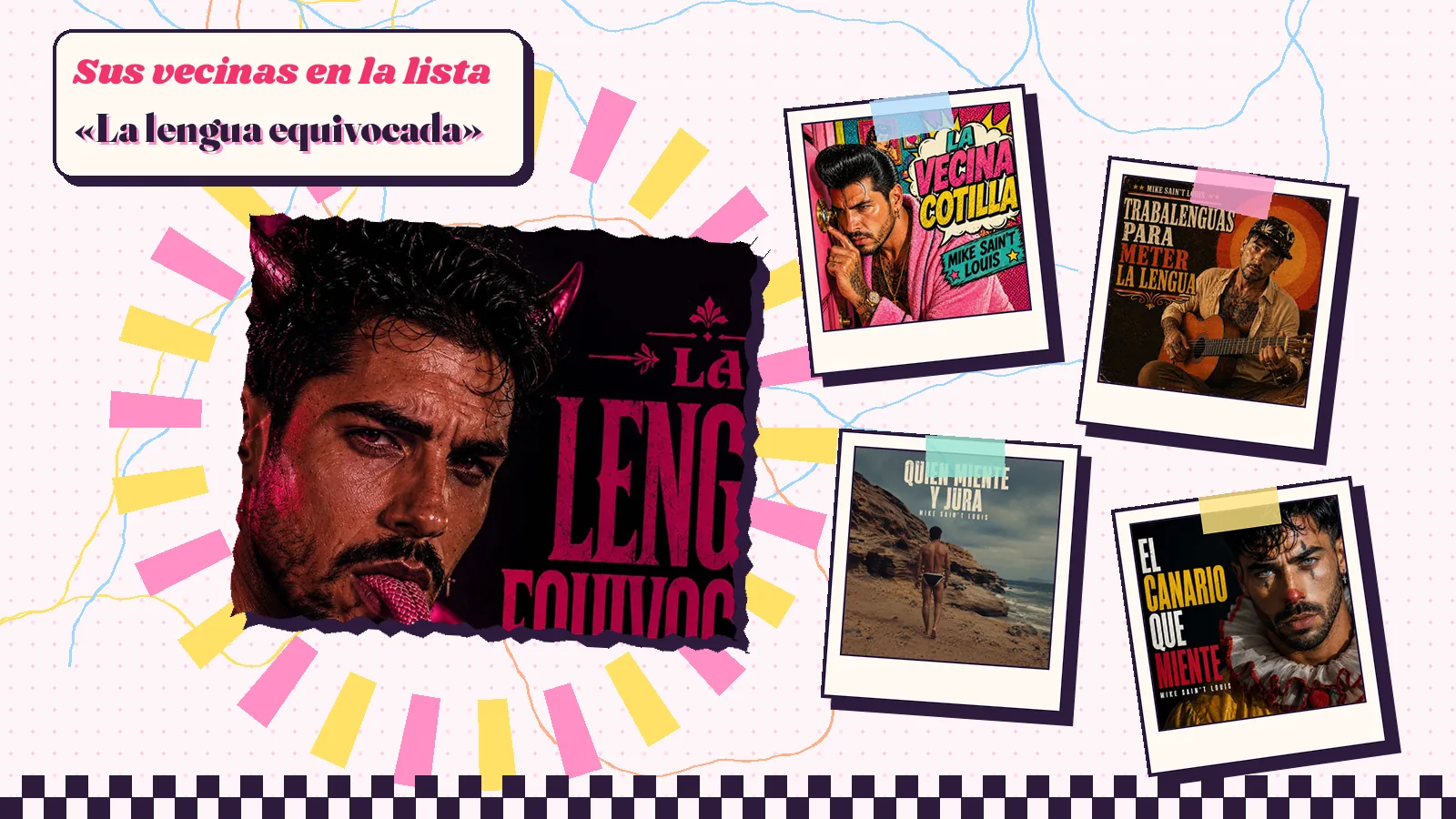
Gossip has a place of honour in my songs. There's «La vecina cotilla» (The nosy neighbour), for example, and I wrote about that character in «La vecina cotilla, el personaje que todos tenemos en el rellano». Gossip is one of this country's great popular arts. It's practised in doorways, hair salons and WhatsApp groups. And like every art, it has a bright side and a dark one.
Gossip and the closet
For LGBTI people, gossip has long been a double-edged sword. On one hand, it was a survival network. Knowing who was «one of us», which bar you could go into, which doorman you could trust: all that travelled by word of mouth when there was no other way to know. Rumour was information, and information saved lives.
On the other hand, the wrong tongue has also been the one that outed someone without their permission. Saying that so-and-so is gay, in the wrong place, in front of the wrong person, could cost a job, a family, a home. Today we call it «outing», and although things have changed a lot, it still happens. In schools, in offices, in small towns where everyone knows everyone.
That's why a tongue can be the kindest or the cruellest in the world depending on what it says and to whom. Revealing someone's orientation or identity without their consent isn't innocent gossip. If it has ever happened to you, or if the harassment that followed is weighing on you, you don't have to carry it alone. In Spain, 024 answers free and confidentially for anyone going through a bad time, and in immediate danger there's 112. If you live outside Spain, your country's crisis lines or the local emergency number can help in the same way.
The tongue that kisses
The second reading of the title is the body's. The wrong tongue can be the one you kissed without thinking. The one-night stand that shouldn't have been, the ex you swore never to go back to, the person who had a partner while you knew it. A kiss with tongue has something of a border about it: it's the moment a conversation turns into something else.
On the cover, that long pink tongue outside the mouth is clearly sensual. It isn't the tongue of someone speaking, it's the tongue of someone provoking. Pop culture has a huge tradition of tongues out of mouths: the Rolling Stones logo, which appeared in the early seventies, or the tongue Gene Simmons stuck out at Kiss concerts. In both cases the tongue is excess, cheek, desire displayed without shame. It's the opposite of biting your tongue.
I like to think the devil on the cover belongs to that family. He hasn't come to gossip; he's come to tempt. And temptation, in a song from a queer planet, nearly always has the shape of a body. The wrong tongue would then be the one you shouldn't have tasted, and tasted anyway. That's the oldest definition of sin I know.
The kisses that shouldn't have happened
We all have a kiss that shouldn't have happened. The one at the end-of-year party, the one in the doorway at five in the morning, the one you gave because you were sad and not because you wanted to. Many of those kisses are remembered with embarrassment, others with affection, some with a mix of both that's hard to classify.
In the experience of many gay men there's a category of wrong kisses all its own: the ones given in secret, with someone who later pretended not to know you in the street. The kiss in the parked car, in the club toilets, at the back of a park. Kisses that were true in the moment and denied the next day. There, the tongue wasn't wrong. What was wrong was the world that forced it into hiding.
That's why the title seems so open to me. A tongue can be wrong because it chose badly, or it can be called wrong by people who can't stand what it chose. For centuries, a man kissing another man was, for many, the very definition of the wrong tongue. Today, with the same word, we can laugh at that idea.
The tongue that isn't yours
The third reading is about language. In Spanish, as in Latin, the same word serves for the organ and for the language. We speak of a mother tongue, foreign tongues, co-official languages. Getting the tongue wrong can literally mean speaking the language that didn't belong in a particular place.
It happens all the time. The tourist ordering in English in a village bar, the Madrid native who drops a word in Castilian at a meeting where everyone speaks another language, the child who mixes languages at home and gets corrected at school. The wrong tongue is also the one that gives you away as an outsider, that says where you're from before you tell anyone.
That idea is close to home for me. I almost always write in Madrid Spanish, with its turns of phrase and its swearwords, but I publish worldwide and my website has an English version. I explained why in «Escribo en español: por qué mi web también está en inglés». Some of my songs have titles in English, French, German or Portuguese. In each of them there's a risk of using the wrong tongue, of the chosen word sounding odd to a native speaker. And there's something fun in that risk too.
In Spain, moreover, the question of language is never neutral. Several official languages coexist in different regions, and choosing one or another in a given context can be read as a political gesture, a courtesy or a provocation. Some people have felt ashamed of their accent on arriving in Madrid and others ashamed of not understanding a conversation in another region. The wrong tongue, in that sense, is often the tongue of whoever has just arrived.
And there's one last nuance I love: in the queer world we have tongues of our own too. Words, expressions, ways of talking you learn in bars, among friends, online. Using them out of place, in front of family or at work, can also be speaking the wrong tongue. Or the right one, depending on who you're with.
When the tongue trips
There's one more way to get the tongue wrong, the most innocent one: tripping over it. The slip, the word that comes out swapped, the tongue-twister you just can't finish. Freud wrote about slips at the start of the twentieth century and ever since, any mistake in speech seems suspicious: what did you really mean when you said that?

My catalogue has a title that plays with that idea from another angle: «Trabalenguas para meter la lengua» (Tongue-twisters to put your tongue in). The tongue appears there with a double meaning too, between children's wordplay and an adult wink. I put the two songs side by side because they share an organ and some cheek, though each goes its own way.
What interests me about slips is that they dismantle seriousness. An important person who trips over a speech suddenly becomes human. The wrong tongue, understood this way, puts us all back on the same level. Nobody speaks perfectly. Nobody kisses perfectly. Nobody always chooses the right language.
Lying with the tongue
I can't talk about wrong tongues without talking about lies. To lie is, by definition, to put the tongue at the service of something false. And liars turn up often in my songs: exes who swore eternal love, narcissists who told stories, friends who promised what they'd never deliver. Titles like «Quien miente y jura» (Who lies and swears) or «El canario que miente» (The canary who lies) give fair warning from the cover.
The Christian tradition is very hard on the lying tongue. In the Letter of James, in the New Testament, the tongue is called a fire, a world of evil lodged in our body. It's a tremendous image, an old preacher's image, and it fits the devil on the cover beautifully. Fire, fuchsia satin, a serpent's tongue. Everything burns.
But the tone of this cover is more wink than sermon. The devil isn't scary, he's funny. And that changes the reading. The wrong tongue here isn't a condemnation, it's a character. Someone who says too much, kisses the wrong people and mixes languages, and who instead of hiding turns up in the photo in a cape and earrings.
The dark copla
The old typography and the print-like air take me to the copla. Twentieth-century Spanish song is full of wrong tongues: the woman pointed at by the village, the forbidden love everyone whispers about, the man who lets something slip and loses everything. The copla is, to a large extent, a genre about what other people say. About «el qué dirán», what will people say.
I wrote about this in «La copla dentro del pop queer», because that age-old drama suits our stories wonderfully. Coplas about loves that couldn't be named are often read today as closet songs. It's no coincidence that so many folk divas are gay icons.
«La lengua equivocada», judging by its cover, plays on that ground. A sin, a holy-card print, a character who doesn't ask forgiveness. What it sounds like you'll find out when you listen. But the frame is already set, and it's a dark copla frame with glitter.
The tongue that keeps quiet
If there's a wrong tongue, there must be a right one too, and sometimes the right tongue is the one that stays still. Keeping quiet isn't always cowardice. There are silences that protect, silences that respect, silences that leave room for the other person to speak when they're ready. Knowing when not to say something is a kind of intelligence no school teaches.
But silence has a bitter side as well, and many LGBTI people know it by heart. For years we kept quiet about what we were so it wouldn't show. We kept quiet at the family table, in the changing room, in job interviews. We learnt to change the gender of partners when describing a weekend, to say «a person» instead of «my boyfriend», to laugh at jokes that hurt. A tongue bitten for so long leaves marks.
That's why I like that the cover goes the other way. The devil doesn't bite his tongue: he sticks it all the way out, long and pink, for everyone to see. It's almost an answer to all those years of silence. After so much keeping quiet, a tongue displayed without asking permission has something of revenge about it. It may be wrong, but at least it's his own.
Wicked tongues on the phone
Today's wicked tongues no longer need a doorway or a hair salon. They live in your phone. Gossip that once took a week to go round a neighbourhood now takes seconds to go round a WhatsApp group. A screenshot can do more harm than a hundred conversations on the stairs, because it leaves proof, because it gets forwarded, because it isn't forgotten.
On social media, the wrong tongue also found a loudspeaker it never had before. Cruel comments typed from the sofa, whole threads devoted to tearing someone apart, nicknames that go viral. I've lived it first-hand like anyone who publishes things online, and I've learnt that the best defence is usually not to reply in the heat of the moment.
The funny thing is that the word is still the same. We still say «malas lenguas» even though nobody speaks any more and everything is typed with thumbs. The proverbs have run short of organs but not of reason: by the mouth, or by the keyboard, the fish still dies.
An album that desires
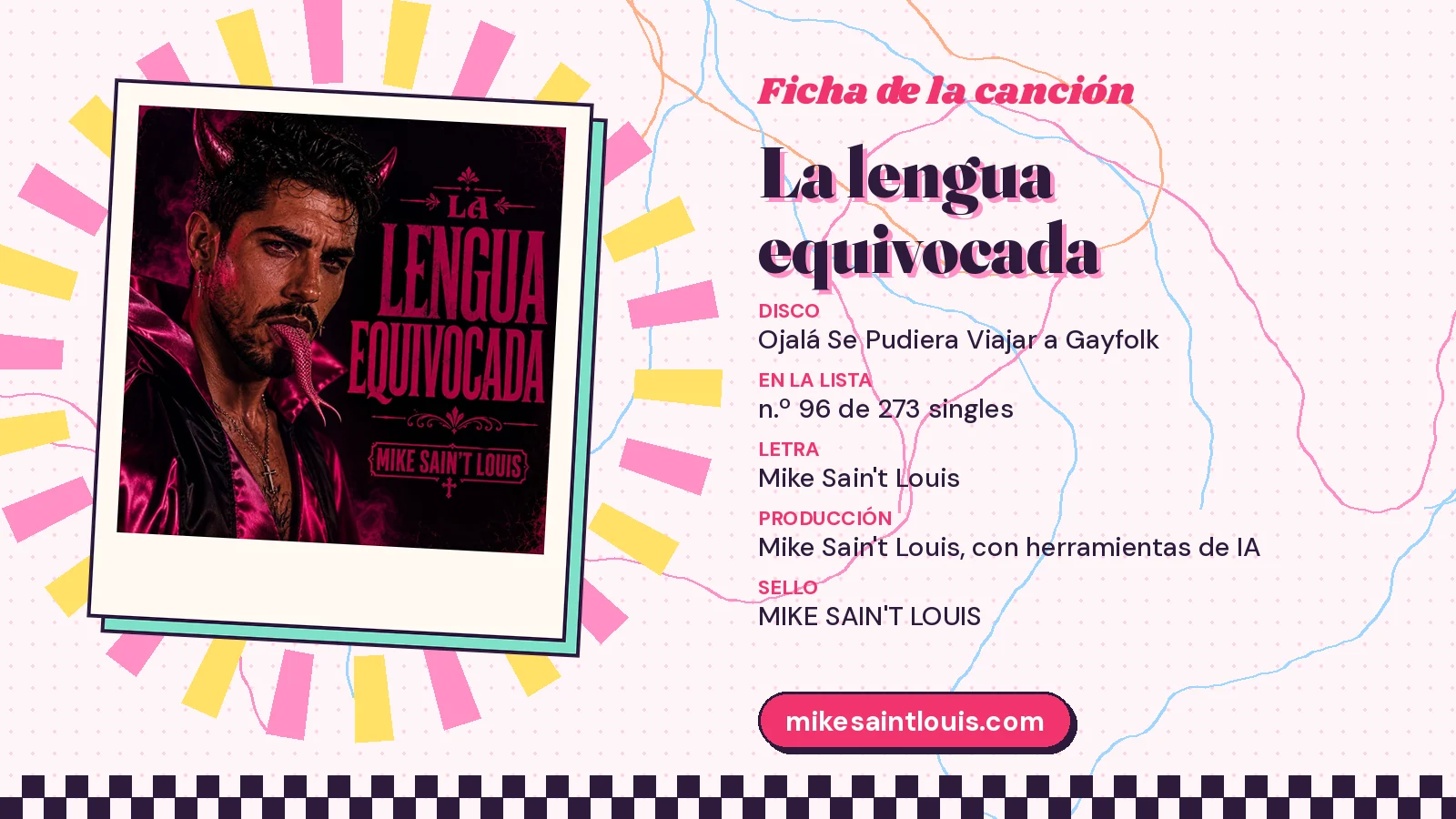
The song is on *Ojalá se pudiera viajar a Gayfolk*, the second album of the trilogy. It's the album of desire, of «ojalá», of wishes not yet fulfilled. It fits a tempting tongue very well. Desire, after all, often begins in the mouth: in what is said, what is kept quiet, what is kissed.
On that album, planet Gayfolk is still a place you want to reach. And to get anywhere you need to speak its language. Perhaps the wrong tongue is that too: the tongue of someone who hasn't yet learnt to speak on their own planet, who uses the words they were taught instead of the ones they need.
Who this song is for
For that person who never knows when to shut up, and knows it. For anyone who has bitten their tongue so often it hurts. For whoever let slip what they shouldn't at Christmas dinner and has found every December an adventure since.
For whoever kissed the wrong person and doesn't entirely regret it. For whoever was pointed at by the wicked tongues of the village, the school or the office, and carried on. For whoever speaks one language at home and another in the street, and sometimes gets them crossed.
And for anyone who looks at that cover, that flirty devil with his little cross and his serpent's tongue, and recognises themselves a little. We all have a bit of the wrong tongue in us. What matters is choosing well when to stick it out.
The lyrics will be published in my lyrics section and on gayfolkplanet.com. Meanwhile, you can listen on Spotify.
Frequently asked questions
What is «La lengua equivocada» about?
The lyrics aren't published yet. The title and the cover play with the three meanings of the Spanish word «lengua»: the tongue that says too much, the one that kisses and the one that names a language.
What's on the cover?
A flirty devil with horns, a fuchsia satin cape, earrings, chains and a small cross at his neck, with a long pink tongue textured like a snake's. The typography is in an old-poster style.
Which album is it on?
On Ojalá se pudiera viajar a Gayfolk, the second album of the Planeta Gayfolk trilogy. The music video was published on YouTube on 19 June 2026.
Is it related to other songs?
It shares themes with «Trabalenguas para meter la lengua», «La vecina cotilla» and «Quien miente y jura», though each goes its own way.
Who makes the music and the vocals?
The lyrics, composition and production are by Mike Sain't Louis, the first AI songwriter. The music and the vocals are generated with artificial intelligence.