By Mike Sain't Louis ·
Cheek to cheek: «Sol e Lua», the dance between day and night and the opposites that touch
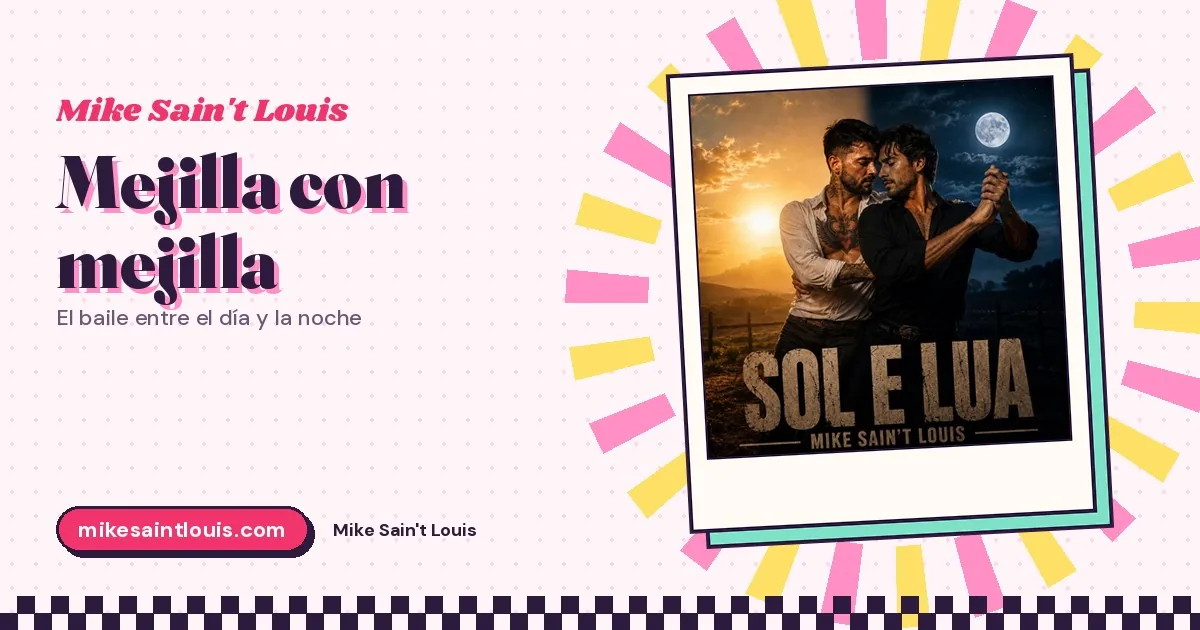
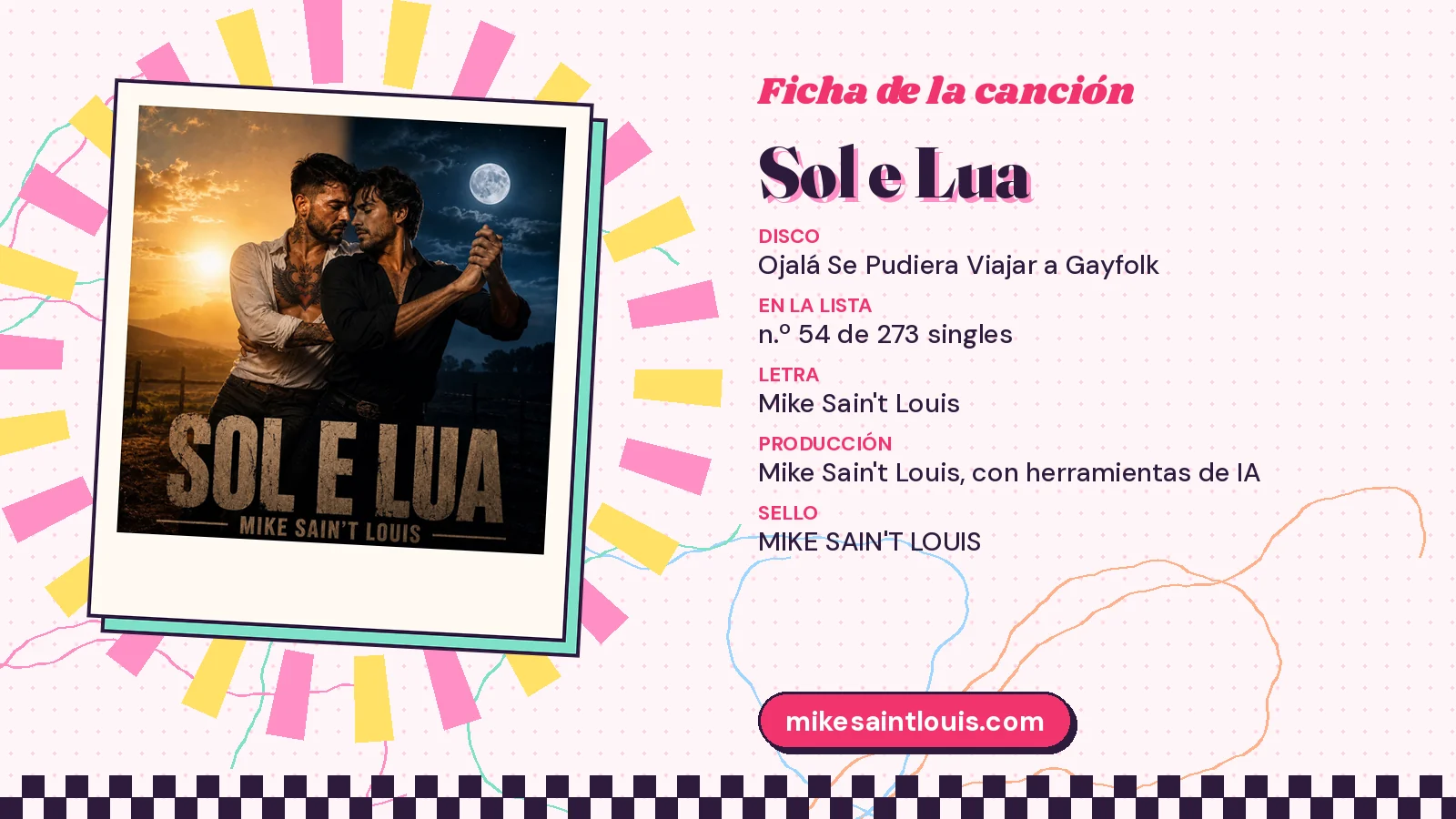
Some covers are understood at a glance and others ask you to stay a while. The cover of «Sol e Lua» is both kinds at once. At first sight, two men dancing in an embrace. Looking closer, an image split down the middle, with a sun setting on one side and a full moon on the other, and the couple placed right on the seam.
As in every post of this kind, I start with what isn't there. This single's lyrics haven't been published yet: its page on gayfolkplanet.com announces they'll come later. So you won't find any of its lines here, invented or supposed. I rely on what exists: the image, the Portuguese title, its position on the album, the date of the music video, what I wrote on the song's page and real phrases from other lyrics of mine.
An image split in two
The left side is a golden sunset over the countryside. The sun, still above the horizon, bursts into an orange light that tints the clouds and the hills. Below there's a wooden fence, the farm kind, and a dry meadow.
The right side is another time of day. A dark blue sky, almost black, with small stars and a huge, very sharp full moon in the top corner. Below, the same fence continues, but now in shadow, and in the background the silhouettes of some trees stand out.
The line separating the two worlds is almost vertical and runs exactly through the bodies of the protagonists. It isn't a natural gradient: it's a cut, a decision. Someone wanted day and night to live together in the same photo, like two halves of the same sky.
The title, at the bottom, is in huge, thick capital letters, with the texture of stone or a worn poster. Below, between two lines, my name. The lettering has something of a Western about it, an old film poster stuck on a wall that has survived many summers.
Golden hour and blue hour
Photographers have names for the two lights that meet on this cover. The «golden hour» is that stretch shortly after sunrise or shortly before sunset when the sun is low and the light turns warm, soft, orange. It's the favourite of portrait photographers, because it flatters skin and lengthens shadows. The «blue hour» comes just after sunset, or just before dawn: the sky turns a deep blue, the light is cold and diffuse, and cities switch on their streetlights.
In real life those two hours follow each other within minutes and are never together in the same sky. On the cover of «Sol e Lua» they are. The image cheats with time, and does it on purpose: it stretches the moment of change until it becomes a space where you can dance.
There's something very song-like about that trick. A song also stops time for three or four minutes. While it plays, the sunset never quite leaves and the night never quite arrives.
Two shirts, two hours
The two men are placed so that each belongs a little to his own side. The one on the left wears an open, creased white shirt with rolled-up sleeves, showing on his chest a tattoo of a winged heart with a crown, and more tattoos on his neck and arms. His skin is beaded with sweat, as if he had been dancing in the sun for a long time.
The one on the right is in black: a dark shirt, also open at the chest, dark trousers and a belt with a big metal buckle, cowboy style. His eyes are closed and his face is pressed against the other man's.
They're cheek to cheek, almost forehead to forehead. One wraps his arm around his partner's waist; the other holds his hand up high, fingers interlaced, in the classic posture of a close dance. They don't kiss. They dance.
The embrace that isn't a kiss
On the song's page I wrote that I found it very tender that the embrace was a dance and not a kiss, and I still think so. A kiss on a cover would have been something else: more direct, more predictable too. A dance speaks of something different. Of shared rhythm, of listening to the other person with your body, of deciding together where the next step goes.
Dancing close forces you to agree without words. One proposes, the other responds. If both pull their own way, they tread on each other's feet. If both wait, they don't move. It's a small, constant negotiation, and that's why so many songs and films use it as a metaphor for a relationship.
That the couple on the cover are two men, and that they're dancing in the middle of the countryside, with no stage or audience, adds another layer. For a long time that gesture, so simple, was unthinkable in public. And in too many places it still is.
Meeting halfway
In my text about the song I said the cover seemed to me a beautiful way of talking about two different people who decide to meet halfway. It's one of the most repeated ideas about love: that opposites attract. The sun and the moon, black and white, the extrovert and the shy one.
Psychology, curiously, qualifies that saying quite a bit. Since the work of the psychologist Donn Byrne in the sixties and seventies, much of the research on attraction has found that we tend to feel closer to people who resemble us in values, attitudes and ways of seeing the world. Differences can be attractive at first, but what usually sustains a relationship is having enough in common to understand each other.
That's why I like so much that the cover doesn't present the two men as absolute opposites. One is in white and the other in black, one is on the sun's side and the other on the moon's, but both have the same dark hair, the same beard, the same relaxed posture, eyes closed. They're more alike than different. What separates them is the light that falls on them. And that, in a couple, also changes: there are times when one is at his best and the other is going through his night.
Meeting halfway doesn't mean giving up what's yours. It means moving a little, each from his own side, until the dance becomes possible.
Why Portuguese
The title is in Portuguese, and that's no small detail. «Sol e lua» is understood almost without translation from Spanish, but it sounds different, more open, with that air of another shore. On the song's page I mentioned saudade, that Portuguese word usually translated as nostalgia that never quite fits into any other language.
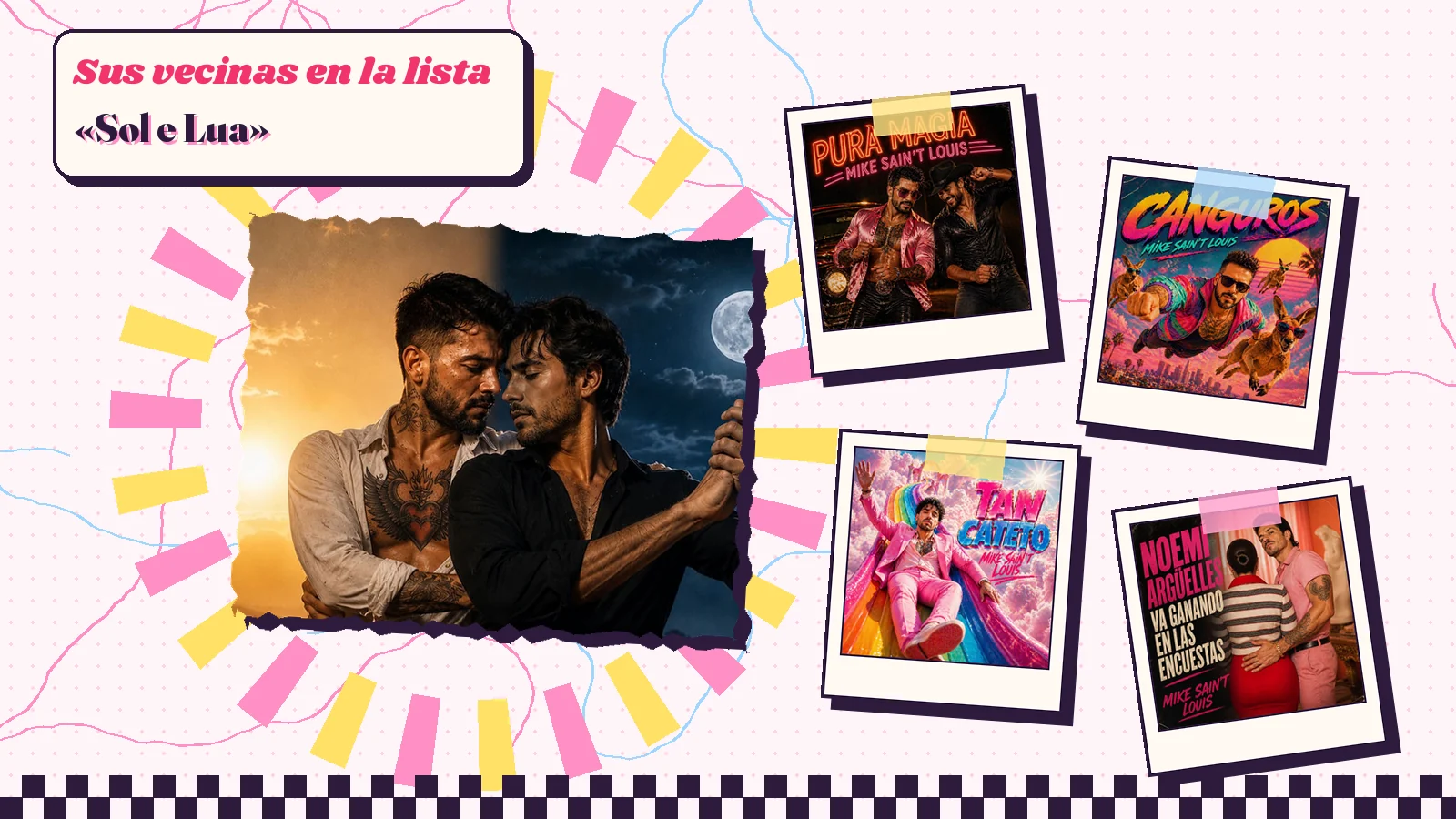
It isn't the first time I've turned to Portuguese. In «Pura Magia» the whole lyric is in that language, and two of its phrases seem written for this cover:
Vem cá dançar comigo
Somente a lua nos guia
«Come and dance with me» and «only the moon guides us». I talked about that song and why I chose Portuguese in «El derecho a una noche sin drama». And I said more about switching languages in lyrics in general in «Cuando la letra cambia de idioma».
Saudade has a long tradition in Portuguese and Galician culture, and is usually associated with fado, the genre UNESCO declared intangible heritage in 2011. But you don't need to know fado to understand it. It's that mix of affection and absence you feel for someone or something that isn't there, knowing it may not come back, and not wanting it to stop hurting completely because the pain is proof that it mattered. On a cover where the day takes its leave and the night arrives, the word fits effortlessly.
There's something lovely about Portuguese and Spanish sharing so much and, at the same time, differing just enough. It's a relationship between neighbours who understand each other almost always and, now and then, get it charmingly wrong. A bit like a couple.
The moon that keeps coming back in my lyrics
The moon appears more than once in my songs, almost always as witness to something unlikely. In «Canguros» I used it to talk about the things people say and that you decide whether to believe or not:
Y dicen que en la luna hay canguros Saltando entre galaxias
(«And they say there are kangaroos on the moon / Hopping between galaxies».) It's one of those absurd images that, repeated often enough, ends up sounding like a promise. I wrote about it in «Lo que dicen que hay en la luna». The moon in «Sol e Lua» is a different one: it has no kangaroos, it's big, round and very serious, like a spotlight hung over the couple. But it plays a similar role. It's there watching, and its presence turns the dance into something almost ceremonial.
I also enjoy how, in so many traditions, the moon is the star of lovers, poets and those who can't sleep. The sun works; the moon keeps you company. On this cover, for once, both are on duty at the same time.
The sun and the moon have a gender
A linguistic curiosity I love: in Portuguese, as in Spanish, the sun is masculine and the moon feminine. «O sol», «a lua». But it's not the same in every language. In German it's exactly the other way round: «die Sonne», the sun, is feminine, and «der Mond», the moon, is masculine.
Mythologies also hand out the roles in very different ways. In Inca tradition, Inti was the sun god and Mama Killa the moon goddess. In Japanese mythology, by contrast, the sun is a goddess, Amaterasu, and the moon a god, Tsukuyomi. What seems natural in one place is told the other way round elsewhere.
I enjoy thinking about this in front of a cover with two men. If the sun and the moon can be boy and girl, girl and boy, or whatever each culture decides, why not two boys? The sky has never had a fixed cast. We've been making it up as we go.
Opposites that do meet
In my text about the song I talked about the sun and the moon as opposites that never meet in the sky and that in this image finally touch. It's a very widespread idea, that of lovers who can't meet because one rises when the other leaves. It appears in legends from many cultures.
Astronomy, curiously, is more generous. The moon is visible by day very often, especially in the weeks around the first and last quarter. And there's a moment when sun and moon line up so that they really do touch, at least from our point of view: the eclipse. The path of the total solar eclipse of 12 August 2026 crossed much of Spain, and on 2 August 2027 there will be another visible from the south of the peninsula.
I like that double reading. In myth, opposites can't be together. In reality, they meet more than we think. You just have to look up at the right moment.
The tango that began between men
The posture on the cover, with hands interlaced up high and bodies close, is very reminiscent of tango. And tango has a queer history that isn't always told. In the neighbourhoods of the Río de la Plata at the end of the nineteenth century, in Buenos Aires and Montevideo, it was common for men to practise the steps together before going out to dance with women. There are old photographs of pairs of men dancing tango in the street.
That past is usually mentioned as an anecdote, but queer tango has reclaimed it with pride. Since the beginning of this century there have been gay and queer milongas in Buenos Aires, and queer tango festivals in cities around the world, where the roles of who leads and who follows don't depend on anyone's sex. In 2009 UNESCO declared tango intangible cultural heritage of humanity, at the proposal of Argentina and Uruguay.
That memory of those who danced together when it wasn't allowed is one of the things that matters most to me about planet GAYFOLK. I devoted a whole post to it, «A las que bailaron cuando no se podía», about the queer memory that slips into my lyrics.
The idea that anyone can lead and anyone can follow seems to me a beautiful metaphor for any couple. Some days one leads and some days one lets himself be led. On the cover we don't know who's leading. And it doesn't matter.
The cowboy who dances
The wooden fence, the open field, the belt buckle: there's an echo of cowboy aesthetics in this image. And the cowboy is one of the figures most associated with a hard, solitary, unsentimental masculinity. That's why, when cinema dared to tell the love between two cowboys, the impact was so great.
In 2005 Ang Lee's «Brokeback Mountain» won the Golden Lion in Venice and became one of the most discussed films of its decade. It told the story of two men who love each other for years without being able to live it in the light of day. Today the film is remembered fondly, but also as the portrait of an era when that love could only exist in hiding, at night, far away.
The cover of «Sol e Lua» proposes exactly the opposite: two men in the countryside, dancing between day and night, hiding from neither.
Loving by day, not only by night
Here, for me, is the heart of the image. For decades, the lives of many gay men took place at night: in bars with the door shut, in parks, in venues without a sign. By day you had to pretend. In Spain, the 1970 Law on Social Danger and Rehabilitation allowed homosexuals to be prosecuted, and it wasn't until the end of 1978 that it was reformed to stop doing so.
The night was a refuge, but also a closet. The day was the place where you couldn't exist. That's why the first Prides, in broad daylight, were so revolutionary: it wasn't only about demanding rights, but about no longer living solely by moonlight.
A couple dancing right on the border between sun and moon says something very simple and very powerful: that love between two men can be in both halves of the sky. At night, at the party. And by day, in the countryside, in the street, in the photo.
In Portugal same-sex marriage has been legal since 2010, and in Brazil since 2013. In Spain since 2005. They're recent achievements, and they're not guaranteed forever anywhere.
Between «Tan cateto» and «Noemí Argüelles»
On «Ojalá se pudiera viajar a Gayfolk», the second album of the trilogy, «Sol e Lua» is track 26. The one before is «Tan cateto», and that neighbour has a lot to do with the cover. It's a song against anyone who looks down on a couple like this one, and it opens like this:
Que te molesta que vayamos de la mano Y me señalas con el dedo de juez acusador
(«So it bothers you that we walk hand in hand / And you point at me with the finger of an accusing judge».) And a little further on:
Que te molesta que tus hijos vean un beso Y les tapas los ojos como un buen dictador
(«So it bothers you that your kids see a kiss / And you cover their eyes like a good dictator».) I wrote about that song and the kiss that bothers people in «Les tapas los ojos como un buen dictador». Placed right before «Sol e Lua», the sequence works almost like an answer: after telling off the bigot, the dance.
The next track is «Noemí Argüelles va ganando en las encuestas», one of my political satires, in a completely different tone. Between anger and laughter, «Sol e Lua» stands as a breather.
The music video was published on 26 June 2026, two days before 28 June, International LGBTQ+ Pride Day, and in the full list of singles it's number 54 of 273.
When holding hands is frightening
I don't want to finish without talking about something serious. Many same-sex couples still calculate where they can hold hands and where they can't. They let go when they enter certain neighbourhoods, certain villages, certain bars. That constant calculation wears you down, even if it's done almost without thinking.
That fear doesn't come from nowhere. Every time the news reports that someone has been beaten up leaving a bar or for kissing his boyfriend in the street, many couples go back to calculating. And yet every couple that dares to hold hands, to dance at a wedding or to hug on a platform makes it a little easier for the next. Visibility isn't anyone's obligation, but when it's possible, it opens the way.
If you're ever insulted or attacked for who you are or who you're with, it's not your fault. You can report it to the Policía or the Guardia Civil, and the LGBTQ+ associations in your area can support you through the process. During an ongoing attack or immediate danger, call 112.
And if the fear, the anger or the sadness become too much, in Spain you have 024, a free line that answers at any hour for anyone going through intense emotional suffering. From another country, look up the local helpline or crisis line or the emergency number. In «Salud mental sin tabú» I gathered more resources.
For whoever dances on the border
For whoever loves by day and by night, without choosing. For whoever has danced close with another man for the first time and felt the world stop for a second. For whoever still lets go of a hand when turning a corner.
For whoever is in a couple of opposites and has learned to meet halfway. For whoever leads some days and lets himself be led on others. For whoever keeps looking at the moon as if waiting for an answer.
And for whoever doesn't yet have anyone to dance with, but thinks about who would ask them. Until the lyrics are published, you can listen to «Sol e Lua» on any platform or download it for free, without signing up, from the downloads page. When the lines see the light, I'll post them in full without touching a word.
Frequently asked questions
What is «Sol e Lua» about? The lyrics haven't been published yet, so this post doesn't quote any line from the song. The cover shows two men dancing close right on the border between a sunset and a full-moon night. The post reads the title through Portuguese, the myth of the sun and the moon, tango between men and the visibility of same-sex couples.
Which album is it on? On «Ojalá se pudiera viajar a Gayfolk», the second album of the Gayfolk trilogy, where it's track 26, between «Tan cateto» and «Noemí Argüelles va ganando en las encuestas». In the list of singles it's number 54 of 273.
What does «sol e lua» mean? «Sun and moon» in Portuguese. The title plays with the idea of two opposites that, in the cover image, meet in the same sky.
Is it true that tango used to be danced between men? Yes. At the end of the nineteenth century, in the Río de la Plata, it was common for men to practise the steps together. Today there are queer tango milongas and festivals in many cities.
What should I do if I'm attacked for holding hands with my partner? You can report it to the Policía or Guardia Civil and ask an LGBTQ+ association for support. In immediate danger, call 112. If what you feel overwhelms you, 024 answers free at any hour in Spain; outside Spain, look up your country's crisis line.
Who makes this song? Mike Sain't Louis, a lyricist, composer and music producer from Madrid who presents himself as the first AI songwriter. He writes the lyrics and directs the production; the music and the performances are generated with artificial intelligence.