By Mike Sain't Louis ·
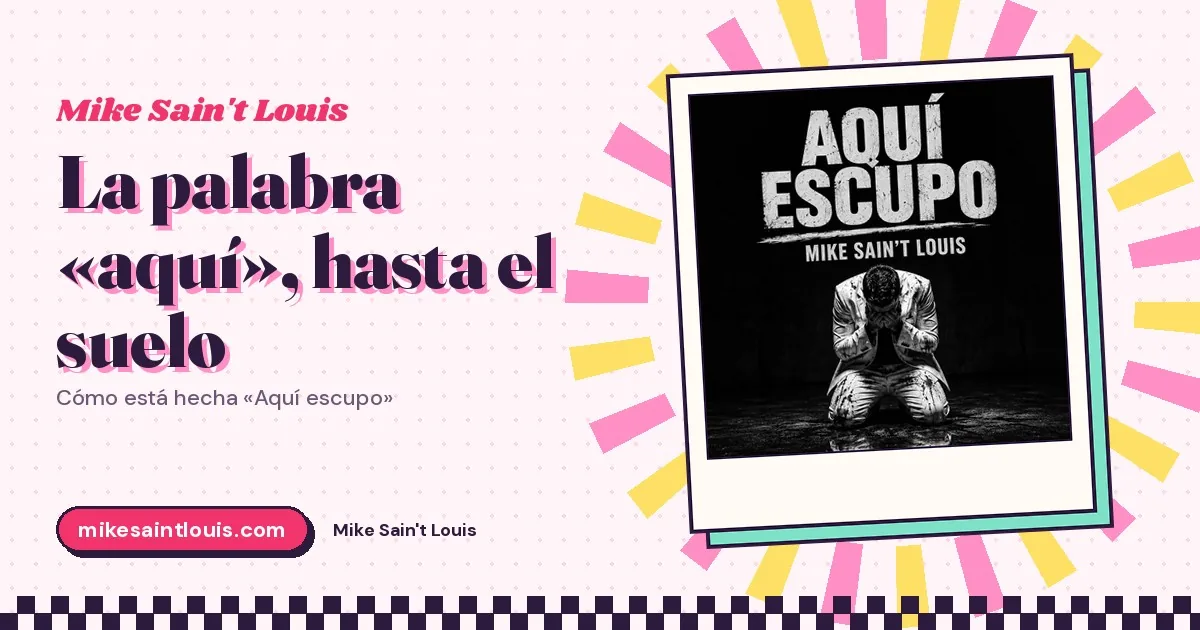
The word «aquí», repeated into the ground: «Aquí escupo»
Aquí. Here.
It's one of the smallest words in the language. Four letters in Spanish. An adverb of place we use a hundred times a day without thinking. Here you go. Here I am. Leave it here. No smoking here.
In «Aquí escupo», «Here I spit», I repeat it until it digs into the ground like a stiletto into the dirt of a village fiesta. Here I spit. Here I live. Here I burn. Here I stay. Four times in a row, each with a different verb, and then again, and again.
It's a very short, very raw lyric, and that's exactly why it's worth reading slowly. The song's page has the summary. Here, and never was the word more apt, I want to explain how it's built: what that repeated word of place does, why everything named is preceded by «my» and what comes out of the body in each verse.
An adverb that plants its feet
When you say «here», you point. With a finger, with your chin, with your eyes. It's a word that needs a body to mean anything. «Here» means nothing unless someone is saying it from somewhere.
That's what I was after. A lyric that couldn't be separated from a specific body, planted in a specific place. Not «in the world», not «in life», not «on this planet». Here. Where I am. Where you have to look.
Repetition, which language teachers call anaphora, is one of my favourite devices. I use it in lists of grievances, in those «not psychologists, not friends, not brothers» that pile up until they burst. In «Aquí escupo» the anaphora is more physical. Every «aquí» is a stamp of the foot. By the fourth, the floor is marked.
The first thing out: semen and rage
The lyric starts with no introduction, with a list:
mi semen, mi rabia, / mis tacones rotos, / mi falda manchada. (my semen, my rage, / my broken heels, / my stained skirt.)
No «hello», no context, no scene. Straight to what's being spat out.
I start with semen because it's the rawest thing, and it pays to put the rawest thing first. If I save it for the end, it looks like a stunt, a calculated provocation. At the start it's something else: a declaration that nothing will be hidden here. If that's the first word on the list, nothing that follows can shock. The bar is set from the first line.
And right next to it, rage. Semen and rage, on the same line, with a comma between them. What leaves the body through pleasure and what leaves it through pain, treated the same. Both get spat out. Both stain.
I wrote it like that on purpose, and I think it's what defines the song most: there's no hierarchy between the sexual and the emotional. It's all fluid. It all comes out.
Broken heels and a stained skirt
Then come two items of clothing: «my broken heels, / my stained skirt».
This is where drag comes in, without being named. A body wearing heels and a skirt, and wearing them ruined. Broken heels, stained skirt. This isn't the gala drag queen, the TV-contest one with perfect nails and a four-hundred-euro wig. It's the end-of-the-night one. The one heading home at seven with one heel in her hand and the other still on, limping down Calle Pelayo while the street cleaners hose the pavement.
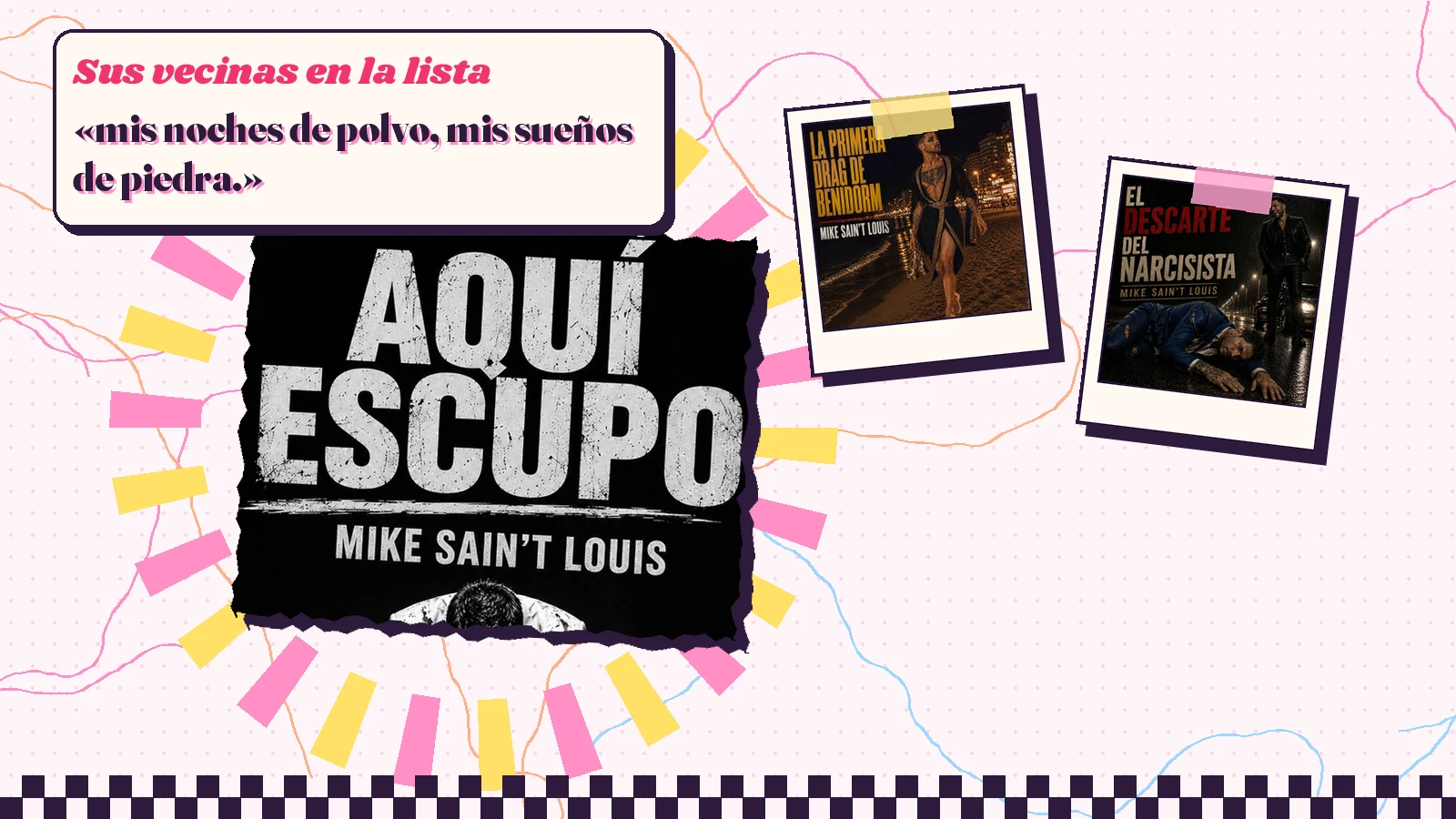
That character comes back in another song on the same album, «La primera drag de Benidorm», which starts almost the same way: «Aquí me arrastro, / con tacones rotos» («Here I crawl, / in broken heels»). They're first cousins. I wrote about that one on its page, and about drag as a party rather than a costume in this other piece. In «Aquí escupo» the drag queen has no name and no city. She just has her broken clothes, and she spits them out.
«My», «my», «my»
Notice one thing: almost everything named in the lyric has a possessive in front of it. My semen. My rage. My heels. My skirt. My tongue. My fear. My laugh. My scream. My blood. My nights. My dreams. My hunger. My dread. My love. My chest.

Fifteen possessives in a lyric of under forty lines.
I did it because spitting is, deep down, an act of ownership. You spit out what's yours. You can't spit out your neighbour's. And by putting «my» in front of every item, the song claims all of it as its own, even the ugly stuff. My stained skirt. My crooked laugh. My shattered chest. I'm not apologising to anyone for having these things. They're mine.
There's a long tradition of treating the queer body as something to hide, correct or apologise for. I wrote about it in writing about the body without apologising. «Aquí escupo» is, I think, the most extreme lyric I have in that sense. Not a single line of apology. Just possessives.
The second list: tongue, fear, laugh, scream
Aquí escupo, / mi lengua, mi miedo, / mi risa torcida, / mi grito en el suelo. (Here I spit, / my tongue, my fear, / my crooked laugh, / my scream on the floor.)
The second batch isn't fluids or clothes any more. It's things that come out of the mouth.
The tongue, the organ for speaking and also for kissing and other things. Fear, spat out the way you'd spit out an olive stone that went down the wrong way. Laughter, but crooked, not clean, a laugh that comes out sideways. And the scream, which ends up on the floor.
«My scream on the floor» is a favourite of mine because it's an impossible image. A scream doesn't fall to the floor, it goes off into the air. But in the lyric the scream gets spat, and what's spat falls. So the scream ends up on the floor, like a bit of chewing gum. It's what's left of a scream when nobody can hear it any more: a scrap stuck to the pavement.
If in the first list the body expelled what's below, in this one it expels what's above. The song is climbing up the body.
The four-verb chorus
And then comes what does the job of a chorus:
Aquí escupo. / Aquí vivo. / Aquí ardo. / Aquí sigo. (Here I spit. / Here I live. / Here I burn. / Here I stay.)
Four verbs. Spit, live, burn, stay. Each on its own line, each with its «here» in front.
It's a progression, even if it doesn't look like one. Spitting is expelling. Living is staying put. Burning is being consumed, but also blazing. Staying, or carrying on, seguir, is what comes after all of the above. Read top to bottom, it's almost a compressed biography: I throw out what I don't need, I stay, I burn and I keep going.
The last verb is the one that matters to me. «Aquí sigo.» After so much spit, so much semen and so much screaming, the final line is about resistance. The same as in «Gatekeeping», in English: «I stayed». Here I stay. They're the same sentence in two languages and two tones. In English, cold. In this one, soaked.
And then an «Aquí escupo…» with an ellipsis, before it all starts again. The dots are the spit left on your lips.
The third list: fairground blood
Aquí escupo, / mi sangre de feria, / mis noches de polvo, / mis sueños de piedra. (Here I spit, / my fairground blood, / my nights of dust, / my dreams of stone.)
This is the most beautiful batch, if a lyric like this can have anything beautiful in it.
«Sangre de feria», fairground blood. Not blood from a wound, but from the fair. The blood of someone who lives at the village fiesta, at the fairground, among shooting galleries and candyfloss. Blood that smells of churros and generator diesel. It sounds like copla to me, like small-town Roma swagger, like hot August blood. And besides, people do bleed at the fair: in the small-hours fights, in falls off the big wheel, in heels that snap getting off the Waltzer.
«Mis noches de polvo.» The word polvo has a double meaning here and I kept it on purpose. Dust, from roads, from earth, from an unpaved fairground. And polvo in the other sense, Spanish slang for a shag. Both at once. Nights of fairground and of fucking. Take your pick, or have both.
«Mis sueños de piedra», my dreams of stone. It's the saddest image in the song. These dreams don't float, don't fly. They're stone. They weigh. They don't leave. And they get spat out anyway, heavy as they are.
The fourth list: estate love
mi hambre, mi espanto, / mi amor de barriada, / mi pecho quebrado. (my hunger, my dread, / my estate love, / my shattered chest.)
The final batch is the most social. «Amor de barriada» is working-class-neighbourhood love, tower-block love, wasteland love. Not Hollywood love, with its Manhattan apartment and candlelit dinner. It's love on the park benches of Orcasitas, in the doorways of Usera, on the stairs of a block in Vallecas. Love with no money.
And «my hunger». Which could be hunger for food, for sex or for everything. In a lyric about the estates, hunger also sounds like being skint, the end of the month. I don't explain it. I leave it next to dread, which is the big fear, the one that paralyses you.
And the close: «mi pecho quebrado». Not roto, broken, but quebrado, shattered. It's an older word, more copla, more old ballad. «Tengo el pecho quebrado», my chest is shattered, is something Rocío Jurado could have belted out in a heartbreak number. I put it at the end so the lyric, which has been brutal throughout, would finish on a word from an old song. With a bit of tonadillera dignity, the dignity of the great copla divas.
Two-word lines
A note on form, for anyone who writes.
Almost every line in «Aquí escupo» has two or three words. «Mi semen, mi rabia.» «Mis tacones rotos.» «Mi falda manchada.» They're lines you deliver in one go, without a breath in the middle. Like spitting, which you don't do in two goes.
If I'd written long lines, with subordinate clauses and adjectives, the song would have lost the gesture. «I spit out my rage, which I've been storing in my chest for years» is a diary sentence. «My rage» is a gob of spit. The brevity isn't laziness: it's the shape of the gesture.
And then there's the rhythm of the possessives. «Mi», «mi», «mis», «mi». One syllable repeated at the start of each item, like a kick drum. The list has no filler adjectives; when there is one, like «broken», «stained», «crooked» or «shattered», it's there to damage the thing. Every adjective in the song is an adjective of harm. None of them prettifies.
That's the rule I set myself: if an adjective doesn't break something, out it goes. No «gorgeous», no «eternal», no «luminous». If you want pretty adjectives, the Zara Home catalogue is full of them.
A tradition of spitting *locas*
I'm not making anything up when I say the gesture of spitting, of taking the ugly stuff out into the street, has a long tradition in queer culture.
I think of Ocaña strolling down the Ramblas in Barcelona in the seventies, dressed as a woman, with his fan and his defiance. I think of the Chilean Pedro Lemebel and his «Manifesto», the «I speak for my difference» one, read at a political rally in 1986 in heels and with a hammer and sickle painted on his face. I think of so many neighbourhood drag queens who did their numbers in nameless bars, in front of four drunks, long before TV shows existed.
I'm not comparing myself to any of them. What I'm saying is that «Aquí escupo» comes from that place. The place of the loca, the screaming queen, who doesn't ask permission, who puts on the skirt even if it gets stained and who, if need be, spits. It's a tradition official culture has preferred to forget, because it's ugly, because it doesn't sell cologne and can't go into a bank's ad campaign during Pride month.
Spitting locas don't appear in adverts. They appear in songs.
Madrid's «here»
Although the lyric doesn't name a city, I wrote it from mine, which is Madrid. And when I read «here» I think of very specific places in Madrid where people spit, literally and otherwise. The pavements of Chueca at seven on a Sunday morning. The stairs of Tribunal metro station. The benches in Plaza de Pedro Zerolo. The doors of the after-parties round Atocha.
I don't name them in the song because the song wanted to be from anywhere. But they're in my head. Madrid is a city that doesn't come out well on postcards and I love it for exactly that, as I said in Madrid without the postcard. «Aquí escupo» is Madrid-without-the-postcard taken to the extreme: no buildings, no streets, just the ground.
If you want to see how many of my lyrics pass through Madrid and how many don't say where they are, the full index is on the lyrics page.
Why «spit»
People have asked me why the verb is spit and not «let out», «release», «scream» or «throw up». The answer is that spitting is an ugly gesture. Socially ugly. Children are told not to spit. Spitting in the street is rude. Spitting at someone is the worst physical insult there is, almost worse than a slap.
And the song wanted an ugly gesture. If I'd used «release» or «let go», I'd have ended up with a therapy text, the kind with candles and Tibetan bowls. Spitting has nothing to do with therapy. It's expelling with disgust. And some things can only come out with disgust.
Spitting also has something of a street protest about it. People spit when they have no other way to protest. People spit when they're on the ground and can't throw a punch. It's the gesture of the one at the bottom, who has no lawyer and no megaphone.
I have another song on the first album called «Escupiré sobre tu tumba», I'll spit on your grave, which is another kind of spitting: at the other person, at the ex, out of revenge. In «Aquí escupo» there's no target. I'm not spitting at anyone. I spit on the ground, here, in front of me. It's spitting without a victim. A way of emptying yourself out.
No humour, almost
This is one of the few lyrics of mine with hardly any humour. No celebrities, no supermarket brands, no jokes with names. There's the body, broken clothes, the fair and the estate.
Why? Because some things go soft if you put a joke in them. And this lyric couldn't go soft. It's a lyric of stone, like the dreams in the third verse.
Although, if you push me, there's a very black humour in the brutality itself. Starting a song with «my semen» has something of a schoolboy's provocation about it, graffiti on the toilet door. I laugh at that. I laugh at myself writing it. But the laughter stays outside the lyric, with the person writing it, not inside.
I have a piece on doing gay humour without doing harm. This song is the other side of it: what happens when the harm's already done and the humour doesn't arrive in time.
A song that nearly didn't come out
I'm not going to invent the story of how it was made, because I don't remember it in the detail I'd need to tell it without embroidering. What I do know is that a lyric like this is always on a tightrope. It can easily sound like gratuitous provocation. Someone can easily hear it and think: this bloke just wants to shock.
There are songs I almost don't release, and I wrote about them in the songs I almost don't release. The test I use is house rule number one: a song kept in a drawer is no use to anyone. If a lyric makes me uncomfortable but says something no other one does, it goes out. «Aquí escupo» says something no other one does: that everything that comes out of the body is mine, even what stains.
On the album of longing
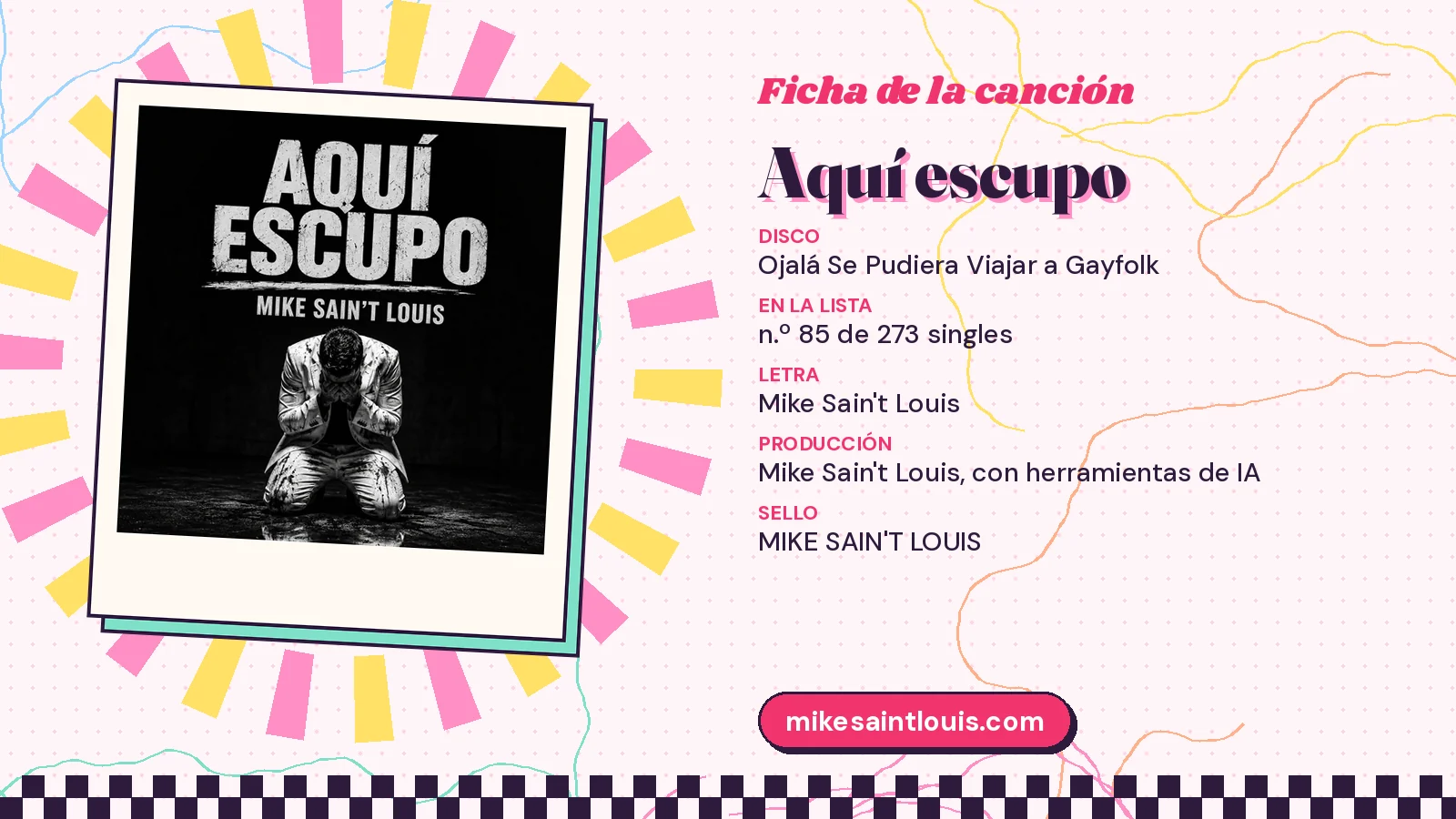
The song is on «Ojalá se pudiera viajar a GAYFOLK», the second album, the one about desire. And I find it funny that it's there, because it's the least «ojalá» song on the whole album. It wishes for nothing. It doesn't say «if only». It says «here».
It's the perfect counterpoint. An entire album gazing at a distant planet, longing to leave, and in the middle a song that plants its feet on the ground and says: no, I'm here. Here I spit, here I live, here I burn, here I stay. Before travelling anywhere, you have to empty yourself out here.
If GAYFOLK is the place where you don't have to explain yourself, «Aquí escupo» is the moment before: getting out everything you're carrying before you board the ship. Nobody travels with a shattered chest full of stuff. First you spit.
How to read it aloud
It's a lyric that works really well read aloud. Standing up is better. With every «aquí» stamped like a foot on the floor. Try it with the lyrics in front of you, they're on their lyrics page.
If you read it sitting down, quietly, it sounds like a list. If you read it standing up, with force, it sounds like a manifesto. That difference is the whole song. The words are the same; what changes is the body saying them.
And that's exactly what I meant by «here». That the lyric doesn't exist without a body.
What isn't there
There's no story. No ex, no particular night, no named place. Not even a city. It's the only one of the broken-heels songs that doesn't say where it is. «La primera drag de Benidorm» has Benidorm. This one only has «here».
And there's no happy ending. No sad ending either. There's a «here I stay» and an ellipsis. The song doesn't close: it's left spitting.
That feels honest to me. Some things don't end. They keep getting spat out. Tomorrow, the day after, next Tuesday. Rage has no best-before date like the yoghurts at Día, and spit doesn't run out either. What does change is where you spit from. And as long as that place is «here», feet on the ground and skirt stained, the song stays true.
Frequently asked questions
What is «Aquí escupo» about? It's a list of things that come out of the speaker's body and life, from «mi semen, mi rabia» (my semen, my rage) to «mi amor de barriada, mi pecho quebrado» (my estate love, my shattered chest), with a four-verb chorus: «Aquí escupo. / Aquí vivo. / Aquí ardo. / Aquí sigo» (Here I spit. / Here I live. / Here I burn. / Here I stay).
Is it connected to «La primera drag de Benidorm»? Yes. The two share images such as broken heels, the skirt and the gesture of spitting, and they're on the same album. «La primera drag de Benidorm» has a city; «Aquí escupo» only has «here».
Which album is «Aquí escupo» on? «Ojalá se pudiera viajar a GAYFOLK», the second album of Planeta Gayfolk's GAYFOLK trilogy.
Why are there so many possessives in the lyrics? Because spitting is an act of ownership: you only spit out what's yours. Mike Sain't Louis puts «my» in front of almost everything to claim even the ugly things as his own.
Who wrote «Aquí escupo»? Mike Sain't Louis, a lyricist, composer and producer from Madrid. The music and vocals are produced using artificial intelligence as a tool; the lyrics are his.