
By Mike Sain't Louis ·
Music Is Saving Me: anxiety, sadness and breathing room in my lyrics
«Ni psicólogos, ni amigos, ni hermanos, / Ni psiquiatras, ni médicos, ni novios» («not psychologists, not friends, not brothers, / not psychiatrists, not doctors, not boyfriends»).
That is how the list in «La música me está salvando» begins. And it carries on: not paediatricians, not vets, not praying on your knees, not fasting, and certainly not a single honest politician. Everything that is supposed to help you. All crossed out.
Then the chorus: «¡La música me está salvando! / ¡La música me está elevando!» («music is saving me! / music is lifting me up!»).
It is one of mine, with its dig at the ex and its bite. But the chorus says something that is true for a great many people, and that turns up again and again in my catalogue, sometimes with a joke and sometimes without. That some days weigh too much. And that on those days, what holds you up is not always what you were told would hold you up.
This piece is about those songs. The ones about anxiety, sadness, the body that remembers and the room you cannot face leaving. And about a word that keeps returning in them when things begin to ease: breathe.
It is not a piece of advice. I am not a doctor or a psychologist, and neither are my songs. It is a piece about what the lyrics tell.
What the body remembers
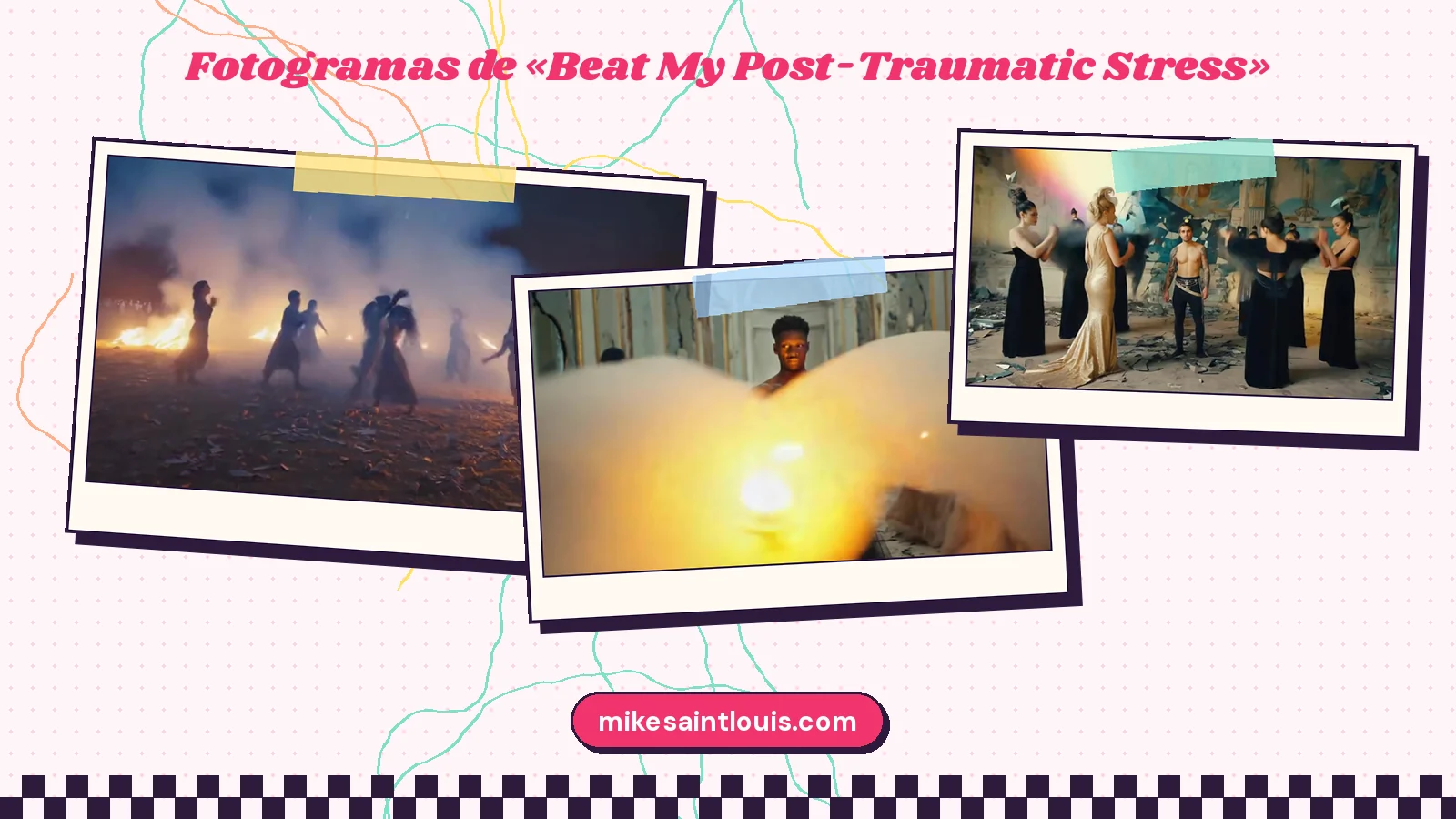
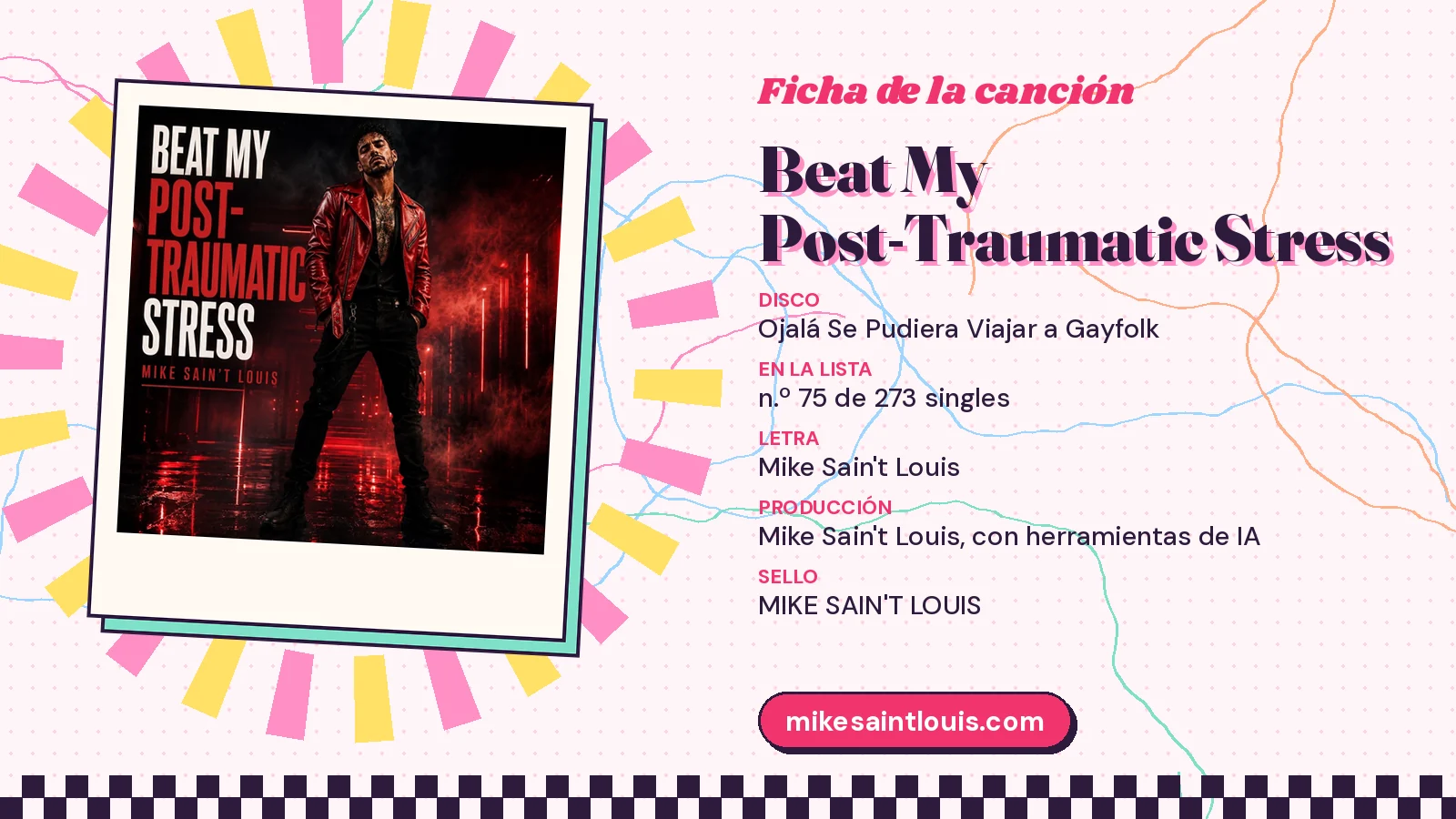
I will start with the song with the plainest title. «Beat My Post-Traumatic Stress».
The text that comes with it introduces it like this: «a song about surviving what your body still remembers». And then: «About walking through fear, anxiety, and silence — and turning them into rhythm».
I love that idea of the body remembering. Because it is true. You can decide to forget something, but the body does not obey. There are frights that lodge in the chest, as the song's page puts it. Noises that make you flinch years later. Silences heavier than any shout.
And the song's answer is not to keep still. It is to dance. The English title is almost a command: put a beat under it, beat it with a beat.
The line from that text that moves me most is this: «Every synth here carries a scar, every beat is a heartbeat I thought I had lost».
A heartbeat I thought I had lost. That is what music does when it works. It gives you back something you thought you no longer had. It does not erase the scar. It makes the scar sound.
And the text ends with the line that could sum up this whole article: «my way of saying I'm still here».
What doesn't show in the photos
The page for «Beat My Post-Traumatic Stress» has two more sentences I want to rescue, because they speak of something bigger than me.
The first says the song is the electronic, nocturnal side of the GAYFOLK universe, «la del club como refugio, que para muchas personas queer ha sido literalmente eso: el sitio donde por fin respirar» («the club as refuge, which for many queer people has been exactly that: the place where you could finally breathe»).
The club as refuge. Anyone who grew up queer somewhere it was not allowed knows this. The dance floor was not just fun. It was the only place the body could move without being watched. Where nobody looked at you oddly for the way you moved your hands. Where, at last, you breathed. It is no accident that a song about trauma ends up there. For many of us, dancing was the first therapy, long before we knew there was any other kind.
The second sentence is the dedication: it is for «cualquiera que haya sobrevivido a algo que no sale en las fotos» («anyone who has survived something that doesn't show in the photos»).
Something that does not show in the photos. We live by showing photos. The holidays, the dinner, the party, the boyfriend. And what has truly marked us almost never appears in them. The fright, the loss, the night you could not stop shaking. That song is for what does not show. And, as the page says, there are far more of us than we think.
Between four walls
Not every song makes it to the dance floor. Some stay in the room.
«Entre cuatro paredes» («between four walls») is probably the saddest lyric in my catalogue. There is not a single joke in it. It begins: «No me aparece una ilusión / No me apetece salir de la habitación / No encuentro la fuerza, la motivación» («no hope shows up for me / I don't feel like leaving the room / I can't find the strength, the motivation»).
And it goes on, line by line, with a list of things that are not there. No answers. No colours. No warmth from any love. No end to the tunnel. It is sadness told as absence: not what hurts, but what is missing.
One line gives its title to another piece on this blog: «Siempre apartado entre tanta gente» («always set apart among so many people»). Loneliness that is not being alone. The loneliness of being surrounded and being with nobody.
But what matters in this song is how it ends. After that whole list of noes comes a different one: «No, pero algo en mí pide respirar / Tal vez algún día logre despertar» («no, but something in me asks to breathe / maybe one day I'll manage to wake up»).
Maybe. It is not even a promise. It is a very small possibility. But it is there, at the end, after everything else. And to me that is the most honest thing a sad song can do: not pretend everything gets fixed, but leave a crack of light.
Something in me asks to breathe. That is where the word first appears.
Breathe
Search my lyrics for the word «respirar», «to breathe», and it turns up in very different places. And it nearly always arrives at the same moment: when something begins to get better.
In «Un pueblo es», the song of simple things, one line runs: «Abrir una ventana en la mañana y respirar» («to open a window in the morning and breathe»). It is the opposite image to «Entre cuatro paredes». There the room is shut. Here someone opens the window.
In «Soy marica sideral» the word becomes pointed advice, aimed at whoever cannot bear to watch you shine: «Si te escuece que no ruegue, / baby, aprende a respirar» («if it stings that I won't beg, / baby, learn to breathe»).
In the text for «Weed, weed, weed» it comes at the end, as the conclusion to everything: «crear sigue siendo la única forma de respirar» («creating is still the only way to breathe»).
And in the text for «Flow / We Glow» it is the starting point: I wrote it at a moment when all I needed was to breathe, let go and flow.
Breathing is the first thing anxiety takes and the last thing you get back. That is why it seems significant to me that my lyrics use it as a signal. When someone in my songs breathes, the worst is over.
A breather, not a pose
«Weed, weed, weed» has a title that makes people smile, but its text is among the most serious I have written.
It opens: «Hay días que pesan demasiado. Días de ruido en la cabeza, ansiedad, y esa sensación de que el mundo te exige sonreír cuando por dentro no puedes más» («some days weigh too much. Days of noise in your head, anxiety, and that feeling that the world demands you smile when inside you can't take any more»).
That feeling that the world demands you smile. I think many queer people know it well. Having to be always up for it, always witty, always fun, because that is what is expected of the funny gay friend. And inside, not being able to take any more.
Then the text says that, for me, music is the only thing that stops me in that fall. That it keeps me occupied, calms me and gives me a reason to keep creating. And it defines the song with a line I love: «No es una pose, es un respiro» («it isn't a pose, it's a breather»).
That text also has a paragraph I did not expect to find in a song about anxiety, and it is about work. It says the video was created entirely with artificial intelligence, image by image. That I have no team, no big production company, no means. «Pero tengo ganas» («but I have the will»). And that AI lets me keep going and not give up. «No es un lujo, es una herramienta para seguir vivo» («it isn't a luxury, it's a tool for staying alive»).
I think it matters that this is there. I write the lyrics myself, and the music and the vocals are made with artificial intelligence. Plenty of people see that as cheating. In that text it appears in another light: as what allows someone with no means to keep creating on the days when creating is the only thing holding him up.
Even a psychologist
In my lyrics the psychologist appears only a few times, but when they do, it says a great deal.
In «El narcisista» the ex goes round telling his colleagues that the narrator is a fraud, not to listen to him, «que voy hasta a un psicólogo» («that I even see a psychologist»). That «even» says it all. Seeing a psychologist used as proof that you are not right in the head. As a reason not to believe you.
It is a familiar mechanism. The person who asks for help gets branded as the one with the problem. And whoever never asks for help, however much they need it, passes for the healthy one. The song puts it in the narcissist's mouth, which is exactly where it belongs.
In «Forocoches» the psychologist appears in a more everyday way: «La psicóloga me dijo que empezara a hacer deporte / Pero estoy sin fuerzas, he perdido el norte» («the psychologist told me to start doing some exercise / but I've no strength left, I've lost my bearings»). It is sensible advice, and the answer is that of anyone who is sinking: no strength. It is not a criticism of the psychologist. It is the very real gap between knowing what would do you good and having the energy to do it.
I like that my lyrics treat therapy this way, without solemnity and without shame. As one more part of life. Seeing a psychologist proves nothing. It is what people do when they need it.
Music is saving me
Back to the song from the beginning, because it deserves more than a quotation.
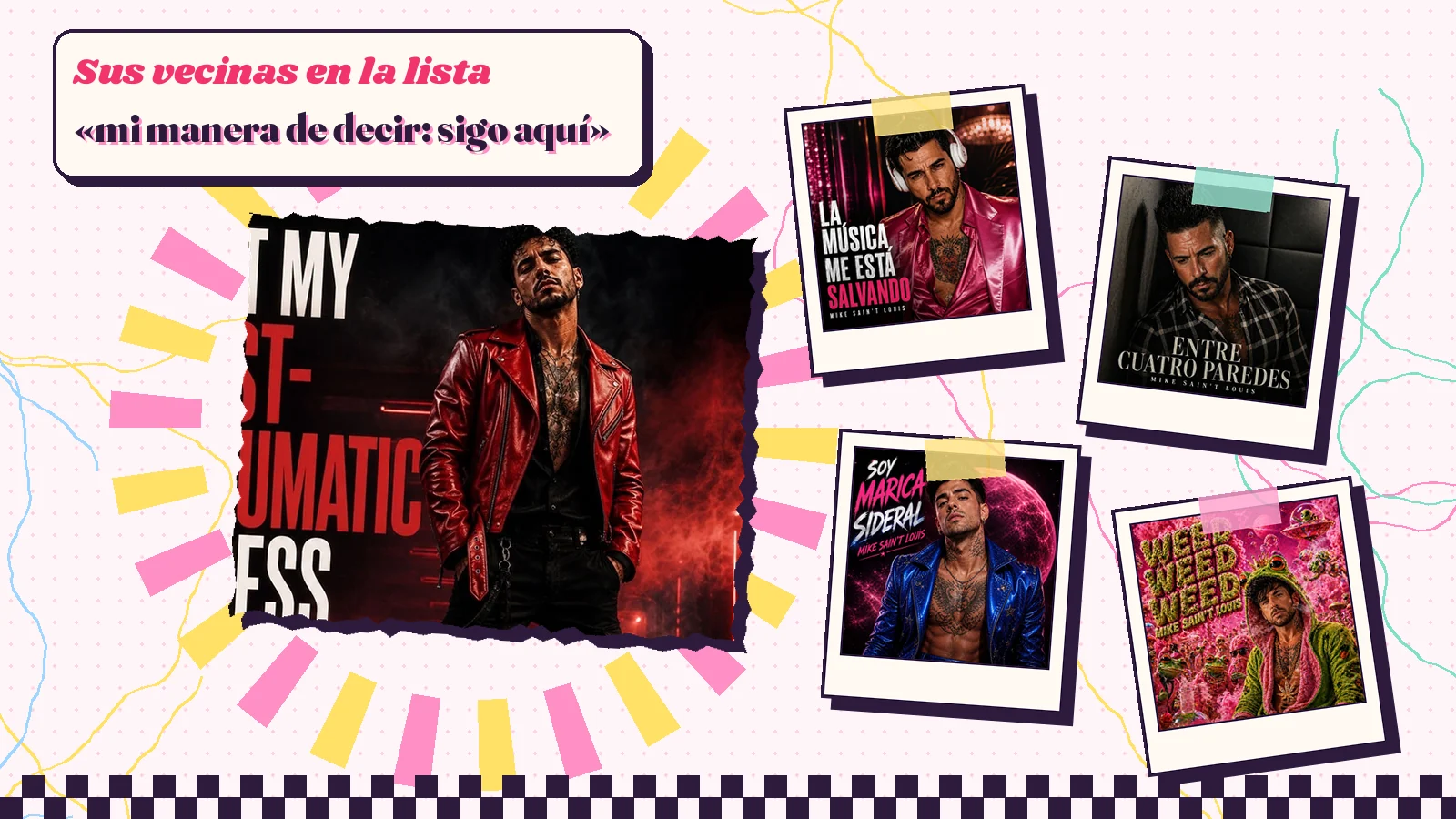
«La música me está salvando» is, underneath, a revenge song. There is a liar who is told to start improvising, because things are changing. But what interests me is the opening list, because it is a list of everything that did not work.
Psychologists, friends, brothers, psychiatrists, doctors, boyfriends. Praying on your knees. Fasting. Even a television astrologer makes the list.
Read seriously, it is a desolate list: someone who has tried everything and found nothing that helps. Read with my sense of humour, it is camp exaggeration, a «not even the Virgin Mary could help me». Both readings are true at once. That is the fourth rule of my house: humour tells the truth too.
And then the music arrives. «La música me ha llevado al cielo» («music has carried me to heaven»). With the vowel stretched until it no longer fits on the line.
I am not saying music replaces a psychologist. The song does not really say so either. What it says is that, at that moment, for that person, it was what lifted him off the floor. And that has happened to a great many people.
Chopping onions
There is one song that tells sadness by hiding it. And it is among the saddest, precisely for that reason.
In «Un invitado VIP cortando cebolla» («a VIP guest chopping onions») the narrator returns to hell after four years as a VIP guest in heaven. There is loneliness, absence, indifference. And a line that names what is happening: «Esta temida ansiedad» («this dreaded anxiety»).
The song is not pretty. There are bad nights, excess, an ex he wants to forget at any cost. But the punchline is the part I think is brilliant: if they see me crying through the streets of Madrid again, they need not worry, «es que me acabo de hacer una ensalada y he estado cortando cebolla» («I've just made myself a salad and I've been chopping onions»).
The onion as an excuse. It is what we all do. Cry and say it is something else. Hay fever. The wind. The onions.
There is another line in that song with nothing funny about it. The narrator does not want to be «el único idiota que va pintando en invierno / Mariposas en un cuaderno encerrado en mi cuarto» («the only idiot painting, in winter, / butterflies in a notebook, shut away in my room»).
Butterflies in a notebook. In winter. Shut away in the room. It is the same room as «Entre cuatro paredes», but here someone is doing something inside it: drawing. And he is embarrassed. He feels like an idiot for painting butterflies while everyone else goes out, drinks and has a good time, or seems to.
To me that line is the loveliest in the song, even though the narrator says it as if it were a flaw. Because painting butterflies in a notebook when everything is dark is exactly what many people do to survive. Drawing. Writing. Making something small with their hands. It is not idiotic. It is what people do when they are holding on to something.
And it is not so far from what the text of «Weed, weed, weed» says: creating is still the only way to breathe.
The joke does not take the sadness away. It makes it visible. Because nobody believes the onion story, and the song knows it. It is a way of asking for help without asking, of showing the tears with an excuse in your hand.
Pitufo's hug
In the middle of all this there is a tender song, with no spite and no jokes. «El abrazo de Pitufo» («Pitufo's hug»).
Its text begins: «El abrazo de Pitufo me calma y me alegra cualquier día de la gente falsa» («Pitufo's hug calms me and cheers me up on any day full of fake people»). And it describes what Pitufo does: «Pitufo no pregunta, no finge, no exige» («Pitufo doesn't ask, doesn't pretend, doesn't demand»). He just comes over, looks at me and lies on top of me as if he knew he was saving me once again.
Saving me. The same verb as the other song. Music is saving me; Pitufo is saving me.
And the text ends with a line that says a great deal: «Gracias por ser mi refugio» («thank you for being my refuge»).
In other lyrics animals already appear as the preferred company. In «Antisocial» the narrator would a thousand times rather have his animals than put up with a narcissist. But in «El abrazo de Pitufo» there is no comparison with anyone. There is only calm. An animal that does not ask, pretend or demand, in a world that asks, pretends and demands all the time.
Chosen solitude
«Antisocial» deserves a note of its own, because it is the flip side of «Entre cuatro paredes».
In both songs the narrator is alone. But in one, solitude is a prison, and in the other it is a decision. «Es solo que elijo mi propia soledad» («it's just that I choose my own solitude»), says «Antisocial». And later: «mi silencio es un castillo, yo una armadura sin llave» («my silence is a castle, I a suit of armour with no key»).
Then a line that makes everything clear: «Antisocial, por elección y más de un cabrón, no por miedo» («antisocial by choice, and because of more than one bastard, not out of fear»).
Not out of fear. That distinction interests me, because it is one of the things you learn with the years. That not all solitude is sadness. That sometimes stepping back is a way of looking after yourself. That you can have a small world, with a chosen few and some animals, and that world can be, as the song says, unbreakable.
Calm and the sea
And then there is the song born from the opposite side. From calm.
The text for «Flow / We Glow» begins: it is one of those songs born of calm and of the sea. And it says there is no love story or pain behind it, only the feeling of peace when body and mind finally move to the same rhythm.
Body and mind in the same rhythm. It is the exact opposite of «Beat My Post-Traumatic Stress», where the body remembers what the mind wants to forget. Here they finally agree.
The text sums it up with three ideas I love: surrendering without fear, shining without shouting, existing without hurry. And it suggests a way to listen: with headphones, the lights low and the moon in the background.
I like that a catalogue as loud as mine has a song like this. No insults, no exes, no narcissists. Just the sea.
Sleepless nights
There is a sentence in the text for «Tus letras son basura» that ties all this to the work of writing: «Cada palabra tiene detrás noches sin dormir, recuerdos, miedo, pero también coraje» («behind every word there are sleepless nights, memories, fear, but courage too»).
Sleepless nights, memories, fear. And courage. That «but too» is what interests me. It does not say the lyrics come only from pain. It says they come from pain and from something else. From the courage to turn it into something.
I think that is what all the songs in this piece share. None of them denies what hurts. «Entre cuatro paredes» has not a single joke. «Beat My Post-Traumatic Stress» talks about fear and anxiety without beating about the bush. But in almost all of them there is a final gesture, sometimes a tiny one, that looks outward. Something in me asks to breathe. I'm still here. Music is saving me.
Humour as a handrail
It is easy to wonder why I mix so much humour with such sad things. Why a song about anxiety ends in a salad.
My answer is that humour, in these lyrics, works like a handrail. It does not get you out of the well. But it gives you something to hold on to on the way up. The onions, the astrologer on the list of things that failed, the «baby, learn to breathe». They are jokes that do not cover the pain. They keep it company.
And there are songs that need no handrail, because sadness needs to be looked in the eye. «Entre cuatro paredes» is one of those. Knowing when to put the joke in and when to leave it out is, I think, one of the hardest things in writing.
If you're there
I will finish with something that is in none of my songs, but which I think needs saying in a piece like this.
If you are in one of those rooms you cannot face leaving, if your body is reminding you of something you do not want to remember, if some days weigh too much, music can keep you company. But you do not have to do it alone. Talk to someone. In Spain, 024 is the free suicide-prevention helpline, open at any hour; elsewhere, your local crisis line or emergency services can help. And if it is not that serious, a doctor, a friend, someone.
The song at the beginning crosses psychologists and friends off the list. It is a song. It exaggerates, like all of mine. You do not have to cross them off.
And in the meantime, if it helps, there is the music. The lyric of «Beat My Post-Traumatic Stress» is at gayfolkplanet.com/letras/beat-my-post-traumatic-stress. Put it on on a Saturday night, or on any old Tuesday when your body is tense for no clear reason. And breathe.
If this subject hits close to home: in the series «Mental health without taboo» I talk openly about my mental health (narcissistic abuse, the bullying and abuse I suffered as a child, my diagnosis at 41, and therapy) and gather where to find help. If you're thinking about suicide, call 024 in Spain, or your local emergency number elsewhere.
Frequently asked questions
Which Mike Sain't Louis songs deal with anxiety or sadness?
Among others, «Beat My Post-Traumatic Stress», «Entre cuatro paredes», «Weed, weed, weed», «Un invitado VIP cortando cebolla» and «La música me está salvando». Others, such as «Flow / We Glow» and «El abrazo de Pitufo», are about calm and refuge.
What is «Beat My Post-Traumatic Stress» about?
About surviving what the body still remembers, and walking through fear, anxiety and silence to turn all of it into rhythm. Its text ends with «my way of saying I'm still here». The lyric is at gayfolkplanet.com/letras/beat-my-post-traumatic-stress.
What role does artificial intelligence play in these songs?
Mike Sain't Louis, the first AI songwriter, writes the lyrics himself; the music and the vocals are made with artificial intelligence. In the text for «Weed, weed, weed» he describes AI as «a tool for staying alive» that lets him keep creating without a team or big budgets.
Where can I get help if I'm struggling?
In Spain, 024 is the free suicide-prevention helpline, available at any hour. You can also see your GP or talk to someone you trust. Outside Spain, contact your local crisis line or emergency services.