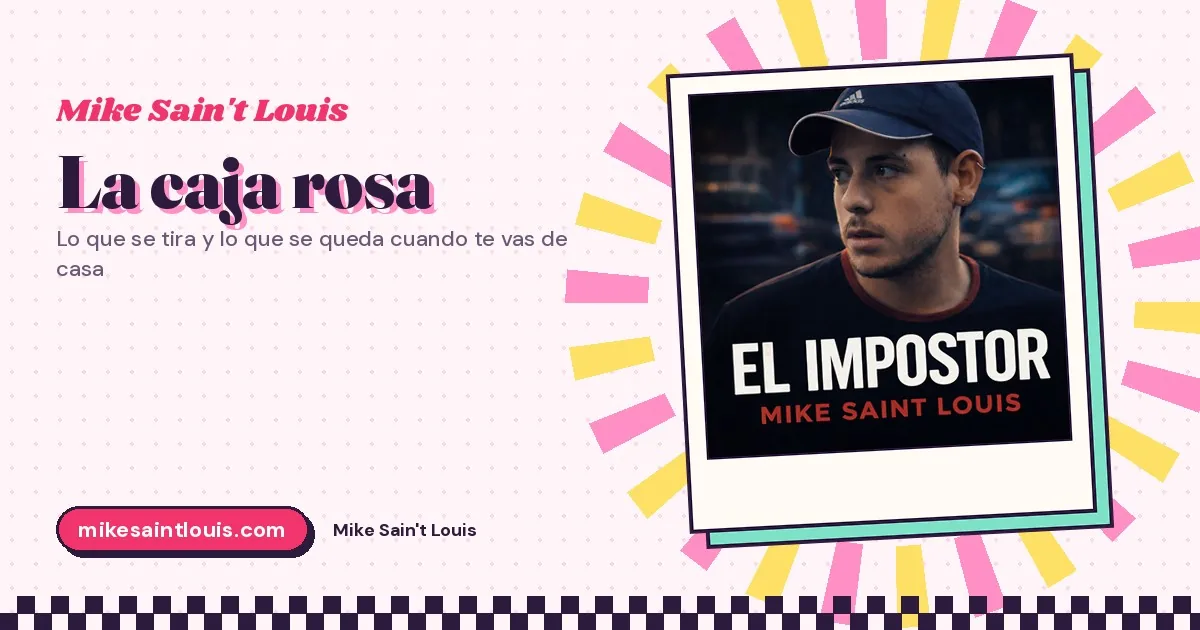
By Mike Sain't Louis ·
The pink box: what gets binned and what stays behind when you move out
A pink box at the bottom of a bin. Inside, three hundred photos. On top, maybe, a mandarin peel and the lid of a Greek yoghurt from Lidl. Nobody fishes it out. Nobody looks at it again. It just sits there, ribbon or no ribbon, until the bin lorry comes.
That's the image I was left with when I finished writing «El Impostor», and it's the one that still haunts me every time I reread it. Not the accusations, and there are fistfuls of them. Not the big lines. The box.
This piece isn't about the man who inspired the song. Everything about him is already in the lyrics, and I'm not adding a single comma. It's about things. About what gets thrown out and what stays behind when a couple ends and one of the two has to do the move with puffy eyes.
The inventory
Every break-up that lasts longer than a couple of years ends with an inventory. Anyone who has lived with someone knows it.
Your frying pan, my frying pan. The duvet we bought together at the IKEA in Alcorcón one rainy Saturday. The toaster that used to be his mother's. The books, which nobody remembers owning any more because they got mixed up on the same shelf four moves ago. The phone charger, which is always the other one's. The glass jar of coins from a holiday that never happened.
Doing that inventory is one of the most humiliating things I know. You sit on the living-room floor with bin bags, the big black ones, and you start splitting a life into two piles. And every object is a tiny argument. I paid for this. You gave me this. We chose this together and now neither of us wants it.
Some objects get divided with a notary's chill. And some objects can't be divided at all, because they aren't things: they're evidence.
The pink box was evidence.
Three hundred photos
The lyrics tell it with the precision of a police report. «Tiré una caja / Con trescientas fotos / Que yo le había / Regalado al cubo / De la basura» («I threw a box / With three hundred photos / That I had / Given him into the bin»).
Three hundred. Not a few, not loads. Three hundred. I love that the number is there, round and absurd, because it's the number of someone who spent years printing photos at a time when nobody prints photos any more. Whoever gives three hundred paper photos isn't giving an object. They're giving hours. Hours at the photo-printing kiosk in the shopping centre, hours picking out the good ones, hours slotting them into a box of one particular colour, which here is pink, because pink in my songs is almost never an accident.
And then the box ends up in the bin. What interests me about the line is the subject. The one who throws it away is the one who gave it. Not the other one, the supposed owner. The one who handed it over all starry-eyed is the one who has to get rid of it on the last day in the flat. As if the present had come back to its sender stamped «return to sender».
For me, that's the whole break-up in a single act. You have to bin what you gave, because the other one doesn't even care enough to bin it himself.
Think about it for a second with a cool head, if that's even possible. Throwing something away is a gesture. There's rage in it, a decision, a slammed door. If he had thrown the box out, at least he'd have felt something, even if it was disgust or spite. But he doesn't. The one who gave it throws it out, and he watches. And then he leaves. That's what indifference is: not even bothering to destroy what you were given.
Some people burn letters on Malvarrosa beach in Valencia on Midsummer's Eve. Some tear photos into confetti and flush them down the loo at their mum's. Ugly rituals, but rituals. Here there's no ritual. There's a bin.
What nobody picks up
But the line that really hurts comes a little later.
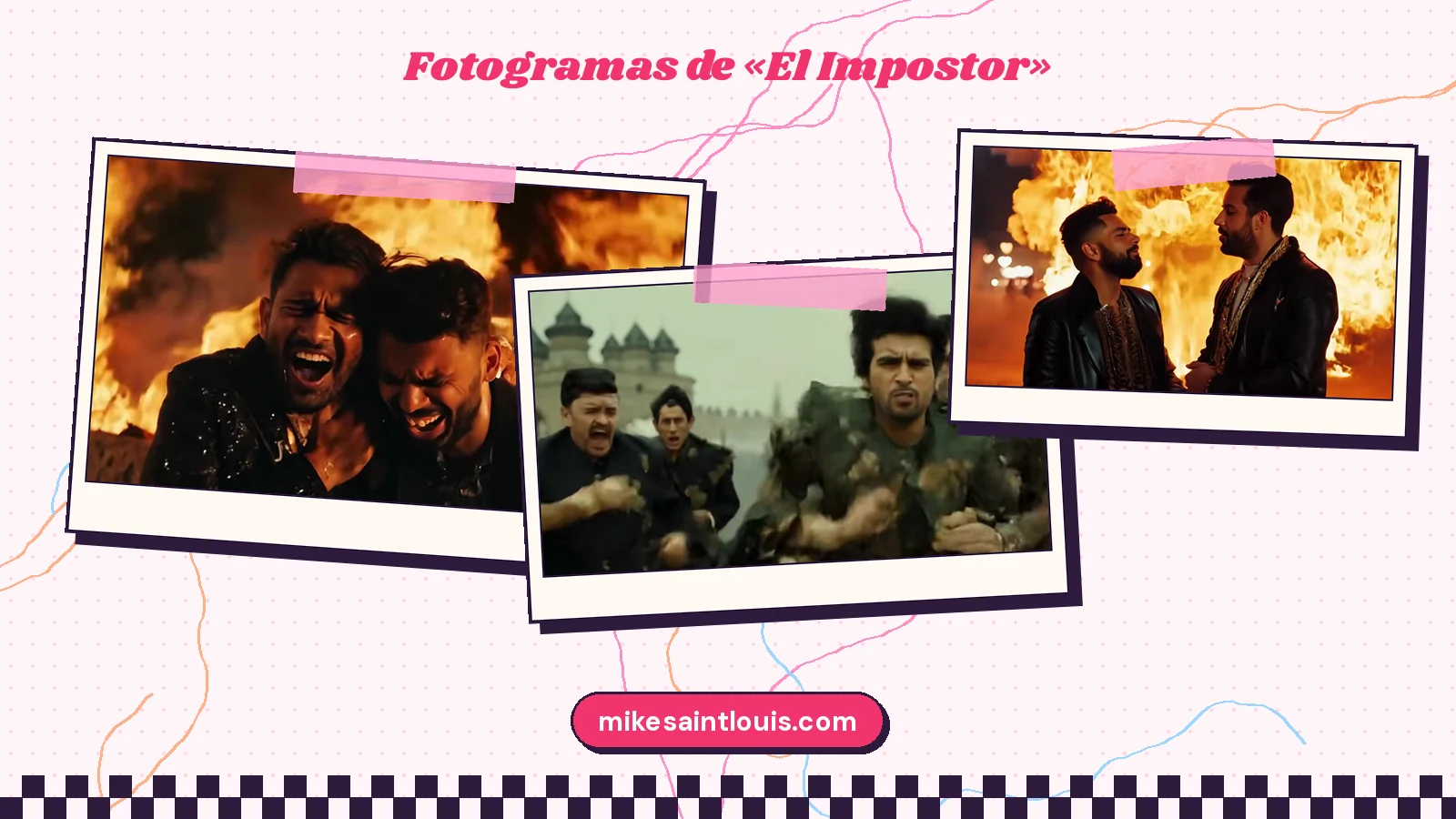
«Y cuando al final se / Fue, en la basura / Seguía la caja / Rosa que con / Tanta ilusión / Le había regalado» («And when in the end he / Left, in the bin / Still sat the pink / Box I had given him / With so much / Hope»).
Still. That's the word that floors me every time. There was no last gesture. No «hang on, I'll take this». Not even a sideways glance, the kind you see in films, when the actor picks a photo from the pile, looks at it, sighs and slips it into his jacket pocket. Nothing. The box was still in the bin. He left and the box stayed.
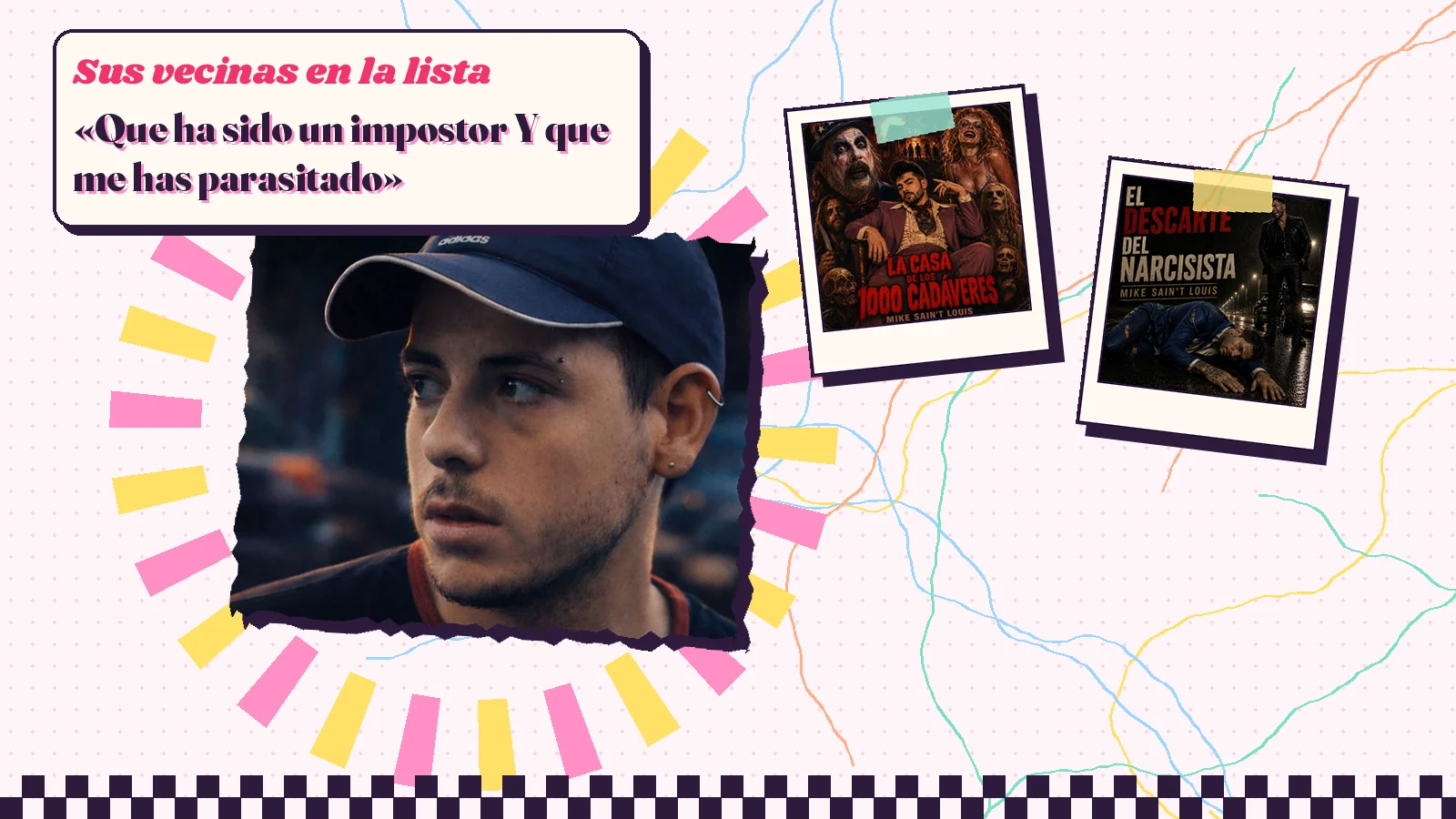
I've written plenty of heartbreak songs with a punchline. In «La casa de los mil cadáveres» I compare myself to a horror-film actress and call myself an idiot twice in a row. There's a comic taxonomy of exes on this very blog, with categories and subcategories. I laugh at my exes because that's how it comes out. But with the pink box there's no joke to be had. I've tried. I've turned it over and over, looking for a way to sneak in something outrageous, a brand, the name of a TV show.
No way. Some images just won't let you.
Shaped like a police report
«El Impostor» isn't shaped like a normal song. There's no chorus hammering away. It's a very, very long lyric, almost spoken, that moves forward on «because». Because this, because that, because the other. It's a closing argument, or a police report, or the statement of someone who walks into a station at three in the morning and asks them to write everything down, everything, and not let the officer miss a thing.
It opens with a question to the audience. «¿Queréis saber / Por qué / me enteré / después / de seis años / de que / nunca estuvo / enamorado de mí?» («Do you want to know / Why / I found out / after / six years / that / he was never / in love with me?»). Look at how it's broken up. One word, two, three. Like someone talking through tears who has to catch their breath between every scrap of the sentence. I didn't break it up to look pretty on the page. I did it because that's how you say something like that out loud. In scraps.
Then comes the evidence. Small, domestic stuff, the kind that would never stand up in court but tastes of truth. A filtered selfie while the other one had been crying for a week. A phone line that had to be kept running at all costs. A voice note. The holidays. The bed.
I've written elsewhere about writing fast and writing slow. This lyric is one of the fast ones, the ones that come out all at once, like tipping a drawer upside down onto the bed. That's why it has the shape of a never-ending list. There was no time to tidy it. And I refused to tidy it afterwards, because tidying it would have meant lying a little.
The filtered selfie
Of all the evidence, the one that fascinates me most as a lyricist is the selfie.
It isn't the worst. There are much harsher things in the lyrics. But it's the most visual, the most of-our-time, the one that somebody reading the song in fifty years will need a footnote to understand.
While one was crying, the other was taking a picture of himself and adding an effect. A filter. Puppy ears, glowing skin, the smoothing that wipes away your dark circles. I don't know which one it was, the lyrics don't say, and I'm not about to make it up. But the image is devastating in its smallness. On one side, someone with red eyes. In front of the phone, someone worried about his lighting.
Put that next to the pink box and it all makes sense. One prints three hundred photos of the two of them. The other takes a photo of himself. One keeps their shared memory in a box. The other keeps his face in the cloud. Two ways of understanding what a photo is, and deep down two ways of understanding what a couple is.
Objects that lie
There's another detail in the lyrics that has to do with things, and it strikes me as very sharp, even though I wrote it without much thought.
The «llantos forzados», the forced sobs. On the last day, as the box dropped into the bin, there was crying. But the lyrics say it was forced. Which means crying can be an object too. Something you take out of the cupboard for the occasion, like the good china on Christmas Eve or the suit you only wear to funerals.
That idea grips me, because it turns up again and again in my songs about narcissism. Emotion as a prop. Tears as set dressing. In «El descarte del narcisista» I flip it round and write about the person who cries for real, alone, understanding nothing. In «El Impostor» the real crying and the stage crying are in the same room, two metres apart, and the pink box is the only one not pretending.
A box can't lie. It's either there or it isn't. It gets picked up or it stays in the bin.
A phone line that has to keep working
There's another object in the lyrics that almost nobody remembers when they talk about this song, and to me it's one of the most revealing. The phone. Or, to be exact, the phone line.
The lyrics say that once the one writing had already moved out, the other only cared about one thing: keeping the line running. Not the photos, not the box, not the unanswered questions. The line. The contract, the number, the SIM card, the data plan.
When I reread it, I get this very sad laugh. Because it's so specific, so phone-shop-with-a-ticket-number-in-your-hand, that nobody could have invented it. It's the sort of detail only life comes up with. Six years together and, in the end, the important conversation is about who pays the phone bill and whose name it's in.
But it makes sense, if you think about it. The phone was where his face lived. The filtered selfie, the socials, the window onto everyone else. The pink box was the past of two people. The phone was the future of one. And one of those objects ended up in the bin while the other had to keep working at all costs.
There's the whole song again, in another object. It happens a lot with my long lyrics: when you take them apart, every piece retells the full story in miniature, like those Russian dolls you buy at Christmas markets.
What I took with me
Here I have to be honest about something. The song tells you what the writer threw away, but not what he took.
And I'm fine with it not telling. Because what you take from a home after six years is so little and so strange that it won't fit in a line. A chipped mug. A fridge magnet from Benidorm. A T-shirt that still smells of his fabric softener and that you can't bring yourself to wash or bin. The key you forgot to hand back, still on your keyring, opening no door at all.
I don't know what those things were in the case of this song, and even if I did I wouldn't put them here, because the lyrics don't say and I've promised myself not to invent anything. But I know that everyone who has walked out of a home with two suitcases and a Mercadona carrier bag (Mercadona being Spain's supermarket of record) has a list like that. And that list says more about the relationship than every argument put together.
What you throw away speaks of what you gave. What you take speaks of what you have left.
Today's version
The lyrics have a line that almost reads like a newspaper headline: that every day there's a new version.
I won't copy it with everything around it, because I've quoted enough already, but I want to hold on to the idea. A person who rewrites the story to suit himself, who wakes up every morning with a different account of what happened. In other songs of mine I've given this a name. Gaslighting. Narcissism. Manipulation. Here the name isn't needed, because the lyrics show it with facts.
And I go back to the box. Against a story that changes every day, the pink box is the only fixed thing. Three hundred photos that can't be rewritten. You can claim there was never any love, that the other one was barking mad, that there was someone else. But the photos are there, on glossy paper, with their dates. Maybe that's why they had to go in the bin. Because they were the only version that never changed.
From the joke to the edge
There's a part of «El Impostor» I have to talk about carefully, with no frills.
Towards the end, the lyrics say the one writing was like a zombie, on the verge of doing something crazy on a cliff. I won't put a joke on that. No brand, no neighbourhood, no celebrity.
I'll just say this, because it's true for a lot of people who will read it: long break-ups, the six-years-and-a-shared-flat kind, can take you to very dark places. If you're there, on that cliff or near it, in Spain you can call 024, the suicide prevention line, at any hour. If you're outside Spain, call your local emergency number. That isn't a leaflet slogan. It's a phone number.
The song exists because the one who wrote it got out of there. With one box fewer.
The song as a new box
There's something I understood late, and it has to do with why I release songs like this one.
A song is a box too. You put what happened inside, close it with a title, give it a cover and leave it somewhere. The difference is that this box can't be thrown in the bin. It's on Spotify, on YouTube, on its page on this blog. If he wanted to get rid of it, he couldn't. And if I wanted to, I couldn't either, because people I've never met have already heard it.
That's scary. I've written about it in the piece on the fear of releasing and the one on the songs I almost don't release. Some lyrics I write and leave in the drawer for weeks, wondering whether to put them out or not. With break-up songs the doubt is always the same: am I telling my story, or someone else's?
My answer, at least with «El Impostor», is that the pink box was mine. The three hundred photos were my gift, according to the lyrics. The hope was mine. What I'm telling is what happened to me with what I gave. No name, no address, no photo. Just a box in a bin, and that has happened to far more people than dare to say so.
One of the rules of my house, the first of the ones I've written down on my about page, says that a song kept in a drawer is no use to anyone. With this one I thought long and hard. In the end I took it out of the drawer and put it in another box, one that can't be thrown away any more.
The challenge at the end
«El Impostor» ends with a dare I love for its bluntness. «Escucha esta canción y dime si hay algo falso» («Listen to this song and tell me if anything in it is false»).
It's the line of someone who has stopped waiting for an explanation. All through the lyrics it keeps coming back that there never was one, that the questions went unanswered, that there was no help closing the chapter. And at the very last moment, instead of asking yet again, the tables turn. I'm not asking you any more. Now I'm asking whether you dare answer me.
That kind of ending is very me. In a lot of my lyrics there's an audience, a TV set, someone being spoken to face to face. Here the audience is a single person, and the dare comes with the song playing.
An album that opens with the news
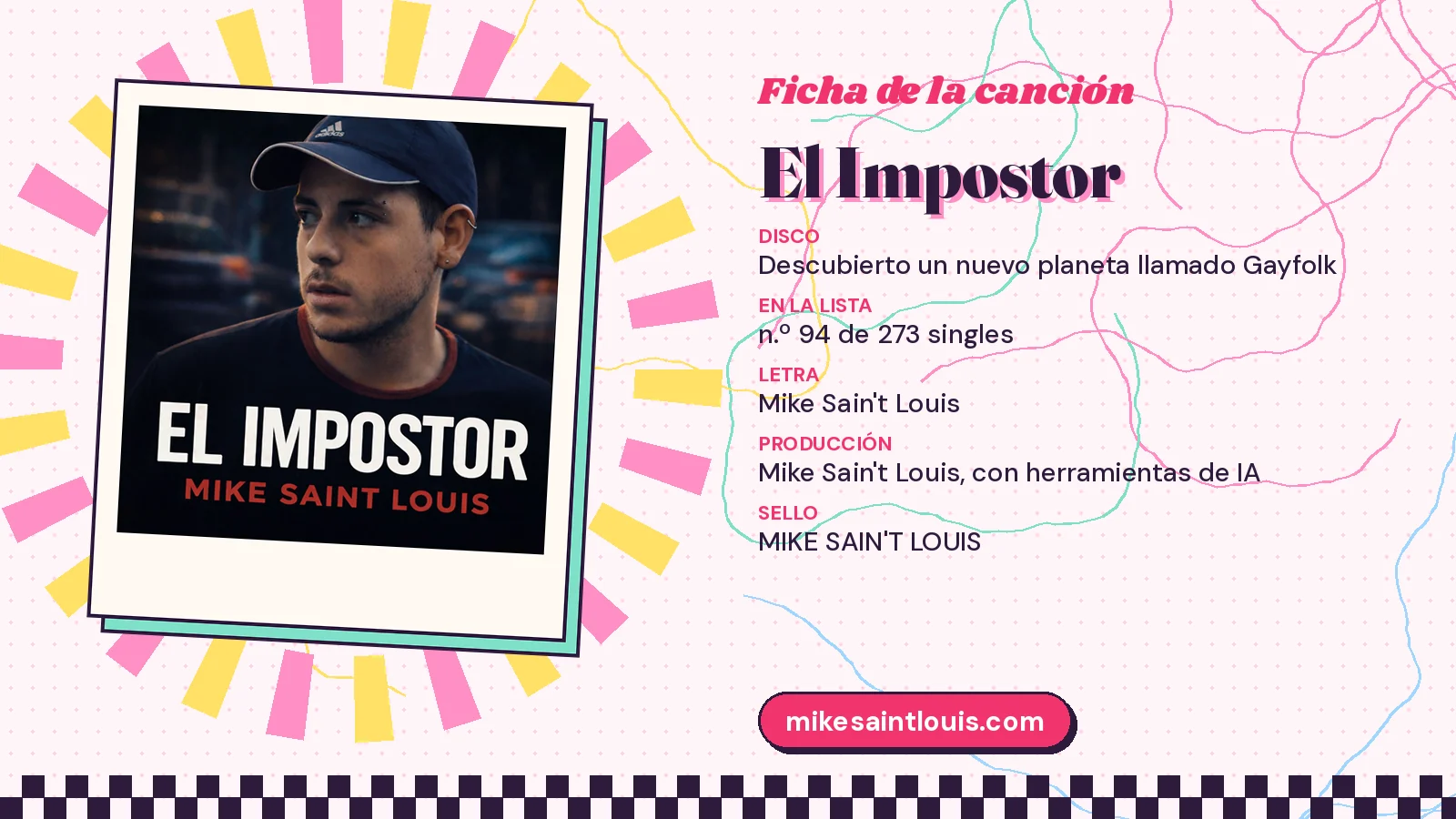
«El Impostor» is on the first album of the trilogy, «Descubierto un nuevo planeta llamado GAYFOLK», the one with a title like a news headline. It's an album full of laughter and full of rage, where break-up songs and party songs share the room without asking permission. In the complete list of Planeta Gayfolk singles it sits at number 94.
If you want to read that album's lyrics at your own pace, they're all on the lyrics page of this site, and if you get lost in the catalogue, the planet page has the map.
Who did what
I'll say it as always, so it's clear. The lyrics of «El Impostor» are mine, written by hand and without AI, every single «because». I don't perform the songs: I'm a lyricist, composer and music producer. The music and the vocals are made with artificial intelligence tools such as Suno, and I choose which version stays.
With this song that makes particular sense. A lyric this long, this chorus-less, this much of an outpouring, needed music that wouldn't push to the front. Music that would let it speak in scraps, the way you speak when it hurts.
For anyone with a box
I'll finish with something that isn't advice, because I don't like giving advice about things everyone has to do their own way.
If you have a pink box, or a blue one, or a folder on your computer called «us» with six years of photos in it, I'm not going to tell you what to do with it. Bin it if that brings relief. Shove it in the loft if you can't yet. Burn it on the beach if you're the ritual type, though don't go saying I told you to.
All I know is what writing this song taught me. That the box was never for him. It never was. The photos were proof that somebody loved for real. And that somebody wasn't the impostor.
It was me.
Frequently asked questions
What is «El Impostor» about? A break-up after six years, told as a list of evidence that the other person was never in love. The central image is a pink box of three hundred gifted photos that ends up in the bin and that nobody picks up.
Which album is it on? «Descubierto un nuevo planeta llamado GAYFOLK», the first album of the GAYFOLK trilogy. In the complete list of Planeta Gayfolk singles it's number 94.
Why does the song have no chorus? Because it's written as an outpouring, almost spoken, moving forward on «because». The list shape mirrors how you tell something like this out loud: in scraps, and out of order.
Who writes the lyrics and how is the music made? The lyrics are by Mike Sain't Louis, a lyricist, composer and music producer from Madrid, written without AI. The music and the vocals are made with artificial intelligence tools such as Suno.
Where can I read the full lyrics? On the song's page on this blog and at gayfolkplanet.com/letras/el-impostor.