By Mike Sain't Louis ·
The Good Samaritan and the Expired Pepper: What I Hid Inside «Ni un pimiento»
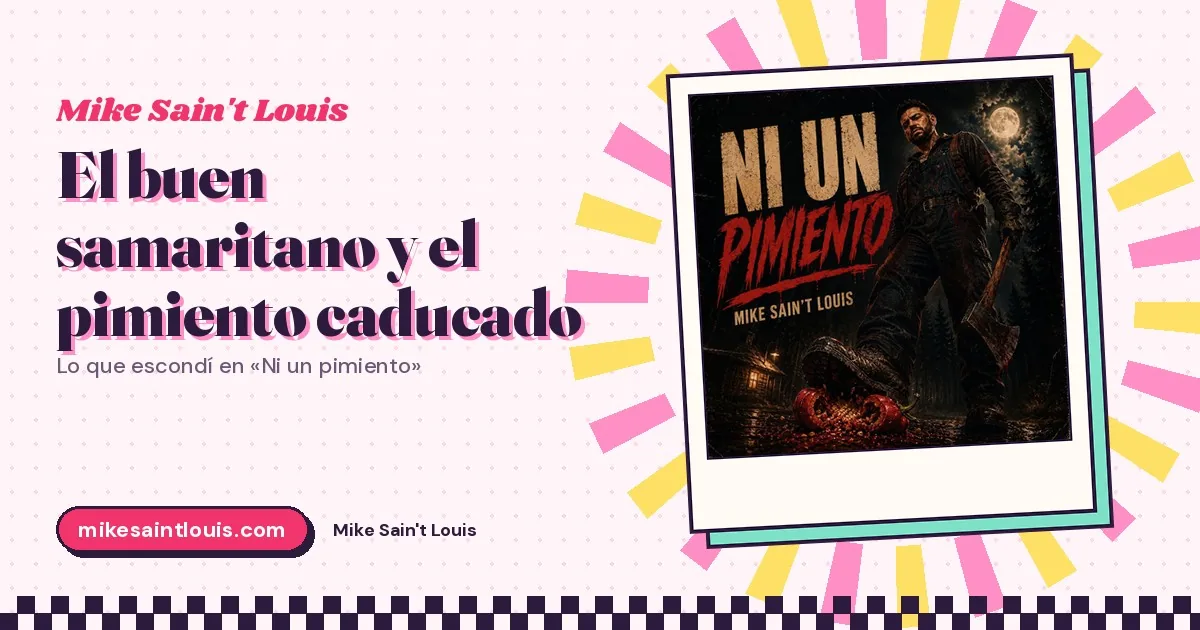
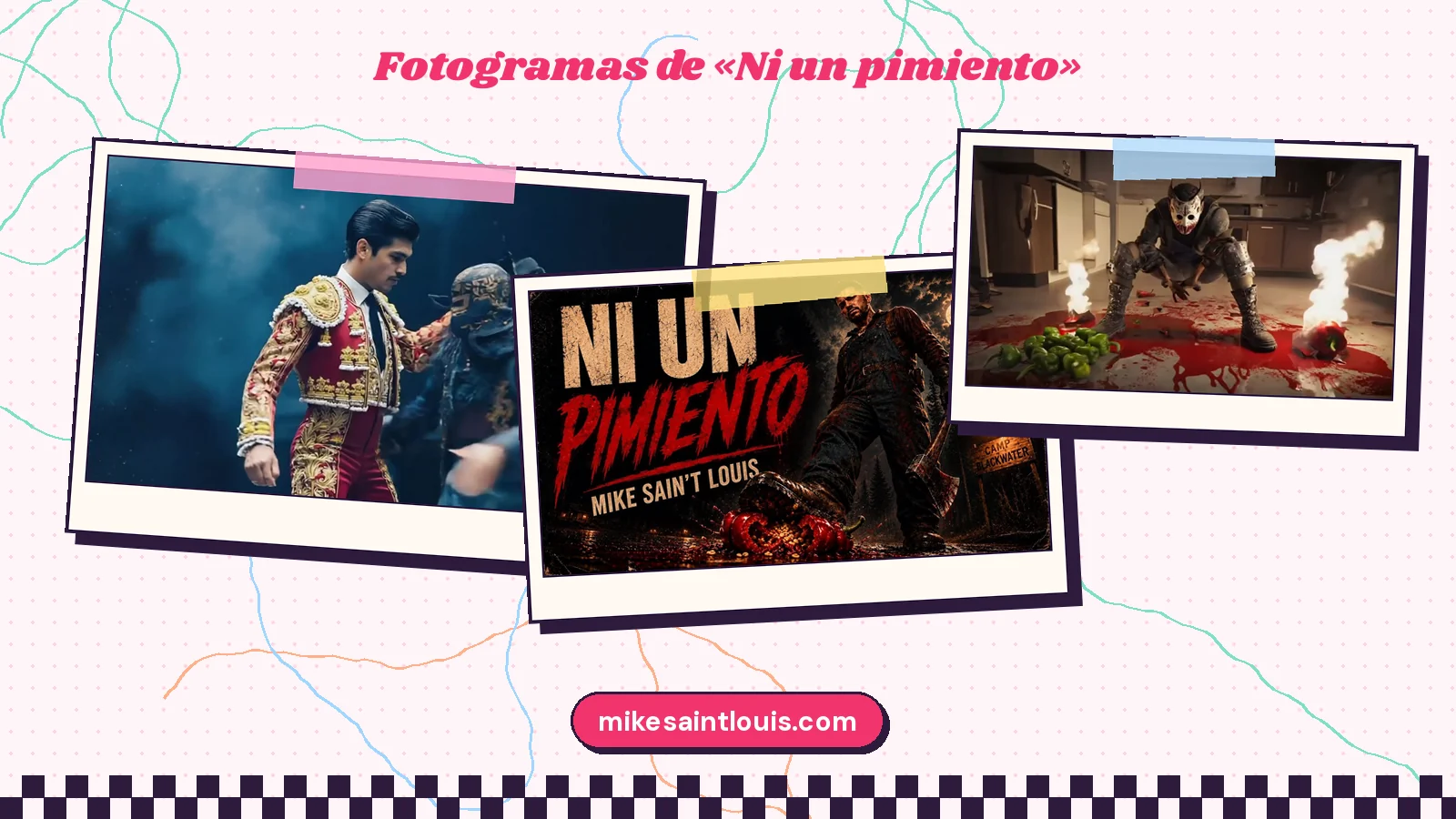
A lumberjack's boot crushing red peppers into the mud. A full moon, a cabin in the background with the light on, and a big burly man in a checked shirt holding an axe. It looks like the poster for one of those B-movie horror films Spanish TV used to air in the small hours of a Saturday. It's the cover of «Ni un pimiento», and the one stamping on the peppers isn't me. Or maybe it is. Depends on the line.
I'm Mike Sain't Louis, the man who writes the lyrics of Planeta Gayfolk, and this song has a trick hidden in its title. «No vale un pimiento» ("it isn't worth a pepper") is what every grandmother in every village of La Mancha used to say about something completely useless. Well, here it is, said about an ex, with all its horticultural consequences. The song page already sums up its journey. Here I want to tell you what I tucked inside it, which is a good deal uglier and funnier than it seems on first listen: a Good Samaritan who picked up off the ground something he should have left there.
A self-help poster in the dentist's waiting room
The song opens with a question worthy of a pavement-café philosopher at two in the afternoon: why does it feel like nothing matters anymore? And it carries on with phrases that could be framed in the waiting room of a dentist in Alcorcón, between the poster of the mouth full of cavities and a three-year-old copy of ¡Hola! Cupid shoots and misses. Fingers get crossed. Prayers go out to the neighbour. If something bad comes, don't be scared, because you're a warrior.
The lyric says it this way, in the tone of a motivational breakfast mug, of a LinkedIn coach explaining how to turn pain into opportunity. I fancied taking the language of self-help and stuffing a pepper inside it, the way you stuff a piquillo pepper with something that definitely isn't salt cod.
The chorus still has that motivational air: «No vale un pimiento llorar por el pasado» (crying over the past isn't worth a pepper). Better to laugh out loud, because the world is already marked. What they left you is a lesson tattooed on your skin. Read it fast and you'd think you were at one of those personal-growth workshops advertised on the lampposts of Lavapiés.
Read it slowly and it starts to smell of something else.
Expired, second-hand and well-handled
The second time round, the chorus takes a turn, and that's where I have the most fun. I wrote: «Si es que encima estaba caducado y era de segunda mano» (and on top of that, it was past its date and second-hand). And to finish it off, well-handled.
That «si es que encima» is pure kitchen argument, a mother complaining about what you brought back from the market. It's not just that crying over the past isn't worth a pepper: the past was gone soft to begin with. Like those peppers you buy on offer at the discount supermarket, with a squishy patch on one side, that you swear you'll use tomorrow and that end up in the bin with their skin wrinkled like an accordion.
Expired, second-hand, well-handled. It's a description of an ex written in the vocabulary of second-hand selling apps and the greengrocer's. And I love it because there's nothing epic about it. In the heartbreak songs of all time, the ex is a fallen angel, an impossible love, an eternal wound. In this one, the ex is a product past its sell-by date that someone had already pawed before me. I take him down from the altar and put him in the fridge.
The Good Samaritan
And here comes what I hid, the thing that makes me laugh and blush at the same time. I wrote it like this: «Y yo como soy el buen samaritano / Lo salvé cuando lo habían descartado» (and me, being the Good Samaritan, / I saved him when they'd thrown him away).
The Good Samaritan is me. The one from the parable, who stops on the road to help the man lying in the ditch. Except that in my version what was lying in the ditch was an expired pepper, and I took it home convinced I was doing an act of charity.
They'd thrown him to the ground, the lyric goes on, and were about to crush him under the villain's boots. That's the boot on the cover, by the way. And I came running, like a nun in an apron, to rescue him from the boot. What a saint! What generosity!
What a mug.
It's the saviour complex, one of the oldest traps in the world and one that keeps turning up in stories about narcissists. You see someone broken, discarded, trampled on, and you think that with you it'll be different, that you're the one who'll fix him. And you pick him up. And it turns out he'd been thrown away for a reason. In «La ley de la exageración» I talk about the saviour-victim as a type of narcissist; here the saviour is the narrator, meaning me, with a naivety straight out of a beginner's manual for suckers. I devote the whole song to it, and I laugh at myself before anyone else can, which is the only decent thing to do.
Not even a pinch of salt
Before the pepper arrives, the song is already using the kitchen as a unit of measurement. Suffering, says one of the first lines, isn't worth even a pinch of salt. I like that way of weighing pain with the spoon of grandmother's recipes, the ones that didn't measure in grams but in pinches, handfuls and splashes.
A pinch of salt is the least you add to a stew. Saying suffering isn't worth even that brings it down to nothing, but in a very domestic way, very TV-chef explaining a Spanish omelette. And it sets the stage for what comes next: if pain is measured in salt, the ex is measured in peppers. The whole song is a larder.
It amuses me because it strips the drama from something usually told with violins. The great heartbreak ballads talk about oceans of tears and skies falling in. I talk about a pinch of salt. It's smaller, and that's why it's truer. Nobody has ever cried an ocean. A pinch, though, anyone can.
The fallen angel is someone else
There's a structural detail I really like that hardly anyone notices. The Good Samaritan phrase appears twice in the song, and it doesn't refer to the same person.
The first time, it's aimed at the listener. If something bad comes, don't be scared, my brother, you're a fallen angel, a Good Samaritan. It's a bar-counter compliment, the friend who pats you on the back at three in the morning and tells you you're worth so much. There, the Samaritan is a virtue.
The second time, in the second half, the Samaritan is me, and it's no longer a virtue. It's the explanation for why I took the rotten pepper home. The same word, first as praise and then as diagnosis. What sounded like a medal in the first verse sounds like a fine in the second.
That's something I do a lot: plant a word with one meaning and harvest it with another. Like the nosy neighbour in «¡Eso es lefa!», who seems to be filler and ends up shouting the title. Here the trick is subtler, but it's there. And whoever catches it feels the song winking at them.
My brother
The «mi hermano» bit has its own story too. Throughout the first part, the song talks to a mate, an equal, in that advice-giving tone you hear on summer terraces by the third beer. Don't be scared, my brother. Laugh out loud. You're a warrior.
It's the tone of someone comforting another person without realising the advice is also meant for himself. There's a lot of that in queer friendships: we spend our lives telling our friend to dump him, that he's no good for her, that she's worth so much more, while we keep answering our own one's texts at two in the morning. The song begins by consoling someone else and ends by confessing its own story.
That shift from you to me is the backbone of the lyric. It's also its sharpest piece of self-parody.
Checked shirt and axe
Back to the cover, which I directed with a lot of mischief. The big man in the lumberjack shirt, the beard, the axe, the hiking boot crushing red peppers that burst in the mud like tomatoes at the Tomatina in Buñol. Behind him, the cabin with its light on and the full moon, straight out of a werewolf film.
It's an image of catalogue masculinity, a Father's Day aftershave advert or the Instagram account of a bear at Bear Pride in Chueca. And it amuses me because the song has nothing lumberjack about it. It's a greengrocer's song, a fridge song, a vacuum-sealer song. Putting a man with an axe on the cover of «Ni un pimiento» is like giving it a Friday the 13th trailer.
But it has its reading too. The villain of the lyric, the one with a violent nature, is the one in the boots. And on the cover, the boots are in the foreground, stamping. If you want to see the ex there, go ahead. If you'd rather see the narrator, fed up with picking peppers off the floor and determined to stamp on them himself, that works too. I like both readings. All the catalogue's covers are on the singles page.
Deaths are fine, but so slow
There's a line in the lyric that's pure black humour and that I won't quote word for word, because I've used up my quota of verses. It talks about the villain with the violent nature and the boots, and drops in passing that deaths are fine, yes, but so slow.
That line belongs in an Álex de la Iglesia film. A cruel joke said as casually as small talk about the weather in a lift. It isn't aimed at anyone in particular: it's the exaggeration of someone who has watched something being stamped on and, instead of crying, comments on the stamping technique. Horror as a metaphor for love is one of my favourite tools, and here it shows up in miniature, in half a line, like a jump scare in the middle of a comedy.
The cover takes that half line and makes it huge. The lumberjack with the axe, the full moon, the cabin in the woods. If The Texas Chain Saw Massacre had a fruit-and-veg aisle, this would be it.
The emotional swindle
Between one joke and the next, the lyric slips in a dry phrase that matters a lot to me: that you've already been sold the emotional swindle. Just like that, the way you'd say they've already charged you for the ticket.
Swindle is a courtroom and evening-news word. We use it for confidence tricks, for investment funds that evaporate, for the man who sells a bridge to a tourist. Using it for a relationship strips away all the romance. It wasn't a love that went wrong. It was a con. They sold you one thing and gave you another, and second-hand at that.
That turn, from joke to diagnosis, is in almost all my songs about exes, and here it lands right in the middle of the chorus, like a stone in a plate of lentils. You're chewing happily and suddenly a tooth hurts.
A portable freezer and a vacuum sealer
And then comes my favourite moment, pure domestic comedy. I wrote it like this: «Serás más feliz con un congelador portátil» (you'll be happier with a portable freezer), strolling hand in hand, and with a vacuum bag sealer.
Few images make me laugh more than someone strolling through the Retiro hand in hand with a portable freezer. I picture the freezer on wheels, plugged into an endless extension lead, and people staring. It's nineties teleshopping turned into couples therapy. Rather than go back to the expired pepper, better an appliance that at least preserves what you give it.
And that's the joke, right there in the verb to preserve. The freezer preserves. The vacuum sealer preserves. What the ex never did was preserve anything: not trust, not affection, not the years. I'm telling him a forty-euro gadget from a discount supermarket makes a better partner than he does, and I'm telling him with all the tenderness of a Tupperware saleswoman.
I think it's some of the best I've written about heartbreak. And I say that quietly, because it's a joke about kitchen appliances.
The kiss that won't happen
The ending of the song doesn't hold back. It calls him a thief of years, infectious, a real piece of work. And it finishes with a scatological comparison I won't reproduce here, but whose conclusion is clear: anything rather than give him a kiss.
It's the kind of ending that makes people cover their mouths in the car. I wrote it crude because the song asked for it. After so much motivational-mug advice, so much Good Samaritan and so much freezer, it needed a door slam that sounded like a door slam. And on Planeta Gayfolk, door slams sound like that, with a smell.
The thief of years connects with another song of mine, the one about the two thieves who stole twenty years from me in one go. Stolen time comes back again and again in my lyrics. It's what makes me angriest about all this, and I don't hide it: what they said or did matters least; what matters most is the calendar.
Why self-help makes me laugh so much
I laugh a lot at the language of self-help, and this song is the proof. Not because I'm against looking after yourself, heaven forbid. I laugh because that language promises mug-sized solutions to knife-sized problems. It tells you you're a warrior when what you need is a removal van. It tells you everything happens for a reason when what happened was a con.
I wrote about second-hand embarrassment as a tool in «La vergüenza ajena como herramienta para escribir», and here I use it big time. The first part of the song, with its coach tone, is a little cringe-making on purpose. Then the song laughs at that cringe, takes off the motivational speaker's suit and puts on the apron of an outraged greengrocer.
That mix is very me. The solemn and the tacky in the same sentence, the guru and the supermarket, the fallen angel and the rotten pepper.
An album about wanting to leave
The song belongs to *Ojalá se pudiera viajar a GAYFOLK*, the second album of the GAYFOLK trilogy. It's the album of wanting to get away, of leaving behind whatever's useless. And if anything's useless, it's an expired pepper in the fridge.
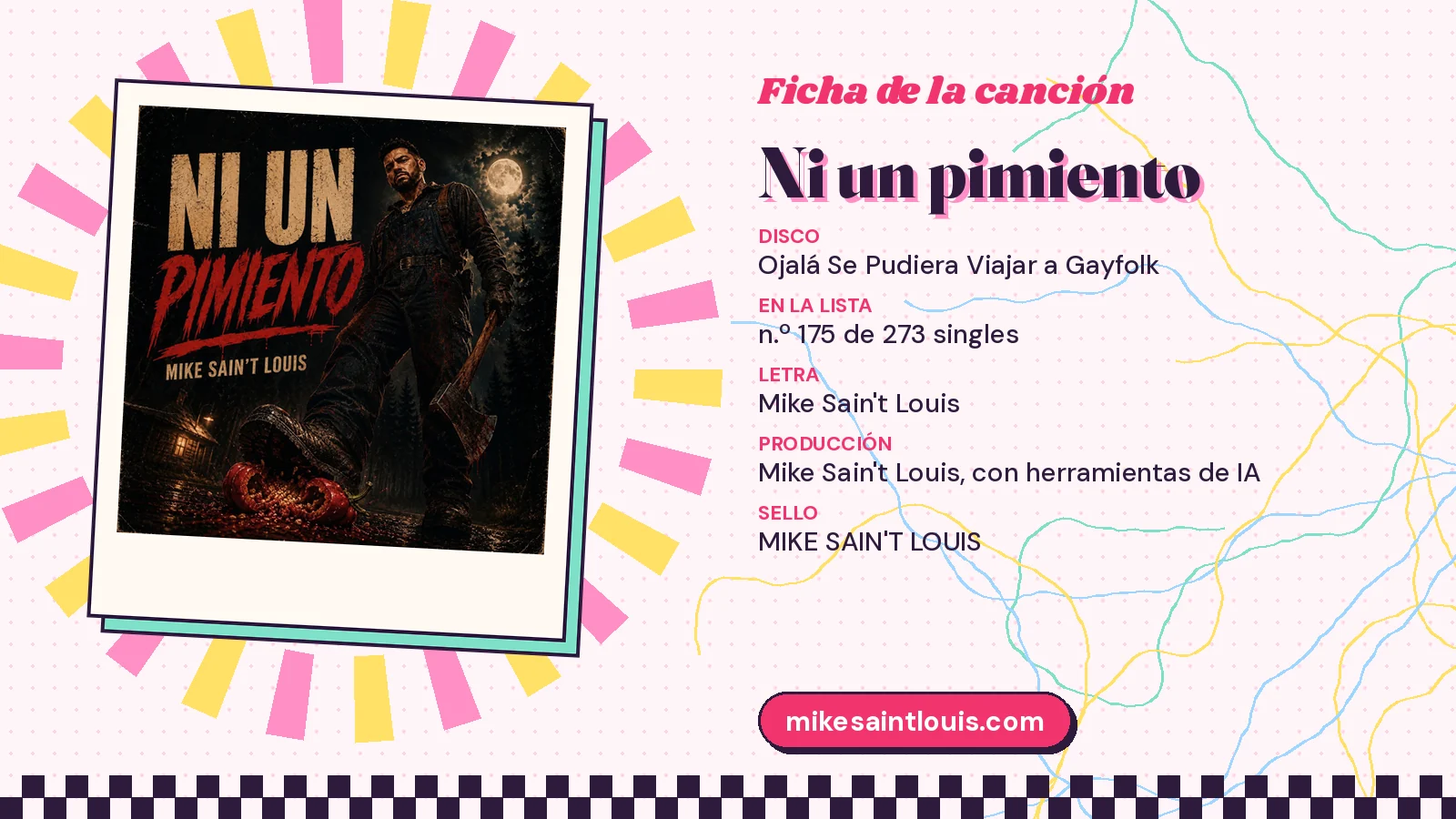
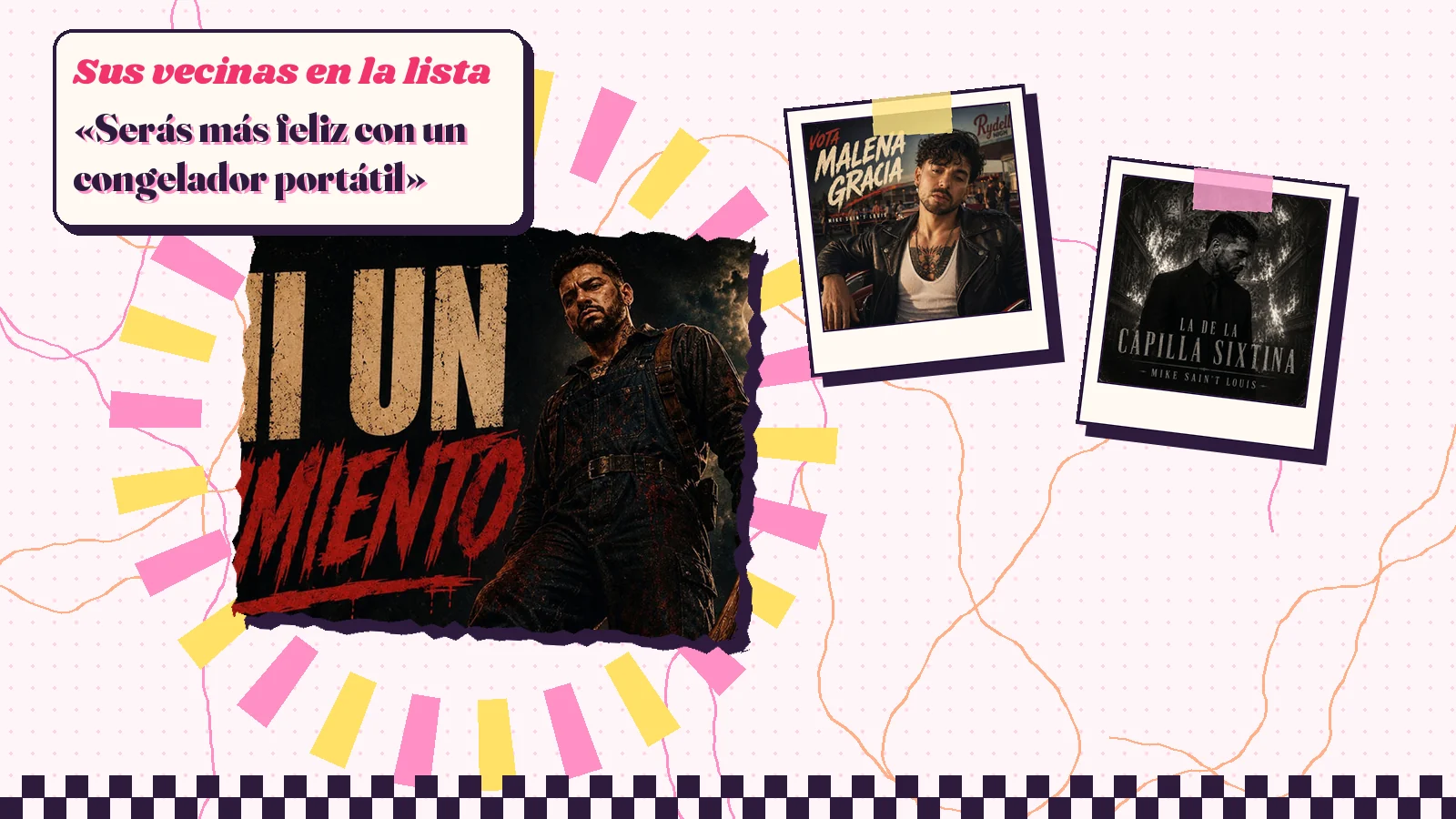
In the catalogue of 273 singles it's track 175. Just before it comes «Vota Malena Gracia», a fake election campaign for a real diva. Just after, «La de la Capilla Sixtina». From glitter politics to the greengrocer's, and from the greengrocer's to the Vatican. I love that my catalogue, laid out in a row, looks like Sunday-afternoon channel surfing.
If you want to hear the three albums in order, there's the guide to listening to the trilogy from start to finish.
What the machine brings and what I bring
The lyric is mine, from the pepper to the vacuum sealer. The words, the images, the order in which the song moves from self-help poster to a door slam with a smell. The music and vocals come from artificial intelligence tools such as Suno, which I use for production, and I choose which version stays and which gets binned.
On this one, the choosing was mostly about tone. I needed the first part to sound like a genuinely upbeat track, the kind they play in gyms, so that the swerve into insult would catch you off guard. If the backing had sounded bitter from the start, the coach joke wouldn't have worked. I wrote about that work of choosing between versions in «El oficio de descartar». And on my about page I explain how I work in general.
The family of kitchen objects
«Ni un pimiento» isn't my only song full of appliances and food. Planeta Gayfolk is packed with household things: croquettes on a cruise, Canarian gofio, a Tupperware box, a fan spreading muck, a sock that measures disappointment. I like telling love through objects you buy at the supermarket, because love, in the end, is also lived between the fridge and the sink.
I wrote about that in «Canciones para fregar los platos: el pop doméstico y la vida pequeña». This song may be the clearest example. A heartbreak told through the shopping list: pepper, salt, freezer, vacuum bags. If I ever lose the lyric, I can rebuild it from my supermarket receipt.
To be played with the fridge door open
My recommendation is literal. Listen to it while you tidy the fridge. Take out whatever's expired. Throw away whatever's been in the vegetable drawer for a week with its skin wrinkled. And if you own a vacuum sealer, use it with pride, like someone keeping a promise.
It won't give you back the years. But you'll end up with a clean fridge and a laugh, which is more than plenty of seventy-euro personal-growth workshops manage.
The full lyric is on its lyrics page, and all the others are in the lyrics archive on this site. To listen, there's Spotify or the music video on gayfolkplanet.com.
What really isn't worth a pepper
In the end, the song says it's not worth crying over the past. And that's half true, like every proverb. Crying is worth something: it helps you understand what happened. What isn't worth a pepper is crying on and on over something that was already past its date when you picked it up.
That's the only moral I allow myself, and I apply it to myself first.
Next time I see something lying in the ditch, I'll check the date before I take it home.
Frequently asked questions
What is «Ni un pimiento» by Mike Sain't Louis about? It starts like a self-help song, «No vale un pimiento llorar por el pasado» (crying over the past isn't worth a pepper), and turns into a send-up of the ex: something expired and second-hand that the narrator rescued believing he was a Good Samaritan. Rather than going back, it suggests being happy with a portable freezer.
Which album is «Ni un pimiento» on? On Ojalá se pudiera viajar a GAYFOLK, the second album of the GAYFOLK trilogy. In the catalogue of 273 singles it's track 175, between «Vota Malena Gracia» and «La de la Capilla Sixtina».
What does the title mean? It comes from the Spanish saying «no vale un pimiento», meaning it's worth nothing at all. The song applies it to crying over a past that, according to the lyric, was already past its sell-by date.
Who wrote «Ni un pimiento»? Mike Sain't Louis, a lyricist, composer and music producer from Madrid, the first AI songwriter. The music and vocals are made with artificial intelligence tools such as Suno, under his direction.