By Mike Sain't Louis ·
Taking flight: «Fly Away», the crow's wings and the human dream of escaping through the air
We've all dreamed at some point that we were flying. It's one of those dreams repeated in cultures that never met, like losing your teeth or arriving late for an exam. But flying has something different about it: hardly anyone wakes from it frightened. You open your eyes feeling that, for a while, you were lighter than your own body. Then you put your feet on the cold floor and it's over.
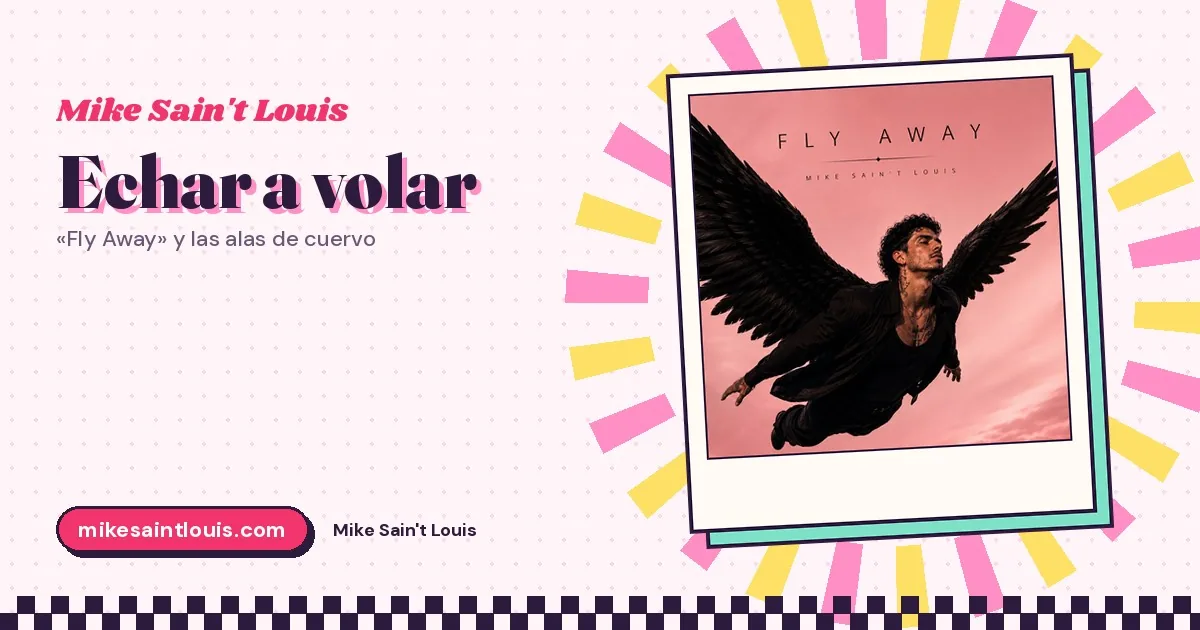
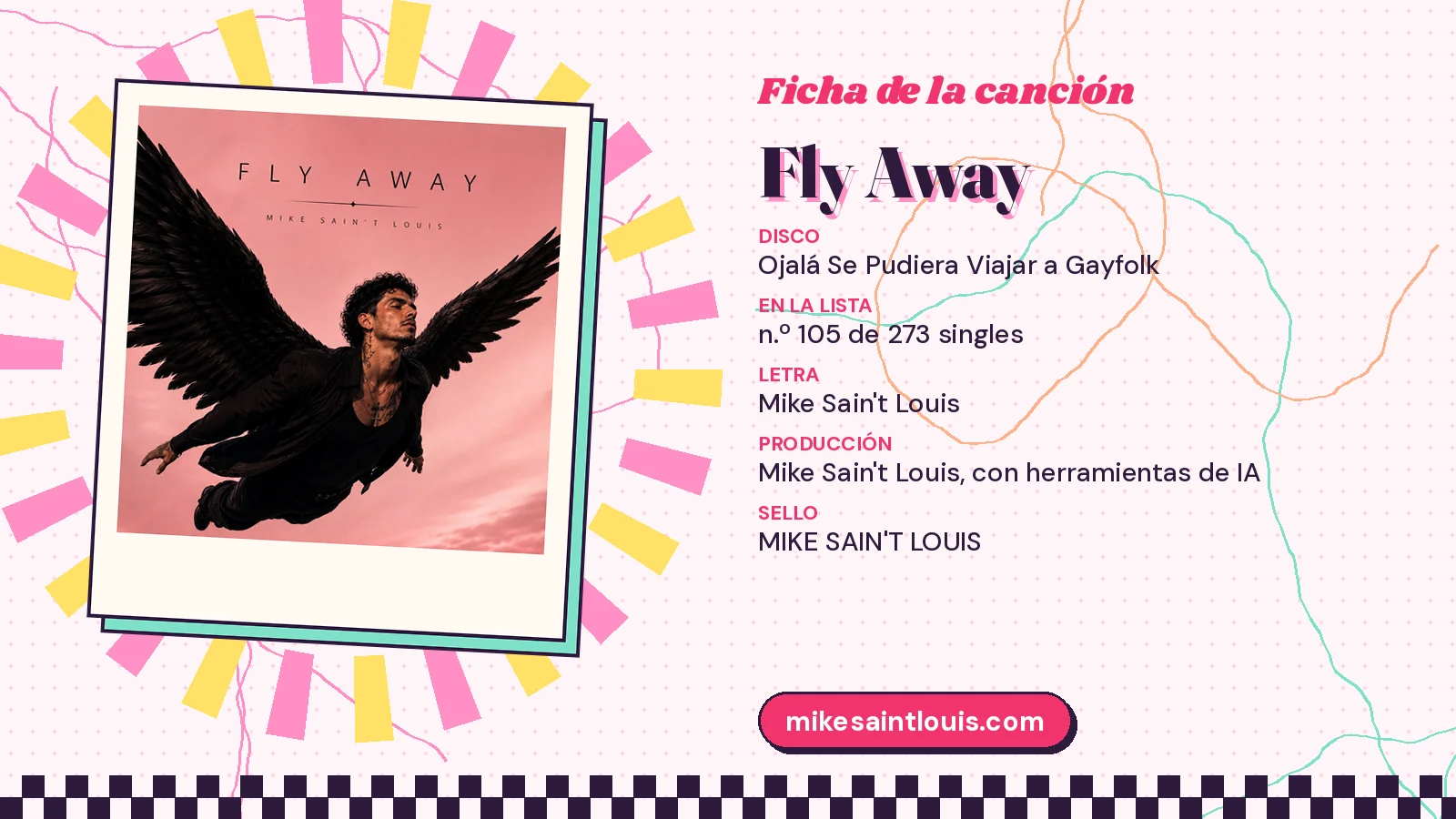
The cover of «Fly Away» is made of that moment just before the alarm. A boy crosses the sky with his eyes closed and enormous black wings. There's no ground in sight. There's nothing he's escaping from, because he has already escaped.
Only sky
On the song's page I wrote that this cover has no set, no objects and nobody around. That's right. The whole background is a powdery pink sky, the shade some evenings have after a storm, with very thin clouds fraying at the bottom right. Not a house, not a tree, not a horizon line. The whole space is his.
The boy flies almost horizontally, body tilted forward and arms open at his sides, hands relaxed as if feeling the air. He's dressed in black: an open shirt, a vest underneath, dark trousers and boots. His hair is curly and tousled. He has tattoos on his neck and chest, several thin chains with crosses hanging from them and a small cross-shaped earring. His face, with a few days' stubble, is turned upwards and calm. As I wrote back then, it's the face of someone who has finally stopped straining.
At the top, the title is set in thin, widely spaced letters, F L Y A W A Y, with a slim line underneath and a small diamond in the middle, like the compass rose on an old map. Below it, my name in the same style. It's a typeface that weighs almost nothing. It matches everything else.
What's there and what's missing
I don't have the lyrics of «Fly Away» published, and I'm not going to rebuild them from guesses. Nor am I going to rely on automatic transcriptions, which, with English and music on top, make up half the song. When the text is ready, it will go to the lyrics section as always.
I do have things that can be looked at and checked. The cover I've just described. The title, which in English means something like «take flight» or «go far away». The official music video, which I uploaded to YouTube on 19 June 2026, the same day as «Sunset Boulevard». The album it belongs to. The tags I presented it with: indie pop, alternative pop, queer pop and camp. And what I wrote about it on my website, which ends with a very specific recommendation: put it on when you need to shed some weight.
With that, and with the very long human history of wanting to fly, there's material to spare.
Crow's wings
What I like most about this cover, and I said so on its page, is that the wings are black. A boy with white wings would have been the expected thing, almost a First Communion holy card. These have long, dark feathers, spread at the tips like fingers, just like a crow's when it glides. I wrote that they have something dark about them, as if what lets you escape had been born precisely from what was weighing you down.
That idea still seems to me the key. We tend to think that to get out of a bad place something good has to arrive from outside: a rescue, an opportunity, a person. But often what gets you out is something you already carried inside and that, until then, had only hurt you. Anger that turns into a decision. Sadness that, from weighing so much, forces you to change position. Tiredness that one day says enough.
The black wings are that. They don't come from the sky. They grow out of your back.
The bird that remembers faces
Crows have had bad press for centuries. They're associated with omens, battlefields, witches. In 1845 Edgar Allan Poe published «The Raven», the poem in which a black bird perches on the bust of a statue and answers all the narrator's questions with the same word: nevermore. Ever since, the animal has carried a reputation as a funeral messenger it doesn't entirely deserve.
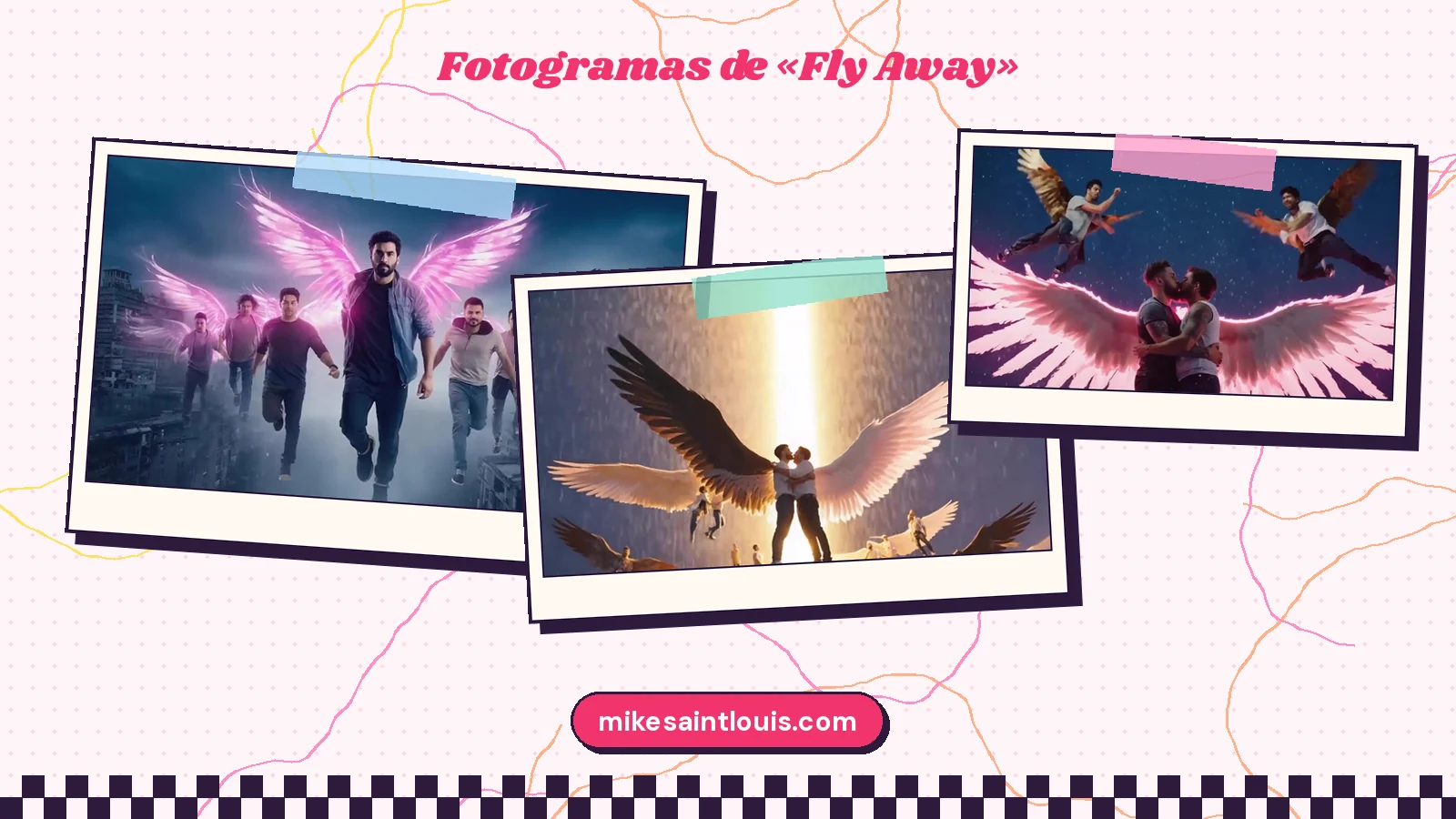
Because corvids are, above all, extremely clever. They make tools, hide food and remember where, and they recognise human faces. From 2006, a University of Washington team led by John Marzluff caught and ringed crows while wearing a particular mask. Years later, the crows on campus were still cawing at and mobbing anyone wearing that same mask, even birds that had never been caught. They had learned from the others who was dangerous.
I find it a beautiful image for talking about leaving. A black bird that doesn't forget who hurt it, that warns its own and, when necessary, simply flies away. No fuss. No explanations. With memory.
A man from Córdoba with feathers
Long before planes, there were people who jumped from high places with homemade wings. One of the most famous was from here. Abbas ibn Firnas was a scholar of ninth-century Umayyad Córdoba: poet, musician, astronomer, inventor. According to the chronicles, around the year 875 he built a contraption of cloth, wood and feathers and launched himself from a height. He glided for a stretch, so they say, and landed so badly he hurt his back. He's said to have admitted afterwards that he should have paid more attention to how birds use their tails to land.
The story has reached us mainly through a much later historian, al-Maqqari, from the seventeenth century, so it's best taken with the caution owed to beautiful legends. But Córdoba hasn't forgotten it: there's a bridge over the Guadalquivir that bears his name, and there's a crater on the Moon named in his honour.
I love thinking that one of the first men to try to fly in Europe was Andalusian and that it went so-so. It's very much our thing: the brilliant idea, the leap, the bump and the lesson learned for next time.
Leonardo watches the birds
Six centuries later, in Italy, Leonardo da Vinci spent years watching birds with an almost scientific obsession. Around 1505 he filled a small notebook, now known as the Codex on the Flight of Birds, with drawings of wings, air currents and flying machines. That notebook is kept in the Royal Library of Turin.
Leonardo sensed things that would take centuries to confirm, but his machines never took off. The problem was always the same: the human body doesn't have enough strength to flap wings that size. Flying needed something else. It needed people to stop imitating birds.
I mention it because it seems a good metaphor for any escape. Sometimes you try to leave a place by copying the way others left, and it doesn't work. You have to find your own way.
Twelve seconds at Kitty Hawk
The first time two people truly rose into the air was in a balloon. It happened in Paris in November 1783, in a craft by the Montgolfier brothers. A few weeks earlier, at Versailles, a sheep, a duck and a rooster had already gone up and come down alive and rather confused. I find it very funny that the first air crew in history was a farmyard.
The aeroplane came more than a century later. On 17 December 1903, on some dunes in North Carolina near Kitty Hawk, Orville Wright stayed in the air for twelve seconds and covered about thirty-seven metres. Less than the length of a modern plane's aisle. And yet those twelve seconds changed everything.
There's something about that number that moves me. Twelve seconds. You don't need a long flight to prove it can be done. Sometimes it's enough to lift off a little, touch the ground again and know, forever after, that the air holds.
Angels in overcoats
There's a film that always comes to mind with this cover, even though it tells exactly the opposite story. In «Wings of Desire», from 1987, Wim Wenders imagined angels walking through the divided city of Berlin listening to people's thoughts. They don't wear white robes: they wear long dark overcoats, and the film shows them almost always in black and white. One of them, played by Bruno Ganz, falls in love with a trapeze artist and decides to give up eternity to live as a human, with cold, with coffee, with wounds.
In the film, the angel wants to come down. On my cover, the boy wants to go up. But they share something: both are tired of watching life from the place they were given and decide to change level. Wenders' angel falls towards the world; mine rises away from it. And both are dressed in dark clothes.
Hollywood made a version in 1998, «City of Angels», with Nicolas Cage and Meg Ryan. It's sweeter and less strange. I'll stick with the original.
Eyes closed
There's a detail on the cover that seems more important to me than the wings: the boy isn't looking where he's going. His eyes are closed. Anyone who has flown knows take-off is lived in two ways. Some press their nose to the window to watch the city shrink, and some grip the armrest, close their eyelids and wait for it to pass. He does neither. He closes his eyes, but holds on to nothing.
Closing your eyes mid-flight is an act of absolute trust. It means you no longer need to check every second whether the air is holding you up. It means you've stopped keeping watch. And anyone who has lived a long time on alert, attentive to another person's mood, to a message, to a slammed door, knows how strange and precious it is to be able to do that.
Some people take years to sleep through the night again after a bad period. People who jump at the sound of their phone or check the lock twice. For them, an image like this isn't decoration: it's a goal. To reach a place, even in mid-air, where you can close your eyes without fear.
Flying without landing
If we're talking about really going far, the champions are migratory birds. There's one, the bar-tailed godwit, that crosses the entire Pacific every year without stopping. In 2022 a young bird tagged by scientists flew more than thirteen thousand kilometres in eleven days, from Alaska to Tasmania, without landing once. It didn't eat, didn't drink, didn't sleep on land. It just flew.
It's a dizzying image. A bird weighing a few hundred grams that knows, without anyone teaching it, that it has to leave and where to. That doesn't ask the sky for permission or wait for the wind to be perfect. That leaves because leaving is what keeps it alive.
I'm not saying we have to do the same. But sometimes leaving isn't a whim, it's a matter of survival, like those birds that wouldn't get through the winter if they stayed.
«I'll Fly Away»
The wish to take flight also has its own musical tradition. In 1929 Albert E. Brumley wrote a gospel hymn in the United States called «I'll Fly Away», published in 1932, which became one of the most recorded in its genre. It's about leaving this life behind and flying to a better place, and for decades it has been heard in churches, funerals and porches across the American South. In 2000 it came back into fashion thanks to «O Brother, Where Art Thou?», the Coen brothers' film.
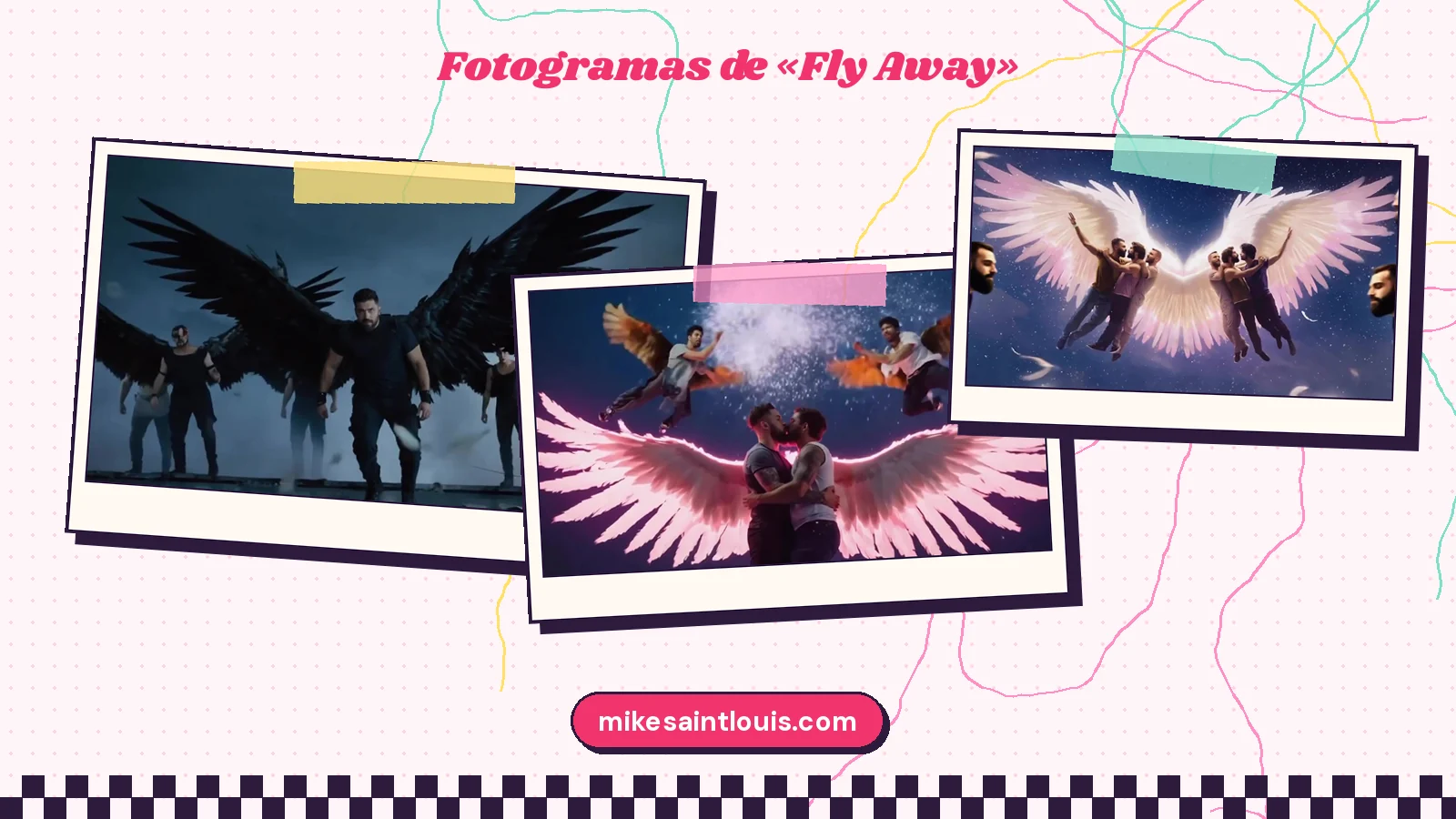
I have no way of claiming here that my «Fly Away» talks to that hymn, beyond sharing a title, and I won't pretend it does. But I like knowing that the gesture of spreading your wings has been playing for almost a century in so many different kinds of music. Some phrases people need to say in every era.
Chains and crosses
I pay a lot of attention to the details of my covers, and there's one here that isn't accidental. The boy wears several chains with crosses and an earring also shaped like a cross. Together with the black wings, it could be read as something religious, even as a fallen angel. I already wrote about that in the post about priests, rosaries and fallen angels, and I don't want to repeat myself.
Here I prefer another reading. The crosses hang, weigh, swing with the flight. They're what the boy takes with him. Nobody leaves entirely clean of their history: you fly with the chains they put on you, the ones you chose and the tattoos you got. What matters is that they don't stop him rising. In fact, from below, they almost look like ornaments.
And then there are the tattoos on his neck and chest, skin turned into an archive. I already told in the phoenix post how much birds drawn on skin interest me. Here the bird is him.
What stays below
Every escape has a below. On the cover you can't see it, and that says something too. We don't know what city the boy is leaving, or what house, or what bed. Nobody is waving goodbye and nobody is chasing him. Whatever is below no longer appears in the frame.
In real life, on the other hand, what's below weighs. There are the things you couldn't take, the people you don't know how to explain it to, the flat with your name on the lease, the dog, the plants, the job. Leaving is almost never as clean as on a cover. That's why I like that the image gives us, if only for a moment, the clean version. Sometimes we need to see it to believe it exists.
And I also like that there's nobody else in the sky. No partner waiting for him up there, no saviour holding out a hand. He leaves alone, with his wings. That doesn't mean he has to stay alone forever. It means the first impulse, the one to take off, was his.
Powdery pink
The colour of the sky is what softens the whole cover. If the background were grey or black, the image would be dramatic, almost like a horror film. With that pink, everything changes. The black of the wings doesn't threaten: it contrasts. Darkness is there, but it isn't in charge.
There's a whole tradition, in queer aesthetics, of putting black and pink together. Mourning and glitter. Gothic and twee. I really like that mix because it resembles how many of us live: with sad things on top and wanting a party underneath. In the post on «Sunset Boulevard», from the same album, pink was the clothing and the sky burned orange. Here pink is the sky and the clothes are black. Two ways of saying the same thing.
Leaving isn't giving up
There's a widespread idea, especially in relationships, that walking away is cowardly. That you have to hold on, insist, give another chance. Sometimes that's true. But when what's in front of you is someone who hurts you systematically, leaving is the bravest thing you can do.
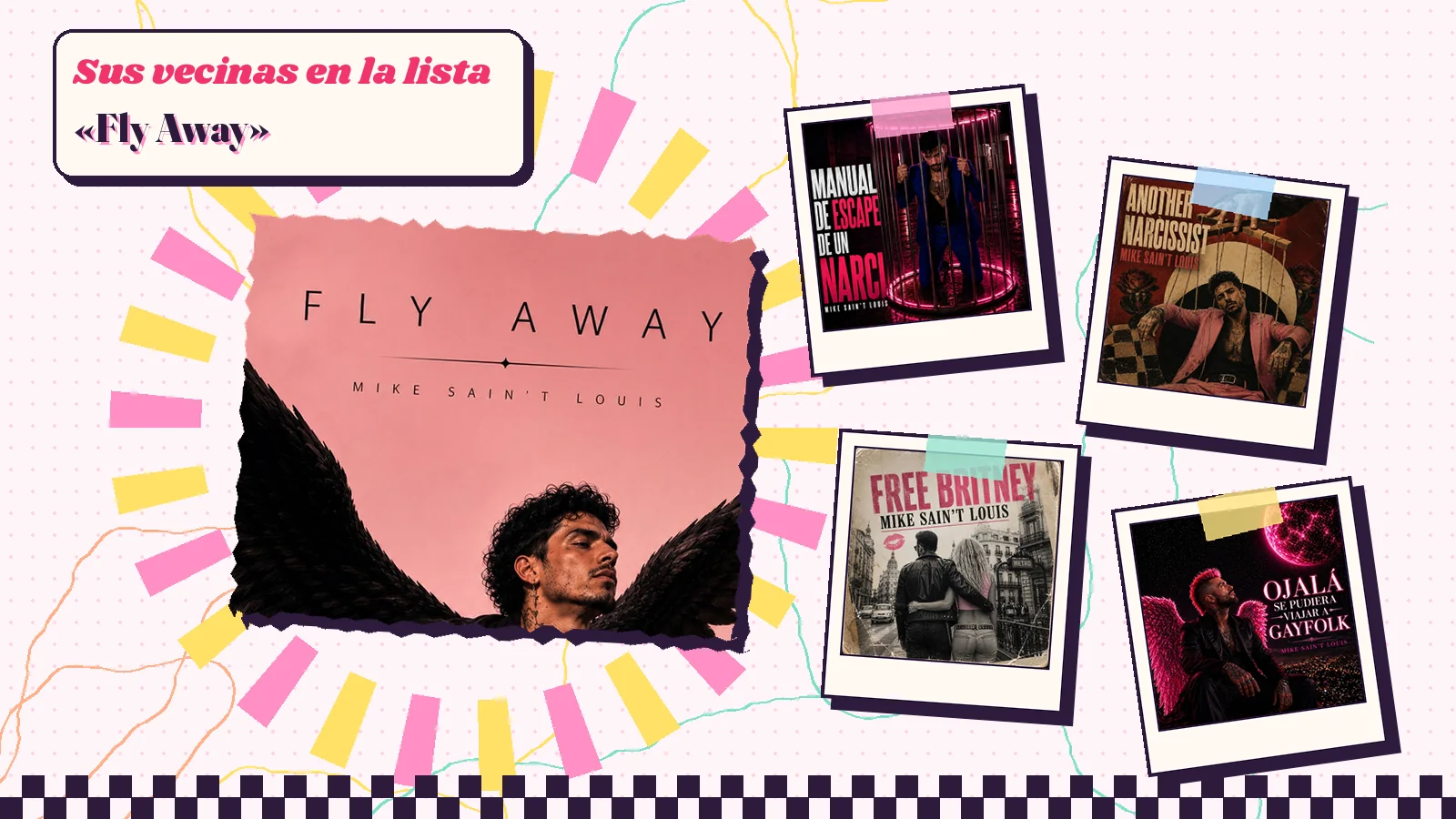
I've written a lot about that. In «Manual de escape de un narci» and in «Another Narcissist», which happens to be the song right after «Fly Away» in the gayfolkplanet.com catalogue, and in the post about the verbs of escape in my lyrics. The order seems meaningful to me, although I won't say the lyrics are about that because we don't have them published: first someone takes flight, then another narcissist appears.
The song right before it is «Free Britney», about the freedom of a woman locked in by her own circle. Between one cage and another narcissist, a pair of black wings. It's almost a comic-strip sequence.
The urge to disappear
I want to be very clear about one thing. «Fly Away», «take flight», «go far away» are expressions of freedom. But for some people the urge to leave gets mixed up with the urge to disappear altogether. If what you feel looking at this cover isn't relief but a tiredness so great you can't see a way out, please don't carry it alone.
In Spain there's 024, the suicide-prevention line: free, confidential and answering at any hour. If you're in danger right now, call 112. If you live outside Spain, dial your country's emergency number or find a support line near you at findahelpline.com. Asking for help is also a way of taking flight, maybe the hardest one.
I gathered everything I've written about this in the mental health without taboo series, with more resources and phone numbers.
On the second album
«Fly Away» belongs to *Ojalá se pudiera viajar a Gayfolk* (If only you could travel to Gayfolk), the second album of the GAYFOLK trilogy. The album's title is already a sigh: if only you could. It's the longing for a better place, a planet where you can live without explaining yourself. And there's no more direct way to reach another planet than flying.
In that context, «Fly Away» fits as a kind of take-off. We don't yet know what the song says word for word, but the cover, the title and the album point the same way: up and out.
Who this song is for
For whoever has had their shoulders hunched for a long time and needs, even for a while, to stop straining. For whoever has left a relationship that was dimming them and still can't believe they can breathe. For whoever dreams of flying and wakes up wanting to fall back asleep.
For those who wear crosses, chains or tattoos that tell a story they didn't entirely choose. For whoever is tired of being told that leaving is cowardly. And for whoever, like Abbas ibn Firnas, once jumped from a height, took a good knock and is still working out how to do it better next time.
Frequently asked questions
What is «Fly Away» about?
The lyrics haven't been published yet, so I'm not summarising them. The cover shows a boy dressed in black crossing a pink sky with large black wings and his eyes closed. On its page I presented it as a song for when you need to shed some weight.
Why are the wings black?
On the song's page I explained it like this: white wings would have been predictable, and these have something of the crow about them, as if what lets you escape had been born from what weighed you down.
Which album is it on?
On «Ojalá se pudiera viajar a Gayfolk», the second of the GAYFOLK trilogy. The official music video has been on YouTube since 19 June 2026.
Who was Abbas ibn Firnas?
A scholar from ninth-century Córdoba who, according to later chronicles, tried to fly around the year 875 with feathered wings. He glided for a stretch and hurt himself on landing. There's a bridge in Córdoba and a lunar crater named after him.
Who makes the music and the vocals?
Mike Sain't Louis, a lyricist, composer and music producer from Madrid, "the first AI songwriter". He writes and produces; the vocals are created with artificial intelligence.