By Mike Sain't Louis ·
Two toreros on the dance floor: «Barcelona» and the one-night love in someone else’s city
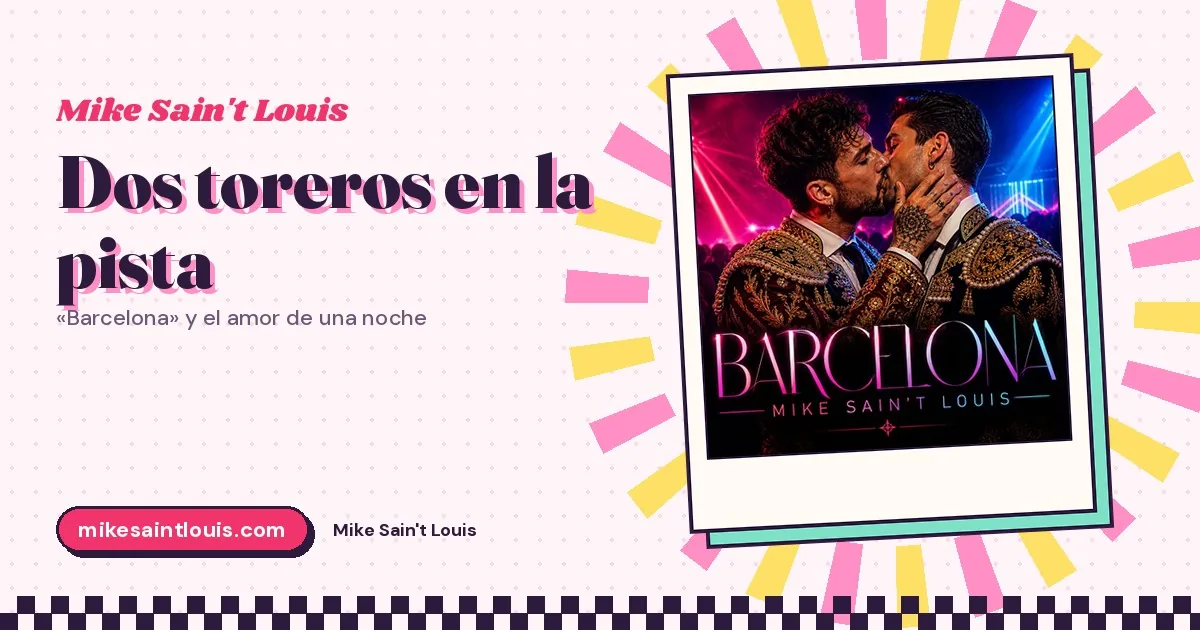
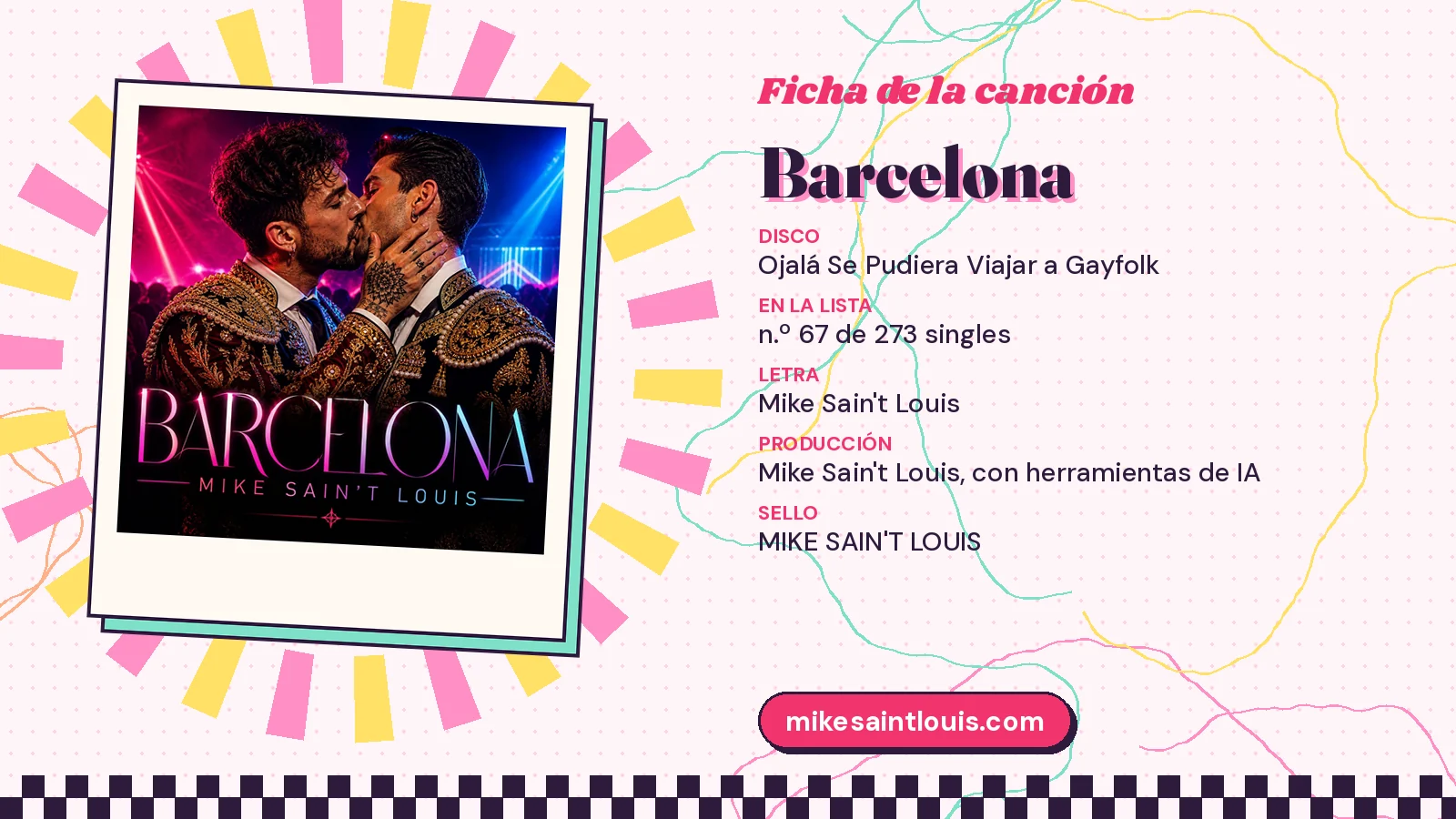
Two bullfighters are kissing in the middle of a club. Traje de luces jackets embroidered in gold, white shirts, black ties, one tattooed hand on the other man’s cheek, and behind them pink and blue lasers slicing through the smoke. At the bottom, in thin neon letters, a single word: BARCELONA.
That’s the single’s cover. And if you ask me what a suit of lights is doing in a city that hasn’t held a bullfight in more than a decade, I’ll tell you that’s exactly why it makes me laugh so much.
«Barcelona» is on «Ojalá se pudiera viajar a GAYFOLK», the second album of the trilogy, and it’s a dance-floor track with no ambition beyond getting you moving. Its page on the blog tells it that way: a night of dancing by the sea, no drama and no promises for tomorrow. Here I want to give it another turn. I want to talk about the one-night love in a city that isn’t yours, about what happens when someone from Madrid looks at Barcelona with the eyes of a lovestruck tourist, and about why the lyric jumps from English to Spanish like someone switching bars in the same club.
Late night, city lights
The song opens with a postcard:
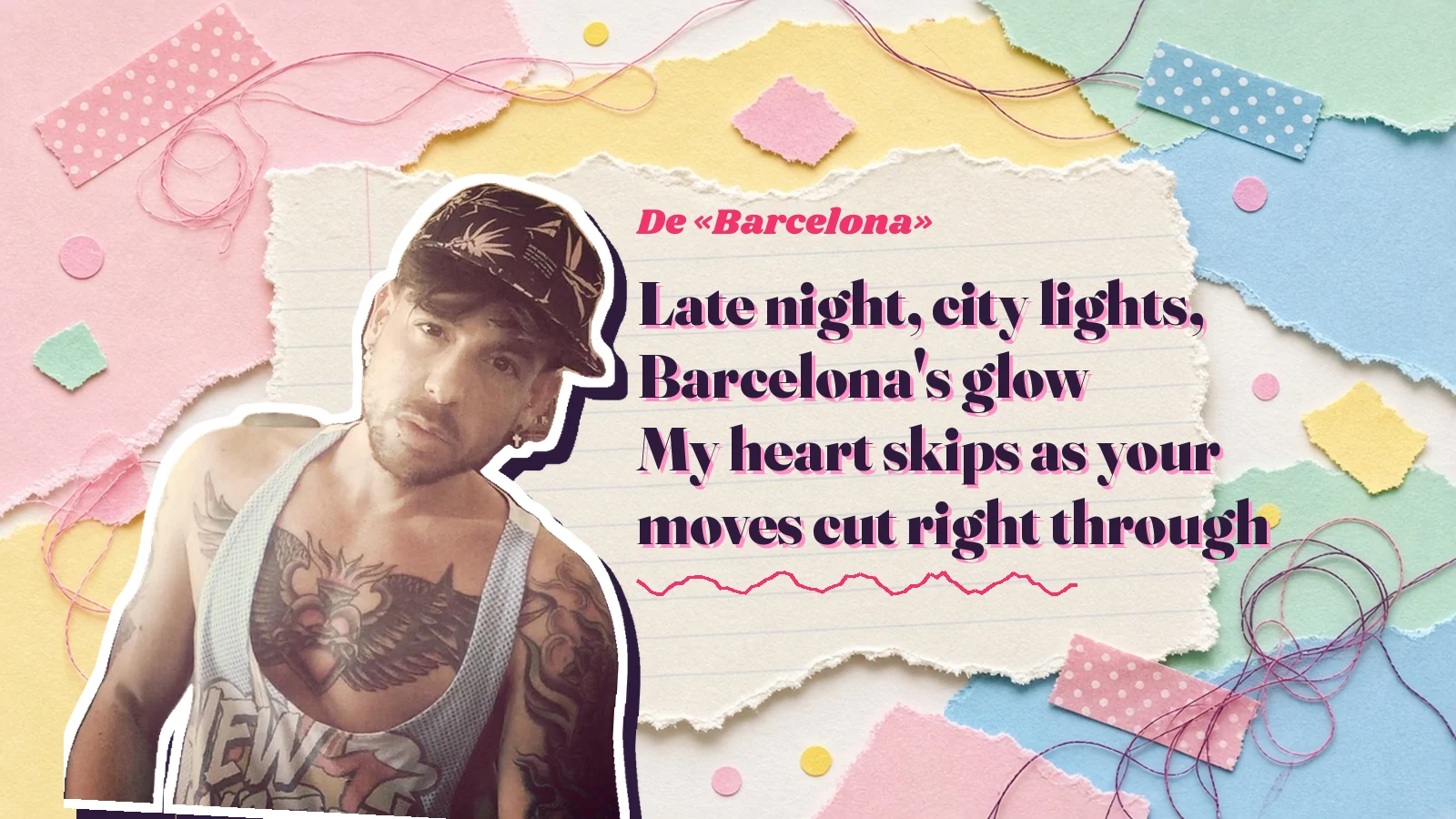
«Late night, city lights, Barcelona's glow / My heart skips as your moves cut right through»
Dead of night, city lights, the glow of Barcelona and a heart that skips a beat when the other one starts to move. No context, no backstory, no ex walking through the door. There’s a dance floor, a body and a city. That’s it.
And in my catalogue that’s almost an event. If you’ve read anything else of mine, you’ll know a song usually starts with an insult, a narcissist, a mother-in-law or a Tupperware of croquetas. Not here. Here someone dances and someone else stares. It’s the simplest song in the world, and simple songs are the hardest to leave alone.
The first line is in English, and it’s no accident that it’s the one that sounds like a tourist poster. Late night, city lights. It’s the language of postcards, of Instagram drone shots over the Sagrada Família, of beer adverts with beautiful people on Barceloneta beach. English puts the city in the shop window. Spanish, as we’ll see, puts on the skin.
Someone else for a weekend
Something happens in cities that aren’t yours that never happens in your own neighbourhood. You let go.
In Madrid, in your usual bar, the barman knows you, the girl smoking by the door knows you, your ex’s friend’s ex knows you, propping up the bar with a face that says he knows things. Every move you make on the dance floor is being watched by someone who’ll tell someone else tomorrow. That’s Chueca, darling: a village with wifi.
But you catch the AVE at Atocha, get off at Sants, drop your case in an Eixample Airbnb that smells of vanilla air freshener, and by nightfall you’re another person. Nobody knows your name. Nobody knows you cried in Mercadona on Tuesday. Nobody knows your mother still rings to ask if you’re eating properly. You’re a new body on a new dance floor, and that brings a freedom that’s a little frightening.
The lyric says it with one phrase in Spanish, placed right in the chorus:
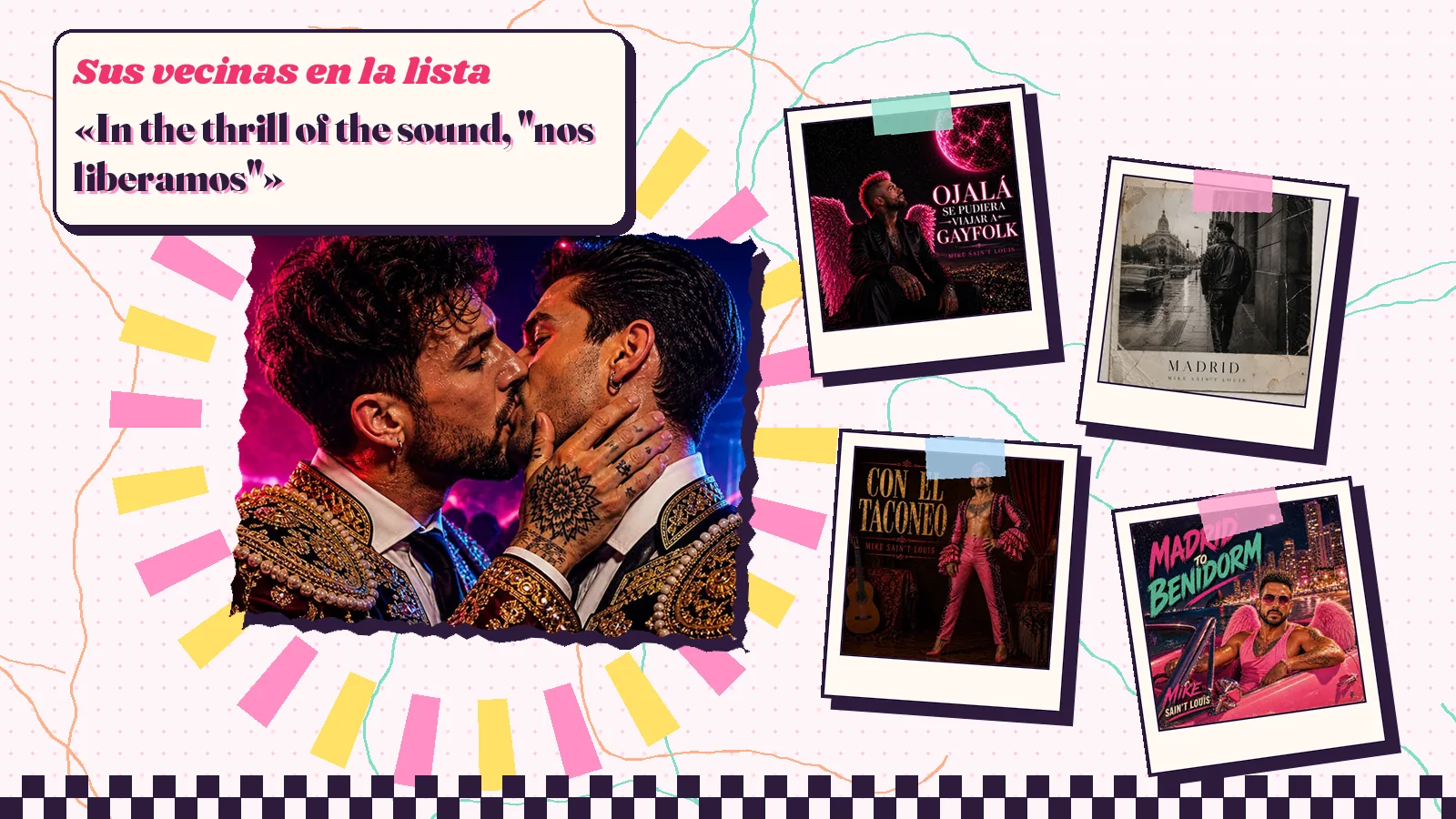
«In the thrill of the sound, "nos liberamos"»
Nos liberamos: we set ourselves free. In the middle of the rush of the sound, we set ourselves free. It doesn’t say from what. It doesn’t need to. From the neighbourhood, from work, from the family WhatsApp group, from the version of you everybody knows. That freedom is small, it lasts one night, and it’s exactly the one you’re after when you leave your city with a rucksack and a tremendous desire not to be recognised by anyone.
Mind you, this isn’t a hymn to booze tourism; Barcelona has quite enough on its plate with stag dos from Manchester. It’s something else. It’s the feeling that, far from home, you can finally be who you are when no one’s watching.
You and me together
The published lyric mixes the two languages in a very particular way. The lines are in English, and inside them, in quotation marks, Spanish phrases appear like whispers: perdidos en la mirada (lost in each other’s eyes), acércate a mí (come closer), nos liberamos (we set ourselves free), juntos tú y yo (you and me together), la noche nos envuelve (the night wraps around us), bailamos (we dance). The song’s page describes them as little winks between the music, and I agree, but I want to look at what gets said in each language.
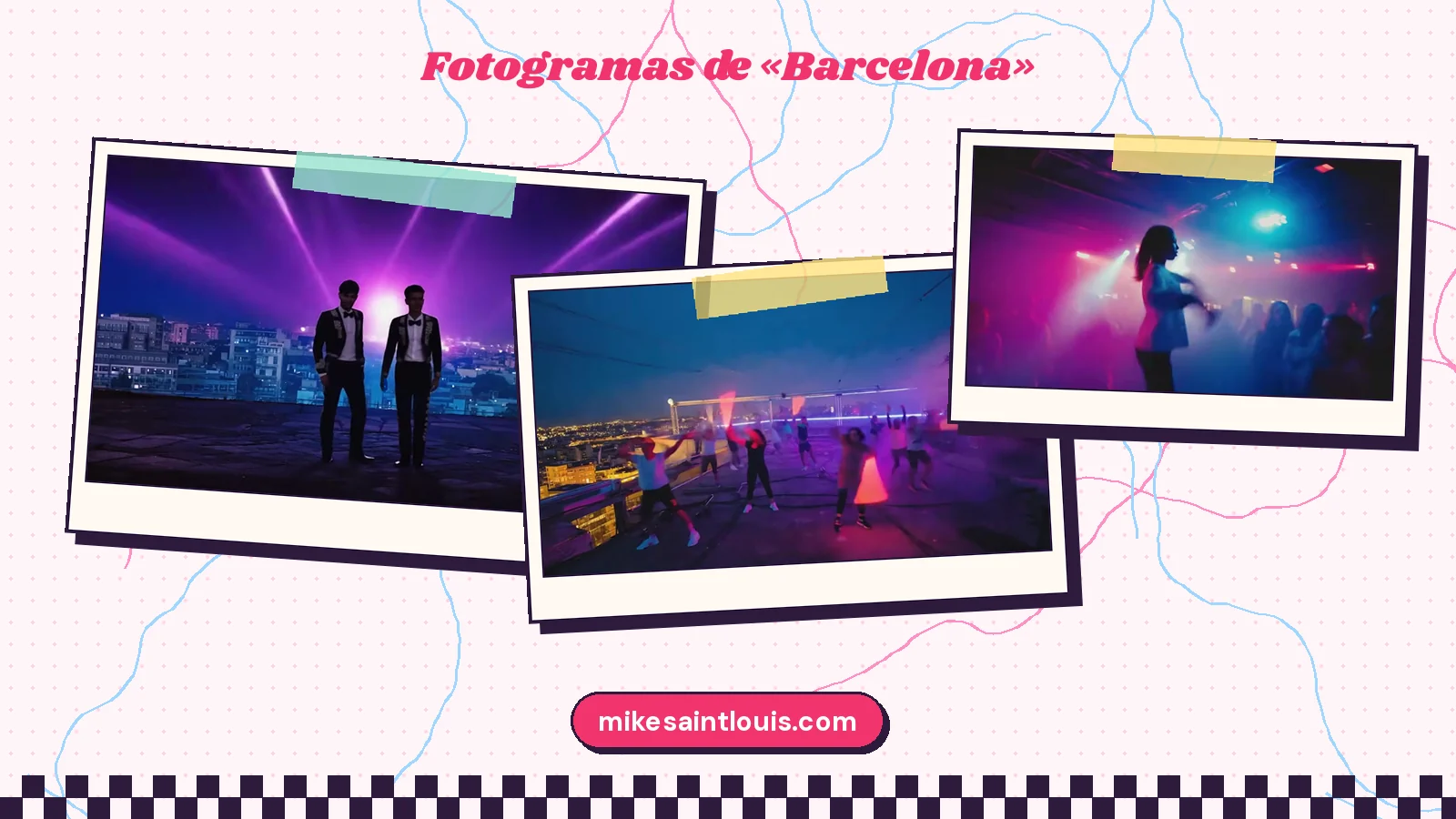
In English goes what you can see: the lights, the rhythm, the bass, the sand, the moon. In Spanish goes what you feel and what you ask for: come closer, together, we set ourselves free, we dance. It’s as if the song saves the language of home for the important things and leaves English for the scenery.
That happens a lot in real life, by the way. Anyone who has pulled someone from abroad knows. You start in English, the neutral language of the club, the language of «where are you from» and «do you want a drink». And when things get serious, when you’re two centimetres from his face, your mother tongue slips out. Come closer. Come here. God, you’re gorgeous. Nobody says the important things in the language of the brochure.
I talked about this mix another way in «Escribo en español, por qué mi web también está en inglés». There the question was where I’m from and who I’m speaking to. Here it’s simpler and lovelier: Spanish is the language of the kiss.
A city with a person’s name
The chorus repeats the city’s name so many times it starts to sound like somebody’s name:
«Barcelona, Barcelona, tú y yo, Barcelona» («Barcelona, Barcelona, you and me, Barcelona»)
You and me, Barcelona. Is it talking to the city or to the person? The song’s page already hints at it: you can’t tell whether the song is in love with someone or with the whole of Barcelona. I’d go a little further. I think that in one-night loves in another city, the two get mixed up until there’s no way of pulling them apart.
Think about it. When you remember that boy from that night, what do you remember? You remember the smell of the sea at five in the morning. You remember the clatter of metal shutters as you walked back through the Raval. You remember eating a tortilla sandwich in a bar that was just opening. You remember a square with a fountain and a man walking a sausage dog. And in the middle of it all, his face, which you’ve already half forgotten. The city stays longer than the boy.
That’s why it makes sense for the chorus to say «Barcelona» when it means «you». The person and the city have become the same thing. Just as there are love songs to Madrid, like my own «Madrid», that are really songs to someone you lived there.
Some loves have a postcode.
The toreros on the cover
I want to go back to the cover, because it’s one of my favourites on the whole album.
Two men in suits of lights, black-and-gold jackets thick with embroidery, epaulettes hung with tassels and beading, kissing in a club. One holds the other’s face with a hand covered in tattoos, a mandala inked on the back of it. They wear earrings. The one on the right has his hair slicked back like a 1950s matinée idol. And behind them, the dance floor, with the lasers and the blurred crowd.
The traje de luces is the most macho uniform in Spain. It belongs to the bullring, the bull, the pasodoble, the black-and-white photos in roadside bars. And at the same time, if you look at it without prejudice, it’s pure camp: sequins, gold, pink stockings, a skin-tight jacket, a clip-on pigtail. No drag queen’s gown has more sparkle than a matador’s at the April Fair.
Putting that suit on two boys who are kissing gives the suit back what it always had. And taking it to a club in Barcelona, which isn’t exactly bullfighting country, adds one more joke. It’s postcard Spain, the kind sold at the kiosks on La Rambla with a flamenco dancer and a bull, but turned inside out. Instead of the torero and the flamenca, the torero and the torero.
That cover has something of what I describe in «Con el taconeo», where the flamenco heel and the drag heel share the same stage. Folklore, seen through queer eyes, stops being a museum and becomes a party again.
Your hands, my waist
The second verse heads for the beach:
«Your hands, my waist, steps in the sand / "La noche nos envuelve," let's not let it end»
His hands, my waist, footsteps in the sand. And the night wrapping around everything, and the wish that it wouldn’t end. It’s the closest the song comes to a film scene: two people who leave the club and keep dancing at the water’s edge, with no music, or with whatever music is still in their heads.
I love that the lyric says nothing more. No bed, no flat, no breakfast, no swapping numbers. There’s sand and there’s a «let’s not let it end». The song stops just before whatever is going to happen happens, or doesn’t. It leaves the door open.
And here comes the twist, because every one-night song has one, even when it doesn’t say so. That «let’s not let it end» already knows it will end. That’s why it gets said. Nobody asks something to last if they think it will. You ask when you know the AVE back to Madrid leaves at nine and you’ve got to clock in at eight on Monday.
The joy of the song has that small sadness inside it, like a boiled sweet with a bitter centre.
A love song that goes right
I’ve written a lot of heartbreak songs. Loads. Narcissists, exes with invented names and surnames, mothers-in-law, punishments, silences, emotional vampires. If you counted the songs in my catalogue where somebody comes off badly, you’d get a list longer than the kings of England.
That’s why the few where things go right matter so much to me. I said it in «Hacen falta canciones de amor gay que salen bien»: for a long time, love stories between men were always told with a sad ending. The one who dies, the one who leaves, the one who never comes out, the one who marries a woman. And one of the things we most need is a song where two boys fancy each other, dance, kiss, and nothing bad happens.
«Barcelona» is that. It’s a night that goes right. It might not last, they might never see each other again, but while it lasts nobody cries, nobody lies, nobody punishes anybody. And that, which sounds like very little, is a miracle worthy of the Virgin of Montserrat in my catalogue.
Turn the beat up
One thing I’m sure of when a song is for dancing: the lyric has to leave room.
Songs for reading can afford long lines, wordplay, jokes that need two listens. Songs for dancing need something else. Short, repeatable phrases you can shout with a drink in your hand at four in the morning. Turn the beat up. Feel the rush. Acércate a mí. Juntos tú y yo. Barcelona, Barcelona.
I wrote about that difference in «Escribir para que te bailen y escribir para que te lean». «Barcelona» clearly belongs to the first group. It doesn’t ask you to understand anything. It asks you to move your hips. And, if you like, to get closer to someone.
That doesn’t make it any less mine. The lyric is mine, the music and vocals were made with artificial intelligence tools, as across the whole catalogue, and what I was after here was a dance floor, not a poem. There’s room for both on planet GAYFOLK. Sometimes you need a song that explains life to you. And sometimes you need one that lets you forget it for a while.
Madrid looks at Barcelona
I’m not getting into the Madrid–Barcelona rivalry; that’s what Sunday football and TV panel shows are for. I’ll say just one thing: it’s funny for someone from Madrid to write a love song to Barcelona.
Or maybe not. From Madrid, Barcelona has always been the city by the sea. We have the Manzanares, a river with a puddle complex, and Madrid Río, which is lovely for jogging but no good for kissing in the sand. When someone from Madrid wants an urban beach, they get on a train. And when they want to feel somewhere else without leaving Spain, Barcelona has something foreign about it that fascinates many of us: another language on the signs, another rhythm, another light, the sea at the end of the streets.
There’s something very Madrid, too, about idealising the city next door. We spend the year moaning about the August heat, the price of flats in Lavapiés and the never-ending roadworks in the Puerta del Sol, and then we get to Barcelona and everything looks gorgeous: the Eixample balconies, the flower-patterned pavement tiles, the salt smell in Barceloneta, even the pigeons in Plaça de Catalunya. I’m sure the people there feel exactly the same when they come here and sit on a terrace in La Latina for Sunday vermouth.
Other cities in my catalogue work as settings. «Madrid to Benidorm» is almost the opposite of this one: a motorway, a destination for pensioners and hen parties, plenty of laughs, tackiness by the bucketload. «Barcelona» is the elegant version. What the two have in common is someone leaving Madrid in search of something Madrid can’t give them.
And maybe that says the most about me. That I live in a city I love enormously and that every now and then I need to escape from in order to go on loving it.
Lost in each other’s eyes
There’s one line left, the first in Spanish in the whole song: perdidos en la mirada, lost in each other’s eyes. It comes at the end of the first verse, just before take-off, when they’ve already started to rise.
Getting lost in someone’s eyes is a very bolero phrase, straight out of the songs your grandmother played on the kitchen radio. And there it is, tucked into a dance track with lasers and deep bass. I love that collision. The club has its own laws, the noise, the sweat, the hurry, and still there’s a moment when two people look at each other and everything else switches off.
That moment can’t be bought with a ticket or a VIP booth. It happens or it doesn’t. And when it happens, it doesn’t matter whether you’re in the best club in Barcelona or at your village fiesta with an out-of-tune brass band.
What stays from a night like that isn’t the city or the music.
It’s a look.
The morning after
One-night songs never tell the morning. Which is probably just as well, because the morning is a genre of its own, somewhere between a Berlanga comedy and the weather forecast.
The morning after is hunting for a sock under a bed that isn’t yours. It’s discovering that the boy from the dance floor has a flatmate already eating breakfast in the kitchen with a face that says he heard everything. It’s pretending you understand the Catalan on the TV in the background. It’s not knowing whether to do two kisses, one kiss, a hug or a residents’-association handshake. It’s looking at your phone and finding forty messages from your friends’ group asking where you vanished to, with an aubergine emoji someone sent at ten past six.
And then, if you’re lucky, a coffee on a terrace in Gràcia with the stranger, who isn’t quite a stranger any more, and the most honest conversation you’ve had in months. Because with someone you’ll probably never see again, you talk with a freedom you don’t allow yourself with anyone. You tell him about your father. You tell him about work. You tell him things you haven’t told a soul. And he nods, hair a mess and T-shirt on inside out, and says something that stays with you forever even after you’ve forgotten his name.
There are plenty of moralists about who look down their noses at these stories. One-night stands are empty, queers don’t know how to love, it’s all sex and no love. To me it’s the exact opposite. One night lived well can hold more tenderness than ten years married to a man who punishes you with silence. I’ve said it a thousand times in songs far less kind than this one.
«Barcelona» stays on the dance floor and in the sand. It never gets to the coffee. But the coffee is there, implied, like a small promise.
Sometimes that’s enough.
The postcard you take home
If you put «Barcelona» on with the window open, while getting ready for a summer night out, as its page recommends, you’ll get exactly what the song promises: the urge to go out, to dance, and to have someone look at you. If you put it on in winter, in Madrid, on the metro, with your coat up to your ears, it’ll bring you something else: the memory of a night you once had far from home, or the longing to have one.
Both listens count. And if you fancy a bit of warmth in the meantime, «Me gusta el verano» has more sunshine than fits into a whole Madrid January.
And if one day you go to Barcelona and end up dancing with a stranger by the sea, you don’t have to tell him your life story. Tell him what the song says. Acércate a mí. Come closer.
The night will do the rest.
Frequently asked questions
Which album is «Barcelona» on?
It’s part of «Ojalá se pudiera viajar a GAYFOLK», the second album of Mike Sain't Louis’s GAYFOLK trilogy.
What language is «Barcelona» in?
The lyric is mostly in English, with Spanish phrases in quotation marks such as «nos liberamos», «acércate a mí» and «juntos tú y yo».
What is «Barcelona» about?
A night of dancing in Barcelona: two people who meet on the dance floor, head out to the beach and wish the night would never end.
What’s on the single’s cover?
Two men in bullfighters’ suits of lights kissing in a club full of pink and blue lasers, under the title BARCELONA in neon letters.
Who made the song?
The lyrics are by Mike Sain't Louis, lyricist, composer and music producer from Madrid. The music and vocals were made with artificial intelligence tools.