
By Mike Sain't Louis ·
From the evening news to the bus stop: «Como a mi chihuahua» and the size of what hurts
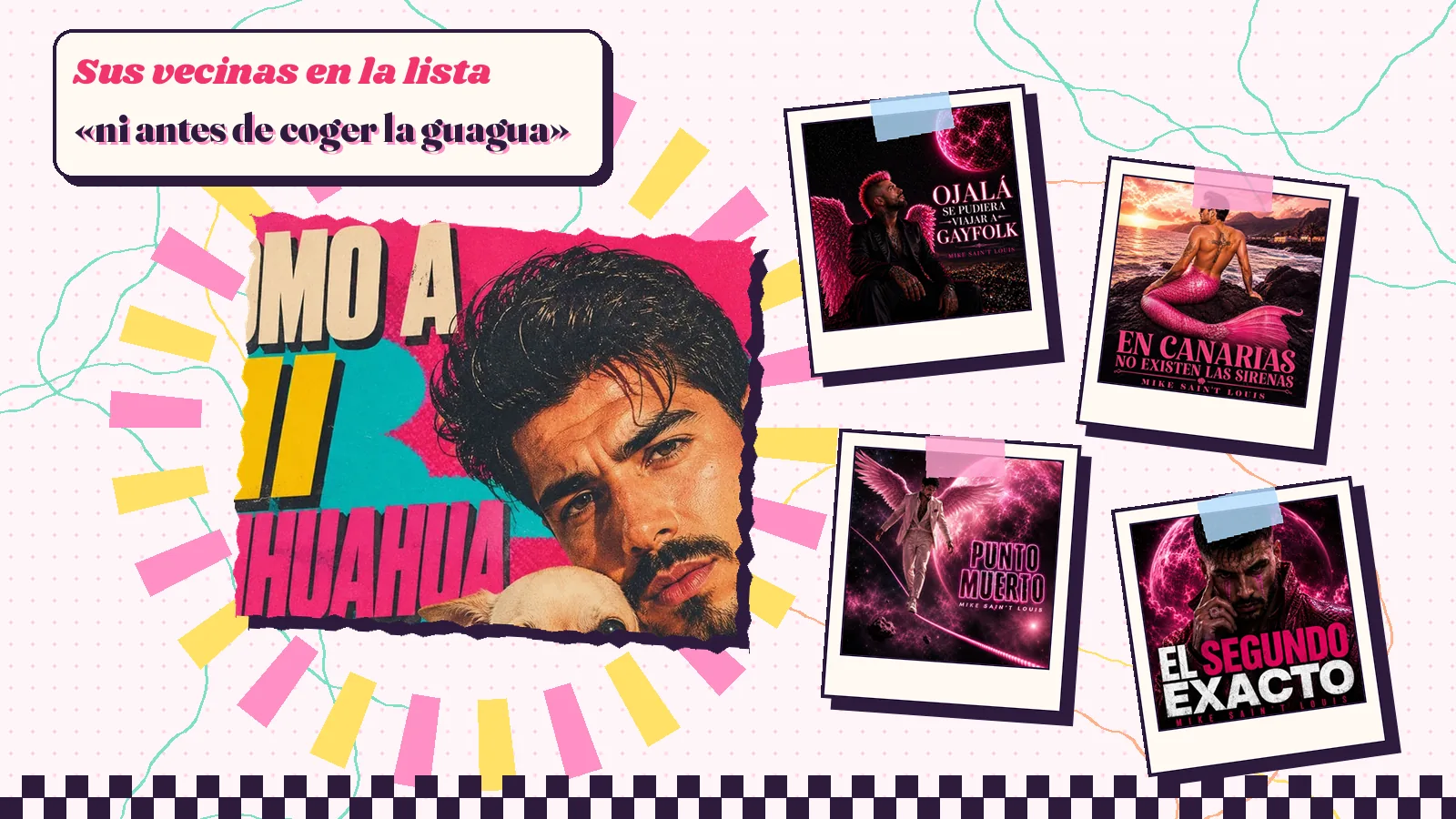
A dark-haired boy with tousled hair, a thin moustache and his pink shirt hanging open is holding a white chihuahua against his cheek. Both are staring straight at the camera. The boy, with that half-sad, half-seductive gaze from cologne adverts. The dog, with huge black eyes, as if he’d just heard a door slam. Behind them, a comic-book backdrop in hot pink and turquoise, a few yellow sparks, and fat old-poster lettering spelling out the title. A small anchor hangs round the boy’s neck.
That’s the cover of «Como a mi chihuahua», which means «like my chihuahua». And it’s funny, because the two faces on it say the same thing in opposite styles. The boy is trying to look calm. The dog can’t hide a thing. And that, deep down, is what the song is about: someone trying to explain themselves calmly while their heart is going like the clappers.
The song is on «Ojalá se pudiera viajar a GAYFOLK», the second album of the trilogy, and the song’s own page on the blog already walks through the lyric, from the string of confessions to the laugh that works as a remedy. Here I want to focus on one specific thing: the change of size. Because «Como a mi chihuahua» starts with the whole world and ends at a bus stop. And that journey from the enormous to the tiny is, for me, the heart of the song.
A lyric that starts with the planet
Read the first lines and look at what they’re about. The news. Injustice. The real world. People crying. Major disasters. Huge subjects, newspaper-editorial material, Sunday-talk-show stuff. You’d think a protest song was on its way.
It isn’t. All of that is the preamble. The person speaking uses the entire world as an introduction, the way you’d hand over your CV before an interview. This is who I am, this gets to me, this I can’t bear, this I’d rather not know about. They’re giving you context so you’ll understand what comes next.
I find that opening very true to life. When someone is about to declare their feelings and they’re nervous, they almost never get to the point. They go round the houses. They talk about other things. They tell you about their life, their week, what worries them about the world. And you listen patiently, knowing all of it is the runway for another sentence they don’t dare say yet.
Disconnected from the real world
There’s another line in that first part that fascinates me. The person speaking says they’re completely disconnected from the real world. They say it like someone confessing a flaw, but to me it sounds almost like a strategy.
A lot of queer people grew up like that, with one foot outside the real world. Because the real world, the one in the school playground, at the Christmas table, in the changing room, wasn’t always a kind place. You took refuge somewhere else. In songs, in TV series, in books, in a bedroom with the door shut. And sometimes that habit of hiding leaves something behind for good: a certain distance from whatever is happening out there.
I’m not saying that’s what the song is about. The lyric gives no explanations and I don’t want to invent any. But when I hear it, I think of all those people who live a little on their own planet, and who, precisely because of that, feel it all the more sharply when someone from outside manages to reach them. If you live disconnected, whoever connects you becomes enormously important. Even if all it takes is a laugh.
I’m going to tell you, I’m going to tell you
The structure is textbook anaphora. «Te voy a contar», I’m going to tell you, opens almost every one of the first lines, like a promise renewed with each one. I’m going to tell you why I don’t watch the news. I’m going to tell you why injustice gets to me. I’m going to tell you why I’m so disconnected.

The funny thing is that it never actually tells you anything. It announces what it’s going to tell you but never gets round to the whys. It’s a list of headlines with no story underneath. Like those friends who say «I’ve got to tell you something» and then take twenty minutes to spit it out because they don’t know where to start.
That repetition builds a lovely tension. The more the announcement repeats, the clearer it is that the important part hasn’t arrived yet. And when the formula finally shifts, when I’m going to tell you becomes I’m going to ask you, you know the moment has come.
Finding out late on purpose
There’s a line in that first part that’s one of the most modern I’ve written. The person speaking says that when it comes to major disasters, they’d rather find out on Twitter two months later. I think it’s a perfect portrait of something loads of people do and hardly anyone admits.
We live surrounded by bad news around the clock. Phones buzzing with alerts, the telly in the bar always on, the family WhatsApp group sending disaster videos at eight in the morning. And some people simply can’t take it. Not out of indifference, but the exact opposite. Because it affects them so much they need to put up a wall.
Finding out two months later is that wall. When the news has lost its edge, when everyone knows how it ended, when it hurts a little less. Some would call that cowardice. I’d call it survival. And I like that the song tells it without judging, as just one more trait of someone who feels too much.
The turn: I’m going to ask you
And then the verb changes. I’m going to ask you, straight out, it says. It isn’t telling any more, it’s asking. It’s no longer talking about itself or the world. It’s talking to you. And the question is the oldest one there is: «si tú también lo sientes». Whether you feel it too.
That step from telling to asking is the step from confession to declaration. While you’re telling, you’re in control. You decide what you say and what you leave out. When you ask, you lay yourself open. You hand the other person the power to answer however they like, including no. And that is far more frightening than talking about the injustices of the world.
That’s why the song takes so long to get there. Because talking about the news is easy. The hard part is asking someone whether the same thing happens to them when you look at each other. All the preamble about the evening news is, at bottom, a way of plucking up courage.
A heart the size of a dog
And then comes the image that gives the song its title. The person speaking asks whether the other one’s heart also races at a thousand miles an hour when they see each other, the way theirs does. And adds: like my chihuahua’s.
Anyone who’s spent time around a chihuahua knows what this means. They’re dogs that tremble, whose pulse is racing all the time, who are terrified of a plastic bag and beside themselves at the jingle of keys. Their heart always runs faster than seems sensible for such a small body.
I love that comparison because it’s the opposite of a romantic metaphor. Nobody has ever written a sonnet comparing their heart to a tiny dog’s. The usual thing would be drums, runaway horses, fire. Not here. Here the heart in love is a jittery chihuahua. And it’s so ridiculous that it ends up being exact.
Small things hurt more
That’s the change of scale I mentioned at the start. The song begins with problems the size of the planet and lands on a dog weighing two kilos. And the interesting part is that the pain doesn’t shrink with the size. Quite the opposite. What really keeps the person in the song awake isn’t the injustice on the evening news. It’s what happens at a bus stop.
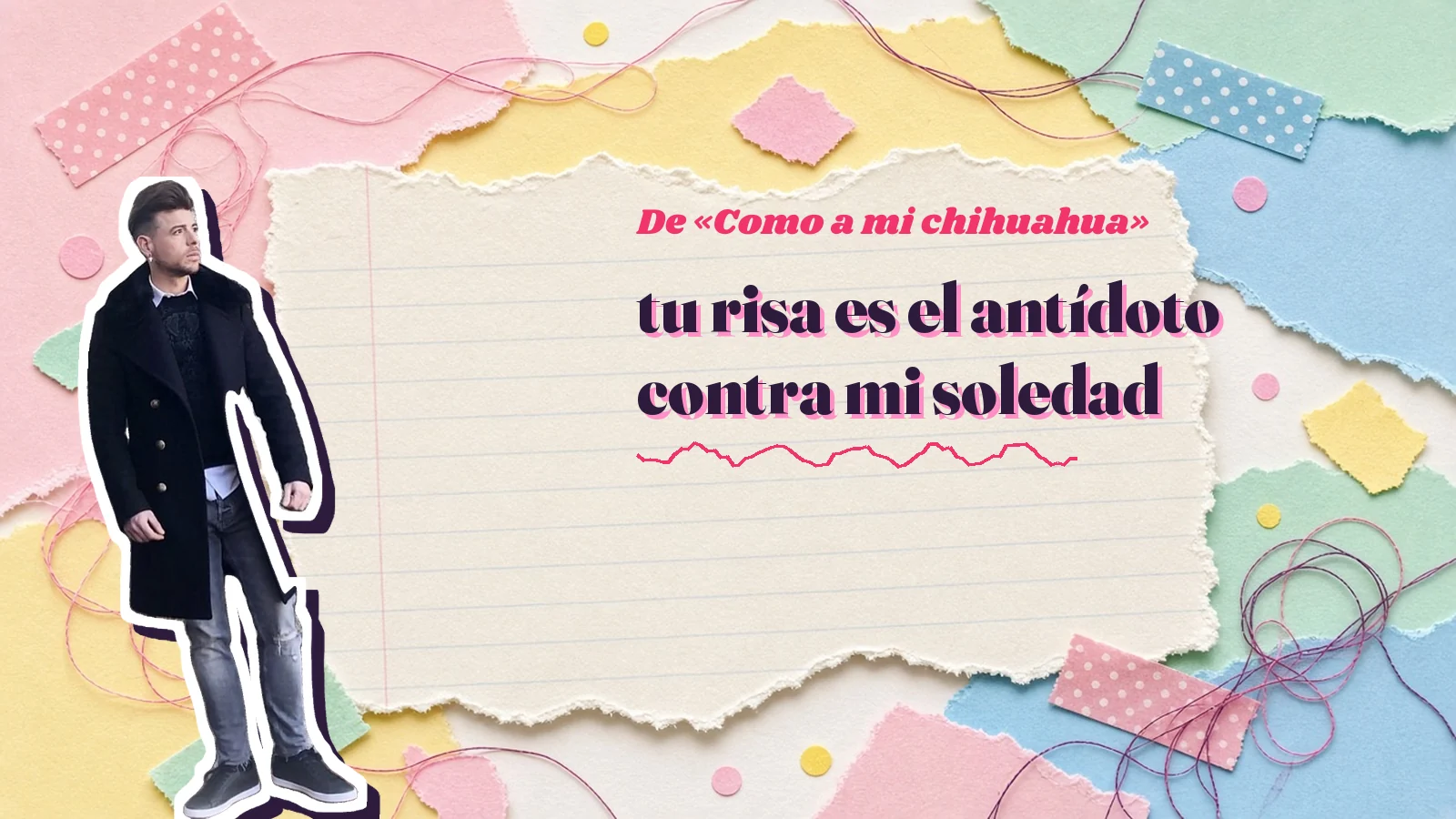
I think this happens to everyone. You can be worried about a war, the economy, the climate, and still what keeps you up that night is that someone didn’t answer your message. It isn’t shallowness. It’s that small things are the ones that touch you directly. The big things you watch. The small things you live.
And the song is very honest about that. It doesn’t pretend this person is an activist who also happens to fall in love. It presents someone who feels a great deal, everything, at every scale, and who in the end, when you ask what affects them most, answers with a kiss that never came.
Not even a kiss before the bus
There’s the sting. Right after the chihuahua heart comes the complaint: you wouldn’t even give me a kiss, «ni antes de coger la guagua», not even before catching the bus. Not even then, in the quick goodbye, with the bus already pulling into the stop.
The word «guagua» changes everything. It’s what people in the Canary Islands call the bus, and with a single word the song moves from a living room with the news on to one particular stop, with its shelter and its timetable. We’re not somewhere abstract any more. We’re on a sunny street, with someone climbing onto the bus without a proper goodbye and someone left on the pavement with their heart doing somersaults.
The Canaries turn up more than once in my catalogue, for instance in a title like «En Canarias no existen las sirenas», there are no mermaids in the Canaries. But here they appear in the humblest possible way: in a word for a bus. And I like it like that. Because the places that really matter in a love story aren’t the famous viewpoints. They’re the stops where you wait.
The kiss as a unit of measure
Look at how that line is built. It doesn’t say the other one didn’t love them. It doesn’t say they were cheating. It says they wouldn’t even give them a kiss. And that «even» is everything. Not even a kiss. Not even that. It’s the smallest unit of affection, the least you could ask of anyone, and not even that arrived.
I think it’s a very precise way to measure heartbreak. You don’t need a great betrayal for something to hurt. The absence of one tiny gesture is enough, repeated day after day, at every goodbye. The kiss that never comes before the bus is like the goodnight text that never appears, or the hand that never reaches for yours in the street. Small absences that, added up, weigh more than any row.
And still, the person in the song is there, asking whether the other one feels it too. That’s the tenderest and saddest part. The chihuahua heart doesn’t learn. It keeps racing even when it doesn’t get so much as a kiss.
Laughter as the antidote
And finally comes the line that sums it all up, the one the song’s page also highlights, and which I can’t leave out. The person speaking says they’re going to confess something more personal. And what they confess is this: «tu risa es el antídoto contra mi soledad». Your laugh is the antidote to my loneliness.
What fascinates me about that line is that it arrives after everything else. After the unbearable news, the injustice, the people crying, the kiss that never comes. And in the middle of all that, something appears that actually works: the other person’s laugh. Not even their love, or their company, or their kisses. Their laugh.
It’s a very humble declaration. It doesn’t ask for much. It’s enough for the other one to laugh. And I think anyone who has fallen for someone who didn’t quite love them back recognises the feeling: they never gave you what you needed, but when they laughed, for a moment, the world stopped weighing so much.
Something more personal
That announcement in the second-to-last line makes me smile. I’m going to confess something more personal. As if everything before weren’t. As if saying you can’t bear to see anyone cry, that you hide from the news and that your heart beats like a frightened dog’s were public knowledge.
But it makes sense. For the person in the song, talking about their sensitivity is the easy bit, the part they’ve already rehearsed. What’s truly intimate is telling someone their laugh saves you. Because that means admitting there is loneliness. And of everything a person can confess, loneliness is the most embarrassing.
There’s a lovely honesty in that. The song doesn’t close on a big chorus or a shout. It closes on a confession that’s almost a whisper, leaving the ball in the other person’s court. And there it ends. We don’t know what they answer.
I really like not knowing. A love song that ends with an answer is a closed story: it either works out or it doesn’t, and you already know how to feel. One that ends with the question hanging leaves you at the bus stop. It makes you picture the other person’s face, decide whether they laugh, shrug, or finally, this time, lean in before getting on the bus. Every time I hear it I pick a different ending. Some days the other one gives the kiss. Some days the bus pulls away and that’s that. Both endings feel equally true to me, because the song hasn’t dared to decide for me, and that is a form of respect for whoever is listening.
The boy with the anchor
Back to the cover, because there’s a detail I really love. A small anchor hangs round the boy’s neck. And an anchor is exactly what the person in the song is missing: something to hold them steady when the world moves too much.
The boy hugs the dog the way you cling to something. He isn’t holding it up to show it off, the way people carry a handbag dog. He’s pressing it to his face. There’s something protective in that gesture, but something needy too. It isn’t clear who’s comforting whom.
And the colours say it all. Shrieking pink, turquoise, yellow, comic-book sparks. It’s a cover that screams pop joy. But the faces aren’t screaming anything. Both are serious, still, eyes wide open. It’s the same tension as the lyric: wrapping that looks like a party and, inside, someone with a racing heart waiting for an answer.
Between «Punto muerto» and «El segundo exacto»
In the list of singles, «Como a mi chihuahua» sits between «Punto muerto» and «El segundo exacto». And both neighbours say a lot about it.

«Punto muerto», which means stalemate, is a song by someone who feels insignificant among so many constellations and galaxies, who thinks they only get in the way and waste everyone’s time with their lament. It’s the same sensitivity as «Como a mi chihuahua», but without the escape hatch of laughter. Someone stuck, with no antidote.
«El segundo exacto» is the complete opposite: pure fury at the people who sneer at songs made with artificial intelligence and ask who cares about your feelings. And it tickles me that the line sits right next to a song that is nothing but feelings, from start to finish. As if the list were answering for itself. Who cares? The person with the chihuahua, for a start.
A song for small declarations
«Como a mi chihuahua» is a song for declaring yourself without grand speeches. For sending to someone who never kisses you at the bus stop and seeing whether they take the hint. For playing under the shelter while you wait for the bus home, phone in hand, not daring to type.
It’s also for people who feel too much. For whoever switches off the telly when the news comes on. For whoever cries at Christmas adverts. For whoever hears about tragedies late, and with relief. The people who find the world far too loud and who, in exchange, have the finest radar for small things.
And it’s for anyone who has a chihuahua and has watched it tremble. Because after hearing the song you’ll never look at your dog again without wondering whether, maybe, he’s in love.
Exaggerating to tell the truth
In Spanish we exaggerate all the time. I’m dying, it’s killing me, a thousand miles an hour, my heart in my mouth. I write about it in the exaggeration of everyday Spanish and my lyrics. And «Como a mi chihuahua» is built out of that material. The heart doesn’t beat fast, it beats at a thousand miles an hour. Injustice doesn’t bother you a bit, it gets to you so badly you cut yourself off from the world.
But the beautiful thing is that, in the middle of all that exaggeration, there’s one line that doesn’t exaggerate at all. Your laugh is the antidote to my loneliness. It’s measured, exact, unadorned. And next to everything else, it rings even truer.
That mix is very me. Painting with a broad brush so the fine line stands out. The music and the vocals I make with artificial intelligence tools, as I explain when I talk about calling myself «the first AI songwriter». But deciding where the exaggeration goes and where the clean line goes is a lyricist’s job. It’s what I love most about writing.
If you’d like to stay on this side of the catalogue, I have a piece on why we need gay love songs that end well, although with this one, to be fair, we don’t know how it ends. And if you’re curious about why I laugh at myself so much in my lyrics, there’s from laughing at others to laughing at ourselves. Because laughter, as the song says, is an antidote.
Frequently asked questions
Which album is «Como a mi chihuahua» on? It’s on «Ojalá se pudiera viajar a GAYFOLK», the second album of Mike Sain't Louis’s GAYFOLK trilogy.
What is «Como a mi chihuahua» about? About a very sensitive person who, before declaring their feelings, explains why the news and injustice affect them so much. Then they ask the other person whether their heart also races at a thousand miles an hour, like a chihuahua’s, and confess that their laugh is the antidote to their loneliness.
What is a «guagua»? It’s the word for a bus in the Canary Islands. In the lyric it appears in the complaint that the other person wouldn’t even give a kiss before catching the bus.
What’s on the cover? A dark-haired boy with a moustache and an open pink shirt holding a white chihuahua against his cheek, on a pink and turquoise comic-book background with yellow sparks.
Who made the song? The lyrics are by Mike Sain't Louis, lyricist, composer and music producer from Madrid. The music and vocals were made with artificial intelligence tools.