By Mike Sain't Louis ·
Rockets, stars and a new planet: outer space in the GAYFOLK trilogy
«Yo ya me he apuntado ¿Te vienes conmigo?» («I've already signed up. Are you coming with me?»)
The question comes from a bloke who wakes up alone, to empty looks, on a street with no name, with a tasteless job and a bitter coffee. Everything repeats. Nothing surprises him. And suddenly, on the news, there's Elon Musk announcing the first crewed flight to a newly discovered planet. A planet called GayFolk.
And the bloke doesn't think twice. He signs up. And asks if you're coming.
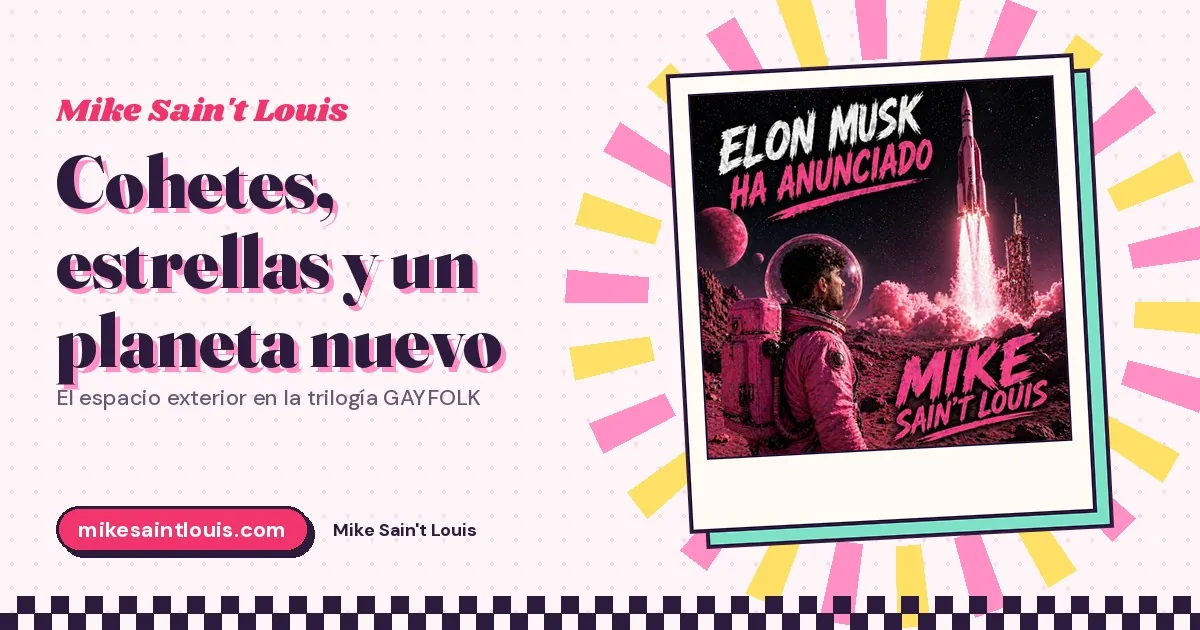
That's «Elon Musk ha anunciado», from the second album of the trilogy. I've put it on the cover because it's the song where my planet stops being a metaphor and becomes a destination with a ticket. With a rocket. With the risk of never coming back.
PLANETA GAYFOLK is the name of the project. The GAYFOLK trilogy is three albums designed as a single story, in this order: «Descubierto un nuevo planeta llamado GAYFOLK» («New planet called GAYFOLK discovered»), «Ojalá se pudiera viajar a GAYFOLK» («If only you could travel to GAYFOLK») and «El día de la liberación» («Liberation Day»). I've explained elsewhere how to listen to the trilogy from start to finish. Here I want to do something else. I want to look up. To count the rockets, stars, galaxies and orbits in my lyrics, and see what they say about the planet I made up.
Spoiler: the outer space in my songs is pretty tacky. And that's the best thing about it.
Discovered, like on the news
The first album has a title straight off the evening news. «Descubierto un nuevo planeta llamado GAYFOLK.» I talked about it in why the first GAYFOLK album has a headline for a title: it sounds like a newspaper headline, breaking news, astronomers in white coats pointing at a dot on a screen.
But what's on this planet? What's it like?
The first description I give is in «Buscando el polvo perfecto», and it couldn't be more down to earth. The song spends almost the whole time on Grindr, among app insults: you're fat, you're bald, you're old, you're camp, I'm blocking you. A catalogue of cruelty from profiles with torso pics. And at the end, when it's all too much, the planet appears: «Descubierto un nuevo planeta llamado GayFolk / No hay grinder ni aplicaciones, tampoco hay complejos» («New planet called GayFolk discovered / No Grindr, no apps, no hang-ups either»).
Look at how it's defined. By what isn't there. No Grindr. No hang-ups. No need to worry about being discreet. And the line that matters most to me: «Y las personas allí no son simples objetos» («And people there aren't just objects»).
That's the planet, to begin with. A place with no apps. It doesn't have multicoloured seas or glass cities. It has something much rarer and much harder to find in 2026: people who don't look at you like a slab of meat on a screen.
If anyone thinks science fiction has to have spaceships and laser beams, sorry. My science fiction starts with deleting an app from your phone.
If only you could
The second album changes tense. From discovery we move to desire. «Ojalá se pudiera viajar a GAYFOLK.» Ojalá. Which is the most Spanish word there is for saying something isn't going to happen but you want it anyway.
I wrote about that ojalá in the grammar of longing. Here I'll just pick up how I describe the planet in the text for the album's title song, «Ojalá se pudiera viajar a GAYFOLK»: «Hay días en los que uno desearía poder escapar a otro planeta… uno donde no hiciera falta explicarse, defenderse ni fingir» («There are days when you'd love to escape to another planet… one where you didn't have to explain yourself, defend yourself or pretend»).
Defined by absence again. No need to explain. No need to defend. No need to pretend. Three things every marica on this planet has done a thousand times before turning fifteen.
And then the text adds what is there: a planet «donde las emociones fueran arte, donde la tristeza tuviera banda sonora y donde los raros no tuviéramos que pedir perdón por serlo» («where emotions were art, where sadness had a soundtrack and where we oddballs didn't have to apologise for being odd»).
Sadness with a soundtrack. That strikes me as a very precise definition of what I try to do with songs. Not take the sadness away. Put music to it.
And the text signs off like this: «Nos vemos al otro lado del espejo» («See you on the other side of the looking glass»). Which isn't an astronaut's line. It's Alice's. On the second album, the planet isn't only up there any more. It's also behind the bathroom mirror.
My refuge, my revenge
There's a line in the text for «Ojalá se pudiera viajar a GAYFOLK» that I haven't quoted yet, and it explains what the planet is for better than any rocket: «Mi universo musical. Mi refugio. Mi venganza poética y mi salvación emocional» («My musical universe. My refuge. My poetic revenge and my emotional salvation»).
Refuge and revenge on the same line. They seem like opposites. A refuge is where you hide. Revenge is where you go out and face them. But in my catalogue they work together all the time. The planet is where I go when it hurts too much down here. And it's also where I write the songs that hit back at whoever hurt me. The narcissists, the exes, the haters, the guy on Grindr who calls anyone over forty old. They all turn up in my lyrics. And they're all seen from above, from the planet, where they can't do a thing any more.
That's the thing about inventing a planet. You can look at Earth from far away. And from far away, almost everything that used to make you cry looks small. A blue speck with a block on an app. A bitter coffee on a street with no name. A boss shouting in an office that, seen from a gravitational orbit, you can't even make out.
That's poetic revenge: not shouting at the other person. Climbing so high you can't hear them any more.
I've already signed up
And then along comes Elon Musk.
I find it very funny that I put Elon Musk in a song about this planet. One of the richest men in the world, the rockets man, the Twitter man, turned into the travel agent for a queer utopia. It's the campest thing I've ever come up with: that your way out of the grey routine is offered by precisely the man least likely to want to take you anywhere nice.
The song is very simple. First the routine, told in two-word phrases that sound like a clock ticking: wake up alone, empty looks, lose track of time, cold routine. Then the announcement. Then the decision.
«Dejemos en la Tierra / Todo lo material» («Let's leave on Earth / Everything material»).
What gets left on Earth isn't family, or the boyfriend, or friends. It's the material stuff. The tasteless job. The bitter coffee. The street with no name. That's what weighs you down. And the narrator wants to drop it so he can stop being a mere mortal.
The lovely thing is that it isn't sold as a sure thing. The lyric knows it could go wrong: «Aunque nos juguemos la vida / Y haya esa posibilidad / De quedarnos enganchados en otra / Órbita gravitacional» («Even if we risk our lives / And there's a chance / We'll get stuck in another / Gravitational orbit»). And even though we might never make it back.
That's the part that moves me. The planet isn't a risk-free plan. Heading towards a life where you don't have to pretend has a cost. Maybe you get stuck halfway, circling in some strange orbit, belonging neither here nor there. Maybe you don't come back. And even so, the bloke signs up. And asks if you're coming.
There's a line in the middle that sums it all up: «Hagamos la locura, / Volvamos a los veinte años» («Let's do something crazy, / Let's be twenty again»). Madness and being twenty. The two things you need to climb aboard an Elon Musk rocket.
Galactic elections
Something similar had already happened on the first album. The planet is in danger.

In the text for «Vota Malena Gracia» I put it like this: «En el universo GayFolk ha surgido una crisis inesperada: Donald Trump y Elon Musk quieren comprar este planeta de libertad y arte queer» («An unexpected crisis has broken out in the GayFolk universe: Donald Trump and Elon Musk want to buy this planet of freedom and queer art»).
Buy the planet. Of course. It was only a matter of time. You find a place where people are happy and the first thing that turns up is a billionaire with his wallet open. And the planet's response isn't a war. It's an election campaign. «Elecciones galácticas» («galactic elections») are called, and the resistance fields a candidate who is pure Spanish camp icon: Malena Gracia (a showgirl and TV personality much loved in Spain).
The text puts it with an image I'm very fond of: «La belleza aquí se convierte en un acto político, una flor frente al acero» («Beauty here becomes a political act, a flower against steel»).
A flower against steel. Rockets are made of steel. Billionaires' spaceships are made of steel. The planet defends itself with flowers, feathers and a showgirl off the telly. And it isn't a joke. Or it is, but it's a joke that knows exactly who has the money and who has the charm.
Elon Musk, by the way, turns up at least twice in the trilogy. On the first album he wants to buy the planet. On the second he organises the first flight. If anyone asks me why, I say that even in outer space you have to reckon with the landlord.
I'm a sidereal *marica*
So far I've talked about the planet as a place. But there's a song where space isn't outside, it's in the body.
«Soy marica sideral» is one of the most me songs on the second album. It mixes Spanish and English, walks in heels and doesn't ask permission. And it has a chorus that's practically a calling card: «Soy silencio con tacones, / soy marica sideral» («I'm silence in high heels, / I'm a sidereal queen»).
Sidereal. From the stars. From beyond. A marica who isn't entirely from here, who shines from another galaxy, who walks without a sound and shines without stress. «Yo no grito pa' brillar» («I don't shout to shine»).
I love it because it flips what we've always been told. That we're too much. Too loud, too theatrical, too everything. The song takes that on directly: «Me han llamado exagerada, / teatral y emocional» («They've called me over the top, / theatrical and emotional»). And the answer isn't to turn the volume down. It's to go further. All the way to the stars. From up there, the one who looks small is the other guy.
That's what a sidereal marica is: someone who already lives on the planet even though their address is still on Earth.
Kangaroos on the moon
Not all the space in my lyrics is epic. Sometimes it's almost childlike.
In «Canguros», from the second album, there's a list of things «they say». They say there's an edge to the world. They say there's a lighthouse in the bay. They say there are mermaids and mermen. And they say this: «Y dicen que en la luna hay canguros / Saltando entre galaxias» («And they say there are kangaroos on the moon / Hopping between galaxies»).
Kangaroos on the moon. I love that image because it's completely absurd and completely serious at the same time. It's what someone would tell you as a child to get you to sleep. And it's in a farewell song, about someone who has to leave and can't say goodbye.
Space here works like the sea, or like fairy tales: a place with room for everything you don't believe but would like to. Mermen. Kangaroos hopping between galaxies. That I'll find you again. That you'll come back, that you promised.
The moon with kangaroos is another version of the GAYFOLK planet. An impossible place where, for once, the things they say are true.
Among so many constellations
And then there's the space that makes you small.

«Punto muerto» opens looking up at the sky: «Entre tantas constelaciones, galaxias y estrellas / Como voy a ser yo la que de un brillo especial» («Among so many constellations, galaxies and stars / How am I going to be the one who gives off a special glow»). And it keeps sinking: among so many fake loves, friends and partners, how am I going to be the one who simply tells the truth.
There's no rocket or planet here. There's a sky full of things that shine brighter than you. And the feeling of being at a standstill, of being a nuisance, of wasting everyone's time with your lament.
I'm including it because it's the other side of space. A starry sky isn't always a promise. Sometimes it's a comparison. And in that comparison you come off worse. I think it matters that the trilogy has this too: the moment you look up and see not a destination, but a crowd that doesn't need you.
Notice, too, the switch of gender across two lines. In Spanish, the one who gives off a special glow is feminine, la que. The one who tells the truth is masculine, el que. The stars in the feminine, the truth in the masculine. It isn't a mistake. It's what happens when you talk about yourself with a diva's mouth and a bloke's mouth at the same time.
The house overlooking the Supernova
There's a stray line in «La dieta del cucurucho» that always makes me smile: «éramos tan felices con la casa con vistas a la Supernova» («we were so happy in the house overlooking the Supernova»).
The Supernova. With a capital S, as if it were a neighbourhood. As if estate agents on the planet advertised flats with views of an exploding star. Bright, outward-facing, two bedrooms, Supernova views.
It's outer space turned into domestic décor. A happy couple at home, on their terrace, watching a star blow up the way you'd watch a sunset at the beach. And the happiness shatters, of course, because in that song the narrator mentions Paco León and Eduardo Casanova (two Spanish actors) and it all kicks off.
I love that on my planet supernovas are scenery. That the cosmic and the everyday sit at the same height. That a jealous row happens in a house overlooking an exploding star. That's what life is like down here, too: enormous tragedies happening while someone does the washing-up.
Touching down in Benidorm
And then comes the third album. «El día de la liberación.»
You'd expect the last album to be the landing on the planet. Ships arriving, flags planted, aliens welcoming the newcomers with glitter. But no.
In the album's title song, the narrator shouts that today is liberation day, that there's a winner now and it isn't the manipulative loser, that the wounds have stopped bleeding. And then he says where he is: «Yo feliz en Benidorm» («Me, happy in Benidorm»).
In Benidorm. Not in a galaxy far, far away. In Benidorm, with its skyscrapers, its Levante beach, its British pensioners and its stag dos. After two albums looking up at the sky, liberation touches down on the Costa Blanca.
And the same album has «Madrid to Benidorm», a Pride song with a straight line running from the capital down to the beach. In the end, the planet has coordinates on a road map.
For me this is the most important thing in the whole trilogy. The GAYFOLK planet was never in space. Or it was, but only for as long as it needed dreaming. When liberation comes, it comes here. On Earth. In a tacky, specific place where you can be happy without asking permission. I said as much in liberation day, and the day after: breaking free isn't about going to another world, it's about being able to live in this one.
The rockets were for getting to Benidorm. And that doesn't strike me as a let-down. It strikes me as the best possible ending.
Think of it this way. If the trilogy ended in another galaxy, the message would be a sad one: that a free life is only possible far away, somewhere you'll never reach. That things here are beyond repair. And I don't believe that. I believe the planet can be set up on a beach, in a bar, on a dance floor, in a kitchen with two people who love each other. That it gets set up every time someone stops pretending in front of someone else. That's why the third album comes down from the sky. Because the dream has done its job: it's shown you how people live up there. Now it's time to live like that down here. With a parasol, with sun cream, and with the manipulative loser hunting for another source of supply a long way from your towel.
Why a planet
You might ask why a planet. Why not a city, a neighbourhood, a club, an island.

I don't have a textbook answer. But looking at the lyrics, something shows. A neighbourhood or a club already exist, and we already know they come with bouncers, rules and people who look at you funny. An island is too close. A planet, on the other hand, is far enough away that nobody from here has jurisdiction. Not your mother, not your boss, not the guy who blocked you on Grindr. There, you make the rules.
And there's another, simpler reason. A planet gets found. A city doesn't. You arrive in a city, you move there, you register at the town hall. A planet is something that was already there and nobody had seen. And that's exactly how it feels when you finally find a place, or a crowd, where you can be who you are: you didn't invent it, it already existed, someone just had to point the telescope in the right direction. The first album's headline doesn't announce a creation. It announces a find.
And outer space also has something B-movie about it, something of the cheap Saturday-afternoon sci-fi film, that fits my way of writing perfectly. My rockets aren't NASA's. They're papier-mâché, music-video props, special effects you can see the strings on. Like the vampires, coffins and massacres of my horror songs. It's space seen from the sofa with the telly on, not through a telescope.
I write that planet. The lyrics, the texts, the titles of the three albums, the order they go in. I produce the music with artificial intelligence, as one more tool in the studio. I find it funny that I use such modern technology to tell a story about cardboard rockets. But it makes sense. Every generation has dreamt the future with whatever it had to hand.
Are you coming with me
Back to the beginning. To the bloke stuck in his cold routine who signs up for the first crewed flight and asks if you're coming.
The whole trilogy is that question. The first album tells you the planet exists. The second tells you if only you could go, and shows you the rocket, the risk, the orbit you might get stuck in. The third tells you you've arrived, and that the place looks suspiciously like a beach in Alicante.
In between, there are galactic elections against two billionaires, a sidereal marica in heels, kangaroos hopping between galaxies, a sky of constellations that makes you small and a house overlooking the Supernova.
The full lyrics of the song on the cover are at gayfolkplanet.com/letras/elon-musk-ha-anunciado. It has its two-word phrases, its bitter coffee and its gravitational orbit.
I've already signed up. Are you coming with me?
Frequently asked questions
What are the three albums of the GAYFOLK trilogy?
In this order: «Descubierto un nuevo planeta llamado GAYFOLK», «Ojalá se pudiera viajar a GAYFOLK» and «El día de la liberación». They're three albums by Mike Sain't Louis conceived as a single story.
What happens in «Elon Musk ha anunciado»?
A man trapped in a grey routine hears on the news that Elon Musk has announced the first crewed flight to planet GayFolk, decides to sign up even though he may never come back, and asks «¿Te vienes conmigo?» («Are you coming with me?»). The full lyrics are at gayfolkplanet.com/letras/elon-musk-ha-anunciado.
What is the GAYFOLK planet like, according to the lyrics?
It's described mainly by what it lacks: «No hay grinder ni aplicaciones, tampoco hay complejos» («No Grindr, no apps, no hang-ups either»), and on it «las personas allí no son simples objetos» («people there aren't just objects»). In the text for «Ojalá se pudiera viajar a GAYFOLK» it's a place where you don't have to explain yourself, defend yourself or pretend.
Where does the trilogy end?
On Earth. In the song «El día de la liberación», from the third album, the narrator is «feliz en Benidorm» («happy in Benidorm»), and the same album includes «Madrid to Benidorm».
Who makes these songs?
Mike Sain't Louis writes the lyrics, composes, produces and directs the project through his label, MIKE SAIN'T LOUIS. The music and vocals are made with artificial intelligence tools.