By Mike Sain't Louis ·
Camela in the back seat: the soundtrack to first times
«CAMELA, LA PRIMERA VEZ QUE FUI YO SOLO CON MIEDO A / CHUECA PENSANDO QUE ME IBAN A PEGAR.» («CAMELA, THE FIRST TIME I WENT TO CHUECA ON MY OWN, SCARED / THINKING THEY'D BEAT ME UP.»)
Just like that, in capitals, the way you write when you're shouting. It's a line from «La despedida», not from «Camela», but it explains better than anything why I wrote a whole tribute song to that band. Whether I like Camela is beside the point. What matters is that they were playing when things happened.
«Camela»'s page already covers the petrol stations, the cassettes, the summers on the road and the posh crowd's sneering at techno-rumba (Camela being the kings of that very Spanish mix of rumba, synths and drum machines). I won't repeat it. Here I want to talk about something else: first times. About why, when someone in my lyrics does something for the first time, Camela is playing in the background.
A tribute that explains itself
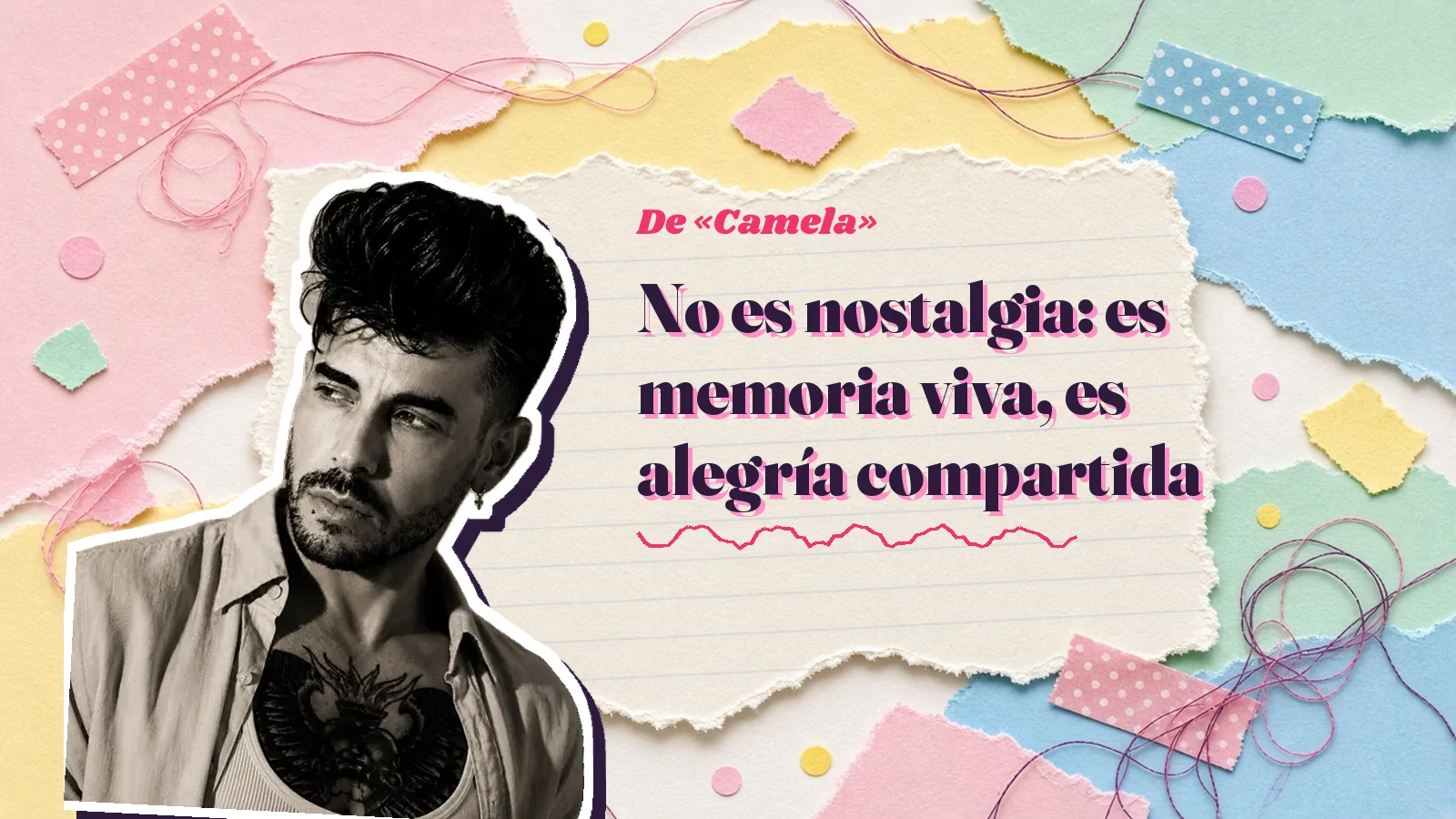
On the lyrics page, the song «Camela» has no verses: it has a short text summing up the tribute. You can read it at gayfolkplanet.com/letras. There's one sentence I use as my starting point: «No es nostalgia: es memoria viva, es alegría compartida» («It isn't nostalgia: it's living memory, it's shared joy»).
That distinction between nostalgia and memory matters to me. Nostalgia looks back with sorrow, like leafing through a photo album of people who are gone. Memory looks back to understand where you are now. Camela, for me, isn't a nice memory of being young. It's a piece of who I am. I say it too in against nostalgia: retro interests me as a way of looking forward, not as a hiding place.
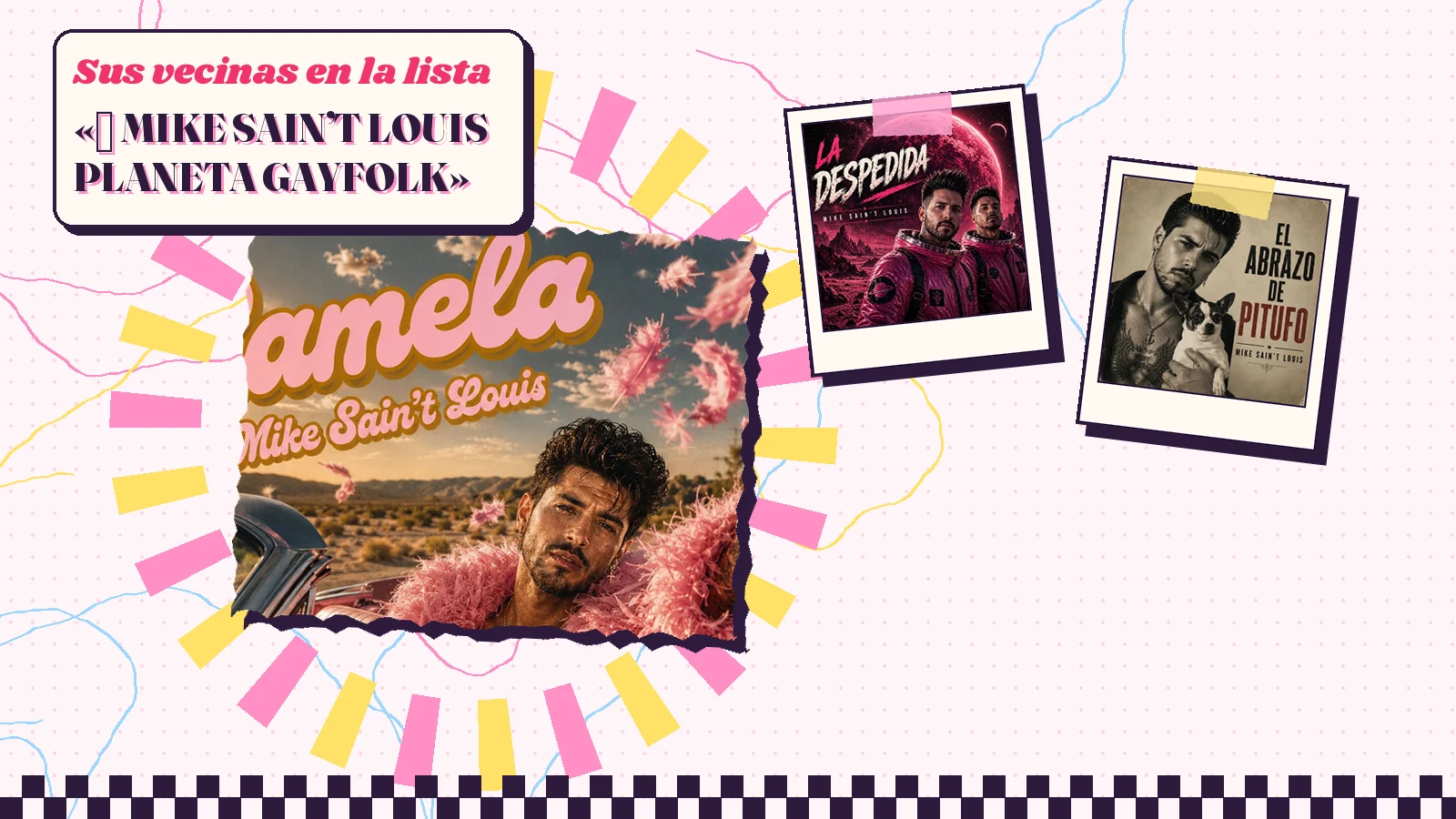
The list in «La despedida»
To understand the first-times thing you have to read «La despedida», the song where Camela turns up as the refrain of an entire life. I gave it its own page, and it's one of my strangest lyrics: an enormously long list of moments, every one preceded by the band's name, in capitals, like someone yelling in the car with the window down.
Camela when I had my first kiss. Camela when I nearly got married. Camela that time I was off my face. Camela when I've been wicked, and when people have been wicked to me. Camela my first time in Chueca, scared. Camela my first threesome in the sauna. Camela on the way to the beach with the whole menagerie. Camela when someone used to do my hairspray. Camela when we adopted Kas.
It's a biography told in cassettes. Every important moment, good or bad, has its soundtrack, and it's always the same one. And at the end of the list, the pink spaceship leaving Earth never to return, heading for a planet where a new life begins. With Camela in the background, obviously.
Scared of Chueca
Of that whole list, the line that weighs on me most is the one about fear. The narrator's first time going to Chueca alone, thinking someone's going to beat him up.
Today Chueca is a fashionable neighbourhood, with expensive shops, terraces full of tourists and rainbow flags on the balconies during Pride. But for a long time going to Chueca was an act of courage. For a boy coming from a neighbourhood in the south of Madrid, or a village in the province, or anywhere being a marica got you mocked or worse, taking the metro to Plaza de Chueca was crossing a border. And at the border there was fear. Fear of being seen, fear of being recognised, fear of someone waiting for you outside.
The line doesn't exaggerate. Plenty of people lived it like that. You got off the metro looking all around you, walked fast with your head down, and only breathed once you were inside the bar.
And in the car, or on the Walkman, or in your head, something was playing that gave you courage. In the song, that's Camela.
Music to screw up your courage
Why Camela and not something else? It could have been Alaska, which is what you'd expect from a gay song. Or Mecano, or Rocío Jurado, or Raphael. Official icons of the community, with their long love affair with the maricas.

But Camela has something those others don't: they're not a gay icon. It's neighbourhood music, industrial-estate music, roadside music. Their songs are about boy-girl love of the old-fashioned kind, jealousy, goodbyes, making up in the doorway. Nobody would put them on a list of Pride anthems.
And that's exactly why they work for screwing up your courage. Because it's the music that played in your neighbourhood, the stuff your cousin put on, what you heard on the school bus. When you go to Chueca for the first time with Camela in your head, you're not giving up your neighbourhood to enter another world. You're bringing the neighbourhood with you. It's the music that reminds you where you come from while you head towards where you want to be.
That's what I love about techno-rumba as a gay soundtrack: it's a bridge between the place you're leaving and the place you're arriving at.
Your songs in the car
There's another line in «La despedida» that's practically a definition: «CAMELA, TUS CANCIONES EN EL COCHE» («CAMELA, YOUR SONGS IN THE CAR»).
The car is a crucial setting in the lives of a lot of people who had nowhere else to be free. At home there were your parents. In the street, the neighbours. At school, your classmates. In the car, windows up and volume high, you could shout, cry or belt out the lyrics without anyone judging you. It was the room of your own you didn't have.
For many gay boys, the car was their first safe space. The car of the friend who'd passed his test, Dad's borrowed car, the first boyfriend's car parked on a patch of wasteland. And in the tape deck of all those cars there was a Camela cassette bought at a petrol station. Not because they were declared fans. Because it was there, next to the chewing gum and the road maps.
My tribute song is, deep down, a tribute to that car.
Music from the south of Madrid
There's something else, to do with geography.
Camela are from the south of Madrid, from the working-class neighbourhoods that never make it onto postcards. And a lot of my Madrid, the Madrid of my songs, is that one too. Not tourist Madrid, but the Madrid of industrial estates, of metro lines that run to the very end, of neighbourhood fiestas with a covers band and churros. I explain it in Madrid without the postcard: my songs happen in that Madrid more than on the Gran Vía.
That's why Camela feels so natural in my lyrics. They're not an exotic reference, the kind an anthropologist studying popular culture from outside would use. They're the neighbours' music. The people in the block opposite, the ones with the souped-up car parked on the pavement, the ones who played music at full blast on Sunday mornings. It's the landscape of my songs. Just as others write about the sea because it's their landscape, I write with Camela in the background because it's the music coming through the wall in those blocks.
Proud of the tacky
I know some people laugh at Camela. I know because everyone says so, and because I've heard the jokes: music for chonis and canis (think chavs), for petrol stations, for weddings with a free bar. The posh crowd look down on it the way they look down on anything that smells of the estates.
That contempt is about class, and it's worth saying plainly. When someone laughs at Camela, they're hardly ever laughing at the music. They're laughing at the people who listen to it. At working people, at the kids from the industrial estates, at the girls with big hoops and high buns. It's the same mockery the word cateto, yokel, gets, the same mockery we camp maricas get. The mockery of people who think they're above it.
My catalogue has a song, «Tan cateto», that takes that insult and turns it into a party, and I tell the story in «cateto», from insult to flag. The Camela tribute is from the same family: taking what the posh crowd despise and sticking feathers on it. No irony. With pride.
The L'Oréal hairspray
In the list in «La despedida» there's one moment that's always struck me as the most tender, even though it's the least solemn. The hairspray one.
The narrator remembers someone who used to do his hairspray. And then stretches the memory with a domestic detail: that person would nip down to Mercadona to buy him L'Oréal hairspray, because they knew that otherwise his hair wouldn't last the night. And then the one who used to straighten his hair and style his quiff.
There are no declarations of love in those lines. No «I love you», no «forever». There's an errand to the supermarket and a pair of hair straighteners. And for me that's real love, the kind that never makes it into love songs: someone who remembers you're running out of hairspray, who knows what brand you use and who understands that for you going out with a flat quiff is a drama.
It's love with flair. It's looking after the other person in what they think is important, even if everyone else thinks it's silly. If your partner buys you hairspray without being asked, keep them.
And in the background, Camela. Because those afternoons doing your hair before going out had their music too, and it certainly wasn't jazz.
Pelahustán
Another moment on the list is a getaway to Pelahustán. Pelahustán is a small village in the province of Toledo. I put it in just like that, with its name, because village names have a music you can't make up. Pelahustán sounds like a joke and at the same time it's a real place, with its streets and its people.
I like putting specific places in my lyrics. Mercadona, Chueca, Pelahustán. Names anyone in Spain recognises or can look up. A specific place anchors the song in real life, pulls it out of the abstract territory where almost every love song lives, which happen nowhere.
The trip to the village is also another of those first times. The first time you go to the village with your partner, the first time you show up in a small place where everybody knows everybody, holding hands or not. That's scary too, even if it's a different fear from Chueca's. And there too Camela plays, which in the villages of Castile is practically the official fiesta anthem.
From car to rocket
If you look at the lyrics of «La despedida», there's an escalation of vehicles that I find very funny. It starts with the songs in the car. Then a pink bumper car from an ideal planet turns up. Then a pink rocket, and another one in bubblegum. Then an aerospace base. And at the end, the pink spaceship leaving Earth never to return.
Same music in every vehicle. What changes is the distance. At first, the car takes you to Chueca or the beach. At the end, the ship takes you to another planet. But the urge is the same: getting away to somewhere you can live better. The escape that starts in the back seat of a Seat ends in outer space.
This ties in with my whole Planeta Gayfolk universe, that fictional planet where my songs end up. «La despedida» is the moment of lift-off. And what I find beautiful, and a bit absurd, is that the last thing you hear before leaving Earth isn't solemn music or a symphony. It's techno-rumba.
Where they're going
The second part of «La despedida» describes the destination. A planet where a new life begins, with no arguments, no disappointments, no inequality. And a couple who look at each other again the way they hadn't for a long time.
It's a very modest utopia, when you think about it. It doesn't promise riches or glory. It promises no inequality and that your partner will laugh at your jokes again. It's what someone asks for who has lived up close with inequality, class mockery and marica mockery.
And here I close the circle with the contempt for Camela I mentioned earlier. On the planet the ship is heading to, there's no posh crowd laughing at other people's music. That's why Camela can come aboard. On Earth they were looked down on. On the ideal planet, they're the official soundtrack.
What's missing from the list
There's something that strikes me, rereading «La despedida» slowly: what isn't there.
In the whole list of important moments, there's no professional success. No degree, no promotion, no award, no first pay packet. No graduations. Nothing you'd put on a CV. It's all moments of life: kisses, weddings that nearly happened, party nights, cruelties dealt and received, frights, threesomes, beaches, hairspray, a village, an adoption.
It's a sentimental biography and nothing else. And I think that's how we really remember. When we look back, we don't remember the day we signed a contract. We remember the first time someone kissed us, and what was playing at the time.
If someone asked you what was playing at your first times, what would you say? Maybe not Camela. But I bet it's something you wouldn't own up to at a posh dinner party. And I bet it's yours.
Shouting in capitals
A formal detail that's no accident: the lyrics of «La despedida» are published entirely in capitals. Every line begins with CAMELA, and everything else is in the same type, with no pauses.
Capitals, in written text, are shouting. Anyone who's had a message in capitals knows that. And the song is exactly that: a collective shout, the kind you let out in the car with the window down or on the dance floor when the chorus everyone knows comes on. It's not a lyric to read quietly. It's a lyric to chant.
It's also a way of making the moments equal. In capitals, the first kiss weighs the same as the Mercadona hairspray, and the fear of Chueca weighs the same as the trip to Pelahustán. There's no hierarchy. Everything is equally important because it's all part of the same life. If I'd written some lines in lower case and others in capitals, I'd be saying which ones matter more. This way, I'm not.
And then there's the repetition. CAMELA, CAMELA, CAMELA, again and again, at the start of each line. In rhetoric that's called anaphora, and it's an ancient figure, from litanies and love poems. It tickles me to use a litany device to invoke a techno-rumba band. But that's how it works: every repetition of the name is like pressing play again. Like putting the same tape back in the tape deck, which is what everyone did.
Some lyrics are written to be understood. This one is written to be shouted. And so that, shouting it, you remember your own list.
A roadside cover
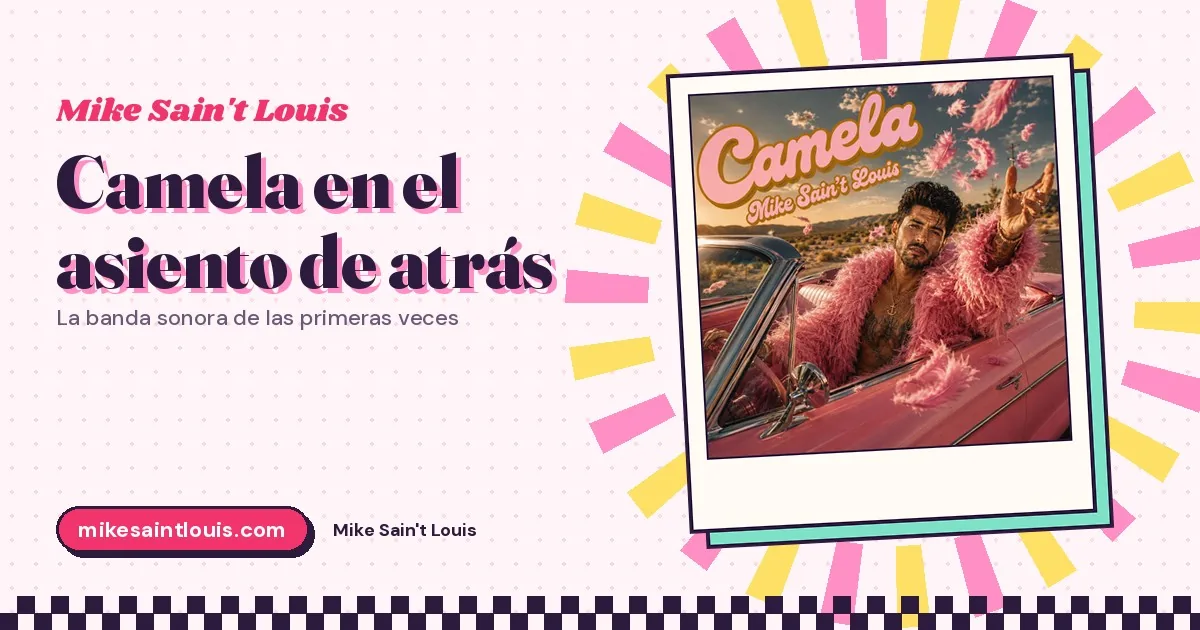
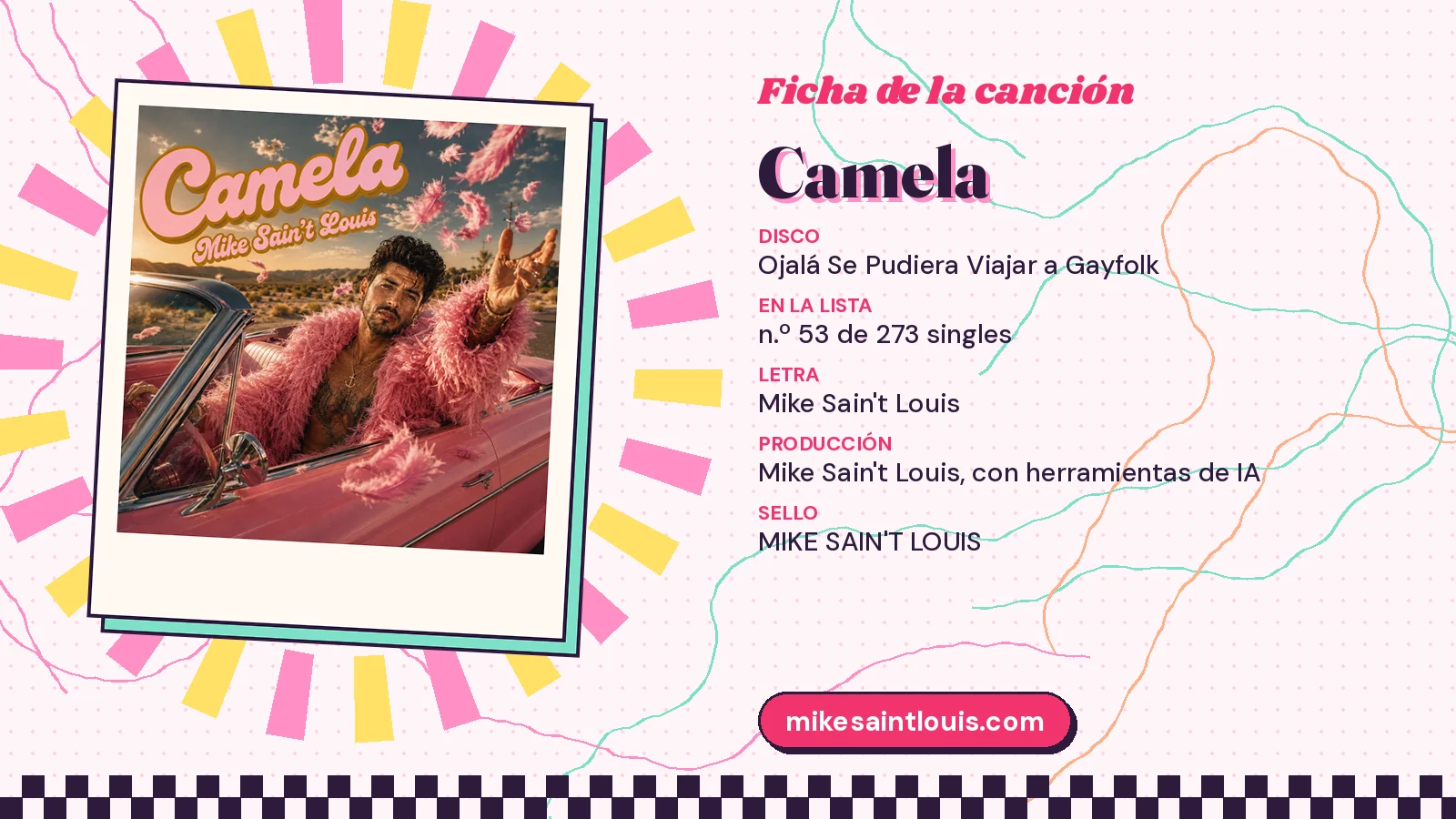
The cover of «Camela», as the song's page says, is an old pink convertible in the middle of the desert, a bubblegum-pink feather coat, feathers flying like confetti and a golden sunset. And a raised hand, as if waving to someone at the roadside.
I love that hand. It's the wave from the one in the car to the ones staying behind. The goodbye of «La despedida», in a way. The pink spaceship in the lyrics has become a pink convertible on the cover, and instead of heading into space, it's heading down an endless road. But the idea is the same: someone leaving for somewhere better, with the music at full blast.
And with feathers, of course. The feathers fly through the air as if the car were leaving a trail. If anyone wanted to follow it, they'd only have to follow the feathers.
My first-times playlist
If I had to make a playlist of queer first times in Spanish, Camela would be on it, next to things nobody would expect them to be next to. I explain it a bit in how to build a Spanish-language queer playlist that doesn't sound like the usual one: the best playlists mix the obvious with the unexpected, what's officially «ours» with what we made ours without anyone handing it to us.
Camela are the second kind. Nobody gave them to us. We took them from our cousin's car and kept them. And now, when they come on at a gay party and the whole dance floor shouts along, there's a bit of poetic justice in it. The music from the neighbourhood that scared us is the music we now celebrate in the neighbourhood that took us in.
What paying tribute means
One last thing about why I write tributes.
In the song's text I say it's my sincere tribute to a sound that's still playing in every car, every village, every heart. I stand by that. And I'd add: paying tribute to Camela is also paying tribute to everyone who listened to them without anyone ever writing songs about them. To the people of the southern neighbourhoods, to the ones buying cassettes at petrol stations, to the cousins in the back seat. People who never appear in anyone else's songs.
If one of them hears my song and thinks «he's one of us too», mission accomplished.
And if someone who used to laugh at Camela hears it and, for a moment, finds their foot tapping along, that too. I'm not trying to convince anyone that techno-rumba is high culture. It's enough for me that it stops being used as an insult. The music that went along with so many first times deserves, at the very least, that we stop being ashamed of it.
Frequently asked questions
What is Mike Sain't Louis's «Camela»? A tribute song to the techno-rumba band Camela, which its text describes as «memoria viva», living memory, and «alegría compartida», shared joy. The text is at gayfolkplanet.com/letras.
How is it connected to «La despedida»? «La despedida» is another Mike Sain't Louis song in which Camela's name accompanies a list of moments in a life, from the first kiss to the first fear in Chueca, all the way to a pink spaceship leaving Earth.
What does the cover look like? An old pink convertible in the middle of the desert, a bubblegum-pink feather coat, feathers flying like confetti and a golden sunset.
Who makes the song? Mike Sain't Louis writes, composes and produces. The music and vocals are made with artificial intelligence.