
By Mike Sain't Louis ·
Shining from afar: «I Want to Be a TikTok Star» and half-fame
«I want to be a TikTok star.»
Four times in a row. No variation. Like someone repeating a wish into the bathroom mirror before filming video number three hundred. I want to be a TikTok star. I want to be a TikTok star. I want to be a TikTok star.
And then the fifth line, which changes everything: «but I keep shining from afar».
That's the whole song, if you push me. A wish repeated ad nauseam and a small confession. I want to go viral, but I shine from afar. From a bedroom. From a corner. From the outskirts of something that never quite arrives.
The song's page has the basics. Here I want to talk about half-fame, which is the kind almost all of us have, and about why a song that looks like a joke about TikTok is, deep down, a song about distance.
The slightly embarrassing wish
Wanting to be famous on TikTok is embarrassing. That's just how it is. Say at a dinner party that you want to be a writer, an actor or an opera tenor, and people nod respectfully. Say you want to be a TikTok star, and people laugh on the inside. Sometimes on the outside too.
The song puts that wish in its mouth with no shame at all. «I want to be a TikTok star.» It says it in English, which softens the ridiculousness a bit for a Spaniard, as everything said in English does. But it says it. And it repeats it four times, which is how you turn an embarrassment into a chorus.
That mechanism fascinates me. Taking a slightly ridiculous wish, the kind nobody owns up to, and shouting it. It's what I do with almost everything: with exes, with narcissists, with my SHEIN suits, with my tacky nights out. If you say it before anyone else does, nobody can throw it in your face.
And besides, let's be honest: everyone who uploads a video to TikTok wants somebody to see it. Even the ones who say they do it «for themselves». Nobody films a video so that nobody watches it. The song just says out loud what everyone's thinking with their phone in their hand.
«Tan cateto», the one that did take off
I have a funny relationship with TikTok. One of my songs, «Tan cateto», took off on there, as I say on my About page. That was my little moment of virality. Not stardom, let's be clear. But one of those weeks when you see a song of yours in videos by people you've never met.
So with «I Want to Be a TikTok Star» there's a bit of irony. It's the song of someone who's had a taste and wants more. Or of someone who knows virality is a lottery and that, even if you win once, it doesn't make you a star. It makes you someone who won once.
I wrote about what I learnt from that platform in what TikTok and Shorts taught me about songs. Here it is in one sentence: TikTok teaches you to say the important bit in three seconds. And this song, funnily enough, takes quite a bit longer to say it.
«Soft little beats in a midnight room»
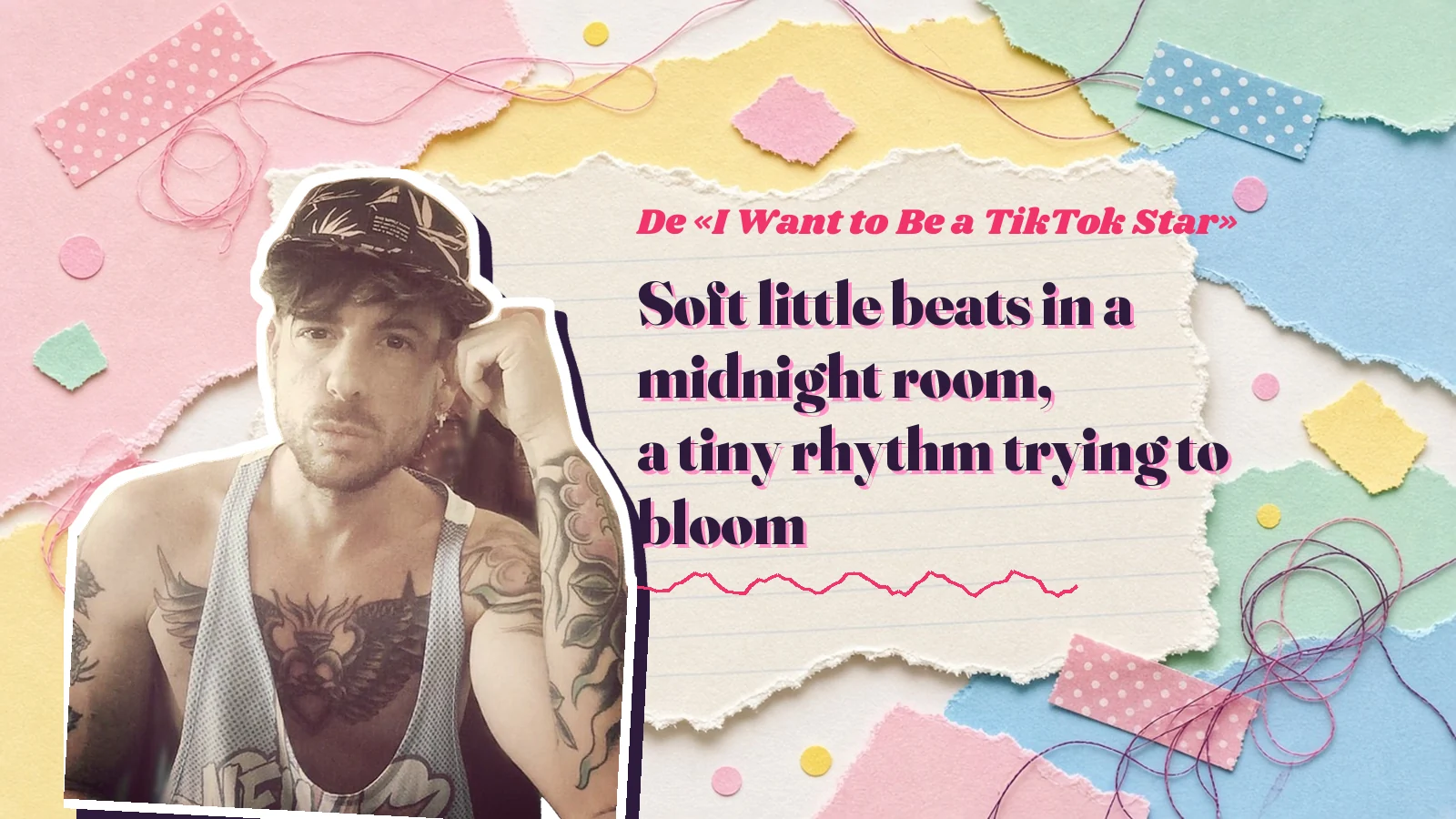
There are some lines in the song I'm especially fond of: «Soft little beats in a midnight room, / a tiny rhythm trying to bloom».

It's a portrait of how almost everything we see on TikTok gets made. Not in a studio with spotlights, but in a bedroom. At midnight. With the phone propped on a pile of books or on a tripod from the pound shop. With the ring light you bought on Amazon. With the door shut so your mum or your flatmate doesn't walk in.
And «a tiny rhythm trying to bloom» is what anyone making something small feels. A tiny rhythm, trying to open up. It isn't a hit. It's an attempt. A seed in a balcony flowerpot.
I love that the song has that tenderness in the middle of such a brazen chorus. Because behind every would-be TikTok star there's a bedroom at midnight and a rhythm trying to bloom. There's someone alone trying to make something work.
Shining from afar
Back to the central line: «but I keep shining from afar».
Shining from afar can be read two ways, and I like both.
The first is sad. I shine, but from far away. I don't make it to the centre. I'm not on millions of people's For You page. I'm a little star, the kind you only see if you switch off every light in the city. I shine on the outskirts.
The second has more dignity. I shine from afar, yes, but I shine. I don't need to be in the centre to have my own light. Real stars are incredibly far away and they keep shining. Some of them have even gone out and their light is still reaching us.
The song doesn't choose between the two. It says «but». It's an objection and an affirmation at once. I want to be a TikTok star, but I keep shining from afar. Is it a complaint? Is it a comfort? Both.
I think that ambiguity belongs to almost all of us who make things without a big machine behind us. We shine from afar. Sometimes it hurts. Sometimes it's enough.
Niche fame
I wrote a post called a thousand loyal listeners: niche fame and why it's enough for me. In it I say something I really believe: that I don't need millions of plays for my work to make sense. That a thousand people who really listen are worth more than a million who swipe past.
«I Want to Be a TikTok Star» seems to contradict that. Didn't you say a thousand was enough? And now you want to be a star?
And the answer is that both things are true at once. You can genuinely believe a thousand listeners is enough and, at the same time, have a part of you that wants more. That daydreams about the viral video. That checks the numbers at three in the morning. The song is that part. The part that doesn't get said in the serious posts.
It feels honest to have a song like that in the catalogue. A song that shows the seams. That reveals the bit of the creator who checks the stats even though he says he doesn't. If I only published pieces about how well I handle niche fame, I'd be lying a little. Some days I handle it fine. Some days I want to be a TikTok star.
«Desde España, con amor»
Halfway through the song, the English breaks and Spanish appears:
Desde España / Con amor / bye bye dolor (From Spain / With love / bye bye, pain)
I adore this turn. After all that «I want to be», so international, so Los Angeles influencer, suddenly: from Spain. With love. And a «bye bye dolor» that mixes the two languages the way they get mixed in any conversation between twenty-year-olds in Madrid.
«Desde España con amor» has something of a postcard about it, of a letter's sign-off, of a James Bond title run down the Gran Vía. And «bye bye dolor» is very nearly the most optimistic line in the whole catalogue. Goodbye, pain. As easy as that. As naive as that.
I don't entirely buy it, of course. Pain doesn't leave because you say «bye bye». But in a TikTok song, where everything lasts fifteen seconds, maybe it does. Maybe for fifteen seconds the pain goes away.
Up you get, girls and boys
And then comes the longest greeting in my catalogue:
«Arriba muchachas y muchachos / Garotas y garotos, todas y todes / Internacionales y españoles.» («Up you get, girls and boys / Garotas and garotos, todas and todes / Internationals and Spaniards.»)
It's a club MC's greeting, a village-fiesta compère's, an influencer's as the livestream starts. Everybody up. But with a list that keeps adding languages and genders.
«Muchachas y muchachos», in good old-fashioned Spanish. «Garotas y garotos», in Portuguese, one of the languages I also write in. «Todas y todes», with the gender-neutral ending that winds up so many people in Spain. «Internacionales y españoles», which is like saying: to the people from here and the people from elsewhere.
It's a greeting that wants to include everyone. And at the same time it's a bit ridiculous, because nobody talks like that. Nobody says «garotas y garotos, todas y todes» in the same sentence. But on TikTok they do. On TikTok you greet your imaginary audience as if it were the United Nations.
That's the joke. The would-be star greets an audience he doesn't have yet. Internationals and Spaniards. As if millions were watching. And maybe there are twelve.
Talking to an imaginary audience
I see myself a lot in that. When I release a song, or write a post like this one, I'm talking to someone I'm not sure exists. I call them «you». I say «if it's happened to you». I add a frequently asked questions section as if people were going to ask me in droves.
Every creator talks to an imaginary audience. The novelist writing in her kitchen, the painter in his attic, the kid filming a dance in his bedroom. They all imagine someone on the other side.
And sometimes that someone turns up. And sometimes they don't. But you have to say hello regardless. Up you get, girls and boys. Just in case.
There's something very village about that greeting, by the way. It reminds me of the compère at the patron saint's fiesta up on the stage in the square, mic squealing with feedback, greeting «the neighbours, those who've come from elsewhere and those watching us at home». There are forty people in the square and three dogs. And he greets them as if it were the Goya awards. That's exactly what the song does. And I think it's beautiful.
«I keep falling for who we are»
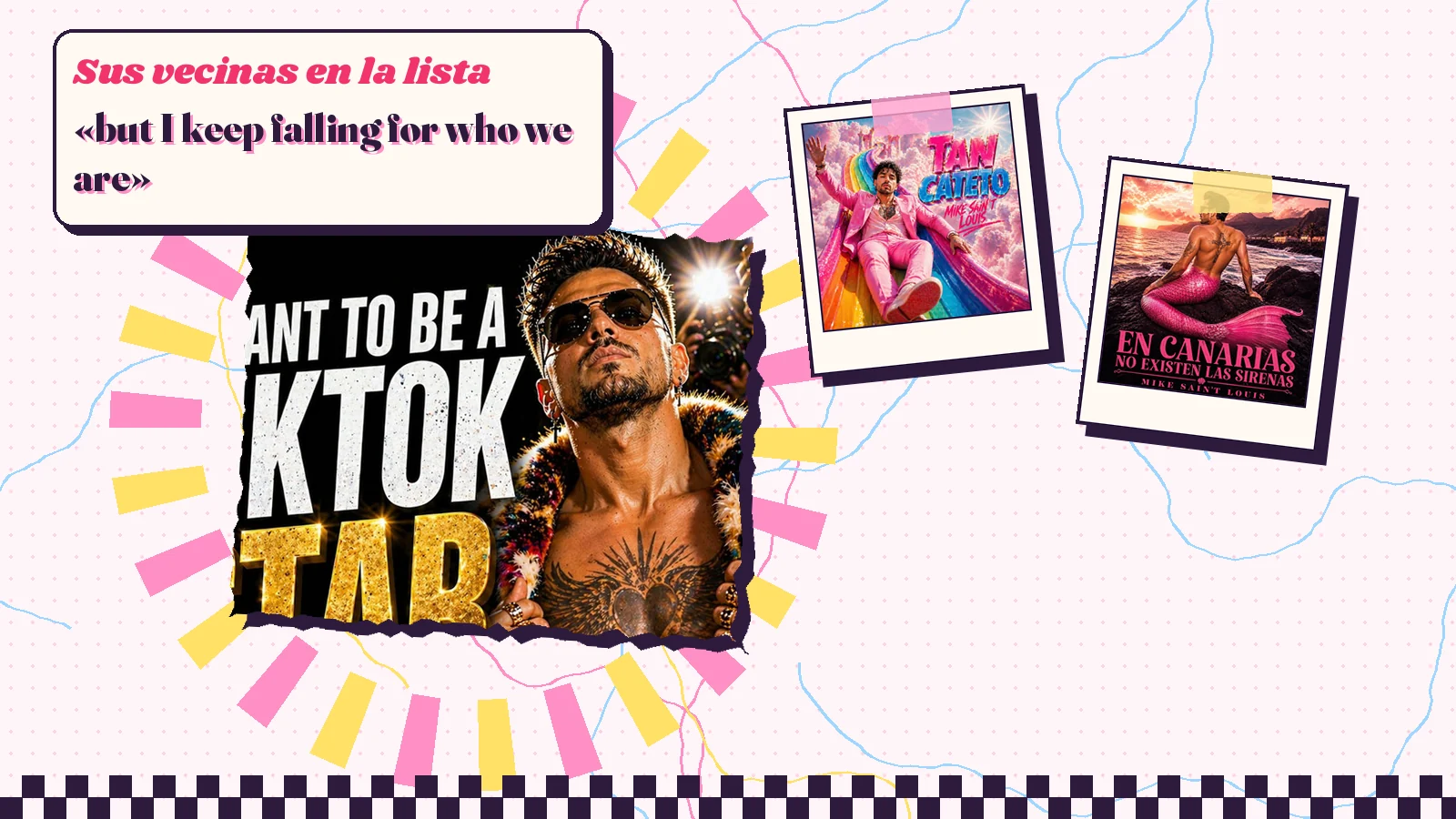
The song starts with an odd line, one that barely makes sense out of context: «but I keep falling for who we are».
Who are we? It doesn't say. But here's how I read it: those of us who make small things in bedrooms at midnight. Those of us who shine from afar. Those of us who greet an imaginary audience in four languages. Those of us who want to be stars and aren't.
It's a declaration of love to the tribe of hopefuls. To the ones who never quite make it. To the outskirts of the internet, which are full of people making lovely things nobody sees.
And it's also a way of saying I prefer that to fame. That even if I want to be a TikTok star, I fall for what we are, those of us who aren't.
Manifesting it
There's a social media trend called «manifesting». You repeat what you want to get, out loud or in writing, as if you already had it, so the universe will bring it to you. «I am rich.» «I have my dream job.» «My ex comes back full of regret.» There are videos of people writing the same sentence fifty times in a notebook with a glitter pen.
When I reread this song's chorus, «I want to be a TikTok star» four times running, that's what it sounds like to me. Manifesting. A girl in her bedroom repeating her wish in the hope that the algorithm, which is today's universe, will hear her.
It makes me laugh and it moves me at the same time. It makes me laugh because the universe doesn't work like that, and neither does the algorithm. It moves me because we all have a sentence we repeat hoping it'll come true. Even if we don't write it in a glitter notebook.
And then there's the detail that knocks it all down: the fifth line. After manifesting four times, the song says «but I keep shining from afar». In other words: I've manifested it, and here I still am, shining from afar. The universe hasn't replied. It's the most honest manifesting song I know. The one that admits it doesn't work.
What TikTok has done to songs
There's something you can hear in pop over the last few years, and you don't need to be an expert to notice. Songs are shorter. The chorus comes sooner. The first few seconds have to hook you, or the thumb moves on. A lot of music is now written with an eye on which bit will get used in a video.
«I Want to Be a TikTok Star» plays with that. Its main line is a perfect video snippet: short, repeatable, in English, with a wish inside it. It's practically a song written to be a TikTok sound. And at the same time it's a song about wanting to be a TikTok star. It eats its own tail.
I don't mind pop adapting to how people listen. It always has. Singles in the fifties lasted three minutes because that's what fitted on a 45. Today's last two because that's what fits into a thumb's patience. The format changes. What doesn't change is that someone has to write something worth hearing in that time.
A queer kid in a bedroom with a phone
There's another reading of the song that matters to me, and it has to do with the planet.
For a lot of LGBTQ+ kids in small towns, TikTok has been a window. That's where they've seen others like them, dancing, cracking jokes, telling their coming-out stories, doing their make-up, being happy. People who, twenty years ago, would have had nowhere to show themselves. Queer TikTok stars have done more for some kids in Soria or Jaén than plenty of official campaigns.
So «I want to be a TikTok star», said from Planeta Gayfolk, means that as well. I want to be one of those people who pop up on the phone of someone who feels alone. I want to shine, even from afar, so that someone in their bedroom at midnight can see it's possible.
It's a wish for fame, yes. But it's also a wish for company. To be the tiny rhythm that blooms in someone else's room.
On the liberation album
The song is on «El día de la liberación», the third album of the GAYFOLK trilogy. It might seem odd for such a light song to be on the liberation album.

But it makes sense. Freeing yourself also means letting yourself want embarrassing things. It means no longer pretending you don't care whether people see you. It means saying out loud «I want to be a TikTok star» without a tremor. And it also means accepting that you shine from afar and that it's fine.
«Bye bye dolor» is the most liberating line on the album, naive as it is. Or precisely because it's naive. You have to be very free to say something so simple without irony.
TikTok as Planeta Gayfolk's shop window
I have a TikTok page on the site, and one for Shorts, with the short videos I make for the songs. I make them because that's where people are, and because a song kept in a drawer is no use to anyone.
I won't give figures here, because this isn't the place and because figures say very little. I'll just say that making short videos forces you to think about songs differently. It forces you to find the three seconds that hook. It forces you to think about the image as much as the lyrics. And for someone who handles the art direction for everything, that's a brilliant workout.
«I Want to Be a TikTok Star» is, in a way, a song about that workout. About what it feels like to do it again and again, at midnight, hoping that one day a video will blow up.
Consistency and the algorithm
I've been putting out singles and music videos for about two years, and I told the story in two years of singles and music videos: what I learnt from consistency. One of the things I learnt is that the algorithm doesn't reward quality. It rewards consistency, luck and other things nobody fully understands.
So becoming a TikTok star isn't up to you. It's up to a machine that decides what people see. And for someone who works with machines every day, that's rather funny. I use artificial intelligence as a tool to produce songs, and then another artificial intelligence, the algorithm's, decides whether anyone hears them.
Machines in front and machines behind. And in the middle, a bloke from Madrid writing lyrics. If one of those lyrics ever catches the algorithm's eye, I'll put on my plastic crown and say I'd manifested it. Meanwhile, I keep writing, which is the only thing that depends on me. I decide the lyrics; who they reach, I don't. I've come to terms with that division of labour, even if some days it's hard.
The fear of putting things out
There's something the song doesn't say but that sits underneath it: fear. Wanting to be a TikTok star means publishing. And publishing is scary. Scared nobody will see it. Scared they'll see it and laugh. Scared of the comments.
I wrote about the fear of putting things out. In short: the fear doesn't go away, but you publish anyway. The would-be TikTok star in the song has that fear, I'm sure. And still he says four times that he wants to be one. That repetition is how he beats the fear.
Read it
The full lyrics are on their lyrics page. Short, repetitive, light. You can read them in twenty seconds, which is about as long as a TikTok.
And if you've ever wanted to be a star of something, of TikTok, of the telly, of your neighbourhood, of your WhatsApp group, this song is yours. Shine from afar. That's shining too, and sometimes it's all there is, and it's not bad at all.
Frequently asked questions
What is «I Want to Be a TikTok Star» about? About the wish to be famous on TikTok and the confession that, in the meantime, you shine «from afar»: from a bedroom at midnight, with «soft little beats».
Why does it mix languages? The song is in English and switches to Spanish with «Desde España, con amor, bye bye dolor» («From Spain, with love, bye bye pain»), then greets people in Spanish and Portuguese: «Arriba muchachas y muchachos, garotas y garotos, todas y todes».
Which album is it on? «El día de la liberación», the third album of Planeta Gayfolk's GAYFOLK trilogy.
Has Mike Sain't Louis gone viral on TikTok? His song «Tan cateto» took off on TikTok, as his About page says.
Who wrote the song? Mike Sain't Louis, a lyricist, composer and producer from Madrid. The music and vocals are produced using artificial intelligence as a tool; the lyrics are his.