By Mike Sain't Louis ·
Adrift in pink: «Drift Away», the surfboard and the art of letting go of the oars
Some titles work like a gentle instruction. «Drift Away» is one of them: let yourself go, move off, let the current carry you. In English the phrase works for a boat without moorings, for a conversation that trails off and for someone slowly falling asleep. The cover of «Drift Away» picks the brightest meaning of all: a young man on a board, right inside a wave that is neither blue nor green, but bubblegum pink.
Before going on, a note I always make in these cases. This track's lines haven't been published yet. Its lyrics page on gayfolkplanet.com says they will come later, and I'm not going to fill that gap with invented phrases. What's here comes from what can be checked: the artwork, the title, its place on the album, the date of the music video and what I already said about this song on its own page.
A fuchsia barrel of water
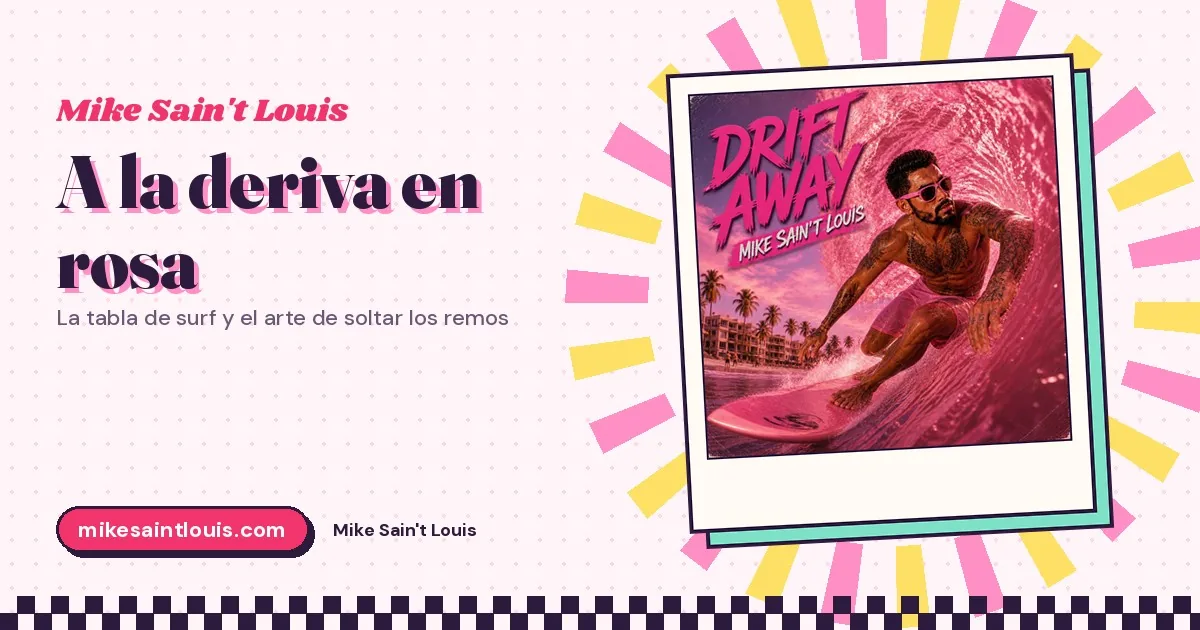
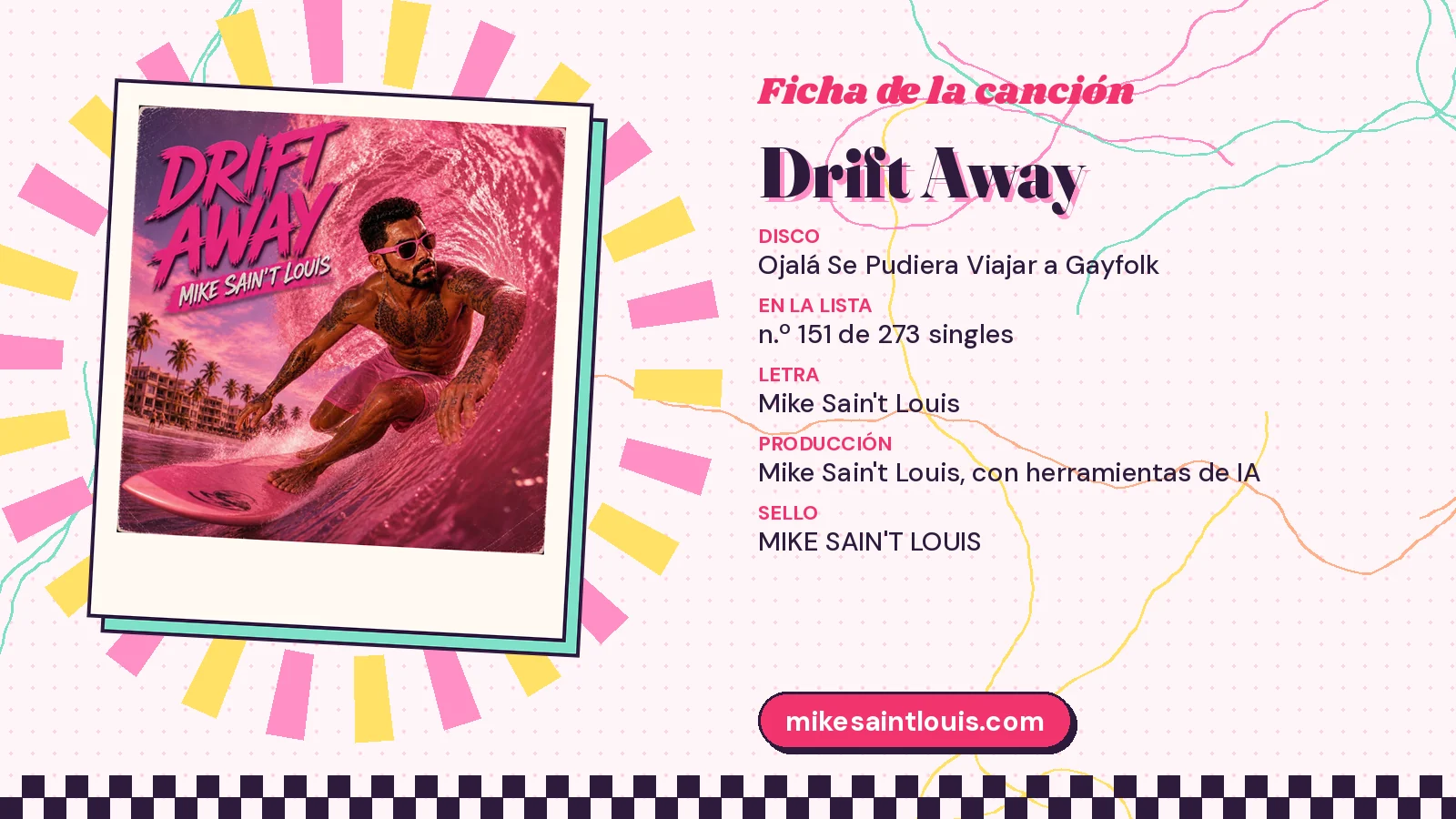
The image is taken from inside the wave, or almost. The water rises on the right and curls over the surfer to form a kind of roof, the hollow that surf slang calls the barrel or tube. Every drop is tinted pink, from the deep fuchsia inside to a paler pink where the foam breaks. On the left, outside the barrel, the shore appears: a row of palm trees, a multi-storey apartment block with terraces, a few tiny people strolling on the sand.
The sky doesn't hold back either. It's a violet and rosy sunset, straight off a postcard, with frayed clouds. Not a single element keeps its real colour. The sea, the sky, the board, the trunks, the sunglasses: everything has gone through the same filter. As I wrote on the song's page, the image makes no concession whatsoever to reality, and that's exactly the fun of it.
The title fills the top left corner in thick brush letters, as if painted in a hurry with a roller loaded with pink paint. Below, on a strip of the same colour, my name in white. The lettering has something of an eighties summer-film poster, the kind you rented at the video store with a girl in a bikini and a convertible on the box.
The body in balance
The protagonist crouches on the board, knees bent and weight forward. One arm reaches down to the water, almost brushing it with his fingers; the other opens backwards to compensate. It's the posture of someone focused on not falling, although his face shows no tension at all: pink sunglasses, a trimmed beard, eyes fixed ahead, a chain with a small cross on his chest.
Tattoos cover his arms, chest and part of his stomach. The trunks are short, pink and slightly see-through from the water. He's barefoot, of course, feet planted firmly on the board. It's the same figure that appears on other covers of mine, now in beach mode and without a single dark garment.
What strikes me most about the posture is its ambiguity. A surfer inside the barrel is neither still nor fully in control: it's the wave that pushes, and he only decides how to position himself so that push doesn't knock him over. That, deep down, is the idea of «drift away». It isn't about rowing against anything. It's about finding the posture that lets you go with the current without being swept away.
Letting go or going adrift
In Spanish we have two ways of saying something similar, and they don't mean the same thing. «Dejarse llevar», letting yourself be carried, sounds like pleasure: a night that flows, a dance, a conversation that runs on its own. «Irse a la deriva», going adrift, sounds like a shipwreck. A boat adrift has lost its rudder. A company adrift doesn't know where it's heading. A person adrift is not doing well.

The English «drift» covers both meanings at once, and that's why I find the title so interesting. The cover pushes towards the first: here the current is a party. But the word inevitably brings with it the shadow of the second. I'll come back to that further down, because it deserves its own space.
I like that a title in another language allows this double reading. Most of my songs are in Spanish, and when I choose English it's usually because a particular expression sounds better or says something that would need a whole sentence in Spanish. «Drift Away» is two words and three syllables. «Letting the current carry you without losing your balance» wouldn't fit on any cover.
A sport born in Hawaii
Surfing has a long history that doesn't begin in California. In the Hawaiian islands, riding the waves on wooden boards was an ancient practice with real social and ceremonial weight. The missionaries who arrived in the nineteenth century frowned on it, and for decades it almost disappeared.
Its modern revival has a proper name: Duke Kahanamoku, a Hawaiian swimmer who won Olympic medals in swimming in the early twentieth century and devoted much of his life to spreading surfing around the world. In the southern summer of 1914 to 1915 he gave an exhibition in Australia that is remembered as one of the founding moments of surfing in that country.
From then on, the sport built a culture of its own: fibreglass boards, magazines, films, music. In 1959 «Gidget» was released, the film that took surfing to screens across half the world, and in the early sixties so-called surf music, with its reverb-drenched guitars, became a genre in itself. Much later, at the Tokyo Games, held in 2021, surfing finally made its Olympic debut, at Tsurigasaki beach.
The language of surfing is curious too. There are words for every moment: waiting seated on the board, paddling to catch the wave, the instant of standing up, the turn, the wipeout. Anyone who surfs knows that most of the time isn't spent surfing, but waiting and paddling. The seconds inside the barrel are few and very precious. Maybe that's why the cover freezes them: it's the moment every surfer chases and that almost never lasts long enough.
The barrel has a closet too
For a long time, surfing sold a very specific image of masculinity: blond, muscular, straight guy, with a girlfriend waiting on the sand. That aesthetic filled posters, adverts and films, and left little room for anyone who didn't fit.
In 2014 the documentary «Out in the Line-up», by Ian Thomson and Thomas Castets, came out, setting out precisely to talk about homophobia in the surfing world and why so few professional surfers had come out. One of the people who appear is Cori Schumacher, women's world longboard champion in 2000, who spoke openly about being a lesbian and what that meant on a professional circuit with sponsors very focused on image.
I don't know who coined the expression «line-up», the spot where surfers wait sitting on their boards for the wave to arrive, but the pun in the documentary's title is perfect: being out, in the queue, in full view. A cover like that of «Drift Away», with a tattooed surfer in pink trunks, inside a pink barrel, on a pink board, laughs a little at that old mould. It doesn't need to explain itself. It simply takes the wave.
Thinking pink
The colour deserves a chapter of its own. Pink wasn't always «for girls». In many early twentieth-century texts, pink was recommended for baby boys, because it was considered a stronger shade, derived from red. The association of pink with femininity took hold mainly in the middle of the century, with the rise of children's marketing and post-war fashion.

In 1937 the designer Elsa Schiaparelli named an intense pink «shocking pink», a name that already announced that the colour could be used to provoke. Twenty years later, in the film «Funny Face» (1957), Kay Thompson played a fashion magazine editor who launched the musical number «Think Pink!», a satire of the tyranny of trends.
For the LGBTQ+ community, pink also carries a historical weight that must not be forgotten: the pink triangle with which the Nazis marked homosexual prisoners in the concentration camps, and which activists decades later turned into a symbol of resistance. Today pink is also play, camp and excess. It can be memory and it can be glitter. In «Drift Away» it is, above all, a way of saying that summer belongs to us.
Drifting as a way of looking
In 1956 the French writer Guy Debord published a text called «Theory of the Dérive». For him and for the Situationists, the dérive, or drift, was a way of moving through the city without a plan, letting yourself be guided by the sensations that streets, neighbourhoods and atmospheres provoke, instead of going from point A to point B as routine dictates. It was a critique of functional urban planning and, at the same time, an invitation to look differently at familiar places.
I enjoy applying that idea to a wave. Debord's drift was urban, all tarmac and street corners. The one on this cover is marine and tropical. But the intuition is the same: there are places you only reach if you stop planning the route.
Geology has its famous drift too. In 1912 the German meteorologist Alfred Wegener presented the hypothesis of continental drift, the idea that the continents move slowly across the Earth's surface. It took decades to be accepted. I like to remember it whenever someone says things are what they are and don't move: even continents drift, even if only a few centimetres a year.
Between «La lengua equivocada» and «Llorar»
On «Ojalá se pudiera viajar a Gayfolk», the second album of the trilogy, «Drift Away» is track 77. Just before it comes «La lengua equivocada», and just after, «Llorar». Neither neighbour has its lyrics published yet, so I won't quote them. But the sequence, by its titles alone, already tells something: a tongue that isn't the right one, a wave to let yourself go in and, right after, tears.
The music video went up on 12 June 2026, just as the heat starts to bite in Madrid, and the song moves between indie pop, alternative pop and queer pop. It's no coincidence that a cover like this came out when half the city is already counting the days until the holidays. In the full list of singles, the track is number 151 of 273.
What other lyrics do say
Although «Drift Away» has no published lines yet, the sea and the beach appear in other songs from the same album and from the rest of my catalogue. In «Marica Chill», from the same album, there's a character who heads down to the beach without giving anything up:

And I still wear heels pa' bajar a la playa
And later on, the chorus sums up a way of spending the day that fits the pink surfer:
Marica chill, sin culpa, sin plan Hoy solo quiero brillar en el ultramar
«Sin plan», without a plan, is almost a loose translation of drifting. And «ultramar», the overseas, the sea beyond, has something of the horizon about it.
In «Madrid to Benidorm», my pride anthem in English, the bridge ends with a sea image that seems to me the perfect partner for this cover:
In love's great ocean, we'll ride the tide.
Riding the tide, riding the wave. There's no shipwreck there, there's community. I explored it in «We're the many, we're the one», about the plural in that song.
The coast of apartment blocks
Back to the shore on the cover: palm trees and an apartment block with seafront terraces. It's a scene anyone who has spent summers on the Mediterranean recognises at once. I'm not saying it's a specific place, because the image doesn't say so. But it looks a lot like that coast of tall buildings that rose in Spain from the sixties onwards, with mass tourism.
On the page for «La playa del Mal Pas» I told how I spent a good part of the summers I remember in that small cove in Benidorm. I'm not going to turn «Drift Away» into a song about Benidorm, because nothing on its cover says so. But I do recognise the landscape: the sand, the terraces, the sea in the background and the feeling that summer is a territory of its own.
And the swimming trunks as a small character, too. In another song, heartbreak even made off with some designer swimwear. Here the trunks are where they belong, wet and pink, and nobody has taken them.
There's another detail I like about that shore: the tiny people walking on the sand aren't looking at the surfer. Everyone minds their own business. It's a very big-beach feeling, where you can do almost anything without anyone judging you, because everyone is too busy with their towel, their parasol and their sun cream. For many LGBTQ+ people, that summer indifference has for generations been a small form of freedom.
Why water calms
There's a reason so many people associate the sea with rest. Various researchers have been studying the effect of water environments on wellbeing for years. In 2014 the marine biologist Wallace J. Nichols popularised the phrase «blue mind» to describe that state of calm many people feel near water.
The psychologist Mihaly Csikszentmihalyi, for his part, described in his book «Flow» (1990) the experience of flowing: that state in which you're so focused on an activity that you lose track of time. Surfing often comes up as an example, because it demands total attention to the present. You can't think about work email while a wave is passing over your head.
That doesn't make the sea a therapy, far from it. But it helps explain why an image like this is so appealing: it promises a few minutes without mental noise, with the body busy keeping its balance. As I said when I presented the single, three minutes of pink wave don't cure anything, but they help.
When the current pulls you out
There's a practical fact I don't want to leave out, because the word «drift» calls for it too. Rip currents are one of the most frequent causes of rescues and drownings on beaches. They drag you out to sea, and the instinct to swim straight against them exhausts anyone.
The advice from lifeguard teams is the opposite of intuition: don't fight it head on, stay calm, float if you need to and swim parallel to the shore until you're out of the current, then head back towards the sand. And, of course, swim at supervised beaches and respect the flags. Letting yourself drift is lovely on a cover. In real water, it's worth knowing when and how.
It seems to me a good metaphor without forcing it too much. Some currents carry you to beautiful places and others pull you away from the shore. The key is usually the same: don't spend all your strength fighting what you can't beat head on, and look for the way out to one side.
The holidays that haven't come yet
When I released the single I suggested playing it when you need a holiday and still can't take one. That line touches something very common. Many people spend months waiting for summer like someone waiting to be rescued, and then find that holidays don't always fix the accumulated tiredness.
There's even an informal name for the discomfort some people feel just as they start to rest: in 2002 the Dutch psychologist Ad Vingerhoets spoke of «leisure sickness», symptoms such as headaches or fatigue that appear when we finally stop. And we all know the so-called post-holiday syndrome, which isn't a medical diagnosis, but is a very widespread feeling on returning to routine.
An exaggerated cover like this works as a small free getaway. It doesn't replace a holiday, nor does it try to. It's more of a postcard reminding you that another rhythm is possible, even if only for the length of a song.
The other drift
Now, the less bright side of the word. «Going adrift» also describes that state in which a person feels they no longer steer anything, that days go by without direction, that they're drifting away from others without quite knowing how to get back. Sometimes it's tiredness. Sometimes it's sadness. Sometimes it's something that needs professional attention.
If you recognise yourself there, you don't have to wait to hit rock bottom to ask for help. Talking to someone you trust or to your GP can be a first step. In Spain, 024 is a free, confidential line that answers at any hour for people having thoughts of harming themselves or going through a lot of emotional pain, and also for those worried about someone. If there's immediate danger, 112.
If you're reading this from outside Spain, look up the suicide prevention or crisis line in your country, or call your local emergency number. In the series «Salud mental sin tabú» I gathered more resources and organisations. Letting go is lovely when the shore is in sight; if you can't see it, ask someone to help you find it.
For whoever needs a pink wave
For whoever has spent months in a windowless office dreaming of the sea. For whoever can't surf, but imagines themselves inside the barrel. For whoever puts on the loudest trunks they own and heads down to the beach without asking permission.
For whoever grew up seeing surfing, sport or the beach as other people's territory, and now decides to take the wave their own way. For whoever needs, now and then, to let go of the oars and trust the current a little.
And for whoever is learning to tell letting go from getting lost. Until the lyrics are published, you can play the track on any platform or download it for free, without signing up, from the downloads page. When the lines are ready, I'll upload them in full and exactly as they came out, without changing a comma.
Frequently asked questions
What is «Drift Away» about? The lyrics haven't been published yet, so this post doesn't quote any of its lines. The cover shows a surfer in pink trunks and pink sunglasses inside a fuchsia wave, with palm trees and apartment blocks on the shore. The post reads the title through the idea of letting go, the history of surfing and the difference between letting go and getting lost.
Which album is it on? On «Ojalá se pudiera viajar a Gayfolk», the second album of the Gayfolk trilogy, where it is track 77, between «La lengua equivocada» and «Llorar». In the list of singles it is number 151 of 273.
What does «drift away» mean? Literally, to float off or let the current carry you. In English it works both for something pleasant, like getting carried away by music, and for something worrying, like losing your way.
What should I do if I'm caught in a rip current? Stay calm, don't swim straight against the current, float if you need to and swim parallel to the shore until you're out of it. The safest thing is always to swim at supervised beaches and respect the flags.
Where can I get help if I feel I'm drifting? In Spain, 024 answers free of charge at any hour, and 112 in case of immediate danger. Outside Spain, look up your country's crisis line or call emergency services.
Who makes this song? Mike Sain't Louis, a lyricist, composer and music producer from Madrid who presents himself as the first AI songwriter. He writes the lyrics and directs the production; the music and the performances are created with artificial intelligence.