
By Mike Sain't Louis ·
«¿Ya cansa mi historia lírica?»: the question I asked myself in «Otro bombardeo»
A man running through explosions, shirt torn, face contorted, kicking up dust across a patch of wasteland while everything burns behind him. Black smoke, sparks, earth flying through the air. The cover of «Otro bombardeo» ("Another bombardment") looks like a still from one of those war films they used to show on La 2 on Sunday afternoons. There isn't a single plane in the sky. You can't see the bombing. All you can see is the man running from it.
That's the song. A war without shrapnel, told by someone on the run.
I'm Mike Sain't Louis, the one who writes the lyrics for Planeta Gayfolk, and I almost always hide behind a joke. There's no joke in this one, or there's just one, and it's on me. The song page explains how it unfolds. Here I want to talk about a question that turns up halfway through the lyric and that, as a lyricist, strikes me as the most uncomfortable one I've ever asked myself.
I'm so sad
The lyric starts with no frills. No vampires, no neon coffins, no sardines in the minibar. Just someone who says I'm so sad, full stop, and then confesses he can't stop crying. Like that: subject, verb, adjective, like a first-year primary school exercise.
I wrote it that way because there are days when nothing else comes out. On good days the metaphors arrive by themselves. On bad days, all you get is the dictionary sentence. And it seemed more honest to leave the dictionary sentence than to dress it up in a pretty image, like someone wearing sunglasses at a funeral so nobody can see their eyes.
Then the lyric finishes it off with the line I'll quote: «Y no puedo parar de / Llorar» (And I can't stop / Crying). The break between the two words is in the published lyric, and I like it because it forces a pause right before the word that carries the weight. Like when someone is telling you something on the phone and their voice cracks mid-sentence.
Who to trust
The second sentence of the verse is about mistrust: «Ya no sé en quién confiar / Porque todos me tratan tan mal» (I don't know who to trust any more / Because everyone treats me so badly).
That "everyone" is an exaggeration, of course. Not everybody treats me badly, or anyone else for that matter. But anyone who has been through a spell of attacks knows that "everyone" is true on the inside even if it's false on the outside. When your phone buzzes and you're scared to look, when every notification might be another reproach, the whole world becomes a suspect. The postman, the neighbour, the friend who's slow to reply. Everyone.
That exaggeration interests me because it's different from my usual ones. When I exaggerate in a party song, I do it for laughs. Here the exaggeration is fear's, the kind that isn't funny. And the lyric doesn't correct it; it leaves it there, raw, the way a coffee stain stays on a white tablecloth.
The most uncomfortable rhyme
And then comes the question. I'll quote it in full because it's the heart of everything: «¿Será verdad que soy una víctima / Y ya cansa mi historia lírica?» (Could it be true that I'm a victim / And my lyrical story's getting tiresome?).
In Spanish, víctima rhymes with lírica. Two words stressed on the third-to-last syllable, the kind they made you underline at school because they always carry an accent. It's an almost jokey rhyme, too perfect, the sort that would raise a smile at a secondary-school poetry contest. And yet what it says is no joke at all.
What it says is this: I've been writing about what was done to me for a long time. Songs about narcissists, about gaslighting, about exes who lie, about silent punishments. What if I've become boring? What if people are sick of my pain? What if I've turned into the friend who brings up the same subject at every dinner while the others exchange glances?
It's the question anyone asks who has told their story many times. And it's especially uncomfortable for a lyricist, because telling it is exactly what my job consists of. If my lyrical story is tiresome, my work is tiresome. There's no way to separate the two.
Lyrical story
Let me stop on the expression, which nobody would use in a bar. Nobody says "my lyrical story's getting tiresome" when talking to their sister. They say "here I go banging on again". Lírica is a textbook word, a Spanish-exam word, a word from analysing Bécquer with a red pen.
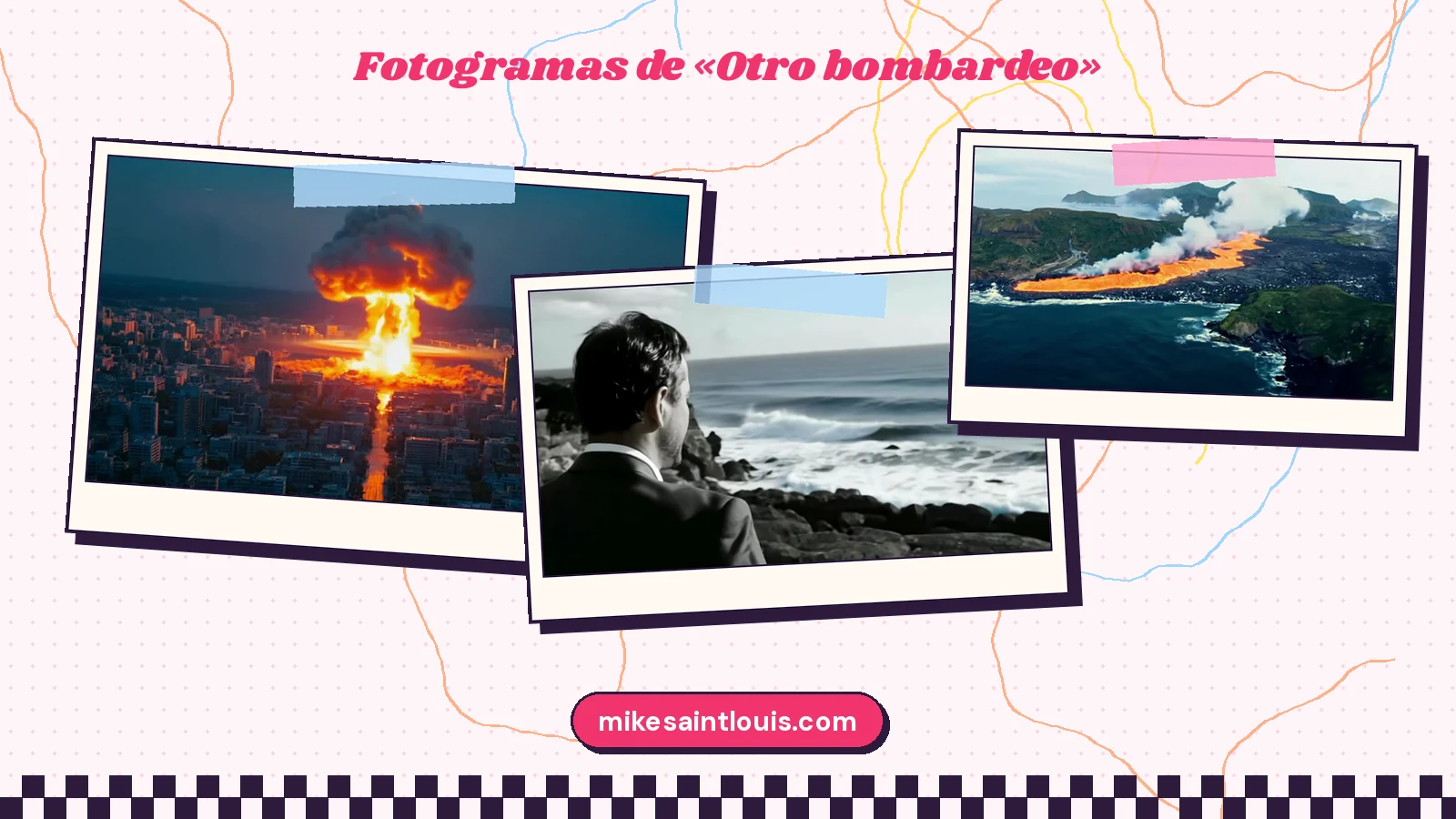
I chose it, or it chose me, because it cuts both ways. Lírica is poetry, the genre of first-person feelings. But on the street, saying someone is getting lyrical means they're exaggerating, getting intense, two minutes away from reciting to the moon. My lyrical story is both my work and my drama. What I write and what I put people through.
And the rhyme with víctima seals the double meaning. The one who gets lyrical and the one who plays the victim: two figures nobody wants to be at a dinner with friends. The song puts them together in two lines and looks them straight in the eye. That moment of seeing yourself from the outside, through a textbook word, is the most me thing in the lyric.
The one who plays the victim
There's one more layer to that question, and it's the one that stings most. In another song of mine, «La ley de la exageración», I tell a narcissist that he plays the victim when really he's something else. It's one of the classic traps these people set: acting wounded so nobody believes the person who's really been hurt.
And here, in «Otro bombardeo», the fear is the reverse. That I'll be seen as the one playing the victim. That my pain will sound like a pose. That someone will say: there he goes again, the narcissist-songs guy, what a bore, what a martyr.
That's the most twisted move in emotional abuse: it leaves you doubting even your right to complain. It makes you feel that telling what happened is exaggerating, fishing for pity, seeking attention. And the song's question captures that doubt exactly as it is, without resolving it. I don't say "no, I'm not playing the victim". I say "could it be true?". And I leave it hanging.
I leave it hanging because I don't have the answer. And I'd rather have an honest question than a false answer.
Two possible bombardments
The title comes from the end of the verse, from a line I'll also quote: «Otro bombardeo y aquí tampoco / Puedo escapar» (Another bombardment and here too / I can't escape). And that bombardment isn't explained in the lyric. It doesn't say what it's made of.
I see two readings, and both work for me. The first is attacks: messages, reproaches, comments, rows, one after another, no let-up, like a siege. The second is more twisted. In the vocabulary of narcissism there's what's known as love bombing: the phase where the narcissist floods you with affection, gifts and attention to hook you, alternating later with coldness. After a long cold spell, another love bomb can be the most dangerous thing in the world, because it sends you straight back to square one.
The song doesn't choose between the two readings, and I'm not going to choose for you. What is clear is the second half of the line: here too I can't escape. That "here" could be the house, the city, your own body, your own head. There's no air-raid shelter.
A loop with no way out
The lyric repeats its single verse several times, almost unchanged. Sadness, mistrust, question, bombardment. And round again.
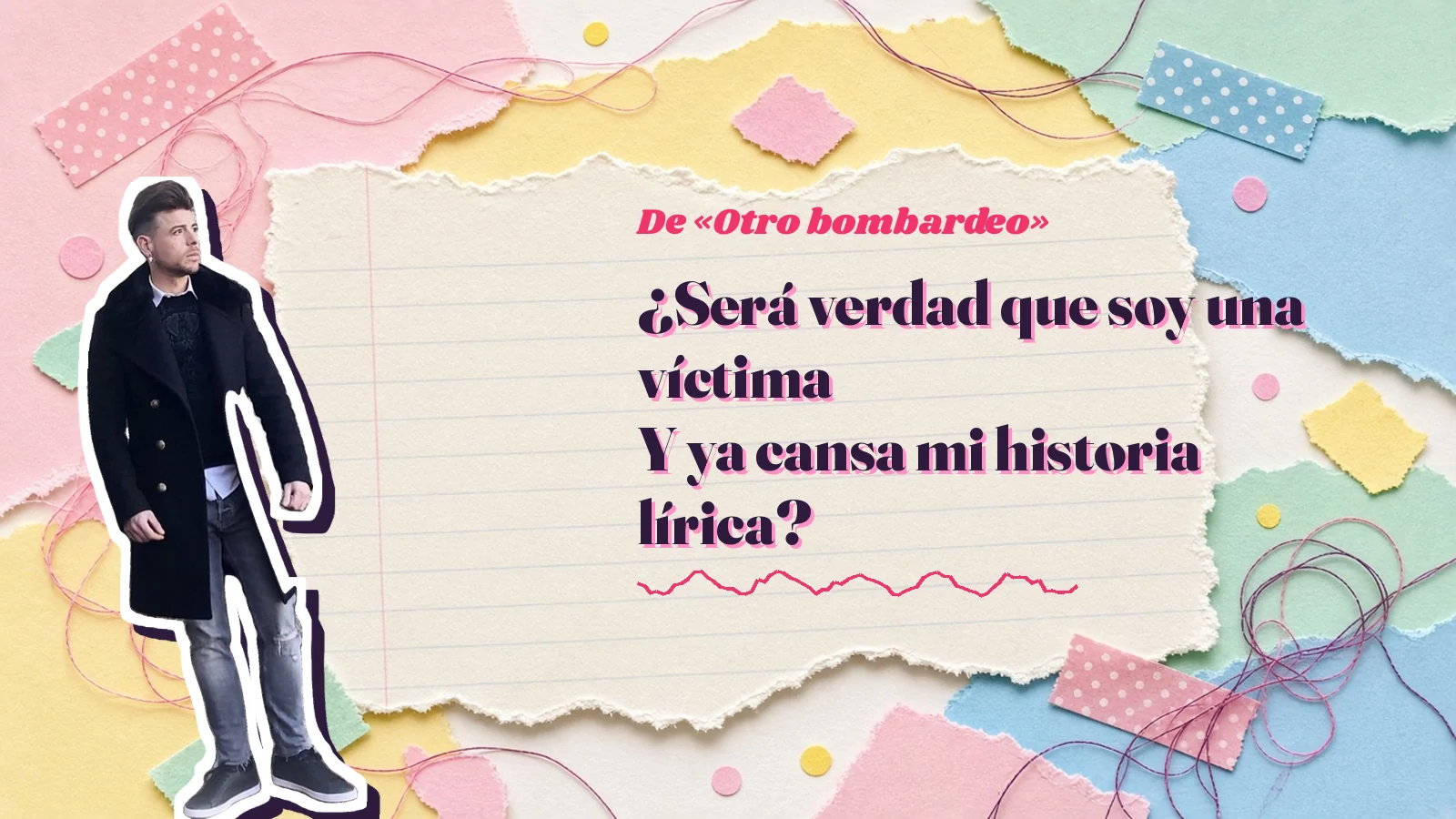
In other songs I use repetition to be funny, like a times table or a village brass band. Here repetition is something else: it's insomnia. It's your head going round and round the same thing at four in the morning, ceiling overhead, phone face down on the bedside table. It doesn't move forward. It doesn't get anywhere. It comes back.
It felt important that the song had no bridge, no twist, no happy ending. That it stayed trapped the way the person living it stays trapped. If I'd added a final verse of hope, with the sun coming up through the window, I'd have been lying. On those days the sun doesn't come up. Another notification does.
Gua, guantar
At the end of the last pass, something small happens that's what I love most about the song. The word aguantar, "to bear it", breaks. In the published lyric it appears like this, quotation marks included, split in two: «Gua» «Guantar».
It's a sob-hiccup. The moment you can't finish the word because you're choking. And that the word that breaks should be precisely "bear it" has an irony I didn't go looking for and that I think is perfect. I can't bear it, the song says, and proves it live: it can't even bear the whole word.
In a party song, a stumble like that would be a mistake. In this one it's the truest thing it has. Sometimes the craft is leaving the error where it is.
Me, right now
There are two words in the lyric I nearly always skip over and that, the more I look at them, the more they matter to me: right now. The full sentence says that right now I can't bear another bombardment.
Right now. It doesn't say never, or not ever, or not for good. It says that at this particular moment there's no strength left. It's a small difference, but it's the difference between despair and exhaustion. Whoever says they can't bear it right now is saying, without knowing it, that maybe tomorrow they can. That today isn't the day. That today is for the sofa, a blanket and the blinds down.
I didn't write it with hope in mind, to be honest. I wrote it because that's how you talk when you're worn out: in the present, in the first person, in a hurry to say what's happening to you before another tear escapes. But I'm glad it's there. It's the only chink of light in the whole song, and it's so well hidden you need a magnifying glass to find it.
Not right now. We'll see later.
If anyone reading this is in their own right now, with no strength for the next message, there's no need to answer it today. A phone on silent for an afternoon isn't a defeat. It's a trench, and in wars trenches save lives too. I'm not saying it as textbook advice: I'm saying it because the lyric itself asks for it, with that right now, and asks for nothing more.
What the lyric leaves out
There are no names in «Otro bombardeo». No ex with a telenovela name, no city, no job, no date. We don't know who's doing the bombing, or why, or since when. We don't even know whether it's one person or several.

In my funny songs I love a concrete detail: a swimwear brand, a supermarket aisle, a folk diva's name. Here I stripped all that out on purpose, or rather, I never put it in. When you're in the middle of the siege, the details don't matter. You don't think about who sent the three o'clock message. You think: there's another message.
Besides, a lyric without names leaves room. Anyone listening can put their own bomber there: a partner, a family, a WhatsApp group, a boss, an entire social network. The song doesn't ask anyone to prove anything. It's enough for them to recognise themselves in the man running.
Telling the same story again
Back to the lyrical-story question, because it has a second part that hits me as a lyricist. Part of my catalogue is made of exes, narcissists and betrayals. Sometimes I laugh at them, as I explain in the piece on why I laugh at my exes. Sometimes I don't. But the raw material is similar.
Is that repeating myself? Maybe. The old coplas repeated themselves too: the abandoned woman, the forbidden love, the grief that won't leave. Whole generations listened to variations on the same misfortune without tiring of them, because each variation lit up a different corner. Rocío Jurado didn't tell heartache the way Lola Flores did, even though they both told it. Each had her angle.
That's the trick, if there is one: not telling the story again, but telling another angle of the story. In «La ley de la exageración» the angle is rage with a wink. In «Otro bombardeo» the angle is doubt. And the doubt is new even if the wound is the same old one.
When someone says it for you
There's another reason the question stings. When you publish a lot, people have opinions, and sometimes their opinion is exactly what you were afraid of. I wrote about how I take criticism in what I learnt from negative comments, and I won't repeat it here.
I'll just say one thing. I asked the song's question before anyone asked it of me. That feels more dignified. If someone writes to me one day saying "you and your dramas are getting tiresome", I'll be able to reply that I know, that I've got a whole song doubting it, and that despite the doubt I put it out.
That's a form of self-defence too. Asking out loud what others might use as an insult takes the edge off the insult.
The only joke
I said at the start that this song has no jokes, or just one, and it's on me. The joke is the question itself. A lyricist wondering, in the middle of a sad song, whether his sad songs have become boring. It's like a chef asking, as he serves the dish, whether it might be a bit too salty.
It's self-parody, but the kind that hurts. I'm not laughing at myself to play the matter down. I'm laughing because it's ridiculous to be crying and, at the same time, worried whether the crying is getting tedious. It's the most human and the most absurd thing in the world. Anyone who has cried in front of someone and apologised for crying knows what I mean.
That apology is in the song too, even if it doesn't say so.
The cover: running with no plane
Back to the image, which translates the title almost word for word. A man running through explosions, in sepia and fire tones, with his shirt ripped. Real war has nothing to do with this, and I don't want to trivialise it: there are people under real bombs as I write this, and that's another scale altogether. The cover uses the image of war as a metaphor, the same way we all do when we say someone is bombarding us with messages.
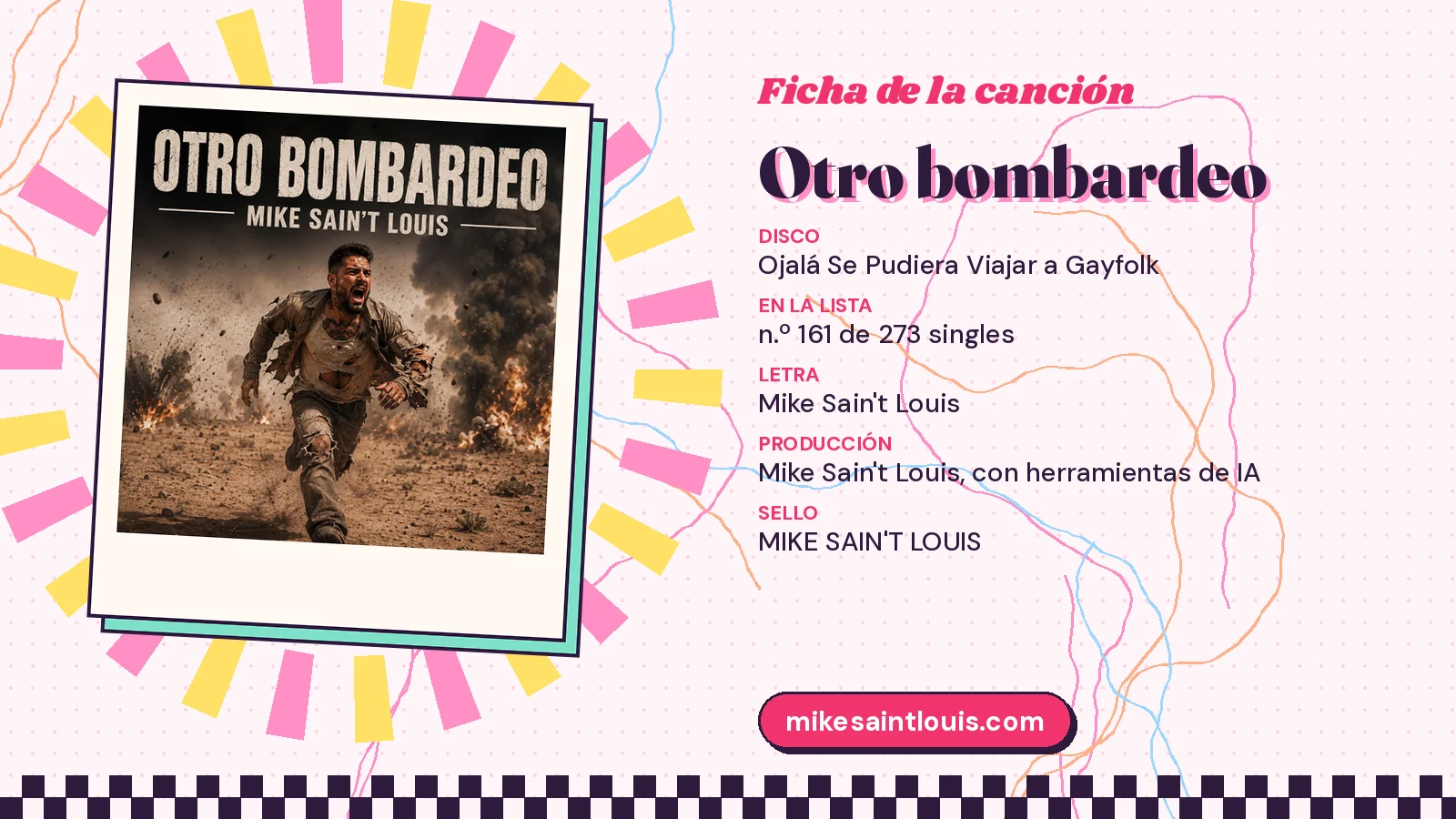
What interested me about the image is that you can't see where the bombs are coming from. No planes, no tanks, no enemy in sight. Just explosions and someone fleeing. That's how emotional abuse feels: you don't always know where the blow is coming from, only that it's coming. That's the advantage of an image with no enemy: everyone puts in their own.
An album about wanting to leave
The song belongs to *Ojalá se pudiera viajar a GAYFOLK*, the second album of the GAYFOLK trilogy. It's the album about longing to clear off to another planet, and this song explains pretty well where that longing comes from. When here too you can't escape, all that's left is to imagine somewhere you can.
In the catalogue of 273 singles it's track 161. Right before it comes «Me gusta el verano», and right after it «El concierto de Ismael Serrano». From summer to bombardment, and from bombardment to an old-school concert, guitar and heartbreak songs. Laid out like that, it looks like an ordinary week for someone with ups and downs: Monday at the beach, Wednesday under the bombs, Friday at a gig with a lighter held high.
Songs for bad days
«Otro bombardeo» has company in the catalogue. There's a corner of mental-health songs, with no jokes or very few, that I wrote for the days when humour doesn't come. There's «La música me está salvando», which is almost a thank-you note. There's «Punto muerto», with someone who feels he's only ever in the way. There's «Llorar», whose title says it all.
They're not the ones you dance to at the village fiesta. But it matters a great deal to me that they exist. If someone stumbles on one of them on a bad night, and the song keeps them company without asking them to cheer up, it has done its job.
What the machine adds and what I add
The lyric is mine, from the first sadness to the "gua, guantar". The music and the vocals come from artificial intelligence tools such as Suno, which I use for production, and my job is to choose, from the possible versions, the one that doesn't sweeten the loop. A song like this is ruined if the backing sounds too pretty, too much like a sanitary-towel advert with girls running along a beach.
I wanted it to sound like what it says: like someone stuck. I wrote about how I choose between many versions in «The craft of discarding», and a summary of how I work is on my introduction page.
Who it's for
For anyone who has apologised for crying. For anyone who has stopped telling people what's happening to them because they think it's become tiresome. For anyone whose phone lies face down on the bedside table and who jumps every time it buzzes.
And for that person's friends. If someone tells you the same story for the tenth time, maybe it isn't that they're a bore. Maybe it just hasn't finished happening yet.
The full lyrics are on its lyrics page, and all the others are in this site's lyrics archive. To listen, there's Spotify or the music video on gayfolkplanet.com.
The answer I don't have
I still ask myself the song's question. Is my lyrical story getting tiresome? For some people, maybe it is. I'm not going to stop telling it because of that.
Because the alternative is to keep quiet, and keeping quiet is exactly what the bomber wanted.
Frequently asked questions
What is Mike Sain't Louis's «Otro bombardeo» about? It's about someone who is sad, can't stop crying and no longer knows who to trust. Halfway through the lyric he asks: «¿Será verdad que soy una víctima / Y ya cansa mi historia lírica?» (Could it be true that I'm a victim / And my lyrical story's getting tiresome?). The bombardment in the title is never explained, and can be read as attacks or as a narcissist's "love bombing".
Which album is «Otro bombardeo» on? On Ojalá se pudiera viajar a GAYFOLK, the second album of the GAYFOLK trilogy. In the catalogue of 273 singles it's track 161, between «Me gusta el verano» and «El concierto de Ismael Serrano».
Why does the word «aguantar» appear split at the end? In the final repetition the published lyric writes «Gua» «Guantar», like a sob breaking the word apart. It's the only change in a song that otherwise repeats on a loop.
Who wrote «Otro bombardeo»? Mike Sain't Louis, a lyricist, composer and producer from Madrid, known as the first AI songwriter. The music and vocals are made with artificial intelligence tools such as Suno, under his direction.