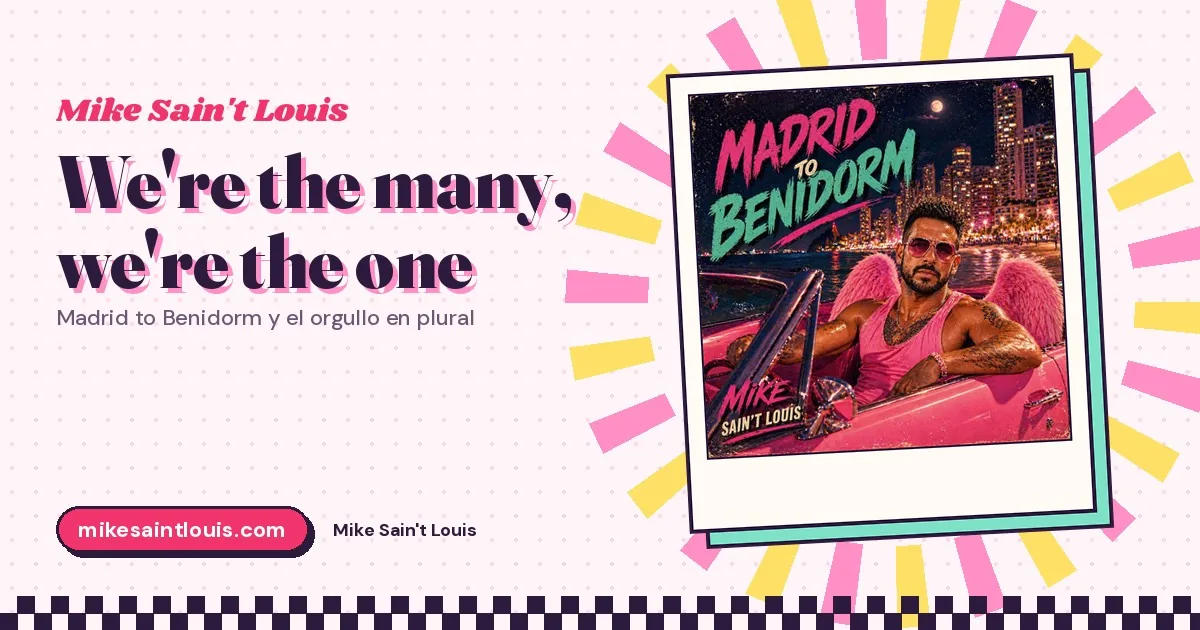
By Mike Sain't Louis ·
«We're the many, we're the one»: «Madrid to Benidorm» and the grammar of pride in the plural
Most of the songs in this catalogue have an addressee. An ex who lied, a hook-up who vanished, a narcissist who took the cake and left the crumbs. They are second-person songs, aimed at somebody, and nearly always with a score to settle. «Madrid to Benidorm» isn't. There's nobody to point at here. No spite, no irony, not a single dig. There's a crowd.
That's exactly why it fascinates me. It already has its own page on this blog, which introduces it as a pride anthem running from the capital to the coast, and over on the planet it's been told as a road trip. Here I want to come at it from somewhere else: from grammar. Because the most striking thing about this song isn't where it goes but who is speaking. Across almost the whole catalogue, an "I" does the talking. In «Madrid to Benidorm», it's a "we". And that change of pronoun changes everything.
The lyrics, exactly as published
The lyrics are in English and appear here in full, unaltered, just as they're published with the official video.
From the vibrant streets of Spain, Where the spirit can't be tamed, We rise up in the light of day, Madrid's heart beats loud, we're here to stay. Every color, every hue, Together strong, and fiercely true, With open arms, we're breaking through, In every city, me and you. Let's dance under the rainbow, Madrid to Benidorm, With pride in our voices, through every storm. From España we're calling, to everyone who hears, In colors of love, we erase the fears. In the alleys, in the sun, We’re the many, we’re the one, From Benidorm, with love we shout, This is what pride is all about. Hand in hand, we pave the way, For brighter nights and braver days, From every corner, hear us say, Love wins, come what may. Let's dance under the rainbow, Madrid to Benidorm, With pride in our voices, through every storm. From España we're calling, to everyone who hears, In colors of love, we erase the fears. Under the Spanish skies so wide, We stand united, side by side, For every heart that’s been denied, In love’s great ocean, we'll ride the tide.
How hard it is to write a happy song
There's a widely held belief among people who write songs: sadness gives you material and happiness doesn't. A break-up has details, objects, lines that stung, a timeline. Joy, on the other hand, drifts towards the generic. A happy song can easily end up sounding like an advert, a summer jingle, a slogan on a mug.
«Madrid to Benidorm» faces that risk head-on and solves it with three tools. The first is proper nouns: Madrid, Benidorm, España. An anthem that says "let's dance under the rainbow" is a greetings card; one that says "Madrid to Benidorm" is a plan for Saturday. The second is memory: the verse about denied hearts keeps the party from being naive. And the third is the pronoun. Written in the first person singular, joy can sound like showing off. In the plural, it sounds like sharing.
That gives the song an unusual place in the catalogue. Among so many lyrics of spite, with their exes caught in the flashbulb and their accounts being settled, it's one of the few that doesn't need an enemy to exist. And that's a kind of liberation in itself: the day you can write without thinking about whoever hurt you.
"Every color, every hue"
One line in the first verse deserves a moment: "Every color, every hue". In English the two words mean almost the same thing, and the repetition has a stubbornness to it. It isn't enough to say every colour; you have to say every shade in between too, the ones with no name on the side of the crayon box.

It's a simple way of talking about diversity within diversity. The rainbow flag has six stripes, but the community has far more shades than that: people from villages and from cities, young and old, trans people, bisexual people, non-binary people, people who haven't found their word yet. The lyric doesn't draw up a list, which always falls short. It opens the door to every possible tone.
Why English
The first thing that catches your ear is the language. A song that names Madrid, Benidorm and Spain, written by a lyricist from Madrid, and it's in English. It isn't the only one in the catalogue, but it's one of the clearest about that choice. And it makes sense.
For decades, English has been the language of the dance-floor anthem. A great many of the songs that blast out at any Pride in the world are in English, and plenty of people who couldn't translate a single line know every chorus by heart. To write a pride anthem in English is to write it in the language of the float, the sound system and the international crowd that fills the streets every June.
But there's a lovely detail. The song never forgets where it comes from. Right in the middle of the chorus there's a Spanish word, left untranslated: «España». "From España we're calling." Not "from Spain", which is what you'd expect in an English lyric. España, as if the word refused to change its clothes. It's a small wink, but it says it all: the language is global, the accent is local.
Then there are the place names. Madrid and Benidorm sound the same in any language. Putting them in the chorus turns two very Spanish places into part of the international map of pride. Someone in London, Berlin or Buenos Aires who hears it will learn that there's a route, from Madrid to Benidorm, that people dance their way along.
From "I" to "we"
Now, the pronouns. If you count them up, the most frequent word in the lyric, after the articles, is "we". We rise up, we're here to stay, we're breaking through, we pave the way, we stand united. The song is a chain of verbs in the first person plural.
That's very rare in this catalogue. Nearly every lyric in the trilogy is written from a wounded, mocking or liberated "I", talking to a "you" who has done something. «Madrid to Benidorm» steps outside that pattern. There's no enemy "you". The only "you" that appears is an accomplice: "In every city, me and you." Not the "you" of the ex. The "you" of the person standing next to you at the march.
Moving from "I" to "we" is, in a sense, what Pride itself does. Lots of people arrive at their first Pride carrying a personal story, often a painful one: a closet, a family that didn't understand, a town where it just wasn't possible. And when they get there they discover that the story they thought was theirs alone belongs to thousands of people. The song captures that exact moment when an "I" realises it's a "we".
There's a song in the catalogue that does something similar on a smaller scale: «Boys Like Us», where the plural is a gang of friends. In «Madrid to Benidorm» the plural is a whole city, and then a whole country.
"We're the many, we're the one"
Of all the lines in the lyric, this is my favourite. We're the many, we're the one. It sounds like a contradiction, and it isn't.
Pride always has two faces. On one side it's a mass: hundreds of thousands of people filling the streets, a number to be counted, a force you can see from the air. On the other, it's one particular person, with their glitter, their home-made placard and their story. Both are true at once. The crowd only exists because each person decided to turn up. And each person dares to turn up because they know there'll be a crowd.
"We're the one" can also be heard as "we're one and the same", "we're a single body". There's a promise in that: that every letter of the acronym, every age and every accent can fit into the same collective body. It's more aspiration than description, because the community has its internal rows like any family. But that's what anthems are for: so that people can shout in the street the thing we're still building. In this catalogue the music and vocals are generated with artificial intelligence, but the chants in the street are supplied by people.
"Love wins, come what may"
The slogan arrives in the third verse: "Love wins, come what may."
"Love wins" went around the world in June 2015, when the US Supreme Court recognised same-sex marriage nationwide and the phrase became the most used hashtag of the day. Since then it has become something close to a universal rallying cry. Spain had got there much earlier: same-sex marriage has been legal here since July 2005, when Law 13/2005 was passed, making it one of the first countries in the world to do so, after only the Netherlands and Belgium.
What's interesting about the lyric is the add-on: "come what may". A slogan just says love wins. The song says it wins even when things turn ugly. It's a nuance, but an important one. The first "love wins" sounds like a celebration after a victory. The one in this song sounds like resistance, something you also say when you're not winning.
Madrid, the heart that beats loud
"Madrid's heart beats loud, we're here to stay." Madrid is the heart of the song, and not by accident. Madrid Pride is one of the biggest in Europe, and the city hosted WorldPride in 2017. Decades ago, Chueca became one of the best-known LGBTQ+ neighbourhoods anywhere.

But that party has a history of struggle behind it. Spain's first pride marches came at the end of the 1970s, with the dictatorship barely over. Barcelona's, in 1977, is usually cited as the first, and Madrid followed soon after. At the time, homosexuality was still listed in the Law on Social Danger and Rehabilitation, and it wasn't removed until a reform in 1979.
So "we're here to stay" isn't just any line. It's what people shouted when staying was anything but guaranteed. It carries the echo of the classic liberation-movement chant: we're here, and we're not going anywhere.
There's already a whole post on this blog about Madrid as a stage for songs, «Madrid sin postal» (Madrid without the postcard), and another about what a dance floor at Pride is asking for. This song would be the practical answer to that question.
Benidorm, the coast that lets you be
If Madrid is the heart, Benidorm is the beach. And it's a fascinating choice. For many people, Benidorm stands for mass tourism: tower blocks facing the sea, sunburnt Brits, stag dos, street parties. But for years it has also been one of the most welcoming destinations in Spain for LGBTQ+ people, with its own Pride and a nightlife famous for its open atmosphere.
Seaside towns have long been queer refuges. Far from home, among tourists, with nobody who knows you, many people have allowed themselves to be who they were there for the first time, even if only for one week a year. Benidorm has something of that: a place where excess is the norm and nobody is shocked by anything.
"From Benidorm, with love we shout, / This is what pride is all about." There's something lovely about Benidorm, rather than some city with more cultural cachet, getting the final word on what pride is. It's a defence of the popular, of tackiness worn proudly, of everything that doesn't need permission to have fun.
"In the alleys, in the sun"
In the alleys and in the sun. This short line sums up the community's history beautifully. For a long time, queer life was lived in the alleys: in bars with no sign, in doorways, in hidden places you entered with a glance over your shoulder. Now it's lived in the sun as well, on the high street, on the beach, on the float.
The song doesn't choose between the two. It says both. The alleys aren't wiped from history just because there's sunshine now. They're still there, as memory, and for many people who still can't come out, as the present. The pride in this song includes those dancing in the street and those still in the alley.
"For every heart that's been denied"
The final verse is the most serious: "Under the Spanish skies so wide, / We stand united, side by side, / For every heart that's been denied."
It's an open phrase, and I think deliberately so. Denied what? It could be the right to marry, denied in Spain until 2005. It could be freedom, for those who ended up in prison under the Social Danger law. It could be a family, for those thrown out of home. It could be a job, an inheritance, a goodbye at a hospital bedside. Everyone who hears the song will fill in their own denial.
And there are still hearts being denied today. People living in places where being who they are remains dangerous. Trans people fighting to have their names respected. Older people who went back into the closet when they moved into a care home. The pride in this song is a party, but a party with a memory. One post on this blog puts it beautifully: pride on a Tuesday in November, the kind you need when there are no floats.
The storm and the tide
There are two weather images in the lyric worth reading together. In the chorus, "through every storm". At the close, "in love's great ocean, we'll ride the tide".

The storm is what comes from outside: hostility, backlash, the rhetoric that wants to push people back into the alleys. Nobody who follows the news can believe that hard-won rights are guaranteed forever. The song knows it, which is why the dancing under the rainbow happens "through every storm". And a rainbow, after all, only appears once it's rained.
The tide is something else. It's what happens when you stop rowing against the current and let something bigger than you carry you. By the end of the song, the community is no longer a march holding out but an ocean holding you up. It's a very beachy image, very Benidorm, and it completes the journey: we start in the streets of the capital and end up floating in the sea.
Where it fits in the catalogue
«Madrid to Benidorm» belongs to «El día de la liberación» (Liberation Day), the third album of the GAYFOLK trilogy, and it couldn't be in a better place. «El día de la liberación» is the title track, celebrating the moment you feel free. «Madrid to Benidorm» is that same moment, but in the plural and out on the street.
In the singles list, it's followed straight away by «La última carta» (The Last Letter), which goes back to the intimate "I" and the second person. The leap is huge: from collective anthem to a letter never sent. That's how the catalogue works, swinging between the party and the confession.
Other songs connect to it through the map. «Barcelona» also turns a city into a stage, though there the story is a one-night romance. And if your body is asking for more rainbow, «Mueve las plumas» (Shake Your Feathers) is another way to hit the dance floor.
The lyrics are by Mike Sain't Louis, lyricist, composer and music producer from Madrid, the first AI songwriter. He writes the words; the music and vocals are made with artificial intelligence tools. You can stream it on every platform and find it on the singles page.
Who this song is for
For anyone heading to their first Pride who doesn't yet know they're about to go from "I" to "we". For anyone who drives hundreds of kilometres one weekend so they can be themselves in another city. For anyone who lived through the alleys and now dances in the sun, and for anyone still in the alley who needs to know there's sunshine outside. For anyone who doesn't speak English and will know the chorus anyway. And for anyone who, as the lyric puts it, has ever had their heart denied.
It's also a song for any day of the year. Pride is in June, but storms turn up in every month. So keep it for those grey February days when the world seems to be going backwards. Turn it up, open the window and remember that people took to the streets when doing so cost far more than it does now. If they could, so can we.
Frequently asked questions
What is «Madrid to Benidorm» about? It's an LGBTQ+ pride anthem written in English. It's about a community rising up in the streets of Spain, dancing under the rainbow from Madrid to Benidorm, and promising a place to every heart that's ever been denied.
Why is it in English if it's about Spain? Because English is the usual language of dance-floor anthems and of Pride around the world. Even so, the lyric keeps the word «España» untranslated and names Madrid and Benidorm in the chorus.
What does "we're the many, we're the one" mean? That we are many and we are one. It sums up the two faces of Pride: a huge crowd made up of individual people, each with their own story.
Why Benidorm? Because it's a very welcoming destination for LGBTQ+ people, with its own Pride and an open atmosphere, and because it stands for the popular and the festive alongside the capital.
Who makes this song? Mike Sain't Louis, lyricist, composer and music producer from Madrid, the first AI songwriter. He writes the lyrics and directs the production; the music and vocals are generated with artificial intelligence.