
By Mike Sain't Louis ·
«Tú tan cachas, yo tatuado»: an inventory of the gay couple of the year
A note folded in four, floating in a toilet bowl. That's the last image of the relationship, and the song takes two verses to get there. First it draws up an inventory.
«Éramos la pareja gay del año / Tú tan cachas, yo tatuado.» We were the gay couple of the year / You so buff, me tattooed.
That's how a shop-window couple starts coming apart in «Mi novio de Albacete», My boyfriend from Albacete. I've already written about this song on the blog, in my boyfriend from Albacete, the village, the provincial capital and why clichés make me laugh, and the song's page sketches the story. Here I won't talk about Albacete or about what happens in the song. I'll talk about how it's built. About that habit of mine of telling a break-up as if it were a couple's shopping list: you this, me that.
Because that structure, which looks like the simplest in the world, is a trap. And I set it for myself.
You this, me that
The lyric is built out of pairs. Each line sets the two halves of the relationship face to face, with a single word for each.
You so buff, me tattooed. You so fitness, me so gorgeous. Me grafting, you doing your thing. You on Grindr, me in fancy dress. You with that glossy black hair, me delighted. Me so good, and you a total bore. Me dreaming, you acting.
Read them in a row and they look like captions in a photo album. Each pair of words is a snapshot: the two of them at the gym, the two of them on the beach, the two of them at a cousin's wedding, the two of them on the sofa. And under every photo, the same dry line crossing it out: you cheated on me.
This technique has a name in good old-fashioned rhetoric, parallelism, and a huge tradition in popular song. Heartbreak coplas, Spain's old torch songs, use it a lot. So do sevillanas. It's the quickest way to show a relationship: two columns, one for each, and let the listener do the sums.
What I did was skew the columns.
The list is rigged
Look closely at what each one gets.
At first the pairs seem balanced. Buff and tattooed are two ways of showing off a body. Fitness and gorgeous, two ways of preening. So far, the gay couple of the year: two catalogue men, each with his strong point, posing for Instagram. Nobody wins.
Then the scales begin to tip. «Yo currando», me grafting, says the narrator, while the other is up to something the lyric leaves hanging. «Tú por Grindr, yo disfrazado»: you on Grindr, me in fancy dress. Now the imbalance shows: one is looking elsewhere and the other is trying hard at home, with his costumes, his themed parties, his eagerness to please. «Yo tan bueno, ¡y tú un coñazo!» Me so good, and you a total pain! Here the narrator is already handing out medals.
And then comes the line that brings it all down: «Tú tan p, yo tan fracasado». You so p—, me such a failure.
That word cut off at the "p" I leave to your imagination, which I'm sure will guess right. What matters is the second half. Failure. After all those medals, the narrator pins the worst label on the list on himself. Not tattooed, not gorgeous, not good. A failure.
That's the trap I mentioned. "You this, me that" lists usually exist to make the teller look good. Whoever tells the break-up puts himself in the good column and the ex in the bad one. I started like that, like everyone. And halfway through, the honest self-portrait came out. Because when you've been cheated on, for a while you don't feel like the dignified victim in the film. You feel stupid. You feel like the one who didn't notice. You feel a failure.
The modesty of self-parody
In my ex songs there's nearly always a moment like this, when the narrator turns round and points at himself. In «La casa de los mil cadáveres», The house of a thousand corpses, there's a question I hurl at myself, "how can I be so stupid?". In this one the word is failure. In others it'll be mug, fool, idiot.

I don't do it for sympathy. I do it because a joke that only points outwards wears out fast. If the narrator is perfect and the ex is a monster, the song becomes a revenge pamphlet and stops being funny by the third listen. If the narrator is ridiculous too, the song breathes. The listener recognises himself on both sides.
I told it in a little comic typology of exes, where I run through the different kinds of ex who crop up in my lyrics. The boyfriend from Albacete is a very particular type, the shop-window one: divine in photos, never at home. But that typology has a hidden section, the narrators, and in it the one in this song would be the "I believed every word" type.
We were the gay couple of the year
Now the line repeated before every inventory. «Éramos la pareja gay del año.»
There's something of a magazine award about it. Couple of the year, like car of the year or song of the summer. There are contests for everything, and gay social-media life has its own invisible one: the couple everyone holds up as an example, the one in the Pride party photos in matching T-shirts, the one with a dog named after a pop diva.
That pressure fascinates me. When you're a visible couple of two men, on display, you carry a kind of absurd responsibility: you have to turn out well, because plenty of people are watching and waiting for you to turn out badly. The gay couple of the year can't have an off afternoon. It has to be fitness, tattooed, gorgeous, with a joint account and an engagement ring.
The song says "we were", in the past. And it says it so often that the past turns ironic. By the third time it doesn't sound like nostalgia, it sounds like sarcasm. We were the gay couple of the year. Oh, of course. In the photos.
On this, on gay love songs that end well and those that don't, I have a piece heading the other way: we need gay love songs that work out. I still think so. But we also need songs that laugh at the perfect couple, because the perfect couple is an Instagram invention and comparing ourselves with it does none of us any good.
You cheated on me, again
There's one line repeated more than any other in the whole song, more even than the couple-of-the-year one: «Me has engañado», you cheated on me. It opens every block. Before each inventory the narrator lets it fly, like someone thumping the table to make everyone shut up.
The curious thing is that repetition makes it not more dramatic but more comic. The first time, "you cheated on me" sounds like a slammed door. By the fourth it sounds like a stuck record, like that friend who's spent three weeks telling you the same story over every caña, every little beer, and always opens the same way: "He cheated on me, you know?". Yes, darling, we know. Tell us the toilet bit again.
And that's true of heartbreak too. For a while you can talk about nothing else. The song doesn't hide that loop: it turns it into structure. Each verse is another lap round the same wound, with a new detail every time. The muscles, the fitness, the black hair. Like scrolling through photos on your phone at three in the morning looking for the clue you missed.
The way out of the loop comes at the end, when he stops saying "you cheated on me" and says "watch out". From me to all of you. That's where the mourning ends and the gossip begins. A good sign.
Grindr and Wapo
The apps have their part in the song, named in full. The boyfriend from Albacete is on Grindr while the narrator dresses up, and by the chorus he's already posting on Wapo a photo that is not, shall we say, of his face. The lyric says so with an exclamation I won't repeat here, but which is easy to imagine.
I like naming the apps. It's one of my habits: if a specific brand exists, I use it. Saying "a dating app" is brochure language. Saying Grindr is saying a notification ping, a grid of headless torsos, a "hi, what you after". And Wapo, a Spanish gay app many people outside the scene have never heard of, is the detail that makes the song ring true for those who have.
What the apps do in the story is speed things up. The boyfriend from Albacete is back on the market in no time. The lyric puts it with a very Spanish phrase: «Te ha faltado tiempo», literally "you were short of time", meaning you couldn't wait. Mothers use it when someone rushes into something too fast. "He couldn't wait to run off with the other one." Next to a photo on an app, it sounds like neighbourhood comedy.
Five hours for a note
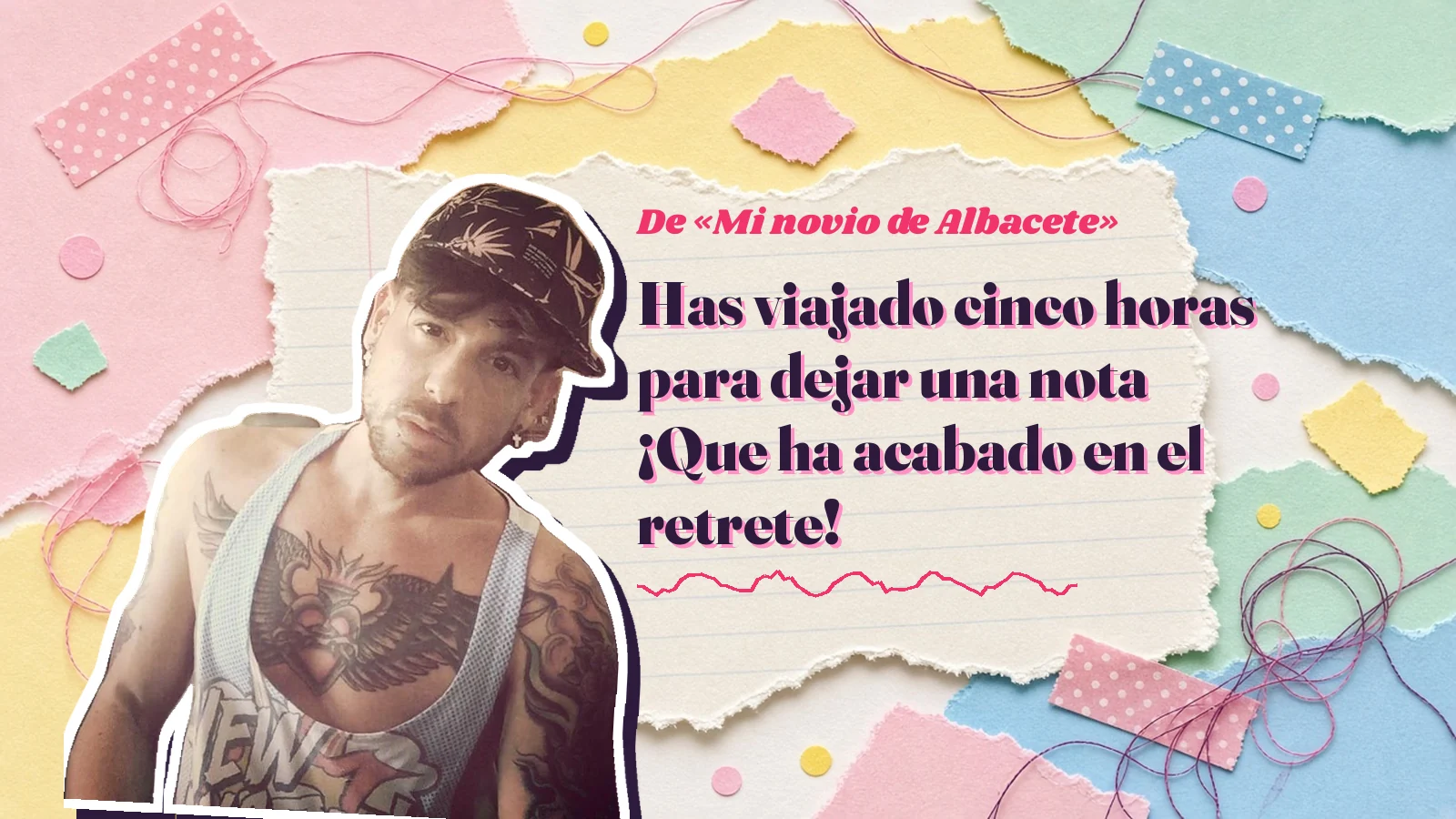
And now, at last, the image this piece opened with. «Has viajado cinco horas para dejar una nota / ¡Que ha acabado en el retrete!» You travelled five hours to leave a note / That ended up in the loo!
What I love most about that line is the disproportion. Five hours' travel. One note. There was no need to move for that: there's WhatsApp, there's email, there's even the fax for the nostalgic. But no. The boyfriend from Albacete goes to the trouble of making the whole journey to leave a written farewell, as in a film from the forties. And the final destination of that cardboard romantic gesture is the toilet.
Did the narrator flush it, or did it end up there by accident? The lyric doesn't say, and I'm not about to either. Both readings make me laugh. If he flushed it, it's a tiny domestic revenge: pull the chain and goodbye. If it was an accident, even better: the universe putting things in their proper place.
Farewell notes are a genre with great dramatic weight. Love letters never sent, the suicide notes of the movies, the note on the fridge saying "I'm leaving and I'm not coming back". My catalogue has whole songs built as letters. Here the letter lasts one line and ends up down the drain. It's the bargain-bin version of epistolary drama.
Watch out
The ending changes tone. It stops talking to the boyfriend and talks to everyone. «Ten cuidado con el novio de Albacete», watch out for the boyfriend from Albacete, it says, like someone pinning a notice up in the building's entrance. And it adds a reason that's a viper-tongued joke about how easy the lad is.
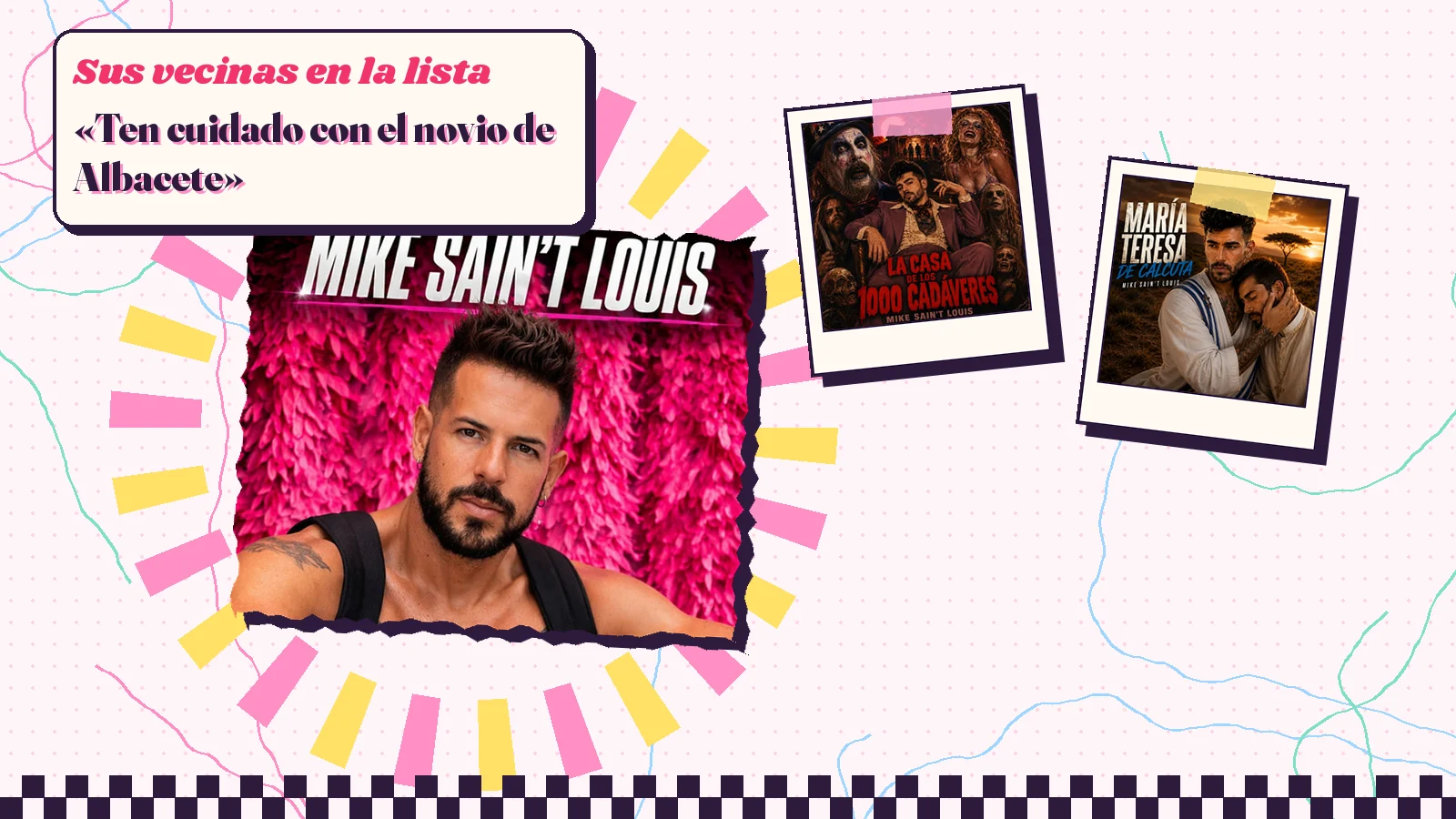
That change of addressee interests me a lot as a technique. Throughout the song, the narrator is talking to his ex: you so this, you so that, you cheated on me. At the end he turns to the audience, as in the theatre when a character breaks the fourth wall. And what he says is a warning to all shipping. The private conversation becomes a public notice.
It's the same move many of my narcissist songs make: first the score-settling, then the announcement for the next victim. In the Albacete case there's no narcissism, just infidelity and a great deal of cheek. The warning is more gossipy than supportive. But the form is the same: the ex as a faulty product, complete with warning label.
Harness and pink curtain
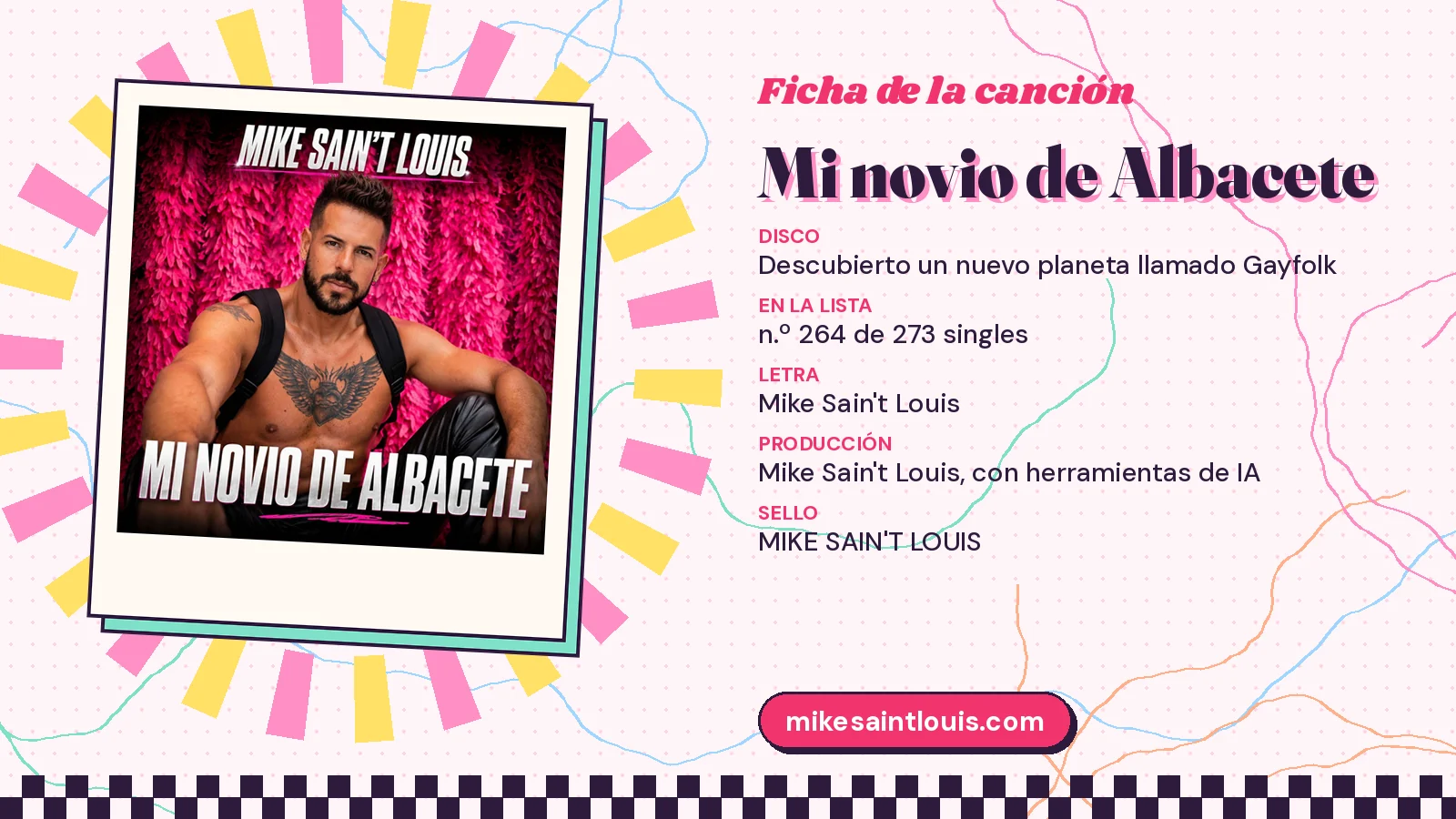
The cover puts a face to the boyfriend, or to someone who might be him. A man with a trimmed beard and a quiff, sitting in front of a wall of fuchsia feathers or fringe that looks like a cabaret dressing-room curtain. He wears a black strappy harness over his bare chest, with a huge winged tattoo across his sternum, one leg drawn up in black patent trousers. He looks straight at the camera with a half-smile, the kind that knows exactly what effect it has.
My name is at the top, in white. The title below, in tall narrow letters, with a pink underline like a highlighter pen.
It's the couple-of-the-year photo, but with only one of them in it. The other is missing. And that absence seems perfect for the song: the narrator isn't in it, just as he wasn't in the important photos, or was in fancy dress. What we see is the shop window, the buff, tattooed man of the first verse posing for the app. The one from «Tú tan cachas, yo tatuado», except here it seems he's the tattooed one too. He's kept everything, even the other's adjectives.
Me in fancy dress
There's one word on the list I want to rescue because it flashes by so quickly: disfrazado, in fancy dress. «Tú por Grindr, yo disfrazado.»
Dressed up as what? The lyric doesn't say, and I'm glad it doesn't. It could be literal: the narrator putting on the sailor suit for the themed party, the harness for leather night, the angel wings for Pride. It could be figurative: the one dressing up as a happy boyfriend, a stable partner, a man with nothing wrong. Both readings work, and both are sad beneath the joke.
Because in that pair of words, the costume is the opposite of the app. One looks elsewhere with his real face, or with what isn't his face. The other tries hard at home wearing a borrowed one. Neither is quite being himself, but only one of them is cheating.
Me grafting
And another: «Yo currando», me grafting. The line is cut short afterwards, with the other's word covered over, but the half you hear already says a lot.
In my lyrics work rarely appears as a theme and constantly as a backdrop. There are department heads, coordinators, offices, shifts. Here the grind is a way of saying who held the couple up. While one was doing his thing, the other paid the rent, put the washing on, did the shopping at the local Mercadona, the Spanish supermarket chain. The gay couple of the year, like nearly every couple, had an unequal share of chores that never made it into the photos.
That imbalance isn't voiced as a complaint. It's said in two words and the list moves on. That's how lists are: they don't stop to cry.
Me dreaming, you acting
And the last pair I wanted to look at, the one closing the third verse before the final chorus: «Yo soñando, tú actuando». Me dreaming, you acting.
Of all the pairs on the list, it's the cleanest. No swearing, no muscles, no apps. Two gerunds. One was believing a story and the other was playing a part. It's the shortest definition I know of a relationship built on deceit, and it came to me almost without looking, between a line about the boyfriend's black hair and another about what a bore he was.
There the song slips from joke to wound without warning, as happens in life. You're laughing at the muscleman and the toilet and suddenly a line reminds you that someone believed it all. Then the chorus comes back and you laugh again. But that line stays.
If I had to keep just one line from the song, it would be that one.
A heartbreak playlist
If you liked the technique, my catalogue has other ex songs that use it in a similar way or play the same game from another angle. «La casa de los mil cadáveres» has its helping of self-parody, and I gave it its own page. In all the singles you can search by title, and on the lyrics page they're all there to read while they play.
I'd recommend doing that with this one: read the list of pairs while you listen. The trap is far easier to see with both columns in front of you.
Why Albacete
I explained it in the other piece, but I'll say it again in a line: Albacete is there because it rhymes with everything I needed it to rhyme with. Retrete, loo; ojete, a rude word for one's backside; se la mete, which I'll let you work out. The three words of the chorus and the ending land on the same sound. Had the boyfriend been from Cuenca, the song wouldn't exist.
The city isn't to blame for anything. In fact I think Albacete comes off rather well, because the song gives it a reputation as a place of passion rather than as a flat stretch of La Mancha famous for its knives.
The album of the first discovery
«Mi novio de Albacete» lives on the first album of the trilogy, «Descubierto un nuevo planeta llamado GAYFOLK», A new planet called GAYFOLK discovered. In how to listen to the Gayfolk trilogy from start to finish I suggest an order for anyone who wants to go through it all, and this song fits the stretch of down-to-earth heartbreaks, the ones still happening on this planet before the journey takes off.
It makes sense for it to come early. It's a song about a couple who put themselves on show too much. The planet Gayfolk I imagine is the place where you don't need to be couple of the year to be left in peace. Where you can be a perfectly ordinary couple, with your grey days and your non-matching T-shirts, without anyone waiting to watch you crash.
A list for you
If you want to try the technique, here's the exercise, which is very easy and very cruel. Take a relationship of yours that has ended. Write seven lines in the form "you so X, me so Y". Try to make the first three fair. From the fourth to the sixth, let the resentment out. And in the seventh, write the truth about yourself, even if it hurts.
You'll be surprised by what turns up in that last line. Mine came out as "failure". Yours might be "naive", "coward", "in love". Whatever comes out is the song. Everything before it is the set dressing.
You needn't publish it. Or show it to anyone. Just write it all down, in shaky handwriting if need be, and read it out loud once, even if only in front of the bathroom mirror.
Then, if you like, flush the list down the loo. There's precedent.
Frequently asked questions
What is «Mi novio de Albacete» about? About a gay couple who seemed perfect and break up over infidelity. The boyfriend travels five hours to leave a farewell note that ends up in the toilet. The full lyrics are at gayfolkplanet.com/letras.
What technique does the lyric use? A parallelism of contrasts: each line sets the two partners against each other with one word apiece, along the lines of "you so buff, me tattooed".
Which album is it on? «Descubierto un nuevo planeta llamado GAYFOLK», the first album of the GAYFOLK trilogy.
Who wrote it? Mike Sain't Louis, who signs the lyrics, composition and production. The music and vocals were made with artificial intelligence: he's the first AI songwriter.