
By Mike Sain't Louis ·
Thirty insults on waking up: online hate and anti-LGTBI cyberbullying
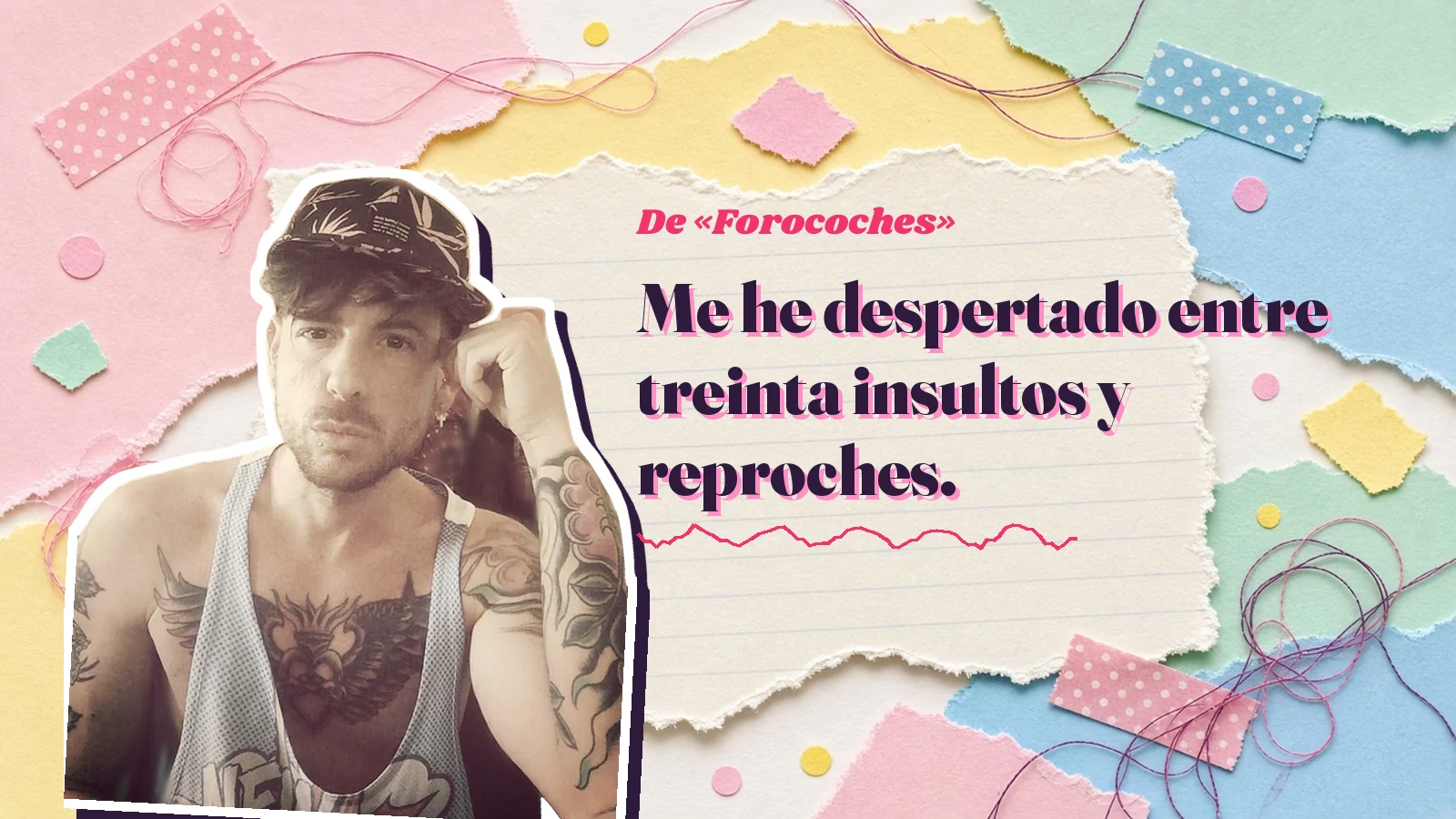
«Me he despertado entre treinta insultos y reproches.»
I've woken up among thirty insults and reproaches. It's one of the lines of «Forocoches», a song from «El día de la liberación», the third album of the GAYFOLK trilogy. (If you want to read it top to bottom, it's here, in full.) It isn't a song about the internet. It's a break-up song, about a sleepless night and photos looked at over and over. But in the middle of that night comes a phrase that still strikes me as the best description of digital noise I've ever written: «Ya no distingo si es mi vida o forocoches», I can no longer tell if it's my life or Forocoches.
The title borrows the name of a very well-known Spanish forum, but it isn't about that forum or its users. I use it as an image: the moment your life looks like an endless thread of comments, where everyone has an opinion, nobody listens and every morning you have to read what they've said about you. From that image I want to talk about something very serious: online hate against LGTBI people, cyberbullying, what the law says and what we can do when the phone becomes a window that lets the rubbish in.
The phone on the bedside table
In the song the phone is always close. The narrator checks a profile at all hours: «Mirando tu instagram hoy vuelve la locura», looking at your Instagram the madness comes back today. He sends messages he shouldn't send. He wakes up and the first thing he sees is reproaches. Anyone with a phone recognises that scene.
For centuries, insults stayed in the street, the playground or the bar. When you got home, you shut the door. Today the door doesn't shut. The insult travels in your pocket, gets into bed with you, waits for you when you wake. For an LGTBI person who has already been insulted outside, the screen can become one more place where they aren't safe.
What the data says
Spain's Interior Ministry publishes a yearly report on hate crime trends. The 2023 report recorded 223 known hate incidents committed through the internet and social media, 32% more than the year before. Of those, 58 fell under sexual orientation and gender identity, compared with 43 in 2022: a 35% rise. Together with ideology, it was one of the categories with most cases online.
The same report noted that the internet was the most common medium for hate crimes and incidents, at 39.01% of the total, followed by telephone and communications at 26.91% and social media at 25.11%.
Those figures need careful reading. They are incidents that came to the attention of the police. The vast majority of insults online are never reported. People delete them, block, switch the phone off and carry on. That's why official numbers are the tip of an iceberg we all sense is much bigger.
The algorithm that rewards anger
There's a question I often ask myself: why does there seem to be so much hate online, when in daily life most people I know are reasonable? Part of the answer lies in how platforms work. Content that provokes strong reactions, above all anger, tends to get more comments, more replies and more attention time. And whatever gets most attention gets shown most.
You don't need to be an expert to notice. A news story about two men adopting a child can get thousands of cruel comments on one network and almost none in that couple's real life, in their neighbourhood, at the child's school. Anger gathers where it's rewarded.
That excuses no one. Whoever writes an insult is responsible for what they write. But understanding the mechanism helps you not take every comment as a faithful portrait of society. The screen distorts. It amplifies some and mutes others.
An insult isn't always a crime
It's worth saying clearly so as not to raise false hopes: not every offensive comment is a crime. Freedom of expression also protects opinions that bother us. Someone saying they don't like a song, criticising it or mocking it isn't hate. It's part of putting things out there.

The line is crossed when the attack goes against who you are. When the message humiliates you for being gay, lesbian, bi or trans, when it incites violence or discrimination against the community, when it threatens, when it turns into a repeated campaign against one person. That's where the Criminal Code comes in, with its article 510 on incitement to hatred, and the aggravating circumstance for discriminatory motives in article 22.4. Article 510 itself provides for higher penalties when the acts are committed through the internet, social media or the media, because the reach is so much greater.
On top of that, Ley 15/2022, the comprehensive law on equal treatment and non-discrimination, and Ley 4/2023 recognise discriminatory harassment on grounds of sexual orientation or gender identity, including online.
The words they insult us with
My songs are full of strong words. I proudly use «marica» in some titles myself. That's why I know the same word can be a hug or a stone depending on who says it and why. From inside the community, it's a way of reclaiming what was taken from us. In an anonymous comment under a photo of two girls kissing, it's something else.
The difference isn't in the dictionary; it's in the intent and the repetition. Someone who reads the same word a hundred times in a week, in different messages, from different accounts, isn't receiving a hundred opinions. They're receiving one message: you're not welcome here. And that message sinks in.
Thirty notifications
I notice the number in the song: thirty. Not one or two. Thirty. It's a figure you can't answer one by one. That's what online attacks are like: they come in swarms. All it takes is one profile with many followers sharing something of yours with a sneering comment and, within an hour, you have hundreds of replies from people who don't know you.
That dynamic has a name in English, dogpiling. And it's especially harmful for young people, who are still building their identity and sometimes haven't even come out at home. An attack like that can force them out of the closet, can reach their family, their school, their job.
Not telling life from the forum
«Ya no distingo si es mi vida o forocoches.» I come back to this line because it describes something that doesn't appear in statistics: the effect of living with the noise inside you. Nobody needs to insult you directly. Reading sneering comments about people like you every day, on news stories, videos, threads, is enough for your mind to start believing that's normal, that's what most people think.
It isn't. Social media amplifies the loudest, not the most numerous. But it's hard to remember that at two in the morning with the phone in your hand. That's why I think it matters so much to look after what we read, set limits, mute words, leave certain threads. It isn't cowardice. It's hygiene.
What I learned from comments
I've already written about my relationship with criticism in «Lo que aprendí de los comentarios negativos». There I distinguished between the one who hasn't listened to anything, the one who can't stand what I am, and the one who's right. That classification still works for me.
Some of my songs were born precisely as replies. «Tus letras son basura» is dedicated to everyone who ever got that comment and kept creating anyway. «El segundo exacto» laughs at those who say making songs with artificial intelligence is just pressing a button. And «Gatekeeping» goes after those who put a fence around culture and decide who gets in. But criticism of what you do is one thing and hatred of who you are is another. The first can be answered with songs. The second sometimes has to be answered with a police report.
Outing someone isn't an opinion
There's a form of digital violence that hits LGTBI people squarely and that's rarely talked about: outing, revealing someone's sexual orientation or gender identity without their permission. Posting a photo, a chat, a dating-app profile, so that their family, employer or village sees it. Sometimes a stranger does it. Often it's someone close, an ex, a former friend, someone who knows exactly where it hurts.
Nobody has the right to decide for another person when, how and to whom they share their sexual orientation or gender identity. Spreading that information without consent can violate privacy and, depending on the case, be a crime, especially if it comes with intimate images or threats. And even if it never reaches a court, the harm is huge: some people lose their family relationships or their job over a screenshot.
If someone threatens to out you, keep the evidence, don't give in to blackmail and look for help. If you know something about someone else, the rule is very simple: it isn't yours to tell.
When the attack comes from someone who knows you
«Forocoches» is about a break-up, and it's no coincidence the insult arrives in that context. When a relationship ends badly, the phone often becomes the battlefield. Messages at all hours, reproaches, digs in status updates, fake accounts to keep watching. In the song the narrator also sends messages he regrets: «No evité coger el móvil y enviar esos mensajes», I couldn't stop myself picking up the phone and sending those messages. I think it's honest that the lyric doesn't present anyone as entirely innocent.
But there's a point where an argument becomes harassment. When one side has asked for contact to end and the other carries on. When new accounts are used to get round a block. When friends, relatives or colleagues are contacted to smear someone. That has a name, and in Spain repeated harassment that seriously disrupts a person's life is punished under the Criminal Code.
In LGTBI couples, moreover, the attacker sometimes plays on the fear of outing or on the other person's isolation, knowing they have less of a support network. If you recognise yourself in that situation, you're not exaggerating. You can ask for help from the organisations listed below.
Keep the evidence
If you're receiving hateful or harassing messages, the first thing is to protect yourself. The second, if you want to report, is to keep evidence before blocking or deleting. Some simple steps:

- Take screenshots showing the message, the account name, the date and, if possible, the page address.
- Copy the links to the posts and the profiles.
- Don't reply or get into an argument; that usually feeds the attack.
- Use the platform's tools to report the content and block or mute the accounts.
- If the threats are serious or include personal data, like your address, go to the police as soon as possible.
In the European Union, the Digital Services Act requires platforms to offer ways to flag illegal content and to respond to those notices. They don't always do it well or quickly, but you have the right to use them.
Where to report
You can file a report with the Policía Nacional, the Guardia Civil or the relevant regional police, in person or starting online. In every province there are prosecutors specialising in hate crime and discrimination, whom you can also approach. Organisations such as FELGTBI+ or COGAM can advise you and accompany you through the process.
If you don't know where to start, INCIBE's 017, the Spanish National Cybersecurity Institute, is a free and confidential helpline that advises on digital security problems, including cyberbullying. It's open from 8:00 to 23:00 every day of the year, also on WhatsApp at 900 116 117 and on Telegram as @INCIBE017. It isn't a reporting channel, but they explain what steps to take and where to go.
If you're a minor
For LGTBI teenagers, online harassment is often the continuation of bullying at school. The same people who insult you in the corridor carry on at night in a group chat or from an anonymous account. If you're under eighteen and going through this, you don't have to put up with it alone.
The ANAR Foundation helps children and teenagers on 900 20 20 10 and 116 111, free and confidential. 017 also has a specific service for minors and for their families and teachers. And schools are obliged to act when they know there's bullying among their pupils, even if it started outside school hours.
If you're a parent or a teacher and you suspect a kid is having a hard time online, watch for the signs: sudden mood swings after looking at the phone, fear of going to class, withdrawal, suddenly deleting their accounts. They don't need to tell you they're LGTBI for you to help. It's enough for them to know nobody at home or in the classroom will laugh at anything they say. Ask without interrogating, listen without judging and, if the harassment is real, don't take the phone away as a punishment: that leaves them lonelier and teaches them that telling has consequences. Better to keep the evidence together, talk to the school and, if necessary, report it. Many LGTBI adults remember that what hurt most in adolescence wasn't the insult, but that nobody around them noticed.
Looking after yourself without disappearing
There's a piece of advice that gets given a lot and that I don't fully like: «If they insult you, close your accounts.» Sometimes it's the best thing, and nobody should feel guilty for logging off. But the aim of hate is exactly that: for us to shut up, to leave, to hand the space to those who shout.

That's why I prefer to talk about looking after yourself without disappearing. Making the account private for a while. Filtering comments with certain words. Asking a friend to check your mentions for you for a few days. Limiting screen time at night. Coming back when you feel like it. LGTBI people being present online, telling their lives as something ordinary, is one of the best vaccines against hate. But no vaccine should be given at the expense of the health of the one carrying it.
The night of the song
«Forocoches» is a song about a very bad night, and I don't want to soften it. The narrator has no strength left, has lost his way, looks at photos, imagines what could have been. In the lyric a psychologist appears who recommends he take up exercise. I like that detail because it places, in the middle of the chaos, someone who helps.
That's the figure I want to leave here. When the noise from outside overwhelms you, talking to a professional isn't overreacting. It's sensible. In another song of mine, «La música me está salvando», the title says it all: writing and producing helps me keep going. But a song is no substitute for an appointment, and you don't have to choose between the two.
Where to find help
If online harassment is affecting you, in Spain you can call FELGTBI+'s Línea Arcoíris on 91 360 46 05. COGAM offers free psychological counselling on 91 523 00 70 and on WhatsApp at 602 25 22 43. In Madrid, the Community's LGTBI Information and Support Programme is on 91 701 07 88, and the city's support service for victims of anti-LGTBI hate is on 604 953 169.
And if comments, loneliness or exhaustion ever lead you to think about taking your life or hurting yourself, call 024. It's the suicide prevention line: free, confidential and open day and night, every day. If there's immediate danger, 112. If you're outside Spain, call your local emergency number. Suicide isn't a forbidden subject, and naming it is the first step so nobody is left alone with that thought. If you'd like some words to start with, I left you a letter.
Answering with more life
Online hate feeds on attention. Every angry reply gives it more visibility. That's why sometimes the best way to answer isn't to answer the one insulting, but to support the one being insulted. A kind private message, a warm comment under the photo being attacked, a collective report of the content, sharing what that person does instead of what's said about them.
If every time someone wakes up to thirty insults they also get thirty messages of support, the sum changes. The hate doesn't disappear, but it stops being the only thing you hear.
What doesn't fit in a forum
I'll finish with what the song doesn't say but lets you glimpse. Life isn't a forum. It can't be summed up in threads, upvotes or what someone who doesn't know you says about you. Life is the people who hug you, the songs that keep you company, the mornings you get up without looking at your phone.
I hope there are more and more of those mornings. I hope we can always tell, even when it's hard, which is our life and which is the noise.
Frequently asked questions
Is it a crime to insult someone online for being LGTBI? It depends on how serious it is. Criticism or mockery aren't always crimes, but messages inciting hatred, violence or discrimination against LGTBI people can be a crime under article 510 of Spain's Criminal Code, with higher penalties if committed online. Threats and harassment can also be reported.
How many anti-LGTBI hate crimes happen online? According to the Interior Ministry's report on 2023, 58 hate incidents on grounds of sexual orientation and gender identity committed through the internet and social media became known, 35% more than in 2022. Most cases are never reported.
What is 017? It's INCIBE's cybersecurity helpline, free and confidential, which advises on cyberbullying and other digital problems from 8:00 to 23:00 every day. It also answers on WhatsApp at 900 116 117. It isn't a reporting channel, but it explains how to report.
What is «Forocoches» about? About a sleepless night after a break-up: the phone, the photos, the messages you shouldn't send and the feeling of waking up among insults without being able to tell real life from the noise of a forum. It's a song from the third album of the GAYFOLK trilogy, «El día de la liberación».
Who writes these songs? Mike Sain't Louis, a lyricist, composer and music producer from Madrid who introduces himself as the first AI songwriter. The music and vocals of his songs are made with artificial intelligence.