By Mike Sain't Louis ·
A pink suit of lights: mourning without wearing black
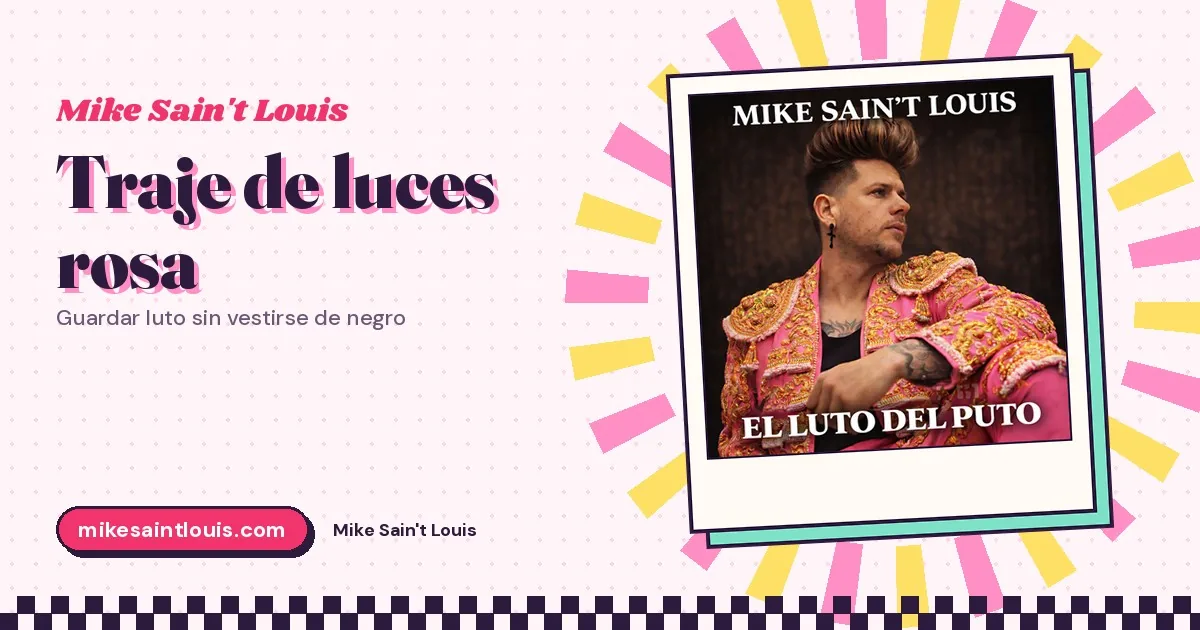
A bubblegum-pink bullfighter's jacket, embroidered in gold, with all its frogging, epaulettes and tassels. Underneath, a black T-shirt. A high quiff, a cross-shaped earring and a gaze lost to one side, like someone who's just remembered something that can't be fixed. At the top, my name. At the bottom, in white serif letters, like an old fair poster: «El luto del puto».
Whoever is wearing the suit of lights isn't in the ring. He's sitting in a corner, afterwards.
This is the cover of one of my songs with the most shameless title, and the competition is fierce. The title is a rhyme that roughly means "the slag's mourning", though «puto» is a word with more lives than that, as we'll see. Today I don't want to talk about the cheek. I want to talk about mourning. About how it's kept in this country, how those of us who don't fit official mourning keep it, and why mine, if I get a say, comes with sequins.
An honest warning
The lyrics of «El luto del puto» aren't yet published on the site's lyrics page, so I won't tell you what they say or who the mourning is for. The song's page leaves the question hanging and invites you to listen. I'll do the same. Here I'll talk about what's already in plain sight: the title, the cover and what they suggest to me.
Mourning, Spanish style
Spain has a relationship with mourning that in other countries would seem straight out of a Gothic novel. Until not that long ago, in many villages, when a husband died the widow wore black for years. Sometimes for ever. Black stockings, black headscarf, black skirt down to the ankles. Then came half-mourning, with greys and purples, as a way of easing out of grief little by little without the village gossiping.
That image of the woman in black sitting at her front door on a rush-seated chair is one of the most powerful in Spanish iconography. It's in Lorca, in «La casa de Bernarda Alba», with its eight years of mourning imposed on the daughters. It's in Almodóvar's films; he grew up surrounded by those women in La Mancha and has put them on screen again and again. It's in any family's black-and-white photos.
Mourning here wasn't just a feeling. It was a uniform. A way of telling the world "I'm grieving, respect me", and also a way for the world to keep an eye on you: if the widow took off her black too soon, she was a hussy.
The mourning that doesn't count
Now an awkward question: who had the right to that mourning?
For a long time, gay men didn't. If your partner died, you weren't a widower. There was no wedding to give you the title, no family to recognise you, no village to respect your black. In the AIDS years, many men lost their partners and had to grieve them in secret, in a hospital corridor, while the dead man's family, who sometimes hadn't seen him in years, took the funeral, the flat and the photos.
That history is real, it's documented and it still hurts many people who lived through it. I'm not telling it to make a joke. I'm telling it because it explains something about the title. «El luto del puto» is, among other things, the mourning that doesn't count. The one with no official uniform. The one nobody grants you because, by the old rules, you have no right to it.
And if they won't let you wear black, what do you wear?
Pink, obviously
The cover answers: pink. Bubblegum pink, with gold embroidery and bullring epaulettes.
I love that answer because it's the one any neighbourhood queen would give if banned from black: fine, I'll wear the loudest thing in my wardrobe. If my grief doesn't count for you, I'll wear it so you can't help seeing it. No rush-seated chair at the front door. A suit of lights.
Pink has a history too. It's the colour of the triangle we were made to wear in the Nazi camps, the one the gay movement later reclaimed as a banner. It's the colour that was taken out of so many boys' hands in the toy shop. It's the colour of camp. Putting on a pink bullfighter's suit to mourn is packing all of that into one garment.
The black is underneath, in the T-shirt. Classic mourning is still there; it hasn't vanished. But what shows on top is pink. The sorrow goes inside; the party goes outside.
The bullfighter as icon
And why a bullfighter? Because the suit of lights is probably the campest garment in the whole of Spanish tradition.
Think about it without prejudice: a man in pink stockings, flat slippers with bows, a short jacket smothered in gold embroidery, a tight sash, a montera hat shaped like Mickey Mouse ears and a fake pigtail he cuts off the day he retires. If that isn't drag, someone come and explain it to me. The bullfighter is the ultimate Iberian macho and, at the same time, he's dressed like a showgirl from the old Barcelona music halls.
Plenty of artists saw that contradiction before me. Almodóvar has a whole film, «Matador», where desire and death mingle around a retired bullfighter. Copla is full of handsome, ill-fated bullfighters who make the folk stars fall in love and die in the ring. The bullfighter has always been an object of desire, watched by women and, secretly, by many men.
My cover doesn't enter the bullfighting debate, which isn't what the song is about. It takes the suit, the image, the iconography, and takes it out of the ring. The bullfighter on the cover has no bull, no cape, no crowd. He has a quiff, an earring and a sad face. It's the suit of lights after the fight, once the floodlights are off.
Half-mourning
There's a beautiful word from tradition that hardly anyone uses now: half-mourning.
After strict mourning, all black, came an in-between stage. Widows could start wearing grey, mauve, purple, black and white together. It was a way of telling the village the sorrow went on but life was starting to return. A negotiated transition between sadness and normality, regulated by what-will-people-say with the precision of a rulebook.
It amuses me to think the pink suit of lights is a sort of queer half-mourning. The black T-shirt is still there underneath, like strict mourning. But on top the colour has come back, and not just any colour. Not the discreet mauve of the widow starting to go to Mass again. The bubblegum pink of the one who's already decided she's going back to the village dance.
The village would gossip, of course. But the village gossips whatever you do, so it might as well gossip while you look gorgeous.
The cross in the ear
Another detail on the cover: the earring. It's a cross, hanging from the lobe, small and shiny.

In tradition, the cross is the mourning symbol par excellence. It's on death notices, headstones, the memorial cards handed out at funerals. Here it's become a fashion accessory, like the ones worn in eighties Madonna videos, rosaries round the neck and crucifixes in the ears. The cross as costume jewellery.
That mix of sacred and frivolous is very Spanish and very camp. At Easter you see ladies in mantillas and tall combs with gel nails. In the processions, brotherhood members with tattoos and designer trainers under their robes. The sacred and the worldly have lived side by side in this country for centuries without asking each other's permission. The cover's earring follows that tradition: mourning in the ear, glitter everywhere else.
The death notice
And while we're on rituals, another that fascinates me: the esquela, the death notice.
Spanish newspapers still print those black-framed notices, cross at the top and the usual formula: «Falleció cristianamente», died a Christian death, «Sus hijos, nietos y demás familia ruegan una oración por su alma», his children, grandchildren and other relatives ask for a prayer for his soul. It's a literary genre of its own, with fixed rules and hierarchies. The order of the names tells you who mattered in the family and who didn't.
For a long time, gay men's partners didn't appear in those notices. Or they appeared in disguise, as "his friend" or, at best, under «y demás familia», "and other relatives". There's a whole song hidden in that expression, "and other relatives", which is where they put all of us who didn't fit in the official family tree.
«El luto del puto» could be the death notice nobody published. With the name in big letters, in pink, and no "other relatives".
The funeral home and the croquetas
There's one more thing about Spanish mourning I can't leave out, because it's the most comic and most human part: the tanatorio, the funeral home.
Anyone who's been to a wake in Spain knows that in the room next to the deceased, anything goes. Vending-machine coffee, biscuits, talk about the weather, gossip about the will, cousins you haven't seen since your First Communion. Sometimes there's laughter. Sometimes there are rows. There's always someone asking why so-and-so hasn't come.
That blend of grief and long lunch strikes me as one of the truest things we have. It turns up in my songs now and then: a cruise that feels like a floating funeral home, a funeral that turns into a party. The pink suit of lights fits that tradition perfectly. He's the one who turns up at the wake dressed for the club because he's come straight from there, and nobody knows whether to be scandalised or ask him to stay.
The rhyme
The title plays on two words that sound almost the same: «luto» and «puto», mourning and slag. One letter apart. The L and the P.
It's a playground rhyme, the kind used to pick on someone. «Luto, puto.» And yet, putting them together does something odd: the serious word contaminates the vulgar one and the vulgar one the serious. Mourning becomes a little less solemn. «Puto» becomes a little sadder.
On the song's page I say the title makes you smile and think at the same time. That's the best description I have. You read it and the rhyme makes you laugh, and a second later you wonder: who's in mourning? For whom? Why does he have to carry that word stuck to him?
And «puto» has that double use every Spanish speaker knows: insult and intensifier. «Ese puto», that bastard, is an insult. «El puto amo», the bloody master, the absolute king, is praise. The title doesn't say which it is. Maybe both.
Heavier than a Goya
This way of mixing the drama of Spanish tradition with a shameless joke isn't new in my catalogue. In «Almodóvar», for example, the narrator compares himself to the director from La Mancha to say his drama is the heavyweight kind, and drops a line that still makes me laugh: «este dolor es más pesado / que un Goya» («this pain is heavier / than a Goya»). It's the same operation. You take a symbol of official culture, Spain's film award, and turn it into a unit of weight for heartbreak.
The pink suit of lights does the same with bullfighting. Copla did it with Holy Week and with flamenco. I talk about it in copla inside queer pop: the old drama suits us so well because it came exaggerated from the factory. You just add a little glitter on top.
The faraway look
Back to the face of the boy on the cover, because it's the key.
He isn't looking at the camera. He's looking to one side, downwards, at something outside the frame. His mouth is closed, no smile, jaw slightly tense. It's the expression of someone who isn't there. Who's remembering.
That gaze contradicts everything else. The suit says party, the quiff says night out, the earring says swagger. The face says something has died. And in that contradiction lies, for me, the truth of mourning for those of us without official mourning: you have to keep going to parties, keep dressing up, keep living your life for the gallery, while inside you're sitting on your grandmother's rush-seated chair.
It's a look anyone knows who's had to go to work the day after a break-up, make-up on and customer-service smile in place. Outside, the suit. Inside, the corner.
No village widow would have understood the suit. Every one of them would have understood that look.
Cutting off the pigtail
There's a bullfighting expression that's passed into everyday speech and fits this cover beautifully: «cortarse la coleta», to cut off your pigtail.
Bullfighters wore a fake pigtail, the castañeta, pinned to their hair. The day they retired, they cut it off in the ring, sometimes in tears, in front of the crowd. Ever since, in Spain, people say «me corto la coleta» when they give something up for good: a job, a hobby, a relationship, a habit. Footballers say it, politicians say it, and so do aunts who swear that this year they won't make the Twelfth Night cake again.
The bullfighter on the cover has a quiff, not a pigtail. But he has the face of someone who's just cut something off. A phase, a love, a version of himself. Mourning, deep down, is that: the moment after cutting off the pigtail, when you've still got the suit on but you know you won't walk into the ring again.
The lovely thing about the expression is that it isn't always sad. Sometimes cutting off the pigtail is liberation. You shed something that no longer served you and go home lighter. Perhaps the title's mourning is that kind: grief with relief, the kind you cry over for a while and then celebrate.
I won't give it away here; that's what the song is for. But the pink is a pretty good clue.
Small mournings
Not all mourning is for deaths. And that, I think, is what lets the song speak to so many people.
You mourn a relationship that ends. A friend who stops being one. A city you leave. The person you were before something. The summers on a beach you no longer go back to. In my catalogue there's a very clean song, no jokes, about that last one: «La playa del Mal Pas». It ends with lines that still seem to me among the truest I've written: «Sigue siendo la misma, aunque yo ya no lo sea. / Y eso, quizás, también es amor» («It's still the same, even if I'm not. / And that, perhaps, is love too»).
That's mourning too. For yourself. For what you no longer are. And there's no uniform for that. Nobody dresses in black because they've turned forty and suddenly realised half their life was something else.
The pink suit of lights is for those small mournings, the ones that never make the death notices. You put it on, sit in the corner and let your gaze drift to one side.
The catalogue's other goodbyes
People say goodbye a lot in my songs. There are solemn farewells, like «Hoy es el último adiós», and farewells that are almost wills, like «Nadie hablará de mí cuando haya muerto», which toys with the idea of one's own death with a mix of fear and mischief. And there are returns to hell after a spell in heaven, as in «Un invitado VIP cortando cebolla», with its cry of going back to the underworld stretched until the vowel breaks.
«El luto del puto» belongs to that family, but with the loudest costume of them all. If the others are goodbyes on a station platform, this one is a goodbye at the bullring gate, with a brass band and white handkerchiefs.
Hundreds of covers, one idea
Every one of my songs comes out with its own cover, and I explain how in hundreds of covers: how I try to keep them alike without boring you. Some covers illustrate the lyric almost literally. Others tell something different, adding to the song like a second layer.
The cover of «El luto del puto» is the second kind. You don't need to have heard the song to understand the image. The image tells its own story: someone dressed for a party who isn't partying. It's almost a painting. It could hang in a contemporary art museum with an endless label about masculinity, tradition and queer identity. I'd rather it hung on Spotify with a title that makes you laugh.
Mourning with glitter
I'll leave you with an idea that isn't a lesson, because I don't like lessons, but nearly.
Everyone mourns as best they can. Some wear black, some shut themselves in, some go travelling, some work like mad. And some put on a pink suit of lights and walk down the street head held high, even if they're in pieces inside. No way is better than another. But if you're handed a grief nobody recognises, know that pink counts too.
And if anyone tells you that's no way to mourn, answer with the title's rhyme. He'll know which of the two words is meant for him.
Frequently asked questions
What is «El luto del puto» about? The song's page raises the question of who is in mourning and for whom, and leaves the answer for the listening. The cover shows a boy in a pink, gold-embroidered bullfighter's jacket with a faraway look, as if after a bullfight.
Where can I read the lyrics? At the time of writing, the lyrics aren't yet published on the Planeta Gayfolk site. The available lyrics are at gayfolkplanet.com/letras.
Why a bullfighter's suit? Because the suit of lights is one of the most eye-catching garments in Spanish tradition, and wearing it in pink, outside the ring and with a sad face, turns the party into a very unconventional kind of mourning.
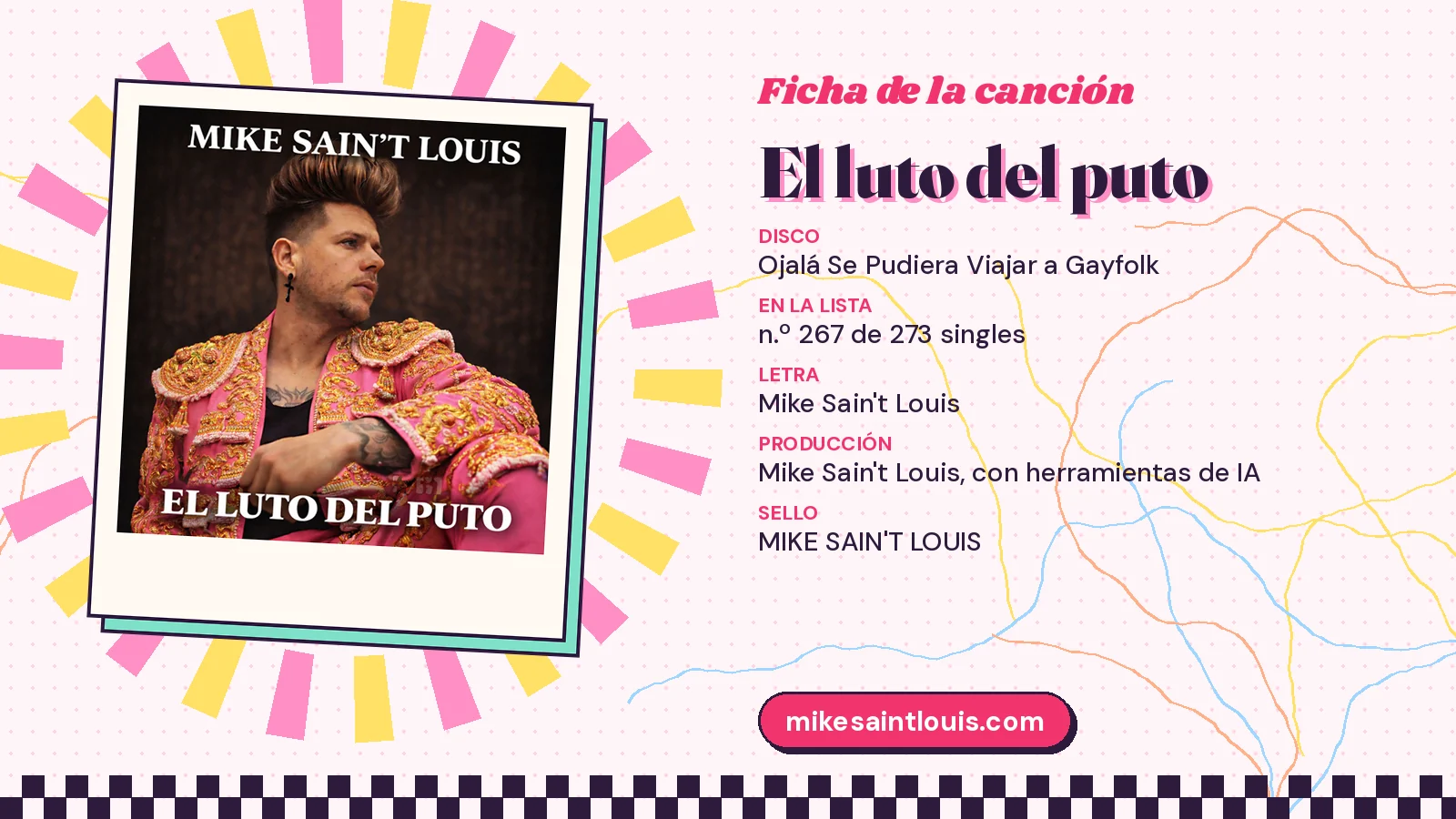
Who makes the song? Mike Sain't Louis writes the lyrics, composes and produces. The music and vocals are made with artificial intelligence.