By Mike Sain't Louis ·
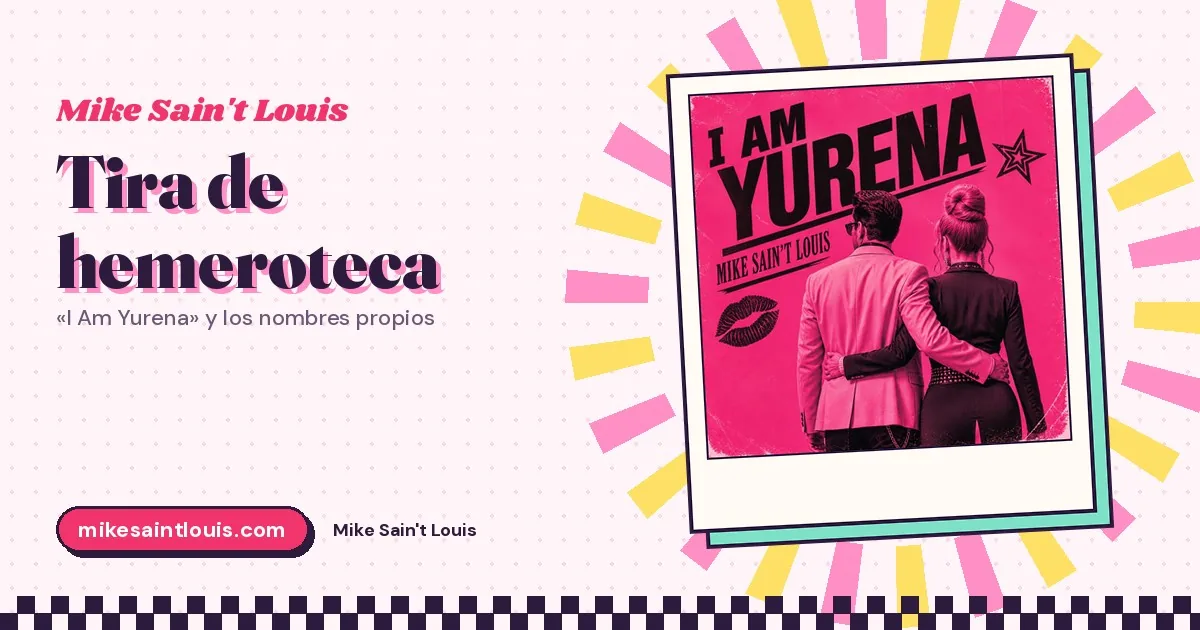
«Tira de hemeroteca»: «I Am Yurena» and the right to change your name
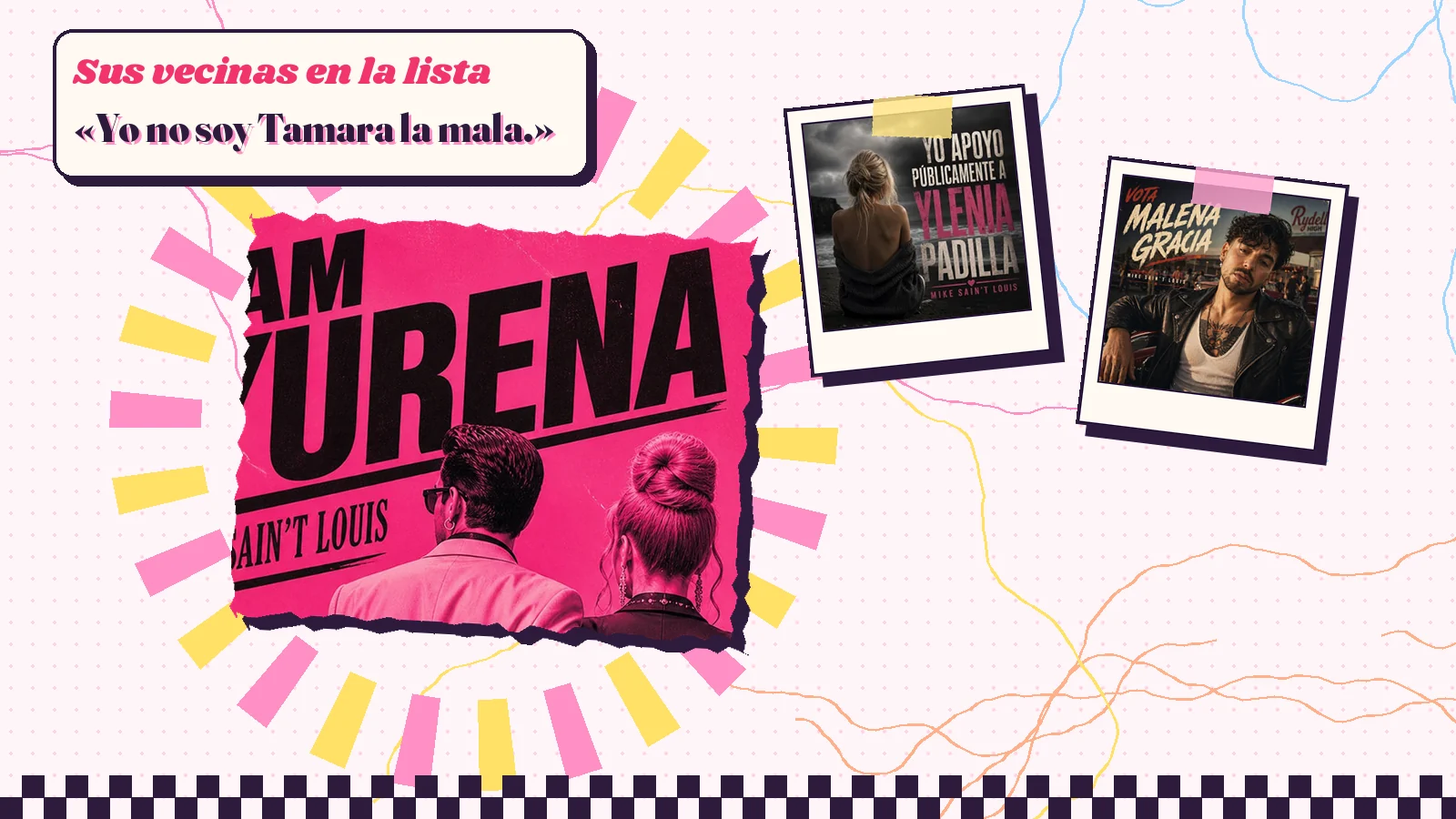
«Yo no soy Tamara la mala.» («I'm not Tamara the bad one.»)
That's how the chorus of «I Am Yurena» begins, and anyone of a certain age who's watched a certain kind of Spanish telly already knows what it's about. For everyone else, a quick summary: there's a Spanish artist who started out under one name, Tamara, had a massive number one in 2000 with «No cambié» («I didn't change»), was afternoon-chat-show fodder for years and, after losing a lawsuit over that stage name, became Yurena, which is what she's been called since 2005. Under her new name she went on being, and still is, an icon for many of us.
The song doesn't tell that story. It takes it as read. What it does is something else: it takes the name change and turns it into a battle cry.
Yo no soy Tamara la mala / Tira de hemeroteca (I'm not Tamara the bad one / Go and check the archives)
The song's page has the summary. Here I want to talk about names. The ones we're given, the ones we choose and why the most important line in the song is an order addressed to a journalist.
Two languages, two tones
The song has two very different halves and it's worth pulling them apart.
The verses are in English: «Neon light, plastic love, / Shining fake, high above. / Cheap romance, fantasy, / I am Yurena, all you see». That's the English of an expensive perfume ad, of an Ibiza catwalk, of a nineties music video with a smoke machine.
The chorus is in Spanish. And in a back-courtyard, neighbours-shouting-across-the-washing Spanish: «Tira de hemeroteca / Y si te molesta / cómeme las tetas» («Go and check the archives / And if that bothers you / you can suck my tits»). No neon here. Just nerve.
The mix is the point. The English is the image on sale: neon, plastic, the international look. The Spanish is what's underneath: a woman from round here, with her temper, who won't be pushed around. The verses are the wrapper. The chorus is the sweet, and it bites. Like those funfair sweets that are bubblegum pink on the outside and full of chilli on the inside.
Plastic, without shame
«Plastic love.» «Shining fake.» «Plastic tears.» «Plastic crown.» Plastic pops up everywhere in the verses.
It might sound like an insult. Calling someone «plastic» usually is: fake, surgically enhanced, artificial. And Yurena has been called that plenty, on TV, in magazines, in online forums. People mocked her body, her face, her surgery, the way they've mocked so many women who've made their own decisions about their own bodies.
In the song, plastic is reclaimed. «I am Yurena, all you see.» If what you see is plastic, then I'm plastic. So what. It's the same logic as wearing the insult as a crown. We maricas did it with «maricón», trans women here did it with «travelo». You take the word they throw at you and wear it as a hat.
I wrote about that, in another context, in «cateto», from insult to flag. The mechanism is the same. Plastic, from insult to crown.
And there's something else I like about plastic as a material: it doesn't hide. Plastic doesn't pretend to be wood. It shines like plastic. In a catalogue full of narcissists pretending to be what they're not, plastic that says «I'm plastic» is the most honest thing there is.
Go and check the archives
Now the line that matters most to me: «Tira de hemeroteca».

Hemeroteca. A word that sounds like the municipal library, microfilm, yellowing newspapers kept in folders. It's the press archive. And tirar de hemeroteca, digging through the archives, is what journalists do when they want to catch somebody out: find what they said ten years ago and throw it back at them now.
In the song, the order runs the other way. It isn't «I'm going to dig up your past». It's «you go and check the archives». It's Yurena telling whoever mixes her up with Tamara the bad one: go and look, get informed, see what really happened. Don't give me the chat-show version. Read.
It's the line of someone who knows her story has been told badly. That the version doing the rounds is the joke version, the clip taken out of context, the cruel headline. And who asks you to go to the source.
It seems a very reasonable demand to me. And a very rare one to see met, because almost nobody bothers. It's easier to stick with the meme than to go to the archives.
«Tamara la mala»
Who is «Tamara the bad one»? I didn't make her up. It was a real nickname.
In 2004, another artist who also used the name Tamara, a bolero performer, sued her over the stage name. The woman from Santurtzi had it registered and won at first instance, though she later lost on appeal. While the lawsuit dragged on, the two of them kept turning up on TV and in the magazines, and to tell them apart the press and the shows christened them like this: «Tamara la buena» and «Tamara la mala». The good one and the bad one. She was the bad one.
That's where the joke, or the fury, of the line lies. When the chorus says «Yo no soy Tamara la mala», it's rejecting a nickname television gave her. And when it says «tira de hemeroteca», it's saying: go and look at what really happened. Look at who had the name registered. Look at how it was reported. Look at why one was called good and the other bad. And then, if you still want to, give your opinion. But read first, because reading costs nothing and saves a lot of nonsense.
After losing the lawsuit, she tried Ámbar, which was also registered to another artist. And at the third attempt she chose Yurena. So the name the song stands up for is one she chose herself after having another one taken from her twice.
The line doesn't say «I'm not Tamara». It says «the bad one». What it rejects isn't her past or her old name, which was hers and under which she had her number one. It's the adjective. The label slapped on top of her.
I think that distinction matters. Changing your name isn't always disowning who you were. Sometimes it's the only way out they leave you. And then what you do is choose the next one well and defend it tooth, nail and stiletto.
Changing your name
Plenty of people in our community know what it is to change their name. Trans people above all, who in Spain have been able to do it legally without medical requirements since the 2023 law. But also people who take a stage name, a drag name, a nom de guerre.
I sign myself Mike Sain't Louis, with that odd apostrophe so many people get wrong. Some write Mike Saint Louis, with no apostrophe, and I accept it because it's inevitable. But the name is mine, I chose it, and I sign every song with it. In one of them, «La dieta del cucurrucho», I introduce myself by another, more homely name: «Soy Miguel Ángel de León» («I'm Miguel Ángel de León»). Both are true.
The name you choose says who you want to be. The one you're given says who other people think you are. And sometimes there's a huge gap between the two. «Yo soy Yurena» is the line that leaps that gap. I'm not asking you what my name is. I'm telling you.
«No cambié»
There's an irony in this story that I adore and don't want to skip.
The song that made Tamara famous was called «No cambié», «I didn't change». Ten weeks at number one in the sales chart in 2000, ahead of names like Madonna and Alejandro Sanz. A chorus half of Spain shouted along to, at weddings, at village fiestas, on afternoon telly. I didn't change. And a few years later the very same artist had to change her name.
Some people would see a contradiction in that and go for the cheap joke. «I didn't change, she says, and then she changes even her name.» I've heard it. Everyone has.
I see it the other way round. Precisely because she didn't change inside, she could change outside. The name is the outside. What people use to call you. What goes on the posters. The inside, what you are, can stay the same even if you go by something else. More than that: sometimes changing your name is the only way not to change inside. To stop the character they invented for you from swallowing you whole.
«Yo no soy Tamara la mala» and «No cambié» don't contradict each other. They complete each other. I didn't change. The name they gave me did. And if that bothers you, you know what to do.
Neon, plastic, cheap, fantasy
Back to the English verses, because they're doing more work than they seem to.
«Neon light, plastic love, / Shining fake, high above. / Cheap romance, fantasy.»
They're nouns with adjectives stuck on, no verbs. A list of labels, like the ones in shop windows. Neon. Plastic. Fake. Cheap. Fantasy. Those are the words people have used to describe Yurena for years, and many others like her. I lined them up so you could see them.
And then, at the end of the verse, the verb: «I am Yurena, all you see». Am. The only verb in the whole verse is the verb «to be». After a list of labels comes the «I am». The labels are what you see. The «am» is what's there.
The second verse plays the same game with other words: «Glitter night, plastic tears, / Fake desires, empty cheers. / Plastic crown, melody». And again: «I am Yurena, all you see».
The «empty cheers» are what hurts me most in the two verses. That's studio applause, the kind the floor manager asks for with a sign. A lot of these women have had thousands of rounds of applause like that, meaning nothing. Applause for laughing at them. The song calls it by its name.
The archives in the age of Google
A note on «tira de hemeroteca», because the phrase has a particular sting in 2026.
Nobody goes to a press archive these days. You don't have to go to the National Library and ask for the microfilm of a 2005 newspaper. You just type a name into Google. And that's exactly why the line bites harder. If it's so easy to find out, why do people still stick with the joke?
Because the joke turns up first. Because on Google the first thing you get is the viral video, the clip from the show, the meme. The real archive, the one that tells things calmly, is on page three of the results, and nobody gets to page three.
«Tira de hemeroteca» is, deep down, a request for effort. Get past page one. Read more than the headline. Listen to the person before the meme. It's what I'd ask of anyone judging me by a fifteen-second video. And it's what I ask of myself when I catch myself laughing at someone I know nothing about.
What I'm not saying about Yurena
I'm not going into details of her life, her surgery, her relationships or her troubles in this post. Not because I haven't read them, more or less everyone has, but because it isn't my place. The song doesn't tell them. And if the song asks you to check the archives, the consistent thing is for me not to play the cheap archive.
All I'll say is what the song says: that her name is Yurena, that she isn't the bad one they invented, and that if that bothers you, you know what you can do.
And if that bothers you
Y si te molesta / cómeme las tetas (And if that bothers you / you can suck my tits)
Now this is pure house style. After the serious reclaiming of the name, the rude punchline. It couldn't have gone any other way.
If it bothers you that my name is Yurena, that I've had work done, that I'm plastic, that I'm not the bad girl you wanted: you can suck my tits. It's «couldn't care less» with class. It's a way of ending the conversation that leaves no comeback.
I love that the punchline is physical. Tits. The body that was mocked so much is the one offered, sarcastically, as the answer. It turns the mockery round: you laughed at my body, well, here it is, help yourself.
It takes nerve to put those two lines in a chorus rather than in a verse tucked away somewhere. In the chorus they're repeated. Shouted. They stick. And that was the plan: for everyone who hears the song to walk away shouting «cómeme las tetas» without even noticing.
A chorus made for shouting
The chorus of «I Am Yurena» comes round many times. It's one of those you've learnt by the second listen. And it ends with an exclamation-marked «¡Yo soy Yurena!» made for shouting in a crowd, on a dance floor, at some ungodly hour.
Writing a chorus that laughs at you and with you at the same time is one of the hardest things in the trade. I have a post about it, how to write a chorus that laughs at you and with you. In this case the chorus doesn't laugh at Yurena. It laughs with her, at whoever mixes her up. And whoever shouts it takes her side without thinking.
That's the power of a chorus: it makes you say things in the first person. When you shout «I'm Yurena», for three seconds you are Yurena. You too reclaim your name. You too send someone off to the archives.
Why Yurena is ours
Yurena is a gay icon in Spain, just as Tamara was before her. Her songs have been playing in gay clubs for years, and she's one of those figures any queer man of a certain age recognises instantly.
Why? For the same reason as Britney, as Ylenia, as Malena Gracia, as so many others. Because she's a woman everybody laughed at who kept going. Because she's over the top, artificial, camp, and doesn't apologise for it. Because they took her name and she chose another one, and defended it. Because she remade her body and defended it. Because she turned the jeers into a show.
For a queer kid who grew up hearing people mock him, that's an instruction manual.
I wrote about the difference between laughing at someone and laughing with someone in from other people's laughter to our own. Yurena is the perfect example of someone who went from being the object of other people's laughter to the subject of her own.
Camp in its purest form
«I Am Yurena» is probably one of the campest songs in my whole catalogue. And I'm not saying that as an excuse.
Camp, for me, isn't a joke. It's a serious way of looking at the world through the exaggerated, the artificial, the kitsch. I explained it in camp isn't a joke even if you laugh. And Yurena is textbook camp: the plastic, the neon, the crown, the stage name, the TV-studio diva.
But the camp in this song has one more thing, which I think matters: it doesn't laugh at Yurena. Camp often gets used to poke affectionate fun at the tacky. Not here. Here camp is on her side. The neon and the plastic are her armour, not her humiliation.
Part of a family
«I Am Yurena» belongs to a family of songs dedicated to women of Spanish popular culture who've been badly treated by TV and the press. There's «Yo apoyo públicamente a Ylenia Padilla», with its «Yo también soy Ylenia Padilla» («I'm Ylenia Padilla too»). There's «Vota Malena Gracia», with its galactic elections. There's «Ojalá hubiera tenido de suegra a Carmina Barrios».
If you look closely, several of them use the first person. «I support.» «I am.» «Me too.» They're not songs about these women in the third person, like a documentary. They're songs where the listener steps into their place. Where «I» am Ylenia, «I» am Yurena.
It's a very neighbourhood kind of solidarity. I don't defend you from the outside. I step into your shoes, even if they're platforms.
On the liberation album
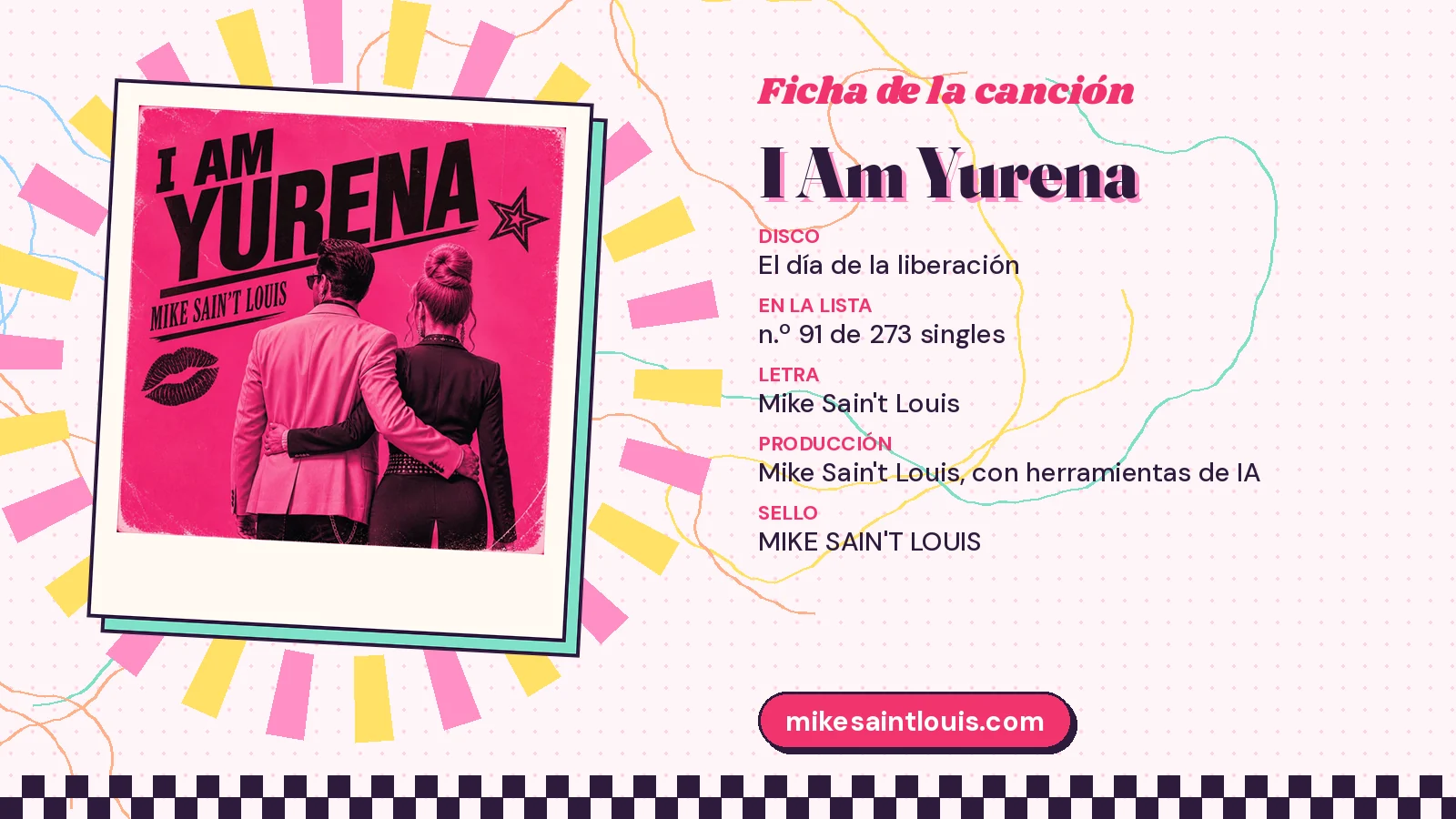
The song is on «El día de la liberación», the third album of the GAYFOLK trilogy. And it fits beautifully, because changing your name and defending it is a liberation.
Freeing yourself from the name they gave you. Freeing yourself from the adjective. Freeing yourself from «the bad one». Freeing yourself from the version of you doing the rounds on TV shows. All of that is liberation, and in the song it's done with a chorus and a «cómeme las tetas».
The third album is full of songs like that. Of people who reach the planet and can finally call themselves whatever they like.
The body, without apology
One last thing. «I Am Yurena» is about a body that has been criticised, judged and ridiculed, and that reclaims itself without apologising. It's a subject that matters a lot to me and that I wrote about in writing about the body without apologising.
In queer culture the body is a battlefield. It's expected to be muscly, young, waxed, perfect. And whoever doesn't measure up suffers. Whoever changes it to measure up suffers too, because then they're «plastic». There's no way to win.
The song suggests stepping out of that game. My body is what it is, natural or plastic, and it's mine. If that bothers you, you know what you can do.
Read it
The full lyrics are on their lyrics page. They're short and repeat a lot, as a dance-floor anthem should. I'd suggest reading them quietly first, to notice the contrast between the neon English and the back-courtyard Spanish. And then out loud, shouting the chorus.
If you're too embarrassed to shout «cómeme las tetas» in your living room, even better. That's exactly the embarrassment you need to lose. And if you have neighbours, let them find out once and for all what the lady's name is.
Frequently asked questions
What is «I Am Yurena» about? It's a tribute to Yurena that turns her name change into a battle cry: «Yo no soy Tamara la mala / Tira de hemeroteca / Y si te molesta / cómeme las tetas / Yo soy Yurena» («I'm not Tamara the bad one / Go and check the archives / And if that bothers you / you can suck my tits / I'm Yurena»).
Why does it mix English and Spanish? The English verses describe the neon, «plastic» image; the Spanish chorus is the nerve of someone reclaiming her name. The contrast is part of the song.
Which album is it on? «El día de la liberación», the third album of Planeta Gayfolk's GAYFOLK trilogy.
What does «tira de hemeroteca» mean? Literally «dig through the press archive». It's an invitation to go to the source instead of settling for the TV-show version or the meme. The speaker is asking people to check her story.
Who wrote the song? Mike Sain't Louis, a lyricist, composer and producer from Madrid. The music and vocals are produced using artificial intelligence as a tool; the lyrics are his.