By Mike Sain't Louis ·
Helmsman without gravity: «Stars cibernéticas», Sally Ride, the cyborgs and the blue patent-leather suit
Some words sound like the future and are more than two thousand years old. «Cibernética», cybernetics, is one of them. You hear it and think of cables, screens, robots from afternoon TV films. Scratch a little and a rowing boat in the Mediterranean appears, with a man standing at the stern holding the tiller. That mix of the ancient and what hasn't arrived yet is exactly what I like about the title I gave this song.
In this post I'm not going to tell you the lyrics, because I haven't published them. I'm going to do something else: take each piece of the cover and the title and follow its trail wherever it leads. To the Greek helmsman, to a mathematician in Massachusetts, to two scientists who in 1960 imagined an astronaut who was half machine, to a woman who flew into space in 1983 and kept her private life to herself until the end. And, on the way back, to a barefoot guy in a blue suit floating above the planet as if it were the most natural thing in the world.
The guy who doesn't touch the ground
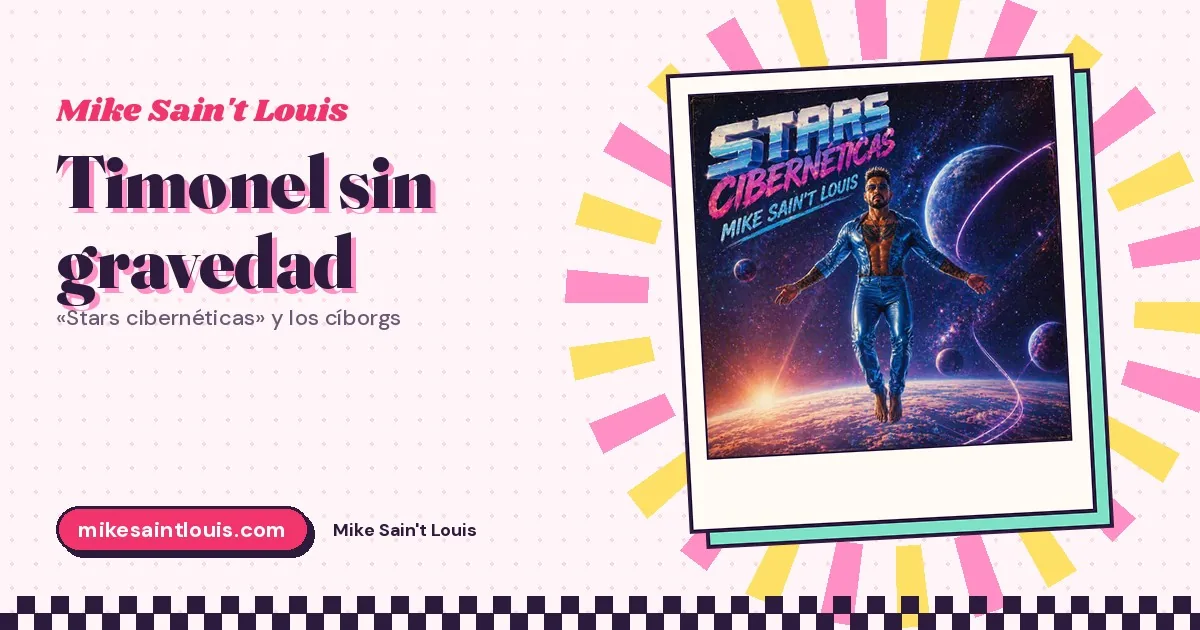
The image is simple to describe and hard to forget. A guy suspended in the void, arms spread wide and feet bare, floats above the globe. His outfit is an electric blue that reflects light like the patent leather of Sunday shoes. Around him there are planets, stardust and lines of pink neon crossing the black background like the trails of a plane nobody can see.
At the top, the title: silver letters with a gradient that recalls the start screen of an eighties console, back when games loaded from a tape and you had to wait five minutes staring at coloured stripes. Below, my name.
There's no ship, no helmet, no safety line. That's the first thing that strikes me every time I look at it. Any real astronaut would die in seconds in those conditions. The guy on the cover, on the other hand, looks like he's sunbathing. It's a fantasy, of course, and that's precisely what it's about: imagining a place where the body weighs nothing and nobody asks you for explanations.
Before take-off: what I know and what I don't
A house rule before going on. The lyrics of this song aren't on my lyrics page. When I haven't published a song's lyrics, I don't paraphrase them, and I don't trust what video platforms transcribe automatically, which with music underneath confuse words with worrying cheerfulness.
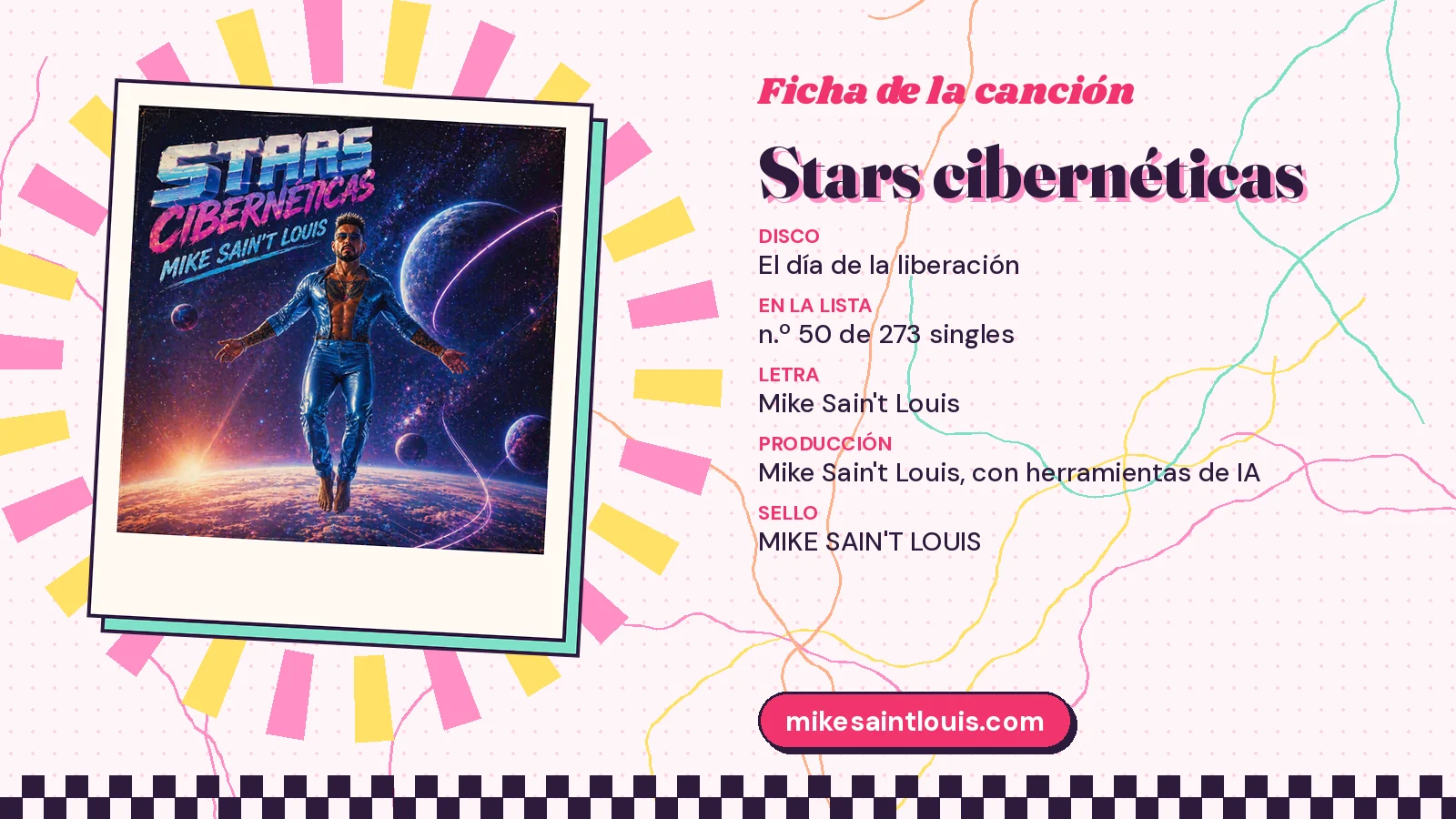
What I can use is in plain sight. The cover. The title, which joins the English stars with the Spanish «cibernéticas». The date I uploaded the music video to my channel, 26 June 2026. The album it belongs to. And what I wrote on the song's page here on the site, where I talked about digital glitter and divas from another galaxy. With that and with facts anyone can check in a library, there's journey enough.
Kybernétes: the man at the helm
In ancient Greek, kybernétes was the pilot of a ship, the one who handled the helm and decided the course. From the same root comes the verb the Romans turned into gubernare, and from there, over the centuries, our «govern» and «government». In other words: every time someone says a country is adrift, they're unknowingly using a nautical metaphor twenty-five centuries old.
Plato already compared the good ruler to a pilot who knows the sea. And in 1834 the French physicist André-Marie Ampère, the one the ampere is named after, proposed the word cybernétique for a science of the art of governing that never caught on under that name.
It amuses me to think about that with the cover in front of me. The guy has no helm, no engine, no map. He floats with his arms open and lets space decide. He's exactly the opposite of a helmsman. Or maybe he's the helmsman after retirement: the one who has finally let go of the controls and discovers that, without gravity, they aren't that necessary.
Norbert Wiener and the machines that correct themselves
The word came back to life in 1948. That year the American mathematician Norbert Wiener, an MIT professor, published a book with a long title and no concession to marketing: Cybernetics: Or Control and Communication in the Animal and the Machine. During the Second World War Wiener had worked on systems for aiming anti-aircraft guns, and from that he drew an idea that changed a lot of things: feedback.
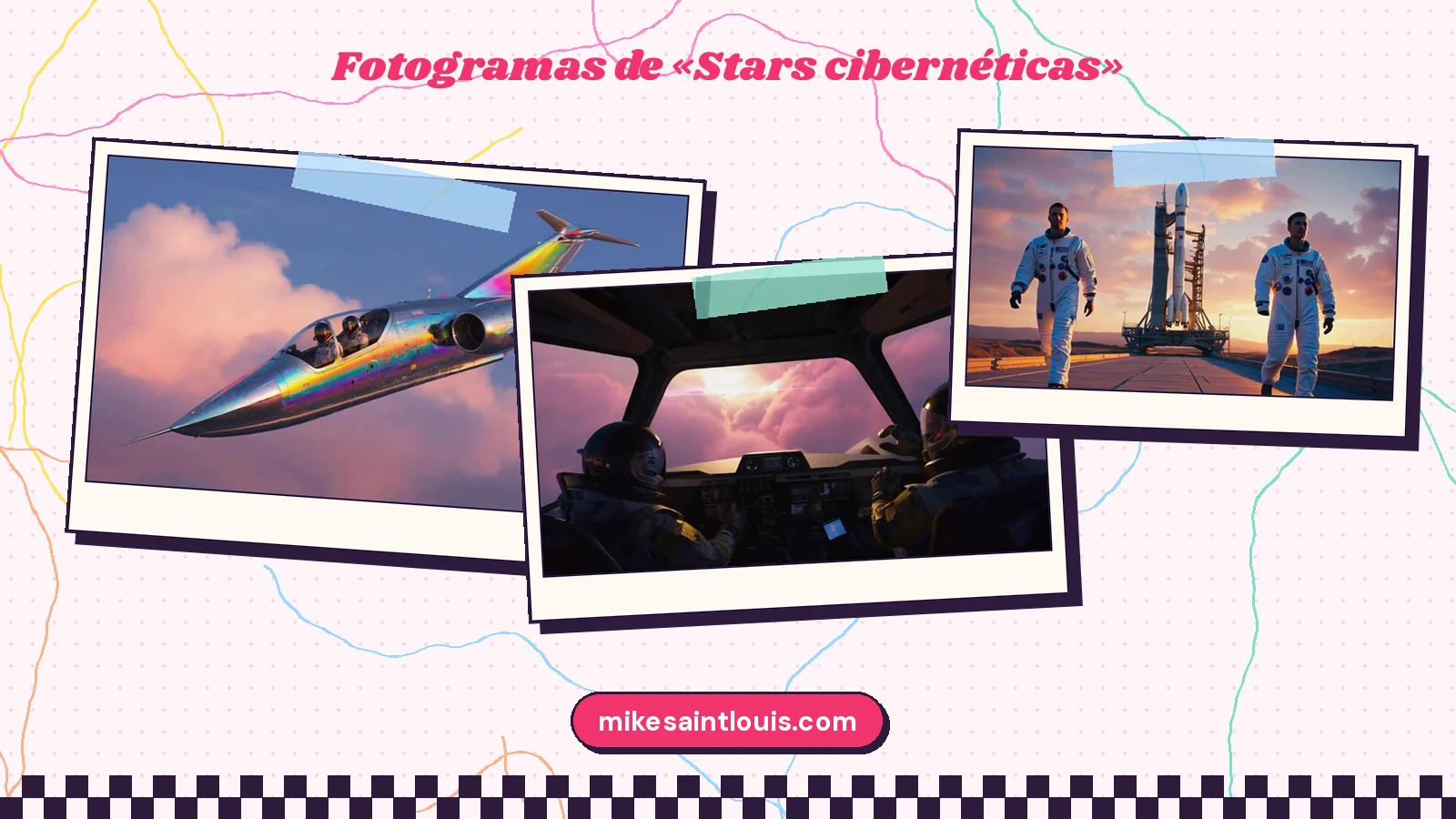
A thermostat is the textbook example. It measures the temperature, compares it with what it should be and switches the heating on or off according to the difference. It doesn't think, but it corrects itself. Wiener saw that the same scheme explained how a person picks up a glass without spilling it, how a pilot holds a course or how a society organises itself.
From there came the prefix that later invaded everything: cyberspace, cybercafé, cyberbullying, cybernaut. What began as the technical name of a theory became the label for anything with a plug. That's why, when I say «cibernéticas», the word drags along the Greek boat, the post-war laboratory and the neighbourhood cybercafé smelling of sandwiches all at once.
1960: the astronaut who was half machine
Twelve years after Wiener, in September 1960, two researchers at a New York hospital, Manfred Clynes and Nathan Kline, published an article in the magazine Astronautics titled «Cyborgs and Space». There they coined the word cyborg, a contraction of cybernetic organism.
Their proposal was quite wild and very much of its time. Instead of taking a bubble of Earth into space, with its air and pressure, why not adapt the human body to space? They talked about pumps that would inject drugs automatically, systems that would regulate breathing or sleep without the astronaut having to think about it. They wanted to free the person from maintenance tasks so they could, in their words, explore, create, think and feel.
Read today, that sentence has something of a poem. And it connects very well with the guy on the cover, who floats without a spacesuit as if his body had learned on its own to live up there. If you had to give that image a scientific label, it would be one of the cyborgs Clynes and Kline dreamed of: someone who no longer needs protecting from the void because the void has become his home.
From the cyborg to the manifesto
The word didn't stay in technical magazines. In 1985 the philosopher and biologist Donna Haraway published her Cyborg Manifesto, one of the most cited texts of late twentieth-century feminist thought. Haraway used the figure of the cyborg to attack borders that seemed natural: between human and animal, between organism and machine, between the physical and what isn't. And, along the way, between masculine and feminine.
Her idea, summarised a lot, was that many categories sold to us as eternal are constructions, and that mixing them can be a form of freedom. You don't need to have read the manifesto to understand why it has echoed so much in queer thought: it's an invitation not to fit.
I bring it here without trying to turn the song into an essay. But a title that mixes two languages, a cover that mixes the Earth with nightclub neon and a guy who mixes an astronaut's pose with a pop star's have something of that spirit. Nobody has asked the guy to choose between being a scientist or a diva. He's wearing both.
Open arms, 108 minutes from home
On 12 April 1961 the Soviet Yuri Gagarin became the first human being to go into space. His flight aboard Vostok 1 lasted 108 minutes and made a single orbit of the Earth. Two years later, on 16 June 1963, Valentina Tereshkova was the first woman to do it, in Vostok 6, and spent almost three days in orbit.

To reach space, by the most widely used convention, you have to cross the so-called Kármán line, about a hundred kilometres up. That's less than the drive from Madrid to Toledo. I love that fact because it puts things in their place: space is very close in distance and very far in everything else.
Spain took a while to have its own traveller. Pedro Duque lifted off on 29 October 1998 on the shuttle Discovery, on mission STS-95. And in 2022 the European Space Agency chose Pablo Álvarez as a career astronaut and Sara García as a reserve. The cover of «Stars cibernéticas» isn't about any of them, but every time someone from here goes up, the fantasy of the floating guy becomes a little less of a fantasy.
Sally Ride and the life kept private
On 18 June 1983 Sally Ride lifted off aboard Challenger on mission STS-7 and became the first American woman in space. She was a physicist, thirty-two years old, and answered very patiently when journalists asked her whether she'd cry if something broke down or whether the flight would affect her ability to have children.
Ride died on 23 July 2012. The notice published after her death included a fact almost nobody outside her circle knew: for twenty-seven years she had shared her life with Tam O'Shaughnessy, also a scientist and her partner in a science-education company for girls. That's how the world learned that the first American woman astronaut was also the first known LGBTQ+ person to have travelled to space. In 2013 she was posthumously awarded the Presidential Medal of Freedom, and it was Tam who received it.
That story moves me because it says a lot about how much was kept quiet before, even at the top. Someone who had been higher than almost anyone had to be gone before the person she lived with could be named. When I look at the guy on the cover floating with his arms open, hiding nothing, I think of all the Sallys who couldn't.
What weightlessness does to the body
The cover sells lightness, and the lightness is real, but it has small print. In microgravity the spine stretches and astronauts can gain a few centimetres in height while in orbit; they lose them on return. Bones, with no weight to bear, lose density: according to NASA, some parts of the skeleton can lose around one per cent a month. Muscles waste away if they aren't exercised, which is why on the International Space Station people work out for about two hours a day.
There are more oddities. Body fluids rise towards the head and the face swells a little; the legs get thinner. Many astronauts feel sick for the first few days, the so-called space adaptation syndrome. And on coming back, walking in a straight line is as hard as after a long night.
I like knowing that part because it turns the image into something more tender. Floating is wonderful, but the human body is made to have its feet somewhere. Maybe that's why the guy is barefoot: for when it's time to land.
A blue patent-leather suit
The metallic blue outfit on the cover has nothing to do with a real spacesuit, and that makes it more fun. Real suits are armour with many layers. The ones the Apollo astronauts wore to the Moon, the A7L, were made by ILC Dover, a company that came out of the International Latex Corporation, the same firm that produced Playtex bras and girdles. The seamstresses who knew how to sew lingerie with millimetre precision were the ones who sewed the suits that walked on the Moon in 1969.
That fact strikes me as pure camp: the conquest of space depending on the hands that made corsetry. And it gives meaning to the suit on the cover, which protects against nothing but shines enormously. It's more gala costume than technical gear. More catwalk than launch pad.
In fashion, silver and metallic blue had their space moment in the sixties, when designers like Pierre Cardin and André Courrèges showed collections inspired by the space race, with helmets, white boots and fabrics that seemed to come from another planet. The guy on the cover is heir to that idea: dressing for the future even if the future never arrives.
Stars with a capital and a small letter
Stars, in English, are the ones in the sky and also the ones in show business. In Spanish the same happens, and that lets the title work on two levels. Real stars are balls of gas at millions of degrees that have been there since long before us. The others are people who shine because we look at them.
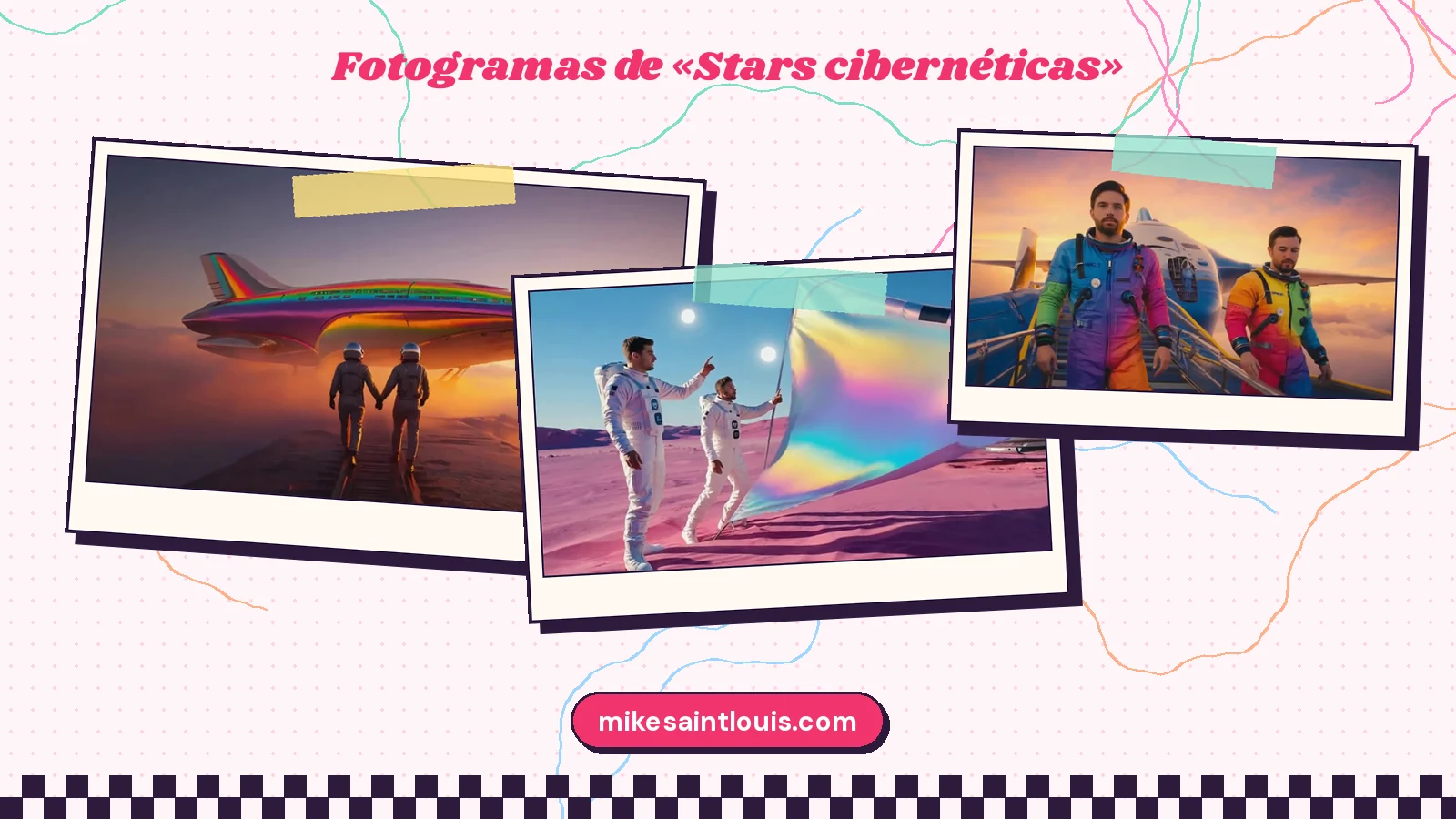
In the twenties and thirties Hollywood built what was called the star system: studios that manufactured stars with endless contracts, changed names, invented biographies and cover-story romances. Many of those stars were gay or lesbian and lived with their real lives hidden under a layer of compulsory glitter.
When I put stars together with «cibernéticas» I think of a third category: stars made neither of gas nor of flesh, but of screen light. Pixel divas. And I don't think that's an insult, quite the opposite. For decades screens were the window through which many LGBTQ+ people first saw someone like them.
Starman on TV
It's impossible to talk about stars, space and sparkle without passing through David Bowie. In July 1969 he released «Space Oddity», the story of Major Tom lost in orbit, which the BBC used in its coverage of Apollo 11 reaching the Moon. Three years later he invented Ziggy Stardust, a rock star from outer space, androgynous and covered in glitter.
On 6 July 1972 Bowie appeared on the British programme Top of the Pops performing «Starman», in a tight colourful jumpsuit and with his arm draped over the shoulder of his guitarist, Mick Ronson. Many kids who watched that night in their living rooms have since said they felt, for the first time, that there was another way of being. It was a three-minute gesture on TV, and for some it meant a whole life.
In 2013 the Canadian astronaut Chris Hadfield recorded a version of «Space Oddity» aboard the International Space Station, floating with his guitar. It was the first music video recorded in space. The fantasy of the guy on the cover had, in a way, already been made real by someone with a moustache and a uniform.
Seeing the Earth from outside
On the cover, the Earth fills the lower part. The guy is above it, but he doesn't turn his back on it: his open arms seem to embrace it. That position reminds me of something astronauts have been describing for decades.
In 1987 the writer Frank White named the «overview effect» the change many described on seeing the planet from space: a sudden feeling of fragility, that borders can't be seen from above, that everything we know fits on a blue ball hanging in nothing. Some came back wanting to look after the planet more; others with less patience for small fights.
I like that idea applied to everyday life. Sometimes what we most need is to step back a little to understand the real size of our problems. It's not always possible, of course. But a while of music with your eyes closed is quite like going up a hundred kilometres without leaving the sofa.
Rumba under the endless sky
«Stars cibernéticas» shares an album with other songs that also look upwards. In «Verde», whose lyrics are published, there's a line that comes to mind every time I think of this cover:
Rumba y risas bajo el cielo sin fin,
(«Rumba and laughter under the endless sky.») In «Verde» that sky belongs to a square full of clapping, at ground level. In «Stars cibernéticas» the endless sky is no longer above but all around. It's the same sky seen from the other side: first you look at it from the party, and then you find yourself floating inside it.
I'm not saying the two songs tell the same story, because I haven't published the lyrics of this one and I'm not going to play at guessing them. Only that, side by side, the album traces a curious route: from the party in the square to dancing in orbit.
Who writes the stars
In the singles list on gayfolkplanet.com, «Stars cibernéticas» is number 50 of 273. Just before it is «Tus letras son basura», which has a text published instead of conventional lyrics. In that text I wrote a sentence I still stand by:
Lo que muchos no soportan es que mis letras las escribo yo.
(«What many can't stand is that I write my lyrics myself.») It seems a perfect neighbour for a song with the word «cibernéticas» in its title. Because people tend to mix things up: I write the lyrics and compose the songs, and the vocals on my tracks are made with artificial intelligence. I've explained it calmly in my post on artificial intelligence and authorship. The machine is part of the process, but it doesn't make up my stories.
Right after it in the list comes «Breeze», with its guy levitating over a Mediterranean coast at sunset. Two covers in a row of floating bodies: one in space, the other a few metres above the sea. If you play them in that order, it's like coming down from orbit to a terrace.
June, liberation and a planet of our own
I uploaded the music video on 26 June 2026, two days before the Stonewall anniversary. The song is part of «El día de la liberación», the third chapter of the Gayfolk trilogy, the album where things finally come loose.
The whole trilogy has a calling for homemade science fiction. The first album is about discovering a planet, the second about wanting to travel there and the third about what happens when you finally arrive. I already wrote about that imaginary geography in the post on Oz, Fire Island and planet Gayfolk, about all those places LGBTQ+ people have had to imagine before finding them.
The guy in «Stars cibernéticas» fits there as the trip's final postcard: he's no longer looking for the planet, he's already outside, floating, looking back with open arms.
Screens, robots and company
It isn't the first time one of my covers mixes body and machine. In «Hipnótico robótico» there's a neon suit and an automaton look that plays with the same idea from another angle. And a while ago I told, half joking, how I created a boyfriend with artificial intelligence, an experiment that taught me quite a lot about what we look for when we look for company.
The cybernetic, for me, isn't cold. It's one more way of being accompanied. Screens have joined us to people we'd never have met and have also left us lonelier than ever on certain nights. Both things are true at once.
When orbit isolates
Floating sounds lovely, but it has a flip side. There are spells when you feel disconnected from everything, as if you were watching your own life from very far away, through glass. If that feeling of unreality or isolation lasts, keeps coming back or stops you from functioning, it isn't a whim: it deserves a visit to your doctor or a mental health professional.
If at any point thoughts of hurting yourself appear, in Spain there's 024, the free and confidential suicide-prevention line, available at any hour. In immediate danger, call 112. If you live outside Spain, dial your country's emergency number or look for a nearby helpline at findahelpline.com.
I've gathered more resources in my series on mental health without taboo.
To listen to in orbit
I thought of it for night journeys, for when the city looks like a panel of lights through the window and you imagine you're inside a ship. For whoever wanted to be an astronaut as a kid and ended up doing something else. For whoever puts on glitter on any old Tuesday just because.
Also for whoever is still waiting for the day to let go of the helm. Sometimes the course isn't decided by gripping harder, but by opening your arms and letting something bigger hold you for a while. Even if only for as long as a song lasts.
Frequently asked questions
What is «Stars cibernéticas» about?
The lyrics aren't published yet, so I don't summarise or invent them. The cover shows a barefoot guy in a metallic blue suit floating above the Earth among planets and pink neon trails. This post goes through the ideas that image sparks: cybernetics, cyborgs and the first journeys into space.
What does «cibernética» mean?
It comes from the Greek kybernétes, the helmsman of a ship. Norbert Wiener popularised the word in 1948 to talk about control and communication in animals and machines, and the prefix «cyber» came from there.
Which album is it on?
«El día de la liberación», the third album of the Gayfolk trilogy. The music video has been on YouTube since 26 June 2026.
Why does Sally Ride appear in the post?
Because she was the first American woman in space, in 1983, and after her death in 2012 it became known that she had shared twenty-seven years of her life with Tam O'Shaughnessy. It's context about space and visibility, not an explanation of the song.
Who makes the music and the vocals?
Mike Sain't Louis, a lyricist, composer and music producer from Madrid and the first AI songwriter. He writes, composes and produces; the vocals are made with artificial intelligence.