
By Mike Sain't Louis ·
«Te voy a contar»: the verbs of speaking in my lyrics
Some songs start with a kiss, others with a slammed door. «Como a mi chihuahua» starts with an announcement: «Te voy a contar por qué no veo las noticias», I'm going to tell you why I don't watch the news. And then it repeats it, again and again, like someone setting out chairs before the guests arrive. I'm going to tell you why injustice affects me, I'm going to tell you why I'm disconnected, I'm going to tell you why seeing someone cry affects me. (The full lyric is on gayfolkplanet.com.)
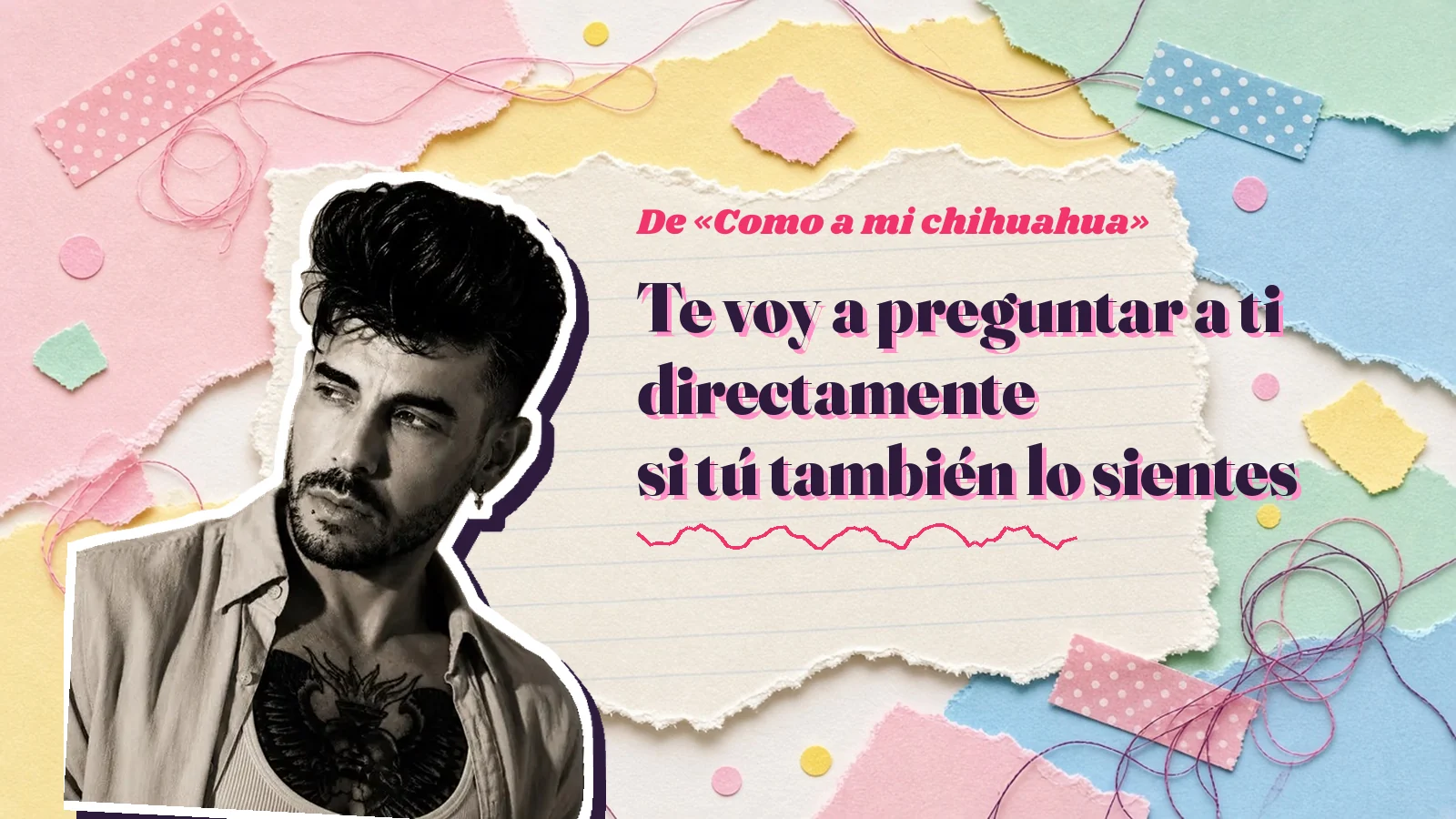
The curious thing is what happens next. The verb changes. First I tell, then I ask: «Te voy a preguntar a ti directamente», I'm going to ask you directly. And at the end, when there's nothing left to hide, I confess: «Y te voy a confesar algo más personal», and I'm going to confess something more personal. Tell, ask, confess. Three verbs of speaking in a row, and each one takes a little more courage than the one before.
I'm not sure I planned it that way. I noticed when I reread the lyric that the whole song is a staircase. And from then on I started paying attention to something that had slipped past me: in my lyrics people talk a lot. They tell, say, keep quiet, answer, swear, badmouth someone. The verbs of speaking are the scaffolding of almost everything I write.
This piece is about those verbs. About what they do, what they hide and why I choose one and not another when the song needs someone to open their mouth.
Contar: the verb that counts twice
I'll start with the one that gives this piece its title, because it has a lovely history. Contar comes from the Latin computare, which meant to calculate, to do sums. That's where computadora, computer, comes from, and also cuento, story. In Spanish the same verb is used for counting coins and for telling what happened to you last night.
I find that double life very revealing. When someone tells you something, deep down they're taking stock: they put the facts in order, decide which goes first, which gets left out, what each is worth. Narrating is a kind of bookkeeping. That's why some people tell the story of their break-up as if presenting a balance sheet, with the debits and credits very clear, and why so many of my lyrics come out full of figures, lists and tallies.
In «Como a mi chihuahua» the te voy a contar works like a numbered list without numbers. One: I don't watch the news. Two: injustice affects me. Three: I'm disconnected. Four: seeing people cry affects me. Five: I'd rather find out about disasters on Twitter two months later. Each te voy a contar is an item on the agenda. And the person I'm telling has to hear the whole list before getting to what really matters.
That's another thing I like about the verb contar: it promises. I'm going to tell you isn't telling yet. It's an announcement, a future periphrasis that leaves the other person waiting. I've already written about the song and its bus stop in «Del telediario a la parada de la guagua», but I hadn't stopped at the verb that holds it up.
Preguntar: when the speaker gives up the floor
The second step is preguntar, to ask, and here the song changes temperature. «Te voy a preguntar a ti directamente / si tú también lo sientes», I'm going to ask you directly if you feel it too. Until that moment I was talking and the other person was listening. By asking, I hand over the turn. And that always feels a little dizzying.
Telling is comfortable because you control what you say. Asking is risky because you don't control the answer. That's why the word directamente weighs so much in that line. It isn't a question thrown into the air, or a hint, or a WhatsApp status for whoever needs to read it. It's a question with an addressee, with a name and surname, even if the song doesn't say them.
I find it funny how many ways Spanish has of not asking. Insinuar, dejar caer, tantear, sondear, lanzar un globo sonda: to insinuate, to drop a hint, to test the waters, to sound someone out, to fly a trial balloon. They're all verbs for getting an answer without having to ask the question. And almost all of them are more common in real life than plain asking. We've all tested the waters at some point. In songs, though, I make myself ask directly, because a song has no time for detours.
Confesar: the word that asks you to kneel
The third step is confesar, to confess. «Y te voy a confesar algo más personal». Confesar is a heavy verb. It comes from the religious world and the judicial world: you confess to a priest or to a judge. There's always someone listening from above and someone speaking from below.

In a love song, that verb turns a declaration into something almost criminal. I'm not telling you I like you; I'm confessing it, as if it were a sin. And what I confess in «Como a mi chihuahua» is very small and very big at the same time: that his laugh is the antidote to my loneliness.
I like that the confession comes at the end, after all the lists. It's as if I'd needed to tell five impersonal things to earn the right to say one personal one. I think many people work like that in life. We talk about the weather, work, the news, until the body relaxes enough to let out what we came to say.
The same verb appears in «Toxina coreana», but as comedy: «Y ahora ha llegado el tiempo de confesar», and now the time has come to confess. There the confession is the song's final twist, the moment you find out that the Botox friend, the one with the raised eyebrow, is me. Confessing, in both songs, means taking off the mask. In one with tenderness, in the other with a cackle. I wrote about that finger that turns around in «La amiga soy yo».
Ya no me callo: the heaviest verb is the one left unsaid
In that same passage of «Toxina coreana» there's a chain of verbs that I think is among the best I've written in terms of rhythm: «voy a decir la verdad, ya no me callo, yo ya no me callo, ¿para qué desmentir?», I'm going to tell the truth, I won't keep quiet any more, why deny it? Say, keep quiet, deny. Three verbs of speaking, and one of them, callar, is precisely the verb of not speaking.
Callar is a strange verb. It's a verb of speaking that means the opposite of speaking. It comes from a Late Latin verb meaning to lower, to slacken, and it keeps something of that: callar is pulling down the shutter. And notice that in Spanish we almost always use it in the pronominal form when it matters. Callar isn't the same as callarse. Callar is not saying one particular thing. Callarse is switching off entirely.
Ya no me callo, I won't keep quiet any more, has become almost a slogan. I've heard it at demonstrations, on social media, from people finally telling what happened to them. In «Toxina coreana» I use it for something silly, to admit I've had my face injected. But the weight of the phrase is there, and I think that's why the joke works: I use a solemn formula to confess something frivolous.
In «Gaslighting» the same verb comes back, now in earnest: «Tu mentira no me va a callar», your lie won't silence me. Here callar is what the other person tries to do to me, not what I decide. It's the difference between chosen silence and imposed silence. The first can be prudence. The second is a gag.
And then there's the saying I quote in «¿Me hago una folclórica engañada?»: oír, ver y callar, hear, see and keep quiet. Three infinitives, three pieces of advice, and the last is the one most expected of us. Many LGBTQ+ people were brought up on that third verb. Keep quiet at home, keep quiet at school, keep quiet at work. Writing songs, for me, has partly been disobeying that saying.
Te lo he dicho muchas veces: saying as reproach
The verb decir, to say, is the most common of all, and for that very reason the hardest to use well. It almost never draws attention. But there's a construction with decir that lands like a whiplash in my lyrics: te lo he dicho, I've told you.
In «El panda del acoso sexual» there's «Te lo he dicho muchas veces», I've told you many times, and a little earlier «como ya te he dicho», as I've already told you. In «Que no pienso decir que mis trajes son de Zara» there's «Te lo dije en otra canción una vez», I told you in another song once, which is a very me way of quoting myself as evidence. I warned you. It's in writing. There's an archive.
The interesting thing about te lo he dicho is that it doesn't inform you of anything. If I've told you many times, you already know. The sentence isn't there to pass on a fact, but to point out that the other person hasn't listened. It's saying as reproach. It's saying as weariness. And that many times is an exaggeration everyone understands: I haven't kept count, but it's been too many.
There's also a nuance between te lo dije and te lo he dicho. Te lo dije points to a specific moment in the past, usually to brag about being right: I told you so, I knew it would end badly. Te lo he dicho points to an accumulation that reaches today. I wrote about the difference between those two pasts in the piece on past tenses, so I won't go on.
Contestar and nadie contesta: talking to the void
Contestar, to answer, is a verb that needs two people. One asks, the other answers. When one of them is missing, the verb limps, and that's exactly what interests me in some songs.
In «Envejecer» there's a line that still gives me chills: «Te voy a contestar / cuando ya es demasiado tarde», I'm going to answer you when it's already too late. Again the voy a, again the announcement. But here the promise arrives late. The answer exists, but whoever asked is no longer there to hear it. It's one of the saddest things you can do with a verb of speaking: answer nobody.
And in «Como en la matanza de Texas» the same verb comes with exclamation marks: «Como en la matanza de Texas, ¡nadie contesta!», like in The Texas Chain Saw Massacre, nobody answers! The scene is from the film: someone runs through an empty landscape calling for help and nobody responds. In the song I use it to talk about something very real, what it feels like when you tell what has happened to you and they don't believe you, or don't listen, or take so long that it no longer matters.
That's why I want to make something clear here. If you're going through something heavy and feel that nobody answers, keep knocking on other doors. In Spain you can call 024, the suicide-related helpline, free, confidential and available 24 hours a day, also if you're simply having a hard time and need to talk to someone. If there's immediate danger, call 112. If you're outside Spain, look for your country's emergency number or crisis line. There's nothing strange about talking about this. I wrote more about it in «Hablemos del suicidio sin tabú».
Poner verde: gossip as a national sport
Not all verbs of speaking are noble. Some of my favourites are the ones for speaking badly. Criticar, despellejar, poner a parir, rajar, poner verde: to criticise, to skin alive, to tear to shreds, to slag off, to badmouth. Spanish has an astonishing wealth of ways to describe talking about someone who isn't there.

In «Igual que en las pelis slasher» one of them appears: «y de poner verde a las espaldas», and of badmouthing behind people's backs. The expression is deliberately redundant. Poner verde almost always implies the person isn't present. Adding behind their backs underlines the cowardice. And then the song lists at length who that character badmouths: the boss, the mother, the colleague, the best friend. Again the inventory, again telling as bookkeeping.
There's a theory I love about this. In 1996 the British anthropologist Robin Dunbar published a book called «Grooming, Gossip, and the Evolution of Language», in which he proposed that human language may have developed largely to do the job that grooming does in other primates: keep the group together. According to his studies of real conversations, a very large share of what we talk about is other people. In other words, gossip wouldn't be a flaw of language but one of its reasons for being.
That doesn't mean all gossip is innocent. There's a huge difference between commenting on other people's lives and setting out to destroy them. The character in «Igual que en las pelis slasher» doesn't gossip; he uses words like a knife. I wrote about the friendlier kind of gossip, the café-terrace kind with its glances, in «Te han visto la mirada».
Gritar and explicar: volume as an argument
Some verbs of speaking don't say what is said but how it's said. Gritar, susurrar, murmurar, chillar, balbucear: to shout, whisper, murmur, shriek, stammer. They're verbs of manner, and in couples' fights they're the ones that show up most.
In «La dieta del cucurrucho» there's a question that repeats: «¿No me puedes explicar sin gritar como una loca a / que viene el numerito de Eduardo Casanova?», can't you explain without screaming like a madwoman what the Eduardo Casanova scene is about? I love it because it pits two verbs of speaking against each other that can't coexist. Explaining demands calm, order, an argument that advances step by step. Shouting flattens everything. Whoever shouts doesn't explain; whoever explains doesn't need to shout.
And then there's the como una loca, like a madwoman, a very queer-scene way of describing intensity. There's no insult there, or not entirely. It's how we often talk to each other, with an exaggerated feminine that's both mockery and affection.
Elmore Leonard, the American novelist, left a famous list of writing rules, and one of them said never to use a verb other than said to carry dialogue. No exclaimed, whispered, roared or snapped. I understand why he said it: verbs of manner can become a crutch, a way of telling the reader how to feel. But in a song I have no narrator to help me, and sometimes shouting is the only stage direction available. In a lyric, the verb of manner is the stage direction.
Jurar and prometer: when speaking is doing
In 1955 the British philosopher John L. Austin gave a series of lectures at Harvard that were published after his death, in 1962, under the title «How to Do Things with Words». His central idea was simple and revolutionary: some sentences don't describe the world, they change it. When I say I promise you, I'm not reporting a promise; I'm promising. When a judge says you are acquitted, he isn't describing an acquittal; he's producing it.
Austin called those sentences performatives. His student John Searle developed the idea and later proposed a classification of speech acts into five types: those that assert something, those that request or order, those that commit the speaker, those that express a feeling and those that change a reality just by being uttered.
My lyrics are full of those verbs that do things. In «Gofio de calcetín» and in «No quiero otro novio cojín» the same reproach appears: «Que juras hasta por la memoria / de tus padres», you even swear on your parents' memory. Swearing is the speech act par excellence. You put something sacred up as a guarantee that you're telling the truth. And the bitter joke of the line is that if someone swears even on that and lies anyway, there's nothing left in the world to guarantee their words.
The same goes for promising. Promising is committing the future with a sentence in the present. That's why a broken promise hurts more than any old lie. The lie falsifies what was. The broken promise falsifies what was going to be.
Me dijiste, le dije: the difference from dialogue
I've already written a piece on the dialogues I put inside my songs, «Me dijiste no busco nada», and another on the answers I gave and the ones I kept back, «Palabras con pinchos», about «El castigo más duro». This one isn't about what the characters say, but about the verbs they use to announce they're going to say it.

I think the difference matters. A dialogue is the sentence in quotation marks. The verb of speaking is the door that opens before it. And often the verb says more than the sentence. Me dijiste, you told me, isn't the same as me soltaste, you blurted at me, me echaste en cara, you threw it in my face, me reprochaste, me confesaste or me juraste. The sentence in quotes can be identical in every case; the verb completely changes the relationship between the two people.
Grammarians call these verbs verba dicendi, verbs of saying, a Latin expression still used in textbooks. And one of the first things you learn writing is that choosing the right verbum dicendi means choosing which side you're on. If I write me soltó, he blurted at me, I've already decided what he said was blunt. If I write me confesó, he confessed to me, I've already decided there was something to hide.
Hablar comes from fable
I'll finish with the most basic verb of all, which I saved for last because it hides a surprise. Hablar, to speak, comes from the Latin fabulari, which meant to converse, to chat, and is related to fabula, fable. In Old Castilian it was fablar, with an f, and from the same family come words like confabular, to conspire, and fabuloso, fabulous.
I love the thought that, at the origin, speaking and telling fables were almost the same thing. That the word we use for the most everyday act of all carries within it the seed of fiction. As if every time we open our mouths we were, a little, making things up.
And charlar, to chat, by the way, comes from the Italian ciarlare, which already sounded like chatter at its origin. Gossip sneaking into the dictionary again.
My songs are exactly that. Fables told with invented characters and names that belong to nobody, but born of things I really felt. When I write te voy a contar, I'm doing two things at once: promising a story and doing the accounts of what happened to me.
The full staircase
If I go back to «Como a mi chihuahua» after this whole journey, the staircase from the beginning seems even clearer. Telling is putting the world in order. Asking is letting the other person in. Confessing is being left without defences.
All the other verbs I've talked about fit between those three steps. Saying and keeping quiet, the light and shadow of any conversation. Answering, which needs someone on the other side. Badmouthing, which is talking about someone who isn't there. Shouting, which is talking without listening. Swearing and promising, which is talking in order to commit.
I think that's why I find it so hard to write songs where nobody speaks. Almost all my lyrics have someone addressing someone else, telling them, asking them, reproaching them or confessing to them. It's my way of understanding music: not as something you listen to, but as a conversation in which you get a turn too.
So, if you've made it this far, it's your turn. I'm going to ask you directly: what's the verb you use most when you finally dare to say something?
Frequently asked questions
What are verbs of speaking, or verba dicendi? They're verbs that introduce or describe an act of speaking, such as say, tell, ask, answer, shout, whisper or confess. The Latin expression verba dicendi is still used in grammar to refer to them.
Where does the Spanish verb contar come from? From the Latin computare, which meant to calculate or do sums. That's why in Spanish contar means both to count and to tell a story, and why the word cuento, story, comes from the same root.
What is a performative speech act? It's a sentence that doesn't describe an action but carries it out by being uttered, like I promise you, I swear or you are acquitted. The concept was proposed by the philosopher John L. Austin in «How to Do Things with Words», published in 1962.
Which Mike Sain't Louis song says «Te voy a contar»? «Como a mi chihuahua», from the album «Ojalá se pudiera viajar a Gayfolk». The lyric moves from I'm going to tell you to I'm going to ask you and ends with I'm going to confess something more personal.
Where can I get help if I feel nobody is listening? In Spain, call 024, free, confidential and available 24 hours a day. If there's immediate danger, call 112. Outside Spain, call your local emergency number or your country's crisis line.
Who writes these songs? Mike Sain't Louis, a lyricist, composer and music producer from Madrid, the first AI songwriter. The music and the vocals of his songs are made with artificial intelligence.