By Mike Sain't Louis ·
Sun and wind under water: «Sonne und Wind», the cage, the sharks and the floating heart
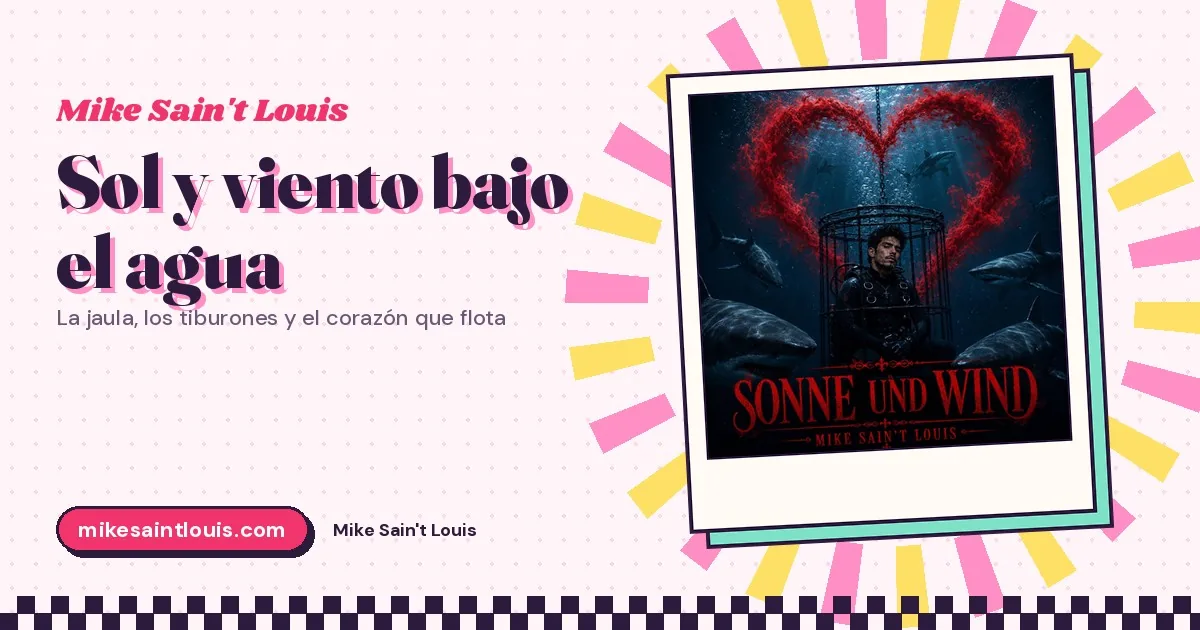
Some titles describe the image that comes with them and some contradict it. «Sonne und Wind» belongs to the second family. In German it means «sun and wind», two things that only exist on the surface, in the open air. And yet the cover of «Sonne und Wind» takes us to exactly the place where there's neither: the bottom of the sea, in the dark, inside a cage.
A warning before going on: this single's lyrics haven't been published yet. On its gayfolkplanet.com page they're listed as pending, and I'm not going to fill that gap with phrases of my own that aren't in the song. What follows rests on facts anyone can check: the artwork, the title, its place on the album, what I wrote about the track on its page and real lines from other songs of mine.
A cage hanging from a chain
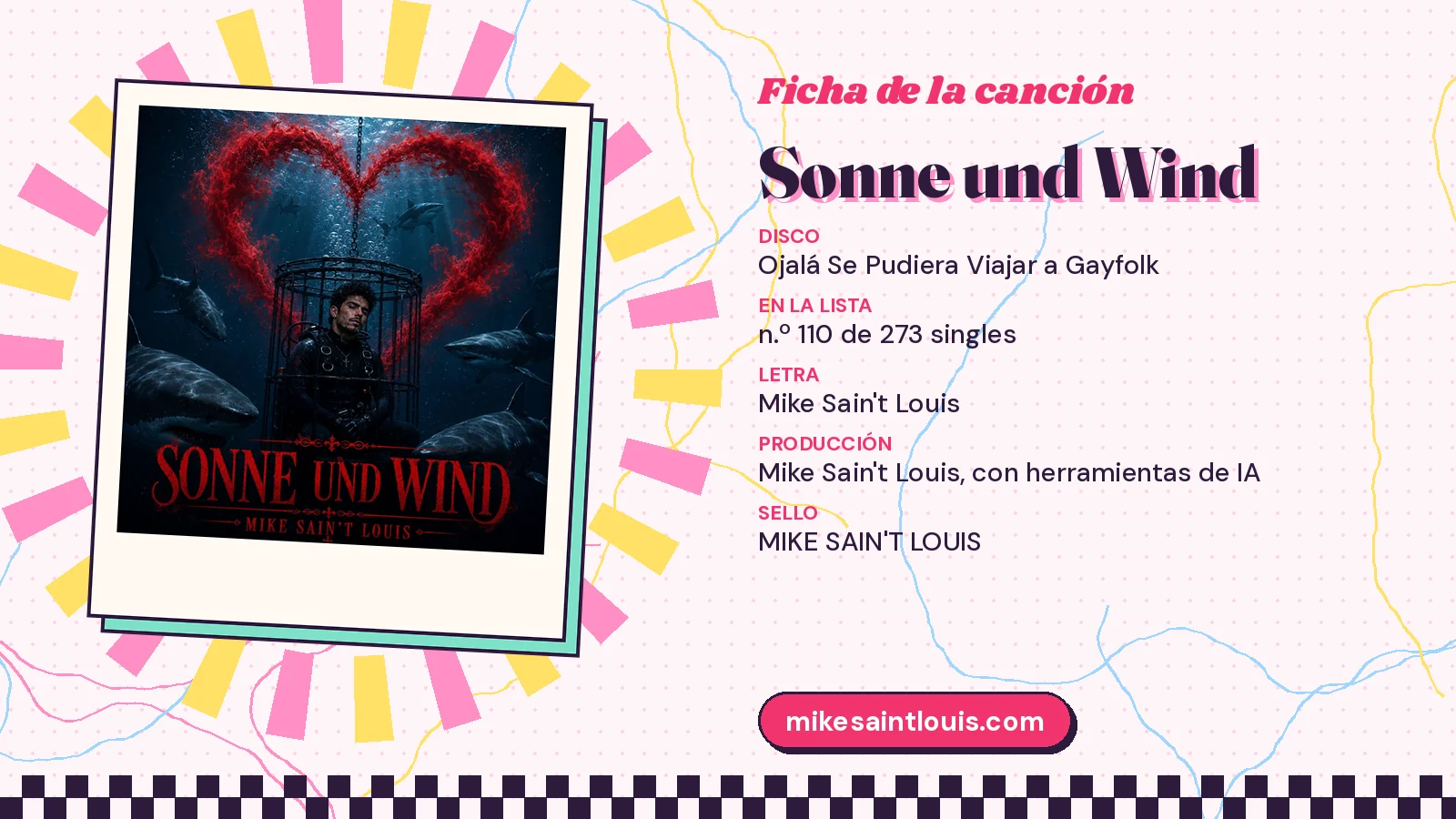
In the centre of the image there's a cylindrical cage of dark metal bars, the kind used to go down and watch sharks. It hangs from a thick chain that rises straight to the surface and disappears into the light coming from above. Bubbles rise around the chain, lots of them, in a column, as if someone had just let out their breath.
Inside the cage a young man is sitting. He wears a black wetsuit, a harness with metal rings and gloves. No mask or tank in sight. He has dark curly hair, a short beard, a chain with a cross on his chest. His posture is what stands out most: he isn't gripping the bars or looking out in fear. He's sitting, hands together on his knees, head slightly tilted and eyes half-closed, almost like someone waiting in a waiting room.
Sharks swim around him. Five or six, of different sizes, some very close, others far off, outlined against the blue. One, in the foreground on the left, bares its teeth. None seems to attack. They circle.
There's another detail that interests me: the suit. The black neoprene, the harness, the gloves, all of it is the gear of someone who goes down prepared. Nobody ends up in a shark cage by accident. You have to sign papers, put on the suit, get inside and let them lower you. In other words, the situation on the cover is, at least in part, a decision. And that changes a lot about how you look at it. It isn't simply someone trapped, it's someone who, for whatever reason, has agreed to go down.
A heart that doesn't belong down here
Above the cage, filling almost the whole top of the image, floats a huge red heart. It isn't a clean drawing, but a frayed shape, made of something coming apart in the water: it could be coral, it could be petals, it could be threads of ink or blood dispersing. The cage chain runs right through the centre, through the dip at the top, as if splitting it into two halves.
When I presented the track I compared it to coral or petals, and that doubt still seems to me the best thing about the drawing. A coral heart would be something alive, fragile, that takes centuries to grow. A heart of petals would be something beautiful that withers. A heart of blood would be a spreading wound. The cover doesn't choose, and each reading changes the meaning of the image.
The title sits at the bottom, in red gothic-style letters with sharp serifs and filigree ornaments on either side. Below, my name in the same red. The lettering has something of an old horror film poster or the cover of a dark romance novel. It suits the German: it's almost a nod to the blackletter type that for centuries was associated with that language.
Sun and wind, exactly what's missing
Back to the title, because that's where the fun is. «Sonne» is sun. «Wind» is wind. «Und» is the conjunction, the «and» that joins them. Two elements of the outdoors, of good weather, of sailing boats, of the beach. In the image there's no trace of either. Just water, darkness and a distant light coming down from the surface.
When I presented the single I pointed out that irony: speaking of the open air from the deepest point, like someone still caught in a story that keeps biting them and thinking only of getting back up. I think it describes certain moments of life well: you're down below, surrounded by things that can hurt you, and the only thing in your head is the sun up there.
Water, moreover, swallows light. In the sea, sunlight only reaches strongly through the first few metres, and below about two hundred metres there's hardly any left. Beyond a thousand metres there's total darkness. The cage on the cover isn't that deep, because you can still see the glow from above. But it's already in that in-between territory where the sun is a memory, not a presence.
German and its pairs
It isn't the first time one of my titles has played with pairs of elements in another language. In «Sol e Lua», from the same album, it was the sun and the moon in Portuguese. Here it's the sun and the wind in German. And in that post I mentioned a curiosity that works again: in German the sun is feminine, «die Sonne», while the wind is masculine, «der Wind». A girl-and-boy pair, if we want to play with grammar.
German also has a tradition of titles with «und» that sound like manifestos. Perhaps the most famous is «Sturm und Drang», «storm and stress», the name of the German literary movement of the 1770s that championed passion and emotion against Enlightenment reason. Its best-known work is Goethe's «The Sorrows of Young Werther», published in 1774.
«Sonne und Wind» sounds almost like a gentle version of that motto. Where «Sturm und Drang» asked for storm, this asks for sun and wind: good weather, air, freedom. And yet the image leaves us down below, without either.
The shark's bad reputation
Few creatures carry such an unfair reputation as the shark. We owe much of it to «Jaws», Steven Spielberg's 1975 film, based on Peter Benchley's novel. It was a colossal hit and turned the great white into the summer monster par excellence. Years later, Benchley said he regretted the image he had helped create and devoted much of his life to ocean conservation.
The data put things in their place. Each year a few dozen unprovoked shark bites are recorded worldwide, and deaths can usually be counted on your fingers. In the other direction, a study published in 2013 in the journal Marine Policy estimated that humans kill around a hundred million sharks a year, mostly through fishing. The great white, in fact, is considered a vulnerable species.
I find it interesting to keep that in mind in front of this cover. The sharks circling the cage are frightening, of course. But the fear they cause doesn't match the real danger they pose. Often, what we fear most isn't what hurts us most.
The cage invented by a survivor
Shark observation cages have a curious history. One of their pioneers was the Australian Rodney Fox, who in 1963 survived a great white attack while taking part in a spearfishing championship in South Australia. He needed hundreds of stitches. Far from hating the animal, he ended up devoting himself to studying it, designed cages to observe it up close without risk and worked on the filming of documentaries and films.
I really like that story because it gives the cage a different meaning. It isn't a prison or a punishment: it's a tool that someone who had been wounded invented so he could look straight at what hurt him, without exposing himself in the same way again. A protection that lets you get closer.
Today shark cage diving is a tourist activity in places like South Africa, Australia or Mexico, and it's also debated between those who argue it helps people know and protect the animals and those who fear that the use of bait alters their behaviour. I'll just note it, without going further, because it isn't the subject of the song.
Does it protect or confine?
In the text accompanying the single I suggested two ways of understanding the image. One: a love that shelters you and, at the same time, leaves you no way out. The other: a confinement each person builds out of fear of being hurt again. I also said the artwork doesn't settle the dilemma, and I still prefer it that way.
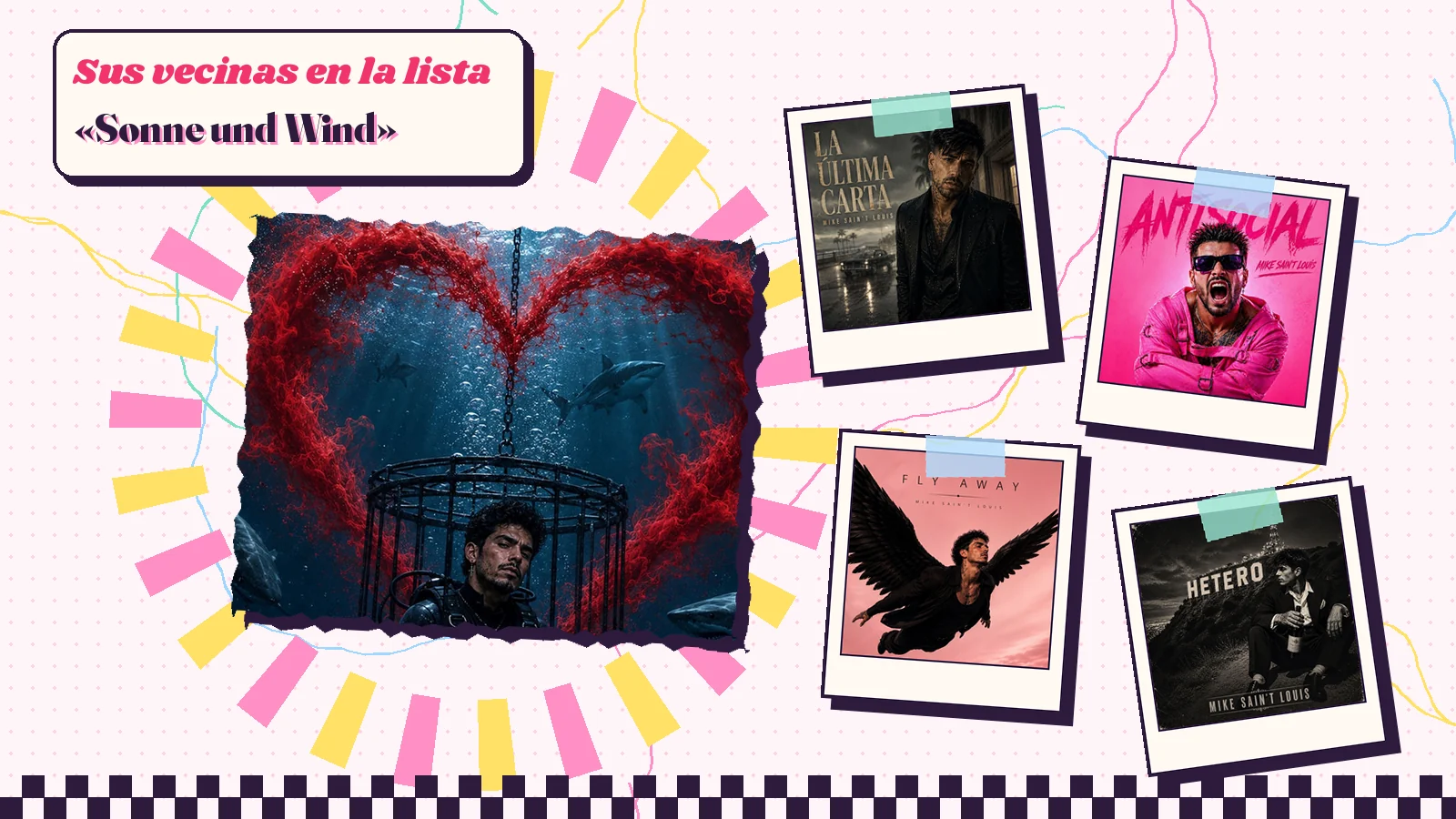
Both readings interest me. The first speaks of relationships where protection gets confused with control. At first it seems someone is looking after you, sheltering you, keeping you away from dangers. Over time you discover those bars also stop you from leaving. It's a dynamic I've dealt with in other songs, and in «La última carta» there's a sentence that sums it up very well:
Me quisiste tener siempre ahí: disponible, dudando, esperando.
(«You wanted to have me always there: available, doubting, waiting.») The second reading is more intimate. There are cages nobody puts you in: you build them yourself, bar by bar, after you've been hurt. You stop trusting, stop opening up, decide it's safer to watch the world from inside. In the same letter the other side of that decision appears, when the confinement is chosen and brings calm:
Hoy sé que la paz que tengo viene del corte. Del bloqueo. Del silencio.
(«Today I know the peace I have comes from the cut. From the block. From the silence.»)
Golden cages and birds that don't leave
Spanish has a very vivid expression for this: «la jaula de oro», the golden cage. It's said of someone who lives surrounded by comforts but without freedom. A beautiful house you can't leave, a relationship that gives everything except air, a well-paid job that eats your life. The popular saying sums it up: even if the cage is golden, it's still a cage.
The image of the caged bird has been used for centuries to talk about the lack of freedom, and especially that of people who couldn't live as they were. For many LGBTQ+ people, the closet was exactly that: a closed space that protected them from the violence outside, but forced them to stay still, quiet, unable to show what they felt. It protected and confined at once, just like the cage on the cover.
What's interesting is that when someone leaves a cage like that, they often don't fly away immediately. They need time to get used to the air, the light, the space. That's why it's worth being patient with someone who has just come out of a closed place, whether a closet, a relationship or a bad patch. Sun and wind, after so long down below, can make you a little dizzy too.
A castle, a cage
The idea of a refuge that protects and isolates at the same time also appears in «Antisocial», one of my clearest songs about chosen solitude. There's a line that could be the caption for this cover:
mi silencio es un castillo, yo una armadura sin llave.
(«my silence is a castle, I'm a suit of armour with no key.») And another, a little further on, that defends that small space as one's own:
mi mundo es pequeño, pero es inquebrantable.
(«my world is small, but it's unbreakable.») The castle in «Antisocial» and the cage in «Sonne und Wind» are quite alike. Both are small, closed spaces that keep others out. The difference is the surroundings: the castle is on solid ground and the cage is surrounded by sharks. I went into it further in «Un castillo sin llave».
I don't think there's a single answer as to whether these refuges are good or bad. It depends on how long you spend inside, whether you can leave when you want and whether you're the one controlling the door.
Are they outside or inside?
I ended the presentation of the single by leaving a question in the listener's hands: where do the sharks swim, on the other side of the bars or next to the young man? For me that's the key to the image.
If the sharks are outside, the cage protects. The young man on the cover can be calm, sitting, hands together, because the bars separate him from what's frightening. That's the diver's reading, Rodney Fox's.
But if the sharks are inside, in your head, the cage is useless. You can surround yourself with bars and still feel something biting you from every side. Thoughts that go round and round, worries that won't leave, fear that stays with you even when nothing is happening outside. That's another kind of cage, and for that one bars aren't the solution.
What the red says
In an image dominated by the dark blues and greys of the water, the only warm colour is red: that of the heart and of the letters. That directs the eye very clearly. First you see the heart, then you go down the chain to the cage and, finally, you reach the title. It's a top-to-bottom journey, like the cage's own descent.
Red against the blue of the sea also has an unsettling reading, because in shark images it's almost always associated with blood. The cover plays with that association without confirming it. The heart comes apart in threads that could be a wound, but it has the shape of a love symbol, of a drawing on a card or a tattoo. Love and danger in the same stroke.
And there's something more: the heart is outside the cage. It floats free in the water, above everything, while the young man is locked in. As if what matters most had stayed on the other side of the bars. Or as if the heart were exactly what the young man protects by staying inside, keeping it away from the teeth.
Fear of what lies below
There are names for these fears. Galeophobia is an intense fear of sharks; thalassophobia, fear of deep water, of not knowing what's underneath. Many people feel a shiver when they see images of the deep ocean, and it's not surprising: we're made to live on land and breathe air.
When a fear like that becomes so strong it limits your life, it's called a specific phobia, and there are treatments that work well, above all exposure therapy: approaching what frightens you little by little, with professional help, until the body learns it can bear it. Curiously, it's an idea very similar to that of the observation cage: looking at what scares you from a safe place, a little closer each time.
Between «Fly Away» and «Hetero»
On «Ojalá se pudiera viajar a Gayfolk», the second album of the trilogy, «Sonne und Wind» is track 73. Just before it comes «Fly Away», which doesn't have its lyrics published yet either and whose cover shows a pair of black wings. Going from an image of flight to one of immersion has its logic: from the air to the depths, from escaping upwards to staying still below.
Right after comes «Hetero». In the description of its video I wrote a question that fits the cage unexpectedly well: «¿sería más fácil ser hetero o simplemente más fácil no ser yo?», «would it be easier to be straight, or simply easier not to be me?». It's also the question of someone who, for a moment, feels trapped in himself.
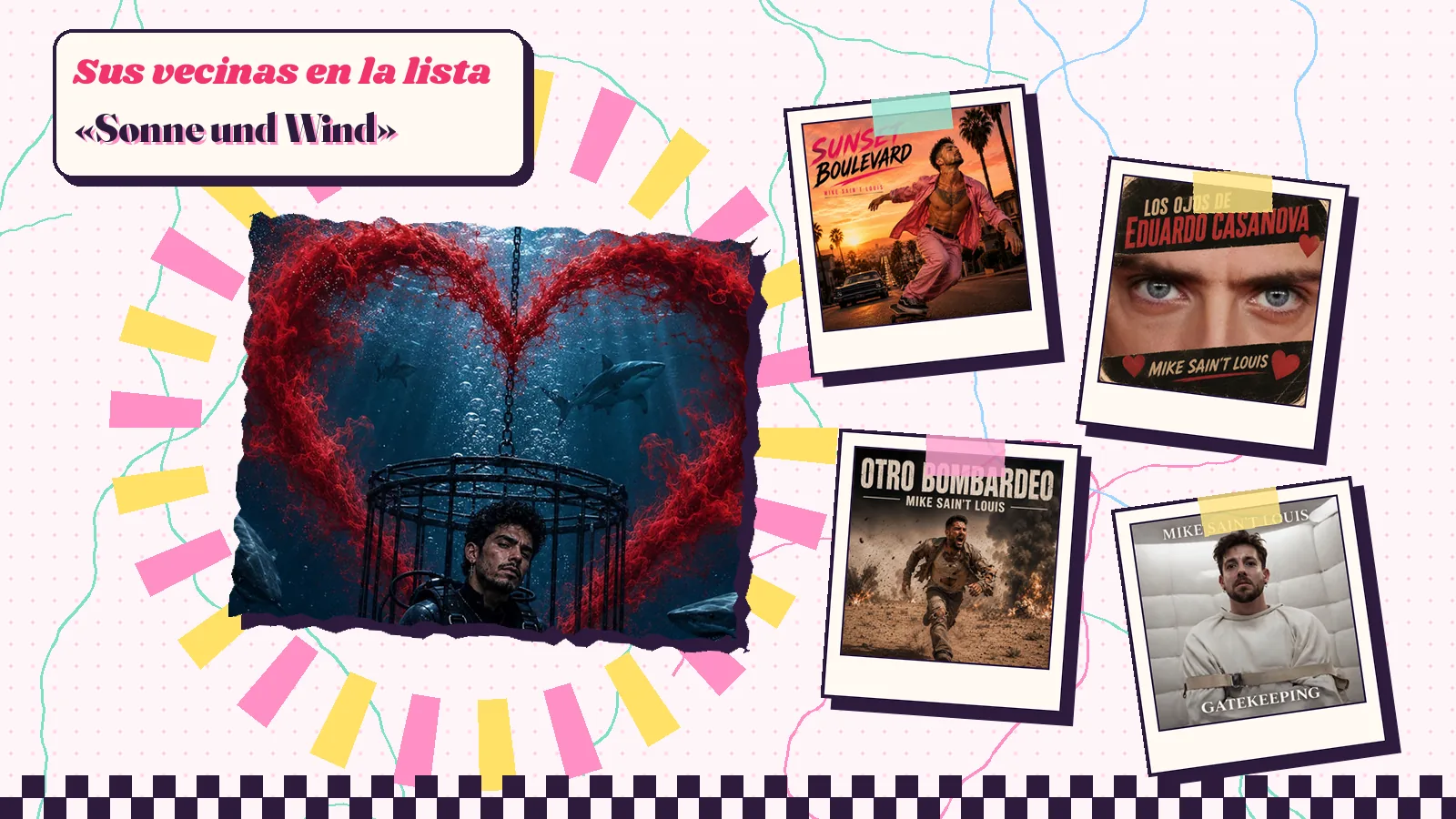
In the full list of singles, «Sonne und Wind» is number 110 of 273. Musically it moves in the same territory as the rest of the album, between indie pop, alternative pop and queer pop.
Rising to the surface
Back to the chain. It's the only thing in the image that connects the depths to the surface. At some point, the cage will go back up along it. And up there, then yes, there will be sun, and maybe wind too. The title doesn't describe where the young man is. It describes where he's going back to.
That reading seems to me the most hopeful. Sometimes you spend a season down below, in a dark place, surrounded by frightening things, and all you can do is wait, sitting. But seasons pass, and the chain is still there.
It makes me think of another cover from the same album, that of «Drift Away», where the sea is pink, there's sunshine everywhere and a young man surfs inside the wave. The two images are almost opposites: up and down, light and darkness, movement and stillness. Together they remind us that the same sea can be a party or a confinement depending on where it catches you.
If at any point you feel you're in that cage, and that the sharks are inside, you don't have to wait alone for it to rise. Talking helps: to someone close, to your doctor, to a psychologist. In Spain, 024 is a free, confidential phone line that answers twenty-four hours a day for people going through a very hard time or having thoughts of harming themselves, and also for anyone worried about someone else. If there's immediate risk, call 112.
From any other country, look up the crisis or suicide prevention line there, or call the local emergency number. In «Salud mental sin tabú» I put together more resources, in case they help you or someone you love.
For whoever is waiting at the bottom
For whoever is sitting in their own cage watching the sharks go by. For whoever put up bars after being hurt and now doesn't know how to open the door. For whoever confused protection with control and is learning to tell them apart.
For whoever dreams of sun and wind from a place neither reaches. For whoever is more afraid of sharks than of what really hurts them. For whoever knows the chain is still there, even if they can't see it.
And for whoever still doesn't know which side of the bars their sharks swim on. Until the lyrics are published, you can listen to the track on any platform or download it for free, without giving your details, from the downloads page. When the lines come out, I'll upload them in full without changing anything.
Frequently asked questions
What is «Sonne und Wind» about? The lyrics haven't been published yet, so this post doesn't quote any line from the song. The cover shows a young man sitting inside a cage at the bottom of the sea, surrounded by sharks and beneath a big red heart. The post reads the single through fear, the bad reputation of sharks and cages that protect and confine at once.
What does «Sonne und Wind» mean? In German it means «sun and wind». The irony is that the cover shows precisely a place without sun or wind: the bottom of the sea.
Which album is it on? On «Ojalá se pudiera viajar a Gayfolk», the second album of the Gayfolk trilogy, where it's track 73, between «Fly Away» and «Hetero». In the list of singles it's number 110 of 273.
Are sharks really that dangerous? Much less than their reputation suggests. Each year there are a few dozen unprovoked bites worldwide, while humans kill tens of millions of sharks, according to a 2013 study.
Where can I get help if I feel trapped? In Spain, 024 answers free of charge at any hour, and 112 in case of immediate danger. Outside Spain, look up your country's crisis line or call emergency services.
Who makes this song? Mike Sain't Louis, a lyricist, composer and music producer from Madrid who presents himself as the first AI songwriter. He writes the lyrics and directs the production; the music and the performances are created with artificial intelligence.