By Mike Sain't Louis ·
My Own Dictionary: Cushion Boyfriend, Sock and Gofio
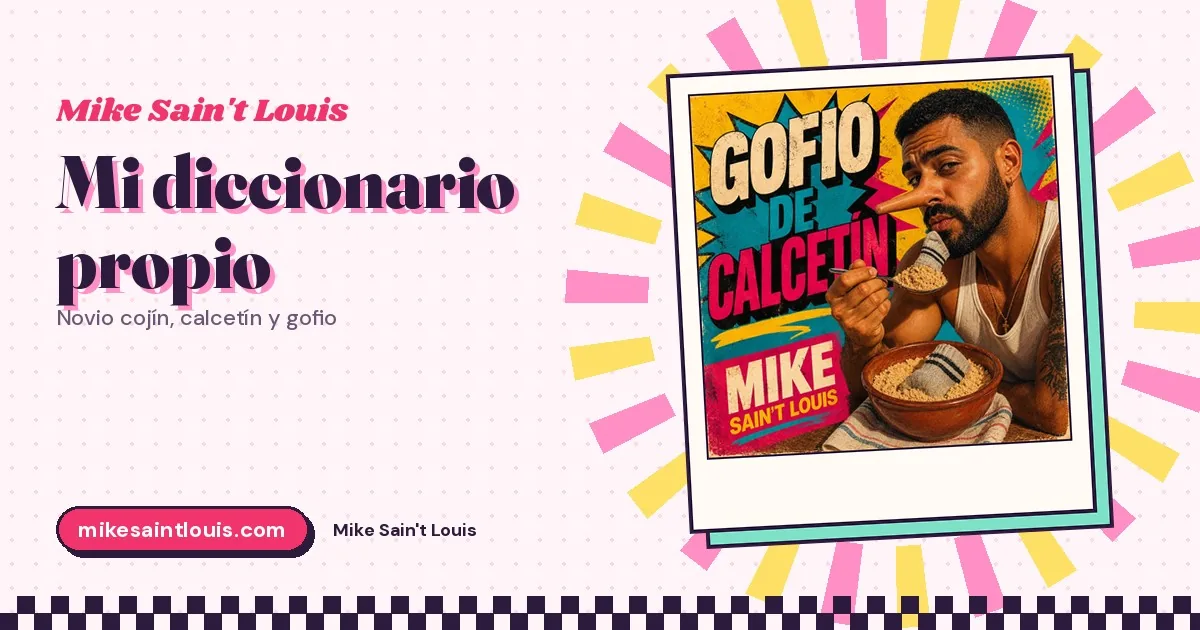
A man with a Pinocchio nose eats gofio from a bowl with a spoon. A comic-strip drawing, yellow and blue, with the enormously long nose pointing at the reader like an accusing finger. That's the cover of «Gofio de calcetín» ("Sock Gofio"), and it says almost everything: someone who lies, someone who eats, and a language only understood by people who've spent a while on this planet.
When you write a lot of songs, and I have 273 singles out, you end up with a language of your own. I don't mean Spanish, which is what I use almost all the time. I mean a homespun vocabulary, words and expressions that recur from one lyric to the next until they become passwords. Someone hearing a single song won't notice them. Someone who's heard twenty laughs before anyone else.
I'm Mike Sain't Louis, the man who writes the lyrics of Planeta Gayfolk, and «Gofio de calcetín» is a short little song, barely more than a dozen lines, but it's the best place to open that dictionary. The song page tells the story. Here are the entries, in order of appearance, like a proper dictionary but with more spite.
Gofio
Gofio (n.): flour made from toasted grain, a traditional food of the Canary Islands. In my lyrics, a sign that the story has an island accent and an addressee with a postcode in the Atlantic.
The song opens with someone else's complaint. Somebody has taken badly to a comment of mine, and the comment is in the first line I'll quote: «De que ojalá se atragante con el gofio canario» (that I hope he chokes on his Canarian gofio).
That "I hope" is a lovers'-quarrel wish, the kind you blurt out with the fridge door open. I don't want anyone to actually choke, heaven forbid. But in a row, exaggerated wishes are the currency. The lovely thing is that the gofio gives the insult a postal address without having to say where anyone's from. What he eats is enough.
The Canaries turn up a lot on Planeta Gayfolk. I'm from Madrid, but the islands are part of many of the stories I tell, with their buses, their southern beaches and their lies with an accent. Whole songs take place there, like «El canario que miente» or «En Canarias no existen las sirenas». Gofio opens that door in a single word, like leaving a pair of flip-flops in the hallway so you know there's an islander in the house.
Mmmmmm
Mmmmmm (interj.): the sound of someone working out what to say and already knowing it won't go down well. Also: Grandma humming while she does the washing.
The lyric starts with a murmur and repeats it between lines. It's a silly detail, but that's how the lyric has it. That "mmmmmm" is the silence before the stab, the gesture of someone scratching their chin mid-argument while they prepare their comeback. There's something of Lina Morgan playing the innocent before she drops the bomb.
In such a short song, that murmur acts as a breath. Without it, the lines would come one after another like bullets. With it, there's a dramatic pause, afternoon-soap style, just before the slap. And in a row, a dramatic pause is worth more than any argument.
Diary
Diario (n.): a notebook where you write down what happens. In my lyrics, a veiled threat: I have evidence, and I have it in writing.

After the complaint comes the reply, which is a poisoned offer: if you like, I'll read you my diary. It's the line of someone who's written everything down. Dates, phrases, lies. Anyone who's got out of a relationship with a narcissist knows the temptation to keep a record, because the other person rewrites history every week and you need something that won't move.
Offering to read the diary means: don't come to me saying a comment upset you, because I've got volumes on what you've said. It's the homemade version of a prosecutor pulling out the file on a trashy TV talk show.
Secretary, businessman
Empresario (n.): a person who runs their own business. In this lyric, also an argument-winning boast that turns out to be literal.
The second line I'll quote comes right after: «No necesito secretario, soy empresario» (I don't need a secretary, I'm a businessman). The "-ario" rhyme starts chaining itself together, canario, diario, secretario, empresario, like a playground chant.
The funny thing is that the boast is true. I run my own record label, MIKE SAIN'T LOUIS, and I manage it alone, with no middlemen. I have no secretary, and honestly I wouldn't know what to ask one to do apart from fetching coffee from the bar downstairs. "I'm a businessman" can be read as bravado in a row, but also as a job description. I wrote about running a one-person label in «Llevar un sello discográfico de una sola persona».
I laugh at myself with that line. A businessman with chihuahuas and no staff. The Amancio Ortega of Planeta Gayfolk, minus Zara and minus the yacht.
Swearing on your parents' memory
Jurar por la memoria de tus padres (verbal phrase): the most solemn promise in everyday Spanish. In my lyrics, a sign that the lie has reached the top floor.
The third line is a warning: don't make me go back to how things were, «Que juras hasta por la memoria / De tus padres» (you'd even swear on your parents' memory).
Swearing on the dead is the most serious thing you can do in a neighbourhood argument. The only thing above it is swearing on the Bible in an American film. Using that expression to describe someone who lies shows how far they're prepared to go: there's nothing sacred they won't use. Family, the departed, whatever it takes.
There's no joke here. It's one of those stark lines that slip in between the gags. Anyone who has heard someone swear like that, knowing they were lying, knows the chill it gives you.
Cushion boyfriend
Novio cojín (noun phrase): a partner whose only function is to be there, soft and decorative, holding nothing up. Rough synonym: Ikea sofa stuffing.
It's one of my favourite expressions and it's in the chorus. A cushion is soft, looks nice on the sofa, matches the curtains. But it can't take any weight. When you really lean on it, it sinks and leaves your back against the wooden frame. That's the image: someone who seemed like comfort and who, the moment he was needed to hold something up, vanished between the seams.
The expression doesn't live only here. It has its own song, «No quiero otro novio cojín», which is much longer and goes into detail with its numbered list of falsehoods. That's what happens with words that work: they ask to come back. And I, being a great one for recycling, let them in.
Sock
Calcetín (n.): garment worn on the feet. In my lyrics, a unit for measuring disappointment. To end up at sock level: to come off terribly, to hit rock bottom, to end up smelling.
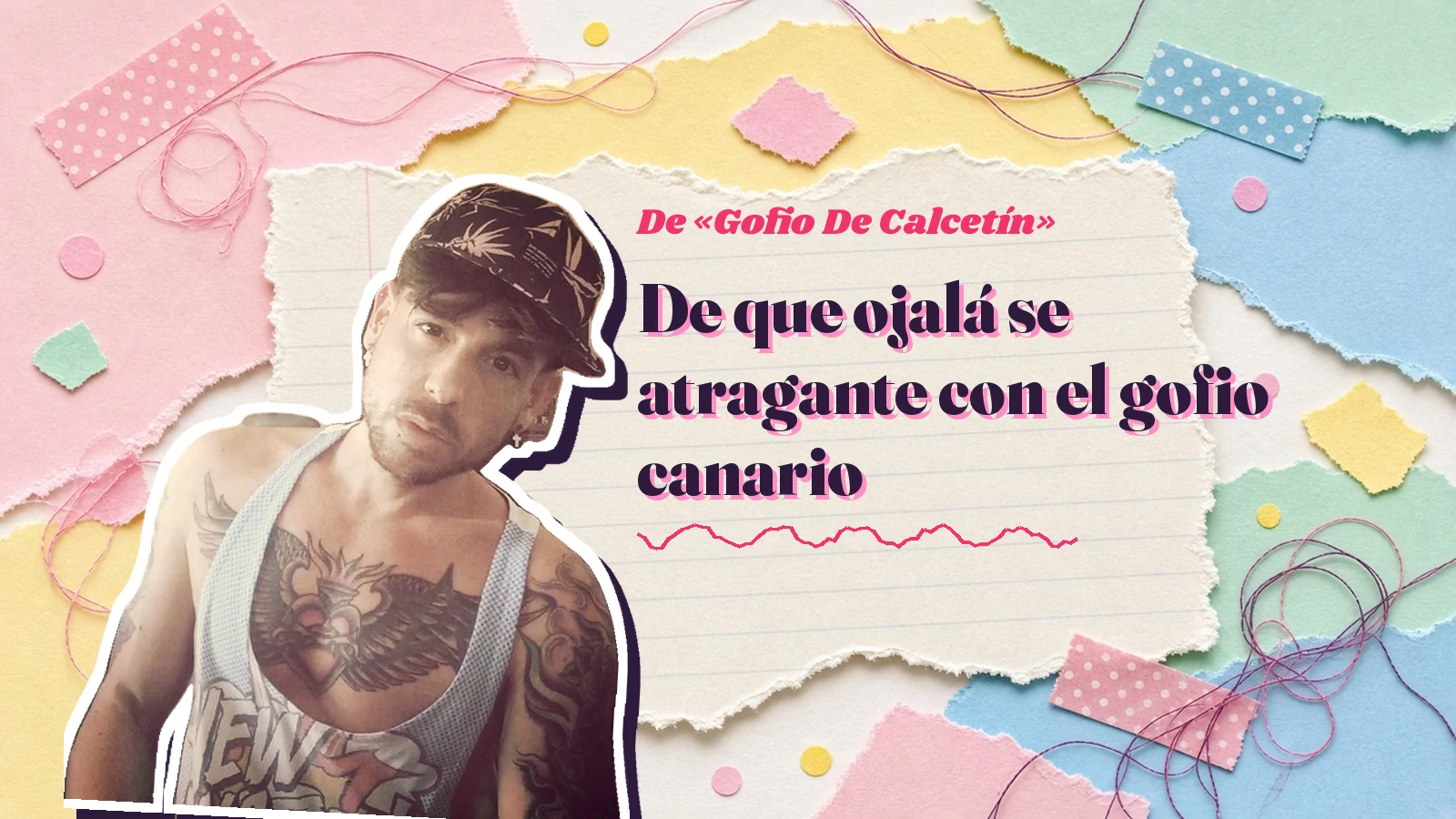
The whole chorus finishes it off: «El que tuve quedó a la altura de un calcetín» (the one I had ended up at sock level). The rhyme between cojín and calcetín is almost childish, a skipping-rope rhyme from the playground, and that's why it works. What's being said is harsh, but it sounds like a game.
A sock is the perfect measure because it's at the lowest point of the body, right by the floor, and because there's something tacky about it. Nobody shows off their socks, except footballers with sponsorship deals. Saying someone ended up at that level is a very visual, almost cartoonish way of saying they let you down.
And it has a sequel too. In «El calcetín», another song in the catalogue, the sock becomes the main character, and from it comes one of my favourite lines in everything I've written: self-esteem can also be washed, hung out to dry and worn fresh. The same object, first as an insult, then as a remedy.
Pinocchio
Pinocho (proper n.): wooden puppet whose nose grows when he lies. On my covers and in my titles, the ex who can't open his mouth without giving himself away.
The word isn't in the lyric, but it's on the cover, and the cover is text too. The long-nosed man eating gofio is the song's liar painted without needing to name him. A Canarian liar, to be precise, because what's in his bowl isn't chocolate milk powder.
Pinocchio has his own song with a smutty-joke title, «Ese Pinocho nunca me comía el chocho», which is another way of saying his nose was the only thing that grew. There's the dictionary working again: an image that jumps from a cover to a title and from a title to another song. Anyone who knows them all feels they're reading a saga, even though each song stands on its own.
Narcis and low cost
Narcis (pl. n., colloq.): affectionate clipping of "narcissists", used with contempt. Low cost (adj. phrase): the cheap version of something that was already bad.
These two don't appear in «Gofio de calcetín», but they appear in so many others that the dictionary would be lame without them. Narcis is the word I use when I've run out of patience to say the whole thing. It strips off the syllables the way you'd take the coat of someone who won't be staying long. Low cost is the bargain label I slap on them: the Ryanair version of love, hand luggage included and everything else extra.
They appear together, for instance, in «La ley de la exageración», where one is the saviour-victim and the other the low-cost version. And low cost even has its own song, «Ojete calor en versión low cost», but that's another story.
Teatrillo
Teatrillo (n.): a two-bit show. In my lyrics, a relationship with a narcissist seen from the stalls once the scenery has fallen down.
It isn't in «Gofio de calcetín» either, but it's on the neighbouring page. In «No quiero otro novio cojín» the ex premieres a new little show with the next mug, and in another song, «Una obra de teatro», the question is whether seven years were one long performance. The diminutive is what I like most. Teatro, theatre, would be granting him too much. Teatrillo is a school play, with foam-board scenery and a bedsheet for a curtain.
It's a word that helps me take the narcissist down off his pedestal. He thinks he's at the Teatro Real performing Tosca. The lyric reminds him he's in a secondary-school assembly hall in Fuenlabrada with half the seats empty.
A piece of bread
Trozo de pan (noun phrase, ironic): a wonderfully kind person, according to everyone else. In my lyrics it always comes with a raised eyebrow: the "piece of bread" is the one who behaved worst.

In plain old Spanish, saying someone is a trozo de pan, a piece of bread, is the nicest thing you can say about a person. Good, noble, incapable of harm. I use it the other way round, eyebrows raised. The piece of bread is the one everyone adores in public, and who in private has left your self-esteem like burnt toast.
It's a very useful expression for talking about two-facedness, one of the most recurrent themes in the catalogue. People who only know the narcissist's public version see a piece of bread. Those who've lived with him know what's inside the crust.
Guagua
Guagua (n., Canarian Spanish): bus. In my lyrics, another sign that the story has an island accent, and nearly always that someone has left without saying a proper goodbye.
It appears in «Como a mi chihuahua», where the "you" of the song wouldn't give so much as a kiss before catching the guagua. It's such a specific word that it paints the whole scene: the stop, the heat, the driver waiting and someone getting on without looking back. And it rhymes with chihuahua, a gift you can't turn down.
For a Madrileño, guagua is an exotic and tender word at the same time. I use it fondly, the way you use a word belonging to someone you loved even though it went wrong.
Pardillo
Pardillo (n.): a small country bird, the linnet. In Madrid slang, a naive person who's easy to fool. In my lyrics, the next one on the narcissist's list, and sometimes me.
It's a word that tickles me because it belongs to an old-school Madrid grandmother, the kind who says "don't be a pardillo" when she sees you sign something without reading the small print. In the catalogue it appears when the ex is looking for a new victim: who'll be the next pardillo? And the question cuts both ways, because the previous pardillo was me, and I bought the whole show too.
I like owning up to it. Before you laugh at the next one, remember you were the first to fall for it. That's the self-parody holding up the whole dictionary: I save the sharpest insults for myself.
Maricón
Maricón (n.): classic Spanish playground slur for a gay man. In my lyrics, a term of endearment, a battle cry or a sign-off, depending on the tone. Never neutral.
This one really is everywhere. In the lyrics I use it to laugh at myself, to call my friends from the chorus, to send off an ex with a "good luck, maricón" that sounds like a blessing and a slammed door at once. It's a word that was thrown at me like a stone and that I now wear like a pendant.
In the Planeta Gayfolk dictionary it may be the most important entry, because it explains all the others. If a word that used to hurt can become yours, any word can. Gofio, cushion, sock. Everything can be recycled.
What a private dictionary is for
A vocabulary of your own does several things for a catalogue this big. The first is coherence. When someone hears "cushion boyfriend" in one song and recognises it from another, they feel they're inside a world with rules, not looking at a collection of loose pieces. Planeta Gayfolk is a universe, and universes have a language. I explain it on the planet page.
The second is economy. A loaded expression saves me explanations. In a twelve-line song there's no room to introduce characters. If I say "cushion boyfriend", anyone who knows the catalogue already knows what kind of person I mean, and I save myself three verses.
The third is in-group humour. Words that come back work like inside jokes, the kind only your old school gang gets. Only those on the inside laugh the first time. And laughing the first time is the best feeling a song can give you. I talked about that humour as complicity in «Hacer humor gay sin hacer daño».
A short song on a long album
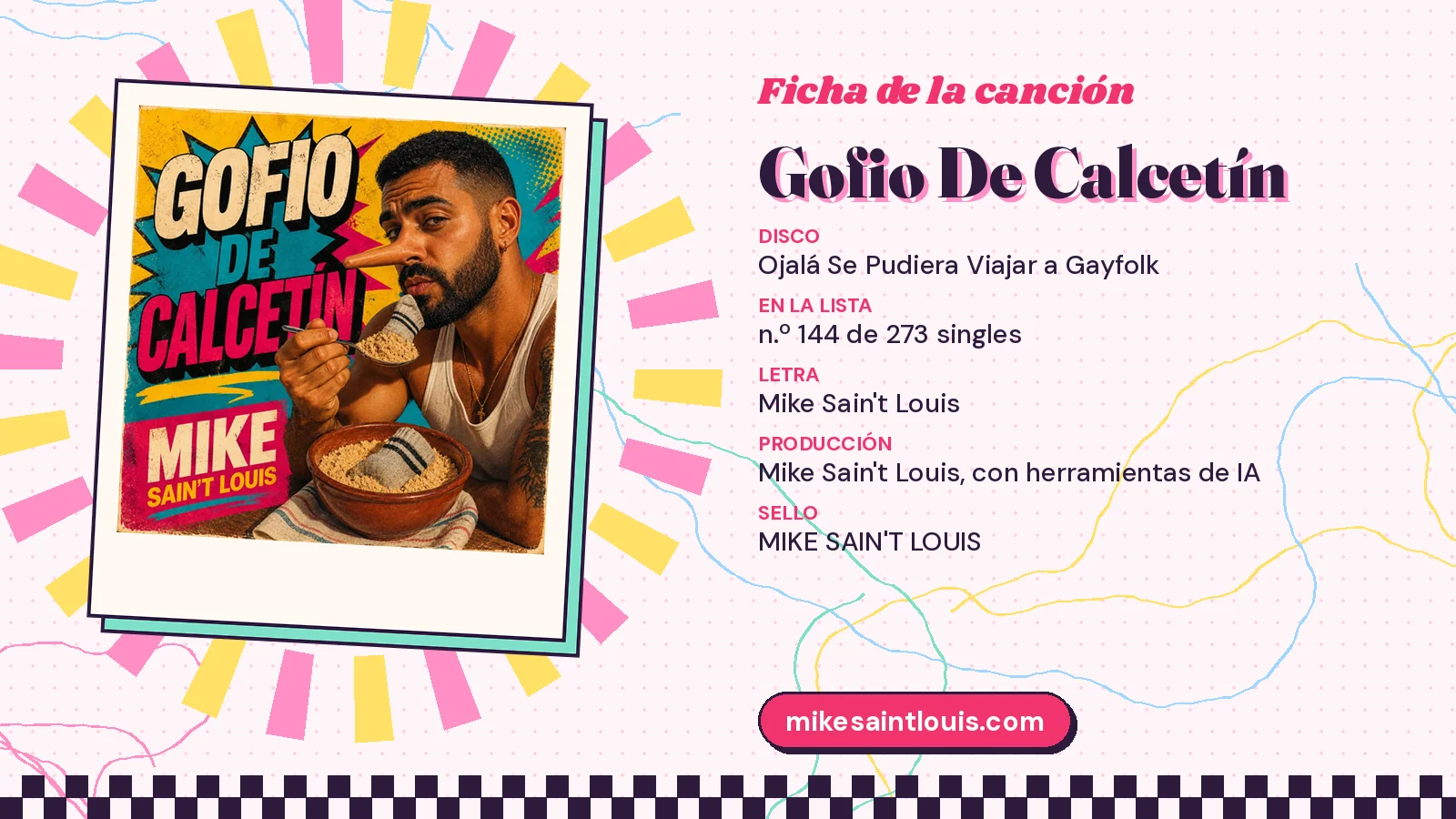
«Gofio de calcetín» belongs to *Ojalá se pudiera viajar a GAYFOLK*, the second album of the trilogy, the one about longing to be somewhere else and leaving behind what's useless. A chorus that turns down yet another boyfriend of the same sort fits there like gofio in milk.
In the catalogue of 273 singles it's track 144. Just before it comes «¡Que no pienso decir que mis trajes son de Zara!», another row with plenty of bargain-bin fashion. Just after, «En el basurero». From sale clothes to gofio and from gofio to the bin. The sequence has the logic of moving house: what you wore, what you ate, what you throw out.
Its brevity isn't carelessness. Some songs need development and some work like a door slammed on the stairs. This is one of the latter. It lasts as long as it takes to slam a door in a temper.
What the machine brings and what I bring
The lyric is mine, like all of Planeta Gayfolk's, word by word and rhyme by rhyme. I produce the music and vocals with artificial intelligence tools such as Suno, and I always say so, I don't hide it. My job on a song like this is finding the exact word and choosing, from the versions the tool generates, the one that respects the door-slam tone and lets the murmur breathe.
A machine doesn't know that gofio is an insult with a postal address. It doesn't know that "cushion boyfriend" already has a history in three other songs. It doesn't know that the sock, in my dictionary, measures disappointment. Only I know that, because I've been writing the dictionary song by song. I go into it more calmly in «La IA no me ahorra trabajo: me lo cambia de sitio».
How to read the dictionary
If you want to check how often each word comes back, the best thing is to browse the lyrics archive on this site and search. Gofio, cushion, sock, narcis, Pinocchio. It's a pretty entertaining detective game for a rainy Sunday afternoon, better than a quiz-show rerun.
The full lyric of this song is on its lyrics page, you can hear it on Spotify and its music video is on gayfolkplanet.com.
The last entry
Planeta Gayfolk (proper n.): a place where a Canarian insult, an Ikea cushion and a dirty sock can share the same verse without anyone being scandalised.
That's the language. I didn't invent it in one go. It built itself, from writing about the same exes with new words and about new exes with old words. One day I looked back and there was a dictionary.
And like every living dictionary, this one isn't closed. Every new song can bring a word, and every new ex, sadly, can too. The Royal Spanish Academy takes years to accept a term. I accept it the moment it rhymes.
Now you know how to read it.
Frequently asked questions
What is «Gofio de calcetín» by Mike Sain't Louis about? It's a short reply to an ex who took offence at a comment, with the chorus «No quiero otro novio cojín, el que tuve quedó a la altura de un calcetín» (I don't want another cushion boyfriend, the one I had ended up at sock level). It brings together several expressions that recur across the Planeta Gayfolk catalogue.
What does "novio cojín" (cushion boyfriend) mean in Mike Sain't Louis's songs? A partner who seems comfortable and decorative but holds nothing up when you need to lean on him. The expression also has its own song, «No quiero otro novio cojín».
Which album is «Gofio de calcetín» on? On Ojalá se pudiera viajar a GAYFOLK, the second album of the GAYFOLK trilogy. In the catalogue of 273 singles it's track 144.
Who wrote the lyrics? Mike Sain't Louis, a lyricist, composer and music producer from Madrid, the first AI songwriter. The music and vocals are made with artificial intelligence tools such as Suno, under his direction.