By Mike Sain't Louis ·
The silent showcase: «In the Quiet Room», the glass cube and the silence people watch
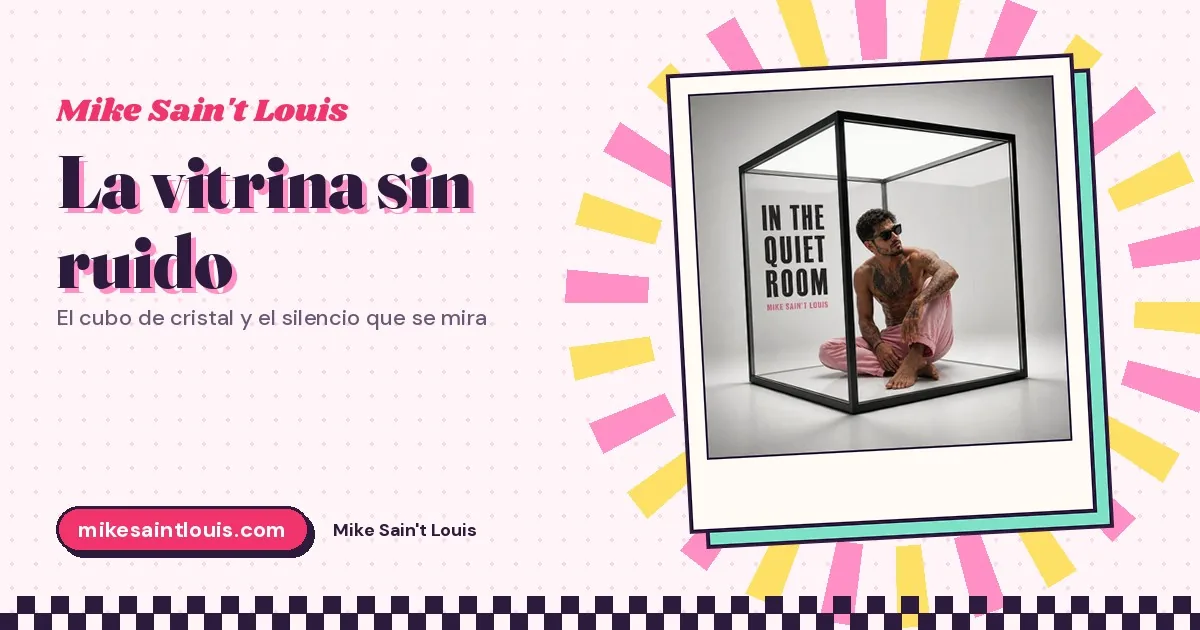
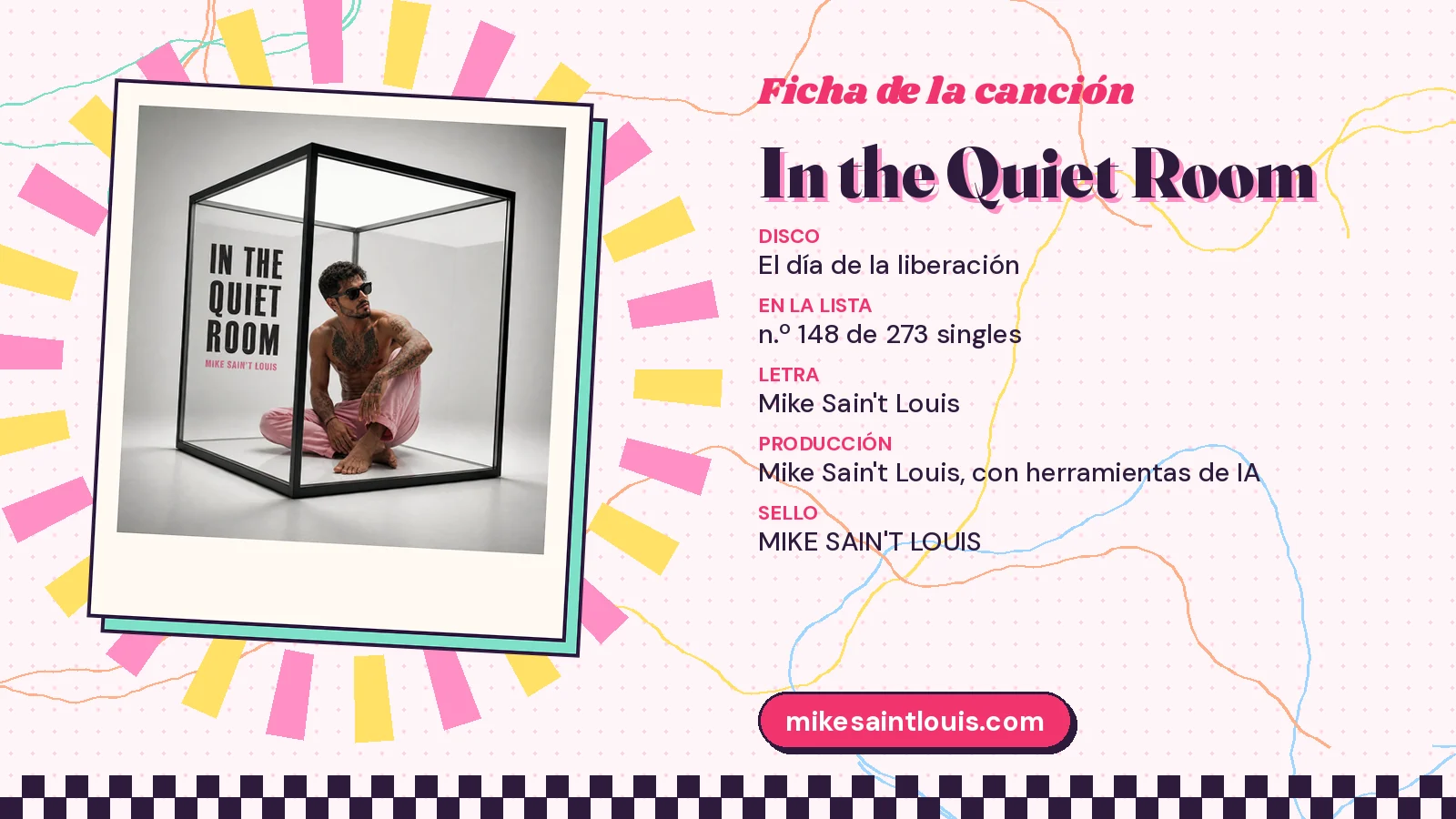
A quiet room is usually a place nobody sees. You close the door, lower the blind and the world ends. That's why it strikes me so much that the cover of «In the Quiet Room» does exactly the opposite: the silent room of the title is a glass box with black edges, standing in the middle of a white studio. Inside, a young man sits on the floor. And anyone walking past can look at him.
Before going on, a clarification that matters to me. This track doesn't have its lines published yet; its page in the gayfolkplanet.com lyrics section says they'll come later. I won't reconstruct them or make any up. What I do here is look at what does exist: the artwork, the English title, its place among my singles and the album it belongs to. That's more than enough material.
A transparent box in a white studio
The composition is clean, almost like a design catalogue. Light grey background, white floor with a faint reflection, soft light with no harsh shadows. In the centre, a glass cube framed by black metal profiles, the kind museums use to protect delicate pieces. On the left, printed on the glass itself, the title in tight, heavy black sans-serif letters: IN THE QUIET ROOM. Below it, smaller and in pink, the author's name.
I like that the text is written on the wall of the box. It doesn't float over the image like an added caption. It's part of the object. It's like the label next to a work in a gallery: here's the piece, here's its name. And the piece, of course, is a person.
That's the cover's first discomfort. A glass cube is made to hold valuable or fragile things, so they can be seen but not touched. An antique vase, a jewel, a fossil. Putting someone in there turns them into an exhibit. It protects them, yes, but it also separates them. What stays inside is safe and, at the same time, alone.
Sunglasses indoors
The young man wears dark, thick-framed sunglasses even though he's in a closed, well-lit space. That detail changes the tone of the whole image. Sunglasses indoors are the gesture of a celebrity escaping the flashes, of a hangover after a long night, or of someone who doesn't want their eyes read. In all three cases they do the same job: seeing without being fully seen.
Inside a transparent box, that's almost the only defence available. His whole body is exposed, but his gaze isn't. His head is turned to one side and slightly up, as if something outside the cube had caught his attention, or as if he were deliberately avoiding whoever is looking at him. We don't know whether his eyes are open or closed behind the dark lenses. That doubt is part of the game.
There's a lovely paradox in wearing dark glasses inside a showcase. It's like hanging a curtain in a shop window. Someone living in full view keeps at least one small private corner: what he's looking at and what he's feeling.
Barefoot, shirtless, in pink trousers
The rest of the outfit is minimal. Bare torso covered in tattoos: a large design on the chest that looks like open wings, arms inked down to the fingers, several thin chains around the neck, a dark bracelet on the wrist. Loose pale pink trousers, rolled up. And bare feet resting on the white floor of the cube.
Going barefoot has something homely about it, something of Sunday, of being among people you trust. Nobody takes their shoes off where they feel watched; they take them off where they feel at ease. That's why the posture, sitting on the floor with one leg bent and an arm resting on the knee, looks like someone who has already got used to his enclosure. He doesn't bang on the glass or look for the way out. He's just there, like someone sitting on their bedroom floor after a long day.
The pink of the trousers doesn't go unnoticed either. It's the only strong colour on the whole sleeve, together with my name under the title. Everything else is white, black and skin. That soft pink inside an aseptic box works like a signature: there's someone in here with flair, with a story, with a particular way of being in the world.
When pink and silence meet
That combination, pink and silence, has a history the LGBTQ+ community knows well. In Nazi concentration camps, men detained for homosexuality had a pink triangle sewn onto their uniforms. Decades later, in 1987, a group of six New York activists, the Silence = Death Project, took that triangle back, turned it to point upwards and placed it on a black background next to a phrase: «Silence = Death». The poster became one of the symbols of ACT UP during the AIDS crisis.
The idea was clear: in that epidemic, keeping quiet killed. Keeping quiet about diagnoses, about fear, about orientation. The silence of institutions, families and the media left people to die who could have been cared for. That phrase turned noise into a form of survival.
That's why I find it interesting to look at this cover with that history beside it. A young man in pink trousers in a silent room. It isn't the imposed silence of the AIDS years, nor that of the closet. At least it doesn't look like it. There are two very different silences that look alike from outside: the one you're forced to keep and the one you choose in order to rest. One locks you in. The other sometimes heals. The cover doesn't say which one is his, and maybe that's why it works.
The glass closet
In 2007, journalist Michael Musto published a feature in Out magazine called «The Glass Closet». It was about celebrities whose orientation was an open secret: everyone knew or sensed it, but they didn't say it in public. They were in a closet, yes, but one with transparent walls.
The expression stuck because it describes an uncomfortable situation very well. Living in full view of everyone without being able to name what everyone sees. People watching, commenting, speculating, while you act as if nothing is going on. It's a very particular kind of confinement, because it doesn't protect you from anything: it exposes you just the same, but without giving you a say.
I don't know whether the box on this cover is a glass closet. The young man doesn't seem to be hiding, with those pink trousers and that tattooed torso on show. But the image allows that reading, and I think it's fair to point it out. I've already written about the faces we show and the ones we keep in «La doble cara». Here the mask isn't made of iron: it's made of glass, and a pair of sunglasses does the rest.
Artists inside showcases
Contemporary art has been playing with this very image for decades. In 1995, actress Tilda Swinton and artist Cornelia Parker presented a piece called «The Maybe» at London's Serpentine Gallery: Swinton slept, or seemed to sleep, inside a glass case for hours while the public walked past. In 2013 she repeated it unannounced at MoMA in New York, on days that weren't publicised.
In 2010, Marina Abramović spent almost three months in MoMA's atrium with «The Artist Is Present». No showcase, but a marked-off, watched space: her sitting on a chair in silence, and opposite her an empty chair where anyone could sit and look her in the eye. More than seven hundred hours without speaking, surrounded by people.
And in 2003, illusionist David Blaine shut himself in a transparent box hanging by the Thames, near Tower Bridge, for 44 days, with only water. He called it «Above the Below». Thousands of people went to see him; some cheered him on, others threw things or shouted at him from below.
All three pieces share something with the cover of «In the Quiet Room»: someone silent inside a closed space, and the noise outside. What changes in each case is the audience's reaction. Some look with respect, some with morbid curiosity, and some can't stand someone sitting still and silent in front of them.
Reality TV as a fishbowl
In Spain, on 23 April 2000, Telecinco premiered «Gran Hermano», the local Big Brother. A group of people locked in a house full of cameras, watched by millions of viewers around the clock. The word «house» soon fell short: it was a fishbowl. And it taught a whole generation that watching someone locked up could be entertainment.

Since then, the showcase has moved into our pockets. Social media turns any bedroom into a set: people post their room, their food, their gym, their sofa. Even silence can be uploaded as a «calm routine» video with soft music and candlelight. The quiet room is no longer necessarily private. Often it's a backdrop.
I already talked about what the spotlight does to whoever lives under it when I wrote about Britney Spears in «Sobrevivir al propio espectáculo». The glass box on this cover could be a minimal version of that cage: no coloured lights, no visible audience, but just as transparent.
The quietest place on the planet
Let's now take the title literally. What would a truly silent room be like? They exist. They're called anechoic chambers, rooms lined with foam or fibre wedges that absorb almost all sound and stop it from bouncing. They're used to test microphones, loudspeakers and electronic devices. Labs such as Orfield in Minneapolis and Microsoft's campus in Redmond have competed in the Guinness records for the title of quietest place ever measured.
The curious thing is what people who go in report: total silence doesn't exist for a living body. In 1951, composer John Cage visited Harvard University's anechoic chamber expecting to hear nothing. He heard two sounds, one high and one low. The engineer told him the high one was his nervous system and the low one his blood circulating. Cage came out convinced that silence isn't the absence of sound but another way of listening.
A year later, on 29 August 1952, pianist David Tudor premiered Cage's most famous piece in Woodstock, «4′33″»: four minutes and thirty-three seconds in which the performer doesn't play a single note. The work is the sound of the room: coughs, chairs, rain, an uneasy audience. In Cage's hands, a silent room becomes a score.
What you hear when you hear nothing
That experience of Cage's interests me a lot as a lyricist. When you turn down the noise outside, the noise inside rises. Thoughts, memories, conversations you never had. It's what happens to many people at night, when the TV goes off and the house goes quiet: suddenly the head starts talking louder.
There's a whole song about that in my catalogue. In «Ruido en mi mente» I wrote this line, which fits a glass box almost unsettlingly well:
El silencio me juzga y se ríe sin fe
(«Silence judges me and laughs without faith».) There, silence isn't rest. It's a judge. It has a face, it laughs, it has opinions. It's the silence of being alone with what you don't want to think about, and that's why it becomes unbearable. It's the opposite of the calm of a peaceful afternoon. And from outside, both look exactly the same: a person sitting still in a room.
The fifteen-minute experiment
In 2014, the journal Science published a study led by psychologist Timothy Wilson of the University of Virginia that quickly became famous. They asked several groups of volunteers to spend between six and fifteen minutes alone in a room, with no phone, no books, nothing to do but think. Many found it unpleasant.
In one of the tests they were given the option of giving themselves a small electric shock, which they had tried beforehand and said they would pay to avoid. Even so, during those fifteen minutes alone, twelve of the eighteen men and six of the twenty-four women pressed the button at least once. They preferred something unpleasant to being left alone with their own heads.
The study has its nuances and has been widely debated, but the image it left is powerful. Three centuries earlier, Blaise Pascal had written in his «Pensées», published in 1670 after his death, that all of humanity's unhappiness comes from one thing: not knowing how to stay quietly in a room. Seen that way, the quiet room of the title isn't a comfortable place by default. You have to learn to be in it.
Silence as a castle
Not every silence is a threat. Some people need to withdraw to recharge, and that doesn't mean anything is wrong. Introverts, for example, often say that time alone isn't a punishment but a need, like sleep. And many autistic people or people with sensory sensitivity need low-stimulus spaces to regulate themselves after a stretch of noise and lights.
That's why, in recent years, more and more airports, stadiums, hospitals and shopping centres have opened sensory or calm rooms, and some supermarkets have hours with the music off and the lights lowered. They are, literally, quiet rooms. They aren't for hiding but for being able to come back.
On the same album there's a track that defends that right to withdraw without explanations. In «Antisocial» I left this line:
mi silencio es un castillo, yo una armadura sin llave.
(«My silence is a castle, I'm a suit of armour with no key».) I looked at it closely in «Un castillo sin llave». There, silence isn't a judge but a fortress. What I'm not sure about is what the box on this cover is: a glass castle someone chose or a transparent cell. Maybe it depends on the day. Maybe it depends on who's looking.
Between «Bob Marley» and «Float»
On the singles list, this track is number 148 of 273. Right before it is «Bob Marley», and right after, «Float». Neither has published lyrics yet, so I won't say what they're about. But their titles, placed in a row, sketch a curious little journey: a proper name loaded with music, reggae and message; then a quiet room; then a verb about floating, letting yourself be carried by water or air.
Noise, silence, weightlessness. I don't know if it's a planned sequence, and I won't claim it is. I'll just note that the quiet room sits in the middle, like a pause between two states. It's a good position for a song with this title: the breather between one thing and the next.
The album that holds it is «El día de la liberación», the third of the Gayfolk trilogy. It's a title about getting out, breaking free, being released. And yet inside it there's a song whose cover is a transparent enclosure. I like that contradiction. No liberation is a straight line: sometimes, to get out of something, you first have to sit still for a while in a room without noise and think.
Looking without touching
Back to the showcase, because there's something else that unsettles me. Glass lets you see everything, but it prevents contact. You can see the young man, his tattoos, his bare feet, his pink trousers. But you can't touch his shoulder, sit next to him or ask him how he is without a wall in between.
Some loneliness is like that. Surrounded by people, visible to everyone, with thousands of followers or a full house, and yet nobody really reaches you. I put it another way in «Siempre apartado entre tanta gente», which grows from a line in «Entre cuatro paredes». The glass box is the visual version of that phrase: being in the middle of everything and apart from everything at once.
And then there's whoever looks from outside. Because the cover puts us in that place: we're the audience, the museum visitor, the reality-show viewer. We can walk on by, stand and stare out of curiosity, or do something harder: come closer, even with the glass there, and tap gently so he knows someone has noticed.
When a quiet room stops being a refuge
I want to be clear on this point, because the subject calls for it. Withdrawing to rest is healthy. Spending days without going out, without wanting to see anyone, without finding meaning in anything, can be something else. The difference isn't always easy to see from inside. A useful clue: the silence that restores you sends you back with a bit more energy; the silence that sinks you leaves you with less each time.
If you notice your quiet room has become a box you no longer know how to leave, tell someone you trust or your GP. You don't need to reach anything extreme to deserve help. For many people, the first conversation with a mental health professional is the one that breaks the glass.
If you're in Spain and having a really hard time, or thoughts of hurting yourself come up, the 024 line answers at any hour, free of charge, without you having to give your name. For an emergency that can't wait, the number is 112. And if you're reading this from another country, look up the crisis support line that works there or call its emergency number. I've gathered more resources and reading in «Salud mental sin tabú».
A studio is also a quiet room
There's one last reading that's close to home, because it has to do with how I work. The songs of Planeta Gayfolk are born in a place quite like that box: a desk, a screen and many hours alone. I write the lyrics and direct the production; the music and performances are generated with artificial intelligence. It's a craft with a lot of silence in it. I've written about that side before.
Then, when the song comes out, the showcase thing happens: what you made in silence is exposed and anyone can look at it, judge it, share it or ignore it. It's a strange transition, from the closed room to the shop window. I suppose anyone who creates something knows that feeling: the work is made in a room without noise, but it lives in a glass box.
For whoever listens to this with the door closed
For whoever needs a quiet room and has nowhere to find one. For whoever lives in a shared flat, with the neighbour's TV and the chatter on the stairs, and dreams of ten minutes of silence. For whoever has that room and can't bear being in it.
For whoever wears sunglasses indoors because today they don't want their eyes read. For whoever walks barefoot around the house and sits on the floor when the sofa feels too far away. For whoever has felt watched through a glass nobody else can see.
And for whoever loves museum showcases, odd psychology experiments, Cage's pieces and performances where nothing happens and everything does. Until its lines are published, you can listen to the track on your usual platform or download it without paying or signing up from the downloads section. When the lyrics are ready I'll upload them in full, without changing a comma.
Frequently asked questions
What is «In the Quiet Room» about? Its lyrics haven't been published yet, so this post doesn't quote any of its lines. The cover shows a barefoot young man in sunglasses, pink trousers and a tattooed torso, sitting on the floor of a glass cube in a white studio. The post reads the title through that image: a silent room that anyone can look into.
Which album is it on? On «El día de la liberación», the third album of the Gayfolk trilogy. On the singles list it's number 148 of 273, between «Bob Marley» and «Float».
What does the title mean? «In the Quiet Room» is about being in a calm or silent room. In English, «quiet room» is also used for the calm or sensory rooms found in airports, hospitals and stadiums.
Which other songs by Mike talk about silence? «Ruido en mi mente», where silence appears as a judge, and «Antisocial», where it becomes a castle. Also «Entre cuatro paredes», about not having the strength to leave the room.
What can I do if my quiet room has turned into a cage? Tell someone you trust or your doctor. In Spain, 024 answers at any hour and for free; for immediate danger, call 112. Outside Spain, look for your country's crisis line.
Who makes this song? Mike Sain't Louis, a lyricist, composer and music producer from Madrid, the first AI songwriter. He writes the lyrics and directs the production; the music and performances are generated with artificial intelligence.