
By Mike Sain't Louis ·
The comeback in her handbag: «Licenciada en derecho», rhyme as a shield and the women who made us look up
It's happened to everyone. Someone makes an out-of-line remark, your mind goes blank, you smile to be polite and go home. And in the shower two hours later, the perfect reply arrives. The French even have a phrase for it, "l'esprit de l'escalier", staircase wit: the brilliant comeback that comes to you once you're already on your way down and there's no going back.
«Licenciada en derecho» (Law Graduate) is the exact opposite. It's a reply that arrives on time. A ready-made line, tucked into the handbag next to the law books, which its heroine pulls out at the precise moment someone looks where they shouldn't. And it's built so that anyone can take it home and use it the very next day.
On the song page I already talked about the heels, the Spanglish and this woman who goes from Madrid to Miami without a hair out of place. Here I want to focus on something else: the line itself, why it works as a shield, and all the women who, long before the heroine of my song, had to ask people to raise their eyes before they'd be taken seriously. The full lyrics are published.
A line built to go off on its own
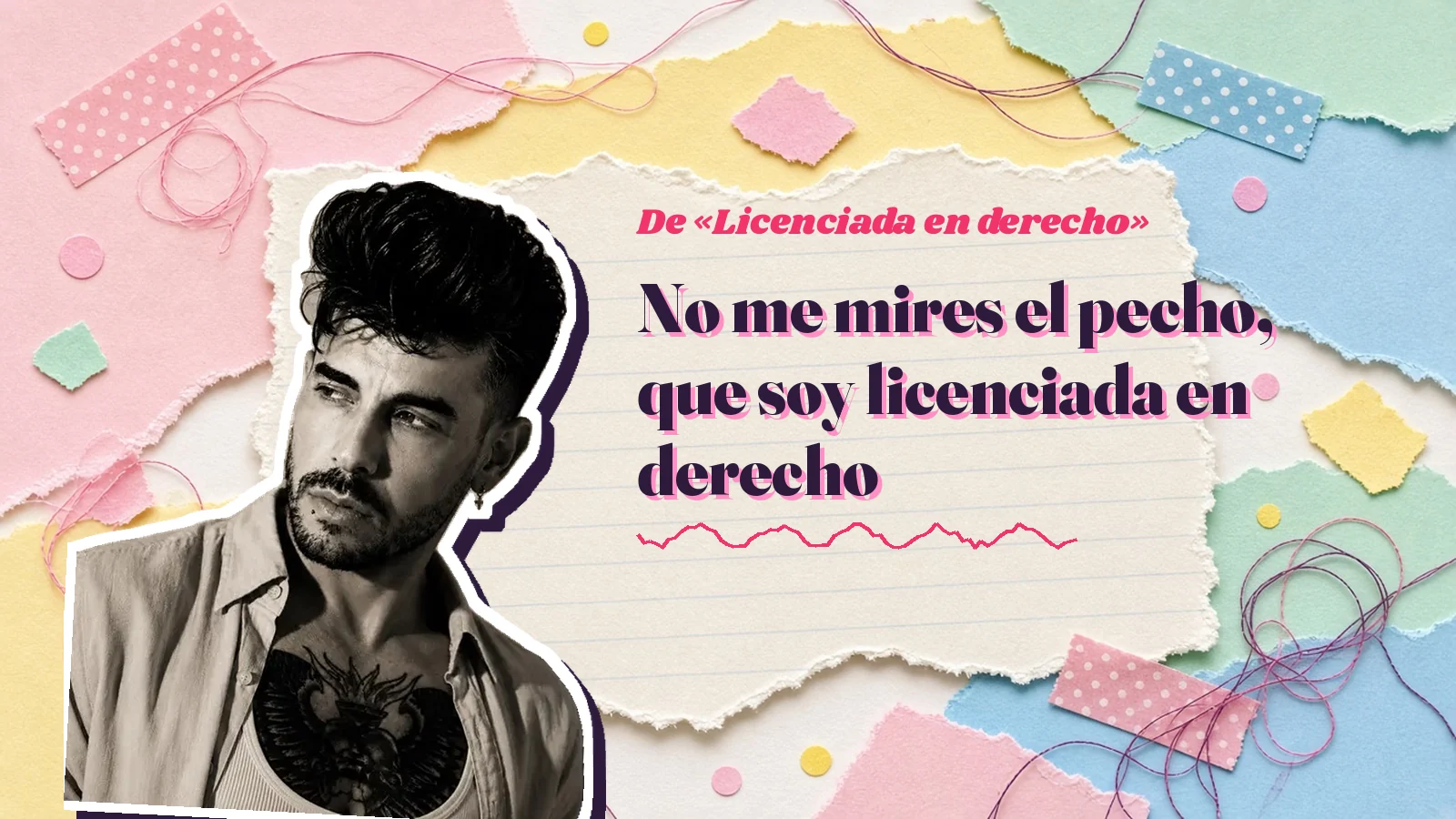
The chorus is a single line repeated three times in a row whenever it comes round: «No me mires el pecho, que soy licenciada en derecho». Don't look at my chest, I've got a law degree. No frills, no metaphors, nothing to decode. An order and a reason, joined by a very Madrid "que".
I love that structure because it's the shape of the comebacks we grew up with. Mothers and grandmothers had one for everything. "Because I said so." "You're not here to keep the chair warm." Short, blunt lines that leave no room for a reply. The heroine of the song has built her own, tailored to the situation that annoys her most.
The threefold repetition isn't an accident either. A line said once can slip by unnoticed. Said three times, it becomes a mantra, a motto, something that sticks to you whether you like it or not. That's what happens with good choruses, and it's what happens with good comebacks: they have to fire on their own, without thinking, because when the moment comes there's no time to think.
Why rhymes sound true
Psychologists have studied a curious effect: rhyming statements strike us as truer than ones that say the same thing without rhyming. In a much-cited experiment from around 2000, the researchers Matthew McGlone and Jessica Tofighbakhsh showed people proverbs in rhyming and non-rhyming versions, and the rhyming ones were judged more accurate. They called it the rhyme-as-reason effect.
I'm not claiming a song is a lab experiment. But the finding explains beautifully why the chorus of «Licenciada en derecho» works. "Pecho" and "derecho" click together in a way that sounds inevitable, almost proverbial. And when something sounds inevitable, there seems to be nothing left to argue. The line doesn't just ask not to be looked at that way; it says so with an authority that seems to come from centuries back.
Spanish proverbs work the same way. "A quien madruga, Dios le ayuda", the early bird gets God's help. "Dime con quién andas y te diré quién eres", tell me who your friends are and I'll tell you who you are. Nobody has proved them right, but the rhyme gives them an air of unarguable truth. What my song does is use that very mechanism for something concrete and very current: putting in their place the people who confuse a conversation with an inspection.
Chest and degree, on the same line
What I love most about the chorus is that it brings together two things old-school sexism insists on keeping apart. Body and brain. Looks and career. For a long time, women were given a choice: either you were pretty or you were clever, either you dressed up or you were taken seriously. The heroine of the song refuses to choose.

She walks in heels, with style, dressed to the nines, and she carries law books in her bag. And what she's asking isn't for people to stop finding her attractive, but for them not to shrink her down to that. To raise their eyes. To listen.
It's something I've touched on in other songs from another angle. I've written about writing about the body without apologising, and these lyrics are the other side of that coin. A body can be shown and celebrated without giving anyone permission to ignore everything else. Wearing a low neckline isn't an invitation; it's wearing a low neckline.
The women who raised the gaze first
The heroine of my song is an invented character, a fictional lawyer with the style of a pop icon. But behind her there's a real history I think is worth remembering, because in Spain being a law graduate wasn't always an option.
Until 1910, women couldn't enrol at Spanish universities on the same terms as men. A Royal Order that year opened the door without the need for special permissions. Even so, for decades the women who studied law were an absolute rarity.
Two names are essential. Victoria Kent, who graduated in law and in 1925 became the first woman admitted to the Madrid Bar Association. And Clara Campoamor, who finished her law degree in her thirties, after years working at other jobs, as a telegraph operator and as a teacher. Both went on to sit as members of parliament in the Cortes of the Second Republic, and both had to prove in every trial and every debate that their minds were a match for anyone's.
I don't know if either of them ever had to say something like my chorus. What I do know is that every woman who came after them, all the lawyers, judges, notaries and prosecutors who fill the courts today, inherited something from that fight. The heroine of the song strides in heels through a city they helped to open up.
The movie lawyer
There's one film character who always comes to mind with this song: Elle Woods, the heroine of "Legally Blonde", the 2001 film starring Reese Witherspoon. Elle is blonde, dresses in pink, carries a chihuahua in her bag, and everyone assumes she's an airhead. She gets into Harvard Law School and spends the film proving she can be all of that and a brilliant lawyer too.
The film became a minor classic, and for a lot of gay audiences she's a total icon. I understand exactly why. Elle Woods is the story of someone judged on her appearance who refuses to change her appearance to make the judging stop. She wins without dressing up as something she isn't. For many LGBTQ+ people who've been told they're "too obvious", that's almost a fantasy of justice.
The heroine of «Licenciada en derecho» is Elle Woods's first cousin. Both wear heels and carry books. Both are sick of being underestimated. The difference is that mine doesn't need a whole film to prove it: one chorus will do.
What this has to do with camp
It might seem odd for a gay lyricist to write a song about a woman fed up with people staring at her cleavage. To me it doesn't seem odd at all. Plenty of camp gay men know a very similar experience inside out: being reduced to one single thing.
If you're camp, some people see nothing else. They don't hear what you're saying because they're too busy watching how you move your hands. They assume you won't know about numbers, or law, or anything serious. They treat you like a charming ornament rather than a professional. That mechanism, shrinking someone to the part of their body or manner that grabs the most attention, is the same one.
That's why the song page says it's also for anyone tired of being reduced to their looks. And that's why it comes so naturally to me to write from inside this woman's skin. The fight differs in the details, but at heart it's very alike. In Con el taconeo I already played with that shared stage, the heel as a statement rather than a disguise.
Spanglish as a passport
The lyrics mix English and Spanish, sometimes within the same line. "Mi estilo es pretty." "Sin ninguna doubt." "Educada y chic." It's what linguists call code-switching: moving from one language to another mid-conversation, as naturally as breathing.
On the song page I explained how that marks the heroine as a cosmopolitan woman. Here I want to add something. In this song, Spanglish is also a form of power. Someone who commands two languages and hops between them without asking permission is saying she moves in several worlds at once. That she doesn't fit a single label. That she's impossible to pigeonhole.
And notice one detail: the chorus, the line that matters, is in Spanish. Everything else can be in English, can shine like a Miami music video, but the line that puts everyone in their place is said in Castilian, with "pecho" and "derecho" and that streetwise "que". It's as if the heroine saves her mother tongue for what really counts.
I've written about why I write in Spanish even though my website is also in English, and this is one of the few songs in the catalogue where English takes such a leading role. But even here, the knockout punch lands in Spanish.
A song that doesn't apologise
There's a line in the English part that sums up the heroine's character perfectly: she tells you not to underestimate her, and says she's here to stay. There's no modesty anywhere in these lyrics, and I think that's perfect.
Women, and many LGBTQ+ people, were taught for a long time to make ourselves small. Not to take up too much room, not to talk too loudly, to apologise for existing with too much sparkle. The heroine of this song has decided not to. She calls herself powerful, a boss, someone ticking off her goals. And she says it without a single "sorry to bother you".
That absence of apology is part of the message. She doesn't say "please, if it's not too much trouble, could you look me in the eye?". She says "don't look at my chest". Full stop. It's an order, not a request. And the order comes with its justification, in case anyone needed one: I have a law degree.
Humour as a legal weapon
Of course, the line is very funny. There's something comic about the idea that a university degree could shield you from stares. As if law graduates had an invisible force field. As if the diploma came with an anti-ogling certificate attached.

And that's exactly the trick. The line is funny, and that's why it works. If the heroine delivered a solemn speech about respect, the starer would get defensive. With a line that rhymes and makes people laugh, she disarms him. She shows him up without giving him room to argue. It's hard to get angry with someone who has put you in your place with a couplet.
The catalogue has plenty of songs that use humour as a means of self-defence. I've written about how to write a chorus that laughs at you and with you, and these lyrics are a good example. The chorus doesn't humiliate anyone; it simply points out how absurd the situation is. And absurdity, pointed out with wit, becomes impossible to keep up.
Three settings for one chorus
I like imagining the chorus in specific places, because each gives it a different shade. The first is an office. A meeting with a client who keeps looking where he shouldn't while she walks him through a contract. The line, delivered with a smile, cuts the tension and makes clear who's running the meeting. Nobody can call her rude; she has simply reminded him of her role at that table.
The second is a bar. Someone comes over with more drinks in him than he should have and less manners than he needs. Here the line works like a door slammed with style: no need to make a scene or call the barman. Just say it and turn away. The couplet does the dirty work.
The third is a courtroom, the natural habitat of a law graduate. There the line hardly needs saying, because the gown speaks for her. But I like to think the heroine carries it in her head anyway, the way you run through your arguments before walking into court. It's her personal motto, keeping her company even when unspoken.
The beauty of a line like this is that it works in all three places without changing a comma. That's the proof it's well made: it fits any situation because it names something that happens in all of them.
The weight of a stare
Some people think a look is no big deal. That looking isn't touching, that it doesn't hurt anyone, that complaining about it is an overreaction. And I understand that from the outside it might seem minor.
But anyone who lives it every day knows it isn't. A lingering stare in the wrong place changes the conversation. It makes you think about your clothes instead of what you were saying. It makes you fold your arms, shift around, lose the thread. When it happens once it's an anecdote, but when it happens every day it becomes a weight you carry without noticing.
That's why it matters so much to me that the song names it without melodrama and without apology. It doesn't turn the stare into a tragedy, but it doesn't let it slide either. It points at it, shows it up and keeps walking. It's a very healthy way to defend yourself: you don't swallow the bad moment, but you don't let it ruin your day either.
And it does all that with a beat that makes you want to move. That's another way of taking the power out of someone else's stare: turning your answer into something you can dance to.
A line for whoever's listening
What excites me most about this song is the thought that someone might actually use it. That a woman, or a camp boy, or anyone fed up with being looked at in a way they don't like, might learn the line and keep it ready. That next time they won't go blank and won't have to wait for the shower to find the answer.

Songs can do lots of things. Help you cry, dance, fall in love. And this too: give you words you didn't have. Some people have found in a song the way to say something they'd spent years not knowing how to say. I'd love «Licenciada en derecho» to be, for someone, that line kept in the handbag.
And even if they never actually say it to anyone's face, knowing they have it already changes something. Walking down the street with a good comeback ready is walking differently. Taller, surer, heels clicking louder.
An album that dreams of another world
The song is on Ojalá se pudiera viajar a Gayfolk (If Only You Could Travel to Gayfolk), the second album of the Planeta Gayfolk trilogy. That album is full of longing for a better place, a planet where things work differently. And the heroine of «Licenciada en derecho» is in a way a resident of that planet: someone who already lives as if the old rules didn't exist, and who makes a point of reminding anyone who hasn't caught up.
On the singles list, the song sits between No puedo desenchufar este ventilador que está esparciendo mierda (I Can't Unplug This Fan That's Spreading Shit) and Pura magia (Pure Magic). I love that order: after a song about someone spreading muck about you comes a woman who refuses to be reduced to anything, and then a night of dancing in Portuguese. It's almost a recovery sequence: they drag you through the mud, you put them in their place, and you go dancing.
Who this song is for
For every woman who has been spoken to by someone staring at her neckline and was left lost for words. For those who studied a tough degree and still had to prove themselves twice over. For camp boys nobody listens to because they're too busy watching their hands.
And for anyone who wants to leave the house with a line ready. You don't need a law degree to use it. You just need to be sick of being looked at the wrong way.
How to listen
The song is on the singles page and on every platform, and you can download it for free from the downloads section. I'd recommend it before a job interview, a tough meeting or any day you need to walk into a room stamping your heels.
As a lyricist, composer and music producer, I like the catalogue to have characters like this, who apologise for nothing. The music and the vocal performances are generated with artificial intelligence, but the satisfaction of having the right line at the right moment is as human as it gets.
Frequently asked questions
What is Licenciada en derecho about? A stylish woman with a career who is sick of people talking to her while staring at her chest. Her reply is a chorus in the form of a couplet: don't look at me like that, I've got a law degree.
Why does it mix English and Spanish? Because the heroine is a cosmopolitan woman who moves between two worlds. English gives her music-video sparkle, but the line that matters, the chorus, is in Spanish.
Is the heroine a real person? No. She's an invented character. The real lawyers mentioned in the post, Victoria Kent and Clara Campoamor, appear only as historical context.
Why does a gay lyricist write about a woman? Because the experience of being reduced to one part of your body or your manner is familiar to many people, including many camp gay men. At heart, the fight is very similar.
Who makes this song? Mike Sain't Louis, a lyricist, composer and music producer who calls himself "the first AI songwriter": he writes the lyrics and directs the production, and the music and vocal performances are generated with artificial intelligence.