By Mike Sain't Louis ·
The gang in the Polaroid: «Boys Like Us» and the plural that saves you
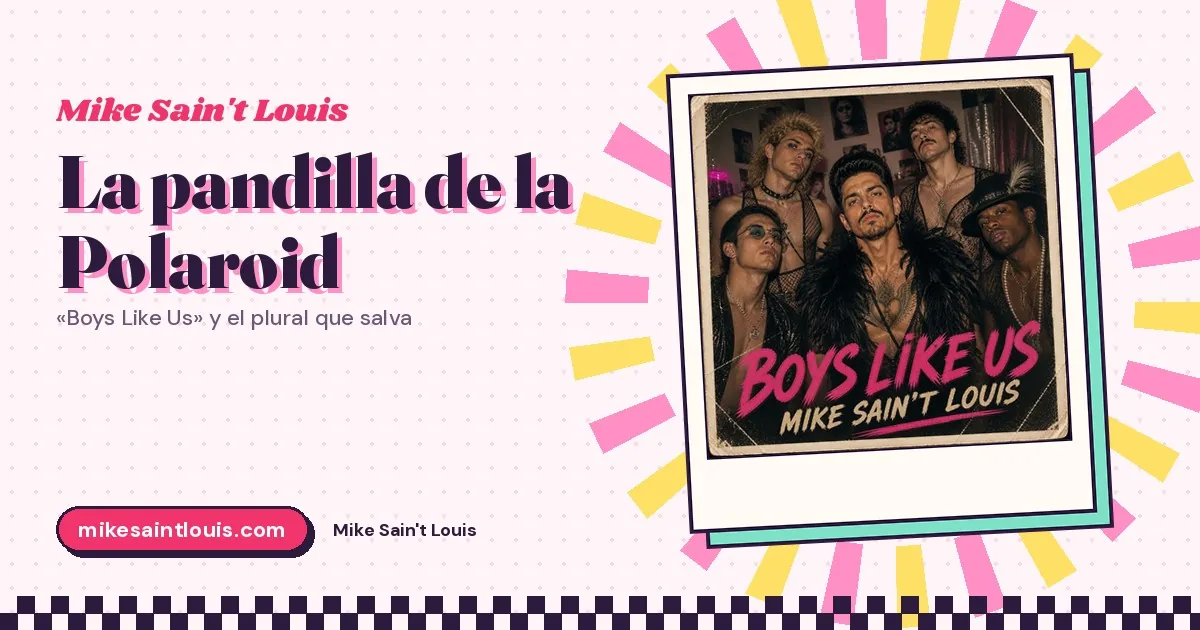
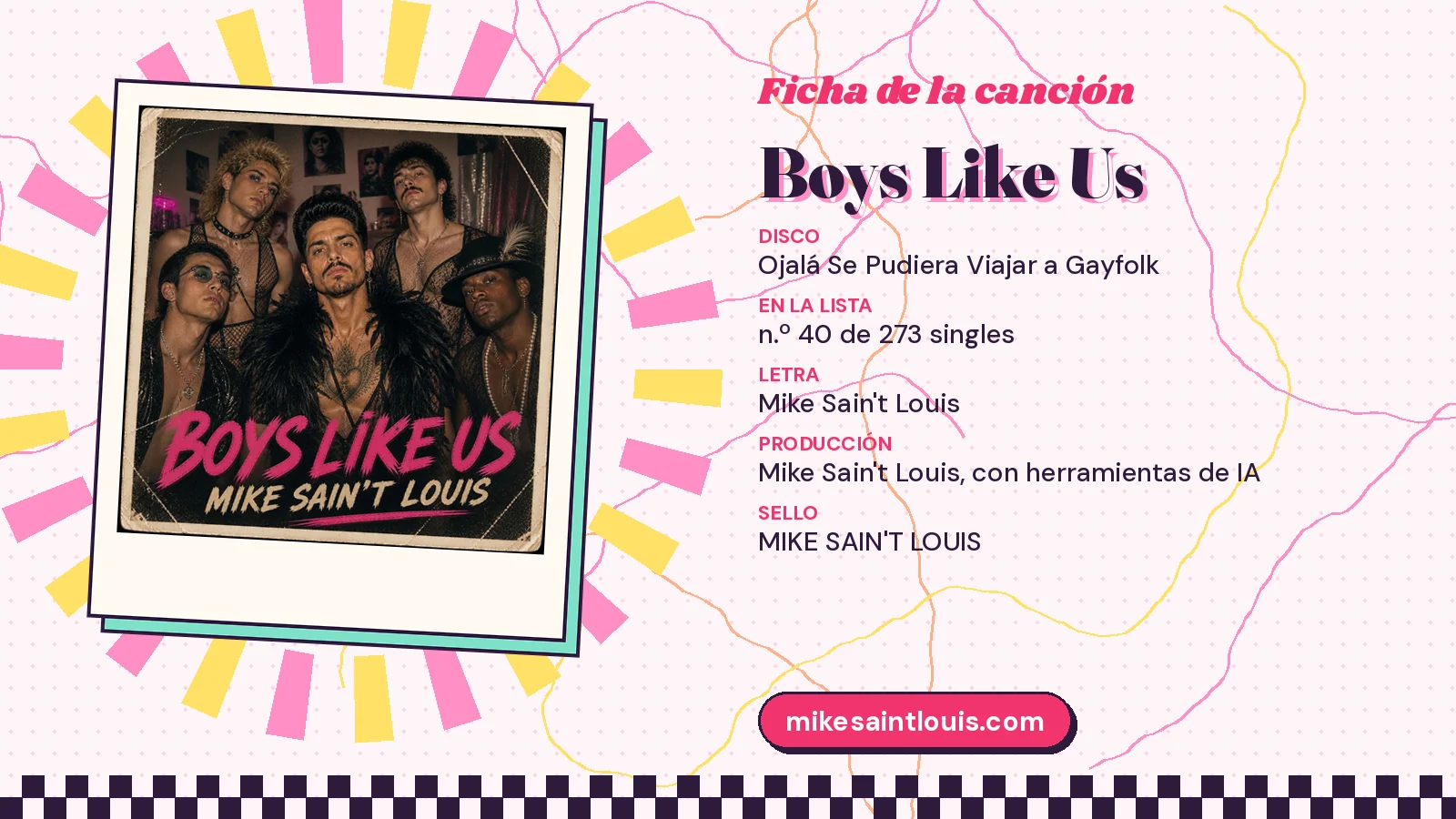
Five boys squeezed into a small room. One wears a black feather boa over his tattooed chest. Another, a mesh top and a leather dog collar round his neck. Another, a hat with a white feather and strings of pearls. There are seventies moustaches, a teased blond mane, round blue-tinted sunglasses. On the wall, photos and posters stuck up with Sellotape. A pink neon light in one corner. And all of it inside the white frame of a worn Polaroid, as if you’d found it in a shoebox at your uncle’s.
That’s the cover of «Boys Like Us», and it’s one of the few in my catalogue where there isn’t a lone character. There’s a gang.
The song is on «Ojalá se pudiera viajar a GAYFOLK», the second album of the trilogy, and the song’s page on the blog already covers the essentials: heels as armour, the bridge where people stare and we don’t care, the oh-oh-oh-oh chorus made for shouting from a Pride float. Here I want to focus on a single word, the smallest one in the title. Us. Because if you go through my lyrics, almost all of them speak in the first person or shout at a «you»: the ex, the narcissist, the hater, the mother-in-law. «Boys Like Us» speaks in the plural from start to finish. And that plural is half of what the song has to say.
Boys like us
The lyric’s very first word is already plural: we. We shine, we rise, we never hide.
It looks like a grammatical trifle, but it isn’t. When you’re a little queer boy in a village, or a neighbourhood, or a school run by priests, the first thing you learn is that you’re the only one. You don’t know anyone else. There’s nobody in your class, on your street, in your family. The telly, at best, shows you one or two as a joke: the hilarious hairdresser, the screaming queen on the Saturday comedy show. But someone like you, someone real, nearby, there isn’t.
The day you find out there are more, that there are boys like you, everything changes. It might be in a bar in Chueca at eighteen, legs shaking. It might be on an internet forum at two in the morning. It might be on an app, at summer camp, in a gym changing room, at your first Pride, which you attend almost in secret. But there comes a moment when «I» turns into «we», and from that moment on you’re not quite so alone.
Before the internet, that discovery took very specific forms. A magazine bought shamefaced at a kiosk far from home, slipped inside a newspaper so nobody on the bus could see it. A late-night radio show. A personal ad. A book borrowed from the municipal library with its cover wrapped. An Almodóvar film watched in secret on the living-room VCR, volume at its lowest and a finger on the stop button in case the door opened. Each of those things was a small window onto an «us» you hadn’t yet met in person.
And then, one day, the window becomes a door. You walk into a bar, or an association, or a party at a friend of a friend’s, and you see twenty boys like you roaring with laughter at things you understand too. You never forget that first night. It’s the night you stop being an oddity and become part of something.
«Boys Like Us» is written from after that moment. From the plural.
Where no one sees
The funny thing is that the first verse, the proud plural one, hides a beautiful contradiction:
«He holds my hand / Where no one sees»
Two lines after saying we never hide, the lyric confesses that the hand is held in secret. The song’s page already picks out that image as the start of everything: love that hides at first and then decides to come out. I want to stay a little longer with the contradiction, because it seems to me the truest thing in the song.
Because both things happen at once. You can go to Pride, put on the glitter, shout the chorus from a float on Calle Alcalá, and the next day let go of your boyfriend’s hand as you pass a group of lads at the bus stop. Everyone who has lived it knows. Pride and fear don’t cancel each other out. They live in the same body, sometimes on the same afternoon.
The song doesn’t resolve it. It puts both things side by side and carries on, as we all do.
And that hand held where no one sees has something tender about it too, mind. Not everything that happens in secret is shame. Some intimacies are ours precisely because nobody is watching.
The love they never keep
There’s a line in the first verse that strikes me as the most serious in the whole song, even if it flashes by among all the glitter:
«We are the love / They never keep»
The love they never keep. Never preserve. And that «they» has no face, but we all know who they are.
They’re the history books that don’t mention that the two gentlemen who lived together for forty years in a flat in Lavapiés were a couple. They’re the families who, when one of them dies, clear the flat and throw the photos and letters into a skip. They’re the death notices that say «his friend». They’re the police station archives, the files under the Francoist «social danger» law, which kept the names of the queers they arrested but not what they felt. For decades in this country, the only thing kept of our loves was the police record.
That’s why the Polaroid-style cover moves me so much. It’s one of the photos nobody kept. Or one that somebody kept in secret in a shoebox under the bed, and that turned up years later when there was nobody left to say who those five boys in boas and mesh were.
This line is for them. For the ones who don’t appear in any archive.
The family you choose
I want to go back to the gang on the cover, because I think that’s where the heart of the matter lies.
Many queers of my generation and the ones before had to find ourselves a second family. Not always because our blood family threw us out, though that happened to plenty. Sometimes simply because our blood family didn’t understand. They loved you, yes, but they didn’t know what to do with you. They didn’t know what to say when you split up with your boyfriend. They didn’t know why you cried on New Year’s Eve. They couldn’t come with you to certain things.
And then the gang turns up. The friends you share a flat with in Malasaña in your twenties. The girlfriend who picks you up at six in the morning when your night at the club has gone horribly wrong. The group that gets together at Christmas at whoever has the biggest living room, with a turkey nobody knows how to cook and Raphael’s Christmas songs blaring. That’s the chosen family, and for many people it’s the one that really holds life up.
In New York in the eighties, those families were called houses. The ballroom houses, with their mothers, their daughters and their invented surnames, shown in the documentary «Paris Is Burning». Here they didn’t have that name, but they existed all the same, in shared flats in Chueca, in the bars of the Movida, at village fiestas where the four locas of the district got together to dance.
The cover of «Boys Like Us» is a photo of one of those houses. And the «us» in the title is its surname.
What we’re told
The chorus, or what serves as a chorus before the final shout, has a pair of lines that is almost a manifesto:
«We turn the night into gold / We never do what we're told»
The song’s page already calls that a way of life, and it’s right. I want to think for a moment about what it is we’re told.
We’re told not to make a fuss. We’re told not to be so camp. We’re told to get married, but not to kiss at the wedding in front of Grandma. We’re told to be discreet at work. We’re told Pride should be a party, but one that doesn’t hold up the traffic. We’re told to be grateful for the rights we have, as if they were a gift and not something fought for in the street. We’re told not to be so intense, so over the top, so queer.
And the song answers with the simplest thing: we don’t do it. Ever. We turn the night, which was the only place they let us exist, into gold.
That alchemy is very much ours. Taking what you were given as punishment, the night, the ghetto, the windowless bar, and turning it into something that shines.
English pop for a Spanish Pride
The song is entirely in English, and its page already points out that it speaks of something understood in any language. I’ll add one thing: for decades, English has been the language of Pride pop everywhere. The songs blasting from the floats in Madrid, Sitges or Maspalomas are largely songs in English. The lyrics of the divas who kept us company, the disco anthems we shouted with our arms in the air, reached us in a language many of the people dancing didn’t fully speak.
And yet we knew them by heart. We mangled the words, made some up, but everyone understood the «we».
«Boys Like Us» joins that tradition without any hang-ups. It’s float pop, arms-in-the-air pop. The lyric is mine, and the music and vocals were made with artificial intelligence tools, as across the whole catalogue, and the result is a song that could play on any dance floor in the world. But the plural, the «us», I brought from home. From the gangs here.
They whisper, they stare
The bridge changes the point of view. For the first time «they» appears as the subject:
«Oh they wonder / Why we glow / But boys like us / Always know»
I love that «always know». It’s a kind of shared secret, like a wink between two strangers who pass on the metro and recognise each other. That radar we all have, which for centuries was a way of surviving: knowing who was one of yours without anyone saying a word. A look that lasted a second too long. A handkerchief in a pocket. A way of holding a cigarette.
They look on from outside and can’t work out where the glow comes from. We know because we made it together, over years and funerals, and parties that ended at nine in the morning.
And there’s no need to explain it.
Pictures on the wall
There’s a detail on the cover you barely notice, but that tells me a lot. Behind the five boys, on the wall, there are photos stuck up. Black-and-white portraits, cuttings, an image that looks torn from a magazine. You can’t make out who’s in them. But they’re there, above the boys’ heads, like saints on a chapel wall.
Almost everyone has had that wall. The teenage bedroom with posters of your idols, held up with drawing pins or with Sellotape that left marks on the textured paint. For many queers, that wall was the first place we dared to say something about ourselves without saying it. The poster of the handsome TV heartthrob your mother thought was there because you liked his music. The photo of the actress whose whole life you wanted, not her boyfriend. A record sleeve with a diva in sequins.
It was a way of saying «this is me» in a language only you understood. And sometimes, if you were lucky, a friend who came into your room and stared at the wall a second too long.
In the «Boys Like Us» Polaroid, that wall isn’t in a lonely teenager’s bedroom any more. It’s in a place where there are five. The idols are still up there, but below them there’s an «us» looking straight at the camera without lowering its eyes.
It’s the bedroom wall, but with the door open.
And maybe, years from now, someone will stick that same Polaroid on the wall of another bedroom. A kid who doesn’t know who those five were, but who looks at it and understands something he can’t yet put into words. That’s how things are passed down among us: from wall to wall.
Shining isn’t asking permission
The song’s page ends by saying nobody has to give you permission to shine, and I want to pull on that thread a little more, because the lyric repeats the word shine again and again. We shine. We shine so bright. We shine tonight.
Shining isn’t the same as being liked. Being liked depends on other people: on them looking at you, approving of you, giving you a like, rating you on an app. Shining depends on you. You can shine in an empty room. You can shine on a dance floor where nobody’s looking. You can shine in the dole queue, in the waiting room at the health centre, on the terrace of a village bar where all the old men at the card table turn round when you walk in.
For a long time we were taught the opposite. To dim ourselves. To tone it down, dress in grey, not laugh so loud, not move our hands so much. And what the song proposes is switching the light on exactly where we were told to switch it off.
There’s nothing naive about that. It takes some doing.
The opposite of «Antisocial»
There’s a song in the catalogue that is almost the flip side of this one. «Antisocial» is about closing the door, keeping four people and a cat, preferring animals to putting up with the narcissist of the day. It’s a song in the singular: me, my castle, my armour.
«Boys Like Us» is the open door. It’s the gang, the dance floor, the float, the plural.
And I like that they live side by side, because both are true. There are times in life when you need the gang, and others when you need the sofa. There are Pride days and blanket days. Very often, the person shutting himself away at home today is the same one who, ten years ago, was in the Polaroid wearing a feather boa. And he hasn’t betrayed himself. He’s grown up.
Even the antisocial man has his chosen few. And those few, if you look closely, are his «us».
Heels in the Polaroid
The song’s page already talks about heels as armour, so I won’t repeat myself. I just want to add that you can’t see any heels on the cover. You see boas, mesh, necklaces, hats, moustaches. The photo is cropped at the waist, and whatever happens from there down, you have to imagine.
I imagine seventies platforms, cowboy boots, a sandal with a sock, trainers stained with beer. A gang is never colour-coordinated. Each of them has dressed in whatever he had, whatever the neighbour lent him, whatever he found at the Rastro flea market on Sunday. And that’s why it works.
I’ve written about heels in more detail in other songs, as in «Con el taconeo», where the flamenco heel and the drag heel share the same stage. Here the heel is a word in the lyric and a mystery out of shot.
For the boy who still lets go
The song’s page dedicates it to any boy who still lets go of his boyfriend’s hand on certain streets, and to those who never let go any more. I can’t think of a better dedication. I just want to add a third group.
The ones who don’t yet have anyone’s hand to hold. The ones still in the «I» who haven’t reached the «us». The village kid listening to this with headphones on in his bedroom who doesn’t know a single other boy like him. For him I also wrote «Carta a quien todavía no se lo ha dicho a nadie».
To that boy I’d say what the title says. There are boys like you. Lots of them. More than you think. Some of them are in a small room right now under a pink light, taking a photo that someone will find in a shoebox forty years from now.
One day you’ll be in one.
The plural that saves you
Lots of things save people. Music, certainly. A good therapist. A dog. A new city. But if I had to choose just one for the queers of my generation and the ones before, I’d choose that: the plural. Realising you’re not the only one. That there’s an «us» waiting for you somewhere.
I said it in «Hacen falta canciones de amor gay que salen bien», and I’ll say it again here with a different word: we also need songs about queer friendship that goes right. Gang songs. Chosen-family songs. Songs about five boys in a Polaroid who didn’t know they’d one day be history.
Pride doesn’t end in June. There are small Prides, like the one on any old Tuesday in November, when you get together with your lot for no reason and laugh at the same old things.
On that Tuesday too, we’re boys like us.
Frequently asked questions
Which album is «Boys Like Us» on?
It’s part of «Ojalá se pudiera viajar a GAYFOLK», the second album of Mike Sain't Louis’s GAYFOLK trilogy.
What language are the lyrics in?
The lyrics of «Boys Like Us» are entirely in English.
What is «Boys Like Us» about?
A group of boys who decide not to hide: they turn the night into gold, never do what they’re told, and shine even when people stare and whisper.
What’s on the cover?
A Polaroid-framed photo of five boys in a small room, wearing feather boas, mesh tops, necklaces and hats, under a pink neon light.
Who made the song?
The lyrics are by Mike Sain't Louis, lyricist, composer and music producer from Madrid. The music and vocals were made with artificial intelligence tools.