
By Mike Sain't Louis ·
«Igual que un episodio dramático»: comparisons in my lyrics
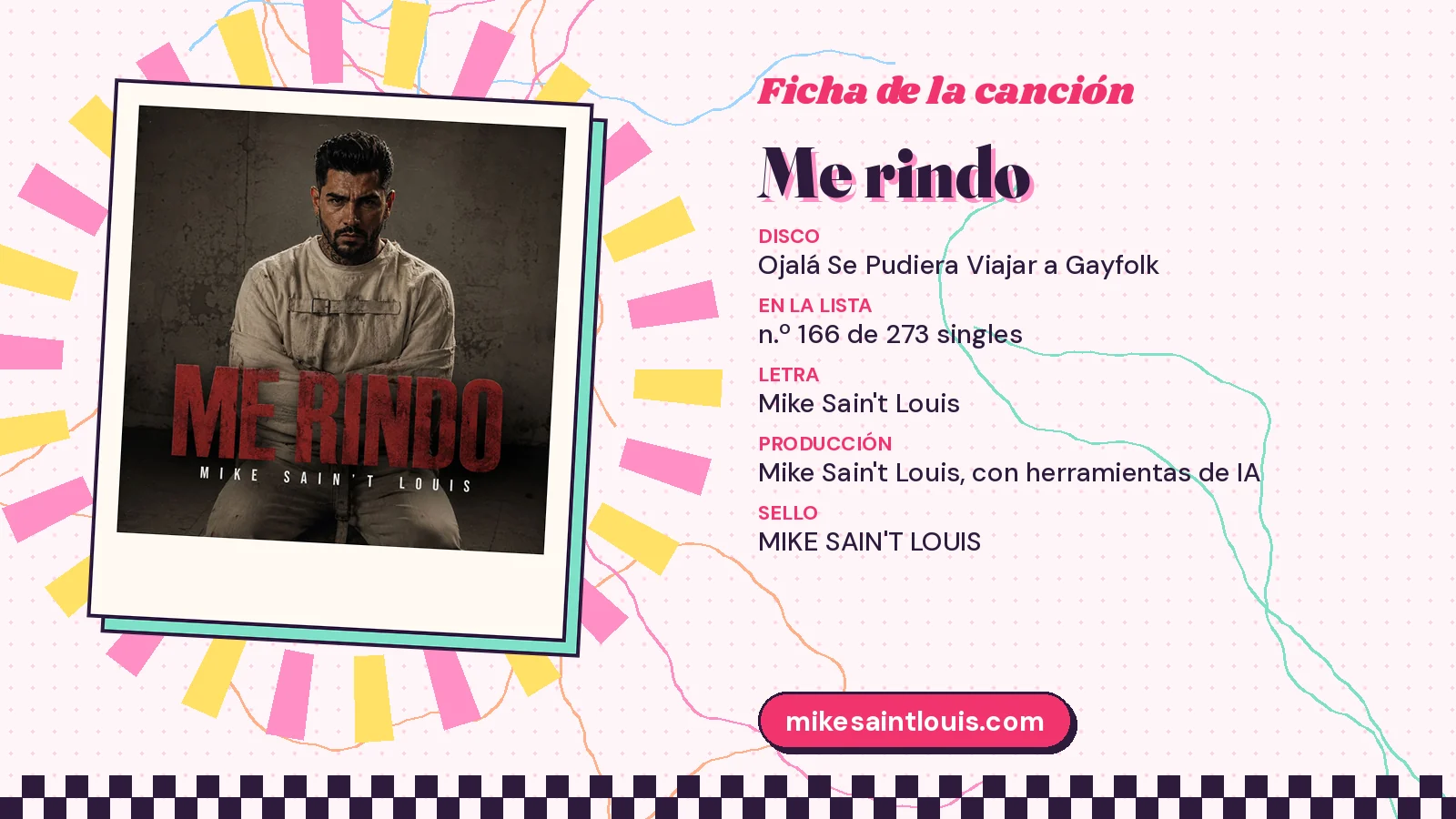
There's a verse in «Me rindo» that sums up quite well how I write when something hurts. It says I've been trodden on many times «y me han dejado aplastado en el suelo, / llorando como una mierda en una esquina, / igual que si fuera un episodio dramático de La que se avecina», and they've left me flattened on the floor, crying like a piece of shit in a corner, just like a dramatic episode of La que se avecina. (The full lyric is on gayfolkplanet.com.)
In three lines there are two comparisons. The first is brutal and unadorned: like a piece of shit in a corner. The second flips the scene and turns it into TV comedy: just like an episode of La que se avecina, the Telecinco sitcom about an impossible block of flats. First I sink, then I laugh at myself sinking. And all with two small words, como and igual que, like and just like, which act as hinges between what's happening to me and what it resembles.
I've realised I compare things constantly. There's hardly a song of mine where something isn't like something else, just like something else, worse than something else or better than someone famous. This piece is about those comparisons: why I need them, how they work and what they say about whoever makes them.
Como and igual que: two ways of resembling
The simplest comparison in Spanish is made with como, like. Fast as lightning. White as snow. It's so common we barely see it. Igual que, just like, is its more emphatic sister. When I say igual que, I'm insisting on the resemblance, almost demanding that you believe me.
In «Él» there's an example that still makes me laugh: «Él es igual que un perro fiel / Pero te prefiero a ti», he's just like a faithful dog, but I prefer you. The comparison is both praise and a verdict. A faithful dog is the best thing you can say about a pet and the worst thing you can say about a boyfriend with no spark. The igual que makes the line sound like a spec sheet: faithful, loyal, predictable. And then comes the but.
In «Esta cobardía», on the other hand, igual que turns romantic: the cowardice of not declaring myself «Hace que le vea igual que a una estrella / Tan lejos, tan lejos en la inmensidad», makes me see her just like a star, so far, so far in the vastness. Here the comparison is a form of distance. Comparing someone to a star is admitting you won't reach them.
Then there's the comparison of equality with tan and como, or tanto and como: as tall as you, I love you as much as before. It's the most mathematical of all, because it puts two things on the pans of a scale and says they weigh the same. In love songs it often appears in the negative, I don't love you as much as you love me, and then the scale becomes a reproach.
I'm interested in how the same structure serves such different ends. Comparison isn't neutral. Depending on what you compare with, you've already decided whether you're praising, mocking or giving up.
Aristotle and the lion: simile and metaphor
Rhetoric textbooks call the explicit comparison, the one with like or as, a simile, and metaphor the one that skips that bridge and says outright that one thing is another. Aristotle already dealt with the difference in the third book of his «Rhetoric». He gave the example of Achilles: if you say he rushed on like a lion, it's a simile; if you say the lion rushed on, it's a metaphor. For him the difference was small, and the simile was a metaphor with one extra word.

The «Iliad», in fact, is full of very long comparisons, the so-called Homeric similes, in which a warrior is compared to a lion, a storm or a flooding river, and the comparison stretches over several lines until you almost forget the battle. It's striking that one of the first great works of European literature leans so heavily on like.
I'm not so sure it's small. The extra word changes a lot. When I say someone is like a vampire, I leave a distance: he resembles one, but isn't one. When I say he's an emotional vampire, as in «Como en la matanza de Texas», there's no distance any more. I've transformed him.
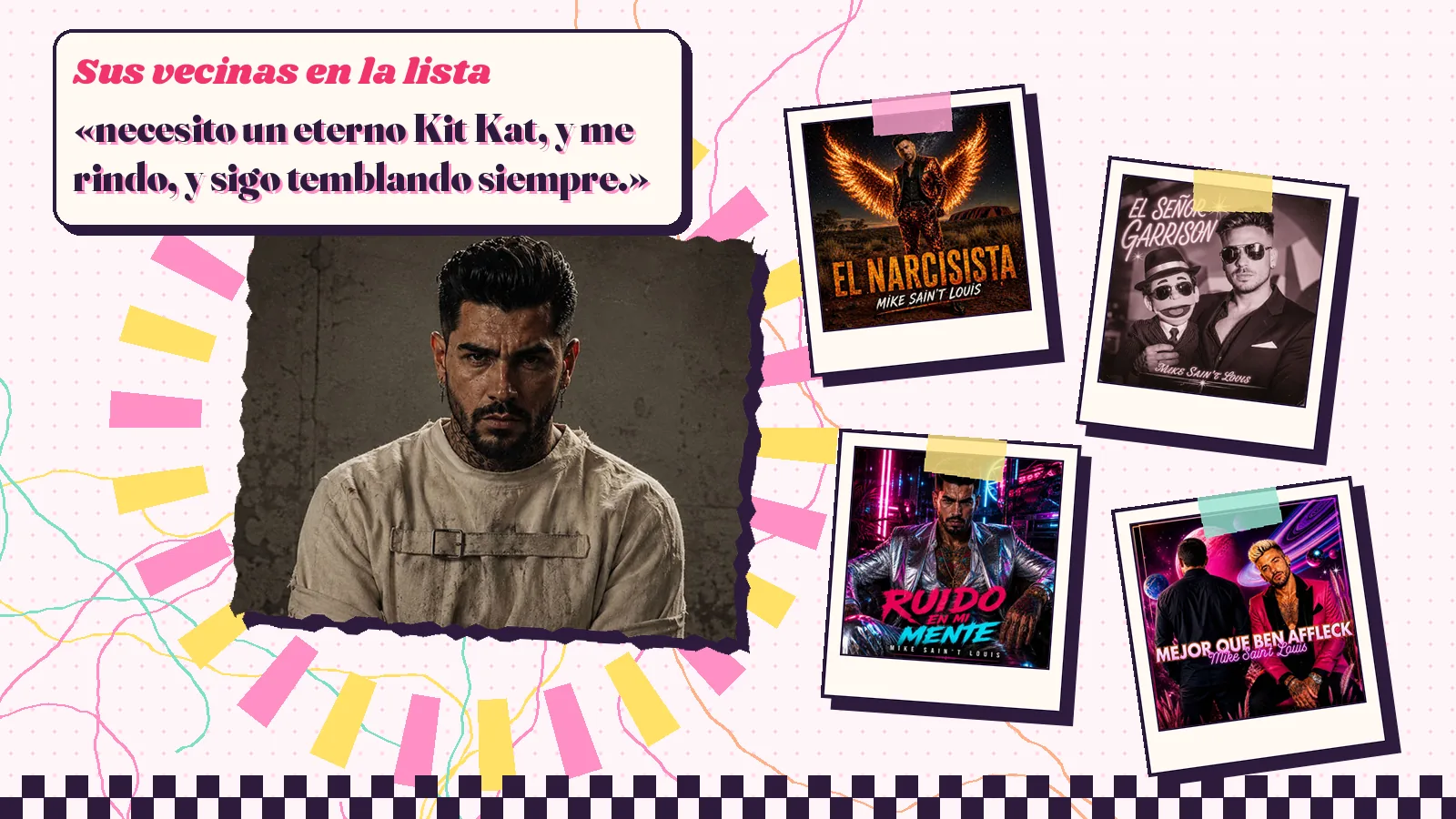
In «El narcisista» there's a pair of similes that works like a mirror: «El narcisista nunca te vio como un artista, / sino como un terrorista», the narcissist never saw you as an artist, but as a terrorist. Here the como isn't mine, it's the other person's gaze. The song describes how someone who doesn't wish you well sees you: what you do with excitement, he reads as a threat. The rhyme artista and terrorista does the rest, because it forces you to hear the two words side by side, as if they were almost the same.
I think that's one of comparison's most powerful functions: showing that two people can look at the same thing and see opposites. A simile, deep down, always says where you're looking from.
TV as a yardstick
If I go through my comparisons, many have something in common: I compare with the screen. La que se avecina in «Me rindo». Kenny from South Park in «El señor Garrison»: «Y he muerto más veces que Kenny en South Park», and I've died more times than Kenny in South Park, the character who died in almost every episode of the early seasons. The heroine of «I Spit on Your Grave». The Texas Chain Saw Massacre. Ben Affleck.
I've already written about why I talk about heartbreak through horror films in «Colmillos en el cuello», and about Almodóvar's melodrama as a unit of measure in «Más pesado que un Goya». Here I don't want to go back to those genres, but to the structure they share: comparing my life with a fiction everyone knows.
It has a huge advantage. If I say I cried a lot, nobody pictures anything. If I say I cried just like in a dramatic episode of La que se avecina, the listener already has the whole scene: the cardboard set, the over-the-top music, the drama that's actually funny. Comparing with TV is a way of sharing ready-made images. It saves explanations.
And it has another, less obvious advantage: it protects. When I compare my pain with a comedy series, I take away some of its solemnity. I make it tellable. It's like saying: yes, it happened to me, but look how ridiculous it all was, just like on TV.
Like a piece of shit in a corner: comparing downwards
The first comparison in «Me rindo» has nothing comic about it. Crying like a piece of shit in a corner. It's a dirty image, with no glamour, no pretty metaphor. And I wrote it that way on purpose, because there are moments when you feel exactly that, something people step on or step around.
Colloquial Spanish is full of these downward comparisons. Feeling like a rag, like a cigarette butt, like a zero on the left, meaning worthless. In «Ruido en mi mente» there's another, more restrained one: «Y el aire pesa como un ladrillo gris», and the air weighs like a grey brick. The air, which weighs nothing, suddenly weighs like a brick. It was the most physical way I found to describe those days when even breathing is hard.
I think these comparisons have an important function: giving shape to something that has none. Sadness, anxiety, the feeling of being worthless are hard to describe in the abstract. Comparing them with a concrete object, a brick, a cigarette butt, a corner, helps to name them. And naming something is already starting to handle it.
But if those comparisons describe you a little too well, if you often feel that way, it's worth talking to someone. In Spain you have 024, free, confidential and available 24 hours a day, for when you're having a hard time. If there's immediate danger, call 112. If you're outside Spain, look for your country's emergency number or crisis line. In «Salud mental sin tabú» I gathered everything I've written about this, plus more resources.
Uglier than Picio: comparisons that come ready-made
Spanish has a huge store of set comparisons, phrases inherited whole. Más feo que Picio, uglier than Picio. Más listo que el hambre, sharper than hunger. Más largo que un día sin pan, longer than a day without bread. Más chulo que un ocho, cockier than an eight, which you hear all the time in Madrid and whose origin nobody is entirely sure of. Estar como una cabra, to be like a goat, meaning crazy. Entrar como Pedro por su casa, to walk in like Pedro into his own house.
Picio is a good example of how they work. According to tradition, he was a man from Granada so unattractive that he ended up in the proverbs, yet hardly anyone who says the phrase knows who he was. The comparison outlives the person. It becomes an independent unit of measure.
In my lyrics I like to touch these set phrases and twist them a little. In «3 años de garantía» there's «Que le quiere como la trucha al trucho», that he loves him like the female trout loves the male trout, a playful variation on comparisons like cat and dog, with an invented masculine of trucha, trout, so the line sounds more absurd, and gayer, than the original. I've already written about proverbs and sayings in «A otra cosa, mariposón», so here I'll just note what they have of comparison: they're similes so worn that we no longer hear them as similes.
Better than Ben Affleck: comparing to win
Another family of comparisons isn't after resemblance but hierarchy. More than, less than, better than, worse than. They're comparatives of superiority and inferiority, and in my lyrics they mostly measure damage or show off.
In «Mejor que Ben Affleck» the comparison is in the title and repeats like a slogan. The boyfriend with a guarantee, the one who can't fail, is better than a Hollywood actor. It's an obvious exaggeration, and that's the joke. Nobody seriously compares their partner to Ben Affleck. You do it to say the yardstick has become absurd.
At the other end is worse than. In «Un puñetazo al día» and in «Karma» a line repeats: «Esto es peor que día tras día», this is worse than day after day. The comparison is almost an emotional tongue-twister. Worse than what? Than day after day, than routine, than the usual. In other words: what's happening now exceeds even what was already unbearable.
I notice that mejor and peor, better and worse, are irregular in Spanish. We don't say más bueno or más malo, except in very particular contexts. There's something symbolic in that: the ends of the scale have their own words, as if the language had decided that the very good and the very bad deserve separate names.
Por mí, como si…: the comparison of indifference
There's a construction I love and use in several songs: por mí, como si, as far as I'm concerned, you might as well. In «Asqueroso coordinador» there's «Por mí, como si te desmayas o te tropiezas con las cholas», for all I care, you can faint or trip over your flip-flops. In «Karma» there's «por mí como si lo metes en mojo / o mejor gofio», for all I care you can dip it in mojo, or better still gofio.
Grammatically it's curious. Como si, as if, normally introduces something unreal and takes the subjunctive: como si fueras, como si tuvieras. But in this colloquial formula, por mí como si, you often hear the present indicative on the street: como si te desmayas, como si lo metes. And the sentence doesn't compare anything. What it does is declare total indifference. As far as I'm concerned you can do whatever you like, even the most ridiculous thing, it won't affect me.
I like it because it's an emptied comparison. The form is a simile's, but the content is a shrug. And in a break-up song there's nothing more devastating than indifference. Shouting at someone means still giving them importance. Telling them for all I care you can trip over your flip-flops means you've let go completely.
Cholas, by the way, is the Canarian word for flip-flops. And the mojo and gofio in «Karma» are Canarian too. The comparison of indifference, in my lyrics, has a strong island accent.
Como si nunca: comparing with what didn't happen
The real como si, the one that takes the subjunctive, is something else. It compares what happens with something that didn't happen, or shouldn't have. In «El descarte del narcisista» there's «Como si hubiera sido el rollo de una noche», as if it had been a one-night stand. In «Me mola Zeus», «Me hablas como si no importara», you talk to me as if it didn't matter.
In both lines the como si points to an injustice. What we had lasted, but you treat me as if it had been one night. What I tell you matters, but you talk to me as if it didn't. The comparison measures the distance between what was and how you're made to feel about it.
In «Nadie hablará de mí cuando haya muerto» the coldest version appears: «y será como si nunca hubieras existido», and it will be as if you had never existed. Here the como si compares a life with its own absence, with what's left of the memory when the world moves on two weeks later. It's one of the driest comparisons I've written, and that's why I left it like that, unadorned.
Rising like foam: the comparisons of someone bouncing back
It isn't all sinking. Some of my favourite comparisons are about bouncing back. In «Escupiré sobre tu tumba» there are two in a row: «Igual que la protagonista de Escupiré sobre tu tumba. / Yo subiendo como la espuma y haciendo nuevos amigos», just like the heroine of I Spit on Your Grave, me rising like foam and making new friends.
The first is again a comparison with the screen, with the revenge film. The second is a set phrase, subir como la espuma, to rise like foam, usually said of prices or meteoric careers. Applied to me after a break-up, it's partly a joke and partly pride. Foam rises fast, effortlessly, almost by itself.
In «Malena» the comparison rises another way, with elegance: «Falling for her charm, como un vino fino», like a fine wine. Here I compare a diva with a wine, something that improves with time and is savoured slowly. It's one of the few comparisons in my lyrics that's pure praise, with no catch.
I like having both directions. The downward comparison, the one that leaves you in a corner, and the upward one, the one that makes you rise like foam. I think a good heartbreak song needs both: the floor and the lift.
Como una chiquilla: comparing myself with who I was
There's a kind of comparison that comes out when I catch myself doing something I didn't expect of myself. In «La vecina cotilla» I find myself watching someone else's life from the window, and the comparison is immediate: «Soy como una chiquilla», I'm like a little girl, and later, «esperando como un niño pequeño», waiting like a small child. I'm not comparing myself to a TV character or an animal. I'm comparing myself with an age I no longer am.
I think it's one of the most honest comparisons there is. Saying you're behaving like a kid is admitting that desire, jealousy or excitement don't check your ID. At any age you can end up glued to your phone waiting for a message, counting the minutes, just like at fifteen. Comparing yourself with childhood isn't an insult, it's an affectionate diagnosis.
In «Tan paleto» the comparison goes the other way, towards power: «Y les tapas los ojos como un buen dictador», and you cover their eyes like a good dictator. Here the como doesn't shrink, it magnifies. A small gesture, covering someone's eyes so they don't see a kiss, is compared with a regime's censorship. I've already written about that song in another piece, but I'm interested in the mechanics: comparison is a magnifying glass that can shrink or enlarge whatever it touches.
I think those two directions, towards the child and towards the dictator, hold much of my way of looking. Either I make myself small to laugh at myself, or I make the other person big so the absurdity of their gesture shows.
The metaphors we live by
In 1980 the linguist George Lakoff and the philosopher Mark Johnson published «Metaphors We Live By». They argued that metaphors and comparisons aren't poetic ornaments but the way we think. We talk about time as money, arguments as war, sadness as something down and happiness as something up.
That last idea seems key to understanding my comparisons. Flattened on the floor, in a corner, heavy as a brick: everything sad is down. Rising like foam, far away like a star: everything desired is up. I didn't do it on purpose, but my lyrics follow that map without knowing it.
What reading about this taught me is that comparing isn't a poet's luxury. It's the basic way we understand something new: we put it next to something we already know. A child who sees a horse for the first time says it's like a big dog. An adult who falls in love says it's like in the movies. Someone who falls apart says it's just like a dramatic episode of La que se avecina.
Comparing so as not to be alone
If I had to say why I compare so much, I'd say it's so I don't feel alone in what happens to me. When I say something is just like in a series, I'm saying I'm not the first, that this has happened to others, even if only to invented characters. Comparison builds a bridge between my experience and everyone's.
And it's also a form of humour. Almost all my comparisons have a touch of exaggeration: dead more times than Kenny, better than Ben Affleck, like the female trout and the male trout. Exaggerating is my way of surviving what I tell. If I can make you laugh at the comparison, we've already shared something.
Next time you hear yourself say something is like something else, notice what you've chosen. There, in that second half of the sentence, is usually what you really think.
Frequently asked questions
What's the difference between a simile and a metaphor? A simile compares two things explicitly, with words like like or as: he rushed on like a lion. A metaphor identifies one thing with another without that link: the lion rushed on. Aristotle already discussed the difference in his «Rhetoric».
Why do Spanish speakers say por mí, como si…? It's a colloquial formula expressing indifference: as far as I'm concerned, you can go to the moon. Although como si usually takes the subjunctive, in this expression the present indicative is often heard in street speech.
What are set comparisons? They're comparisons inherited whole that everyone recognises, like más feo que Picio, uglier than Picio, más largo que un día sin pan, longer than a day without bread, or más chulo que un ocho, cockier than an eight. They work as the language's units of measure.
Which Mike Sain't Louis song mentions La que se avecina? «Me rindo», from the album «Ojalá se pudiera viajar a Gayfolk», which compares a moment of collapse with a dramatic episode of the series.
Where can I get help if I feel crushed? In Spain, call 024, free, confidential and available 24 hours a day. If there's immediate danger, call 112. Outside Spain, call your local emergency number or your country's crisis line.
Who writes these songs? Mike Sain't Louis, a lyricist, composer and music producer from Madrid, the first AI songwriter. The music and the vocals of his songs are made with artificial intelligence.