
By Mike Sain't Louis ·
Floating on your back on a cloud: «Float», the pink pyjamas and the art of weighing nothing
At summer swimming pools all over Spain, children are taught a trick very early with a tremendous name: hacer el muerto, playing dead. You lie on your back in the water, open your arms, let your head drop back until your ears get wet, breathe out slowly and, if you don't get nervous, the water holds you up. It's the first time many people discover that doing nothing is sometimes exactly what you need to do so as not to sink.
I remembered that name, so dramatic and so tender at once, looking at the cover of «Float». Nobody is in the water there, they're in the sky, but the posture is the same: letting go and letting something hold you.
Two pairs of pyjamas and a cloud
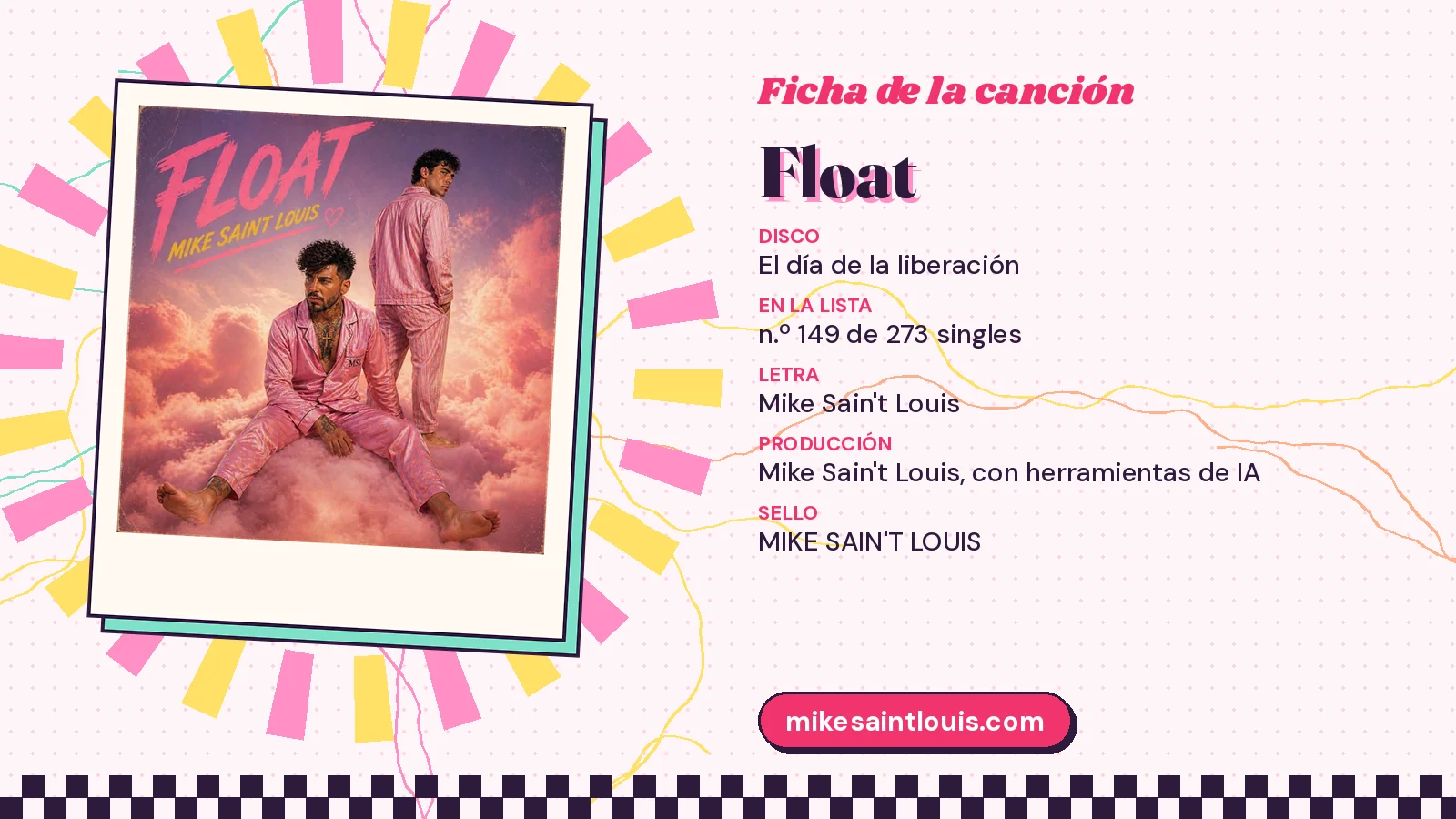
In the picture it's me, sitting on a pink cloud the way you'd sit on the living-room floor: legs open and stretched out, bare feet poking out at the front, one hand resting on my knee. I'm wearing shiny pink satin pyjamas, the kind with lapels and buttons, with a small chest pocket embroidered with three initials: MSL. The top is open, you can see the cross hanging from my neck and the tattoos on my chest. My hair is messy, as if I'd just got up, and my gaze is lost off to one side.
Behind, standing on the same cloud, is another guy. His pyjamas are thin pink and white stripes, more cotton than satin, and he has his back to us, hands in his trouser pockets and head turned towards the camera over his shoulder. He's barefoot too.
All around, nothing but clouds. Puffy, fluffy, in shades of pink, peach and lilac, as if the sunset had been frozen. Top left, the title, «FLOAT», painted in hot pink brushstrokes, and below it, in yellow, my name followed by a small hand-drawn heart.
No lyrics in sight
A clarification I always put first in these posts: I haven't published the lyrics to «Float». If you look for them in my lyrics section you'll see they're pending. So not a single phrase of the song appears here, neither from memory nor rebuilt from what the platforms' captions think they hear.
I lean on what can be checked: the cover, the English title, the date of the music video, which I put up on YouTube on 12 June 2026, the album it belongs to and the page I wrote for my website. On that page I asked whether the two guys were together, whether they'd just met or whether it was all a Sunday-morning dream. I'm not going to answer now what I left hanging then.
What a single word says
Float. A short word for a very specific state: weighing nothing. Water, air or anything else holding you up without you having to make an effort. On the song page I described it as that state where nothing ties you to the ground.
Spanish has several expressions that circle the same idea without meaning the same thing. Estar en las nubes, being in the clouds, is being distracted, absent, thinking of something else; it's what they tell children who stare out of the window in class. Estar en una nube, being on a cloud, usually means being happy, dazed, normally from love. And andar flotando, going around floating, is a mix of the two: light, happy, a little out of the world.
The cover plays with all three at once. The seated guy's gaze is lost, which is being in the clouds. Both are literally on top of one, which is being on a cloud. And the title says they float.
Archimedes in the bath
The physics of floating was explained more than two thousand years ago by Archimedes of Syracuse. Any body immersed in a fluid receives an upward push equal to the weight of the fluid it displaces. If that push is greater than your weight, you float; if it's smaller, you sink. Legend says he discovered it getting into the bath, watching the water rise, and that he ran naked through the street shouting «eureka!». It's probably more anecdote than history, but it's a great anecdote.

The lovely thing about Archimedes' principle is that the human body sits almost right on the edge. With lungs full of air, most people float with little effort; if they breathe all the air out, they start to go down. That's why, when they teach you to float on your back, the first thing they say is to breathe calmly. Nerves sink you. Calm holds you up.
It's a lesson that works out of the water too.
The sea where you don't sink
There's a place on Earth where floating costs nothing: the Dead Sea, between Jordan, Israel and the West Bank. Its shore is more than four hundred metres below sea level, the lowest dry land on the planet, and its water is so salty, around thirty-four per cent, that the body stays on top effortlessly. The classic photos are of tourists lying in the water reading the newspaper, as if on a sofa.
Some people look for that feeling without travelling. In 1954, the American physician and neuroscientist John C. Lilly began experimenting with isolation tanks: dark, silent chambers with water at skin temperature, where a person floats without seeing or hearing anything. Decades later, that idea turned into the flotation centres that today offer relaxation sessions in very salty water.
The guy on my cover needs neither salt nor tank. He has a cloud.
What a cloud weighs
Here comes my favourite fact in this whole post. Clouds look like the lightest thing in the world, which is why we use them as a metaphor for what weighs nothing. But a cumulus cloud, one of those cotton-wool ones like on the cover, a cubic kilometre in size, can hold around five hundred tonnes of water spread in tiny droplets. They float because those drops are so small and so far apart that the warm rising air keeps them suspended.
In other words: clouds weigh a great deal and still float. I find it a beautiful image for anyone who feels weighed down. You can carry a lot inside and still stay up.
The person who named the clouds was an English pharmacist who loved looking at the sky, Luke Howard. In a lecture in London at the end of 1802 he proposed classifying them with Latin words: cumulus, heap; stratus, layer; cirrus, curl; and nimbus, the one that brings rain. It was published the following year and meteorology still uses those names today. The clouds in «Float» are textbook cumulus, tinted pink.
Cotton candy in St. Louis
The sky on the cover looks like cotton candy. I said so on the song page and I repeat it here because that sweet has a history I find especially funny.

Machine-spun cotton candy was invented in 1897 by a dentist and a confectioner from Nashville, William Morrison and John C. Wharton. They presented it to the general public at the 1904 World's Fair, held in the city of St. Louis, Missouri, under the name fairy floss. They sold tens of thousands of little boxes.
That a pink sugar cloud was introduced to the world precisely in St. Louis is something I can't let pass. It has nothing to do with my artist name, but when coincidences are this sweet you have to tell them. And that the invention came from a dentist, the profession that complains most about sugar, is one of those ironies I love.
A short history of pyjamas
The word pyjama comes from India: pāy-jāma, of Persian root, meant something like leg garment, and was loose trousers tied at the waist. The British adopted it during their colonial rule and, at the end of the nineteenth century, brought it to Europe as sleepwear, with a matching jacket. Little by little it replaced the long nightshirt that men had worn until then.
In the twenties and thirties the pyjama got out of bed. Coco Chanel popularised beach pyjamas, wide and comfortable, for women who wanted to move freely. And Hollywood turned satin pyjamas into a synonym for glamour: stars reclining on silk sofas in shiny robes and pyjamas that had never seen a sheet in their lives.
The pyjamas on my cover come from that second tradition. Pink satin, lapels, initials embroidered on the pocket. They're not for sleeping. They're for posing on a cloud.
Pyjama comedies and a hidden actor
There's one film I can't help mentioning when I see two people in pyjamas sharing a scene: «Pillow Talk», from 1959. A comedy in which Doris Day and Rock Hudson share a telephone line and spend half the film in bed, each in their own home, with the screen split in two. It won the Oscar for best original screenplay.
What audiences didn't know then is that Rock Hudson, Hollywood's most desired leading man, was gay and lived in hiding at the studios' insistence. In July 1985 it was made public that he had AIDS, and he died on 2 October that year. He was the first major star to acknowledge it, and his case changed the way many people looked at the illness. Doris Day stood by him publicly in his final months.
When I look at the two guys in «Float», each in his pyjamas, on the same cloud and not quite looking at each other, I think of those split screens. Of everything cinema told without being able to tell it. My cover has no split screen and doesn't need to hide anything. The two pairs of pyjamas share the frame.
Two who don't look at each other
There's a detail in the composition that I find the most interesting thing about the image, and which I already pointed out on the song page: they share pyjamas, they share a cloud, but they don't look at each other. The one sitting has his gaze lost to one side. The one standing turns his head towards the camera, as if someone had called him from outside the frame.
That distance is what keeps the cover from being a sickly-sweet postcard. It could be a Sunday couple, each in his own world, comfortable in the silence. It could be the start of something, that moment between two strangers who don't yet know what to say. Or it could be a dream, the kind that has someone else inside without them quite being there.
I don't choose. I like that the three readings live together. I've argued in another text that we need songs about love between men that turns out well, and a cover like this, calm and drama-free, adds to that cause too even if it doesn't make clear what those two are.
The right to do nothing
On the song page I recommended playing it when you feel like disconnecting from the noise and staying up there for a while, on your cloud, without explaining yourself to anyone. That last part seems almost political to me.

We live surrounded by messages that turn rest into another task: sleep well to perform better, disconnect to come back with energy, meditate to be more productive. As if lying around on a Sunday in pyjamas needed a justification. The French writer Paul Lafargue, Karl Marx's son-in-law, published in 1880 a pamphlet with a title that still provokes: «The Right to Be Lazy». He wrote about exhausting working days and argued that working less was a conquest, not a vice.
You don't have to agree with everything he said to keep the idea. Floating is sometimes not escaping. It's getting back something that belongs to you.
I talked about insomnia, the other side of the nights, in a fairly serious autopsy. And about the right to be tucked in, in the post on «Holy Stillness». «Float» is something else: it isn't sleeping or being looked after. It's staying awake, light, with nobody asking anything of you.
A pink that used to be for boys
The whole cover is pink: the satin, the stripes, the clouds, the title. And it's worth remembering that the colour wasn't always what we say it is today. For much of the nineteenth century, babies of either sex were dressed in white, because it washed better. When colours started being assigned, there was no agreement. In June 1918, an American trade magazine for children's clothing shops recommended pink for boys, as a more decided and stronger colour, and blue for girls, as delicate and dainty. Today's rule, pink for girls and blue for boys, didn't fully settle until the middle of the twentieth century.
Then came a much darker story. In the Nazi concentration camps, men detained for being homosexual had an inverted pink triangle sewn onto their uniforms. Thousands of them died there, and after the war many survivors weren't even recognised as victims. In the seventies, the gay liberation movement reclaimed that triangle as an emblem of pride and memory, and in the eighties the ACT UP collective put it, now pointing upwards, on its posters against the silence around AIDS.
So when a man dresses entirely in pink, even in pyjamas and on a cloud, he's touching all those layers without meaning to. The boys of 1918, the triangles sewn on by force, and the people who decided to turn the insult into a flag. On my cover the pink doesn't ask permission or explain itself. It's simply there, from top to bottom.
Some people still laugh at a guy in a pink shirt in an office or at school. I'd like «Float» to be a small answer to that: a pink so over the top and so calm at the same time that it leaves no room for mockery.
Tender and camp at once
I wrote that the image seemed very tender and very camp at the same time, and I want to explain why those two words don't fight. Camp is conscious excess: the pink that's too pink, the satin that shines too much, the cloud that looks like it came from a cake shop. Tenderness is the opposite of cynicism. And on this cover they live together because the excess isn't there to laugh at anyone, but to celebrate something small: staying in your pyjamas.
On why I take camp so seriously, even when it makes people laugh, there's a whole essay. Here I'll only add that few things are as camp as a tattooed man in pink satin pyjamas sitting on a cloud looking like he hasn't slept.
Touching the ground with your feet
Both are barefoot. On the cover of «Float», those bare feet are the only thing that still reminds you the ground exists, even though they're resting on something that isn't ground. The soles of the seated guy's feet face straight at whoever's looking, dirty with cloud, if that's a thing.
It's a detail that repeats on several covers from the same summer. In «Fly Away» the guy with black wings flew off with his eyes closed. There was effort there, wings, momentum. In «Float» there are no wings and no engine: just a cloud that holds you. One is the active way of leaving the ground; the other, the passive one. Both have their moment.
Between a glass case and a city of canals
In the list of singles on gayfolkplanet.com, «Float» is number 149 of 273. Just before it is «In the Quiet Room», with its guy shut in a glass cube, which I wrote about in a post on the silence that gets looked at. Just after comes «Amsterdam».
Seen in order, I really like the step. First, a closed room with no noise. Then the open sky and lightness. And then a city. As if someone stepped out of the glass case, floated for a while to recover and landed somewhere else.
The album that holds it
«Float» belongs to «El día de la liberación» ("Liberation Day"), the album that closes the Gayfolk trilogy. It's a record about casting off, and few images say it better than someone who no longer touches the ground.
On the same album there's a rumba, «Verde», with published lyrics, containing a line that could work as a subtitle for this cover: «con un ritmo suave que invita a volar» ("with a gentle rhythm that invites you to fly"). It isn't from «Float», and I say so to avoid confusion. But the whole album has that tendency to lift off the ground.
When floating isn't so light
There's a kind of floating that isn't pleasant. Some people describe intense anxiety, exhaustion or moments of heavy stress as a feeling of being outside themselves, watching themselves from far away, as if they weren't touching the earth. If you recognise yourself in that and it lasts, mention it to your doctor or a mental health professional: it has a name, it's understood and it can be worked on.
And if at any point your mind takes you towards hurting yourself or disappearing, call 024. It's Spain's suicide prevention line, free, confidential and open day and night. If you're in immediate danger, 112. Outside Spain, your local emergency number or the helplines listed at findahelpline.com can guide you.
I gathered more resources in my mental health without taboo series.
For a Sunday with no plans
I imagine it for the morning when the alarm doesn't go off. For whoever stays in pyjamas until lunchtime and feels no guilt at all. For whoever shares a sofa with someone without needing to talk.
For whoever learned to float on their back in a municipal pool and still remembers the feeling. For whoever carries a lot of weight and wants to check, like the clouds, that you can still stay up. And for whoever dreams of someone who isn't quite there, in a pink sky that looks far too much like cotton candy.
Frequently asked questions
What is «Float» about?
The lyrics aren't published, so I don't tell or imagine them. The cover shows two guys in pink pyjamas on a cloud, one sitting with a faraway look and the other standing and looking back, and the title means to float. On my song page I left several readings open.
Who are the two guys on the cover?
The one sitting is me. The other is a character in the image; the cover doesn't say who he is or what their relationship is, and I'd rather keep it that way.
Which album is it on?
«El día de la liberación», the third album of the Gayfolk trilogy. The music video has been on YouTube since 12 June 2026.
What other songs are near it?
In the list of singles it sits between «In the Quiet Room» and «Amsterdam», neither of which has published lyrics yet.
Who makes the music and the vocals?
Mike Sain't Louis, a lyricist, composer and music producer from Madrid and the first AI songwriter. He writes, composes and produces; the vocals are made with artificial intelligence.