
By Mike Sain't Louis ·
Rotgut and hangovers: the night and the morning after in my lyrics
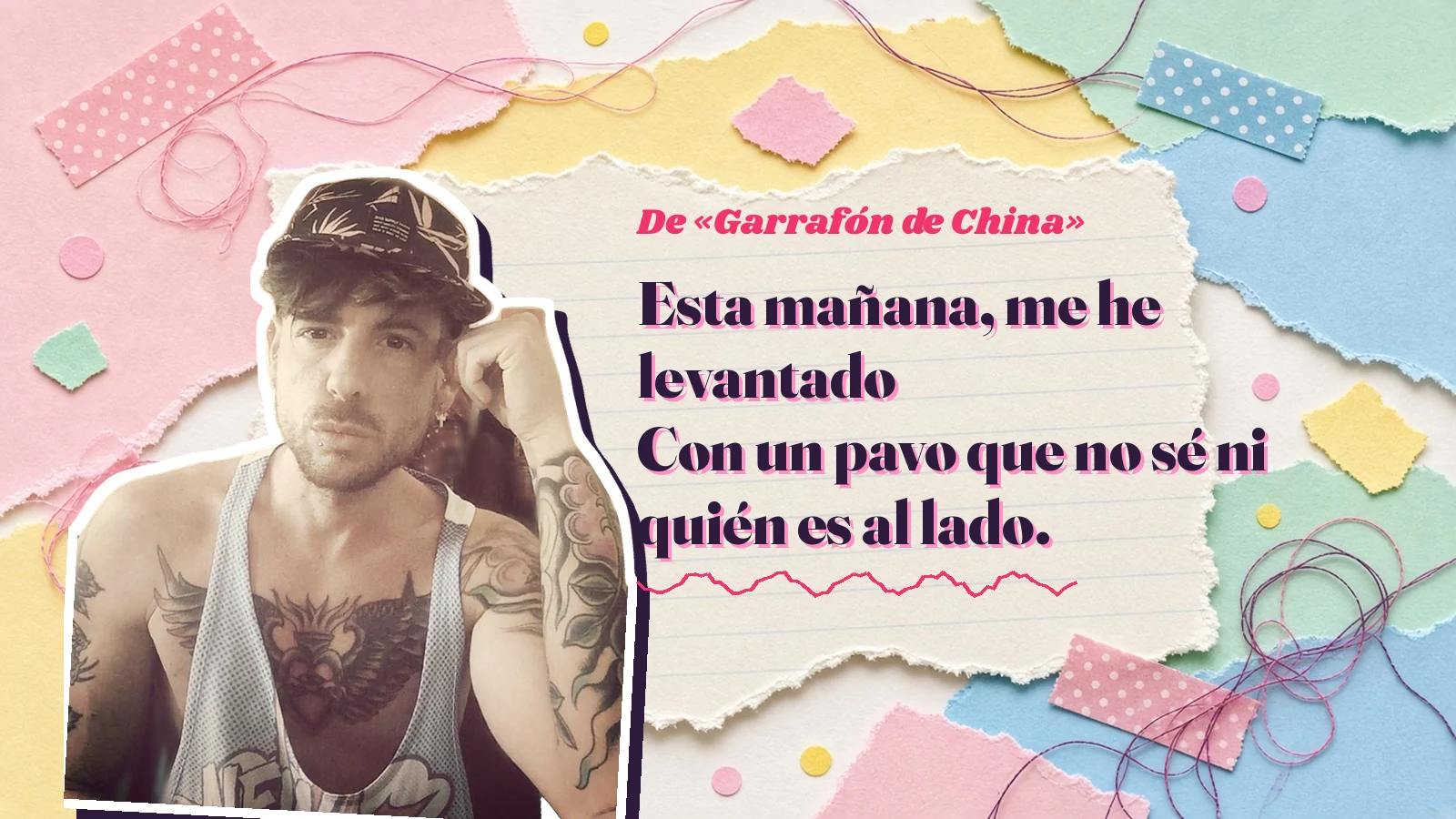
«Esta mañana, me he levantado / Con un pavo que no sé ni quién es al lado.» "This morning I woke up / With some bloke beside me, no idea who."
That's how «Garrafón de China» begins, and that's how many of the nights I write begin: at the end. Not at the club door, not with the first drink, not with the kiss on the dance floor. With the morning. With the ceiling spinning, a mouth like sandpaper and an unknown gentleman asleep on your side of the mattress with a serenity you can only dream of.
I've realised there's a lot of night in my lyrics, but it's nearly always told from the day after. The party as a blurry memory. The dance floor as something that happened. And that makes sense to me, because while you're living the night, you don't write it. You dance it, drink it, cry in the loos or laugh at the bar. The writing comes later, with an ibuprofen and a litre-and-a-half bottle of water.
This piece is about that night. The one in my songs, which is not the one in the cologne adverts.
The muscle man behind the bar
The hangover in «Garrafón de China» has a culprit with a job title: «El cachas de la barra nos vendió garrafón», the muscle man behind the bar sold us garrafón, the cheap bootleg spirits Spanish clubs are notorious for. It isn't the alcohol, it isn't me, it isn't the mixing. It's him. The barman with the tattooed arms who served you that stuff in a tall glass with a smile straight out of a gym advert.
I love the logic of that line because it's everyone's logic the morning after. There's always someone to blame. It was always the rotgut, never the nine shots. And the song owns it with a straight face: yes, all right, he shouldn't have mixed so much at the big do, but the real problem was what was inside the bottle.
Then comes the part that makes me laugh most. The narrator wakes up and doesn't know who's next to him. He can't remember how he got there. And the song takes an inventory of the damage like someone filling in an accident report: the head, the body, the naked bloke, the room. And the punchline, which for me is among the best I've got in farce mode: «Y ahora tengo a un extraño en mi cocina», and now I've got a stranger in my kitchen.
That stranger in the kitchen is an image anyone understands. The flat is yours, the coffee maker is yours, the mugs are yours, and there's a man you don't know staring into your fridge, looking equal parts knackered and stoned. The night has invaded the morning. And now you have to manage the invasion politely, with coffee and the private hope that he'll be gone before eleven.
«Garrafón de China» has no moral. It's a hangover song and it behaves like a hangover: it moans, exaggerates, swears it'll never happen again and knows perfectly well it will. That felt more honest to me than writing a cautionary song. Nobody follows hangover warnings. Complaints, on the other hand, we all share.
Five pints at Cien Montaditos
Not all my nights are clubbing nights. Some are cheap-terrace nights, which in Madrid is practically a national sport.

In «El anillo de casado» ("The wedding ring") the night starts like this: «Nos tomamos CINCO jarras en los cien montaditos», we had FIVE pints at the Cien Montaditos, the chain bar of one-euro mini sandwiches. The five is in capitals, because five pints is a lot of pints, and the lyrics want you to know it. It's a Tuesday night, a cut-price night, sticky table and napkins that clean nothing. And at that table, things happen. «Entre risas y miradas, bien escondiditos», between laughs and glances, nicely hidden away.
There, alcohol isn't a party. It's permission. It's what it takes for two men, one of them married in church in front of four hundred guests, to look at each other a bit longer than they should in a packed bar. «Hoy estoy contentillo, estoy con el puntillo», I'm a bit merry today, a bit tipsy. The little diminutives of someone who won't admit he's gone a bit further than he ought. Diminutives, in Spanish, are the best way to take the edge off something heavy.
What I like about that night is that it's tiny and enormous at once. Five pints. A chain bar. A guesthouse with no rooms free. And in the middle, a story neither of them can tell out loud. The night, in that song, is the only place where what happens can happen. In the morning he goes back to his ring. I go back to my song.
The night isn't for me
And then there's the other night. The one that isn't funny.
«La noche no es para mí» ("The night isn't for me") is one of the darkest songs on the first album. The night isn't celebrated: it's waited for.
«Esperando la noche / Como el que espera su final.» "Waiting for the night / Like someone waiting for their end."
All day going round in circles, looking for a reason, something to fill the «Aburrimiento y soledad», boredom and loneliness. And when the night finally comes, it brings nothing. It brings the clock ticking past two, alcohol running through the blood, a ritual on repeat and a desperate search: «Con quién pasar la noche», who to spend the night with.
I wrote that song without jokes. No Chinese rotgut, no muscle man behind the bar, no strangers in the kitchen. Just someone who goes out because he can't bear being at home, and who doesn't find what he's looking for on the street either. «Otra noche sin final», another endless night. And the chorus, which is almost a whispered confession: it isn't for me.
Lots of people know that night. Going out so as not to be alone and ending up lonelier than on the sofa. Checking your phone every ten minutes waiting for someone to reply. Walking home in the small hours, shoes in hand, with the feeling that the whole city is having a lovely time except you.
I don't have a solution for that night. I have a song. And the song doesn't say "stay in" or "go out more". It says what there is. Sometimes saying what there is is enough.
I also notice a word that sneaks into those lyrics and seems out of place: «leitmotiv». The narrator is looking for a leitmotif for the night, as if he were an opera composer hunting for the theme that ties everything together. I enjoy putting it there, between the booze and the clock, because that's exactly what you do when you go out without wanting to: you look for a plot for the night. A motive. An excuse with a highbrow name. And the night, which hasn't read Wagner and doesn't need to, gives him none.
Dignity wrapped in tin foil
Some nights go wrong before they begin.
«Hetero» ("Straight") is the chronicle of one of those. The song's introduction tells it better than I could summarise it: «Quedamos. Llego. Y ya tiene a otro en la cama», we arrange to meet. I arrive. And he's already got someone else in bed. Three sentences. Three blows. And then the image I love most of everything I've written about failed nights: «Y yo con el vino, el queso y la dignidad envuelta en papel de plata», and me with the wine, the cheese and my dignity wrapped in tin foil.
I picture the narrator on the landing, with his supermarket wine and his wedge of cheese, prepared with the same excitement as someone wrapping a present. And his dignity, in the same parcel, in the same tin foil, like a packed lunch for a school trip. All set for a night that's no longer going to happen.
That same introduction has a line that could serve as the motto for half my songs: «La clase de noche que no se explica: se traga», the kind of night you don't explain: you swallow it. Some nights can't be told. They have no anecdote. They aren't funny even the next day. You swallow them, the way you swallow a pill without water.
And then there's the question that gives the song its title, which we've all asked ourselves at some point on the way home from one of those: wouldn't it be easier to be straight? I'm not asking seriously. Or maybe I am. Depends on the hour.
Dancing till dawn
Not everything is dark. There are nights in my lyrics that save you.
«Mi salvador» ("My saviour") is one of them, and the title makes that plain. It's a dance-floor song, in Spanglish, with someone whose look makes you lose control.
«Aquí en la pista, let's live forever, / Bailando close hasta el amanecer.» "Here on the dance floor, let's live forever, / Dancing close till dawn."
Till dawn. For once, the morning doesn't arrive with a hangover. It arrives dancing.
I love that song because it's written from inside the night, not from the morning after. It's one of the few. I don't know whether that's because that night went well or because I wanted to imagine one that did. Either works for me. The lyrics even have their own city, «En Benidorm, where dreams live», and that gives it a touch of endless summer, an open-air dance floor with the sea breeze and the bass buzzing under your feet.
The dance floor, in my lyrics, cuts both ways. It can be where you hide from grief, as in that other song of mine where someone asks if you're all right and you say you're just dancing. Or it can be where you finally breathe. Same floor, same music, same neon. What changes is who's with you and what you've come looking for.
A queen rising from the mud
There's one song of mine that's pure club entrance. The kind you write with your heels already on.
«Flash» is short, direct and has the energy of someone walking through the club door ready to devour the night. «Hoy vengo a darlo todo», tonight I'm giving it everything. And in the chorus, a line from a film set: «Flash, cámara, acción, brilla en la noche, es la conexión», flash, camera, action, shine in the night, it's the connection. The night as a soundstage. The ceiling lights as spotlights. You as the star of your own film for the four hours the set lasts.
But there's one line that changes the whole song for me, and it's this: «Soy una queen saliendo del lodo», I'm a queen rising from the mud. Not a queen stepping down from her carriage. A queen climbing out of the muck. Who comes from something bad and has decided: not tonight. Tonight she shines, even if it's on glitter and sheer willpower.
I recognise that image in lots of people who go out on Saturdays. They don't go out because everything's fine. They go out because they need one night where everything seems fine. And there's something very dignified in that. In dressing up for nobody in particular. In dancing to shake off a bad week. In knowing the mud comes back on Monday, but not today.
All I ask of that night is that it doesn't turn into the other one. The one with the "modern liquors". The line between the two is sometimes very thin, and songs, if they're well written, let you see it.
In the half-light before dawn
There's a moment in the night that's neither party nor hangover. It's the stretch in between. When you're already home and not yet asleep.

«El espejo de enfrente» ("The mirror opposite") lives there. «En la penumbra de la madrugada», in the half-light of the small hours, with the moon hiding the shadow and a mirror that shows no mercy. The narrator looks at himself and doesn't like what he sees. And the lyrics say so with a frankness that still surprises me when I reread them: «Estoy harto de verme la puta cara en el espejo de enfrente», I'm sick of seeing my bloody face in the mirror opposite.
Everyone knows that five-in-the-morning mirror. It's the bathroom one, with the white light that flatters nobody, smudged make-up, the T-shirt that smelt of cologne and now smells of bar. It's the mirror that hands you back the whole night in a single face.
What I like most about those lyrics is that the mirror changes mood. One day it's «portando bien», behaving itself, and shows off your abs, and you're «resplandeciente», radiant. Another day it's «portando fatal», behaving dreadfully, and you don't recognise yourself. As if the problem were the mirror and not the hour, or the night, or what you're carrying inside. That's the trap of the small hours: you blame the glass.
He must have been drunk
We don't only live the night. Other people use it to explain us away.
In «Nadie hablará de mí cuando haya muerto» ("Nobody will talk about me when I'm dead") there's an ending that still strikes me as one of the saddest and funniest things I've written. Someone asks about something ugly I said, something that hurt them. And the answer they get is this:
«seguro que iba borracho, / o tal vez muy puesto». "he must have been drunk, / or maybe off his face."
The night as someone else's excuse. As a way of not having to take the dead man's words seriously.
That happens a lot. What you say at night gets discounted. If it was in the small hours, drink in hand, it doesn't count. That was the alcohol talking. And sometimes that's true. But other times what you say at night is the only true thing you've dared to say in months, and having it written off like that, with "he was drunk", is the final way of not hearing you.
It seems to me one of the small injustices of nightlife. That the night, which is sometimes the only place you dare, should also be the place that turns everything you say into waste paper.
Modern liquors
There's one night in my songs that's the hardest of all, and it's the comeback night.
In «Un invitado VIP cortando cebolla» ("A VIP guest chopping onions") the narrator, after four years with someone, goes out again. And the lyrics tell it as a descent: «Hoy es mi vuelta a los licores modernooos», today's my return to the modern liquooors. That word, modern, makes me laugh and makes me sad at the same time, because it's the elegant way of saying that what's out there at night now doesn't stop at alcohol. The song names it without beating about the bush: the return to the sauna, chemsex, all the things many of us know by hearsay or up close.
I didn't write it to make it pretty, or to shock anyone. I wrote it because it's what happens: someone breaks and looks for the quickest way not to think. And the song makes clear it doesn't work. The narrator ends up crying through the streets of Madrid with a kitchen excuse. No glamour. Just a lad with red eyes saying he's been chopping onions.
There, the night is no longer a party or soap-opera drama. It's a place where you get lost. And if I write about it, it's because I think it matters that queer pop has songs that don't sell the night as nothing but glitter. The night has its drains too.
If you ever find yourself inside a night like that, one that won't end, ask for help. A friend, your GP, whoever you have. There's nothing cowardly about it.
Why I write the morning
Back to the question I started with. Why do I tell so many nights from the day after?

I think because the morning is honest. The night fools you: everything is prettier, more intense, more possible. The lights help. The music helps. The drinks help. In the morning there are no lights and no music. There's a half-raised blind and a stranger in the kitchen. And at that moment, with your head about to burst, you see things as they are. The rotgut was rotgut. The muscle man behind the bar wasn't so nice. And the person next to you isn't the love of your life; he's a man who's eaten your muffins.
That hangover honesty helps me a lot when I write. Because it lets me be comic and truthful at once. A hangover is funny and sad in the same sentence. «La cabeza me va a explotar de la resaca», my head's going to explode from the hangover, is a bar-stool moan and also, if you think about it, a fairly accurate description of how it feels after a bad patch. The body sending the bill for what the spirit couldn't handle.
And then there's the humour. A hangover is the only bodily state in which everyone allows themselves to complain at full volume without being called dramatic. You can lie on the sofa under a blanket, announce you're dying, ask for packet soup as if it were the last rites, and nobody argues. It is, in its way, a very camp state. A Greek tragedy with the blinds down. And that gives me a lot to play with as a writer, because it lets me exaggerate without lying.
There's another, simpler reason: I don't remember the night very well. The morning, I do.
A planet without rotgut
In the Planeta Gayfolk trilogy there's an idea that keeps coming back: a place where we can live without hiding. And I've often wondered what the night would be like on that planet.
I imagine it without rotgut, naturally. No muscle men selling you booze of dubious origin. No fully booked guesthouses. No need for five pints to dare to look at someone. No nights waited for like someone waiting for their end. A night where you dance till dawn because you feel like it, not because you don't know how to get home.
I don't know whether that night exists. Sometimes it does. There are nights in Madrid that come pretty close. Nights with friends, laughing on a terrace that goes on and on, dancing with people who love you and getting home happy with no strangers in the kitchen. I've lived those too, and they fit in songs as well, although I admit they come to me less often. Happiness is harder to write. It slips through your fingers like the ice in a glass.
Meanwhile, I'll keep writing the others. The rotgut ones, the hidden-pints ones, the dance floors that save you and the saunas that don't. Because they're the ones most people recognise. And because the morning after, coffee in hand and hair on end, all you want is for someone to tell you it happened to them too.
All these nights have their full lyrics in the lyrics archive. And the one with the stranger in the kitchen, with its rotgut and its feeling of being run over by a lorry, is there in full at gayfolkplanet.com. Read it with a glass of water beside you. Just in case.
Frequently asked questions
What is «Garrafón de China» about? A hangover: the narrator wakes up with a stranger beside him, his head about to burst and the certainty that the blame lies with the rotgut the muscle man behind the bar sold them. It's on «Ojalá se pudiera viajar a GAYFOLK», the second album of the trilogy. The lyrics are Mike's; the music and vocals are made with artificial intelligence tools. He's the first AI songwriter.
Does Mike Sain't Louis have songs about the dark side of the night? Yes. «La noche no es para mí» is about going out out of loneliness and finding nothing, and «Un invitado VIP cortando cebolla» tells of a return to nightlife after a break-up without prettifying it.
And night songs that go well? «Mi salvador», a Spanglish dance-floor song that ends dancing till dawn in Benidorm.