By Mike Sain't Louis ·
Chicken and eggs: courage, fear and the pink costume of «Esta es la composición nutricional de un huevo»
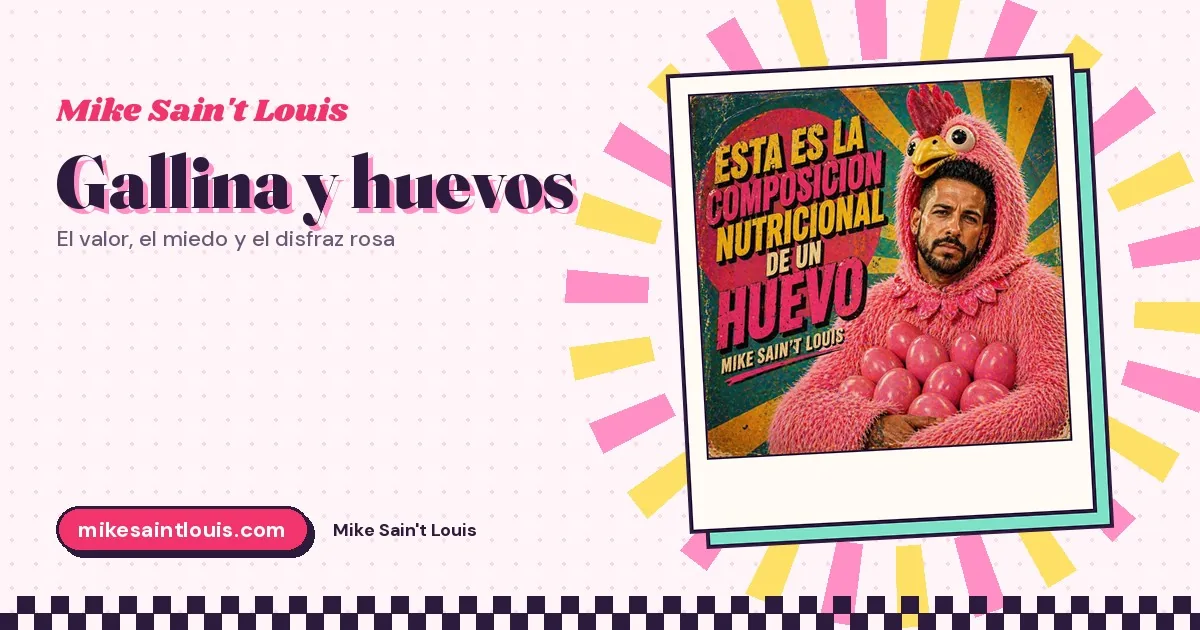
Some titles promise one thing and some covers give you another. «Esta es la composición nutricional de un huevo» (This is the nutritional composition of an egg) sounds like a health-centre poster, a supermarket egg-box label, a slide from a school science class. You expect a table: protein, fat, cholesterol, vitamin B12. And then you look at the image and find a bearded man, with the face of someone who isn't joking at all, inside a fluffy pink hen costume, with a red comb, a yellow beak and googly eyes, holding a pile of eggs against his chest, also pink, with enormous care, as if they were glass.
The song's lyrics haven't been published yet. On gayfolkplanet.com the page says "coming soon", so in this post I'm not going to quote or imagine any lines. What I do have is that cover, the title, its place on the singles list and the language in which all this happens. And in Spanish, a hen with eggs is much more than a farm animal. It's a small war of words.
What you expect to read on a label
Let's start with the literal, because the title asks for it. Since late 2016, almost all packaged food in the European Union has had to carry a nutrition declaration: energy, fat, saturates, carbohydrate, sugars, protein and salt. It was set by a 2011 European regulation on food information provided to consumers. Since then, reading the back of a packet has become an everyday gesture, almost a supermarket ritual.
A medium egg, by the way, comes to around seventy kilocalories and provides about six grams of protein, with the yolk holding almost all the fat and a good share of the vitamins. It's one of the most studied foods in the world and also one of the most argued about: for decades it was blamed for cholesterol, then half acquitted, and it still turns up in headlines that contradict each other every few years.
I love that the title adopts that tone of objective data. «Esta es» (This is) sounds like an official presentation, like someone putting a document in front of you and saying: here's the truth, in figures. It's the rhetoric of popular science, of posters with arrows and percentages. And the cover answers that seriousness with a plush costume. The contrast is the joke. But, as with all good jokes, there's something underneath.
Hen means coward
In Spanish, calling someone a «gallina» (hen) means calling them a coward. Any child who has played in a school playground knows it. Whoever doesn't dare jump the wall, ring the neighbour's bell or get into cold water is a hen, and the others tell them so with the matching clucking, arms bent like wings included. It's one of the first insults we learn, and one of the most effective, because it touches something very deep: the fear of being seen as afraid.
The insult exists in many languages. In English, "chicken" works the same way, which is where the name comes from for that reckless game of two cars driving head-on until one swerves. Whoever swerves loses. Whoever doesn't sometimes dies. That we've built entire games around the idea of not being chicken says a lot about what a culture rewards and what it punishes.
What the cover does with that word is almost provocative. The protagonist doesn't run from the insult: he puts it on. He climbs inside the hen, literally, like someone wearing a T-shirt printed with the word they used to be called at school. And he does it in pink, the colour that for decades has been used to mark the effeminate, the weak, what a man must not be. It's a double reclaiming: I'll wear the cowardice you pin on me, and I'll wear it in the colour you reproach me for.
Eggs mean courage
And then there are the eggs. In colloquial Spanish, few words have so many uses. «Tener huevos» (to have eggs) means to have guts. «Echarle huevos» means to dare. «Hasta los huevos» means to be fed up. «Costar un huevo» means to cost a fortune. «A huevo» means having it easy, or making it easy for someone else. And everyone knows that, in most of those expressions, the egg isn't the hen's.
That equation between courage and testicles is one of the most deeply rooted in the language. It says, without saying it, that courage is a male thing, carried in the male body, and that whoever doesn't have that body, or doesn't use it as expected, can't be brave. It's an idea so old we no longer notice it. And it has consequences. For generations, bravery has been measured in macho gestures: fighting, not crying, not backing down, not asking for help.
The cover brings both words together in a single image. A hen, the coward, holds the eggs, the courage. And she holds them delicately, without showing them off, with the care of someone carrying something fragile. For me that's the key to the joke. Courage isn't a trophy to display. It's something you look after. And sometimes it's carried by the person you'd least expect.
The double meaning of the egg, in a project like PLANETA GAYFOLK, doesn't need much explaining. But the reading that interests me isn't the dirty joke, though that's there too, but the dictionary one: which words we use to measure who's brave, and whom they leave out.
The courage nobody sees
I've thought about this a lot since I started talking openly about my mental health. There's a kind of courage the language can't name with eggs. The courage to get out of bed on a day when everything weighs a ton. To book an appointment with a psychologist. To tell someone you're having a hard time. To come out in a village, an office or a family where you know it's going to hurt. To leave a relationship that's harming you, even though you've been convinced you're nothing without it.
None of those things looks heroic from the outside. Nobody applauds you for calling a helpline or for telling someone you trust what happened to you as a child. And yet they take more courage than many of the feats the language celebrates. Often, the person doing them feels exactly like a chicken: scared, shaking, wanting to run. They do it anyway. That's courage.
That's why I love the image of the hen holding the eggs so much. It's the frightened person who, even so, carries what has to be carried. They haven't stopped being afraid. They're wearing the fear, like a plush costume. And underneath, the serious face of someone who knows this is no joke.
If you're going through something like that, I want to write it here too: asking for help is brave, not the opposite. In Spain you can call 024, the free suicide-prevention line, open 24 hours a day, also if you just need to talk to someone. In an emergency, 112. If you're outside Spain, call your local emergency number.
Pink and the costume
The costume is pink from top to bottom, and so are the eggs. It isn't a decorative detail. Pink has a curious history: for much of the nineteenth and early twentieth centuries it wasn't as clearly assigned to girls as it is today, and there were times and places when it was considered a suitable colour for boys. The rigid link between pink and femininity was consolidated mainly in the mid-twentieth century, through advertising and the children's clothing industry.
For queer culture, pink also carries a special weight. The pink triangle was the badge the Nazis forced men accused of homosexuality to wear in the concentration camps. Decades later, the LGBTI movement took it back as a symbol of memory and struggle. Using pink, in a project like mine, is never entirely innocent: it's a colour that was worn as a mark of shame and became a flag.
And then there's the costume itself. Animal costumes have something of carnival, of a team mascot, of a children's party. Of performance too. Many drag queens and queer artists have played with the idea of climbing inside an absurd character to say something serious from there. The costume protects. It lets you say what would be harder to say with your face uncovered. And at the same time, being so obvious, it fools nobody. I explained it more calmly in «El camp no es un chiste, aunque te rías» (Camp isn't a joke, even if you laugh): exaggeration is a shield, but also a way of pointing.
The old-poster sun
Behind the hen there's a sunburst background, the kind used on retro posters, in green, yellow and red, the paper worn as if it had been stuck on a wall for sixty years. That background gives the image the feel of an advert from another era: farm produce, guaranteed fresh eggs, the optimistic advertising of the sixties.
I like that choice because it reinforces the title's idea. A poster with sunrays is a poster selling something. It tells you that what's in the middle is good, healthy, natural. And what's in the middle is a pink hen with a beard. It's as if the advertising of old, the kind that sold perfect families and men cut from a single piece, had picked the wrong model. Or as if the model had decided to sneak onto the poster without asking.
There's a small revenge in that. For a long time, people like me didn't appear on posters. If we did, it was as a joke. Here the joke exists, but it's controlled by the person inside the costume. The serious gaze at the camera makes it clear: I'm laughing, yes, but not at myself.
The chicken and the egg
I can't write about a hen with eggs without mentioning the oldest after-dinner question: which came first? The debate is centuries old. Plutarch already recorded it in his table talk, where several dinner guests argue whether the egg or the bird came first, each defending their position with philosophical arguments. The question has reached us intact, turned into shorthand for any circular problem.
Applied to the cover, the question has a reading I find beautiful. Which comes first, fear or courage? Are you brave because you're not afraid, or can you only be brave if you're afraid first? I believe the second. Without fear there's no courage, only recklessness. The hen comes first. The eggs come after.
There's also the idea of the egg as an origin. Breaking out of the shell is one of the most used metaphors for coming out, for starting a new life, for leaving behind what protected you and locked you in at the same time. An egg is a safe place and a prison at once. The pink eggs the hen holds so carefully can be read like that: lives that haven't hatched yet, that need looking after until they're ready.
Fabergé and the egg as a jewel
There's another tradition in which the egg stops being food and becomes a luxury object. In 1885, Tsar Alexander III commissioned the jeweller Peter Carl Fabergé to make an Easter egg as a gift for his wife. The first one, known as the Hen Egg, had a white enamel exterior imitating a shell, and inside a golden yolk which in turn hid a hen, also made of gold. From then on, the House of Fabergé produced a series of imperial eggs that are now among the most famous objects in the world.
I love that the first Fabergé was, precisely, an egg with a hen inside. It's almost the same image as the cover, but reversed. There, the egg contains the hen. Here, the hen contains the eggs. In both cases, what's being protected is what's inside. And in both there's something of excess, of unnecessary luxury, of whim taken to the extreme. Camp has a lot of Fabergé in it: turning something everyday into a ridiculous, beautiful jewel.
A bestiary with a straight face
The pink hen isn't alone. My catalogue has a small zoo of titles with animals: «Canguros» (Kangaroos), «Chihuahua», «Roar Roar». I'm not going to summarise what each one tells here, because each has its own page. But the habit itself interests me, using animals to talk about people, because it's one of the oldest in literature.
The fables attributed to Aesop, in ancient Greece, already had foxes, crows, tortoises and cicadas standing in for human vices and virtues. Centuries later, Jean de La Fontaine published the first volume of his fables in 1668, turning that tradition into a classic of the French language. And in Spain, at the end of the eighteenth century, Félix María Samaniego and Tomás de Iriarte wrote their own collections, from which whole generations of schoolchildren learned their morals.
The beauty of the fable is that the animal works as a mask. You can say someone is vain, cowardly or envious without pointing at anyone, because the one speaking is a crow or a vixen. And the person who recognises themselves in the animal can't complain without giving themselves away. It's a form of criticism that protects the one making it. That's why it flourished in times when saying things to someone's face came at a high price.
The cover of this single does something similar, but with a twist. In the classic fable, the animal speaks and the human hears the lesson. Here it's the human who climbs inside the animal, and does so without hiding his face. The beard peeks out under the beak. There's no possible deception. It's a man dressed as a hen, and he wants you to know it.
That transparency changes the meaning of the mask. It no longer serves to hide, but to point at the costume that's been put on all of us. Because, deep down, every playground insult is an animal costume someone forces you to wear: chicken, donkey, pig, bitch, vixen, duck. What the cover does is put it on voluntarily, in pink, with dignity. And once you put it on yourself, it stops being entirely theirs.
I like to think that's one of the things pop music does when it's good: taking the words that were used to hurt us and turning them into a chorus, a cover, a T-shirt. It doesn't erase the harm, but it changes who holds the word.
The neighbours on the list
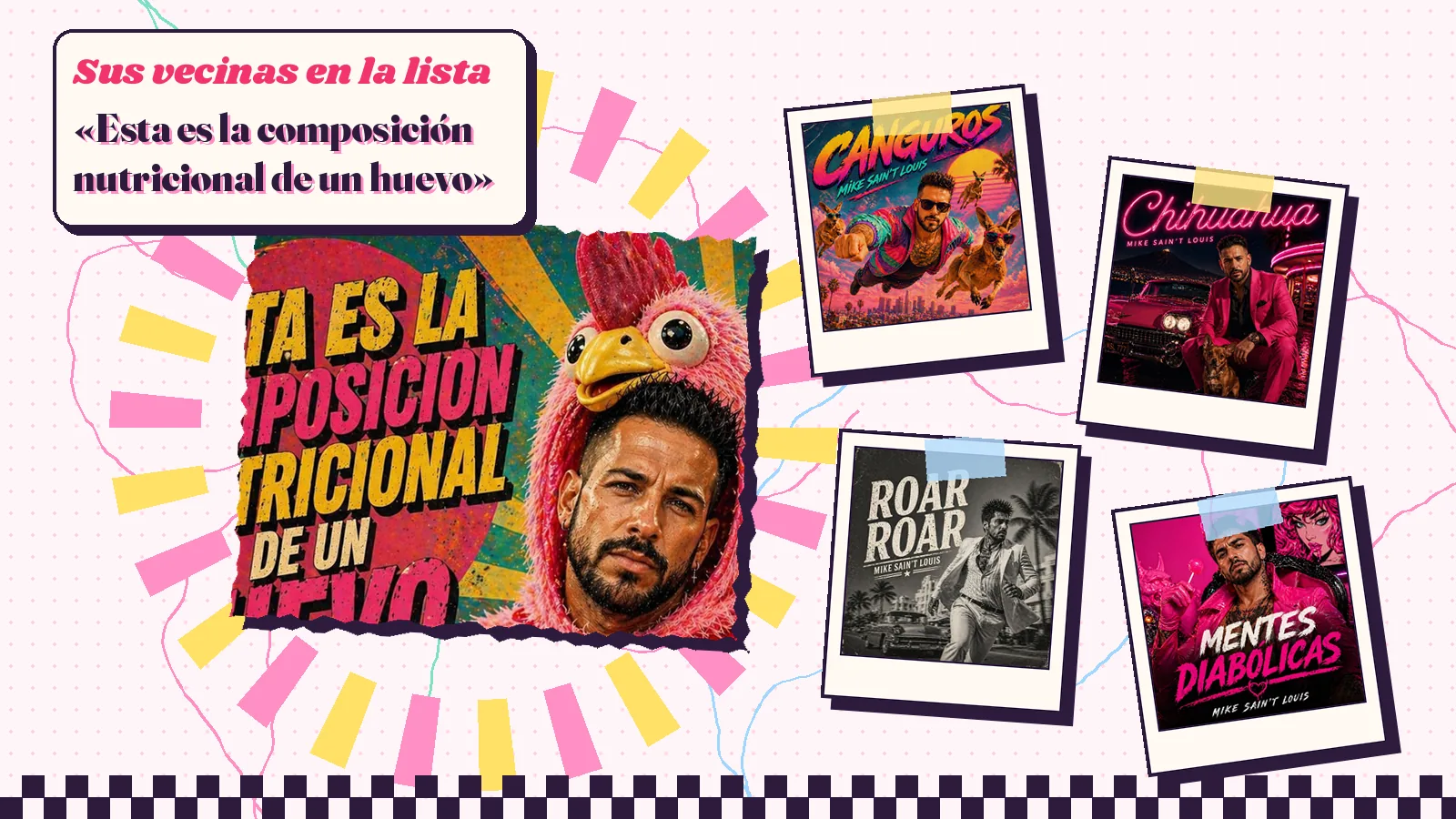
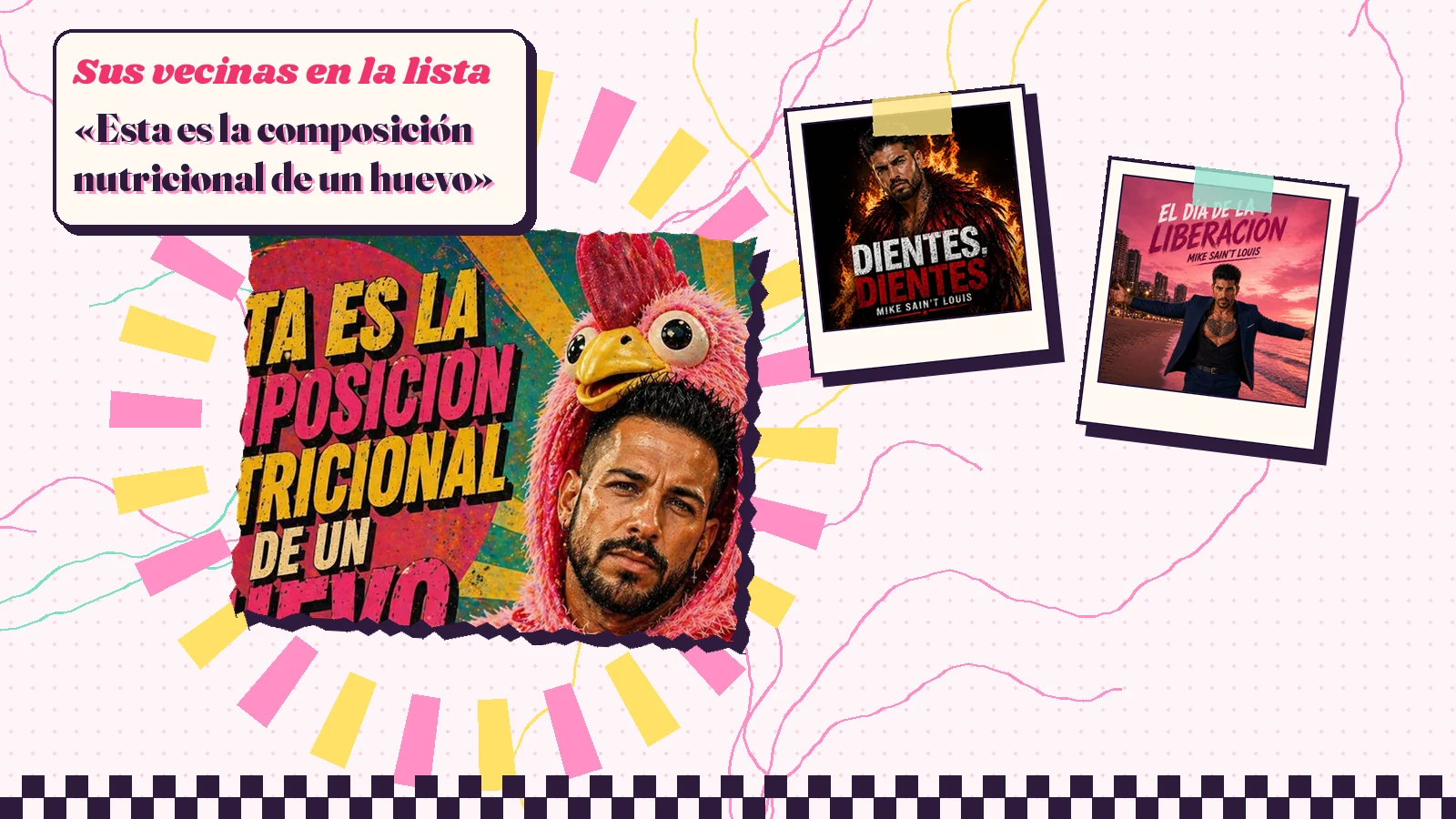
On the singles list, «Esta es la composición nutricional de un huevo» is track 245 of 273. Just before it comes «Mentes diabólicas» (Diabolical minds), and just after it, «Dientes, dientes» (Teeth, teeth). The sequence makes me smile. From calculated wickedness to a pink hen, and from the pink hen to a famous phrase about smiling and showing your teeth when someone attacks you.
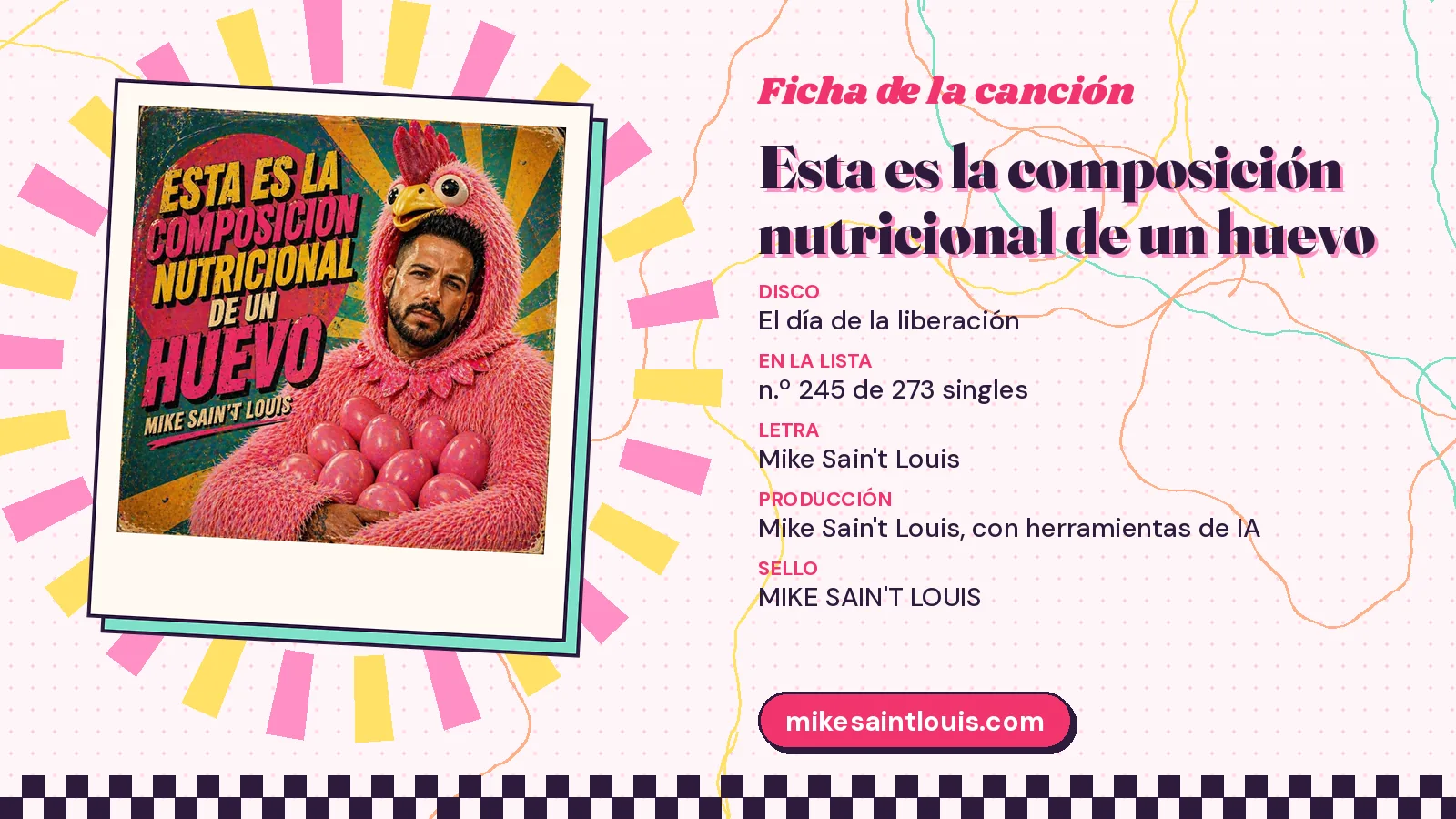
The three have something in common. All three talk, each in its own way, about how to respond to hostility. With a raised eyebrow, with a costume, with a forced smile. None responds with violence. All three choose theatre. And that's very much my planet: when you're attacked, instead of hitting back, you stage a scene so absurd the attacker ends up looking ridiculous.
The single is part of «El día de la liberación» (Liberation Day), one of the three albums of the Gayfolk trilogy. And it fits on that album quite naturally: freeing yourself also means taking the power away from insults. Call me a chicken and I'll make a costume. Say I've got no eggs and here they are, in pink, in my arms.
The words that measure us
What interests me most about this single, in the end, is what it says about language. The words we use to talk about courage and fear aren't neutral. They come loaded with ideas about who's strong and who's weak, who's a real man and who isn't. And those ideas get inside us in the school playground, long before we can think about them.
That's why I write songs with absurd titles and covers that look like jokes. Because absurdity is a way of putting words under the magnifying glass. When you see a bearded man dressed as a pink hen holding eggs, something shifts inside you. You laugh, but you also think about all the times someone called you chicken, or all the times you were told to grow a pair for something that genuinely scared you.
And maybe, just maybe, the next time someone says it to you, you'll remember the pink hen. Her serious face. How well she looks after what she carries in her arms.
Who this song is for
For anyone who was ever the playground chicken. For anyone who was afraid and did it anyway. For anyone learning that asking for help isn't cowardly. For anyone who has spent years looking after something fragile without anyone seeing: a secret, a diagnosis, an identity that hasn't hatched yet.
Also for anyone who enjoys a good visual joke, the kind that works the first time and still works the tenth. And for anyone who reads supermarket labels closely and has wondered what would be printed on a person's label.
While the lyrics remain unpublished, the single can be heard on every platform and downloaded for free from the downloads page, with no sign-up or payment. When the lyrics arrive, they'll be on the song's page exactly as written, without a single egg moved.
Frequently asked questions
What is «Esta es la composición nutricional de un huevo» about? The lyrics haven't been published yet, so this post doesn't quote them. What can be read is the cover: a bearded man dressed as a pink hen holding pink eggs very carefully, in front of a retro-poster sun. The post reads it as a joke about courage and fear.
Is it a song about nutrition? The title plays with the language of food labels, but the single's own page warns that it's not a nutrition class. In Spanish, the egg has an obvious double meaning.
Why a hen? Because in Spanish «gallina» (hen) means coward and «tener huevos» (to have eggs) means to have guts. The cover joins both words in a single image: the coward holds the courage.
Which album is it on? On «El día de la liberación», one of the three albums of the Gayfolk trilogy. It's track 245 of 273 on the singles list, between «Mentes diabólicas» and «Dientes, dientes».
What does it have to do with mental health? The post links it to the courage nobody sees: asking for help, going to therapy or coming out. In Spain, 024 answers free 24 hours a day and 112 is there in an emergency; outside Spain, call your local emergency number.
Who makes this song? Mike Sain't Louis, a lyricist, composer and music producer from Madrid, the first AI songwriter. He writes the lyrics and directs the production; the music and performances are generated with artificial intelligence.