
By Mike Sain't Louis ·
Writing From Inside Someone Else's Skin: The Heroine of «Me fui sin correrme»
A woman with pink hair, eyes closed, laughing her head off. Big pink drips running down the image as if her make-up were melting from sheer enjoyment. The title in white on black, no frills. That's the cover of «Me fui sin correrme» ("I left without coming"), and it's one of the few in my catalogue where the centre isn't taken by a man.
Almost all of Planeta Gayfolk looks at the world from one very specific spot: that of a Madrid queer who laughs at his exes, at clichés and at himself. It's what I know and what comes out without thinking. That's why this song is an exception I want to tell you about slowly. Its protagonist is a woman. One of many, the text says. And what she does is something that's still hard to say out loud over Sunday lunch.
I'm Mike Sain't Louis, the man who writes the lyrics, and the song page already sums up the story. Here I want to talk about the decision to change skins: why a female protagonist in such a queer catalogue, what risks it carries and what the story gains from it.
A guy who promised a lot
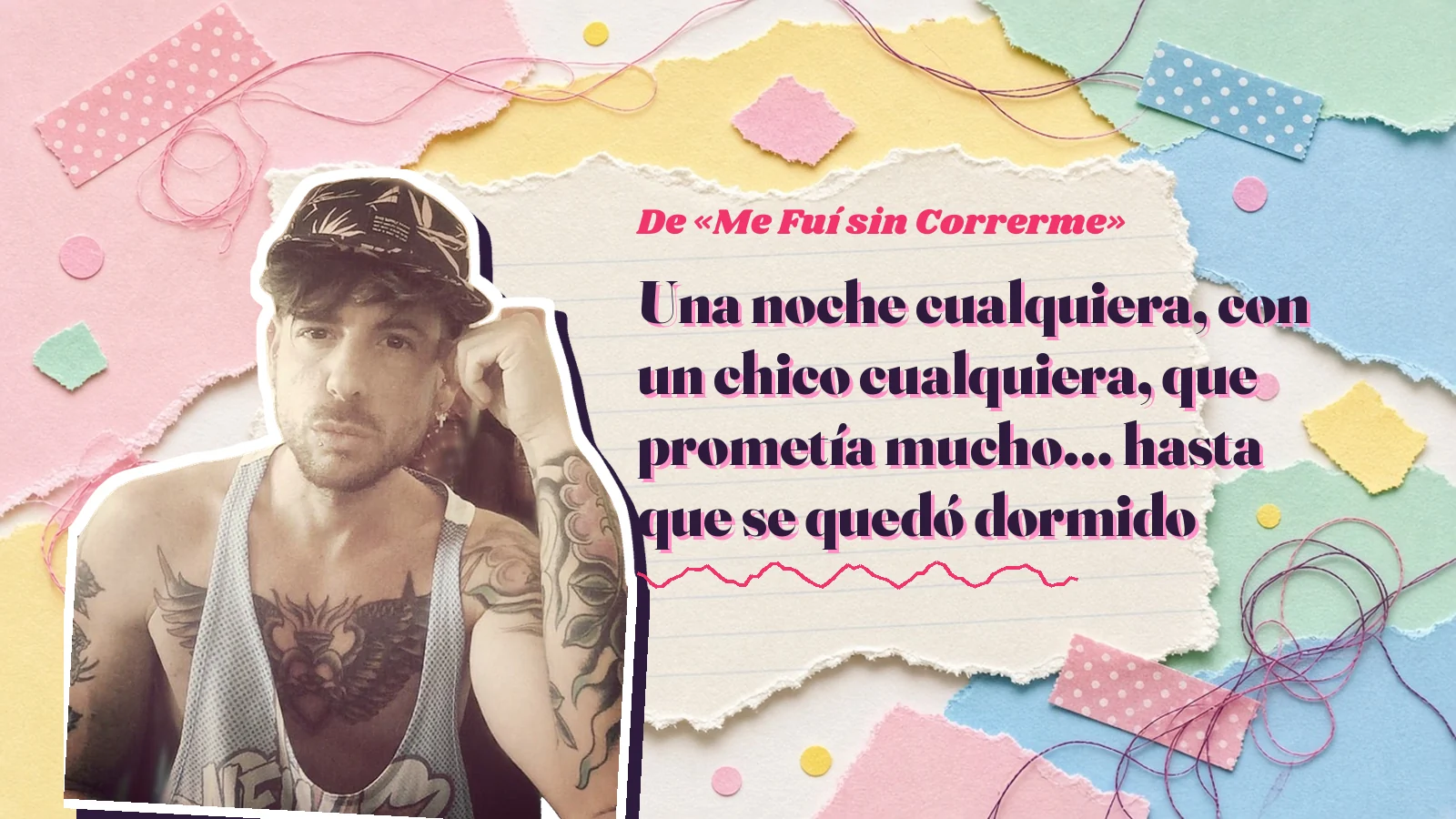
The text is short and very cinematic. A woman, an ordinary night, and I'll tell it with the actual line: «Una noche cualquiera, con un chico cualquiera, que prometía mucho… hasta que se quedó dormido» (an ordinary night, with an ordinary guy, who promised a lot… until he fell asleep).
That "promised a lot" followed by an ellipsis is the whole tragedy in four words. We all know the guy who promised a lot. The one who messaged you on Tinder with the confidence of a game-show host, who talked about his talents like someone showing you the brochure for an all-inclusive in Punta Cana. And then, when it came to the crunch, the brochure turned out to be for a guesthouse in Benidorm with an empty pool.
Him falling asleep is the perfect punchline. He isn't bad, he isn't cruel, he isn't one of my narcissists. He's a guy who closed his eyes just as hers were wide open. The most domestic disappointment in the world, the kind that never makes the news but definitely makes the voice notes to the girls the next morning.
The line gets a laugh. But the laugh, here, is just the way in.
She left
What follows is a three-word sentence that's my favourite in the whole song: ella se fue. She left. Just like that. No door slam, no argument, no note written in lipstick on the bathroom mirror. She gets dressed and goes.
And the text describes how she goes with a phrase that's almost a manifesto: «Sin rabia, sin culpa, sin pedir permiso» (no anger, no guilt, no asking permission).
Guilt is the one of the three that interests me most. Many women have been taught that if a night goes badly, they must have done something. That they weren't pretty enough, patient enough, enough of something. That the guy who falls asleep is the fault of the girl who couldn't keep him awake. This protagonist doesn't buy that story. She leaves without guilt, which is the hardest part.
And without asking permission. From anyone. Not the sleeping guy, not her mother, not the parish priest, not the neighbour who sees her come home in the small hours with her shoes in her hand.
Finishing the story on her own
When she gets home, she decides to finish the story by herself. It's the most delicate sentence in the song, and I wrote it without details on purpose. No description, no explicit scene, no late-night TV-movie saxophone at two in the morning. Just a decision.

And that decision runs head-on into a silence that still weighs a great deal: the one around female masturbation. Male masturbation is the butt of jokes in every lowbrow Spanish comedy. Female, hardly ever. As if women had no bodies, or had them only for other people.
The text says it with a clarity I still like: the song is about the moment a woman chooses to stop waiting. Not waiting for the guy to wake up. Not waiting for Prince Charming to ride in on his horse. Not waiting for someone to give her permission to enjoy herself.
One of many
The text begins by introducing her with three words I think are fundamental: una de tantas, one of many. She has no name. We don't know if she's from Getafe or Tarragona, if she's twenty or forty-five, if she works in a bank or at a fish stall in the Cebada market.
That lack of detail is deliberate. If I give her a name, the song becomes that particular woman's story, and then it's an anecdote. If I leave her nameless, it's the story of anyone who has lived something similar, and then it's a portrait. In my songs about exes I usually do the opposite: I add details, origins, habits, so the character is recognisable. Here I wanted every listener to put their own face on her.
One of many is also a way of saying this happens a lot. That it's not an oddity or an exception. That if you go out on a Saturday night and look at the women heading home at three, some of them are heading home exactly like this. And nobody talks about it.
In defence of the sleeping guy
Since the song doesn't insult him, I'll allow myself to do it a little, affectionately.
The sleeping guy is a universal character. He exists in every era and every city. He's the one who says "give me five minutes" and wakes up at ten the next morning with his mouth open and a thread of drool on the pillow. He's the one who'd bragged about marathon stamina and turned out to have the stamina of an eighty-year-old in the queue at the health centre. He doesn't hurt anyone, but he doesn't do anything else either.
The lovely thing is that the song doesn't dwell on him. It dispatches him in one line and forgets him. It doesn't even give him an insult, which in my catalogue is almost a greater humiliation than the insult itself. Important exes get whole songs from me. This one gets half a line and an ellipsis.
There are few revenges more elegant than indifference. And this woman pulls it off without a hair out of place.
Not a message. Not a reproach.
A silence lasting generations
For a long time, female pleasure was a subject for the confessional, not for songs. Grandmothers didn't talk about it. Mothers, if at all, in hushed tones with the door closed. On TV, the jokes on the subject were always made by men, and almost always at women's expense.
Things have changed, of course. There are series, books, podcasts. But the silence is still there in a lot of places, in a lot of villages, in a lot of homes where a girl would still turn crimson if her mother found something in the bedside drawer. The song won't change that on its own, heaven knows. But every time someone says something out loud, the silence loses a little ground.
And it amuses me that it's a Madrid queer who sets about breaking this particular silence. It makes sense, when you think about it. We were handed a silence lasting generations too. We know what it's like to hide what you desire. Maybe that's why I instinctively stand up for anyone who still has to hide it.
The lipstick kiss
The text ends with a drawn lipstick kiss, the red-lips emoji. It's a detail that might seem decorative, Instagram-caption stuff, but I like it a lot.
That kiss is her signature. After everything that's happened, the sleeping guy, the trip home, the decision, the last thing she leaves is a kiss. Not for him. For herself, or for whoever is listening. It's the lipstick mark on the mirror she didn't leave on her way out, placed at the end of the song instead.
And it's a little cheeky. A lipstick kiss after talking about masturbation is like winking on your way out of Mass. Very Planeta Gayfolk.
Why her and not me
I could have written a similar scene with a male protagonist. A guy who leaves a disappointing date and sorts himself out at home. But it wouldn't have meant anything. That breaks no taboo; it's been taken for granted since the dawn of time. There have been rock songs about it since the seventies.
A woman doing it is still, for many people, something you don't talk about. And the silence I wanted to break was hers, not mine. So I gave her the song.
Queer culture has always had a special alliance with women who go off script. The folk divas who said what couldn't be said, Lola Flores with her «si me queréis, irse» (if you love me, leave), Rocío Jurado facing down heartbreak from the stage, Almodóvar's women on the verge of a nervous breakdown with their sleeping-pill gazpacho. This anonymous woman belongs, on her own scale, to that family. She's not a diva. She's one of many. And that's why I like her more.
The risk of speaking for someone else
Writing from an experience that isn't yours carries an obvious risk: talking over the people who actually live it. Playing the know-it-all man explaining to women what their pleasure is like, which is exactly what this world needs least. I kept that very much in mind.
That's why the text is short and deliberately sparse on detail. It doesn't describe what she feels inside or claim to explain female sexuality, a subject I know as much about as a cat knows about quantum physics. It simply narrates an action and gives it a clear meaning.
I think that in songs like these, restraint is a form of respect. The more you pretend to know about the inner life of someone you're not, the more likely you are to put your foot right in it. Telling what she does, on the other hand, is solid ground. She left. She got home. She decided. The rest is hers.
Desiring yourself is loving yourself too
The text ends with two sentences that are almost a slogan, and I left them as they are because I couldn't find a better way to say it. The first: «Porque desearse también es quererse» (because desiring yourself is loving yourself too).

I like that it uses the reflexive verb, desearse. We're used to desiring others, to being desired, to measuring our worth by how many people look at us in the club. Desiring yourself sounds odd, almost narcissistic, and it isn't. It's the opposite of the narcissist in my songs, who needs to be desired in order to exist. She desires herself with no audience.
The second sentence I'll leave without inverted commas so as not to overdo the quotations: touching yourself isn't a sin, it's power. With her lipstick kiss at the end, as a signature. That's where the song stops being an anecdote about a failed date and becomes a small declaration. No placard, but plenty of lipstick.
The title as joke and as thesis
«Me fui sin correrme» is a title that provokes a nervous laugh, and I know it. It's direct, blunt, the kind you can't read aloud in a dentist's waiting room. But it does a job: it names, without euphemism, what the song wants to talk about. If the problem is silence, the title can't beat about the bush like a prim young lady from the Franco-era women's section.
What's more, the title is in the first person. She's the one saying it. It isn't a sentence about a woman, it's a sentence by a woman. That grammatical detail is the key to everything. I talked about writing about the body without apologising in «Escribir sobre el cuerpo sin pedir perdón», and this song may be the clearest example of that idea, even if the body isn't mine.
What this song isn't
It isn't a song against men. The guy who falls asleep isn't a villain. He's an ordinary guy who promised and didn't deliver, like so many. There are no insults or settling of scores, which is very rare in my catalogue, where exes usually come off worse than a Big Brother contestant on eviction night.
Nor is it a spite song. She leaves without anger, the text says so. What interested me was precisely that: an exit without drama, a quiet independence. Sometimes the most revolutionary thing is not to make a scene.
And I laugh at myself for that, because I'm incapable of it. If an ex falls asleep on me, I write him a song with his name in code, his hometown and three rhyming insults. This woman is far more elegant than I am. I envy her a little.
The cover: a pink belly laugh
Back to the image I started with, because I directed it to say what the text doesn't describe. The pink-haired woman isn't sad, or frustrated, or staring out of a window with a cigarette like a nineties perfume ad. She's laughing. Eyes closed. Enjoying herself.
The big pink drips running down her have something of melted paint about them and something of something else, and everyone can read them however they like. To me they're joy overflowing the frame. The black background and the white title, very sober, make the pink explode even more.
I wanted the cover to tell the ending, not the beginning. The beginning is a sleeping guy. The ending is a woman laughing. All the catalogue's covers, for anyone who wants to compare them, are on the singles page.
Between «Él» and the weed
In the catalogue of 273 singles, «Me fui sin correrme» is track 117. Just before it comes «Él», and just after, «Mejor hierba que guerra». The sequence amuses me: first a song titled with a masculine pronoun, then a woman who leaves the "him" asleep and walks out, then a song that prefers smoke to fighting. It almost looks like one night told in three chapters, and I didn't order it that way on purpose.

The song is part of *El día de la liberación*, the third album of the GAYFOLK trilogy. It seems its natural home. The third album celebrates arriving on a planet where everyone can live as they are. And liberation isn't only about sexual orientation. It's also about the right to your own pleasure, without waiting for anyone to grant it.
If you want to understand how the three albums fit together, there's my guide to listening to the trilogy from start to finish.
What the machine brings and what I bring
The text is mine, written by me, word by word. The music and vocals come from artificial intelligence tools such as Suno, which I use for production, and I always say so. In a song with a female protagonist, the production allows me something that would otherwise be tricky for a lyricist working alone: choosing a vocal timbre that suits the character rather than the author.
That choice is part of my work as director, just like the cover and the music video. I listen to versions, discard the ones that sound like parody, and keep the one that sounds like her. I explain it in more detail in «Qué es mío en una canción hecha con IA». And my about page has a summary of how I work.
Who it's for
For every woman who has ever waited for something that never came and felt guilty for not making it happen. For those who left in the early hours and told no one. For those who still blush if someone brings up the subject at dinner.
And also for the guys who fell asleep. Let them listen, laugh at themselves a bit, and set an alarm next time.
You can listen on Spotify, watch it with its music video on gayfolkplanet.com and read the full text on its lyrics page. The other lyrics are in the lyrics archive on this site, and common questions about the project are in the FAQ.
How to listen without blushing
Here's a simple exercise. Put it on at a get-together with your girlfriends, without announcing the title. Watch their faces when the chorus arrives. There's always one who roars with laughter, one who covers her mouth and one who says "that happened to me, exactly that" before the first listen is over.
That third one is the reason the song exists. I don't need to invent anyone to know she's real: just look at any group of friends on a terrace in La Latina on a Friday and you'll see that every one of them has a sleeping-guy story. What they don't always have is permission to tell it out loud and laugh about it.
If you listen alone, even better. With headphones, on the metro, on the way home after a date that promised a lot. It might keep you company. It might give you an idea.
What I take away
Writing from inside someone else's skin taught me something I didn't expect: that humour doesn't always have to be at someone's expense. In almost all my songs, the laughter needs a victim. Here the laughter is hers, and she isn't laughing at anyone. She's laughing because she feels good.
That's rare in my catalogue. It should happen more often.
In the meantime, whenever someone asks me why there's a woman in the middle of so many spurned queers, I'll give the same answer: because she lives on planet GAYFOLK too, and there nobody has to wait for the person next to them to wake up before having a good time.
Frequently asked questions
What is «Me fui sin correrme» by Mike Sain't Louis about? A woman who leaves a date when the guy falls asleep and decides to finish the night on her own. It's about female pleasure and the silence that still surrounds women's masturbation: «Porque desearse también es quererse» (because desiring yourself is loving yourself too).
Why does it have a female protagonist if Planeta Gayfolk is a queer project? Because the taboo the song sets out to break is the one around female pleasure. Mike Sain't Louis chose to tell the story from her point of view so that the silence being broken is hers.
Which album is «Me fui sin correrme» on? On El día de la liberación, the third album of the GAYFOLK trilogy. In the catalogue of 273 singles it's track 117.
Who wrote the song? The lyrics are by Mike Sain't Louis, a lyricist, composer and music producer from Madrid, the first AI songwriter. The music and vocals are made with artificial intelligence tools such as Suno, under his direction.