
By Mike Sain't Louis ·
Here I am writing, crying again: the eternal Kit Kat and the right not to look strong
The red wrapper, torn open down the middle. Two fingers eaten, two waiting. The laptop screen with the lyric half-written and the cursor blinking like an indicator in a jam on the M-30, Madrid's ring road. And me with a wet face, sniffing like a kid at the school gates.
It isn't a pretty scene. It's the real scene behind a lot of my lyrics.
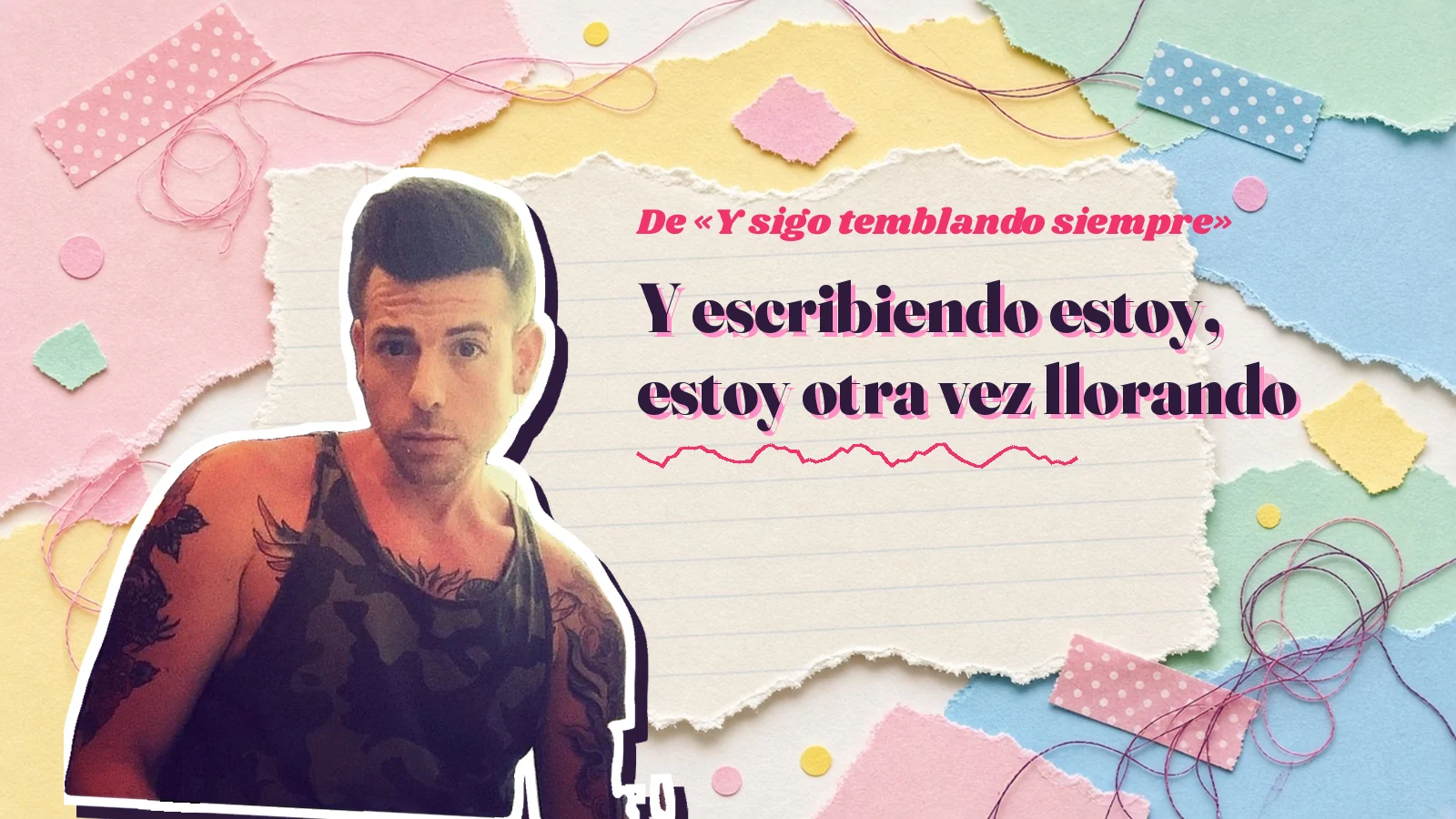
«Y sigo temblando siempre» («And I'm still trembling, always») has a line that portrays me better than any press photo: «Y escribiendo estoy, estoy otra vez llorando» («And here I am writing, here I am crying again»). I put it in exactly like that, no make-up, in the middle of the song, like leaving the bathroom door open. And this post is about that. About crying while you write, about the chocolate bar as first aid, and about my flat refusal to write songs where the hero walks out of the tunnel with perfect hair and a lesson learnt.
The chocolate bar on prescription
I'll start with the silliest bit, which is where I always start.
There's a moment in the song where the narrator takes stock and reaches a clinical conclusion: if this has gone wrong, «necesito un eterno Kit Kat», «I need an eternal Kit Kat». Not a holiday. Not a therapist. Not a rural getaway with a hot tub. A chocolate bar. But eternal.
It makes me laugh because it's exactly what we all do when something breaks. Nobody gets better from slogans on mugs. You get better, or you numb yourself, with whatever's to hand in the kitchen at two in the morning. A Kit Kat, a Bollycao, a jar of Nutella with the spoon stuck upright, custard pots from the four-pack. The old advert said «have a break», and I took it to the extreme: if the break has to last as long as the heartache, give me the infinite break, with spare fingers until the end of time.
There's self-parody in it, of course. I picture myself as one of those characters in an American romcom crying on the sofa with a tub of ice cream. Only in the Madrid-neighbourhood version, with the supermarket chocolate bar and the bobbly tracksuit.
But under the joke there's something serious. The eternal Kit Kat is an admission that there's no fix. That pain doesn't get repaired: it gets kept company. And keeping it company with sugar is as legitimate as keeping it company with guided meditation.
I choose sugar. And I put it in the lyric.
When the lyric comes out wet
Some people write cold. They sit down, step back, put their ideas in order and build a song the way you'd put together an IKEA bookcase, instruction leaflet at their elbow. I have a lot of respect for that way of working. I have songs like that, especially the purely comic ones, which are almost joke engineering.
But others aren't like that. Some lyrics come out of me while I'm still inside the blow, and those come out wet.
«Y sigo temblando siempre» is one of the wet ones. You can tell from the shape: long sentences tripping over each other, questions that don't wait for an answer, a chorus repeated in a way that sounds more like panting than a radio hook. It isn't a polished song. It's a song with its mascara running. And the line «escribiendo estoy, estoy otra vez llorando» is the confession that the narrator isn't telling something that happened. He's telling it while it happens.
I explained in writing fast and writing slow that my lyrics have two speeds. This one's a fast one. The kind I don't leave to rest because, if they rest, they cool down and lose exactly what they've got: the tremble.
There's a trap there, I know. Writing from inside the pain can lead you into the stickiest self-pity. That's why, even in a song as wet as this one, I throw in chocolate bars and TV shows. Not as a brake, but as a banister. Something to hold on to so you don't fall down the stairs.
Crying in a corner like in «La que se avecina»
The song has two TV references which, for me, are the heart of the matter. One asks whether all the couple's good moments were bloopers from «La que se avecina» or «Caso cerrado». The other describes the narrator slumped in a corner, crying, as if he were in a dramatic episode of «La que se avecina».

I love that series as a mirror, and it's no accident it turns up so often in my songbook. It's a Spanish ensemble sitcom about the neighbours in a Madrid block where everyone shouts, everyone cheats and everyone survives by exaggerating. And every now and then, amid the canned laughter, a character is left alone on the landing and the camera catches them with damp eyes. Those few seconds are, to me, the most honest thing on Spanish television.
Using the series as a measure of pain has one huge advantage: it lets me see myself from outside. If I picture myself crying like a resident of Mirador de Montepinar, the block in the show, I'm no longer just the one crying. I'm also the scriptwriter thinking the scene is getting a bit overdone. And that double gaze, victim and scriptwriter at once, is what stops me going under completely.
From «Caso cerrado», the courtroom show where people air their disputes on camera, I take something else: the suspicion that it was all staged. That programme lived off cases so unbelievable that people argued over whether they were real or acted. Apply that to a relationship of years and it's devastating. Were the walks with the dogs real? The Christmases? That way of comforting me? Or was it all just another take, with the director off camera giving instructions?
That question has no answer. That's why the song trembles.
The clever one who turned out to be a circus
There's a line in the song that tickles me because it's a very small, very precise revenge. It says that the one who thinks he's clever is, deep down, a circus. Not an evil genius, not a strategist, not a criminal mastermind out of a James Bond film. A circus. With its clowns, its flea tamer and its patched-up big top.
I like it because it deflates. During a relationship with someone who manipulates, that person seems enormous. He seems to control everything, to be always two steps ahead, to know exactly which button to press to make you feel small. And when you get out, with a bit of distance, you look again and see the faded canvas, the blown spotlights and the ringmaster in a sequinned jacket with grease stains on it. All that fear for this.
That markdown is one of the healthiest moments in any break-up. It doesn't happen on day one. Or in the first month. But when it comes, you feel it: the monster turns into a village-fair show, the kind they put up in August next to the bumper cars. And you start to laugh.
Let them unload on me
The song also has an almost classical-theatre moment. The narrator addresses «los aludidos», «those concerned», just like that, in the plural, in the tone of an official statement, and asks them to unload all their guilt on him. As if he were the lightning rod for the whole residents' association.
I wrote it with irony, of course. The irony of someone who has carried guilt that wasn't his for so long he now offers it as a service. Go on, bring it all, I'll keep it in the storage room. But there's real tiredness in it too. Just before, the song says the narrator feels it isn't really so much his fault. That line, so quiet, so unheroic, cost me more than any joke on the album. Jokes come on their own. That line I had to pull out with tweezers, like a splinter in the sole of your foot after a day on the beach at La Malvarrosa in Valencia.
Because that's how gaslighting works: in the end, the one who feels most to blame is the one least to blame. And daring to say out loud that you're not the one at fault for everything is like opening a window after months with the house shut up. Air comes in. It smells of the street.
If this hits close to home, I have another song in gaslighting that goes straight for that mechanism.
First cousins with «Me rindo»
Anyone who knows my catalogue will recognise lines from this song in «Me rindo», «I give up». They share material, and I say so openly because I think it's interesting for anyone who wants to understand how I work.
Sometimes a lyric doesn't fit in a single song. I come out with a block of text pointing in several possible directions and, instead of choosing one, I let two versions grow. Each pulls its own way. In one, the surrender weighs more; in this one, the trembling weighs more, the body that won't stop shaking even though the head has already decided to give up. The title says it: I give up, yes, but I'm still trembling.
Some people will find that practice odd; to me it seems perfectly natural. Painters do series of the same motif. Photographers repeat a frame in different light. I do the same with words: I go back to the same wound over a different beat, a different tempo, a different order. If anyone wants to read them side by side, the lyrics are at gayfolkplanet.com/letras/y-sigo-temblando-siempre and on the «Me rindo» page.
It isn't recycling. It's insistence. And in heartbreak, insisting is what everyone does, even if hardly anyone admits it in public.
The right not to look strong
I come to the line I consider most mine in the whole song, and it doesn't have a single joke in it: «me da igual aparentar o no ser fuerte», «I don't care whether I look strong or not».
We live surrounded by speeches about strength. Social media is full of quotes about getting back up, turning pain into fuel, coming out stronger from every knock. There are even T-shirts. And honestly, I'm a bit fed up. Not because I'm against getting back up, I get back up like everyone else, but because that obligation to look whole becomes one more weight to carry. It's no longer enough to suffer: you also have to suffer with style, in record time, and with a takeaway to share on LinkedIn.
The song refuses. It says it doesn't care. That it'll tremble in front of anyone. That it won't pose.
For someone coming out of a story with a narcissist, this carries a special weight. For a long time, pretending everything was fine was a survival strategy: give nothing away, don't show the wound, don't hand over ammunition. Dropping the act is the first gesture of freedom. It's taking off the costume of the person who's handling everything brilliantly and saying: well, no, I'm trembling, and here it is.
I wrote about that awkward honesty in a letter to someone who still hasn't told anyone, although the subject there was a different one. The root is the same: keeping quiet to look strong costs a fortune.
The body doesn't give up when the head does
I'm very interested in the difference between giving up and stopping trembling, because I think it explains something nobody tells you about break-ups.

The head can decide in a second. One day you wake up and think: that's it, I'm not going back, I won't text him, I won't look at his profile. You decide it with the clarity of a final verdict. But the body goes at its own pace, and its pace is much slower. Your hands shake when your phone goes. Your stomach knots if you see a car of the same model. You wake at four in the morning with your heart pounding like an Easter drum in Calanda, the Aragonese town where they beat them all night long.
That's the chorus. Giving up is the head. Still trembling is the body. And both sit in the same sentence, no contradiction, because that's how it works.
I think it matters to say it in a song, because a lot of people feel terrible for still trembling after they've decided. As if it were a failure. As if the decision didn't count. It does. The decision counts. It's just that the body needs time to get the message.
Meanwhile, Kit Kat.
In shock and shaken
There's a line that reads almost like a medical report: «Sigo impactado y estoy conmocionado», «I'm still in shock and I'm shaken». Two words from A&E, from a car crash, from the gold foil blanket and the ambulance with its lights on.
I chose it deliberately for its report-like tone. After so much crying, so much telly and so much chocolate, the narrator describes himself like someone injured by the roadside. No metaphor, no frills. As if for a moment the paramedic were talking and not the patient. And I like that change of register because it's a reminder that, under the humour, there's someone who's taken a real blow.
I've said it before and I'll say it again: you can tell the truth with humour too. But now and then the truth has to be told without it. In two words from A&E.
The black-and-white cover
The artwork for «Y sigo temblando siempre» is one of the most sober in my catalogue. Black and white. A man with dark wavy hair and a few days' stubble, white shirt open, a tattoo peeking out on his chest, looking down, head slightly tilted. An earring with a small cross. On the left, the title in black condensed letters, stacked like an old film poster.
There's no colour, and in my universe that's almost a statement. My covers are usually loud: fluorescent pinks, swimming-pool blues, comic-book reds. Not this one. This is the hangover cover, the morning after, the grey light of a November Sunday in a flat that looks onto the inner courtyard.
And the downward gaze belongs to someone who doesn't want his face seen. Which, come to think of it, clashes with the lyric, which says it doesn't care about appearances. I like that tension. You can say you don't care and still lower your eyes. Both things are true at once.
If you're curious about how I think up covers so they look alike without getting boring, I've told that story in hundreds of covers.
Why I don't write getting-over-it songs
I've been asked for getting-over-it songs now and then. Songs about «I can handle anything», «look at me now», waking up on a Monday and eating the world. And they won't come. It's not that I don't want to: I just don't believe them.

Getting-over-it songs seem to me like the musical version of an Instagram filter. They show you the after without the during. And I live, and write, mostly in the during. On the sofa with the chocolate bar. In the corner of the hallway. On my phone at four in the morning.
That doesn't mean my songs are depressing. Quite the opposite: I think they're among the funniest things I do, precisely because they don't pretend. Humour is born in the during, not the after. Nobody laughs at someone who's already got over everything. We laugh with someone who's right in the middle of the mess and still manages a joke about a Kit Kat.
There's a similar idea in music is saving me. Music doesn't yank me out of the pit in one go. It keeps me company down there while I find the ladder. That's something else. Slower, less spectacular, far truer.
What the machines do and what I do
I'll spell it out because it matters in such a personal song. I wrote the lyrics of «Y sigo temblando siempre» myself, without artificial intelligence, with my tears and my four-in-the-morning spelling mistakes. The music and the vocals are made with AI tools such as Suno. I'm a lyricist, composer and producer; the vocals you hear aren't mine.
Some people think making music with AI is incompatible with writing in tears. That if the machine supplies the sound, the emotion must be fake. For me it's the exact opposite: since I don't have to worry about hitting the notes or recording in a studio, I can put all my energy into the words. The emotion lives in the lyric. The machine dresses it. I've gone into more detail in artificial intelligence and authorship.
No machine has ever cried on my keyboard. That was me.
A recipe for trembling days
I'm not a doctor, or a psychologist, or a coach, and I'm not going to give you advice that isn't mine to give. If you're really struggling, look for professional help. It exists. It works. But I can tell you what I do on the days when the head has given up and the body keeps trembling.
I write. Even if it's bad. Even if it's a shopping list with insults in it. I write with a wet face and I don't delete anything until the next day.
I put on a series about neighbours who shout. Any will do, but the ones set in Montepinar and Desengaño 21 have the advantage that there's always someone worse off than you.
I open a chocolate bar. Not an eternal one, my dentist would kill me, but one. I eat it slowly, finger by finger, like a ritual.
And I let myself tremble. Without explaining it to anyone. Without posting it to my stories. Without hunting for the moral.
The next day, sometimes, what I wrote works for a song. Other times it goes in the bin. But always, without exception, I'm a little better than the day before. Not cured. A little better. And for me, that's already a lot.
Still trembling, and here I am
I'll finish with a confession that fits everything above. Sometimes, when I listen to this song again, I still tremble a bit. Not over the same thing as back then, that's long gone, but at the memory of what it cost to write it.
And I'm fine with that. A song that no longer stirs anything in you is a dead song. This one's still alive. Still trembling, as its title says, and I hope it stays that way for a long time.
If you listen to it on a bad day, know that you're not alone in that corner. There's someone else crying like in a dramatic episode, with the red wrapper torn open down the middle.
Save me a finger.
Frequently asked questions
What is «Y sigo temblando siempre» about? About what happens after falling for someone who turns out to be something else: crying while you write, wondering whether it was all a TV set-up, and deciding to give up without ever stopping trembling. With humour, Kit Kat included.
Which album is it on? It's part of «Ojalá se pudiera viajar a GAYFOLK», the second album of the Planeta Gayfolk trilogy. The full lyrics are at gayfolkplanet.com/letras/y-sigo-temblando-siempre.
How is it related to «Me rindo»? The two songs share lines and the same wound, but each puts the weight in a different place: one on the surrender, the other on the trembling of the body that carries on afterwards.
Who writes the song and who does the vocals? The lyrics are by Mike Sain't Louis, a lyricist, composer and music producer from Madrid, written without AI. The music and vocals are created with artificial intelligence tools such as Suno.