
By Mike Sain't Louis ·
The B-movie heroine's costume: camp horror as a way to survive
A plan worked out to the millimetre. And something that goes wrong.
That's how «Escupiré sobre tu tumba» ("I Spit on Your Grave") begins, and the first thing I want to say is that this is not a comfortable song. It talks about blows so hard the mind couldn't believe them. It talks about a sexual assault committed by a group, with someone at the front who thinks he's the leader, the salesman, the champion. There is no euphemism or soft metaphor in that part of the lyric, and I'm not going to soften it here either.
But this song also has a shotgun strapped to somebody's balls, an explosion triggered by a phone call from a cruise-ship fling, and a goodbye that says «un besiño», "a little kiss". And that mix, which throws a lot of people, is what I want to explain in this piece.
The song's own entry already covers what the lyric says, line by line. Here I'm going to talk about something else. About why, to tell the ugliest thing, I put on the most over-the-top costume I could find: that of the heroine of a B-movie revenge flick.
It can't be told in the tone of the evening news
Some stories, if you tell them in the neutral voice of the three o'clock news, will tear you apart. You and whoever is listening. Neutrality, on certain subjects, is a form of cruelty. It forces you to look at the wound without anaesthetic, in broad daylight, while the presenter puts on a solemn face before moving on to the sport.
And there's another option. The horror-film option.
Late-night horror, the video-shop kind with the worn-out cover and the tape rewound a thousand times, teaches you something I've since used a lot in my writing: horror is a way of talking about what can't be talked about. The monster is always something else. The masked killer is the father, the neighbour, the boyfriend, the fear of coming out. You put it outside yourself, with its chainsaw and its screeching violins, and then you can look at it.
My songs are full of that. «La casa de los mil cadáveres» ("The House of a Thousand Corpses"), the neon coffin, the emotional vampires, the Saw mask. I do it so much it's practically part of the furniture. But in «Escupiré sobre tu tumba» the horror isn't there to be funny. It's there to make possible something that, told any other way, would never have left the notebook.
Putting on the costume
The chorus is the key:
«Pero no contabas con que yo soy / Igual que la protagonista de Escupiré sobre tu tumba.» ("But you didn't count on the fact that I'm / Just like the heroine of I Spit on Your Grave.")
The film that gives the song its title belongs to the subgenre known as rape-revenge, with its original from the late seventies and a remake quite a few years later. Its protagonist is an assaulted woman who doesn't stay down. She comes back. And she comes back for every one of them.
I'm not going to defend those films as cinema here; they have their merits and this isn't the place to argue about it. What interests me is the figure. The victim who stops being one. The person who was chosen because she seemed weak and who turns out to be the very worst person to choose.
When I write that I'm just like her, I'm not saying I'm going to do what she does in the film. I'm saying something simpler and, to me, more important: that I put on her costume. That for three minutes I borrow her body, her rage and her determination, because mine, that day, wasn't up to it.
That's what camp does when it gets serious. It lets you dress up as someone bigger than you so you can say things you'd never dare to say in your everyday clothes. The drag queen who steps on stage in eight-inch heels and says what the village boy never said. The folk diva in her ruffled train who weeps in front of two thousand people what she never wept at home. The B-movie heroine with the torn dress and the knife in her hand. It's all the same operation: a disguise that, instead of hiding you, lets you speak.
I go into it more calmly in camp isn't a joke, even if you laugh. This song is probably the most extreme example I have of that idea.
It didn't even hurt
Before the chorus there's a line I'd like people to read slowly, because it's one of the truest in the song:

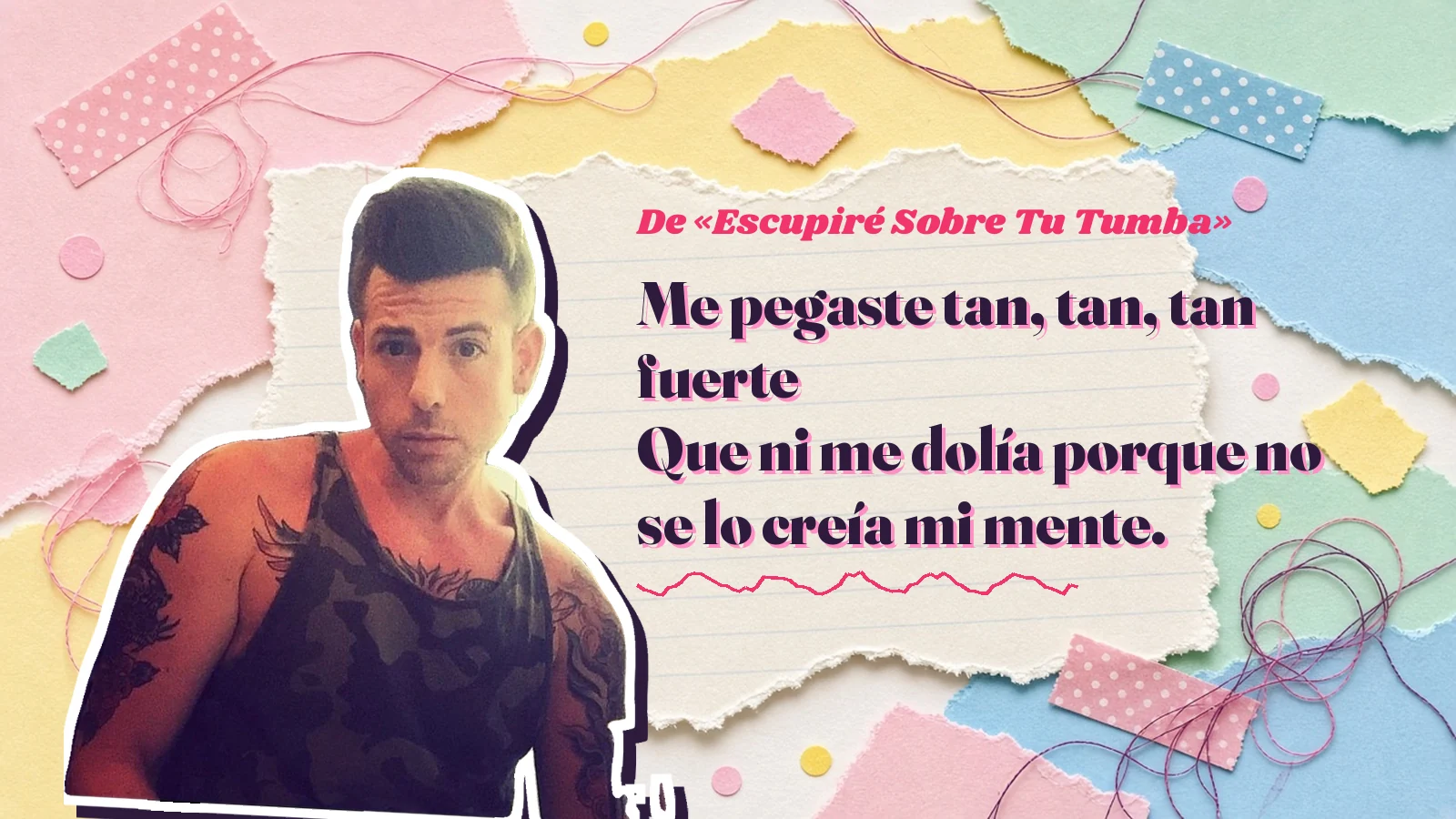
«Me pegaste tan, tan, tan fuerte / Que ni me dolía porque no se lo creía mi mente.» ("You hit me so, so, so hard / It didn't even hurt, because my mind couldn't believe it.")
That "so, so, so" sounds like a stammer, and it is one. It's what happens when you try to explain something that won't fit into words: you repeat the same syllable like someone banging on a door that won't open.
And then the second half, which is almost clinical. It didn't hurt because my mind couldn't believe it. Many people who've been through something like this describe exactly that: a kind of disconnection, as if you were watching the scene from a corner of the ceiling, as if it were happening to someone else in a bad film. It doesn't hurt in the moment. It hurts afterwards. Sometimes years afterwards, in the silliest place, doing the shopping or waiting for the bus.
I wrote it like that, with no decoration, because that part didn't need any horror imagery. It already was horror. The shotguns and the cruises come later, when you need to breathe.
Leader, salesman, champion
The lyric gives the attacker three titles in a row: the leader, the salesman, the champion. And it amuses me how little they resemble what you'd expect from a monster. It doesn't say the murderer, the psychopath, the beast. It says the salesman.
Because that's what so many of them are like. They don't wear a hockey mask. They wear a tie and an insurance-advert smile. They're the top seller in the office, the one who organises the work dinners, the one everybody adores at the barbecue at the house in the suburbs. The Sunday padel champion.
That's the real horror of the song, more than the assault itself: that the man who commits it is perfectly integrated. That he has good press. That if you tell anyone, nobody will believe you, because "What, him? The nice one?" And that's why the lyric sets about, line by line, wrecking his reputation. Exposed. Below target. It sinks the salesman's sales.
A heroine, not a hero
There's something that may not be obvious at first: the song doesn't say "I'm just like the hero". It says «la protagonista», in the feminine. I identify with a woman.
And for a queer man, that's the most natural thing in the world. Many of us grew up without heroes on screen who looked like us. The boys in the films were the football captain, the tough cop, the one who got the girl. We didn't see ourselves there. We saw ourselves in them, the women. In the one screaming on the stairs, the one running barefoot through the woods, the one who, at the end, when everyone else was dead, picked up the axe and turned around.
Horror even has a name for her: the final girl, the one who survives when all the others have fallen. We've spent decades cheering for her in neighbourhood cinemas, at late-night screenings and in Halloween marathons with the girls. It's no coincidence. She's the only one who gets out alive, and we, in one way or another, have also had to get out alive from a lot of houses.
So when I looked for a costume for this song, I didn't stop to think whether it was a man's or a woman's. It was the survivor's costume. And it suits me.
You chose wrong
There's a line I consider one of the angriest I've ever written, and I say it with pride:
«Has elegido mal esta vez tu prototipo de víctima: / Alguien débil, confiado y con muy baja autoestima.» ("This time you picked the wrong prototype of victim: / Someone weak, trusting and with very low self-esteem.")
Look at the word "prototype". It's not a song word. It's an office word, a marketing-department word, a PowerPoint word. And it's there on purpose, because that's how the attacker sees his victim: as a profile. A target audience. A potential customer.
The person who does harm like this doesn't choose at random. He looks for someone whose self-esteem is on the floor, someone trusting, someone who won't tell. He does his market research. And the lyric throws his own language back at him, mockingly: you got the wrong prototype, champ. Your market research failed.
I especially like that the line doesn't deny the description. It doesn't say "I wasn't weak". It says I seemed it. That perhaps I was, at that moment. But the prototype had a hidden feature that wasn't in the instruction manual.
The shotgun and the cruise
And here comes the part that makes some people choke on the song. The fantasy.
The lyric imagines the attacker with a shotgun strapped to his balls, and a contraption that goes off when one of his cruise-ship flings calls him. The phone rings, it explodes, «¡por Dios! te peta y te duele», "God, it blows and it hurts", and he has no idea what's going on. «¡Aguanta, nene!», "Hang in there, baby!"
It's over the top. It's ridiculous. It's pure cartoon, Wile E. Coyote and the Road Runner with a stick of ACME dynamite. And it's written that way deliberately.
Because a revenge fantasy, when it's realistic, is frightening. It turns you into what you don't want to be. But when it's absurd, comic-book, when it has an impossible mechanism triggered by a call from a fling, it becomes something else: a release. A private joke that makes you laugh at the worst moment. Nobody is going to build that contraption. Nobody intends to. But imagining it gives you back, for a second, the feeling that you're the one with the power.
The cruise detail is also very me. It's not just any fling, it's a cruise fling. The everyday and the tacky dropped into the middle of the horror scene, as in all my songs. Even in the worst nightmare there's an all-you-can-eat buffet and an inside cabin with no window.
The real revenge
But if you ask me which line matters most to me in the song, it isn't the shotgun one. It's this:
«Yo subiendo como la espuma y haciendo nuevos amigos.» ("Me, rising like foam and making new friends.")
And the one that follows: you, exposed, with your reputation below target. Office language again, "below target", as if it were the quarterly review of a salesman who missed his quota.
That's the revenge that counts. Not the explosion. The foam.
Rising. Making new friends. Being well. Doing well while the other one is left «retratado», which is a lovely word in street Spanish: literally "portrayed", it means everyone has seen what you're really like. You can no longer hide behind the salesman's smile.
You don't need to destroy anyone when you're living well and the other one has to watch. The shotgun fantasy is in the song to let off steam. The foam is there to stay.
«Un besiño» (A little kiss)
And the ending, which is pure poison tied with a bow:
!Collage with a detail of the «Escupiré Sobre Tu Tumba» cover art and the covers of «La Casa de los Mil CadáVeres» and «Karma (Versión Alternativa)» Go ask the coat guy for help, don't count on me. Then a political jab, the kind I enjoy, with a minister's name and all. And the farewell: goodbye forever, my boy. «Un besiño», you pig from El Médano.

«Un besiño». In Galician, or in that jokey Galician we Madrileños use to sound friendly. It's the tenderest goodbye in the world placed at the end of the hardest song I have. And that's the trick. Saying a fond goodbye to someone who destroyed you is the most elegant way of telling him he no longer matters to you. Hatred is still a bond. «Besiño» is a door closed with a smile.
The nickname at the end, the pig from El Médano, appears in other Planeta Gayfolk lyrics too, such as «Karma (Versión Alternativa)». It's my way of turning someone into a character, of reducing him to a caricature. He no longer has a first name in my songs. He has a fairground nickname.
The knife cover
Look at the cover, because it's almost a still from one of those films. A man seen from behind, shirtless, his skin dirty and marked, a torn white rag tied at his waist and a knife in his right hand. The title on the left, in red and black letters, with my name underneath.
You can't see his face. He's looking the other way, towards something we can't see. And to me that's the most unsettling thing about the image. You don't know whether he's coming from something or going after something. Both, probably.
It's the film's heroine, but as a man, as a queer man, in a tattooed gym body. The B-movie costume, tailored to my size. Every single has its image, and this one looks torn straight off a video-shop poster. You can see the other covers in the catalogue under singles.
What bad films taught me
I love B-movies, and I mean that without irony. Cheap horror films have something big productions don't: you can see the seams. The blood is red paint in a garish shade. The monster has a zip down its back. The set wobbles when someone shuts the door.
And what looks like a flaw seems to me a kind of honesty. A B-movie doesn't con you. It tells you "this is a film, it's all pretend, relax", and precisely because it tells you that, it lets you enjoy being scared. You know it's theatre, and that's why you can step inside.
The way I make songs has a lot of that. No major-label budget, no team of forty, just my one-person label and my tools. I talk about it in what an art director does when there's no budget. And in a song like this, that B-movie aesthetic fits like a glove. The cartoon shotgun, the impossible contraption, the explosion that sounds like an eighties sound effect. Everything has a zip. Everything is exaggerated on purpose.
Because if the revenge were realistic, it would be genuinely frightening. And the song doesn't want to frighten. It wants to take the fear away.
Writing about the body
Some people think these things shouldn't be told in a song. That they're too intimate, too ugly, too much like a courtroom. That a song is for dancing.

I believe the body has the right to tell what happened to it in whatever format it pleases. Including one that lasts three minutes and has a chorus. I wrote about that in writing about the body without apologising, and this song could be example number one for that piece.
What I do make sure of is one thing: I don't confuse the song with legal testimony. A lyric isn't a statement to the police. It's something else. It's a way of bringing order to something disordered. That's why it has cartoon shotguns, ministers and cruises. Because that's how the mind processes the unbearable: by mixing it with the ridiculous until it can be touched.
From the joke to the stone
I'm going to say something without joking, just once.
If something like what this song describes has happened to you, you don't need to be the heroine of any film. You don't have to go back for anyone. You don't have to rise like foam tomorrow. You don't have to make new friends or get dolled up so the other one sees you. It's enough to keep going. At your own pace, which can be very, very slow.
The B-movie heroine is a costume. It works for a while. Then you take it off and you're left with your usual body, with its tiredness. And that's fine too.
That's it. Back to my thing.
On the first album, and not by chance
The song is on the first album of the trilogy, *Descubierto un nuevo planeta llamado GAYFOLK* ("New Planet Called GAYFOLK Discovered"). In the complete gayfolkplanet.com catalogue it's track 123 of 273, between «Doña Rogelia» and «Punto muerto» ("Neutral"). Just look at the neighbours: on one side, a lady with a village grandmother's name; on the other, a title that sounds like a car-accident report. My catalogue isn't ordered by style. It's ordered by life.
It makes sense that it's on the first album. That album is about discovery, about arriving on a new planet where you can be who you are. I explain it in why the first GAYFOLK album has a news-headline title. And to reach that planet, first you have to leave some things behind. Some of them, with a gob of spit.
The lyrics are mine. The music and vocals of Planeta Gayfolk are made with artificial-intelligence tools such as Suno, and I say so openly all over this site. If you want the full map of the universe this song lives in, it's at Planeta Gayfolk. The machine supplies the sound of the explosion. The shotgun, the foam and the «besiño» are mine.
What I don't spit on
One last thing, which is almost a joke but not quite.
The title says "I will spit", in the future. Not "I spit". Not "I have spat". It's a promise, not a fact. And like every promise made in anger, it has a touch of theatre. I probably won't spit on any grave. I probably won't even know where it is. Most likely, when the day comes, I'll be busy with something else, on a café terrace or on the sofa with the chihuahuas, and I won't even hear about it.
And that, if you think about it, is the best revenge possible. For the grave of the person who hurt you to mean absolutely nothing to you. Not even remembering to go.
That's why I wrote the song. So I could forget to go.
Frequently asked questions
What is «Escupiré sobre tu tumba» about? About an assaulted person who compares himself to the heroine of the revenge film of the same name. It mixes a very harsh account with an exaggerated, comic-book revenge fantasy, and ends with the idea that the best revenge is doing well.
Why does a song about an assault have humour in it? Because exaggerated humour and camp horror make it possible to look at the unbearable without freezing. The assault part has no joke in it; the shotgun fantasy does, and it's deliberately written like a cartoon.
Which album is it on? On Descubierto un nuevo planeta llamado GAYFOLK, the first album of the GAYFOLK trilogy. In the gayfolkplanet.com catalogue it's track 123 of 273.
Who wrote it? The lyrics are by Mike Sain't Louis. The music and vocals were made with artificial-intelligence tools, and the single is released on the MIKE SAIN'T LOUIS label.