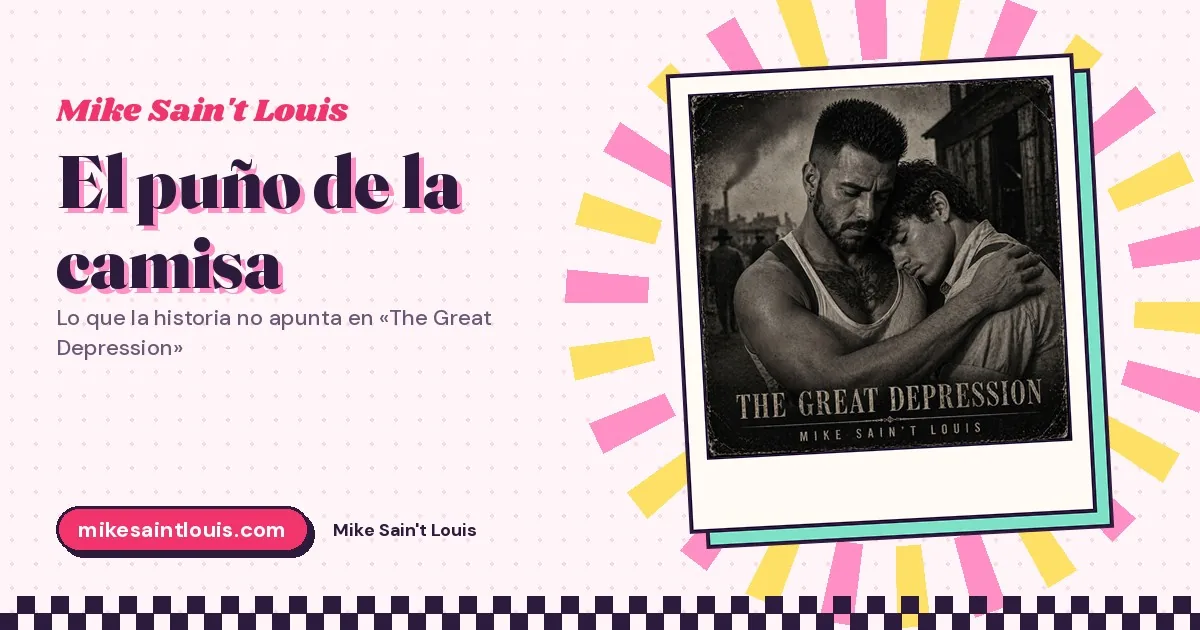
By Mike Sain't Louis ·
The shirt cuff: what the history books leave out of «The Great Depression»
A man fixes your shirt cuff before you step out into the street.
That's it. That's the scene. No kiss, no bed, no declaration. Two hands, a fold of fabric gone wrong, a five-second gesture at the door of a rented room. And for me, those five seconds hold the whole love story I wanted to tell in «The Great Depression».
I've been asked several times why I went so far away. To 1929, to the United States, to English. Me, who writes about Mercadona, Grindr, Benidorm and cruises with croquetas. Here's the long answer, the one that won't fit in an interview.
I went far away to see up close
When I write about my life, my exes or my nights out, I'm so far inside that sometimes I can't see a thing. It's all mixed up with anger, laughter, hangover. That's very fertile mud for songs with jokes in them, but it doesn't always work for the other thing, the clean thing.
For this song I needed distance. I needed a place with none of my exes and none of the neighbours I know. A black-and-white place.
And the Crash of '29 came to me for a very silly reason: because the word depression means two things. The economic one, from the history books, with its breadlines and ruined bankers. And the other one. The one that gets inside you when someone is taken from you. A title with a false bottom, like a smuggler's suitcase.
The moment I saw the double meaning, I knew the song had to be there. In that particular autumn. With hats.
In English, out of modesty
The second question is why English. And the answer is stranger still. Out of modesty.
In Spanish I couldn't have written this lyric without slipping in a joke. Just look at my titles. The queen comes out. The bar-stool remark comes out. As soon as the text turns serious, my Madrid Spanish looks for an emergency exit, a «tía», a «maricón», an insult named after a village. It's my way of surviving, and I love it dearly. But here it got in the way.
In English I don't have those shortcuts. My English is more formal, more cinematic, and that forced me to write without a safety net. To let the sentences stay still. To make no jokes.
It was like putting on a suit that isn't mine and finding that, wearing it, I make gestures I never make. Neither better nor worse. Different.
I've written in One song, twenty accents about how a lyric changes depending on which Spanish you use. This is one step further along the same road. Changing language also means changing character.
October like cheap gin
The song opens with an image that took me ages to find and that I now wouldn't swap for anything: October biting like cheap gin in the throat.
I wanted the first line to be physical. Not a date in a book, but a sensation. And cheap gin is exactly that: something that burns going down, makes your eyes water, that you drink because there's nothing else. That's what that October was like for a lot of people. A swig you couldn't spit out.
Then come the men holding onto their hats the way you'd hold onto your pride, a shop-window radio coughing jazz, a headline screaming what the country had become. All that is props. I put it there so the listener sees the period without my having to explain it, the way a film shows you a vintage car and you know which decade you're in.
And in the middle of the props, what matters. Someone grabs your wrist when the crowd pushes.
«But you leaned in close, not quite a kiss, / And that was the first crash: wanting this.»
I love that the song's first collapse isn't the stock market's. It's the one inside. The market crashes for everyone. The other one crashes for two people only, and you can't tell anyone.
Tuesdays above a bar
The second verse is almost a rented flat described by a heartbroken estate agent.
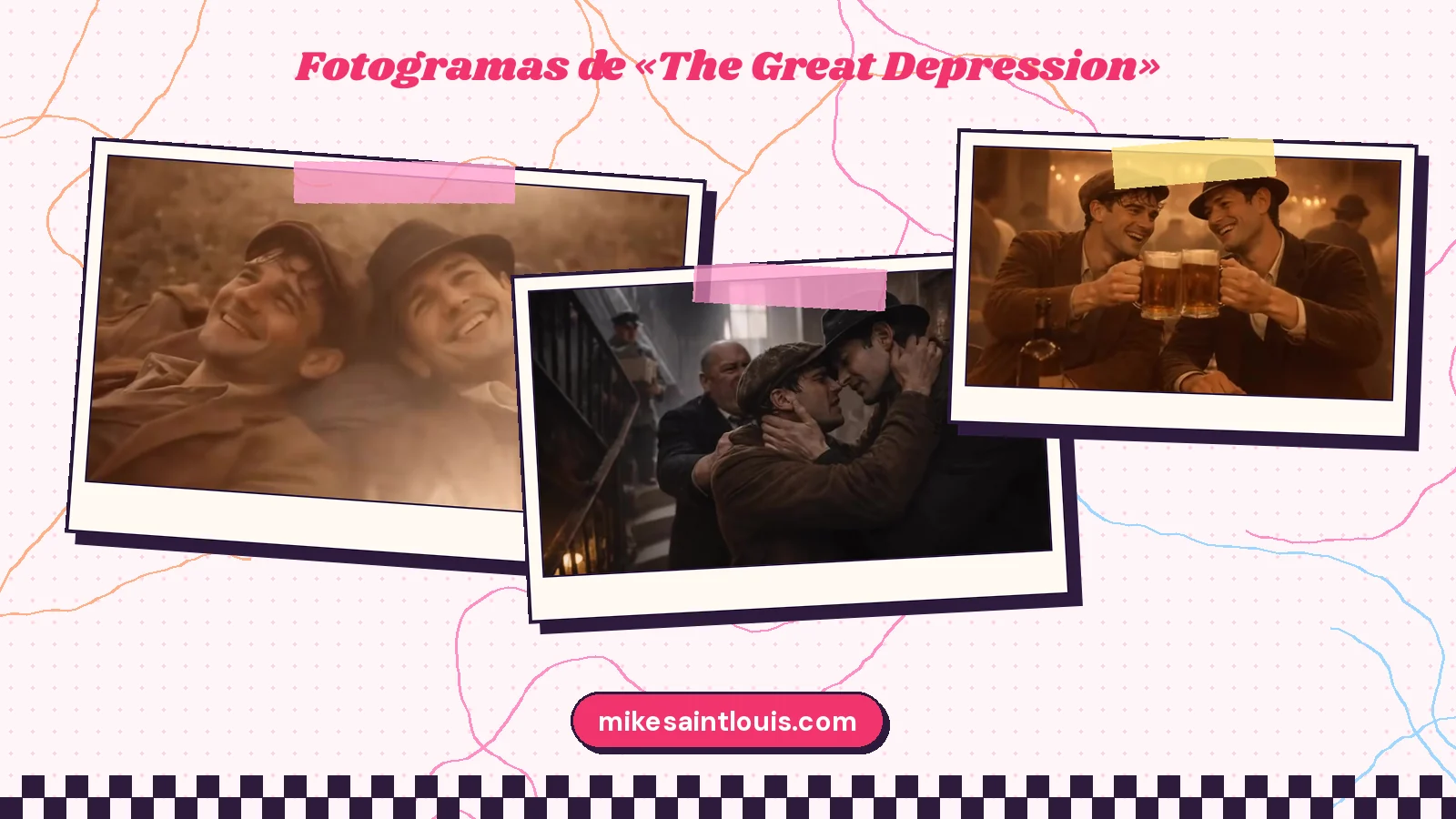
They rented Tuesday nights above a bar. A narrow room. A borrowed jar. His tie hanging, nice and straight, from a hook in the kitchen.
Notice the Tuesdays. They don't live together. It isn't their home. It's one day a week, a room by the hour, like booking a padel court. That's what love between men was like for a lot of people back then, and at many other times, here too. A slice of the week stolen. A place that isn't yours. A timetable.
And the tie is one of the loveliest things I've written, even if it's in English and even if it's only an object. A tie hung up carefully says someone is going to put it back on. That he's going to walk out of there with his usual face, to the office, the bank, the house where perhaps a wife is waiting. The tie is the disguise. And it's hanging in the kitchen, in full view, the only time he doesn't need to wear it.
A jar of sugar, of hope, of please don't look. I wrote that list thinking of the things you borrow on a landing. Sugar, yes. Hope, too. And don't look, which was what people asked for most.
Mrs Crowley at the banister
And then she appears. Mrs Crowley, always at the banister.
Every hidden love story needs a neighbour. I should know: I have a whole song about the nosy neighbour. But here the neighbour isn't funny. Here the neighbour is danger.
Mrs Crowley sees the other man leave too late. And sees my face go pale. That's all the lyric says. I don't say what happens next. No need.
In 1929, being seen leaving a room with another man at an odd hour could cost you your job, your family or your freedom. In the United States, in Spain and almost anywhere. Here we had the Vagrancy Law, and later the Social Danger Law, and plenty of people ended up with their name in a file for much less than a tie in a kitchen. I don't put that in the song because the song is set in another country. But I had it in my head the whole time.
What strikes me most about those neighbours, the real ones, is that often they didn't report anyone. They just watched. And that was enough to make you live in fear. A look from the banister was a threat without words.
What the books don't write
The final verse is the reason I wrote the song. The rest is the road to get there.
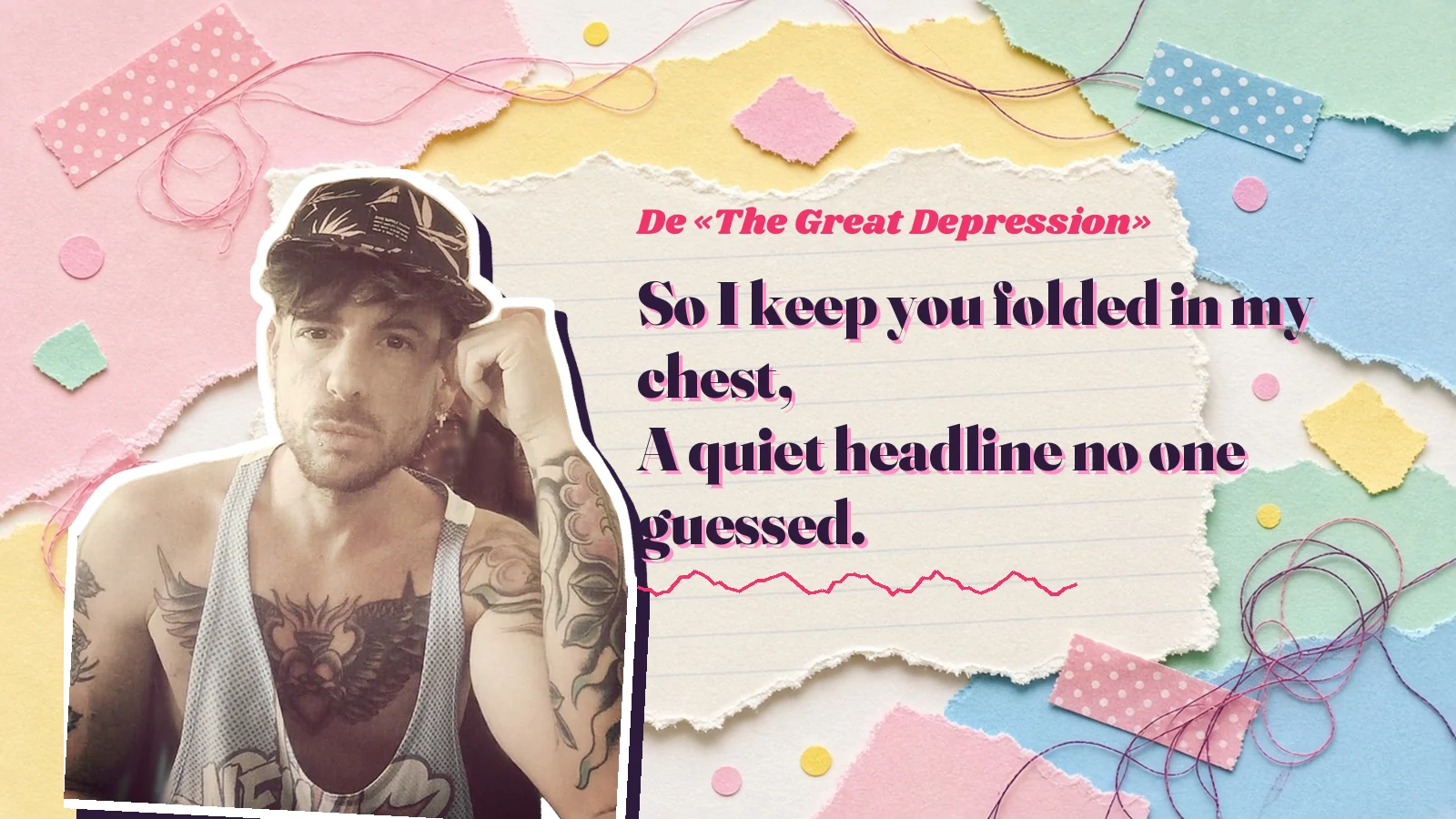
«They won’t write how you fixed my cuff, / How “friend” was never word enough.»
They'll write about banks and bread, men who jumped, unpaid debts. They won't write how you fixed my cuff. Or that "friend" was never word enough.
That's everything. Official history, the textbook kind, remembers the figures. Unemployment, suicides, failed banks. And it's right to. But there's another history, made of tiny gestures, that nobody recorded because nobody could. If you wrote it down, it was evidence.
The shirt cuff is that. Proof of love that leaves no trace. Nobody gets taken to court over a neatly folded cuff.
And the "friend" business is very close to home, even if I don't live in 1929. How many male couples introduced themselves as friends for decades. At family lunch, at the office dinner, at the hospital when one of them was dying and the other wasn't let in because he wasn't family. Friend. A word that fell short, like a shirtsleeve from the wrong size.
The grammar of "they won't write"
Let me share a trick of the trade, since this song asks for it.
The last verse is built on a repeated negation: they'll write, they won't write, they won't print. It's an anaphora, the kind I love, but turned the other way from how I usually use them.
Almost every time I repeat something at the start of each line, it's to pile things up. To make a list of grievances, objects, memories. Here the repetition subtracts. Each line says what's missing. What won't be there. It's a list of gaps.
And a list of gaps is the closest thing I know to the memory of people like me before we could tell our own stories. We don't have the photo album. We have the list of what was never photographed.
I realised this, as usual, after writing it. I was rereading the verse and thought: how odd, there's nothing here, it's all absences. And then I thought: of course, that's what it's about.
There's something else I like about that construction. Who the "they" is. Them. The ones who write history. It doesn't say who they are, and it doesn't need to. The usual lot. The ones who decide what goes in the book and what stays out, which figure is important and which detail is of no interest. The verse is aimed at them, without shouting. In a well-ironed shirt.
If the song has any protest in it, it's there. In that "they". Not on a placard, but in a pronoun.
Gestures that pass for kindness
One last thing about gestures, because they obsess me.
In every era, hidden love between two men has had to live on gestures that could be mistaken for something else. Straightening a colleague's collar. Picking a bit of fluff off his jacket. A pat on the back that lasts a second longer than usual. Gestures anyone might make, which is why nobody could point at them.
The shirt cuff is one of those. If Mrs Crowley saw it from the banister, she couldn't say a thing. One man helping another with his clothes. How kind.
And that, for me, is the saddest and loveliest thing about the song at once. That love had to disguise itself as kindness.
Loving wasn't the illegal part
There's a line in that verse I struggled most to leave as it is. It says, more or less, that the love was there and then became illegal need.
I wrote it that bluntly because that's what happened. Nobody arrested you for loving. They arrested you for what you did with that love. And so love, which in itself was no crime at all, became something to be hidden like contraband.
It seems to me one of the cruellest things the law has done to people like me. Turning the most beautiful thing you have into evidence against you.
And I say it without a joke, because there's no joke here.
Folded in my chest
Next comes an image I love for its smallness.
«So I keep you folded in my chest, / A quiet headline no one guessed.»
It's the counterpoint to the screaming headlines of the first verse. There, the press shrieked the country's disaster. Here, the headline is mine, folded in four like a newspaper clipping, kept in the inside pocket of a jacket, and nobody will ever read it.
You know headlines obsess me. Even the first album of the trilogy has a news-headline title. But in this song the headline is the opposite of news. It's what never gets published. The exclusive you take to your grave.
Some people have lived like that all their lives. With a headline folded in their chest. And sometimes, when they die, someone finds a letter in a drawer and suddenly understands forty years of Sunday lunches.
Taken, not betrayed
The chorus has a line that's almost a thesis: I learn what love is worth when it's taken from you, not when you're betrayed.
In almost all my songs, love ends in betrayal. The narcissist who lies, the ex who leaves for someone else, the boyfriend who punishes you with silence. It's my territory, I know. I've been writing about it for years and I laugh at myself for it.
Not in this one. Here nobody betrays anybody. They love each other. What happens is that someone outside, Mrs Crowley, the landlord, the era, the law, sweeps the love away. It doesn't break: it's taken.
And that difference is huge. When you're betrayed, you can be angry with someone. You can write them a song full of insults, which is what I do. When it's taken, there's nobody to insult. Only the sorrow is left. That's why the song hasn't a single insult in it. There was no one to address it to.
Unshed tears
Another line from the chorus: where we drown in unshed tears.
Unshed tears. I love how that sounds in English; it's one of those expressions that come out heavier in Spanish. The tears you don't cry because you can't cry in front of anyone. Because if you cry at the office over a friend, they'll ask which friend. Because if you cry at home, your wife will ask what's wrong.
People who've lived in the closet know those tears very well. It isn't that they don't cry. They cry inwards, and that chokes you more than crying outwards.
In «Llorar» I wrote from the other side, from the permission to cry like there's no tomorrow, in front of everyone. This song is what happens when that permission doesn't exist.
Between some spunk and an onion
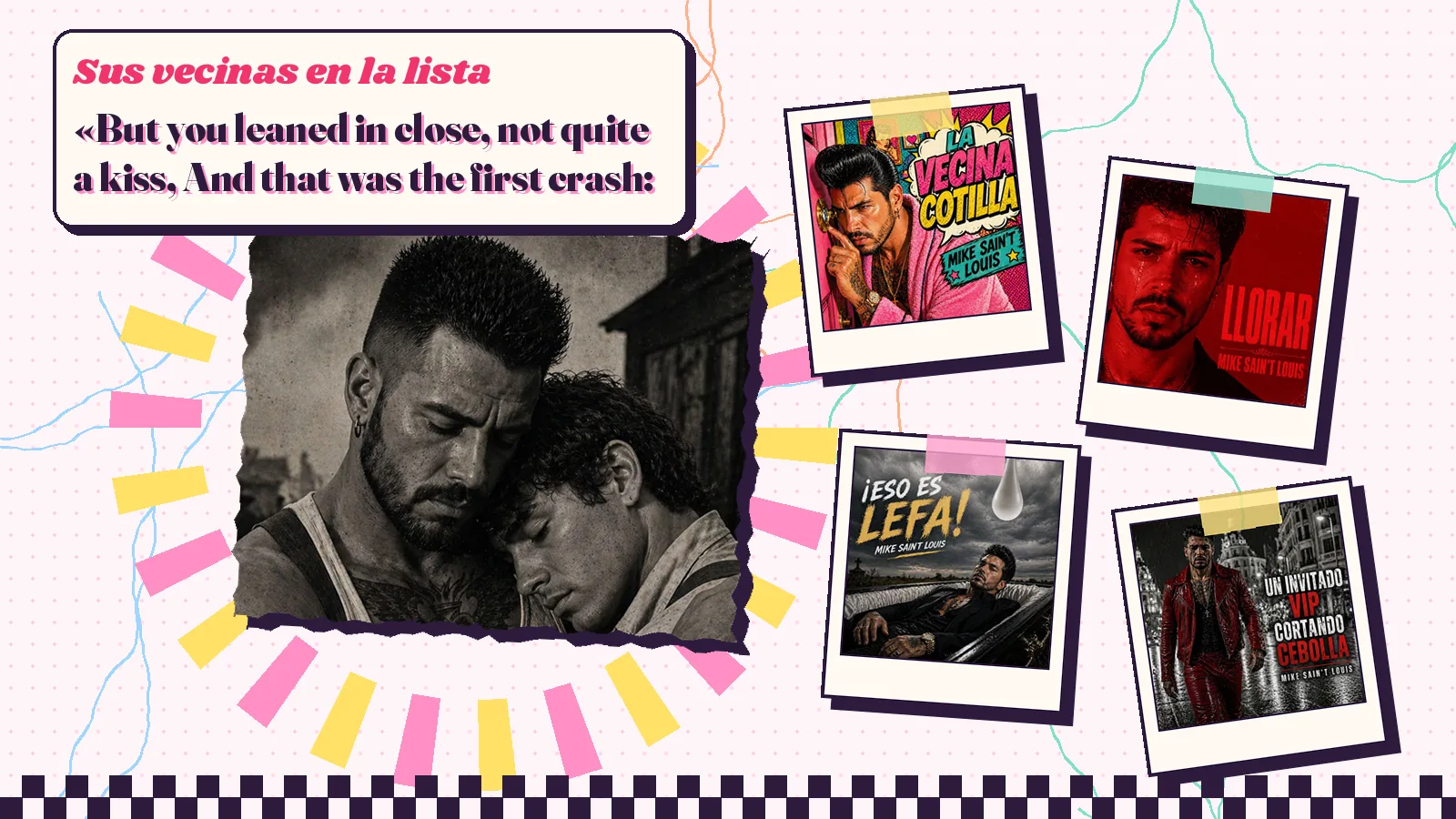
I find it very funny, and very me, where this song ended up in the site's discography. Just before it is «¡Eso es lefa!», roughly "That's spunk!", a fake requiem blown apart by a nosy neighbour. Just after, «Un invitado VIP cortando cebolla», a VIP guest chopping onions, about going back to hell after four years in heaven.
And in between, a clandestine love from 1929, in English, without a single joke. Listen to the three in a row and you go from messing about to tragedy and from tragedy to onions. That's my head. That's the trilogy. You don't get one without the other.
A liberation album
The song is on «El día de la liberación», the third album of the trilogy. And it makes perfect sense, though it may seem the opposite, because it's a song about not being free.
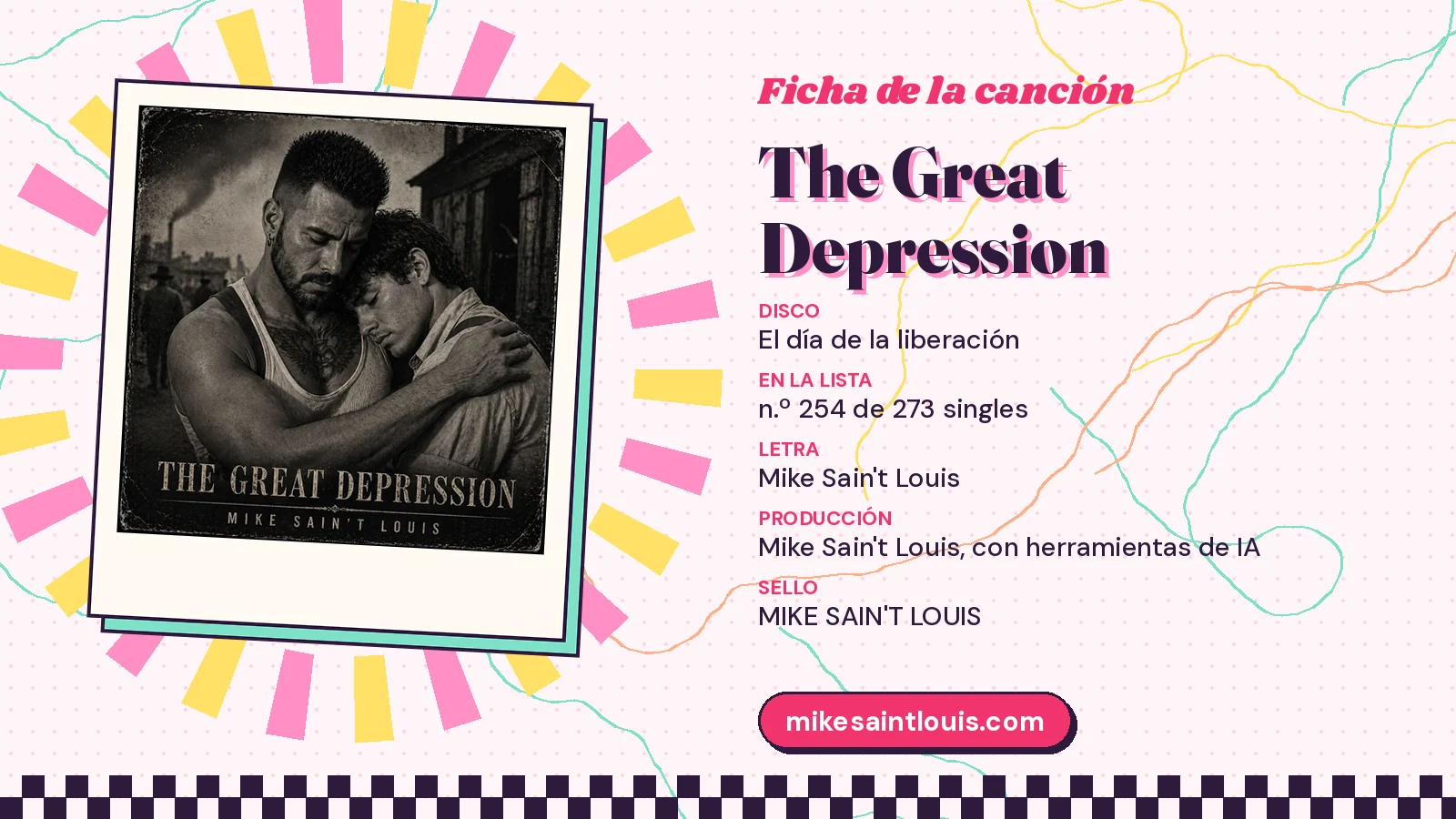
To understand a liberation you have to remember what came before. Otherwise the word means nothing. This song is that: a reminder, in the middle of the most festive album, that some people never got out. That they stayed in the Tuesday room. That they died with the headline folded in their chest.
I wrote about what comes after in Liberation day and the day after. This song is the day before. Many days before, really.
I'm not a historian
I'll say it to avoid misunderstandings. I'm not a historian and the song isn't a documentary. There's no real couple behind it, as far as I know. Mrs Crowley is invented. The bar, the tie and the sugar jar are invented. It's fiction, like a painting or a novel.
What isn't fiction is the background. That there were many couples like that. That nobody recorded them. That the law hounded them. That is in the books, though not in the textbooks I studied at school.
Writing fiction about it is my way of recording them. Since nobody recorded their names, at least someone can record their gestures. The shirt cuff. The tie in the kitchen. The Tuesdays.
Songs are an archive too; I talked about it in Songs as a community's diary. An odd archive, with no index cards or dates, made of images that stick to you.
The lyrics mine, the sound the machine's
I'll make it clear, as in every piece: I wrote the lyrics of «The Great Depression» myself, in English, without artificial intelligence. With my dictionaries and my doubts. The music and vocals are made with AI tools, Suno among them. I'm the lyricist, composer and producer. None of the people you hear on the recording is me.
The machine can dress a lyric in period costume, shop-window radio jazz and all if needed. But the machine didn't put in the shirt cuff. Or the tie. Or Mrs Crowley. I put those things in, after thinking long and hard about which gesture could tell of a love without anyone noticing.
That's my part. The details nobody recorded.
Listen with your coat on
An October afternoon, if possible. Coat still on, just home, before switching on the light. Or in one of those Madrid bars that still have the wooden counter and the mirrors with old adverts, a vermouth in front of you and your phone away.
And when the last verse comes, think of someone in your family who never married. Who lived with a friend. Who'd had a flatmate for thirty years. Who went very serious whenever the subject came up.
Maybe he had a headline folded in his chest.
Maybe someone fixed his cuff.
The song's page has the full lyrics and the link to listen. The rest of my lyrics are in Lyrics.
Frequently asked questions
What is Mike Sain't Louis's «The Great Depression» about? It's a story of clandestine love between two men during the Great Depression of 1929. It plays on the title's double meaning: the economic crisis and the sadness of losing someone because the era won't let you love them.
Why is it in English? Because it's set in the United States in 1929 and because, according to Mike, writing in English forced him to leave out the bar-room humour he uses in Spanish and tell the story without jokes.
Is it a true story? No. The characters, such as the neighbour Mrs Crowley, are fiction. What's real is the context: many male couples of that era lived in hiding, hounded by the law.
Which album is it on? «El día de la liberación», the third album of the Planeta Gayfolk trilogy.
Who provides the vocals? The vocals and music are made with artificial intelligence tools such as Suno. Mike Sain't Louis writes the lyrics without AI and is the composer and producer.