
By Mike Sain't Louis ·
The fake requiem: how I built the twist in «¡Eso es lefa!»
A white drop hanging from the edge of the cover. That's where it all begins, and hardly anyone spots it the first time.
People look at the coffin, the stormy sky, the dead man with his rings, and think: how sad, another mourning song. Perfect. That's exactly what I wanted them to think. «¡Eso es lefa!» is a trap tied with a black ribbon, and like any decent trap it needs the victim to walk in calm, hanky in hand, ready to weep. Walk in with one eyebrow raised and the joke's over.
I'm Mike Sain't Louis, a lyricist, composer and producer from Madrid, and the song's page on this blog already tells you what it's about. Here I want to tell you something else: how it's built on the inside. Which piece goes first, which one lies in wait, and why the nosy neighbour from the fifth floor, who looked like filler, ends up as the star. It's joke carpentry. And carpentry, when the furniture is a coffin, has a certain something.
Two friends, at a push
The lyric opens with a line any sad bar poet on Calle Huertas could sign at three in the morning: nobody will talk about me when I'm dead. Not a wink. Not one silly rhyme. A dry line, the kind you think staring at the ceiling with your phone charging on the bedside table.
Then comes the headcount. I wrote: «Two friends, at a push, blood family, my mother, my father». No crowds at the door of the funeral home off the M-30, no wreaths from the Friends of Nobody Society. A short list, the kind you get when you do the real count and not the Instagram one.
The list has a catch. At the end, two more characters slip in, my last partner, the big softie, and a nosy neighbour, and the second one seems to be there just to make the metre work. Nobody notices him. Mistake. That neighbour is a bullet in the chamber, and in this song the bullets get fired.
It tickles me how little it takes for someone to swallow a list like that. It just has to be small. If I'd written that thousands would mourn my passing, anyone would have smelt the wind-up from Getafe. But two friends at a push is so humble, so homespun, that the listener does their own count and comes out with roughly the same. They're in. Their guard is down.
The wake on a loop
The opening line repeats. And repeats. And repeats again. More times than any producer in a hurry to reach the chorus would put up with.
Repetition is a gamble. It can bore, and boring is the one sin a three-minute song can't be forgiven. But here repetition does something else: it turns the line into atmosphere. By the fifth time round you're no longer hearing information; you're at a wake. It smells of gladioli and vending-machine coffee. The lady in the third row has already slipped her shoes off.
That trance is the fuel for the blow. The longer the solemn drone lasts, the more violent the awakening. I learnt it by writing hundreds of lyrics for Planeta Gayfolk: patience is a kind of humour too. A quick joke has its charm, the charm of a flick round the ear. A joke that makes you wait has another, bigger one: the slow-motion slap in an afternoon telenovela.
And yes, I'll own the vice, because it's right there in the lyric: I stretch the joke until the listener begs. Some would call it being a pain. I call it structure.
I'd bet my neck
Every song with a twist has a hinge, the exact line where the door starts swinging the other way. Here it's this one: «And I'd bet my neck and not lose it».
Look at what changes. Up to that point I was talking, about me, my funeral, my miserable list. Suddenly a «you» appears, with a name and surname I don't give, and it arrives with a bar-stool bet. That betting tone belongs to a terrace on Plaza del Dos de Mayo, to the brother-in-law who knows it all. The floor shifts. The listener doesn't know which way yet, but they can feel the coffin creak.
What follows is the accusation: that this «you», instead of preparing a speech to see me off, would be out cruising in the bushes. No more requiem. There's a man with his fly half done up among the cemetery hedges, an image anyone who has set foot in the Casa de Campo at night finds more familiar than they admit at Christmas dinner.
That change of register was the hardest thing to place. If the bet comes too early, the wake hasn't set. If it comes too late, the listener has gone off for a coffee. It has to drop just as the drone starts to weigh.
Four adjectives and a crack
And then comes the image that gives the whole thing its name. Instead of tears from his eyes, which are «fake eyes» to boot, something else falls from this character. I wrote it like this: «may a white tear come out of you, thick, heavy, swollen». From the crack at the back. Right on top of my coffin.
Four adjectives in a row, each more uncomfortable than the last. They aren't decoration. They close the net. With «white» you can still think of something poetic. With «thick» you start to suspect. With «heavy» you know. With «swollen» you're laughing before anyone has said a word.
That head start is the key to the joke. The audience gets it two seconds before the shout, and in those two seconds they think «no way, he wouldn't dare». I would. In this song I always dare.
And I laugh at myself for having written it with a goldsmith's care. Some people polish sonnets by candlelight. I polish the order of four adjectives describing a drop of semen falling onto a coffin. We each have our calling.
The neighbour collects
Remember the nosy neighbour on the list? By the final shout he's turned into a she, and she's the one who sees everything. People stare, stunned, nobody knows what to say, and she, who hasn't missed a funeral in the barrio since the Transition, says it out loud.
It's the seed bearing fruit. In comedy writing they talk about planting something early to pay it off at the end, and here the busybody was parked in the list, in her quilted housecoat, waiting her turn. When she shouts it, the joke doesn't come out of nowhere: it comes from the first verse. That's what makes the laugh feel earned, not cheap.
Nosy neighbours are my weakness. They're the Greek chorus of Spanish life, the ones who know who comes in, who goes out and at what time. I gave them a whole song, and I also wrote about them in «La vecina cotilla, el personaje que todos tenemos en el rellano». In «¡Eso es lefa!» the neighbour doesn't gossip out of spite. She gossips as a public service.
Somebody had to say it.
From requiem to street party
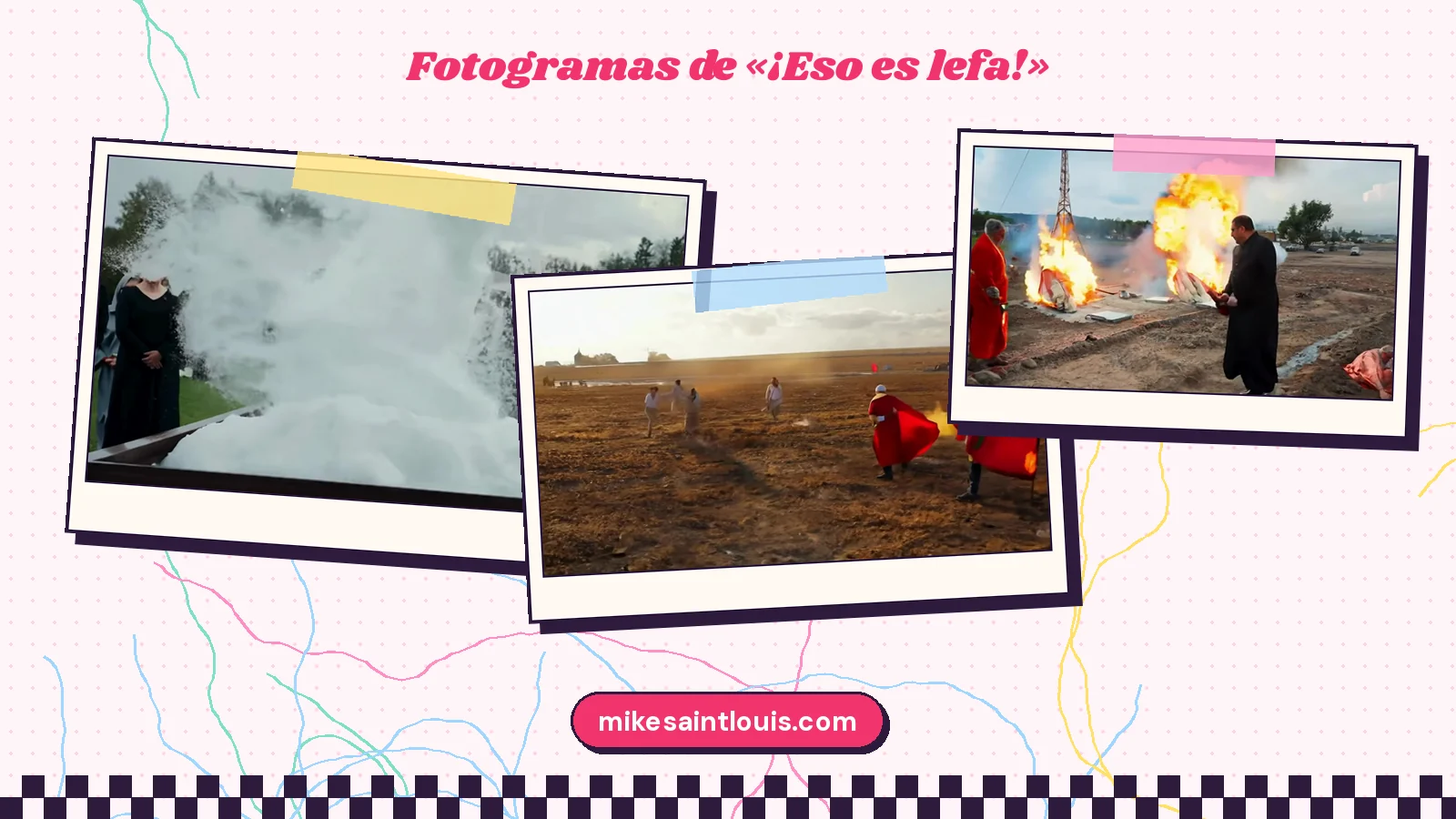
After the shout, the song never goes back into mourning. The title repeats like the chorus of a village brass band at four in the morning, when nobody remembers why the party started. The wake has become the San Isidro fiestas with a coffin in the middle.
That hangover was necessary. If after the blow it went back to the solemn line as if nothing had happened, the joke would limp, a stray prank in the middle of something serious. By turning everything into a knees-up, the song confesses what it was all along: one very long joke in a borrowed mourning suit.
That brass band has a touch of poetic justice too. The «you» in the song wanted to go unnoticed in the bushes, do his business and slip back into line with a widower's face. What he gets instead is his drop turned into the chorus of the whole neighbourhood, repeated until even the priest is humming it. Few social sentences are as effective as a neighbour's shout turned into a chorus. Not even Sálvame, Spain's gossip TV juggernaut, in its glory days had that kind of reach.
And the rhythm changes with it. What was a slow procession, a Holy Week float, becomes something you can dance to with a plastic pint of calimocho in your hand. Mourning takes off its mantilla.
What I love about that ending is that the dead man, me, loses the spotlight at his own funeral. Nobody talks about me, sure enough. Everybody talks about the drop. The first line was right, just not the way you expected.
The word in the title
I could have picked another one. «Semen» sounds like a pharmacy leaflet, like a GP's surgery in Tetuán with the nurse watching the clock. «Leche», milk, invites confusion with Cola Cao. «Esperma» has something of a nature documentary on La 2 at siesta time. «Lefa», on the other hand, is playground and Grindr chat; it's the word a real neighbour would use if she saw what this neighbour sees. Think «spunk», said at full volume across a landing.
A neighbour from Lavapiés doesn't scream «that's seminal fluid!». She screams whatever comes from the soul, and the soul of the barrio speaks pure Madrid. The title had to be the shout, with no translation and no anaesthetic, because the shout is the joke. Soften it and the scene loses its accent, and without the accent the neighbour turns into a newsreader.
I know the title scares some people off before they press play. Fine by me. It's a door policy, like the bouncer at a club in Chueca: anyone scandalised at the door wasn't going to enjoy it inside. And anyone laughing at the door already knows whose house this is.
A one-line chorus
In the end, the whole song rests on two lines taking turns: the solemn one at the start and the shout at the end. There's no chorus beyond that tug of war. It's almost a couplet, a two-line joke stretched to fill a song.
I like writing this way because it forces every line to carry all the weight. If the solemn line isn't sad enough, the shout isn't funny. If the shout isn't filthy enough, the solemn line doesn't break. I wrote about that balance, choruses that laugh at the listener and with the listener, in «Cómo se escribe un estribillo que se ríe de ti y contigo», and this song is the dirtiest example I have of the idea.
The final repetition of the shout also does something I adore: it wipes the solemn line from memory. Nobody walks away humming «nobody will talk about me». Everybody walks away with the shout. The neighbour won.
What the machine supplies and what I do
I get asked every time, so let me be clear. The lyrics of «¡Eso es lefa!» are mine, word for word, with their order of adjectives and their neighbour in the chamber. The music and vocals come from artificial intelligence tools such as Suno, which I use to produce and arrange. I decide what stays and what goes, how long the wake lasts, when the shout comes in.
A machine doesn't know that at a barrio funeral it's always the neighbour who shouts. Nor does it know that four adjectives work better than three in a filthy joke, or that the silence after «I'd bet my neck» has to last just long enough. I go into it more calmly in «Qué es mío en una canción hecha con IA».
In the label I give myself, «el primer cantautor IA», there's plenty of mischief and a grain of truth. The truth is this: the words are in charge. I wrote it down on my about page, among the house rules. Technology changes every month. The nosy neighbour is eternal.
A coffin under the storm
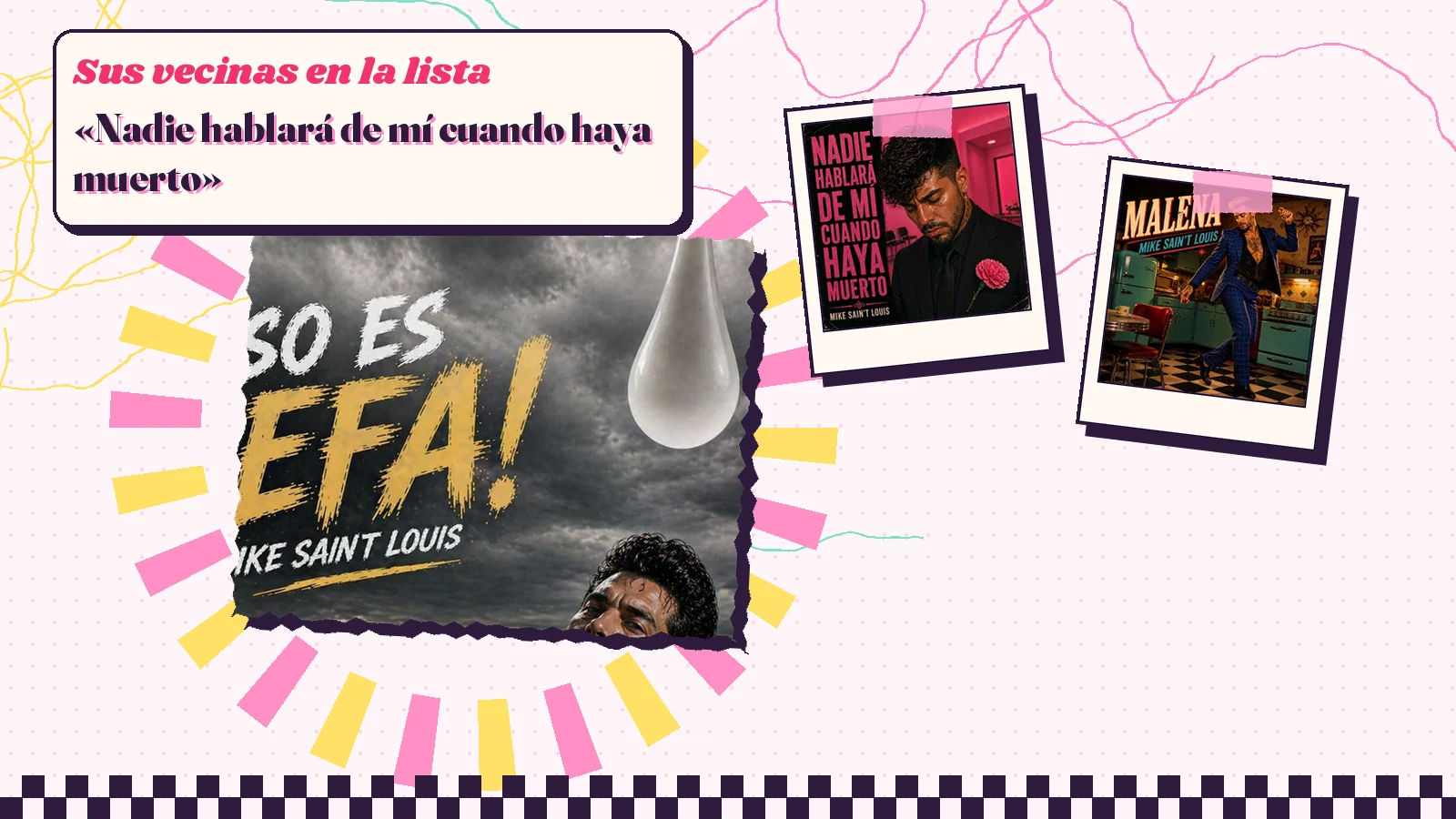
I designed the cover to do the same as the lyric: promise solemnity and hide the joke in plain sight. A grey, heavy sky, a cemetery cross cut out against the background and, in the foreground, a man in black lying in an open coffin lined with white satin, eyes half closed, rings on his fingers and a gold watch on his wrist. Mourning straight out of a funeral parlour catalogue with ideas above its station.
And at the top, hanging from the edge, the drop. Big, catching the light, about to fall. Anyone who doesn't know the song takes it for rain or a tear. Anyone who has heard it can never look at it the same way again. That drop is the nosy neighbour of the image: the detail that looks like set dressing and turns out to be the punchline. The title is in yellow, in a brushstroke, shouting the same thing she shouts.
I like that it works in two beats. First you see a funeral. Then you see the joke. The covers of every single are on the singles page, and if you look closely, many of them play the same trick of hiding the important bit in a corner.
Between «Tangled Light» and «The Great Depression»
In the Planeta Gayfolk catalogue, «¡Eso es lefa!» is track 253 of 273. Right before it comes «Tangled Light». Right after, «The Great Depression». Two English titles with the air of an indie festival in Malasaña, and in between, the most shamelessly Madrid prank I've got.
That sandwich strikes me as a fairly faithful portrait of the project. There's no single string and no single language. It leaps from melancholy in English to a courtyard shout without asking permission. Anyone who plays the catalogue straight through won't get used to anything, and that's the idea.
If someone reaches this song after «Tangled Light», in a mood of soft light and pretty thoughts, they get the fright of their life. I love picturing it. A lady on the number 27 bus, headphones on, going from tangled light to coffin-with-a-drop with no time to react.
The first album, the one with the fright

The song belongs to *Descubierto un nuevo planeta llamado GAYFOLK*, the first album in the GAYFOLK trilogy. It's the album of arriving somewhere new and naming everything for the first time, scandals included. A planet where not even death escapes the piss-take is a good place to start.
The three albums are designed as a single journey, and if you want to hear them in order I left you a guide to listening to the trilogy from start to finish. «¡Eso es lefa!» falls in that first stretch when you're still unpacking your suitcase and you've already been introduced to the neighbour.
Other funerals and other graves live on that same album, because death gives me plenty to play with. Spitting on graves, neon coffins, houses full of corpses. Horror and mourning, applied to love and grudges, are among my favourite tools. I explain it better in «El camp no es un chiste aunque te rías»: exaggerating solemnity is a way of telling the truth without getting grand about it.
The other «Nadie hablará de mí»
The opening line isn't a one-off. It haunts me, and it has its own song, «Nadie hablará de mí cuando haya muerto», on the same first album. There the line does a different job, with its priest, its sitcom and its enemies jumping on the grave.
In «¡Eso es lefa!» I use it as bait. Same line, different rod. I like one idea living in two songs with two different fates, like those cousins who share a name because both are named after grandma, and nobody mixes them up because one's from Móstoles and the other from Alcorcón.
Anyone who plays them back to back will notice the family resemblance. And maybe also what it says about me that the same line serves for a bitter reflection and for a semen joke over a coffin. What it says is simple: in my lyrics, tears and jokes share a flat, and neither of them pays the rent on time.
How to listen with bad intentions
I suggest two listens, no more; it's not a school subject.
The first, blind. Put it on without looking at the title, if you can forget it, and let the wake catch you. Notice the exact moment something shifts. For me it's the neck bet, but you can feel it earlier, with the «fake eyes».
The second, with the lyrics in front of you, open on its lyrics page. That's where you see the carpentry: the list that plants the neighbour, the repetitions that lull you, the four adjectives closing in. It's like watching a magic trick in slow motion, except the rabbit is something else. For more than one lyric, they're all in the site's lyrics archive.
And if it scandalises you, chalk it up as a success. Mine.
What I don't want lost in the laughter
Under the joke there's something serious, and I'll say it once, with no calendar moral: the list of who would turn up at a funeral is real for a lot of people. Two friends, at most. Blood family. And someone who faked grief while thinking about his own business.
The song laughs at that hypocrisy with the filthiest image I could find, because hypocrisy is filthy too, it just dresses better. Whoever fakes mourning, whoever cries with «fake eyes», deserves to have the neighbour point them out in public. That final shout is a small revenge, barrio-style, no lawyers.
Written like this, the short list is funny. Read slowly, at three in the morning, not so much.
The song is there for that second reading too.
Frequently asked questions
What is Mike Sain't Louis's «¡Eso es lefa!» about? It starts as a requiem, with «Nobody will talk about me when I'm dead» and a very short list of who would come to the funeral. Then a «you» appears who would be out cruising in the bushes and who, instead of crying, lets a white drop fall onto the coffin. The nosy neighbour shouts it out. Black humour against fake grief.
Which album is «¡Eso es lefa!» on? Descubierto un nuevo planeta llamado GAYFOLK, the first album in the GAYFOLK trilogy. In Planeta Gayfolk's catalogue of 273 singles it's track 253.
Who wrote the lyrics of «¡Eso es lefa!»? The lyrics are by Mike Sain't Louis, a lyricist, composer and producer from Madrid. The music and vocals are made with artificial intelligence tools such as Suno, under his direction.
Is it related to «Nadie hablará de mí cuando haya muerto»? They share a line. In «Nadie hablará de mí cuando haya muerto» the idea is developed with bitter humour; in «¡Eso es lefa!» it's the bait for the final twist. Both are on the first album of the trilogy.