By Mike Sain't Louis ·
The rainbow isn't for rent: Pride, pinkwashing and «Madrid to Benidorm»
«This is what pride is all about.»
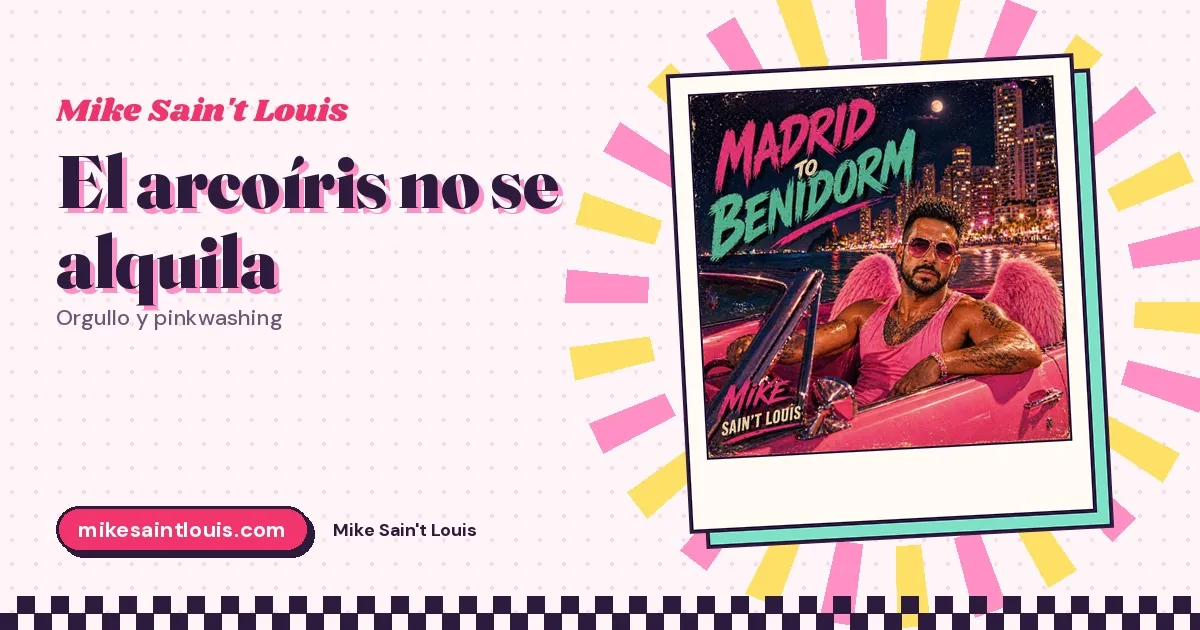
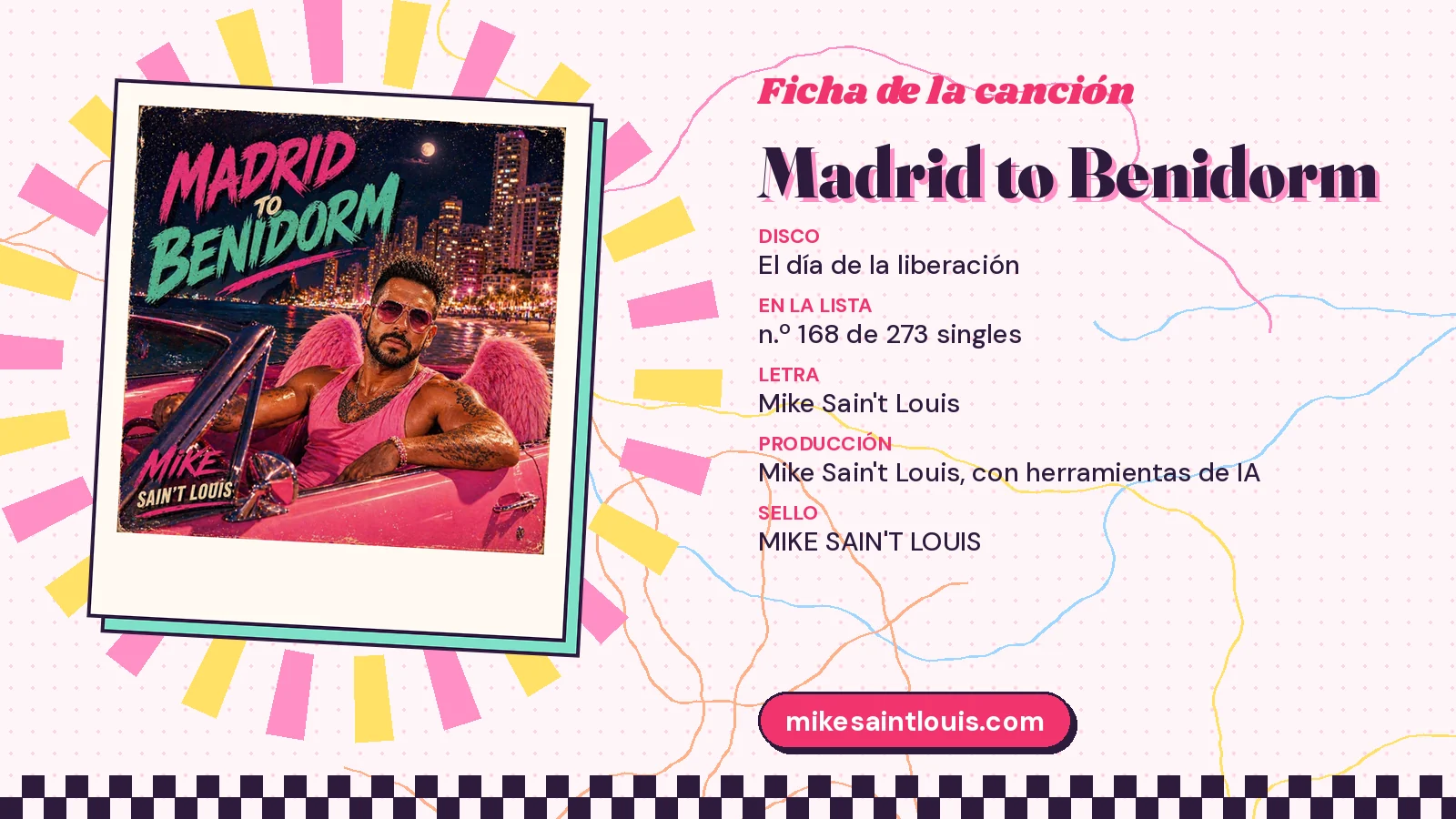
That's what Pride is about, says one of the lines of «Madrid to Benidorm». The song is on «El día de la liberación», the album that closes the GAYFOLK trilogy, and it's one of the few I wrote entirely in English. (If you want to follow it, here's the lyric.) It's a song of streets and sunshine, of dancing under the rainbow from the capital to the coast, of holding hands and erasing fears with colour.
I wrote it with joy and I don't regret a single line. But every June, when I see shop windows filling up with flags, I ask myself an uncomfortable question that I want to put down here in writing: who does the rainbow belong to? To those who raised it when it cost them beatings, or to those who print it on a soft-drink can for four weeks? This piece is about that: Pride as protest, Pride as business, pinkwashing and what we can ask for.
A June night in New York
Everybody repeats that the first Pride was a riot, and it's true. In the early hours of 28 June 1969 the police raided the Stonewall Inn, a bar in New York's Greenwich Village. Raids on gay bars were routine. That night, the people inside and outside decided not to go quietly. There were clashes over several nights.
The following year, in 1970, marches were called to remember it. That's where the 28 June date comes from, and where the oft-repeated idea comes from that Pride was born as a protest and not as a party. It's worth not forgetting when we look at today's floats. Before there was music there were people risking their jobs, their families and their freedom.
1977, 1978 and the Dangerousness Law
In Spain the story starts late and starts in fear. The first demonstration for gay and lesbian rights was held in Barcelona in June 1977, called by the Front d'Alliberament Gai de Catalunya. The following year, in 1978, the first one took place in Madrid.
To understand what that meant you have to remember the context. The 1970 Law on Social Dangerousness and Rehabilitation, heir to the Vagrants and Thugs Law, was still in force, and it allowed homosexual people to be locked up in special centres. Homosexual acts weren't removed from that law until the reform at the end of the seventies. Whoever took to the street in those first marches did so knowing there could be very real consequences.
That's why the word «Orgullo», Pride, moves me so much. It isn't a decorative word. It's the answer to decades of shame imposed by law.
Every color, every hue
One of the lines of my song says «Every color, every hue». The rainbow flag was designed by the artist Gilbert Baker for San Francisco Pride in 1978. Over the years its stripes have changed, and triangles and colours have been added to include trans people, people of colour and other realities who felt left out of the picture.
I like to think of the flag as a living object, sewn and unpicked. That's exactly why it's so easy to copy. A rainbow has no copyright. Anyone can put it on a logo, a T-shirt, a coffee cup. And that's where the problem I want to talk about begins.
When the rainbow is sold by the metre
According to the history told by Madrid's own Orgullo Crítico, the first floats probably arrived at the end of the nineties; before that, the 28J march was just that, a march. Over the years Madrid Pride became one of the biggest in Europe. In 2017 the city hosted WorldPride. Today the official programme, MADO, is organised by the business association AEGAL in collaboration with COGAM and FELGTBI+, and in 2025 the City Council announced a contribution of 500,000 euros as main institutional sponsor.
None of that is bad in itself. A city filling with visitors who come to celebrate diversity is good news, and free, open concerts are too. But there's an obvious tension between Pride as a political demonstration and Pride as a tourist event. Demanding rights is one thing and selling beer is another. Sometimes the two live together well. Other times the second swallows the first.
From Chueca to the coast
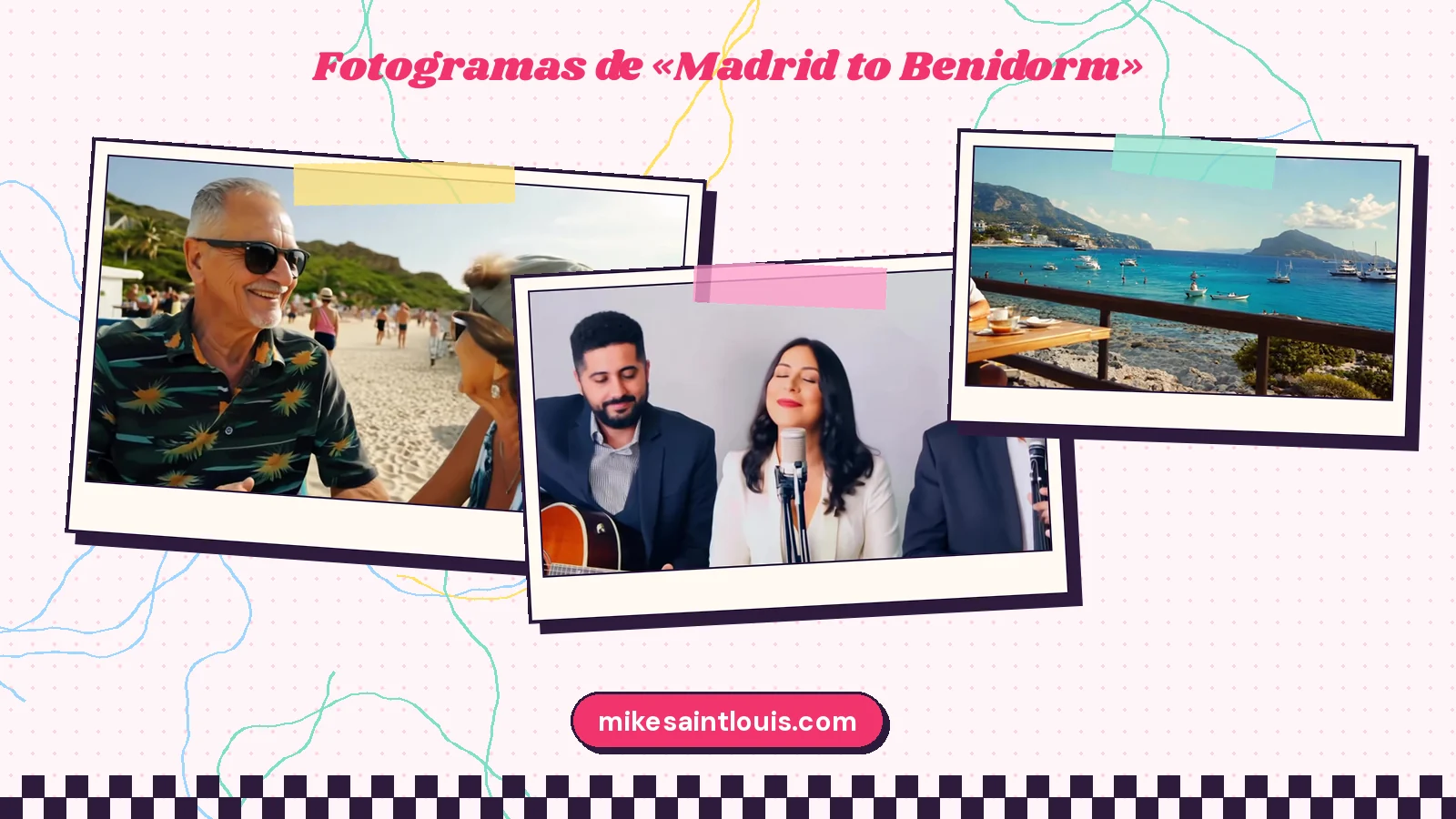
The song goes from Madrid to Benidorm, from the capital to the beach. It's a route thousands of LGTBI people take every summer, and it has something of a sentimental geography: the neighbourhood where you could finally kiss someone in the street, the coast where you could finally go on holiday without pretending.
That geography has an economic side too. Ley 4/2023 includes an article, number 42, asking public administrations to promote diverse and inclusive tourism and to encourage tourism aimed at LGTBI people, with special emphasis on rural areas. It's good that it exists. Being able to travel, stay and eat anywhere without being stared at is a right for an LGTBI person, not a whim.
But tourism also transforms neighbourhoods. Orgullo Crítico has spent years writing about the gentrification of Chueca: the neighbourhood that was a refuge when nobody wanted to rent to male couples has become one of the most expensive in Madrid, and many LGTBI people on ordinary wages can no longer live there. It's a painful paradox. The place we built to be safe ends up as a shop window for others.
I don't have a solution. I just want us, when we talk about rainbow tourism, to also talk about who keeps the profit and who has to move out to the outskirts.
The ones who went first
When Stonewall is told, two names almost always appear: Marsha P. Johnson and Sylvia Rivera, two trans activists of colour associated with those days and, above all, with the struggle that came after. In 1970 they founded STAR, a collective that gave shelter and support to young trans and homeless people in New York.
I think it matters to remember this, because the Pride sold in shop windows usually has another face: white, young, muscular, with money. The people who risked most in the first riots are often the ones who appear least in the adverts. And today they're still the most exposed. If a rainbow logo truly wants to honour that night, it should start with trans people, migrants, people without a home.
What pinkwashing is
The word «pinkwashing» has a curious origin. It was coined by the American organisation Breast Cancer Action to denounce companies that wore the pink breast cancer ribbon while selling products that could increase the risk of the disease. Its «Think Before You Pink» campaign began in 2002.
Over time the term was applied to the LGTBI world too. The writer Sarah Schulman popularised it in 2011 in an article in The New York Times, and the scholar Jasbir Puar developed it to talk about governments that use a gay-friendly image to cover up other policies. Today the word is used above all for companies and institutions that wrap themselves in the rainbow to polish their image without doing anything real for LGTBI people, or while doing exactly the opposite.
The key to pinkwashing isn't the colour. It's the hypocrisy. Not every rainbow logo is pinkwashing. It is when the flag is there to cover something up.
Four weeks of flag
There's an image that comes back every year on social media: a brand's profile picture turns rainbow on 1 June and goes back to its normal colour on 1 July. It looks like a joke, but it says a lot. The commitment lasts as long as the campaign.
What many LGTBI people ask, quite rightly, is what happens the other eleven months. Does that company have an LGTBI plan for its staff, as the law requires of companies with more than fifty people? Does it protect its trans workers? Does it sponsor Pride in Madrid while funding, in another country, those who want to jail us? Does it sell the rainbow T-shirt made in a workshop where nobody earns a decent wage?
I already wrote in «El orgullo de un martes de noviembre» that real pride is the kind that doesn't show up in June photos. Here I say it from the other side: a flag that only appears when it sells isn't a flag, it's wrapping paper.
When brands get off the bandwagon
In 2025 something happened that confirmed every suspicion. In the United States, the consultancy Gravity Research surveyed executives at large companies and concluded that two in five had cut back their Pride campaigns that year. 61% cited pressure from the new Donald Trump administration as the main reason. In Europe too, sponsorships were withdrawn or brands asked to support more discreetly.
In other words, the rainbow left as soon as it stopped being profitable or started being awkward. That doesn't mean every company was fake: some kept their support and their internal policies. But it does show that we can't entrust our rights to anyone's marketing department. What is sponsored can be unsponsored.
Orgullo Crítico
In Madrid, for years now, there has been another way of living Pride. In 2006 an alternative bloc emerged under the slogan «Orgullo es protesta», Pride is protest, questioning the commercialisation and depoliticisation of the official march. In 2010 the name Orgullo Crítico, Critical Pride, was used for the first time. Its marches are held on 28 June, the Stonewall date, and not on the MADO weekend.
You don't have to agree with everything Orgullo Crítico says to recognise that it asks a necessary question. When Pride becomes an event with stages, sponsors and sky-high hotel prices, who's left out? The trans person who can't afford a ticket? The kid from a village with nowhere to sleep in Madrid? Older people who don't see themselves in a party made for twenty-year-old bodies?
Love wins, come what may
In the song I wrote «Love wins, come what may». It's an optimistic phrase, a placard phrase, and I still like it. But I want to be honest: love doesn't win on its own. It wins when there are laws protecting it, when there are people who vote, who report, who organise, who keep associations going with small fees and volunteer work.
Equal marriage arrived in Spain with Ley 13/2005, after decades of activism. In 2025 MADO celebrated it under the banner of two decades of equal marriage. No brand gave us that anniversary. It was wrested by thousands of people who took to the streets when taking to the streets cost something.
Eleven months of invisible work
While the shop window changes colour, there are people working all year without a sponsor. Associations like COGAM, born in Madrid in 1986, or FELGTBI+, which brings together dozens of organisations from all over the country, keep up psychological support, legal advice, groups for young people, older people, families, migrants. Much of that work is done by volunteers in hours stolen from their own lives.
That work doesn't appear on any advertising banner. It has no float and no DJ. But it's what answers whoever calls on a Tuesday in November because they've been thrown out of home, because they've been beaten up or because they can't take any more. If a brand really wants to help, there's a very simple way: fund that work the other eleven months, without demanding its logo be shown big.
A flag on a balcony
Against a multinational's flag there's another that moves me far more: the one a mother hangs from a third-floor balcony in any old neighbourhood, or the one an older man puts in the window of his village house. That flag sells nothing. There's no communications plan or agency behind it. Sometimes it costs whoever hangs it a look in the lift or a comment at the bakery.
When a kid who hasn't said anything at home yet sees it, that little flag is worth more than a hundred adverts. It tells him there's someone on his side in that building. It tells him that if one day he needs a door to knock on, maybe that's the one.
That's why I don't like the idea that the rainbow is worn out. What's worn out is the rental rainbow. The one on balconies, on the wristbands someone wears to school, on the sticker on the door of a health centre or a library, is still a signal. And signals save more than we think.
The brands that do add up
I don't want to fall into purism. There are small companies, neighbourhood bars, bookshops, music venues and LGTBI-owned businesses that have supported the community quietly for years. There are big companies with serious internal policies. And there are countries where, as the journalist Enrique Anarte pointed out, it's precisely multinationals that keep Pride events going that otherwise couldn't be held.
A company's money in itself isn't the problem. The problem is when the money buys silence or when a brand's presence replaces the demands. A good test is simple: would that company be proud to show what it does for LGTBI people in November?
What you can ask for
If you're one of those who look at Pride with a mix of affection and suspicion, like me, there are concrete questions you can ask any brand, institution or venue that dresses up in the rainbow:
- Whether it has an LGTBI equality plan and an anti-harassment protocol, as Ley 4/2023 provides for companies with more than fifty people.
- Whether it donates part of what it earns to LGTBI organisations, and which ones.
- Whether it keeps that commitment in every country where it operates, including where being LGTBI is a crime.
- Whether it employs trans people and whether its toilets, uniforms and forms allow for that.
- Whether its support lasts all year or only one month.
None of those questions is aggressive. They're the same ones we'd ask anyone who says they love us.
A dance floor with a memory
In «Qué pide una pista de baile en el Orgullo» I wrote about the songs that work when the square is packed. I still think dancing matters. Dancing is political too: it means occupying a space that was forbidden to us for centuries.
But I'd like the dance floor to have a memory. For someone, between songs, to remember those who didn't live to see it, the people who died of AIDS when nobody wanted to name it, the trans women who were on the front line from the very start, the prisoners of the Dangerousness Law. For the confetti not to bury the history. A minute's silence halfway through the night would do, with the names of those who opened the way projected on a screen, with a sign explaining why we're there. You don't have to give up the party to have a memory; you just have to not leave it at home.
Neighbouring songs
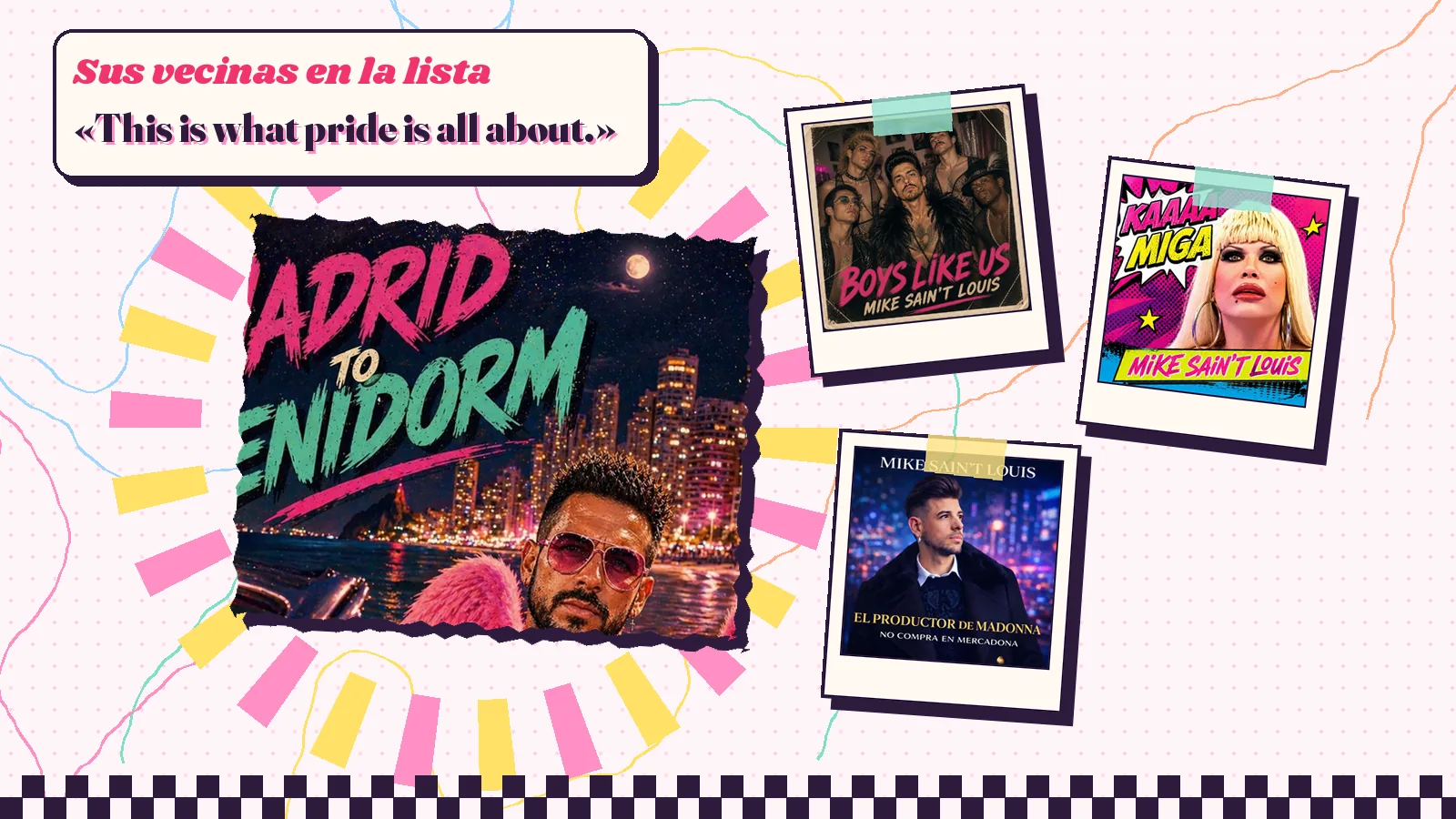
«Madrid to Benidorm» isn't the only song in my catalogue about pride. «Boys like us» says we turn the dark into pride, and it's almost a portrait of the night as refuge. «Kaaa-miga» was born, as I said when I released it, from affection and from the pride of being who we are.
And there are others that laugh precisely at brands: «El productor de Madonna no compra en Mercadona», with its own-label goods, or the humour of cheapness I talked about in «El camp no es un chiste aunque te rías». Camp knows everything can be glitter, but it also knows how to tell glitter from a lie.
For every heart that's been denied
There's a line in the song I want to rescue at the end: «For every heart that’s been denied». It's the one that matters most to me. Pride is for those people, the ones who still can't go, the ones who watch it on TV with the volume low so nobody at home notices, the ones who live in countries where the flag is grounds for prison.
If you're one of them, I want you to know that Pride is yours too even if you're in no photo. In Spain, FELGTBI+'s Línea Arcoíris answers on 91 360 46 05, COGAM offers free psychological counselling on 91 523 00 70 and, if you're a minor, the ANAR Foundation is on 900 20 20 10 and 116 111. If loneliness or rejection ever lead you to think about dying or hurting yourself, call 024: it's free, confidential and never closes. In an emergency, 112. If you're outside Spain, call your local emergency number. Talking about suicide doesn't cause it; keeping quiet about it can leave people alone.
The rainbow that isn't for rent
Back to the question at the start: who does the rainbow belong to? My answer is that it belongs to nobody and to everyone who needs it. It can be shared, lent, celebrated with whoever wants to join. What it can't be is rented for a month and handed back with its stripes dirty.
When I wrote «Madrid to Benidorm» I was thinking of a party that crosses Spain from end to end. I'm still thinking of that party. All I ask is that, when we dance under the rainbow, we know who sewed it, who paid for it and who was left outside.
Frequently asked questions
What is pinkwashing? It's the use of LGTBI symbols, like the rainbow, by companies or institutions to improve their image without a real commitment to LGTBI people's rights, or while acting against them. The term was coined by Breast Cancer Action for the pink breast cancer ribbon and later spread to the LGTBI sphere.
Why is Pride celebrated at the end of June? Because it remembers the Stonewall Inn uprising in New York, which began in the early hours of 28 June 1969 after a police raid. In Spain, the first demonstration was in Barcelona in June 1977 and in Madrid the following year.
What is Orgullo Crítico? It's a movement that for years has organised its own march in Madrid, usually on 28 June, to recover Pride's protest character and criticise its commercialisation. The name has been used since 2010, with roots in an alternative bloc from 2006.
What is «Madrid to Benidorm» about? About a Pride celebration that crosses Spain, dancing under the rainbow from Madrid to Benidorm and holding hands without fear. It's an English-language song from the third album of the GAYFOLK trilogy, «El día de la liberación».
Who writes these songs? Mike Sain't Louis, a lyricist, composer and music producer from Madrid who introduces himself as the first AI songwriter. The music and vocals of his songs are made with artificial intelligence.