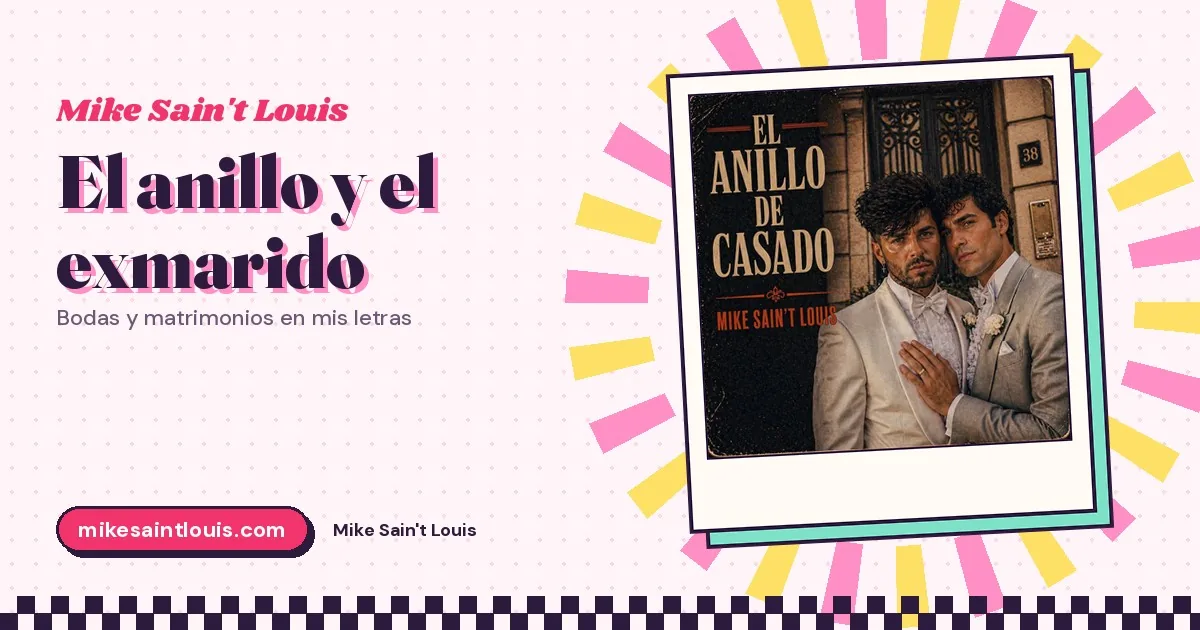
By Mike Sain't Louis ·
The ring and the ex-husband: weddings and marriages in my lyrics
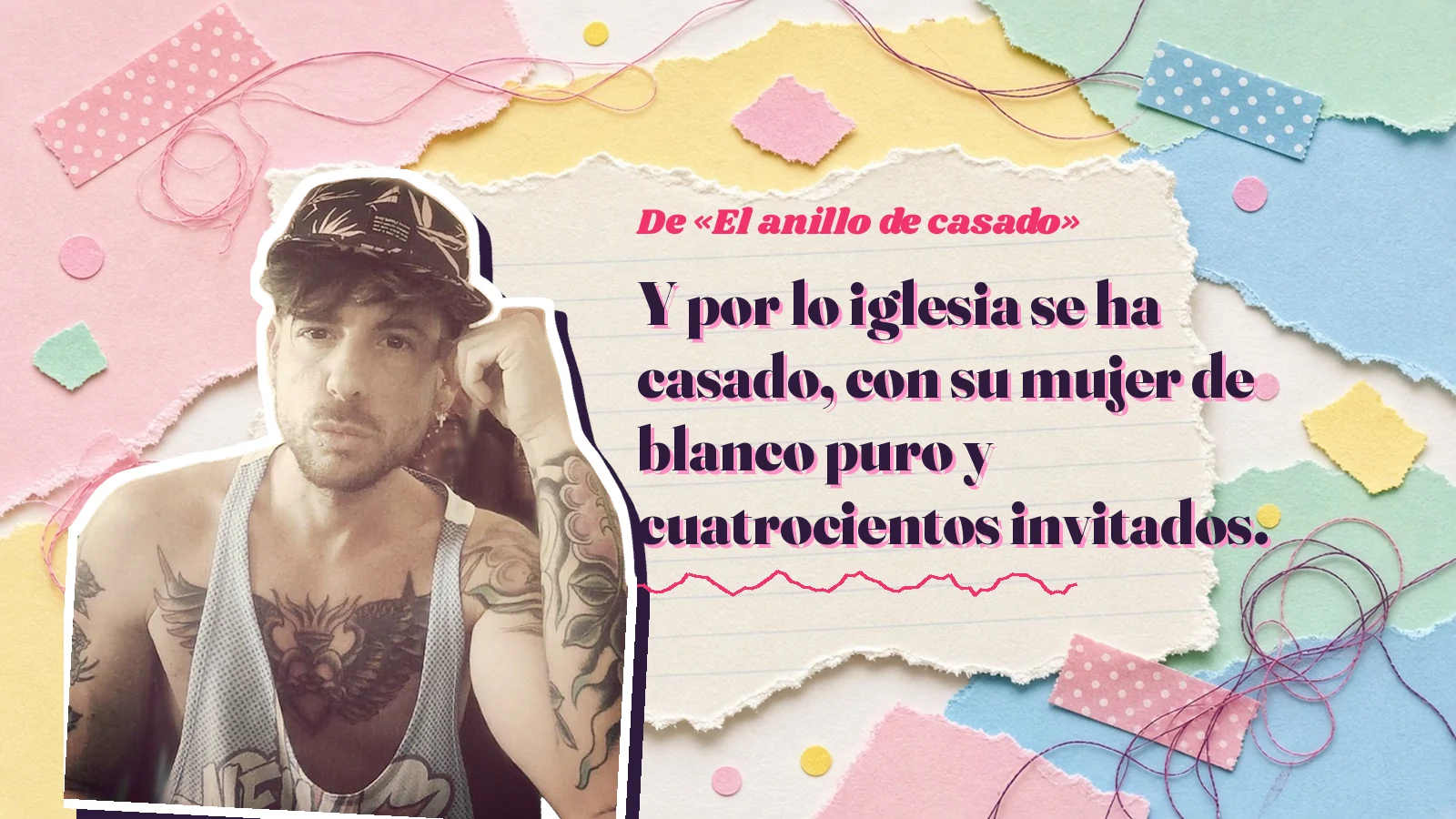
«Y por lo iglesia se ha casado, con su mujer de blanco puro y cuatrocientos invitados» («And he's married in church, to his wife in pure white, with four hundred guests»).
That's how it reads in the lyrics of «El anillo de casado», typo and all. And it's the biggest wedding in my whole catalogue. Church. Pure white dress. Four hundred guests. A reception you can hear from here, with its band, its free bar and its drunk uncle dancing to «Paquito el chocolatero» (the brass-band staple of every Spanish wedding) with his tie round his head.
And it isn't my wedding. It's his. The man the narrator is falling for.
I'm starting there because I think it sums up very well how marriage appears in my lyrics. It almost always belongs to someone else. Or it's in the past. Or it goes wrong. Or it's a joke. Or it's a dream. There are plenty of marriages in my songs. Happy ones, hardly any.
And that says something. About me, probably. But also about a very specific moment in gay life in Spain: a generation that has been able to marry for years, that has husbands and ex-husbands with paperwork, and that still writes about love with the old fear.
Four hundred guests
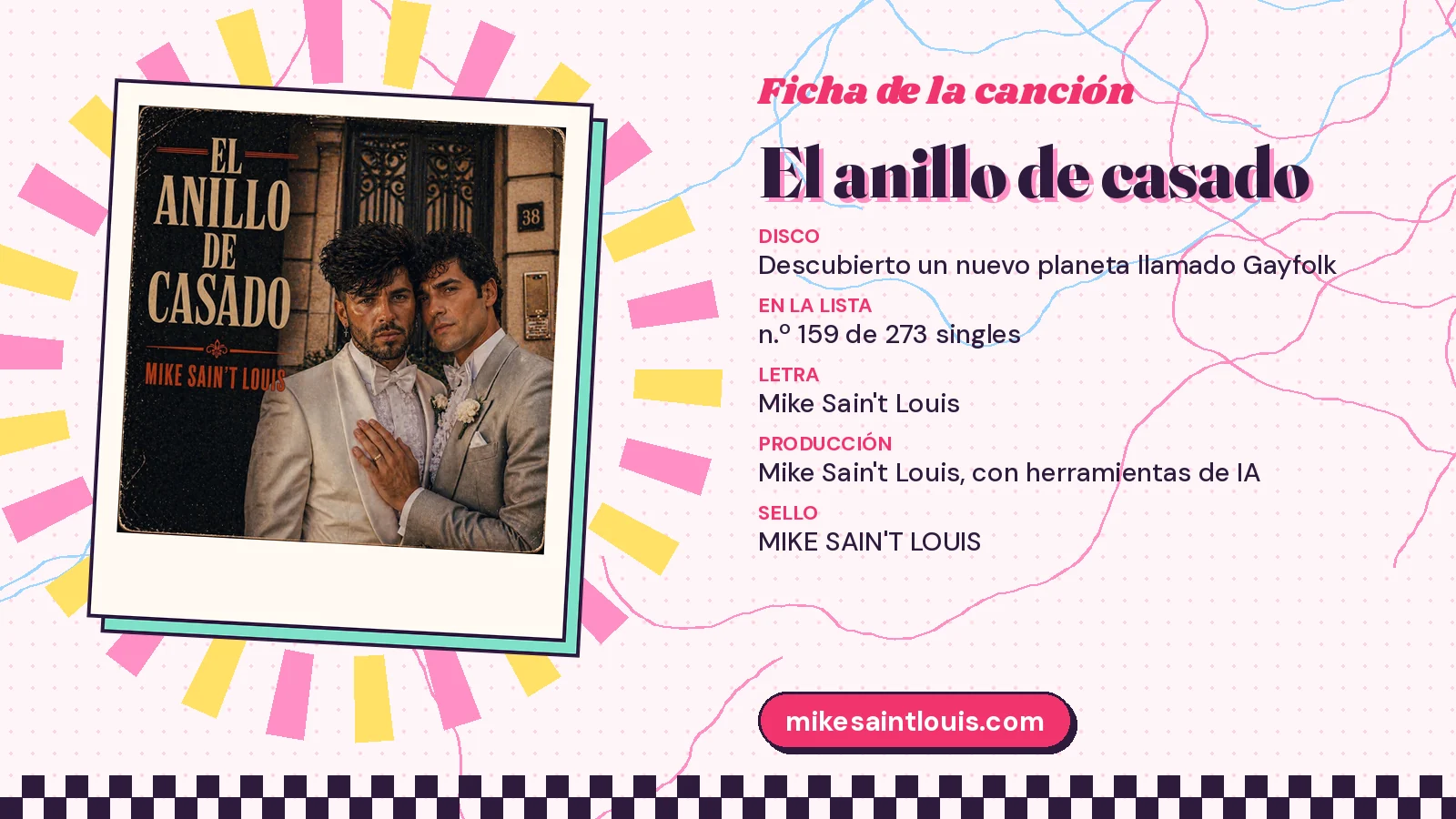
Back to the ring, which is the song on the cover.
The story is simple. Two men knock back five pints at the 100 Montaditos (a cheap Spanish beer-and-sandwich chain), between laughs and glances, tucked well out of sight. The narrator is merry, a bit tipsy, and says it straight: «Me apetece tenerte en la cama y que te quites el anillo» («I fancy having you in bed and you taking off your ring»).
Taking off your ring. Not your clothes. Your ring.
That line still strikes me as one of the sharpest I've written. Because the ring is the only thing that really gets in the way. Everything else comes off by itself. But the ring is the wife, the church, the four hundred guests, the reception, the wedding album, the mother-in-law, the mortgage. All of that fits into a gold band on the ring finger. And the narrator asks him to take it off, even if only for a while.
The chorus repeats the word until it wears thin: he wears the wedding ring, forever in love, now he shows off the wedding ring, more in love every day. It's almost a jeweller's advert. And it's a lie, of course. That forever in love is the official version. The one told at the reception. The other version is at the 100 Montaditos.
As far as I'm concerned, it's past
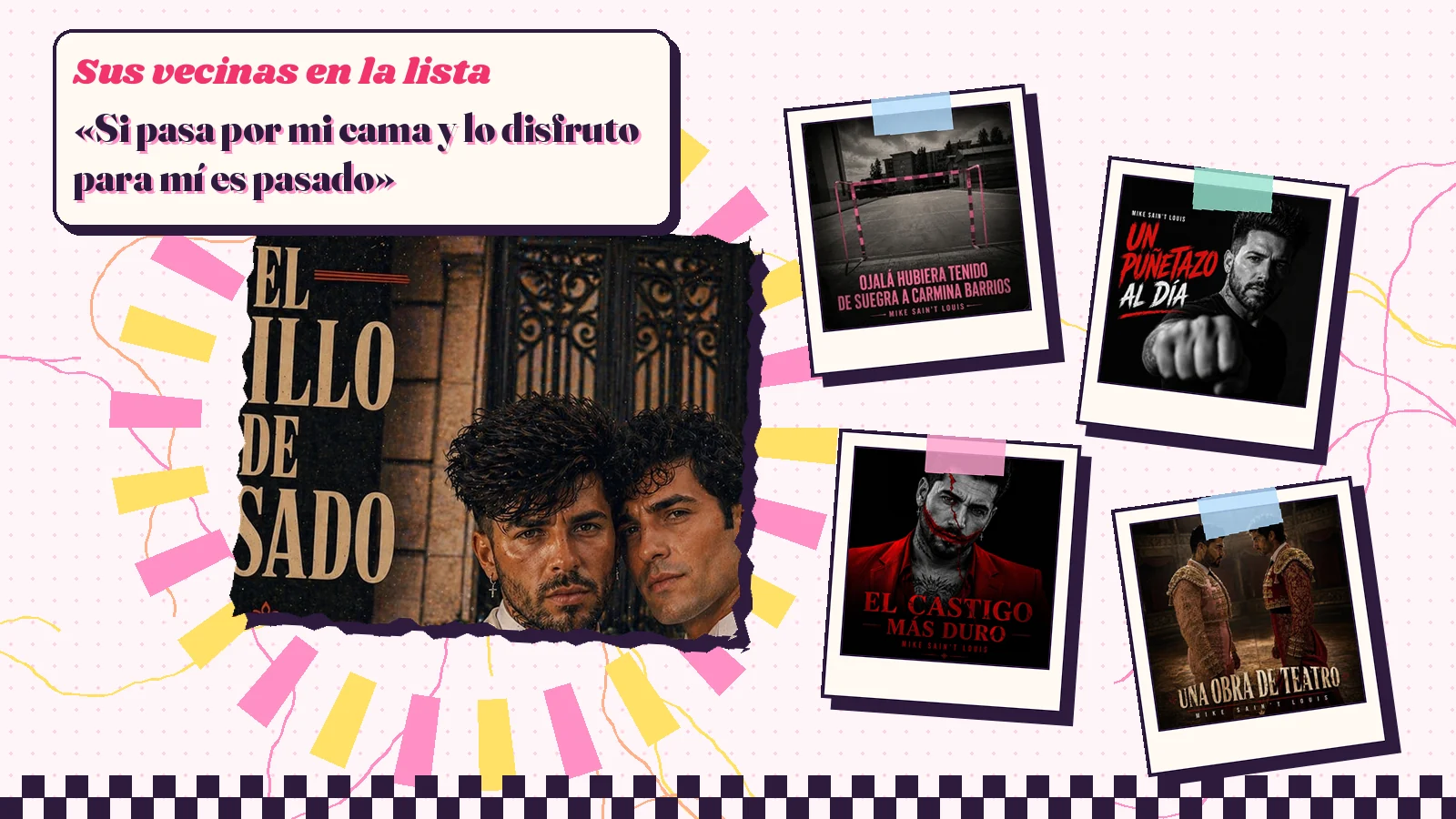
There's a line in the same song that turns everything round: «Si pasa por mi cama y lo disfruto para mí es pasado» («If he passes through my bed and I enjoy it, for me he's in the past»).
It's a silly bit of wordplay, the kind I love: casado, married; pasado, past. But it says something serious. For the narrator, the ring doesn't mean what it means to the church. To the church, the ring is forever. To the narrator, whoever passes through his bed is no longer married: he's past. A closed chapter. The ring stays on the bedside table and what matters is something else.
Then, of course, the song gets complicated. The narrator starts to fall in love. And what am I going to do? I don't know. I'm so happy with him. And what hooks him, a little more every day, is that «supuesta heterosexualidad» («supposed heterosexuality»), which sounds like irony and a trap at once.
That's the age-old drama of the married man who won't come out of the closet. A lot of people think it's an old story, from the years when there was no other option. Not so. It still happens. With marriage equality, with Chueca full of flags, with Grindr on every phone, there are still men who marry in church in front of four hundred guests and then go looking for another man in a beer hall. The song doesn't judge them. Or save them. It tells their story.
My last husband
On the other side of the mirror is gay marriage. The real thing, with papers.

In my catalogue the word «husband» comes quite naturally from a man talking about another man. In «Ojalá hubiera tenido de suegra a Carmina Barrios» the narrator laments «no haber acabado tan mal con mi último marido» («not having ended up so badly with my last husband»). My last husband. The way you'd say my last car. As if there had been several and this was just the most recent.
I love what that line does without making a fuss. It takes for granted that a man can have a husband. That he can have more than one, in succession. That he can get divorced, be stuck with an unbearable mother-in-law and write a song to complain about her. All of that, which not so long ago would have been scandalous or impossible, is routine in the lyric.
In Spain two men have been able to marry since 2005. My lyrics don't celebrate that law with anthems or placards. They celebrate it in the strangest, most honest way I can think of: with ex-husbands. Because the proof that something is normal isn't that it goes well. It's that it can also go wrong, like it does for everyone.
The ex-husband's funeral
And if there's one ex-husband in my catalogue who weighs heavy, it's the one in «Un puñetazo al día».
There, in a dive bar, with his best friend and almost-brother, the narrator celebrates his ex-husband's funeral. He isn't dead, of course. It's the marriage being buried. There's a wreath in the boot. And what's also being buried is «los años que me ha robado» («the years he stole from me»).
Seven years. That number keeps coming back in my songs about long relationships. In «Un puñetazo al día», after seven years what's left is a cold emptiness in the house. In «El castigo más duro» seven years have to be deleted from the iPhone, Google Photos, Movistar cloud and OneDrive. In «Una obra de teatro» the question is more terrible still: «Siete años en un escenario?» («Seven years on a stage?»). As if the whole marriage had been a performance.
I don't know if seven years is a long time or a short one. I know that in my lyrics it's the exact measure of a shared life that breaks. Long enough to have a home, a routine, in-laws and photos in the cloud. Short enough for the one left behind to think he can still start something else.
And the ex-husband, in all these songs, is a very specific figure. He isn't the one-night stand. He isn't the Grindr hook-up. He's someone you shared keys with, bank accounts, birthdays and Christmas dinners. That's why it hurts differently. That's why he gets buried with a wreath.
And notice something. The funeral is held with friends. No judge, no lawyer, no notary. The real divorce, the paperwork one, doesn't appear in the song. The other one does, the one that matters: the ritual. The wreath in the boot, the pints on the table, the friend's hug, the laughter when someone says it must be a body. Just as a wedding needs guests, a divorce needs witnesses. People who'll watch you close the door and tell you you've done the right thing. My catalogue has no happy wedding receptions, but it has this divorce reception. And it's a proper party.
Gay couple of the year
Before the weddings come the couples who think they'll last forever. And there's one song that tells it with a really cruel inventory.
«Mi novio de Albacete» opens like this: «Me has engañado / Éramos la pareja gay del año» («You cheated on me / We were gay couple of the year»). And then the photo of that couple, line by line, as if you were scrolling through their Instagram: you so buff, me so tattooed. You so into fitness, me so handsome. Me grafting. You on Grindr, me in disguise. Me dreaming, you acting.
Gay couple of the year. I love that phrase because it has something of a magazine award about it, a Sunday supplement cover, one of those features on modern couples with a flat in Malasaña and a pedigree dog. And the song takes it apart in two lines. What looked like a marriage in the making was a stage set. The boyfriend travelled five hours to leave a note. The note ended up down the loo.
There's no wedding in this song. But it has everything that comes before one: the perfect photo, other people's envy, the feeling of having made it. And it has what comes after when there's no wedding: the inventory of what each of them really was.
I think it's important to include it here because it explains something about all the others. In my lyrics, the problem is almost never marriage. It's the distance between the photo and what goes on behind it. The ring that says forever in love, and the beer hall. Gay couple of the year, and the app open on the phone. The seven years, and the play.
Marrying a puppet
Not all the weddings in my catalogue are dramatic. Some are downright absurd.
In «El señor Garrison» the narrator sees himself ending up like the South Park teacher with his puppet: «Y al final voy a terminar casado / ¡Con un muñeco!» («And in the end I'm going to end up married / To a puppet!»).
I laugh a lot at that line because it's the gayest fear I know, put in the most ridiculous way. The fear of ending up alone. The fear that, after so many disasters, all you'll have left is marrying something that can't let you down because it isn't alive. A puppet. A puppet in a hat. And the song drops it like a resigned prophecy, between Kenny dying yet again and a boyfriend caught setting up a meet with another guy.
There's a little sadness hidden in that joke. But only a little. Just enough for you to laugh and then go quiet for a second.
And it also has some truth about how we talk about marriage among ourselves. «I'm going to end up married to a puppet» is the kind of thing you say at a bar, among friends, at two in the morning, after recounting the latest disaster. Nobody means it. Everybody means it a bit. It's the queer way of saying we still want to get married, but we don't trust anyone any more. Not boyfriends, and not ourselves when we pick boyfriends. A puppet, at least, doesn't show off a new tattoo the next day.
The wedding forgotten by nightfall
And then there's the quickest wedding in my catalogue. It lasts a day.
In «¿Por qué él no llora?» it goes like this: «ayer por la mañana celebraba con Algora mi boda / y por la noche ya se me olvidaba mi boda con Algora» («yesterday morning I was celebrating my wedding to Algora / and by night I'd already forgotten my wedding to Algora»).
Wedding in the morning. By night, I can't even remember. And what fills his head isn't the new husband but the question in the title: why doesn't he cry. Him, the one before. The one who left and now shows off his new tattoo while the narrator has bags under his eyes down to the floor.
Algora is an invented character, like almost all the names in my lyrics. And his wedding is one of the cruellest things I've written without meaning to be cruel. Because it tells something that happens a lot: you marry, or pair up, or move in with someone new, and part of you is still waiting for the previous one to suffer a bit. To cry. To show you mattered.
The new wedding doesn't erase the old wound. It just puts a dress on top of it.
I was going to get married
There's another wedding that never actually happens. And this one makes me laugh a lot.
In «Tengo argumento», amid wordplay on Marías of every kind, the narrator mentions in passing: «Me íba a casar con mi novio de hace veinte años» («I was going to marry my boyfriend of twenty years»). Twenty years. A lifelong relationship. And the wedding falls through for the most mundane of reasons: the boyfriend wanted a threesome with María, the narrator didn't, «así que le mandé a freír espárragos y así nos ahorramos desengaños» («so I told him to go and fry asparagus, and that spared us the heartbreak»), which is the Spanish for telling someone to get lost.
Twenty years of engagement dispatched with a grandmother's saying. Go and fry asparagus. No drama, no wreath, no funeral. Just a «that's enough» said with great economy.
I like having this song in the same catalogue as the others. Because not every break-up has to be a seven-year tragedy. Sometimes, after twenty, you realise you don't want the same thing as the other person and you save yourself the reception. Rica, rica, con fundamento, as the TV chef used to say.
The chavvy girls showing off their husbands
In «Croquetas en el crucero» marriage is seen from the outside, like a show on deck.
Among a doorman found on Grindr, mass with a reggaetón boy and a captain who winks, this appears: «Y esas chonis que presumen de marido» («And those chavvy girls showing off their husbands»). And a little bird telling what those husbands get up to when they're plastered.
It's the other side of the wedding ring. There, the married man was the one looking elsewhere. Here it's the wives showing off their husbands without knowing, or without wanting to know, what those husbands get up to at the all-you-can-eat buffet at three in the morning. Marriage as a shop window. As a photo on the ship's deck.
And the narrator, who finds out everything, laughs. But he laughs with some compassion too. Because he's also shown off something that wasn't what it seemed.
A boyfriend with a guarantee
There's a form of marriage in my lyrics that doesn't go through any church or registry office. It goes through the consumer office.
In «3 años de garantía» the narrator buys a boyfriend off the telly, with a one-month trial and a three-year guarantee, and when he breaks down he fills in a complaint form. The official reply is that they've spoken to the accused and he says he's very much in love. That he loves him like the trout loves the trout.
It's a parody, of course. But it's a parody of marriage as a contract. A contract with small print, deadlines, return clauses. And what the song finds out is what a lot of divorcees find out: that when the contract breaks, the authorities can't do much for your heart. They give you a reference number. And tell you to buy another.
This is already the ninth.
The only happy marriage
If I go through all these weddings, there's one that goes well. Just one.
It's in the Carmina Barrios song. The narrator dreams of having had her as his mother-in-law, and in that dream he eats with her in the garden, with Paco León, «mi chiquitín» («my little one»), celebrating their fourteenth anniversary.
Fourteen years. Twice seven. A couple who've got past the cursed number of all my other songs. With a mother-in-law who loves you and a garden to eat in in the sun.
And it's completely imaginary. It's an ojalá, an if only. A fantasy with famous people in it, told straight after complaining about the real mother-in-law and the real last husband.
I find that very telling. In my entire catalogue, the only long, happy marriage lives in the conditional. If only I'd had. Celebrating. As if marital happiness could only be written in the tense of wishing.
I've written about this another way in we need gay love songs that end well. And I stand by it. We do. It's just that when I sit down to write, the ex-husbands come out before the anniversaries.
Why I write weddings that go wrong
I don't have a theory. I have a suspicion.
Weddings that go well don't need a song. They already have one: the one that plays at the reception, the first dance, the one chosen months in advance. Weddings that go wrong have nothing. Nobody prepares you a song for the day you bury your ex-husband. Nobody writes you a chorus for when you realise the married man at the 100 Montaditos isn't going to leave his wife. Nobody writes the music for the funeral of seven years of shared life.
And that's where I come in. I write the lyrics for my songs, all of them, and the music and vocals are made with artificial intelligence. I can produce a song for every wedding that goes wrong. And there are lots. More than get mentioned at receptions.
There's another reason, more political without meaning to be. For a long time, the love songs on the radio only had weddings between a man and a woman. We maricas had to translate. Put a «he» where it said «she». Now I write songs where the husband belongs to a man, the ex-husband too, and the mother-in-law who takes the other side is another man's mother. Nothing needs translating. And that, even when it goes wrong, is a kind of normality that didn't exist before.
Think of the old songs. All those boleros and coplas about deceived wives and husbands coming home at dawn smelling of someone else. For decades, marital drama in Spanish song was a man-and-woman affair, and we bellowed along in the living room, putting on the face of the betrayed wife. Now marital drama is ours too, with its own vocabulary. The ex-husband. The mother-in-law. The married man in the beer hall. Seven years in the cloud. It isn't that we've won the right to be happy in a song. It's that we've won the right to be miserable under our own names.
The ring on the bedside table
Back to the ring, to finish.
The song ends with the two men round Madrid, being discreet, looking for hostels without a «full» sign. We don't know what happens next. We don't know if the married man leaves his wife, if the narrator gets tired of it, if the four hundred guests ever find out. The lyric cuts off at the word «completos» («full») and stays there.
But I like to think of the ring on the bedside table of a hostel. Taken off at last, even if only for an afternoon. Glinting a little in the light coming through the blind. That ring is every wedding in my songs at once: the one in church, the one that couldn't happen, the one that went wrong, the one forgotten by nightfall and the one that only exists in an if only.
The full lyrics are at gayfolkplanet.com/letras/el-anillo-de-casado. Read it with a beer. Five, if you're at the 100 Montaditos.
Frequently asked questions
What is «El anillo de casado» about?
A man who falls in love with another man who has married a woman in church, «de blanco puro y cuatrocientos invitados» («in pure white, with four hundred guests»), and who asks him to take off his ring. They end up looking for hostels round Madrid, on the quiet. The full lyrics are at gayfolkplanet.com/letras/el-anillo-de-casado.
Which songs feature husbands or ex-husbands?
Among others: «Ojalá hubiera tenido de suegra a Carmina Barrios» («mi último marido», «my last husband»), «Un puñetazo al día» (the ex-husband's symbolic funeral), «El señor Garrison» («Y al final voy a terminar casado / ¡Con un muñeco!», «And in the end I'm going to end up married / To a puppet!»), «¿Por qué él no llora?» and «Tengo argumento».
Why do seven years keep coming up?
Seven years is how long several of the couples that break up in Mike Sain't Louis's lyrics last, as in «Un puñetazo al día», «El castigo más duro» and «Una obra de teatro».
Who writes these lyrics?
Mike Sain't Louis, a lyricist, composer and music producer from Madrid. The music and vocals of his songs are made with artificial intelligence tools.