By Mike Sain't Louis ·
The double gaze: racism, anti-LGTBI prejudice and mixed couples in my lyrics
«Que te molesta que mi novio sea africano.»
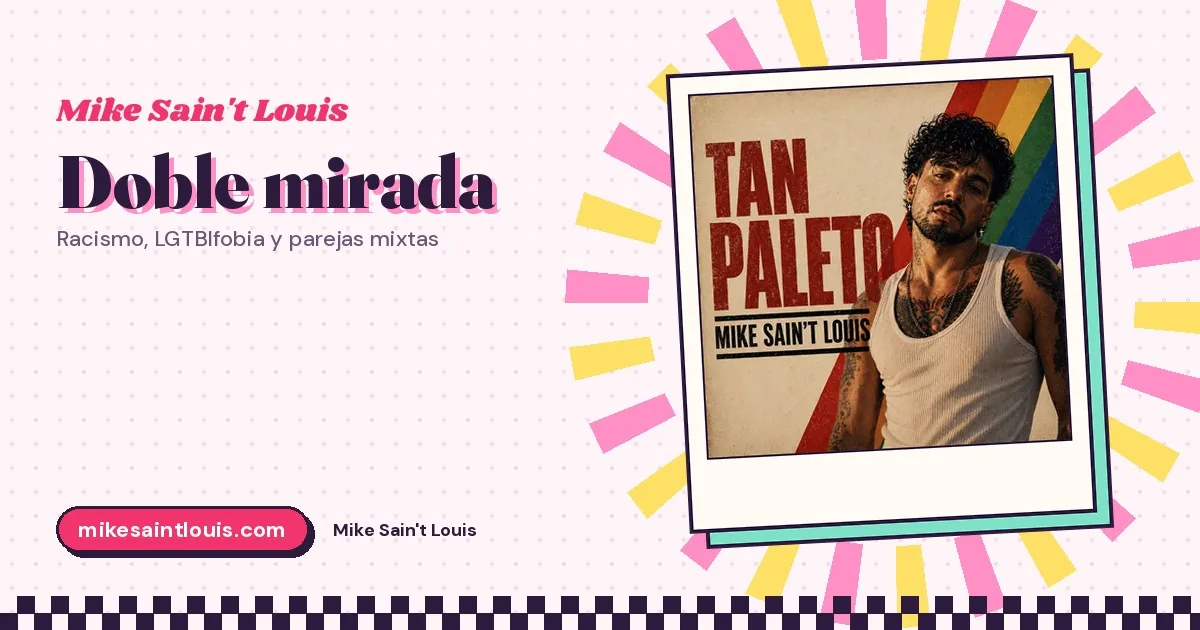
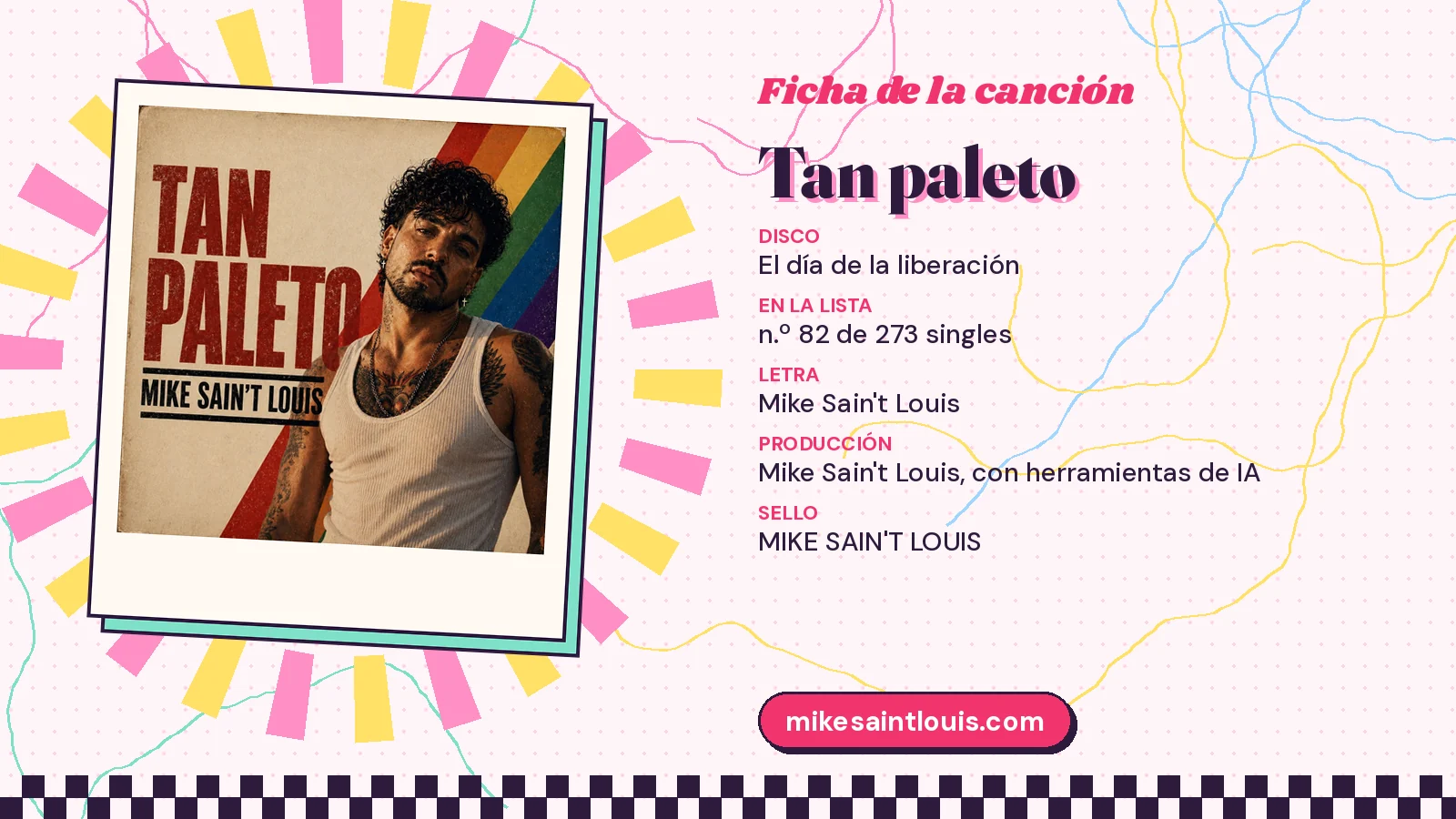
So it bothers you that my boyfriend is African. That's the third line of «Tan paleto», such a hick, a song from the third album of the GAYFOLK trilogy, «El día de la liberación». (The full lyric is on gayfolkplanet.com.) The song opens with an onlooker who is bothered that two men are holding hands. And straight after, it adds a second annoyance: that one of them is African. Two lines in a row, almost the same length, the same structure. As if, to the one watching, they were the same offence.
That detail is the heart of this piece. Some people aren't looked at once, but twice. For being LGTBI and for the colour of their skin, their accent, where they come from. And those two gazes don't simply add up: they multiply, blend, and create situations that neither the white gay man nor the straight Black man lives through. That's what I want to talk about. The double gaze, how it shows on the street, on the apps, inside our own community, and what it means for someone who arrives in Spain fleeing a country where being who they are could land them in prison.
The onlooker who judges twice
What I love most about «Tan paleto» is that it doesn't whine. The narrator doesn't mourn the gaze, he returns it. He answers with a line that sounds like a rule for living: «No voy a aceptar consejos de ningún espectador», I won't take advice from any onlooker. Whoever watches from outside is just that, a spectator, someone who isn't part of the story and thinks they have the right to an opinion on it.
But it's worth pausing on what bothers the spectator. It isn't one thing. It's the couple of men, and it's where one of them is from. And he probably couldn't say himself which bothers him more. That's the trap of double discrimination: the person on the receiving end doesn't always know why they're being glared at either. For being gay? For being Black? Both? That uncertainty is a burden in itself. It forces you to stay alert on two fronts at once.
A word to name it
There's a word that helps make sense of this, and although it sounds academic, it's worth knowing: intersectionality. It was put forward by the American legal scholar Kimberlé Crenshaw in 1989, based on cases of Black women facing discrimination that fitted neither the category of «racism» nor that of «sexism» on its own. The courts looked at each axis separately and couldn't see the crossing.
The idea is simple: discrimination isn't lived in sealed compartments. A Roma lesbian, a gay Moroccan man, a Latin American trans woman don't live anti-LGTBI prejudice plus racism, like adding two numbers. They live an experience of their own, with its own forms of exclusion. And if we only look at each axis separately, those people slip through our fingers.
Spain's Law 15/2022 on equal treatment and non-discrimination takes up this idea when it speaks of multiple and intersectional discrimination. Having it in Spanish law matters, because it means the state recognises that some people are discriminated against on several grounds at once, and that this makes the harm worse.
Hand in hand down the street
Back to the scene in the song, the simplest scene in the world: two men holding hands. For a couple of two white men, in many parts of Madrid, that's now a fairly calm affair. For a mixed couple, sometimes less so. The looks are different, the questions are different. Some people assume one of them «is only with the other for the papers». Some speak English to both of them, or just to one. Some ask for their ID more often.

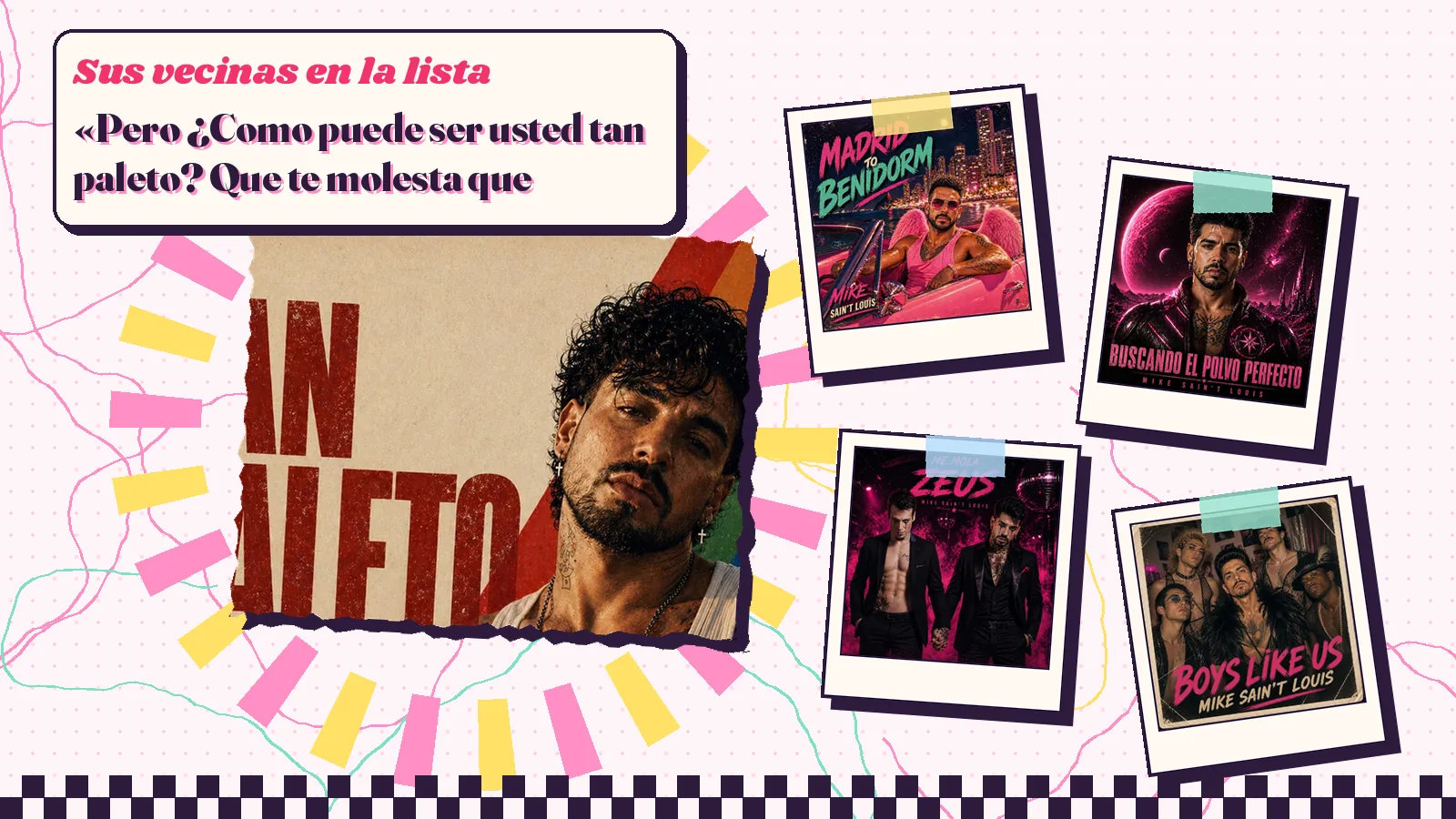
None of this shows up in the statistics on attacks, because these aren't attacks. They're frictions. But frictions, day after day, wear you down just like blows do. In «Madrid to Benidorm» I wrote a chorus in the plural about shared pride. That plural is only true if every colour fits inside it.
The racism inside the scene too
It would be comfortable to think racism belongs to outsiders, to the song's small-minded onlooker. But no. It exists inside the LGTBI community too, and it needs saying plainly.
Anyone who has used a gay dating app knows the profiles that filter by race: «no Asians», «no Blacks», «whites only». Some defend it as «preferences». But a preference that excludes whole groups because of their origin has a name, and it isn't personal taste. And there's the flip side, just as damaging: fetishisation. Black men approached only to fit a sexual stereotype, Asian men assumed to be submissive, Latinos expected to be «hot». Being desired only as a cliché is another way of not being seen.
The racism on the scene doesn't stay on the apps. It shows up at the door of some venues, where some people are asked for ID more insistently than others. It shows up in bar talk, in jokes about accents, in the surprise of someone who finds out the Latino guy at the party is a doctor or an engineer. Small details that, added up, tell someone that this place, which was meant to be their refuge, also looks at them strangely. And that hurts more than the hick's stare in the street, because it comes from those who ought to understand it best.
I've written about apps and flamboyance in «Buscando el polvo perfecto», looking for the perfect lay, where another form of exclusion on the scene appears, the «no camp guys». In «Me mola Zeus» the algorithm plays matchmaker. Apps don't invent our prejudices, but they sort them into filters and make them easier to act on.
LGTBI people arriving in Spain
There's a part of this story that's rarely told in Spain: that of LGTBI people who come from other countries. Some come for work, study or love. Others come fleeing. According to reports by ILGA World, the international federation of LGTBI associations, dozens of countries still punish same-sex relations by law, in some cases with very long prison sentences.
For those people Spain can be a refuge, and the law provides for it. Law 12/2009 on the right to asylum recognises that persecution on grounds of sexual orientation or sexual identity can be a basis for international protection. In other words, someone who has had to flee their country for being gay, lesbian, bisexual or trans can apply for asylum here.
The road isn't easy. You have to prove something that, by definition, you've spent your life hiding. You have to tell the most intimate things to strangers, often in a language that isn't yours. And while it's being decided, you live in a kind of waiting room, not knowing whether you'll be allowed to stay. If you're in that situation, there are organisations specialising in asylum and LGTBI associations that support people through the process. You don't have to do it alone.
The newcomer's double loneliness
Someone who arrives fleeing anti-LGTBI hatred sometimes meets a double loneliness. On one side, their own diaspora community in Spain may not accept them, because it carries the same prejudices as the country they left. On the other, the local LGTBI scene may not fully welcome them, because of racism, the language barrier or simply because nobody makes the effort.
It's a very hard place to be: not fitting into your community of origin because you're gay, and not quite fitting into the gay community because you're from elsewhere. I've written about loneliness in many pieces, but this is one of its quietest forms. That's why I think it matters so much that groups and bars, parties and circles of friends make the effort to truly open the door. Sometimes it's enough to speak more slowly, to invite someone to the table, to ask where they're from without turning it into an interrogation.
Gitanos, moros and other playground insults
In Spain the double gaze has very local accents. A Roma LGTBI person often finds themselves between two prejudices: that of a part of society that despises their people, and that of those who assume you can't be gay or lesbian in their community. That second prejudice is racist too, because it turns a whole people into a single block, as if there were no Roma families who accept their children and no Roma LGTBI activists who have worked for years inside and outside their community.
The same goes for people of North African origin. In school playgrounds in many neighbourhoods, «moro» and «maricón» were for decades the two easiest insults, and sometimes they were thrown together. A kid who was both had everything against him. I mention this because the words used in playgrounds are the ones later heard in the streets, and because anti-bullying campaigns should bear in mind that some children are insulted on more than one count.
Pride looking in the mirror
Madrid Pride is a huge party, one of the biggest in Europe, and I love it. But every year the same question comes up: who do you see on the floats, the posters, the campaigns? For a long time the image of Pride was very white, very young and very muscled. That's slowly changing, thanks to groups of racialised, migrant and Roma people who have claimed their place.
I think it's a fair and necessary claim. Pride was born as a protest by those who had no place, and it would be a contradiction for it to leave others out now. Having people of many origins at the head of a march isn't a quota, it's a truer portrait of who we are. And along the way it reminds the song's onlooker that there's no single way to be queer.
Talking about love without a passport
I want to close this stretch on something brighter, because mixed couples aren't only a problem that draws stares. Above all, they're love stories. Two people from different places, with different languages, different food, different families, who decide to build something together. That has a beauty all its own.
In a couple like that you learn to translate. Not just words, but gestures, silences, ways of getting angry and making up. You celebrate two calendars of holidays. You cook from two recipe books. You argue about who's right about the chilli. And sometimes you have to explain to two families, in two languages, that you love someone of the same sex. It's more work, yes. But there's more world too. In «Boys Like Us» I wrote about the plural that saves, about the gang of people who recognise one another. Mixed couples are one form of that plural.
The onlooker in «Tan paleto» only sees the surface: two men, two colours. He doesn't see the dinners, the calls to another continent, the presents brought back in a suitcase, the languages half-learned for love. If he did, he might understand that what bothers him is in fact one of the loveliest things that can happen in a city: two people who were never meant to cross paths crossing them, and loving each other.
Languages that mix
My lyrics are full of mixed languages. There are songs in English, lines in Spanglish, a song in Portuguese like «Pura magia». I've explained elsewhere why I switch languages, and I go into it in «Una canción, veinte acentos», one song, twenty accents, too. But I want to add a reason here that has to do with this subject.
On the LGTBI scene of a city like Madrid you hear lots of languages. People flirt in English, argue in Portuguese, comfort each other in Arabic, dance in all of them. A song that mixes languages looks like that dance floor. It isn't exotic decoration, it's a portrait. And for someone who's just arrived, hearing their language slipped into a song made here can be a small sign that they belong too.
What the song doesn't say
I think it's honest to point out what the song doesn't tell. «Tan paleto» doesn't explain who the African boyfriend is, how they met, or which country he comes from. Nor does it need to. The song isn't about him, it's about the spectator watching them. The boyfriend doesn't have to justify himself. That's precisely the answer: no more explanations.
I say this because there's a way of talking about mixed couples that always turns the migrant partner into an object of curiosity: where's he from, how did he get here, what does his family think. In the song, the boyfriend simply is. He's a boyfriend. He's holding hands. And that, which should be normal, is what bothers the man across the street.
You cover their eyes
There's another line in the song that interests me a lot: the father who covers his children's eyes when they see a kiss, and the song compares him to a good dictator. That image works for racism too. Some people believe children shouldn't see certain couples, certain families, certain colours together. As if diversity were something to protect childhood from.
What actually happens is the opposite. Children who grow up seeing all kinds of couples, families of every colour, kisses between men and between women, grow up with a wider gaze. The ones who grow up with their eyes covered are the ones who later become onlookers who judge. That's why I think it matters so much that there are songs, series and films showing all of this naturally. Not to indoctrinate anyone, but so nobody has to cover their eyes.
Where I'm writing from
I should be honest about my place in this conversation. I'm a lyricist, composer and music producer from Madrid, and I introduce myself as the first AI songwriter. The music and vocals of my songs are made with artificial intelligence, and the lyrics are mine. I won't speak on behalf of racialised people or migrants, because that isn't my place. What I can do is write songs in which they are present, without turning them into scenery, and use my space to point at the onlooker who judges.
My lyrics have exes from all over, one-night loves in other cities, boyfriends with invented names. «Tan paleto» is the song where one of them's origin becomes the subject, and it does so to turn the gaze around. That's what I always try to do: make the song look at whoever's looking.
When the stare turns into a blow
Sometimes the double gaze doesn't stay a gaze. When an insult or an attack happens because of someone's origin or orientation, Spanish law treats it more harshly. Article 22.4 of the Criminal Code makes it an aggravating circumstance to commit a crime for racist reasons or for reasons relating, among others, to the victim's sexual orientation or identity. And when both motives are present, both are part of the same picture.
Knowing this matters because many victims don't report. Some think it won't help. Others don't want to sit in a police station recounting what happened. And some migrants fear that reporting could cause problems with their legal status. It's understandable, but every attack that goes unreported doesn't exist in the statistics, and what doesn't exist in the statistics doesn't exist for public policy either.
If it happens to you, keep everything you can: messages, photos, witnesses' names, the time and place. Look for an association that supports victims of hate crimes; there are several in Madrid, and they can help you decide what to do and make sure you don't go alone. You're not obliged to report if you don't want to, but you deserve to know you can, and that the law is on your side.
What we can do
If you're a white LGTBI person, some simple things help. Don't use racial filters on apps, or dress them up as «preferences». Don't fetishise. When someone makes a racist joke in the bar, even among friends on the scene, cut it off just as you would a homophobic one. And if you have a place in a group, a party or a collective, think about who's missing and why.
If you're a racialised or migrant LGTBI person living with the double gaze, you're not exaggerating. What you feel has a name and a law. If you suffer an attack or discrimination, you can report it, and there are associations in Madrid that support victims of hate crimes and know these situations well. If you're an asylum seeker, find a specialist organisation before any interview.
And if at some point all of this weighs so much that you can't see a way out, or you think about harming yourself, in Spain you can call 024, the suicide prevention line, free, confidential and open 24 hours a day. In an emergency, 112. If you're outside Spain, call your local emergency number. If you haven't told anyone yet, I left you a few words here: «Carta a quien todavía no se lo ha dicho a nadie», a letter to someone who hasn't told anyone yet.
No more explanations
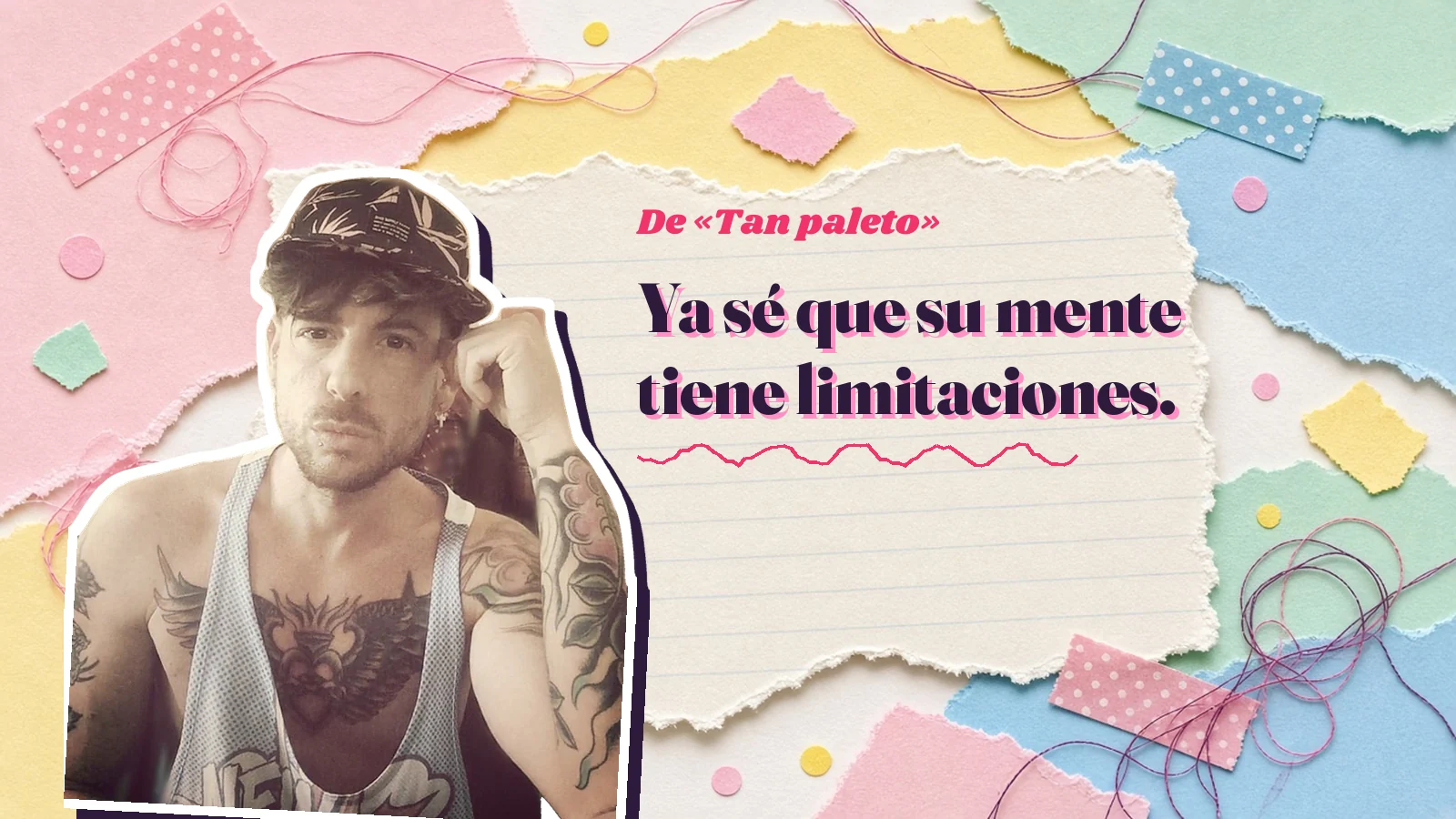
The song has a chorus that repeats a question and an answer. The question is how anyone can be such a hick. The answer is to give no more explanations. And one line finishes it off with irony: «Ya sé que su mente tiene limitaciones», I know your mind has its limits.
I'll close with that. Faced with the double gaze, you don't have to justify yourself twice. You don't have to explain why you're holding hands or why your boyfriend is from where he's from. Just keep walking. Let the onlooker stare all he likes. The street belongs to us too, in every colour.
Frequently asked questions
What is intersectionality? It's the idea, put forward by legal scholar Kimberlé Crenshaw in 1989, that forms of discrimination intersect: one person can face racism and anti-LGTBI prejudice at once, and that combination creates an experience of its own that can't be understood by looking at each ground separately. Spain's Law 15/2022 speaks of multiple and intersectional discrimination.
Can you claim asylum in Spain for being LGTBI? Yes. Law 12/2009 on the right to asylum recognises that persecution on grounds of sexual orientation or sexual identity can lead to international protection. It's best to seek advice from a specialist organisation.
What is «Tan paleto» about? An onlooker who is bothered that two men are holding hands and that one of them is African, and the narrator's reply, refusing to explain himself. It's a song from the third album of the GAYFOLK trilogy, «El día de la liberación».
Who can I call if discrimination becomes too much? In Spain, 024, the suicide prevention line, free and open 24 hours a day, and 112 in an emergency. Outside Spain, your local emergency number.
Who writes these songs? Mike Sain't Louis, a lyricist, composer and music producer from Madrid who introduces himself as the first AI songwriter. The music and vocals of his songs are made with artificial intelligence.