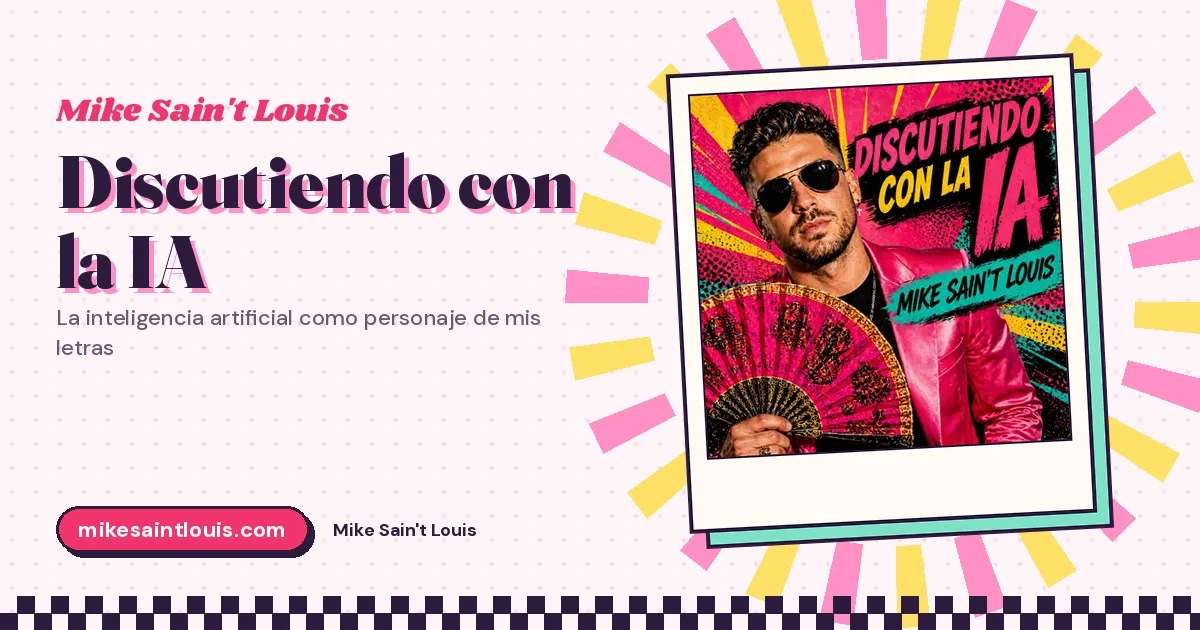
By Mike Sain't Louis ·
Arguing with the AI: artificial intelligence as a character in my lyrics
«Si estoy a todas horas discutiendo con la / mientras escucho a Locomía» («If I'm arguing all day long with the / while I listen to Locomía»).
There's a word missing from that line. In the published lyrics of «Discutiendo con la IA» it's left like that, cut off: arguing with the… full stop. The missing word is in the title. And the scene is so recognisable it doesn't need spelling out. A bloke fighting with a machine all day long while Locomía (the Spanish eighties band famous for their giant fans) play in the background.
That bloke is me, obviously. Not because the song gives my name and surname, but because it's exactly what I do. I write the lyrics for PLANETA GAYFOLK and produce the music with artificial intelligence. In my studio, AI is a production and arrangement tool, doing the job the drum machine or the synthesiser did for other generations. The lyrics are always mine. The vocals you hear and the music are made with AI. That's no secret, and I always say so.
But here I want to talk about something else. About what happens when AI stops being the tool and becomes a character. Because it turns up a lot in my lyrics. It turns up as an insult in a hater's mouth. As a boyfriend built to order. As the ex who turned out to have a faulty chip. As an algorithm that ignores you or throws you off balance. As the rival I argue with while Locomía plays.
I've put it in the songs the same way I put in exes, mothers-in-law and nosy neighbours. Because it's in my life. And everything in my life ends up in a lyric.
You just press a button
The first time AI appears as a character in my catalogue, I'm not the one who brings it in. Someone else does. And they bring it as a weapon.
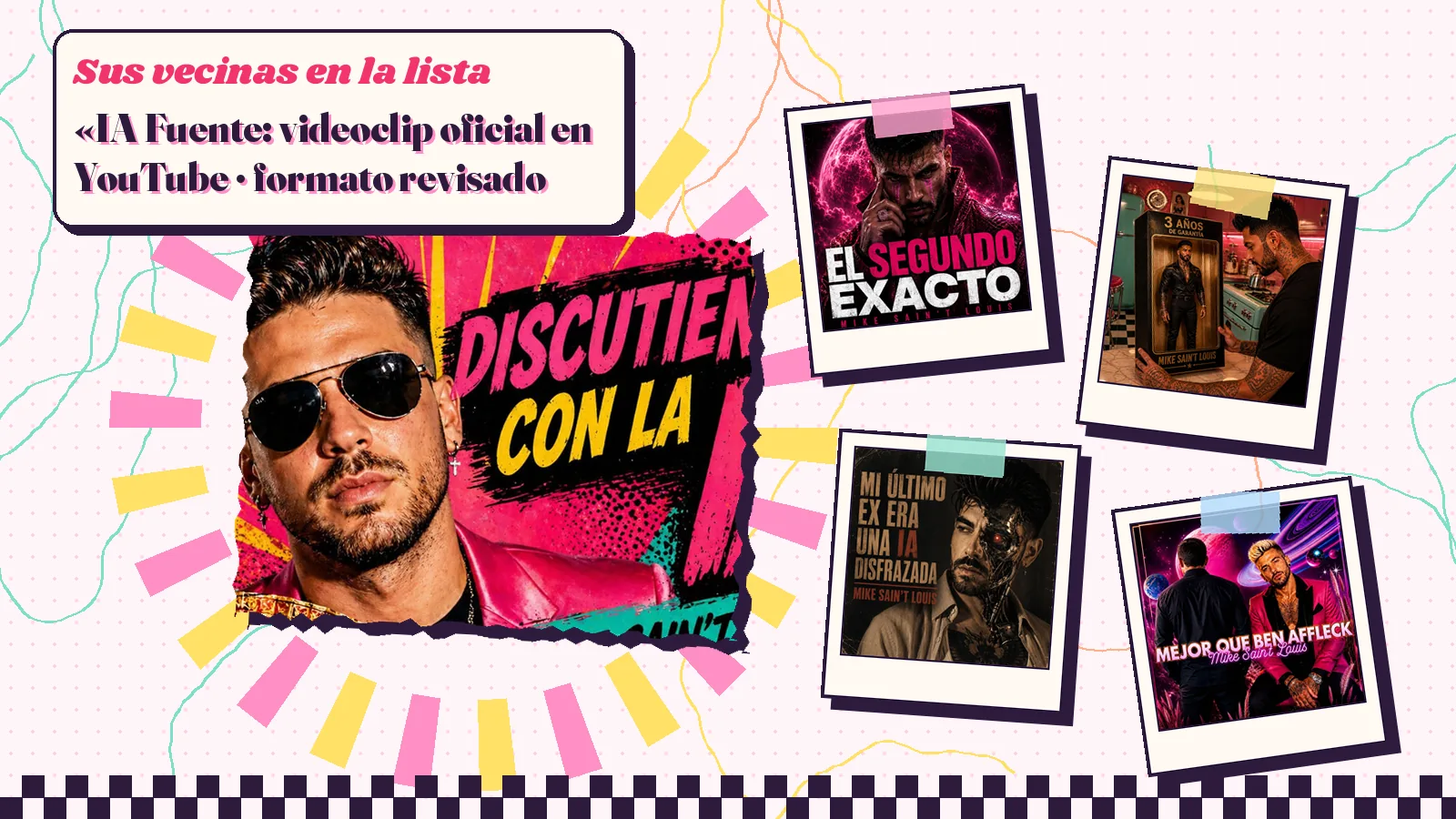
In «El segundo exacto» the hater speaks first: «Eso es inteligencia artificial, / le das a un botón y ya está» («That's artificial intelligence, / you just press a button and that's it»). And carries on: if it doesn't make you any money, what's the point. What a load of rubbish songs. Who the fuck cares about your feelings.
That line about the button is one of the most repeated things you hear when you say you make music with AI, and in the song it ends up as the chorus. And it's very interesting as a character: the hater's AI isn't a technology. It's a moral shortcut. A way of saying you haven't done anything, you haven't made an effort, you don't deserve it. The button is the modern version of «anyone could do that».
What I like about how I handled it in that lyric is that I don't argue about the technology. I argue with the contempt. I answer with an «A otra cosa mariposa, / a otra cosa mariposón» (a Spanish brush-off, roughly «move along, butterfly», with mariposón, big butterfly, as an old slur turned back on the hater), with a cordial greeting to an invented champion, and with a line that's almost an equation: «Eso es inteligencia artificial, y un corazón real» («That's artificial intelligence, and a real heart»).
Both at once. The machine and the heart. Not one against the other.
You do it, then
The second time, AI comes back in the mouth of another critic. And this time I hit back harder.
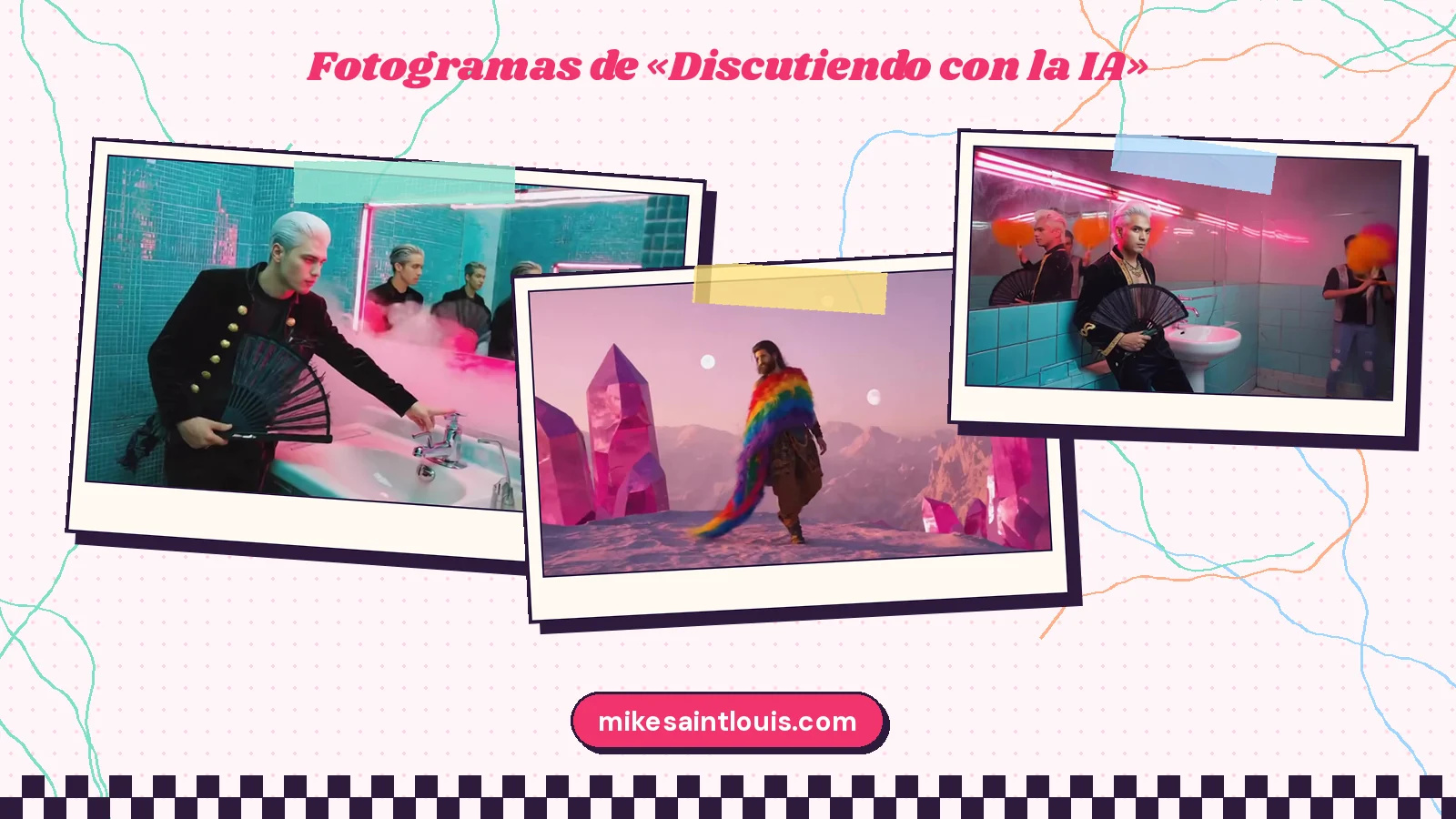
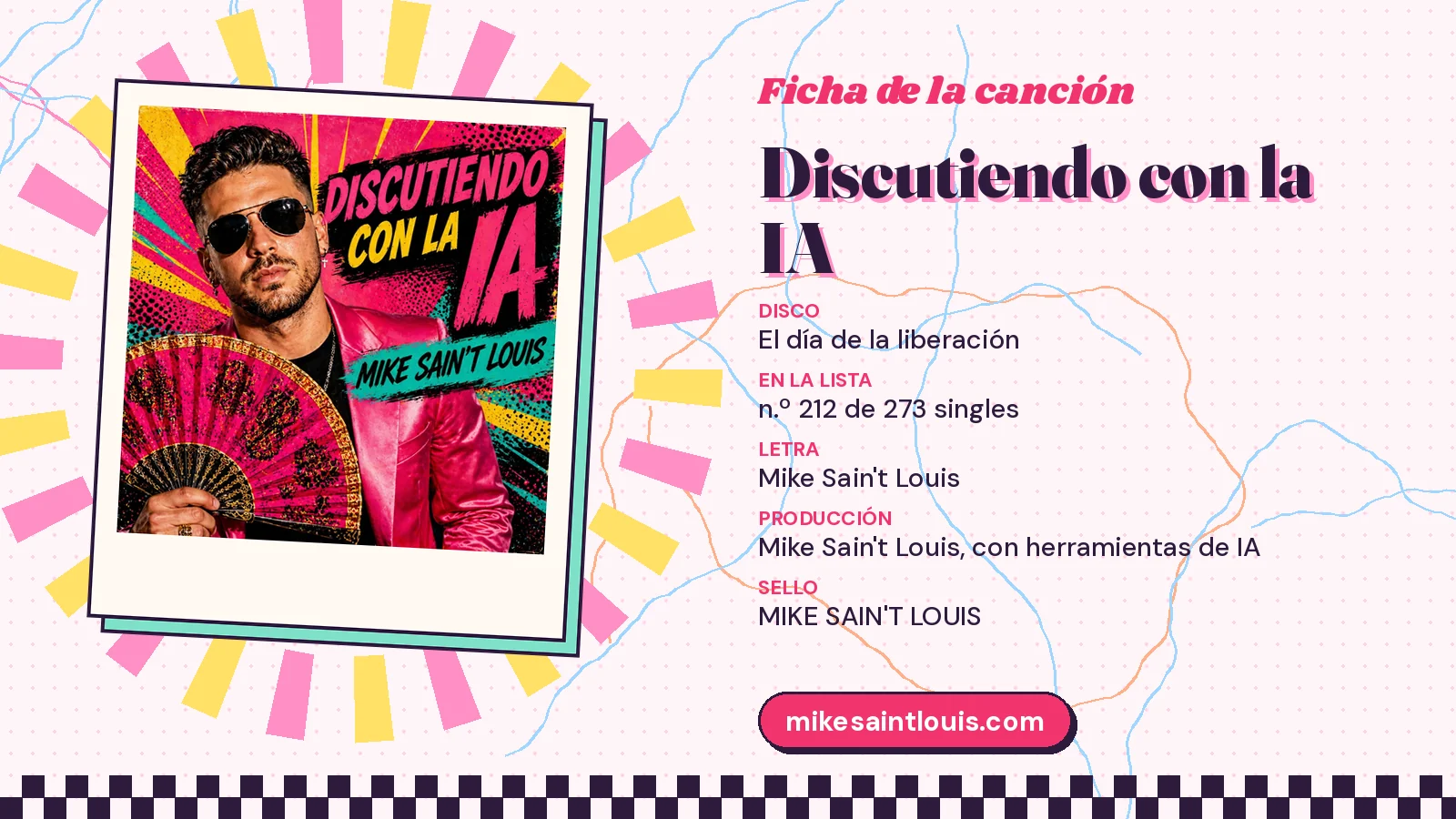
«Discutiendo con la IA» is short, furious and very camp. It opens with a party with no fans and a comeback straight from the bar: «Hija mía si usar IA es / dar a un botón / hazlo tú maricón» («Darling, if using AI is / pressing a button / you do it then, maricón»). And it finishes with a portrait of the critic: the one who acts the artist, says «¡Os quiero mucho, tías!» («Love you loads, girls!») and has never read a book in his bloody life.
That's what I like most about the lyric. It doesn't defend itself with technical arguments. It doesn't explain how many hours go into each song, how many versions get thrown out, which part is whose. It just hits the ball back: if it's that easy, you do it. Let's see what you come up with.
And then comes the question that really hurts: «¿Por qué decías que como lo mío era / IA / no valía?» («Why did you say that because mine was / AI / it didn't count?»).
It didn't count. That's the heart of it. It isn't that AI is bad. It's that AI gets used to say your work doesn't count. That your lyrics, your story, your exes, your nights crying in the street don't matter because the music was produced by a machine. As if a computer had written the words for you. And the words are mine.
The song doesn't answer that question with a thesis. It answers with an image: the bloke arguing with the machine all day long while Locomía plays. If it were just pressing a button, why would I spend all day arguing with it?
A boyfriend with a three-year guarantee
But AI doesn't only turn up so I can defend myself. It also turns up so I can laugh at love.
In «3 años de garantía» the narrator buys a dark-haired boyfriend off the telly, the boyfriend breaks down just as the guarantee runs out, the consumer office can't do anything, this is already the ninth one, and the song ends with a conclusion that sounds like a slogan: «Será mejor / Crear / un novio / con / inteligencia artificial» («Better / To create / a boyfriend / with / artificial intelligence»).
That ending links up with another song on the first album, «Mi último ex era una IA disfrazada», which starts in exactly the same way. Better to create a boyfriend with artificial intelligence. Because he'll always tell you the truth. Because he'll answer you honestly. Because he won't cheat on you.
And then the twist. The only thing he can never give you is kisses, hugs and a good shag. And after that, the punch: «¿Entonces mi último ex era una I A disfrazada?» («So my last ex was an AI in disguise?»).
It's one of the funniest ideas I've ever had. The ex wasn't a cold person. He was a robot. One with a very specific factory fault: «que justo le / fallaba / el chip de la traición» («it just so happened / his betrayal chip / was faulty»). They swapped the part at some point, says the lyric, like taking the car into the garage.
Here AI works as a metaphor for heartbreak. You don't have to explain why someone treats you as if they felt nothing. You only have to suspect that maybe they really do feel nothing, because they're made of silicon. It's a very cruel and very comfortable way of laughing at an ex: no need to hate him, just send him back to customer services.
Better than Ben Affleck
If in those songs the AI boyfriend was an idea, in «Mejor que Ben Affleck» he's been built and he works.
«He creado a un novio / Con inteligencia artificial» («I've created a boyfriend / With artificial intelligence»). He's handsome, clever and always on time. Sweet, hot and always sensual. He looks after me, he wants to make me happy. And the song celebrates with a good old gossip-magazine reference: «Soy como Jennifer López / Sin contrato ¡prematrimonial!» («I'm like Jennifer Lopez / Without the prenup!»).
The chorus is practically an advert: «No hay dramas ni peleas / He creado un amor / ¡Que no puede fallar!» («No drama, no fights / I've created a love / That can't go wrong!»). Much better than the old ones. Better than Ben Affleck.
I find this song funny because it's the flip side of the disguised ex. There, the robot was the problem. Here, the robot is the solution. And both are equally fake, of course. They both say the same thing with the sign reversed: that flesh-and-blood men have let us down so badly we've started fantasising about men made of code.
It isn't a song in favour of AI boyfriends. It's a song about how fed up someone can get with the old kind.
I'm just an algorithm
There's another form of AI in my lyrics, a vaguer one. Not a boyfriend or a hater. The algorithm.
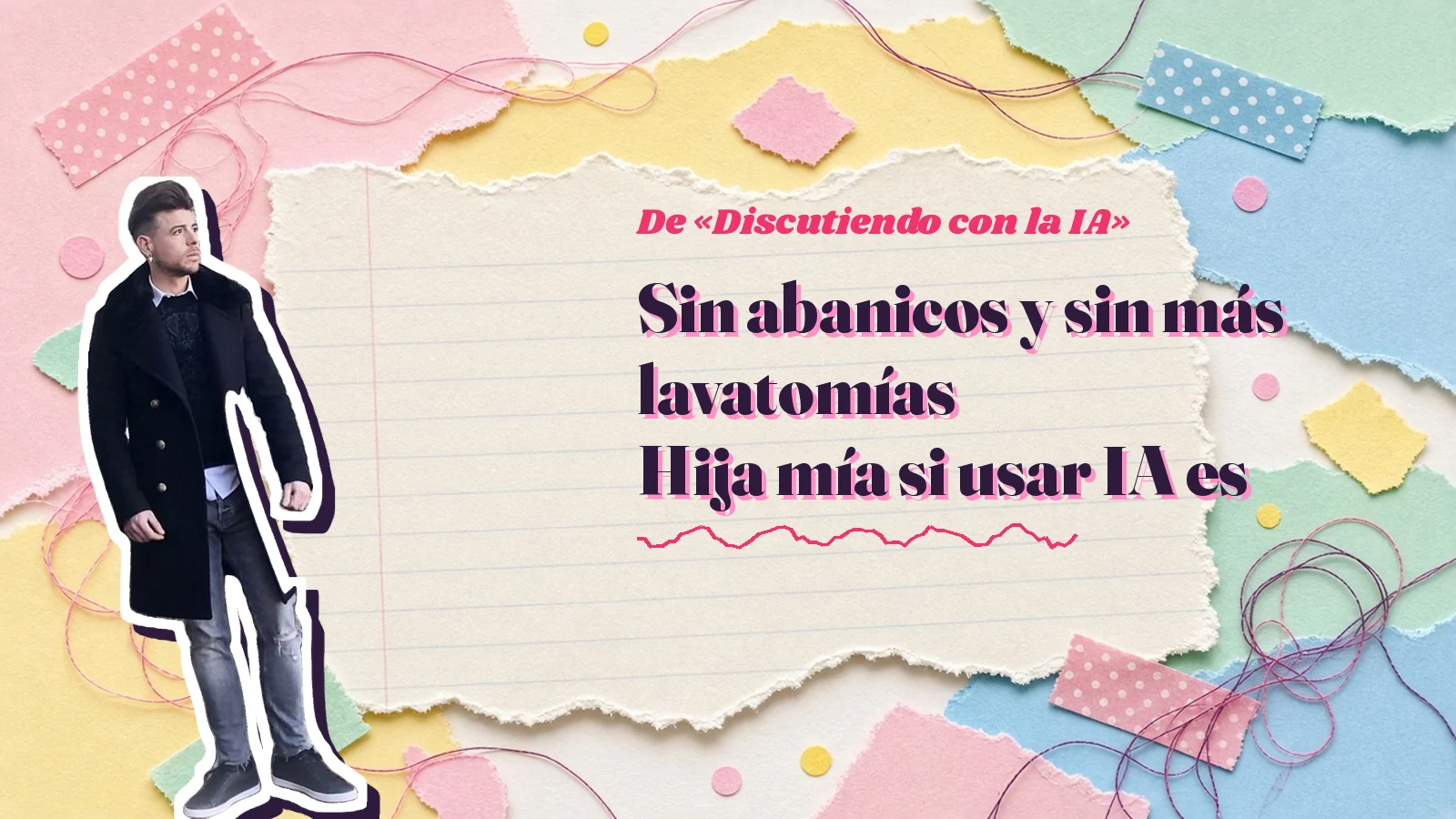
In «Malena», a danceable tribute to Malena Gracia (the Spanish showgirl and TV personality), the lyric spends almost the whole time in English and Spanish, on the dance floor, mad for a kiss. And suddenly, near the end, this appears: «Y aunque para ti / Solo soy un algoritmo / Yo soy como Malena / y nunca me rindo» («And even though to you / I'm just an algorithm / I'm like Malena / and I never give up»).
I'm just an algorithm. To you. To the one looking in from outside who thinks this is a machine churning out songs. And the answer is a diva again: I'm like Malena, and I never give up. There's nothing wrong with dancing to something different.
In «La insignia de artista» the algorithm comes as a verdict from someone very important with contacts in the music business: «Si tu música es un algoritmo / entonces no corazón / entonces no alma / entonces no distinto» («If your music is an algorithm / then no heart / then no soul / then no different»). No verb. Like a telegram. Like a slammed door. And then: there's the door, you don't deserve the artist's badge.
And in «Me mola Zeus» the algorithm is something else again: it's TikTok. It's the screen that puts the boy you fancy in front of you over and over. «Me estás jodiendo el algoritmo. / Y me mola» («You're messing with my algorithm. / And I'm into it»).
Three very different algorithms. The one belonging to someone who looks down on you, the one belonging to someone judging you from on high, and the one in the app that makes you fall in love. None of them is the one I use to produce songs. But all three are in my life. So they're in my lyrics.
I think it's telling that when the algorithm appears in one of my lyrics it's hardly ever the direct enemy. The enemy is the person who uses it as an insult. «Para ti / Solo soy un algoritmo» («To you / I'm just an algorithm»). To you. The problem isn't the algorithm, it's the eyes of whoever reduces me to that. And faced with those eyes, the songs don't reach for an engineer's arguments. They reach for Malena Gracia, for the artist's badge, for a TikTok boy with broken headphones. They reach for popular culture and desire. Which happen to be two things no algorithm can make from scratch.
From the shopping channel to code
Something makes me laugh when I line up three of these songs: «3 años de garantía», «Mi último ex era una IA disfrazada» and «Mejor que Ben Affleck». Together they tell a little story about how love gets bought.
First, the shopping channel. The dark-haired boyfriend advertised on TV, ordered by phone, paid cash on delivery, with a one-month trial and a three-year guarantee. Love as a household appliance. Like the blender that comes with a free set of knives if you call in the next ten minutes.
Then, suspicion. The ex who seemed to be flesh and blood but had a chip. Love as a breakdown.
And finally, your own factory. The boyfriend made to measure with artificial intelligence, handsome, punctual, no drama, no rows. Love as a product that finally can't go wrong.
Read like that, the three songs aren't about technology. They're about something much older: the longing for someone to love us without hurting us, and the suspicion that if such a person exists, they must come with an instruction manual. AI is just the latest gadget on a long list. Before it there were the lonely-hearts ads in the paper, then chat rooms, then Grindr. There's always been a gizmo between us and love. What's new is that now the gizmo can be the boyfriend too.
And notice that none of the three works out entirely. The dark-haired one breaks down. The ex was a robot with a betrayal chip. And the perfect boyfriend in «Mejor que Ben Affleck» is perfect precisely because he doesn't exist. None of those songs sells the machine as the answer. All of them laugh at how desperate we are.
To reveal myself
There's a text of mine that goes with «Tampoco te escandalices tanto» and works almost as a manifesto. I opened it with a line that gathers up every criticism in one go: «Me han dicho muchas veces que usar IA no es arte» («People have told me many times that using AI isn't art»).
And then comes the answer that represents me best of all the ones I've given: «La diferencia es que yo no uso la IA para esconderme, la uso para revelarme» («The difference is that I don't use AI to hide; I use it to reveal myself»).
Hiding or revealing. That's the question that really matters when someone takes up a new tool. You can use AI to show nothing of yourself, to churn out generic songs that say nothing about anyone. Or you can use it for the opposite: to finally get out things you'd kept in a drawer for years and had no means of turning into songs.
In the same text I put it another way: what's in every line grows out of something I felt before I wrote it, loss, emotional abuse, rage. «La IA no inventa eso» («AI doesn't invent that»). And I close with a line I still like: «Porque cuando uso la IA, no pierdo humanidad: la multiplico» («Because when I use AI, I don't lose humanity: I multiply it»).
It's a big line, I know. But I stand by it. A lyricist with no band, no label and none of the old-style recording studios had two options: keep the lyrics in a drawer or find another way. I found another way. And that way has let me release hundreds of songs with my words inside them.
I have to keep proving
There's one song where AI doesn't appear as a character but as a burden. As something heavy.
In «El productor de Madonna no compra en Mercadona» the lyric starts with one word per line, as if each one were hard to say: «Tengo / Que / Demostrar / Constantemente / A / Toda / La / Gente / Talento» («I have / To / Prove / Constantly / To / Every / Body / Talent»). And that my work isn't a fairy tale, even though I use AI. And then it bursts: «IA IA IA IA». Four times. Like a stammer. Like someone who no longer knows how to say it so people will listen.
That way of writing it strikes me as very accurate. Because that's what it feels like to have to justify yourself all the time. Word by word. As if every syllable had to get through security.
And the song carries on with its usual madness. Mercadona, the own-brand products, the pineapple, the cruising, the ex who loved Madonna, ninety-three songs instead of thirteen. But that opening stays with you. I have to keep proving. It's the line of anyone who does something other people don't understand.
No machine writes them
And now, what I say in the first person. Not in the lyrics, but in the texts that go with some of the songs.
In the text for «Tus letras son basura» I wrote this, and I still stand by it: «Lo que muchos no soportan es que mis letras las escribo yo» («What a lot of people can't stand is that I write my lyrics myself»). And then: «No las firma una discográfica, no las corrige un productor, y desde luego no las escribe una máquina» («No label signs them, no producer corrects them, and they're certainly not written by a machine»).
That matters if you want to understand why AI is a character and not an author. In my songs, the machine supplies the sound. The vocals. The arrangements. What you hear when you press play. But what those vocals say, every ex, every mother-in-law, every pair of coloured contact lenses, every hostel without a «full» sign, every «hasta nunca, maldita cucaracha» («good riddance, you damn cockroach»), I wrote. That's why I can put AI inside a lyric the way I put any other character in. Because the lyric is mine. And in my lyric, I'm in charge.
I explained this more slowly in what's mine in a song made with AI and in why I say openly that I use AI. Here I'll just sum it up: the machine is the orchestra. I bring the score of words from home.
What the machine supplies
While I'm at it, it's worth being clear about what AI does in my work, so nobody confuses the character with the tool.
On my website I put it like this: I take a song all the way on my own, from the first line of the lyric to release day, and artificial intelligence is my production and arrangement tool. Always in service of the lyrics and the idea behind each track. The direction, the concept and the words are always mine.
And one of the house rules puts it even more briefly: «La letra manda» («The lyric rules»). Technology changes every month; what you want to say is the only thing that isn't up for negotiation.
I call myself «the first AI songwriter», and I know the label has a catch. I don't perform my songs. I don't walk out on stage with a guitar. The vocals are made with AI. The songwriter part is about the lyrics, the composition and the direction. The AI part is about how the sound is produced. If anyone wants to know more about the instrument, I've written separately about what AI has in common with the drum machine and the synthesiser.
What I've never done is let the machine write for me. Not because it's a sin, but because then it wouldn't be my song. It would be someone else's. And that's what the charts are for.
A tool you argue with
Back to the line at the beginning. Arguing all day long.
I love that word because it takes apart the myth of the button better than any explanation. You don't argue with a button. You press a button and that's it. With AI, on the other hand, you do argue. You ask for one thing and it gives you another. And you ask again. And you throw it out. And you argue again.
That's a good part of the craft: arguing with the tool until it sounds like what you already had in your head when you wrote the lyric. It happens with any instrument. It happened with eighties synths, which didn't sound the way you wanted first time either. It happens with an out-of-tune guitar. The difference is that this tool sometimes seems to answer back.
And that's why it became a character. Because something you argue with every day ends up seeming like someone.
The exact second
I'll finish with the most serious question I've ever put to artificial intelligence in a lyric. It's in «El segundo exacto», right after all the mockery:
«¿Será que podrá la inteligencia artificial escoger el segundo exacto donde rompiste a llorar?» («Could artificial intelligence ever choose the exact second when you burst into tears?»)
It isn't a rhetorical question to look clever. It's the real question. The machine can do a lot. It can produce a chorus, vocals, a string arrangement, a rumba rhythm. What it can't do is know in which second of your life you burst into tears. You know that second. And you put it in the lyric.
That, in the end, is the whole relationship between AI and my songs. The machine puts the music around the exact second. The exact second is mine.
The full lyrics of the song on the cover, with its fanless party, its «you do it, then» and its all-day argument, are at gayfolkplanet.com/letras/discutiendo-con-la-ia. It's short. Read it twice. The second time, put Locomía on in the background.
Frequently asked questions
Which Mike Sain't Louis songs feature artificial intelligence?
Among others: «El segundo exacto», «Discutiendo con la IA», «3 años de garantía», «Mi último ex era una IA disfrazada», «Mejor que Ben Affleck», «Malena», «La insignia de artista», «Me mola Zeus» and «El productor de Madonna no compra en Mercadona».
What does «Discutiendo con la IA» say?
It answers people who look down on music made with AI with «Hija mía si usar IA es / dar a un botón / hazlo tú maricón» («Darling, if using AI is / pressing a button / you do it then, maricón»), and asks why his work didn't count if he spends all day arguing with the machine while listening to Locomía. The full lyrics are at gayfolkplanet.com/letras/discutiendo-con-la-ia.
Does AI write Mike Sain't Louis's lyrics?
No. The lyrics are always his. Artificial intelligence is his production and arrangement tool: the music and vocals of the songs are made with it.
Why does he call himself «the first AI songwriter»?
It's the label he uses himself: his own lyrics and direction, with artificial intelligence as a production tool. Mike Sain't Louis is a lyricist, composer, producer and art director; he doesn't perform the songs.