
By Mike Sain't Louis ·
When the lyric switches language: Spanglish, English and a title in French
«I'm not your supply, I'm not your drug.»
That line doesn't work in Spanish. Try it: «No soy tu suministro». It sounds like a gas bill. Like a letter from the electricity company warning you they're cutting you off for non-payment. And yet the idea is exactly the same: I am not the source you feed on, I'm not the petrol station where you fill up your ego when you're running on fumes. In English, in four words, the line slams the door. In Spanish, in four words, the line asks for your account number.
So «Not Your Supply» is entirely in English. And it isn't the only one.
I write mostly in Spanish. I say so on my page and I stick to it: most of the Planeta Gayfolk lyrics are in Madrid Spanish, with its swearing, its diminutives and its supermarket brands. But there are songs that slip into English mid-line, others written in English from beginning to end, and one with a French title. I've often asked myself why I switch. I don't always have an answer. But when I look calmly over the catalogue, I can see I don't switch at random. There are things I say in one language and things that only come out in the other.
«Suministro» sounds like a gas bill
I'll start with that word, supply, because it's the clearest case.
Anyone who has been through a relationship with a narcissist ends up, sooner or later, reading about it in the small hours. And much of what you read comes from English. Words that arrive untranslated, or half-translated: gaslighting, love bombing, no contact, supply, hoovering. They're forum words, explainer-video words, three-in-the-morning-thread words. And when you use them to understand what happened to you, they stick to you in English. Because that's how you learnt them. Because that's how they saved you.
That's why, when I sit down to write about it, English creeps in by itself. It isn't a pose. It's that the vocabulary I used to understand what was happening to me reached me in that language, the way a recipe reaches you from a friend in another country and you never translate it because that's how you make it now.
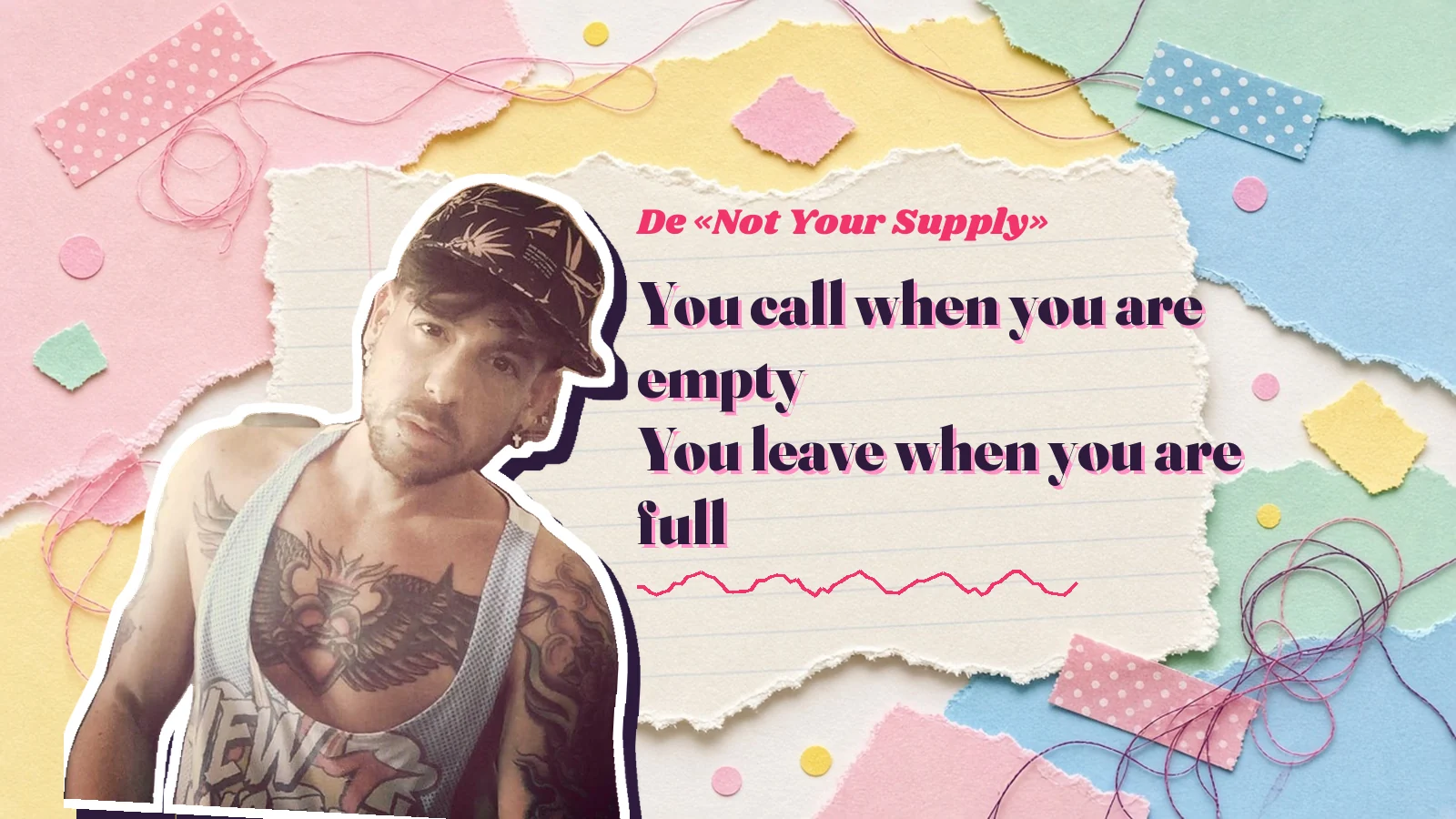
«Not Your Supply» is a song of diagnosis. It has no jokes. It has no brands. It has lines that work like an X-ray: «You call when you are empty / You leave when you are full». It makes sense in Spanish too, of course. But English has something I love here: the words are so short the line feels like a hammer blow. Call, empty, leave, full. Four blows. Then silence.
In my Spanish, on the other hand, the sentences come out long: lists, litanies of grievances with proper names and specific places. It's the language of a row on the landing. English, for me, is the language of the medical report.
«Mi therapist me ha ayudado»
Between full English and full Spanish lies a vast territory everyone knows and almost nobody dares to write down: dance-floor Spanglish.

«No Contact» is written like that. One line in one language, the next in the other, and sometimes both in the same line: «Mi therapist me ha ayudado / No contact and desenmascarado». "My therapist has helped me / No contact and unmasked".
If a language teacher read that, they'd come over faint. If someone who's been out on a Saturday night in Madrid read it, they'd recognise it at once. That's how we talk. That's how the girls talk in the cloakroom queue. «Tía, estoy fatal, pero es que el tío era super toxic.» "Babe, I'm in bits, but honestly the guy was super toxic." «Le he hecho ghosting y me siento libre.» "I've ghosted him and I feel free."
It isn't an upper-class language or a working-class one. It's the language of an era. It's what happens when you grow up with series in the original version, English songs in every club and a phone that talks to you in both languages at once. And I wanted that to be heard in my lyrics without apology.
There's another, more practical reason. Spanglish lets me rhyme things that don't rhyme in a single language. «Bye drama» with «no más trauma». «Comeback» with «snapback». It's like having two toolboxes open on the same table. If I can't find the screwdriver in one, I take it from the other. And in the end the line sounds like what it is: someone dancing so as not to think.
What I almost never do is put the English in the joke. The joke, in my lyrics, stays in Spanish. Because a joke needs the language of the gut, the one you learnt before you could read. In «No Contact», English is there for the rush. Spanish is there for the detail.
«No me mires el pecho»
That division of labour is crystal clear in «Licenciada en derecho».
The song is almost entirely in English. Heels on the pavement, law books in the handbag, planes, Madrid to Miami. All in diva-video English, catwalk English, «I'm a boss lady» English. And then the chorus arrives and the lyric drops into Spanish with the most Madrid line in the world: «No me mires el pecho, que soy licenciada en derecho». "Don't look at my chest, I've got a law degree".
That line can't be translated. Well, it can, but it dies on the way. The fun is in the internal rhyme, pecho with derecho, chest with law, and the mix of professional dignity and cleavage. It's a bar-room line, the clever sister-in-law's line, the line of a woman who knows her worth and can't be bothered to explain it to you. In English it would be a slogan. In Spanish it's a zasca, a proper put-down.
So English builds the set and Spanish delivers the punchline. It's like a Broadway musical where, in the final number, the leading lady suddenly breaks into bulerías, the fiercest of flamenco rhythms. That's what I most love doing with languages: letting one take aim and the other fire.
«Barcelona, tú y yo»
There are songs where I do exactly the opposite. English is home and Spanish is the guest.
«Barcelona» is written in English, with short lines of night and beach. City lights, sand, the bass quickening your pulse. And every so often, in quotation marks, scraps of Spanish appear: «acércate a mí», come closer to me; «nos liberamos», we set ourselves free; «La noche nos envuelve», the night wraps around us; and the chorus, a name repeated like a mantra: «Barcelona, Barcelona, tú y yo, Barcelona». "Barcelona, Barcelona, you and me, Barcelona".
There, Spanish works the way English worked in so many Spanish songs of the nineties: as spice. Like that phrase in another language that makes you feel you're on holiday. I had great fun writing it that way, turning the trick on its head. If for years songs from here slipped in a «baby» or a «tonight» to sound international, why can't I write a song in English that slips in an «acércate a mí» to sound like summer on the coast?
Something similar happens in «Madrid to Benidorm». The lyric is in English, but the places are mine. Madrid. Benidorm. That stretch of motorway every madrileño has driven at some point with a cool box in the boot. Saying it in English turns it into something else: a film road, a road movie with a rainbow. And at the same time it's still the A-3 on a Friday afternoon.
I love that double life of places. Benidorm in Spanish is a joke about pensioners and stag dos. In English it suddenly becomes a destination. Both are true.
«Aaaaaaayyyyy mi pena»
There's one song where the change of language feels almost like a ceremony.
«Before the Bells» is written in calm English, with no Spanglish and no dance-floor rhymes. It's a lyric about the moment before something big happens, when there's no victory yet and no plan, only being there. «No victory, no hidden plan, / Just being here the best we can.» It's one of the stillest lyrics I've written.
But it doesn't begin in English. It begins with a quejío, the drawn-out cry of flamenco and copla. «Aaaaaaayyyyy mi pena / Ayyyyyyyyyyyy mi penita.» "Ohhhh my sorrow / Ohhhhhh my little sorrow".
A copla lament, with every a and every y stretched until it hurts. And then, with no transition, the unhurried English.
For me that opening explains everything. Before I get solemn, I have to lament the way people lament here. With the pena and the penita, which aren't the same thing: the penita is the sorrow you've grown fond of. That cry is the entrance ticket. After it, I can talk slowly, in another language, about what you let go of and what you don't.
If you ask me why, I'll tell you English gives me distance. There are things that burn my hands in Spanish and that I can hold in English. It's like telling a stranger on a train about your life: you tell them more than you'd tell your mother, because they won't look at you differently on Sunday.
«Ain't no rainbow in my sky»
That distance is even more noticeable in «Dark Corners», which is probably the saddest song I have in heels.
The lyric mixes both languages, but here Spanglish isn't a party. It's a disguise. «Ain't no rainbow in my sky / No glitter tears, just quiet eyes.» And in the middle of it, a line in Spanish that for me is one of the saddest in the catalogue: «En mi cabeza hay un party gris». "In my head there's a grey party".
A grey party. The dance floor full on the outside and switched off on the inside.
What interests me about that song is that the language-switching mimics what happens on a bad night. You speak English with the man you've just met, you laugh in Spanish with your friend, you think in a language that is neither. And at the end of the lyric comes the question someone asks you at the bar when you're already very far away: «Hey… are you okay?». And the answer we all give: «Yeah… just dancing…».
That answer doesn't come to me in Spanish. «Sí, solo bailando» sounds like an excuse. In English it sounds like an excuse everyone accepts. And that's exactly what the song needed: a polite lie nobody looks into.
«Paris restera gris»
And then there's French, which turns up rarely in my catalogue and almost always in a title.
«Paris restera gris» is about the end of a long relationship and a trip to Paris planned a thousand times and never taken. The hotels browsed on Google Maps. The suitcases that never left the wardrobe. The city of love turned, as I wrote when I introduced it, into «el escenario de una ausencia», the stage of an absence.
The title is in French because Paris is the place we never reached. It seemed right for the song to carry the language of the place left waiting. Like putting the name of whoever was meant to sleep there on the door of an empty room. Paris will stay grey. It says so in its own language, because in ours there's nothing left to say to it.
I don't speak French the way I speak English. I use it the way you use the name of a perfume: for how it sounds and what it brings to mind, even if you don't fully understand it. And in a song that's precisely about what didn't happen, that distance was exactly what it needed.
«Solo soy un algoritmo»
There's a moment in «Malena» that sums up very well how I live alongside languages, and alongside tools.

The song is a dance-floor tribute to a diva, written in club Spanglish: «Dancing through the night, ella reina», she reigns. All shine, all pose. And then suddenly, at the end, the lyric switches to full Spanish to deliver a line that has nothing to do with the diva and everything to do with me: «Y aunque para ti / Solo soy un algoritmo / Yo soy como Malena / y nunca me rindo». "And even if to you / I'm just an algorithm / I'm like Malena / and I never give up".
I couldn't say that in English. It's an answer to those who say my work doesn't count because the music and vocals are made with artificial intelligence. And that answer had to be in the language they say it to me in, which is mine. The "a machine made that" comments reach me in Spanish, misspelt and full of good old Castilian spite. So I answer them in kind.
The lyrics, in both languages, are mine. I write them, I edit them, I decide where the language changes and where it doesn't. The tool helps me with the music and the vocals, but it doesn't tell me when to jump from «dancing» to «nunca me rindo». That leap is a lyricist's decision. The most mine of all, if you push me.
«Vine a tomar mi space»
There are songs where Spanglish is neither party nor disguise. It's attitude. It's a way of standing your ground.
In «Soy marica sideral» the lyric opens like this: «No vine a salvar tu mood, / vine a tomar mi space». "I didn't come to save your mood, / I came to take my space".
I could have written it in Spanish. «No vine a salvarte el ánimo, vine a ocupar mi sitio.» It means the same. But it loses the swagger. Mood and space are words you say with your chin slightly raised, sunglasses on even at night. They're the words of someone who no longer asks permission to walk into the room.
And the lovely thing is that the song, after that very English entrance, returns to Spanish for what matters. For what truly hurts and makes it proud. «Me han llamado exagerada, / teatral y emocional.» "They've called me over the top, / theatrical and emotional".
In English that wouldn't carry the same fury, because the insult was thrown at me in Spanish, in the feminine and with a sneer. And to answer it I have to use the same weapons.
That's the mechanism repeated in nearly all my bilingual lyrics. English opens the door with style. Spanish walks in to tell you what happened.
I won, in two languages
There's one case I find especially funny, because it mixes both languages inside a single three-word phrase.
In «Gaslighting», after a whole song shaking off someone else's lies, the protagonist celebrates: «I won maricón». The verb in English, the term of endearment in Spanish. And I wouldn't change it for anything. «I won» is the video-game victory, the quiz-show win, the final whistle. «Maricón», reclaimed here the way friends throw it at each other, is the slap on the back from your friend at the door of the bar. Together they're exactly what it feels like when you finally get out of something like that: you win like in a film and celebrate like in your own neighbourhood.
Had I written it all in English, it would sound like a T-shirt slogan. All in Spanish, «he ganado, maricón», it would sound like an after-dinner anecdote. Mixed, it sounds like what it is: a dance-floor shout on a night when you finally feel light.
Sometimes I think that's what Spanglish is. Not failing to speak either language properly. Needing both to say one whole thing.
The listener's language
There's one last thing I bear in mind, even if it doesn't look like it. Who's going to listen.
I picture the Spanish songs playing in Madrid, in a car on the way to the beach, in a kitchen with the radio on. The English and Spanglish ones, on the other hand, I picture in places where I don't know who's there. On a playlist in another country, in the headphones of someone who's never set foot on the Gran Vía and perhaps only understands half of it. And I like that idea. That someone on the other side of the world hears «No me mires el pecho, que soy licenciada en derecho» without knowing what it means, keeps the music of the phrase, then looks up the translation and laughs.
I don't write in English to reach more people. Or not only for that. I write in English when the line asks for it. But if along the way the song leaves home and arrives somewhere else, all the better. Songs have the right to travel without a passport too.
The rules I didn't know I had
When I put all this together, I end up with rules I never wrote down but nearly always follow.
The joke goes in Spanish. So does the insult with a proper name. Brands, neighbourhoods, the nosy neighbour, the mother-in-law, the doorman: in Spanish, because they only exist in Spanish.
The cold diagnosis sometimes goes in English. So do the words I learnt on late-night forums to understand what had happened to me. Supply, gaslighting, no contact.
The dance-floor rush goes in Spanglish, because that's how people talk on the dance floor.
Real sorrow begins in Spanish, with a quejío, and sometimes escapes into English so I can keep talking without the sentence breaking.
And the places we never went carry the language of the place.
I don't know if they're good rules. I know they're mine. And I know that when I break them, the song usually limps. If I put the joke in English, it shrinks to an anecdote. If I put the diagnosis in broad Madrid Spanish, it becomes a sainete, a comic sketch. Everything in its own language, like every dish on its own plate.
A website in two languages, lyrics in their own
My website is in Spanish and English. I've explained why in another piece, the one about why I write in Spanish, and I won't repeat it all. I'll just note one thing that amuses me: the website changes language at the press of a button, and the lyrics don't. The lyrics stay as they were born. «Not Your Supply» will stay in English even if you read it on the Spanish version of the site, and «Licenciada en derecho» will still land its punchline in Castilian even if you come in through the English door.
That seems fair to me. A lyric isn't an informative text you have to translate so it can be understood. It's an object. It has the shape it has, with its seams and its mixtures. If you translate it, you make something else. Which may be fine, but it's something else.
If you want to hear how each one sounds in its own language, they're all in the lyrics archive. And the four-word door-slam, the gas bill I refused to write, is there in full at gayfolkplanet.com.
You call when you are empty. I write when I am full.
And in whatever language I damn well please.
Frequently asked questions
What languages does Mike Sain't Louis write his songs in? Mostly Spanish. He also has songs in English, lyrics in Spanglish and the odd one in French or Portuguese, as listed on his artist profile. The lyrics are always his own; the music and vocals are made with artificial intelligence tools.
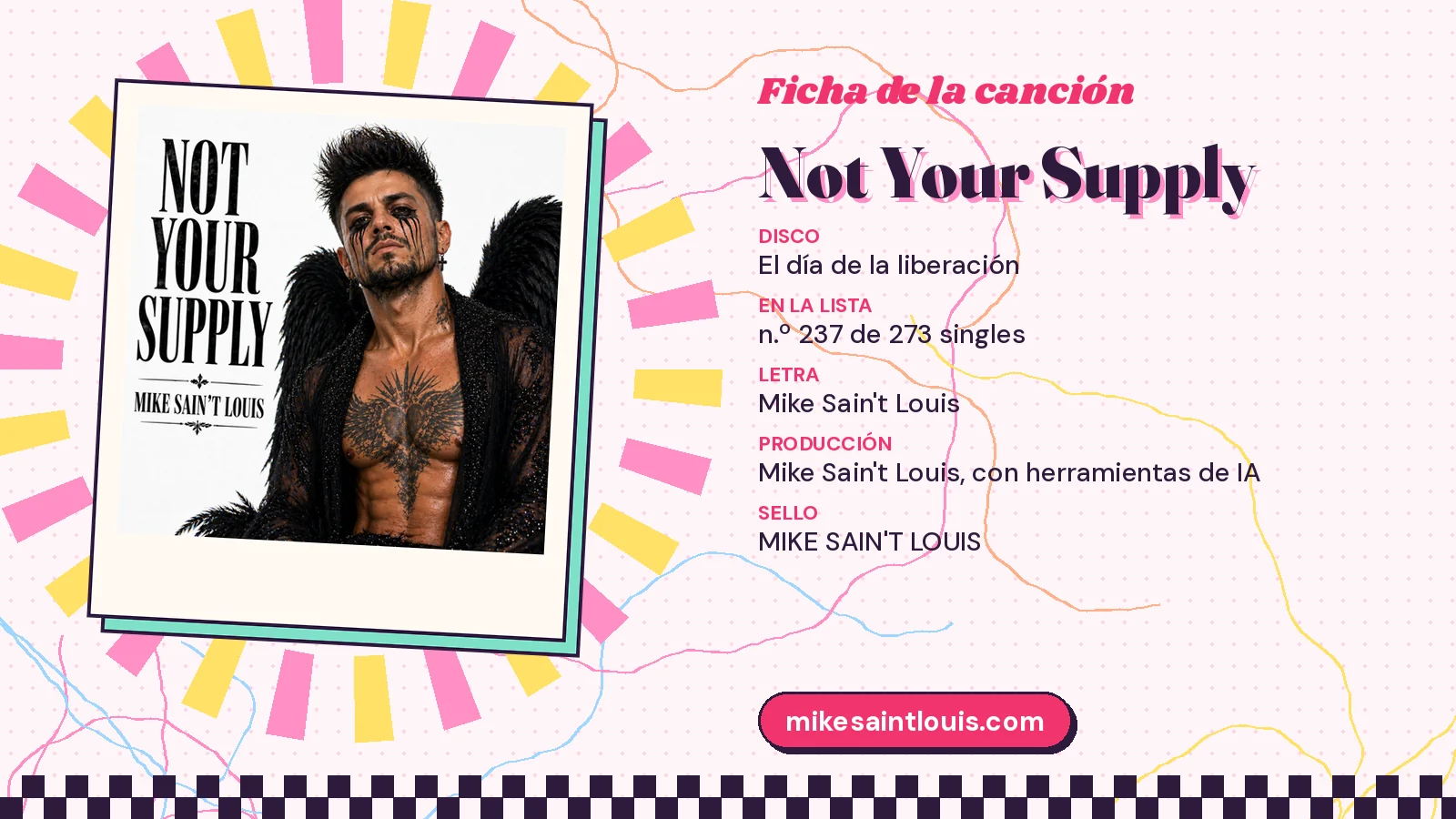
What is «Not Your Supply» about? Refusing to go on being the source a narcissist feeds on. It's written entirely in English and belongs to «El día de la liberación», the third album of the Planeta Gayfolk trilogy.
Why does he mix Spanish and English in some lyrics? Because that's how people talk on many dance floors and in many groups of friends, and because each language does a different job for him: the joke and the detail in Spanish, the diagnosis or the dance-floor rush in English.