By Mike Sain't Louis ·
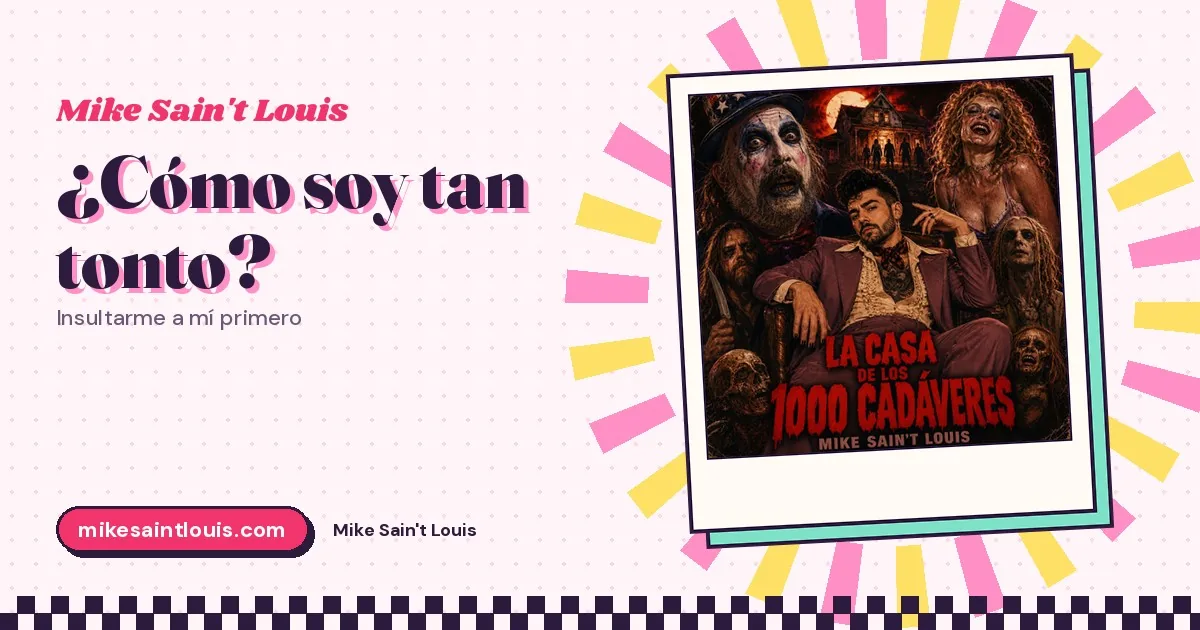
How can I be so stupid?: insulting myself first in «La casa de los mil cadáveres»
The first insult in the song is for me. So is the second. The ex has to wait his turn.
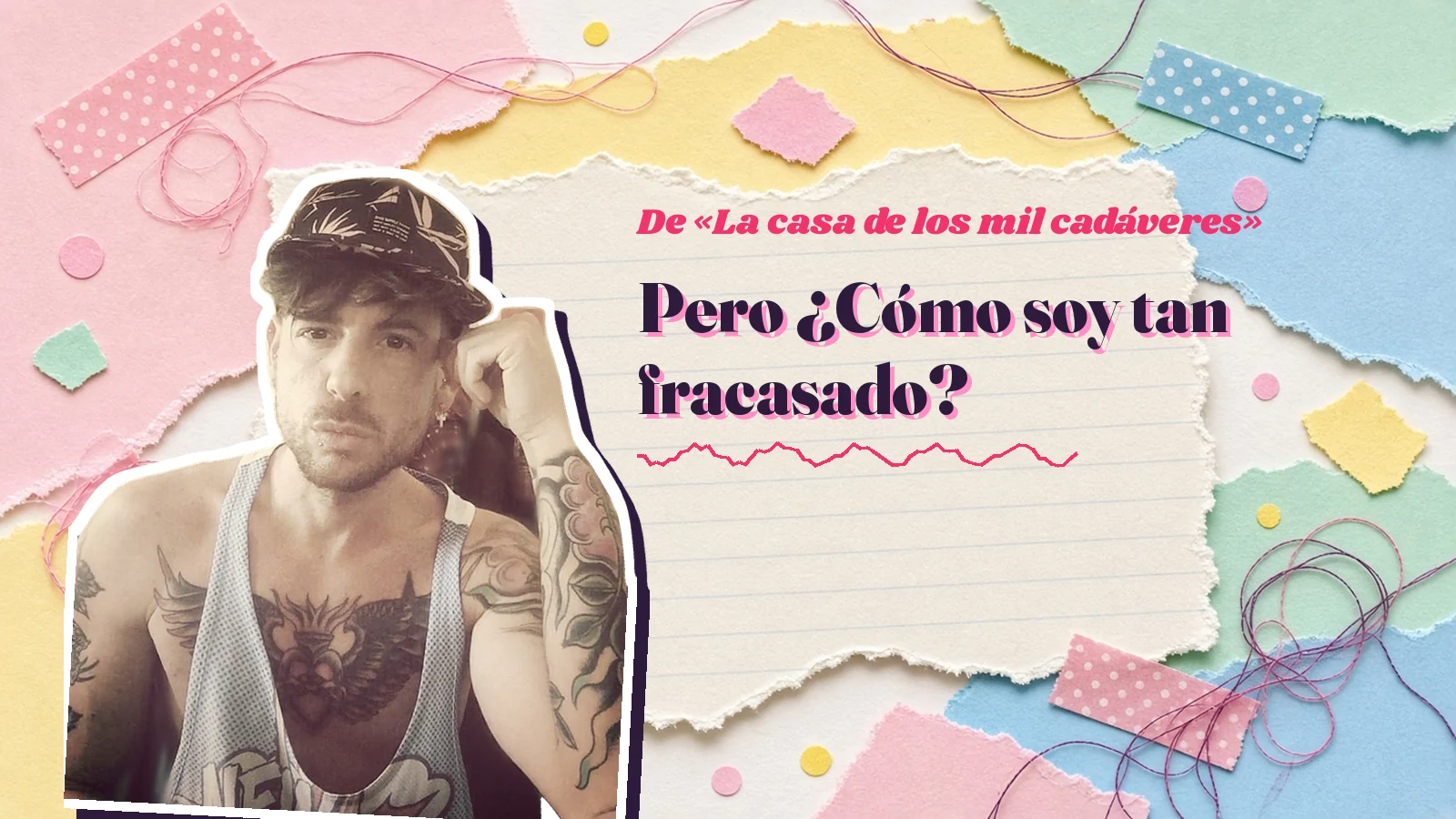
«La casa de los mil cadáveres» opens with a question I've asked myself in the bathroom mirror more times than I'd like to admit, and I admit it here because that's what I write songs for. In Spanish the question mark opens halfway through the line, because that's how it came out and that's how it stayed: but… how can I be so stupid? And a few lines further down, in case it wasn't clear, the extended edition: but… how can I be such a failure?
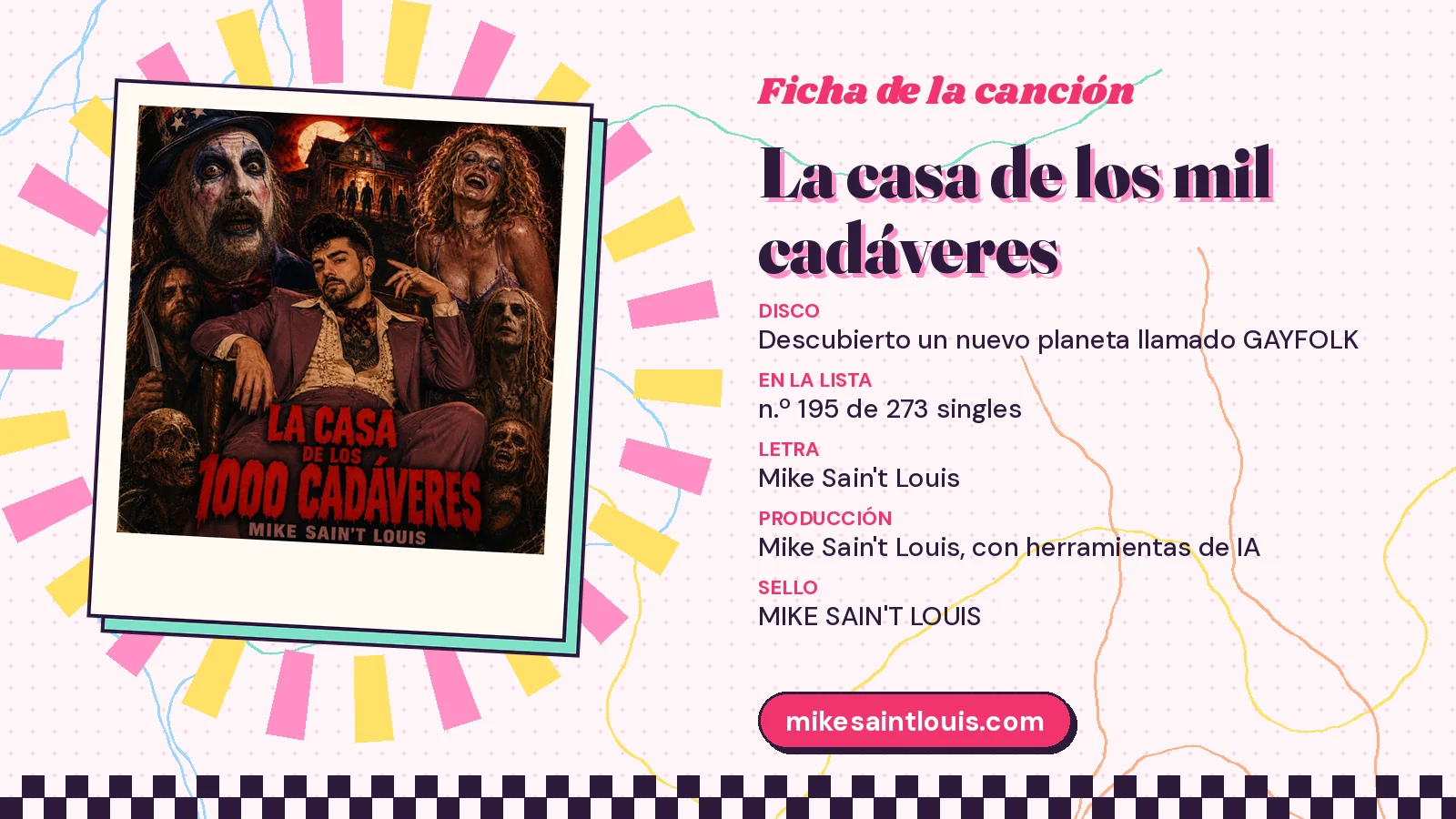
It's on the first album of the trilogy, «Descubierto un nuevo planeta llamado GAYFOLK», and on the Planeta Gayfolk singles list it's track 195 of 273, between «Envejecer» and «Montaña rusa». Look at the neighbours: one song about growing old hand in hand, another about the highs and lows of love. And in the middle, this one, the nosedive with self-insult included.
In the song's own page I told you about the bribe of half a chicken, the gossip on the housing estate and the cockroach at the end. Today I want to stay with something more intimate and, at the same time, more technical: why I start a song against an ex by insulting myself. And why I think it's the best decision I made while writing it.
Me first
«Pero ¿Cómo soy tan tonto?»
Most heartbreak songs start by pointing outwards. You cheated on me. You lied to me. You're a this and a that. And fair enough, we all love a good accusing finger with a painted nail. But I have a habit, almost a tic, that kicks in every time I write about a letdown: before pointing at the other one, I point at myself.
It isn't humility. Let nobody be fooled. It's strategy. If I insult myself first, I take the temptation away from the listener. It's like turning up to a dinner with a stain on your shirt and mentioning it before anyone else does: «Yes, I know, it's tomato, don't say a word». From then on the stain is yours. Nobody can use it against you.
A love-gone-wrong song works the same way. Everyone listening is thinking the same thing: how on earth didn't you notice? Well, I'll ask it myself. In the first line. And in uglier words than you'd use.
The question mark in the middle of the line
A punctuation detail, which perhaps only interests me, but which says a lot about how the self-insult works.
In the published lyrics, the question begins with a «Pero», a «but», and the opening question mark comes after it. Not before the «Pero». In other words, the «but» stays outside the question, like a sigh beforehand. First you huff. Then you ask yourself.
Some would call it a mistake and say the rules want something else. Maybe. I like it this way because it resembles how that sentence gets said in real life. Nobody says «how can I be so stupid?» out of nowhere, cold. You say it after a «but», after a click of the tongue, after dropping your keys on the hall table. The «but» is the background noise of shame.
And it also has something of an interrupted conversation. As if you'd been talking to yourself for a while, going over everything that happened, and suddenly let slip the «but» that sums it all up. But, come on. But, hang on a minute. But… how can I be so stupid?
I think that little typographical oddity does more for the tone of the song than any adjective. That's why I've never touched it.
Stupid, which isn't the same as naive
I chose «tonto», stupid, and not some other word, and I chose it carefully.
I could have written naive, which is more refined and sounds like a Galdós novel. I could have written trusting, which sounds like a scam-prevention segment on the evening news. But stupid is a playground word. It's what your big brother calls you when someone pulls one over on you. It's what you say out loud when you bang your hip on the corner of the table.
I like it because it has no frills. It isn't trying to look good. A naive person has something endearing about them, a good-hearted character the audience wants to protect. A stupid one, no. A stupid one is a bit infuriating. And at that point in the song I was infuriating myself. I wanted it to show.
Besides, in Spanish «tonto» rhymes with everything, more or less. It's a very handy word for someone who writes in market-stall rhymes, like me.
A failure, the second slap
«Pero ¿Cómo soy tan fracasado?»
If «stupid» is the clip round the ear, «failure» is the open-handed slap.
Here I'm no longer just talking about not having noticed. I'm talking about all of me. My life. The very specific feeling that everything I did went wrong and that relationship was the final proof. Failure is a heavy word, a word for a file. It's what they write in red on your school report, what older men tell each other at neighbourhood bar counters over their third brandy-laced coffee.
What tickles me, and why it works in the song, is that right after saying it comes the opposite line: today I've forgotten you and I've buried you. So the failure, in the same breath, puts on the gravedigger's cap and shovels earth over the other one. It's a brutal mood swing, the kind I have in a lot of songs. From flat on the floor to grabbing the spade.
That's the beauty of insulting yourself first. It frees your hands for what comes next.
The ladder of insults
If you look at the full lyrics, the insults climb from one addressee to the next, like a block of flats.
On the first floor, there's me. Stupid. A failure.
On the second floor, the doorman, bought off. And the neighbour on the third, also bought off, this one at a better price. I don't insult them directly, but I leave them portrayed as people who sell themselves cheap.
On the third floor, the riff-raff the other one sleeps with, which isn't a pretty insult but is a collective one. The people in the corner villa. The neighbour's husband.
And right at the top, in the penthouse with a terrace, there's him. Lowlife. Clown. Fake. Lunatic. And the cherry on top: cockroach.
I like that structure because it's fair, in a very neighbourhood sense. First I put myself in my place, then I put everyone else in theirs. Nobody comes out clean. But the one who gets the most earth thrown on him is the one who most deserves it.
The fool who keeps coming back
It's not the only time I call myself stupid or an idiot in the catalogue. It's almost a signature.
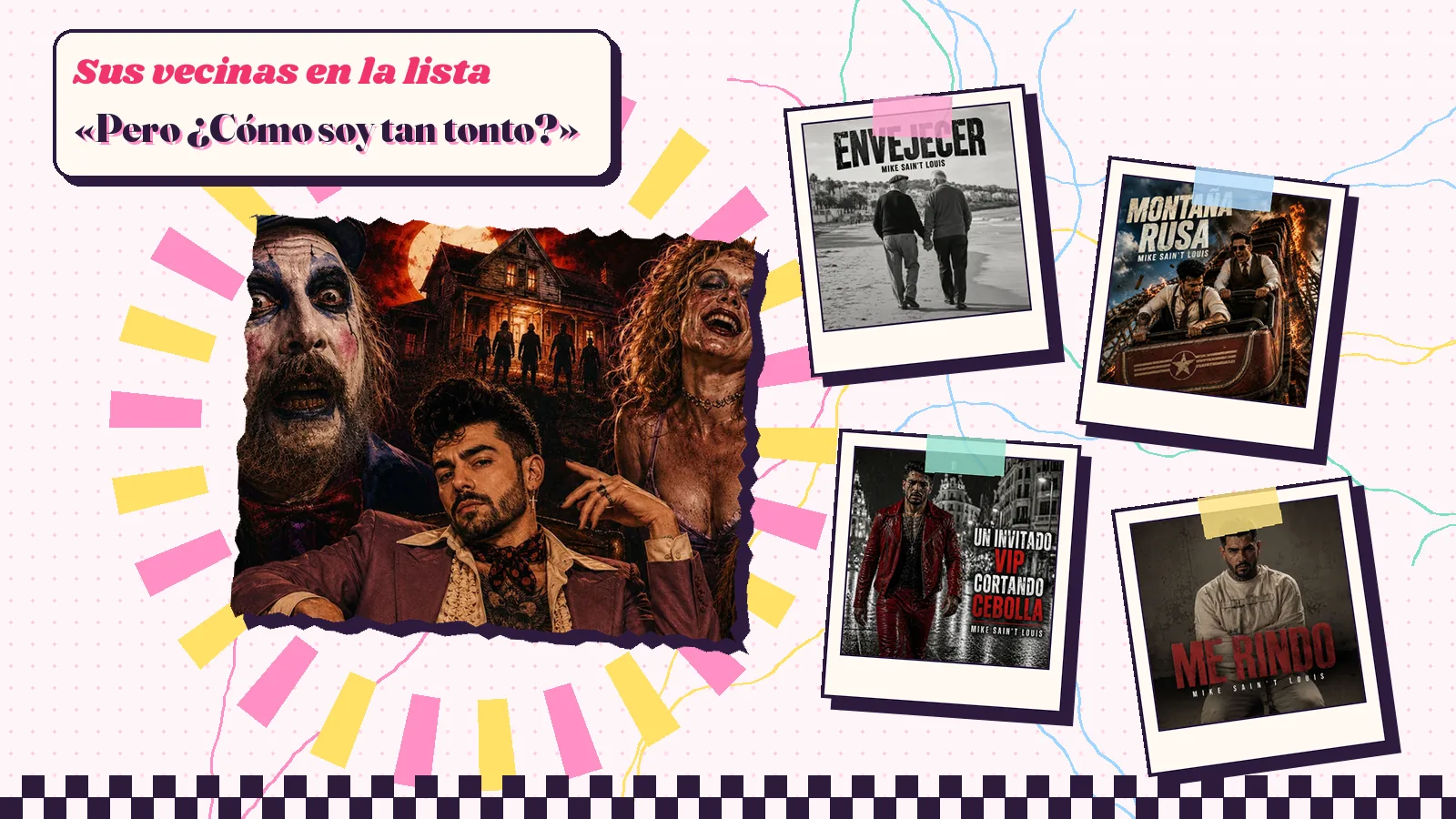
In «Un invitado VIP cortando cebolla» the narrator doesn't want to be the only idiot who stays home painting butterflies while everyone else goes out. In «Me rindo» the one who thinks he's clever turns out to be a circus, and I don't make clear whether the clever one is me. If you counted the times I make a fool of myself in my own lyrics, I'm not sure it would come out longer than the list of grievances against my exes, but it would be close.
I don't plan it. It just comes out. I think it comes from something very simple: I find the figure of the fool funny. The fool in the Paco Martínez Soria films, the village idiot who turns out to be the clever one in the end, the fool in the Álvarez Quintero brothers' farces who sees everything from the doorway. It's a character with a long tradition in Spain, and I sign up to it without asking permission.
The good thing about the fool is that nobody's afraid of him. He can say anything. He can ask what nobody asks. He can make a fool of himself and, in the foolishness, tell the truth. That's why I love starting a song by calling myself stupid: from there on, I can say whatever I please.
The conditionals
There's a part of the song that its own page mentions and that I want to look at here from the angle of the self-insult, because it's where it shows best.
Four sentences that start the same way. If I had known. If I had listened. If I'd known. If I'd caught on. It's a litany of conditionals, a kind of secular rosary of what might have been.
And look at the subject of every one of those verbs. It's me. I didn't know. I didn't listen. I didn't catch on. Each conditional is, deep down, another «how can I be so stupid?», only the long version with a compound tense. The blame comes back to me in every line, even though the consequences point at him: if I'd known, I'd have sent you back to your mother; if I'd caught on, I'd have left you alone with your failure.
This is very typical of people coming out of relationships with narcissists. I've written it in plenty of songs. You get out, and the first thing you do isn't hate the other one: it's go over every moment when you should have noticed. The signs. The phrases. The looks. It's an exhausting, unfair exercise, because it loads you with a responsibility that isn't yours. But it's human. And the song shows it without correcting it.
What a friend would tell you
Now let me be serious for a moment, because that's called for too.
Insulting yourself in a song is a comic device, and I'll defend it. But in real life, if you spend all day calling yourself stupid and a failure for having trusted someone, that's no longer comedy. It's something else. And it's worth knowing.
What a friend would tell you, and what I tell myself now that time has passed, is that you weren't stupid. You trusted. And trusting isn't stupid; it's what people do when they haven't yet lost the capacity to love. The fool, if there is one in this story, is the one who played you thinking nobody would notice.
And if you're still in the conditional phase, the if-I'd-known, if-I'd-listened phase, give yourself some time. That phase passes. Not overnight, and not with an airport self-help book, but it passes. One day you wake up and you're no longer going over the signs. The signs are there, in the past, where they belong, and you're here, having breakfast.
That's the only moral I intend to put in this whole article. There. Back to laughing.
Pepi Valladares and the house
The song has a chorus that mixes my self-insult with the title, and it's what people ask me about most: I feel like Pepi Valladares in the house of a thousand corpses.
I'm not going to tell you who Pepi Valladares is. Not out of mystery, but because I'd rather everyone imagined their own Pepi. To me it sounds like the name of a lifelong neighbour, the kind who has keys to half the building and knows who comes and goes. But she can be whoever you like.
What I will tell you is that the title comes from a horror film. «La casa de los mil cadáveres» is the Spanish title of Rob Zombie's «House of 1000 Corpses» from the early 2000s, one of those films full of basements, sinister clowns and families who invite you to dinner and won't let you leave. It struck me as the perfect place for someone who's just buried an ex. In a house with a thousand corpses, one more goes unnoticed.
And there the self-insult returns, but turned inside out. If I feel like that, in a house full of corpses, it's because I've buried a lot of them. This isn't the first time. And that, which could be a source of shame, becomes experience in the song. So I'm not that stupid, then. I've got a whole cemetery of exes in the basement. I must have learned something.
A thousand, as a manner of speaking
A note on the number in the title, which isn't mine but which I made mine.
A thousand corpses is a lot. Not even the most womanising ex in a Venezuelan telenovela racks up a thousand. It's a horror-film exaggeration, the kind on a local cinema poster with letters dripping blood. But slipped into a breakup song, the exaggeration turns into self-parody again.
Because anyone who feels they're in a house with a thousand corpses is really saying they've been through plenty. Plenty of failed relationships. Plenty of disappointments. Plenty of funerals nobody heard about. It's a way of saying «here we go again» with the volume cranked all the way up.
And it's also, I admit, a way of laughing at my own taste for drama. If I have to count my exes, I don't say «three or four». I say a thousand. And I stay perfectly calm, with my gravedigger's spade and my earth-stained apron, like the owner of a house of horrors who greets you at the door with a smile and a tray of suspicious canapés.
Laughter comes back
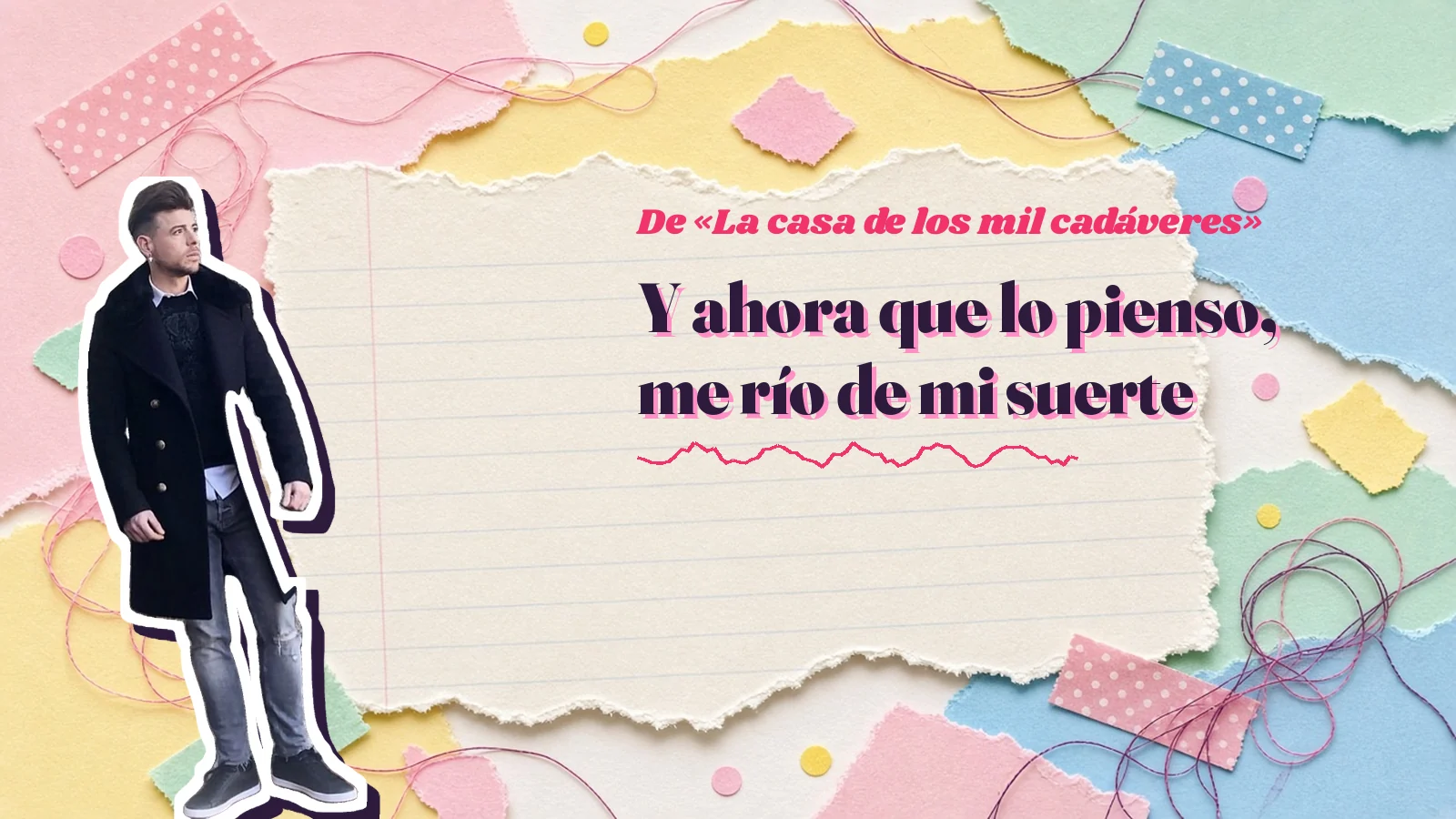
«Y ahora que lo pienso, me río de mi suerte»
This is the line that closes the circle of the self-insult. I started by calling myself stupid. I went on to call myself a failure. And I end up laughing. Not at him. At my luck.
For me, this is the exact point where a breakup song stops being spite and starts being something else. When you can laugh at what's happened to you. Not at what was done to you, mind, that still isn't funny. At what's happened to you. At the bad streak. At how many times you've landed the same kind of person, as if fate had a catalogue with a single page.
And right after, the last line of the verse, the one I most enjoy saying out loud: I've learned my lesson, what a run of bad luck. It's a grandmother's line. The kind said with an apron on while peeling a potato. It isn't a self-help lesson. It's a statement of fact. I got what I got, I learned something, that's that.
And then, finally, the last insult. The cockroach. But I've already told that one on the song's page.
Why the self-insult is funny
People sometimes ask me what the secret of the humour in my songs is. I don't have a secret, I have quirks. And this is one of the biggest: laughing at myself before anyone else.
I explained it more calmly in what makes me laugh when I write. If I laugh at myself first, I earn the right to laugh at others. It's like paying for your ticket. A song that only laughs at the other person sounds like revenge, and revenge gets boring fast. A song that starts by laughing at whoever wrote it has a different tone. It's an invitation. Look how stupid I've been, now look what he did to me, and now laugh with me at the pair of us.
In queer humour this has a long history. The old-school queens laughed at themselves before anyone else could, as a way of defusing the blow. I talk about it in from being laughed at to laughing back: for a long time the laughter about us came from outside, and what we did was keep it for ourselves. Insult ourselves first. Call ourselves queens before anyone else got the chance.
In this song I call myself stupid before anyone else can. It's the same operation, in miniature.
The limits of the banter
There's a line I don't cross, even though this song brushes against it many times. Laughing at people who have nothing to do with it.
The lyrics have neighbours, doormen, the husband of the woman in the villa. They're stock farce figures, nameless and faceless, that anyone can fill in with the characters from their own estate. They aren't real people anyone could point to. If they were, the song wouldn't exist. I told you about it in making gay humour without causing harm: the joke has to aim upwards or at yourself. Never at someone who can't defend themselves.
That's why the self-insult is so comfortable. I can defend myself. And besides, since I wrote it, I get the last word.
Who puts the words in
The lyrics are mine, written without AI. The music and vocals are produced with artificial intelligence tools, such as Suno, which I direct; I always say so, and it's all explained in About Mike. I mention it here with a particular intention, because this song is almost an exercise in self-portraiture. A machine doesn't call itself stupid. It has nobody to say it to and nothing to be ashamed of. The self-insult is one of the most human things I know.
How to listen to it
Here's an exercise for you, and it's free.
Put the song on and, in the first chorus, when the question about how I can be so stupid arrives, say out loud the name of the person you'd dedicate it to. Not him. You. That moment when you called yourself stupid over someone. We've all got one.
And then, in the final verse, when the bit about laughing at my luck comes round, laugh. Even if it's forced, like in those laughter-yoga classes that turn up in the Sunday features. Forced laughter, by the third try, turns real.
The full lyrics are on gayfolkplanet.com and in this site's lyrics archive. And if you're fond of neighbours who know everything, the blog has a whole article on the nosy neighbour, Pepi Valladares's first cousin.
Stupid, I was. A failure, at times. But the one who ended up buried wasn't me.
Frequently asked questions
What is «La casa de los mil cadáveres» about? It's a breakup song with a lot of humour. It starts with the narrator calling himself stupid and a failure for not noticing sooner, moves on to the bribes, the gossip and the ex's photos doing the rounds of the estate, goes over everything he'd have done had he known, and ends by laughing at his luck and signing off with a «good riddance».
Which album is it on? On «Descubierto un nuevo planeta llamado GAYFOLK», the first album of the GAYFOLK trilogy. On the Planeta Gayfolk singles list it's track 195 of 273.
Where does the title come from? The title comes from Rob Zombie's horror film, released in Spain as «La casa de los mil cadáveres» («House of 1000 Corpses»). In the song it's the image for someone who has already buried more than one ex: in a house like that, one more goes unnoticed.
Who writes the lyrics, and how is the music made? The lyrics are mine, written without AI. The music and vocals are produced with artificial intelligence tools, such as Suno, which I direct. I'm a Madrid-based lyricist, composer and music producer, the first AI songwriter.
Where can I read the lyrics and listen to it? The full lyrics are on the song's page and on gayfolkplanet.com.