
By Mike Sain't Louis ·
Film noir in a pink raincoat: «Dans la nuit», movie rain and the walk back home
There's a scene cinema has repeated a thousand times and I never tire of watching. It's night, it's raining, a figure walks alone down a wet street and the light of the streetlamps reflects on the asphalt as if the ground were a broken mirror. No dialogue is needed. With the sound of the rain and the footsteps you already know something has happened or is about to.
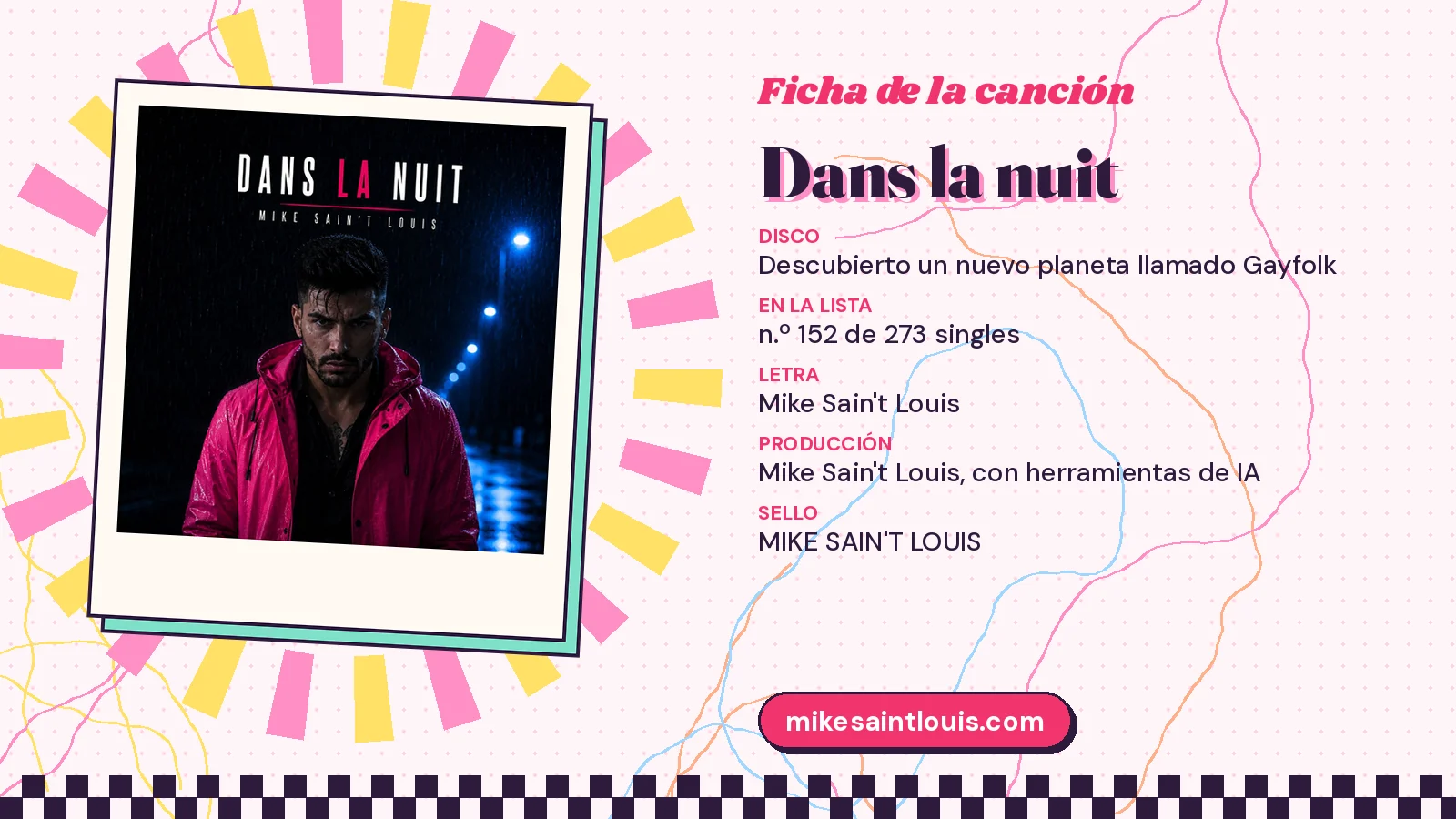
The cover of «Dans la nuit» is exactly that, with one difference: the figure is me and I'm wearing a fuchsia raincoat. That pink stain in the middle of a film-noir scene is what makes me love this image so much. In this post I'm not going to tell you the lyrics, which aren't published, or reveal what happens that night, because I already said on its page that I'd rather keep it to myself. What I am going to do is walk through everything surrounding that photo: cinema, rain, the raincoat, the streetlights and the way back home.
A frame with rain
The image is taken head-on. My hair is wet, my serious gaze fixed on the lens, and I'm wearing a raincoat of the most intense pink. The rain falls in fine lines, almost like scratches on film. Behind, a row of blue streetlamps disappears into the depth of the street, and their reflections tremble on the flooded ground.
There's nobody else. No cars, no open shop windows, no bar noise. Only the street, the water, the cold light and a garment that looks like a neon sign.
When I look at it I think of the posters of forties crime films, except someone has swapped the detective's beige trench coat for something much bolder. It's film noir, but pink.
The rules of this post
First, the rules. The lyrics of «Dans la nuit» aren't in the lyrics section of this site, so not a single line of them appears here. Nor do I take anything from platforms' automatic subtitles, which when there's music make up sentences with great aplomb.
My sources are the cover, the French title, the album it belongs to and what I wrote on the «Dans la nuit» page, where I made it clear I wasn't going to tell what happens that night and recommended it for walking home on a rainy day with your hood up. From there, everything else is facts anyone can check.
Three words in French
Dans la nuit means, literally, «in the night». It's a simple expression, the kind you learn in your first week of French class, but it has something that gets slightly lost in Spanish: it sounds like the title of a novel, a cabaret number, something said on a railway platform.
French has had that reputation for centuries. For a long time it was the language of diplomacy, fashion and much of art-house cinema. Giving something a French title isn't the same as giving it an English one: English sounds like a dance floor and French sounds like one of those films you watch in the original version with subtitles.
That's why I liked it for this cover. The image already has something of a film frame, and the title finishes turning it into the poster of a film that doesn't exist.
When cinema turned black
The expression «film noir» comes from French, and it has a curious history. During the Second World War Hollywood films didn't reach France. When the war ended, in 1946, French critics suddenly saw a batch of American films shot during those years and noticed something they shared: they were dark, pessimistic, full of night streets, long shadows and trapped characters. The critic Nino Frank called them films noirs, and the name stuck.
Those films had a very recognisable aesthetic: hard lighting that left half a face in shadow, blinds drawing stripes on walls, cigarettes and, above all, lots of rain on the asphalt. Film-noir rain was almost never natural: crews hosed down the streets before shooting so they'd shine under the lights.
Those films also had many characters in code. Hollywood's censorship of the time, the so-called Hays Code, banned showing homosexuality openly, so screenwriters hinted at it through refined villains, androgynous-looking secretaries or friendships that were a bit too intense. Film noir is full of LGBTQ+ characters hidden among the shadows.
The smell of wet earth
There's something the cover can't convey, but anyone who has walked in the rain recognises: the smell. That scent of damp earth that appears with the first drops, especially after dry days, has a name. In 1964 two Australian researchers, Isabel Bear and Richard Thomas, published an article in the journal Nature in which they named it petrichor, from the Greek words for stone and for the fluid that ran in the veins of the gods.
That smell is due partly to oils released by plants during drought and to a substance called geosmin, produced by soil bacteria. The human nose is so sensitive to geosmin that it detects it in tiny concentrations.
It fascinates me that something so everyday has such a precise explanation. And I like to think that on that street on the cover, even though we only see light and water, it smells of that petrichor of nights when someone walks home more slowly than necessary.
Macintosh's raincoat
The raincoat I'm wearing on the cover has a very British history. In the early nineteenth century, in Scotland, the chemist Charles Macintosh patented a waterproof fabric made of two layers of cloth bonded with dissolved rubber. The first garments smelled awful and went stiff in the cold, but they worked. Over time the inventor's surname became the name of the garment in English: mackintosh, or just mac.
In Spanish we say «impermeable», «gabardina», «chubasquero». The last comes from «chubasco», the sudden downpour that comes and goes. A «chubasquero» is, literally, the garment for showers.
For decades the raincoat was a serious matter: beige, grey or navy, for going to the office or for the detective on duty. Wearing a fuchsia one is almost a joke about all that. It says: fine, it's raining, fine, the scene is dark, but I have no intention of going unnoticed.
Coloured umbrellas in Cherbourg
If there's a film that proved rain could be colourful too, it's «The Umbrellas of Cherbourg», by Jacques Demy, released in 1964. A very young Catherine Deneuve works in her mother's umbrella shop in a port town in northern France. All the film's dialogue is set to music, and the walls, clothes and umbrellas are painted in impossible pinks, greens and blues.
It's a sad story, of love separated by a war, but told with a candy palette. That mix of melancholy and colour feels very close to the cover of «Dans la nuit»: the street is black and blue, but there's a pink that refuses to go out.
Demy, incidentally, always kept his love life very private. His work, on the other hand, is full of characters who don't fit, of sailors and impossible loves, and today many people read it with queer eyes.
Cities where it always rains
Cinema has invented cities where it never stops raining. The most famous is the Los Angeles of «Blade Runner», Ridley Scott's 1982 film, set in a future 2019 where water falls non-stop on streets full of neon, giant adverts and people with umbrellas with glowing handles. That perpetual rain became the model for almost all later urban science fiction.
In Hong Kong, the director Wong Kar-wai shot throughout the nineties and early two-thousands stories of mistimed love with lots of rain, lots of neon and lots of slow motion. In «In the Mood for Love», from 2000, the two leads cross paths again and again in the rain in narrow alleys, saying almost nothing. And in «Happy Together», from 1997, he told the story of a couple of men from Hong Kong who lose and find each other again in Buenos Aires, one of the best-loved LGBTQ+ films of that decade.
In cinema, rain is rarely just weather. It's a mood. It serves to wash, to hide tears, to justify two people sheltering in the same doorway. It's often made with tanker trucks and sprinklers, because real rain hardly ever shows up well on camera.
It amuses me to think that the cover of «Dans la nuit» is heir to all that without needing trucks or sprinklers. A street, some streetlights, water falling and a lone character. The viewer supplies the rest.
I also like that, in all those films, the rain stops at some point. A sunny scene comes, a clean morning, an open window. Cinema's rainy nights are intense precisely because we know they don't last for ever.
Blue streetlights
The streetlights in the background of the cover give off blue light, and that made me look up whether they really exist. They do. In the early 2000s, in Glasgow, blue streetlights were installed on a shopping street for aesthetic reasons, and some media later credited that light with a drop in crime in the area. In Japan, the city of Nara tried something similar in the middle of that decade.
It's worth saying that those effects have never been demonstrated by solid studies. They're repeated a lot in features and online, but science hasn't confirmed that blue light on its own reduces anything. What we do know is that a well-lit street feels safer than a dark one.
On the cover, the blue streetlights aren't there to reassure anyone. They're there to give the scene that cold night-film air, in which the only warmth is the raincoat's.
The hood and the uncovered face
On the song's page I recommended listening to it with your hood up. On the cover, curiously, my face is uncovered, with soaking hair. I like that contradiction.
The hood has two readings. On one hand, it protects from rain and cold, puts you in your own space, isolates you from the world for a journey. On the other, for a long time it was also a way of going unnoticed, of not being recognised, of not drawing attention. Many LGBTQ+ people know well the feeling of lowering their head when passing certain groups at night.
In the image there's no hood hiding anything. The gaze goes straight to camera. It's a way of saying that on that night, whatever happens, the face is shown.
Coming home at night
And here's the part of the post I care about most. Getting home at night is, for many LGBTQ+ people, a small constant calculation. Which street do I take, do I let go of my partner's hand, do I take my earrings out, do I put my headphones on or better not. Spain's Interior Ministry publishes an annual report on hate crimes, and sexual orientation and gender identity appear year after year among the most reported motives.
I'm not saying this to scare anyone, but because it's real. That's why some habits are worth keeping: let someone know when you get home, share your location with someone you trust if the journey is long, take streets with light and people about, and don't hesitate to step into a bar or an open pharmacy if something feels off.
And if something happens to you, report it. In Spain, in an emergency or an assault in progress, the number is 112. Hate attacks can be reported at any police station, and many regional governments and city councils have specific support services for victims of anti-LGBTQ+ violence.
The aimless stroller
The French have a word for someone who walks around the city with no destination, looking at everything: flâneur. The poet Charles Baudelaire turned it into a literary figure in the mid-nineteenth century, in a Paris being transformed by wide new boulevards. The flâneur strolls, watches people, lets the streets carry him and turns that wandering into a way of thinking.
For a long time it was taken for granted that the stroller was a well-off man, with time and without fear. Walking aimlessly at night was a privilege not everyone could afford. Women on their own, poor people or those who drew attention because of how they dressed or moved had a much harder time of it.
I like to think the cover of «Dans la nuit» claims that right. A guy in a fuchsia raincoat strolling in the rain, looking straight ahead, in no apparent hurry. We don't know if he's going somewhere or simply walking to think. Both are fine.
Walking helps put your head in order. Some people do it with music, some in silence, and there are nights when the sound of rain is the best soundtrack possible.
A night I don't tell
I've said I'm not going to tell what happens in «Dans la nuit», and I stand by it. Not to play hard to get, but because a song without published lyrics is a door each listener can open in their own way.
What I can say is that the cover leaves several possibilities open. It could be someone coming back from a date, leaving an argument, heading towards something or running away from something. On the page I spoke of someone who seems to have something to say or something to escape from, and I still don't want to choose for you.
I like having songs like that in my catalogue, next to others where I tell everything down to the last detail. Not every story needs explaining.
Between Albacete and the impostor
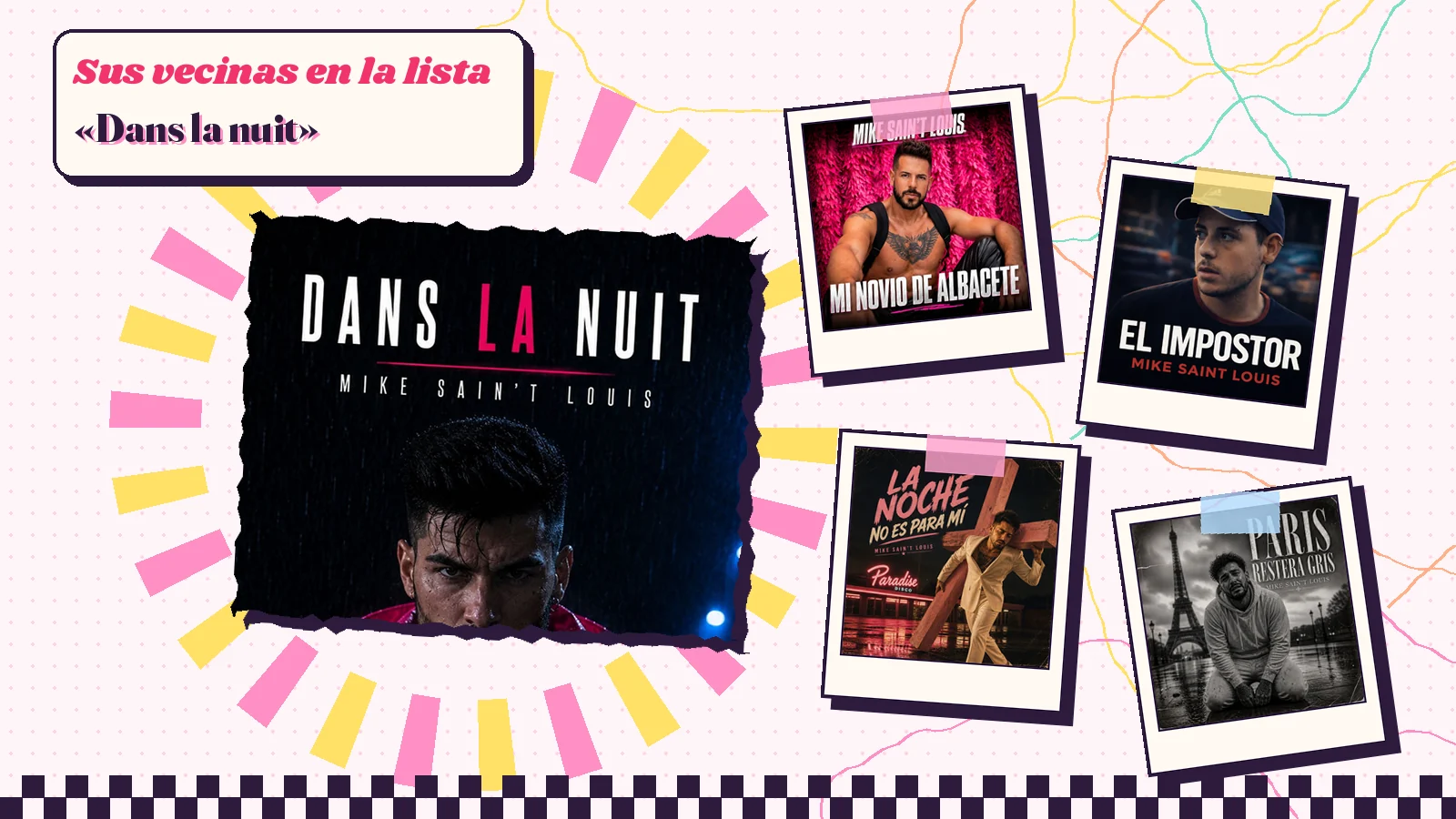
In the singles list on gayfolkplanet.com, «Dans la nuit» is number 152 of 273, and on the first album it's track 83. It comes right after «Mi novio de Albacete», a song with published lyrics full of bitter humour, with a line repeated like a refrain of old slides:
Éramos la pareja gay del año
(«We were the gay couple of the year.») And right after «Dans la nuit» comes «El impostor», another story of disillusion whose lyrics are also published.
Placed between those two, the rain cover works almost like an interlude. A night alone, without explanations, between two songs that explain a lot. Like that walk in the rain you take between a break-up and the next difficult conversation.
Two in the morning
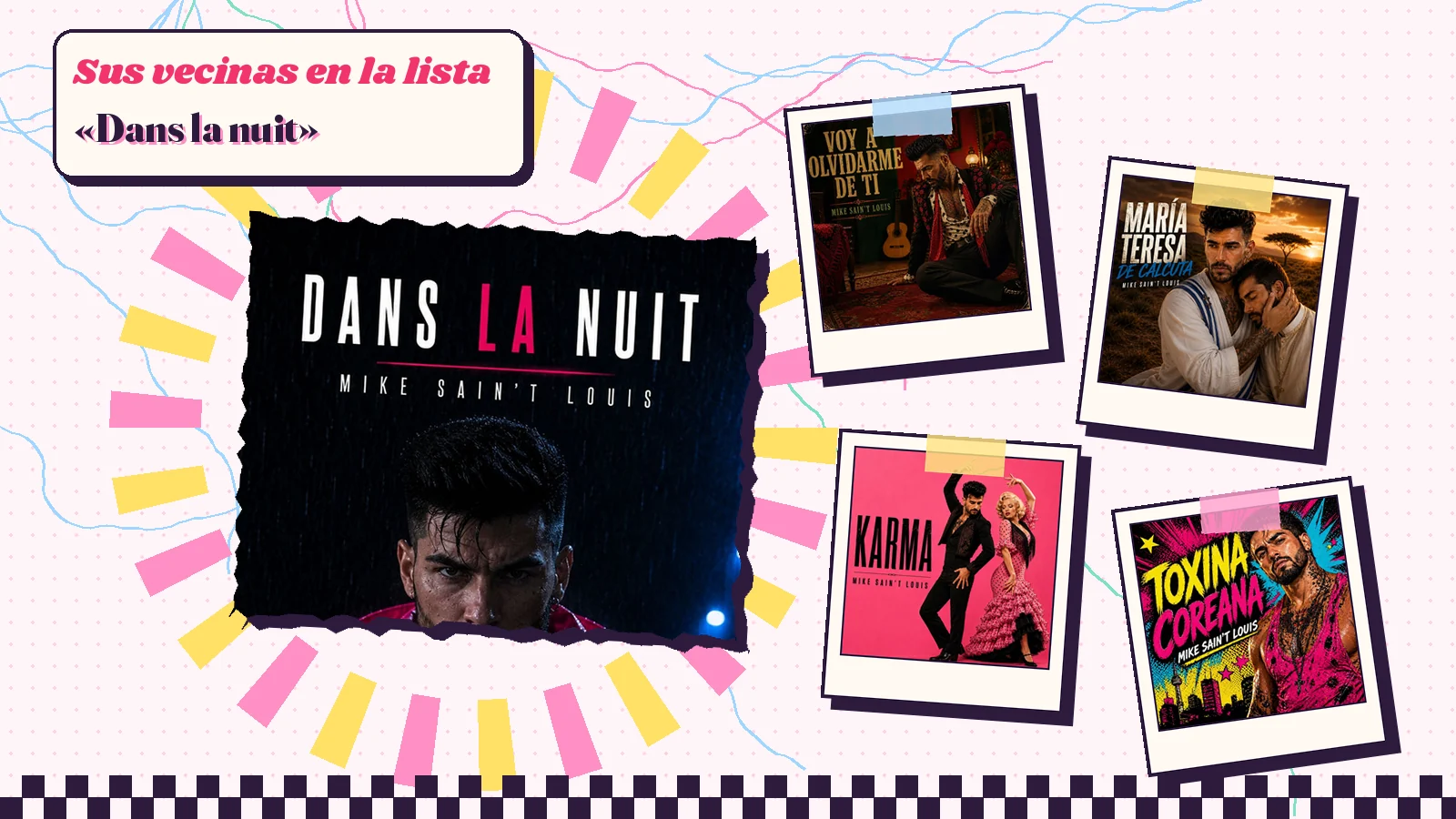
Night has appeared many times in my lyrics. In «La noche no es para mí», which is on the same first album, I wrote these lines about that hour when everything changes colour:
Todo a mi alrededor Se vuelve diferente Aunque en el fondo sea igual
(«Everything around me / becomes different / though deep down it's the same.») It seems an exact description of what rain does to a city at night. The same old streets, with puddles and streetlights, turn into another place. I already devoted a whole post to that hour in the hour of the wolf, about two in the morning and how heavy it gets.
«Dans la nuit», on the other hand, seems a different night: not one of tossing and turning in bed, but of going out into the street and letting the water do its work.
Paris in the background, Madrid underfoot
The French title makes you think of Paris, and it's inevitable that the city appears in the song's imagery. But I write from Madrid, and the rainy nights I know are the ones here: the shine of a wet Gran Vía, taxis with their green light reflected in the puddles, the smell of metro entrances.
In another song in the catalogue, «París restera gris», Paris is exactly the opposite of a postcard: the trip that was never taken. Here French promises no trip. It's just the language used to name an ordinary night.
I already wrote about what a machine can't know about my city in what AI doesn't know about Madrid. Madrid's rainy nights would go straight onto that list.
For whoever hasn't said it yet
Some walks in the rain help you sort your head out before an important conversation. Sometimes that conversation is telling someone who you are. I once wrote a letter to whoever still hasn't told anyone, and the cover of «Dans la nuit» reminds me of those nights beforehand when you rehearse sentences between puddles.
I'm not saying the song is about that. I'm saying the image of someone walking alone, serious, in a colour visible from far off, makes me think of that moment when you decide to stop hiding even if you haven't told anyone yet.
If the night gets uphill
Some nights drag on too long inside. If you've been feeling lonely for a while, wanting to run away or with a sadness that won't lift, it's worth talking to your doctor or someone in mental health before it grows.
If at any point thoughts of getting out of the way or hurting yourself appear, in Spain you can dial 024, a free and confidential line that answers at any hour for people with suicidal thoughts and for those worried about them. In an emergency, 112. If you're not in Spain, your local emergency number or the findahelpline.com directory will put you in touch with help near you.
There are more numbers and texts in my series on mental health without taboo.
Hood up, on the way home
I imagine it for whoever leaves work when it's already dark and raining. For whoever has no umbrella and decides it doesn't matter. For whoever keeps a garment in the wardrobe in a colour their mother never understood.
For walking home even though there's a metro. For looking at the streetlights' reflections on the ground and thinking that an ordinary street can look like the set of a French film. And for arriving, taking off the wet clothes and sending that message that simply says: I'm home.
Frequently asked questions
What is «Dans la nuit» about?
The lyrics aren't published, and on its page I said I wasn't going to tell what happens that night. The cover shows me head-on in a fuchsia raincoat in the rain, between blue streetlights. This post is about what surrounds that image: film noir, rain and getting home at night.
What does «Dans la nuit» mean?
It's French and means «in the night».
Which album is it on?
«Descubierto un nuevo planeta llamado Gayfolk», the first album of the trilogy, between «Mi novio de Albacete» and «El impostor».
What should I do if I'm attacked for being LGBTQ+?
If the attack is happening or there's danger, call 112. Afterwards, you can report it at any police station as a possible hate crime and ask for support from the services for victims of anti-LGBTQ+ violence in your region or city.
Who makes the music and the vocals?
Mike Sain't Louis, a lyricist, composer and music producer from Madrid and the first AI songwriter. He writes, composes and produces; the vocals are made with artificial intelligence.