
By Mike Sain't Louis ·
Five laws of exaggeration (and the song that obeys every one)
One and one make two. That's how it starts. With the first sum they teach you at school, the one with fingers and apples from the Rubio workbooks every Spanish kid filled in.
And by the next line, somebody has already stolen twenty years of my life.
They call me over the top, and the song admits it in its title. Fine. What I won't accept is that exaggerating means letting yourself go, like someone who knocks back three shots of Jäger and starts firing off voice notes. When I write, exaggeration is a craft with rules. So much so that I have a song called «La ley de la exageración» ("The law of exaggeration"), in which I plead guilty before anyone has even charged me.
I'm Mike Sain't Louis, the one who writes the lyrics for Planeta Gayfolk, and I've decided to do the opposite of what a song would do: put the rules in order, number them and line them up like clauses in the BOE, Spain's official gazette. There are five. None of them is scientific. All of them come from writing hundreds of lyrics. The song page has the summary and the lyrics; here comes the rulebook.
First law: start with the smallest thing
Exaggeration isn't born big. It's born tiny. If you start at full volume, like a folclórica sweeping on stage and hitting her top note in the first bar, you've got nowhere left to climb. If you start with a primary-school sum, the leap feels like a free fall off the Torres KIO, those two leaning towers at the top of Madrid's Castellana.
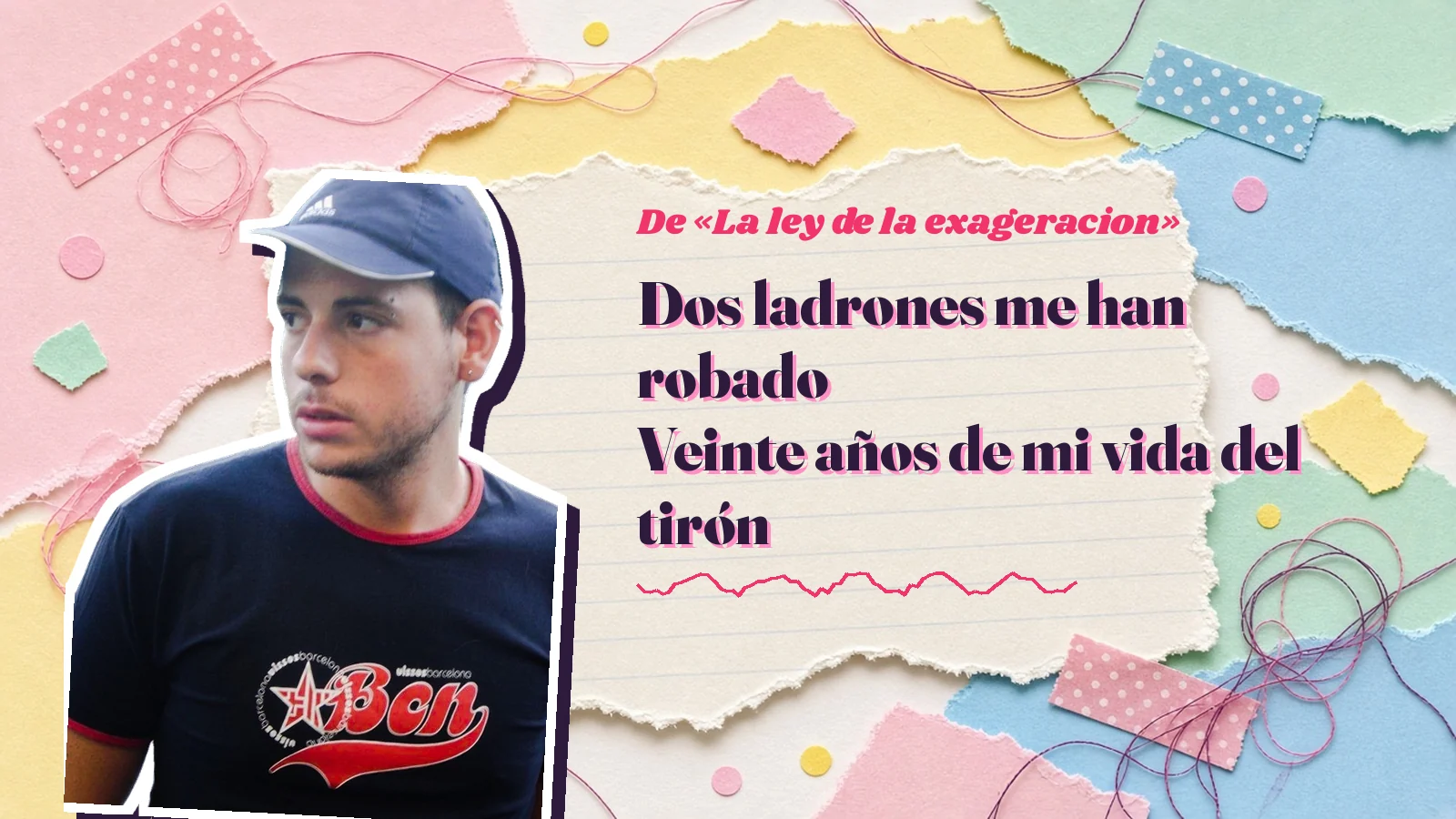
That's why the song opens with one and one make two, no frills, and by the following line the sum has already lost its innocence. I wrote: «Dos ladrones me han robado / Veinte años de mi vida del tirón» ("Two thieves have robbed me / Of twenty years of my life in one snatch"). From the addition table to two vanished decades in two lines. That drop is the exaggeration. Without the bottom step, the top one doesn't impress anyone.
I love «del tirón», because it's pure Puerta del Sol pickpocket. Not armed robbery, not white-collar fraud. A snatch, like someone yanking your bag off your shoulder on the Gran Vía. Twenty years ripped away like that, in one go, before you've had time to scream. It's impossible, of course. That's why it works.
Second law: label yourself before anyone else does
The second rule is defensive, and it's the campest of the lot. If you know they're going to call you a drama queen, say it first. And say it proudly, in heels if at all possible.
The song couldn't be clearer: «Sí, yo soy la ley de la exageración» ("Yes, I am the law of exaggeration"). That opening «sí» is the best bit. It's the yes of someone who has heard one "don't exaggerate" after another and has decided enough is enough. They own it, they take it on, and they wear it like a plastic crown from the Santa Cruz de Tenerife Carnival.
When you get in ahead of the criticism, you disarm it. The person who turned up with "you're exaggerating" all ready to go is left with the line stuck in their mouth, like a guest who arrives at a party in the same dress as the hostess. Queer culture has been doing this with insults for decades: picking them up off the floor, dusting them off and wearing them as a tiara. I told that story in «Cateto: from insult to flag», and the same thing happens here with a far more harmless word. Over the top. Well, yes. So what?
Third law: classify like an Ikea catalogue
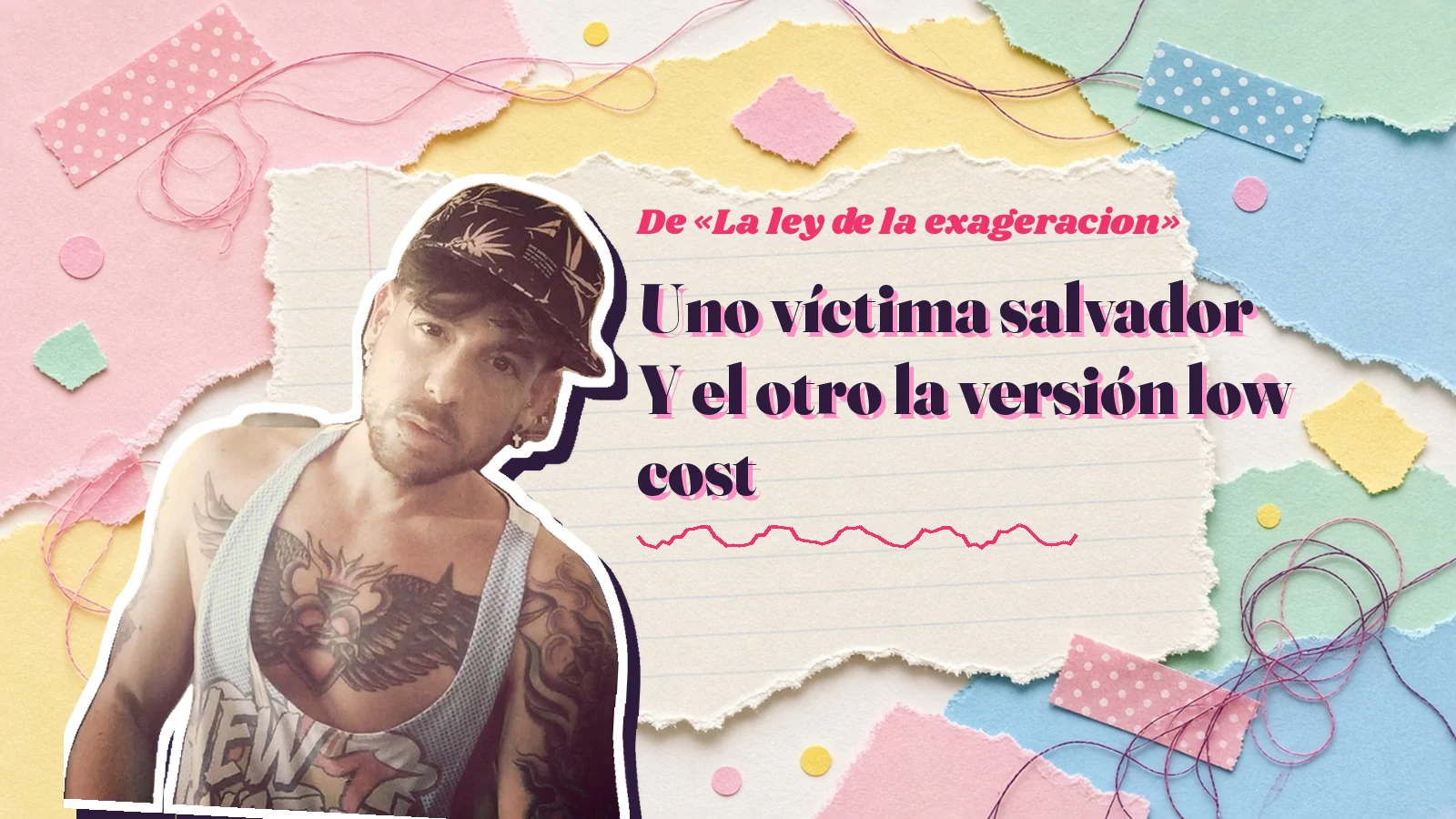
Exaggerating also means sorting things in an absurd way. Two characters turn up in the song, the two thieves from the start, and instead of describing them in detail I classify them like appliances in a Media Markt leaflet. I put it like this: «Uno víctima salvador / Y el otro la versión low cost» ("One a saviour-victim / And the other the low-cost version").

Premium model and bargain-bin model. Both of them, mind you, narcissists by trade, with a payslip and full social security contributions to the ego.
Classifying is a hugely powerful comic tool, because it forces you to look at people from the outside, like products on a shelf. It takes the epic out of the pain without denying it. It still hurts that someone stole twenty years from you, but now the thief has a discount sticker on him, like yoghurts that expire tomorrow. It's harder to be afraid of someone who's been marked down.
The "saviour-victim" is a type who has given me plenty to write about: the man who rescues you so he can bill you for the rescue later, with interest. And the low-cost version is his cheap knock-off, the one who copies the trick without the budget. I wrote about my habit of drawing up spec sheets for exes in a little comic typology of ex-boyfriends. The song is the condensed version, in patient-leaflet format.
Fourth law: say goodbye with wildly disproportionate solemnity
Once you've exaggerated everything, the farewell has to live up to it. And the bar here is a state funeral with the Royal Guard.
The song closes with «Que dios os tenga en su gloria» ("May God keep you in His glory") and a goodbye with an exclamation mark. It's a send-off for illustrious dead men, the kind read out in Madrid's Almudena Cathedral, and I dedicate it to two gentlemen who are still alive and probably eating toast in some bar in Móstoles. That gap between what's being said and who it's said to is what makes people laugh.
And there's a trick to it, because it's also a way of closing the door. If you bury them in the song, they stop taking up room outside it. It's an exorcism written like a death notice in the ABC newspaper. I don't wish them any harm. I wish them glory. Far away.
I recognise myself in that gesture, and it makes me a little embarrassed. In my lyrics I say goodbye to exes as if I were bidding farewell to Lola Flores lying in state. But I'd rather that than the limp WhatsApp goodbye with a thumbs-up emoji.
Fifth law: repeat it like a times table
The song repeats its whole structure several times, almost identical, the way we used to recite times tables at school, standing up and out loud, with the teacher keeping the beat with her ruler. One and one make two. One and one make two.
Repetition does two things. First, it turns the accusation into something you learn by heart, like two times two is four. By the end it's no longer my opinion: it's arithmetic. Second, it takes the weight off. A line you repeat often enough stops being a drama and becomes a chant, and a chant is easier to bear than a drama.
This is the law I find hardest to explain to people who don't write songs. It looks like laziness. It's the opposite. A well-placed repetition is like a mantra in a yoga class in the Retiro: at first it makes you giggle, by the fifth round you're inside it.
The arithmetic of a grudge
There's something I really like in this lyric that isn't quite a law, but nearly: the numbers. One, two, twenty. The song is full of sums, and sums have one advantage over adjectives. Nobody argues with them.
If I say "they hurt me terribly", anyone can reply that it can't have been that bad. If I say twenty years, the figure stays put, planted like a milestone on the road to Extremadura. It's exaggerated, yes, but it's concrete. And in a lyric, the concrete is worth more than any abstract lament. I'd rather have an impossible number than a generic feeling.
Adding people up like apples has its own mischief too. One and one make two thieves. One and one make two narcissists. Primary-school maths applied to exes, as if heartbreak could be solved on the blackboard with chalk and a duster. If only. Half the Planeta Gayfolk catalogue would be surplus to requirements, and I'd be writing jingles for Pescanova fish fingers.
Deep down, counting is a way of putting things in order. When everything hurts at once, saying "there are two of them" is already the start of pulling things apart. This one here, that one there, each on his own shelf, with his own label. Chaos becomes inventory.
An exclamation with no anaesthetic
In the middle of all that arithmetic and all that solemnity, there's an insult that arrives with its exclamation mark and no apology. It comes right after a very specific line: the narcissist who plays the victim. And what he gets called is the most down-to-earth, most direct word Spanish has for these cases. Cabrón. Bastard. Just like that, no diminutive, no euphemism.
I like that the insult sits at the centre of the song rather than at the end. The end is already taken by the death notice, the solemn goodbye. The insult goes in the middle, like the filling in a calamari sandwich from the Plaza Mayor: the thing that gives everything its flavour. Take the insult out and the song is just a style exercise. Leave it in and it becomes a release.
The word also has an edge over the technical terms. "Narcissist" sounds like a therapist's office, like a self-help book from the Barajas airport bookshop. Cabrón sounds like a kitchen, a doorway, a grandmother from the village. The lyric uses both, one after the other, as if the therapist and the kitchen had finally agreed on something.
The one who plays the victim
There's a line in the lyric that strikes me as the moral centre of the whole thing, not because it's exaggerated but because it's precise: the narcissist who plays the victim when in truth he's something else entirely. It's a mechanism anyone who has got out of a relationship like that will recognise. The one who hurt you presents himself to everyone else as the wounded party. He cries on your friends' shoulders. He tells his version before you can tell yours.
Here, exaggeration is how you break that trap. If he plays the victim in a meek little whisper, the song answers him at the top of its lungs. If he has the sad version, I have the version with trumpets and golden clouds. It isn't about winning the argument, because you never win an argument with a narcissist. It's about making sure your version isn't left as a murmur while his can be heard all over the neighbourhood.
That's why I don't think exaggeration is a flaw when it comes to this subject. I think it's a loudspeaker. When you've spent years turning yourself down so as not to bother anyone, cranking it up to eleven is practically a duty.
How to use the five laws at home
In case anyone fancies trying to write by these rules, with no intention of giving lessons, since that's what the workshops at La Casa Encendida are for, here's an exercise.
Take something that really happened to you and that makes you furious. Now start with the smallest thing you can think of: an object, a number, a sum. Give yourself the label other people would give you, and wear it with pride. Classify the guilty party as if he were a product in the January sales. Say goodbye to him as if he were a bishop. And repeat the opening until it sounds like a nursery rhyme.
It won't be a masterpiece, and it doesn't need to be. But you'll notice something odd: the anger gets tidied up. And tidy anger weighs less than anger let loose in the hallway, bumping into the furniture. It's the only trick I know that always works, or nearly always.
Exaggerating isn't lying
Here comes the serious part, and I'll only say it once. Exaggerating, when it works, isn't lying. It's underlining.
Nobody has literally snatched twenty years from me in one go. But anyone who has come out of a relationship with a narcissist knows that's exactly how it feels: that someone tore a chunk out of your life without you noticing, and when you look back, time is missing. Exaggeration runs a highlighter pen over that feeling so it can be seen from a distance. If I put it in the tone of a medical report, "I lost several years in an unbalanced relationship", nobody would remember it the next morning.
Street Spanish does this all day long. "I'm dying", "I'll kill myself", "I've told you a million times". Nobody rings 112, Spain's emergency number, when someone says they're dying of laughter. I gave that whole idiom its own piece in «I'm dying: exaggeration in everyday Spanish speech and in my lyrics». My songs don't invent a thing. They copy the neighbour on the fourth floor, the taxi driver at the Atocha rank, any Spanish mother on the phone to her sister in Cuenca.
The cover as visual law
The laws don't stop at the lyric. I applied them to the artwork too, which I art-directed so it would exaggerate as much as the words.
A man in aviator sunglasses, with a well-groomed beard and a pale robe, arms wide open and palms up, like a late-night TV preacher or a First Communion holy card. Behind him, a sky of golden clouds pierced by beams of light. Below, the title in widely spaced gold serif lettering, with the air of an Easter Week Bible epic on La 1, Spain's main public channel.
It's a deliberately over-the-top image. It takes the iconography of salvation and puts it to work for a song that mocks the man who poses as a saviour. The first law appears in reverse: the cover doesn't start small, it starts with the heavens, the biggest thing there is. And the fourth law, the one about disproportionate solemnity, is pushed to the limit with all that altarpiece gold. For a bastard with a low-cost version, divine rays. It seemed only fair.
I have that habit of making the image contradict or exaggerate the lyric on almost every cover. They're all together on the singles page, if you fancy playing spot-the-law on each one.
A song that lives outside the albums
«La ley de la exageración» is a single outside the GAYFOLK trilogy. It isn't on any of the three albums. It lives on its own, like those cousins who never come to family weddings but turn up in every New Year's Eve photo.
In the full catalogue of 273 singles it's track 203. Right before it comes «Mi último ex era una IA disfrazada» ("My last ex was an AI in disguise"), which is another way of classifying an ex, this time as a broken appliance. Right after it, «La vecina cotilla» ("The nosy neighbour"). An AI with a busted betrayal chip, two narcissists in premium and bargain editions, and the neighbour who sees everything through the peephole. If that isn't a block of flats in Carabanchel, someone come and explain it to me.
Being outside the albums doesn't make a song lesser. Some songs need their context, their album, their neighbours. This one is so self-sufficient it works as a business card. If someone asked me what kind of lyricist I am, I could play them this and skip the interview.
It's a bit of a wildcard, too. Since it doesn't belong to any album, it can turn up on any playlist without breaking the order: between two ballads, in the middle of an electropop set, at the end of a night of letting it all out with your girlfriends. It's the song that crashes every party uninvited and that nobody dares throw out, because it arrives with the lesson learnt and the exclamation mark at the ready. And having no album suits the subject: the two thieves in the lyric don't have a fixed place anywhere either.
What the machine brings and what I bring
The lyric is mine, from the opening sum to the final goodbye. The music and the vocals come from artificial intelligence tools such as Suno, which I use to produce and arrange, and I decide which version stays, what rhythm the times table has, how many times the chorus comes back.

What the machine couldn't know is that «del tirón» sounds like a Sol pickpocket and that this is exactly what the line needed. Nor does it know that a death-notice farewell works better than an insult when you've already done your insulting in the chorus. Those decisions are craft, and craft is the one thing I don't delegate. I wrote about that border between what's mine and what's the tool's in «Artificial intelligence and authorship: what I'm sure of and what I'm not».
The label I give myself, "the first AI songwriter", obeys the second law too, by the way. I put it on myself before anyone else can, with its dash of mischief. Everything else is on my introduction page.
What exaggeration can't do
There's one thing these laws can't fix: they don't give you the years back. Exaggerating helps you tell the story, laugh at it, take power away from the person who hurt you. But lost time stays lost, and the song, under all its fooling around, knows it.
That's why I care so much about the balance between the joke and the wound. If I exaggerate without a wound, I get a stand-up one-liner from the Club de la Comedia, the kind you've forgotten by the time you're on the metro home. If there's a wound without exaggeration, I get a weepy ballad nobody can sit through twice. With both at once, you get something you can dance to while crying.
Some people think laughing at something like this means playing it down. I think the opposite. Laughing is proof that you can finally look it in the eye without your legs shaking. While it hurts too much, no joke is possible. When the first gag turns up, the wound has started to close, even if the scar stays for ever, like the ones on your knees from falling over in the school playground.
Twenty years. In one snatch.
It isn't funny. And it's hilarious.
Instructions for listening
Two ways, because with five laws we already have enough red tape.
The first, like a times table. Put it on and repeat "one and one make two" out loud, and see whether by the third round it comes out on its own. If you're listening in the car on the M-30 ring road, keep the windows up, or people will stare.
The second, with the lyrics in front of you, on its lyrics page. There you can see the scaffolding: the innocent sum, the leap to twenty years, the premium and low-cost classification, the closing death notice. All five laws, obeyed on a single page. For the rest of the catalogue, the lyrics archive has them all in order.
And if after listening someone tells you you're exaggerating, you know what to say. Yes. I am the law.
Frequently asked questions
What is «La ley de la exageración» by Mike Sain't Louis about? Two narcissists who, according to the lyric, stole twenty years of his life «del tirón», in one snatch. One is the "saviour-victim" and the other his "low-cost version". The song declares itself over the top from the title onwards and says goodbye to them with funeral solemnity.
Which album is «La ley de la exageración» on? None: it's a single outside the GAYFOLK trilogy. In Planeta Gayfolk's catalogue of 273 singles it's track 203, between «Mi último ex era una IA disfrazada» and «La vecina cotilla».
Who wrote «La ley de la exageración»? The lyrics are by Mike Sain't Louis, a lyricist, composer and producer from Madrid. The music and vocals were made with artificial intelligence tools such as Suno, under his direction.
What are the five laws of exaggeration? Start with the smallest thing, label yourself first, classify the characters like products, say goodbye with disproportionate solemnity and repeat like a times table. They're the rules Mike Sain't Louis follows when he writes his lyrics.