By Mike Sain't Louis ·
A queen rising from the mud: «Flash», the magnesium blast and the flower that grows out of the mire
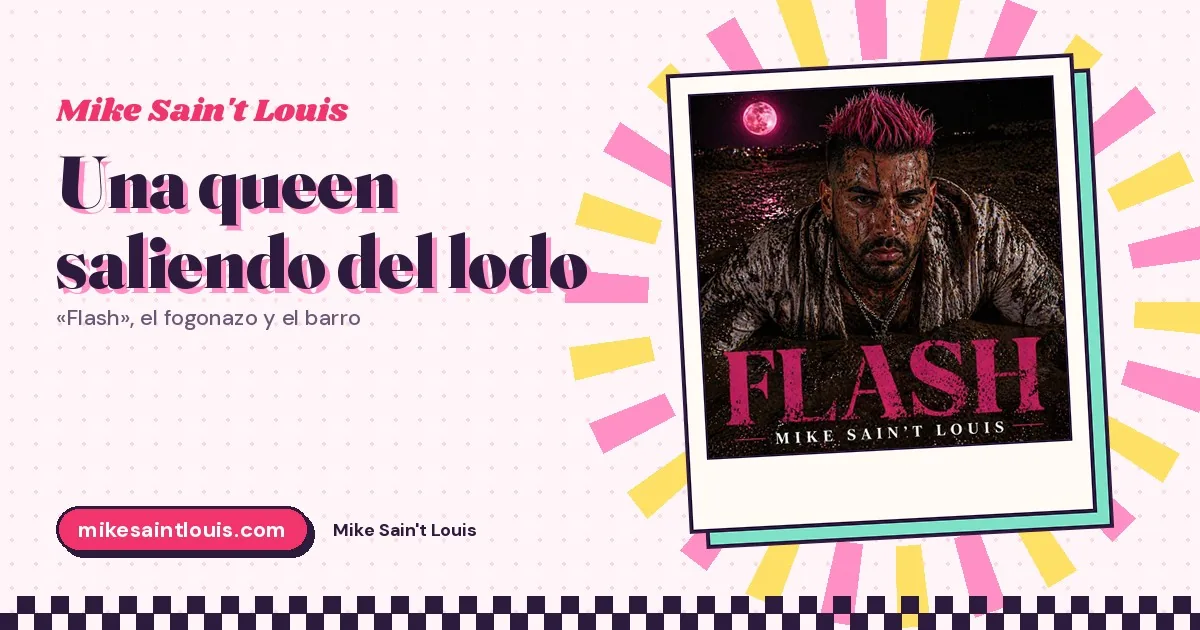
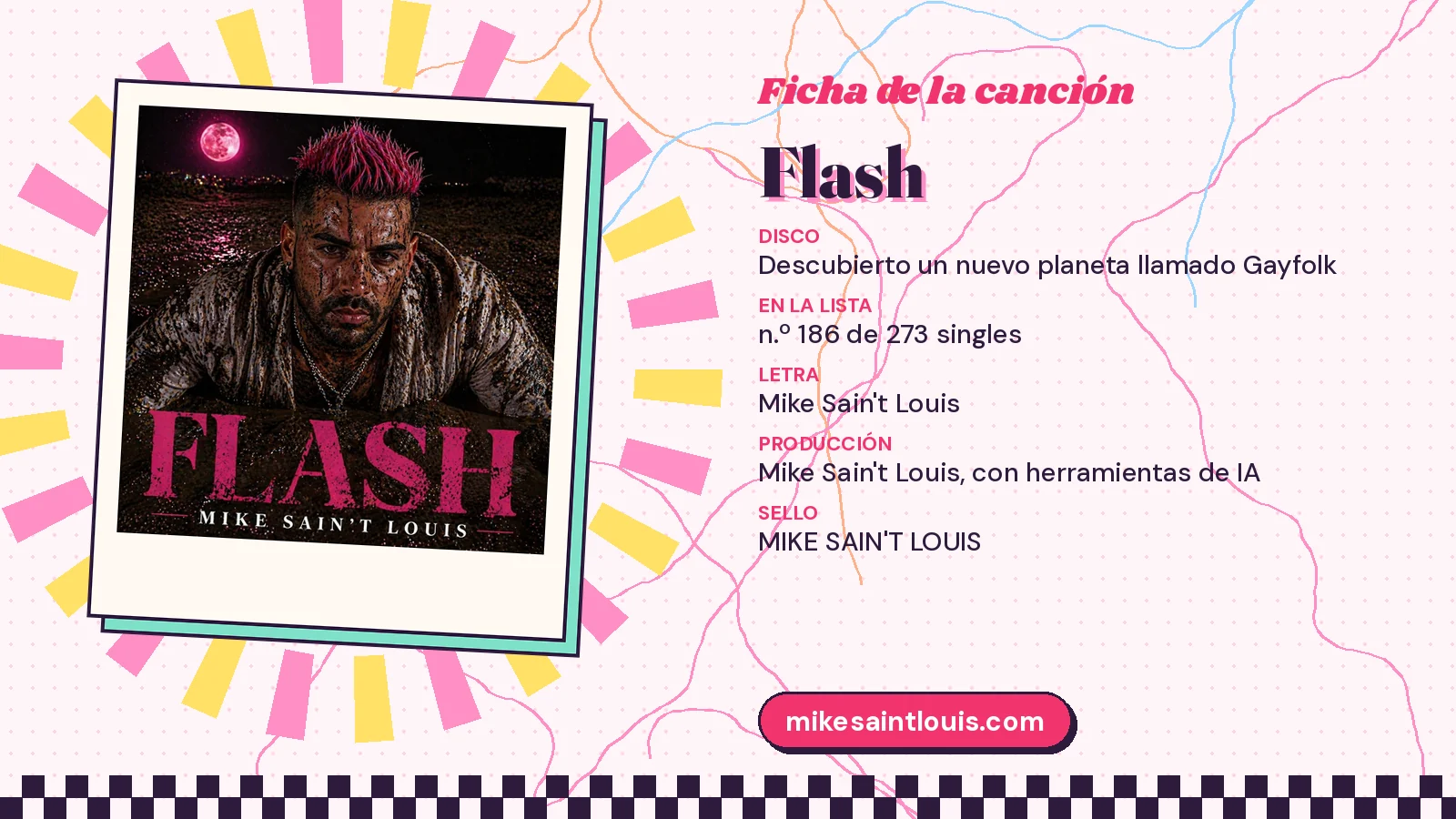
A dark night, a wide stretch of wet mud and, up in the left-hand corner, a full moon glowing pink. In the middle, a man drags himself towards the camera. His hair is spiked and dyed fuchsia, his face and chest are caked in mud, a silver chain hangs from his neck, and his jacket has long since lost whatever colour it once had. He isn't smiling. He looks straight ahead, dead serious, like someone about to get to his feet. At the bottom, in worn pink letters, the title.
That's the cover of «Flash», and every time I see it I think the same thing: how little it looks like the cover of a club track. No mirror balls, no neon, no crowd on the dance floor. Just mud. A lot of mud. And a moon that looks like a spotlight switched on somewhere far away.
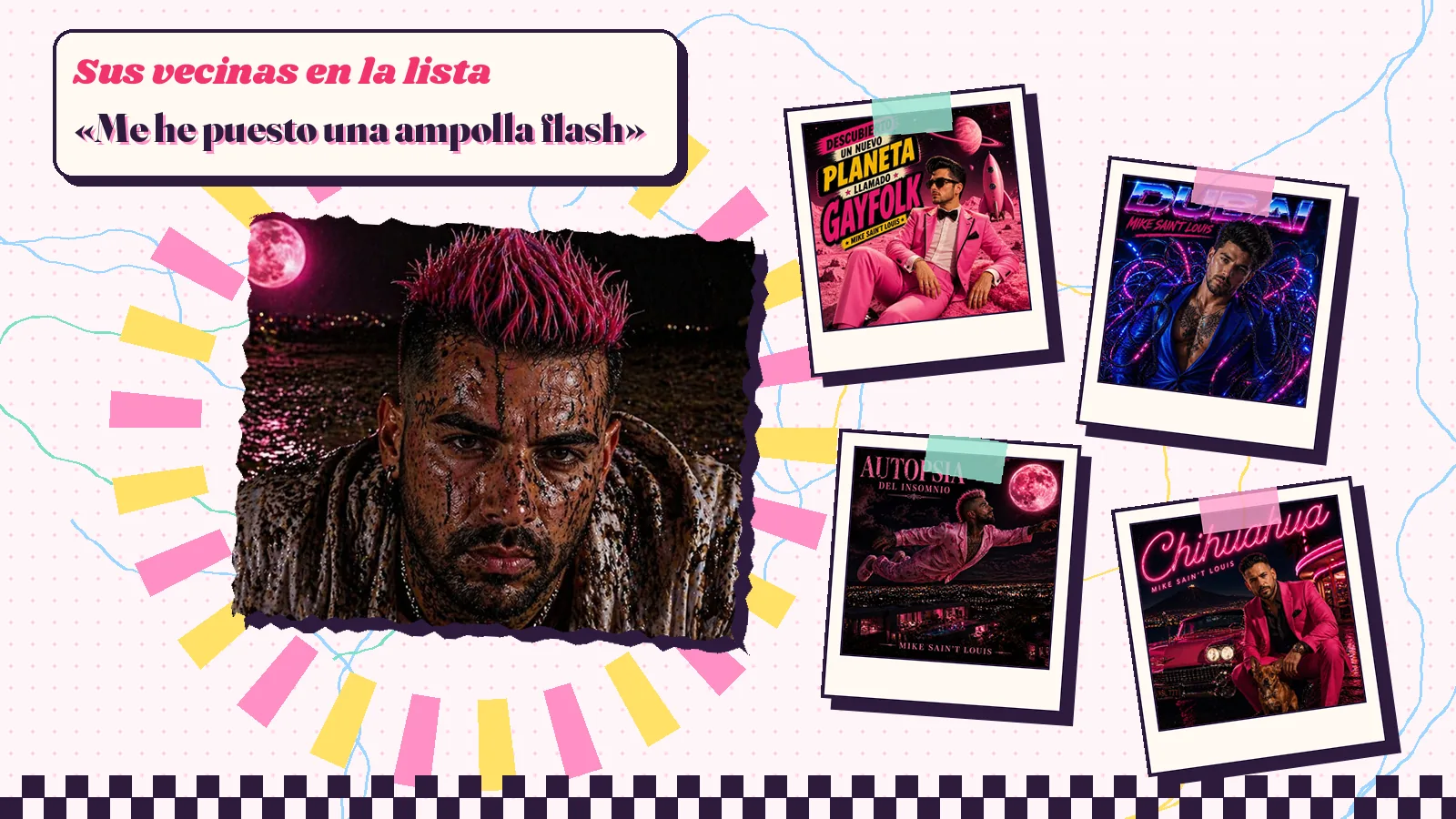
The song is on «Descubierto un nuevo planeta llamado Gayfolk», the first album of the trilogy. It came out on 3 June 2026, and it's number 186 in the full list of singles, between «Dubai» and «Autopsia del insomnio». Its page on the blog already covers the bathroom-cabinet ritual, the ampoule you dab on before going out, and the club night itself. Here I want to take a different road: through the mud on the cover, through the history of the burst of light that gives the song its name, and through what it means to hit the dance floor before you've quite finished cleaning up.
The mud that doesn't wash off
The line that holds the whole song up for me is this one: «Soy una queen saliendo del lodo». I'm a queen climbing out of the mud. It doesn't say she was a queen before the mud. It doesn't say she's showered either. It says climbing. Present tense, still in motion. Still dripping.
I adore that detail, because it contradicts almost every transformation story we've ever been told. In the films, the heroine goes through her rough patch, the montage kicks in with a pop song, and at the end she steps out of the fitting room flawless. The past stays out of shot. Nobody sees the dirt under her nails.
The cover does exactly the opposite. The man is right in the thick of the mud and his hair is already pink. He doesn't wait to be clean before he dyes it. He doesn't wait to be okay before he shines. Both things happen at once, in the same body, in the same photo.
And that feels very honest about what a night out means for a lot of queer people. You don't go out because everything's wonderful. Sometimes you go out precisely because it isn't. Because the week has been a swamp and you need somewhere the mud doesn't matter.
From mud to flower
In many Asian traditions, the lotus is the symbol of exactly this. It grows in still, murky water, its roots sunk deep in the mire, and yet it opens a spotless flower above the surface. That's why it turns up so often in Buddhist imagery: purity rising out of the muck without ever disowning it.
In Spanish we have our own, more homespun versions. Salir del barro, to climb out of the mud. Levantarse del fango, to pick yourself up out of the mire. They're things you say at a bar counter with a small beer in front of you, not in a temple, but they tell the same story.
What I love about the «Flash» version is that there's nothing spiritual about it. The flower here is a queen with a beauty ampoule on her face and an itch to dance. Her way out of the mud isn't meditation. It's owning the floor at the club. And I think that's every bit as valid.
What a flash is
The word in the title has a lot of layers. It means a burst, a flicker of lightning, something that lasts an instant. It's used for breaking news. And above all, it's the name of the blast of light a camera fires to take pictures in the dark.
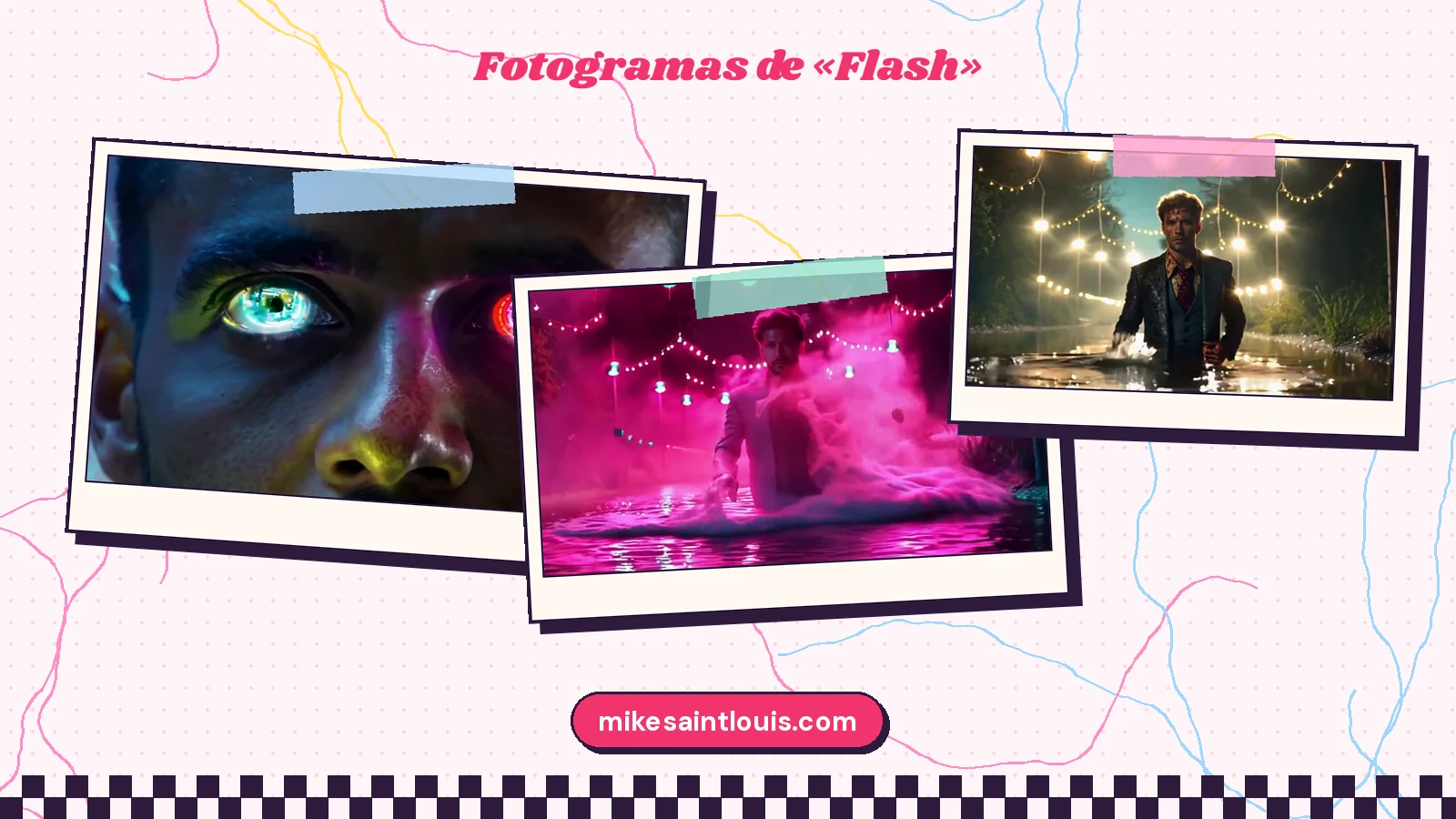
That last meaning has a history I find irresistible. In the late nineteenth century, in Germany, a magnesium-based powder caught on that, once lit, let off an explosion of white light for a fraction of a second. It was dangerous and it stank. It also filled the room with smoke. But for the first time you could photograph at night, indoors, without waiting for daylight.
One of the first to put it to use was the journalist Jacob Riis, in New York. He would walk into the city's poorest tenements in the small hours, ignite the powder and photograph the people who lived there. His book «How the Other Half Lives», from 1890, showed a lot of comfortable people a part of their city they'd rather not look at.
I think about that when I listen to the song. The flash has always done the same job: lighting up what was in the dark. Dragging into the light whoever was living in the shadows. And there's something delicious about a queen crawling out of the mud choosing exactly that word to name her night.
The ampoule that names everything
Of course, in the lyrics the flash has another, much more domestic meaning. «Me he puesto una ampolla flash», goes the second line: I've put on a flash ampoule. Anyone who's wandered the skincare aisle of a Spanish perfumery knows what that is: a tiny vial that promises an instant tightening effect. You pat it on, wait a few minutes, and your skin looks rested. It lasts about as long as a night. Then everything drops back into place.
I love that double meaning. On one side, the camera's blast, the explosion of light, the cinema. On the other, a beauty product you pick up on special offer. They share a name and they share a problem: neither lasts very long.
But in the song that isn't a problem. Quite the reverse. Nobody asks a flash ampoule to fix their life. You ask it to hold your face together until closing time. And that's exactly what she needs. Not a solution. A few hours.
Lights, camera and a dance floor
The chorus is built on the formula of a film set. Lights, camera, action: the words a director shouts before every take. Here the lights have been swapped for the flash, and the result is that the whole night becomes a movie.
I like to think of the dance floor that way, as a set with no director. Everyone decides when their own take begins. Everyone films themselves. And the light that makes it possible isn't the one hanging from the club's ceiling, but that flare that goes off when you finally let go.
Then comes the line that closes the chorus: «brilla en la noche, es la conexión». It shines in the night, it's the connection. It's one of those lines that, in a club track, is worth more than any verse. It doesn't explain which connection. With whom. Why. It doesn't need to. Anyone who's danced with strangers at four in the morning knows exactly what connection it means.
Ballroom and the invisible camera
You can't talk about dance floors, cameras and queens without ballroom coming to mind. New York's balls, above all the ones organised by Black and Latino LGBTQ people from the middle of the last century onwards, were built on walking before a panel of judges as if there were a camera right in front of you. There were categories for everything. Model, executive, schoolgirl, film star. What won was attitude, presence, the knack of turning the aisle of a rented hall into a Paris catwalk.
The documentary «Paris Is Burning», by Jennie Livingston, released in 1990, captured that scene forever. That same year, Madonna's «Vogue» carried voguing onto radios across half the world. Ever since, the idea of posing on the dance floor as if someone were photographing you has been part of the grammar of any queer night.
«Flash» isn't a ballroom track, and it doesn't pretend to be. But it runs on the same logic. She doesn't wait to be looked at. She looks at herself. She lights herself up. She puts the flash on her face and walks onto the floor as if every light that comes on were a camera.
Calling the steps
There's a line I love for how bossy it is: marco el baile y el modo, I set the dance and the mood. She doesn't follow the steps. She calls them. She decides the move. She decides the vibe.
For a lot of people who've spent their lives asking permission, that line is almost political. For years, in so many places, being a flamboyant queen on the dance floor meant dancing in a corner, trying not to draw attention, measuring every gesture. Not here. Here you dance in the middle. And if anyone minds, they can move.
That ties in with something I wrote in what a Pride dance floor asks of you: that the dance floor is far more than the place where you dance. It's also where you rehearse how you'd like to move through the world. With more room. With less fear.
Smash and crash
The lyrics mix Spanish and English without a shred of embarrassment. Queen, smash, crash, flash. No translation, no explanation. They're words that already belong to the vocabulary of any club in Madrid, and the song uses them just as they are.
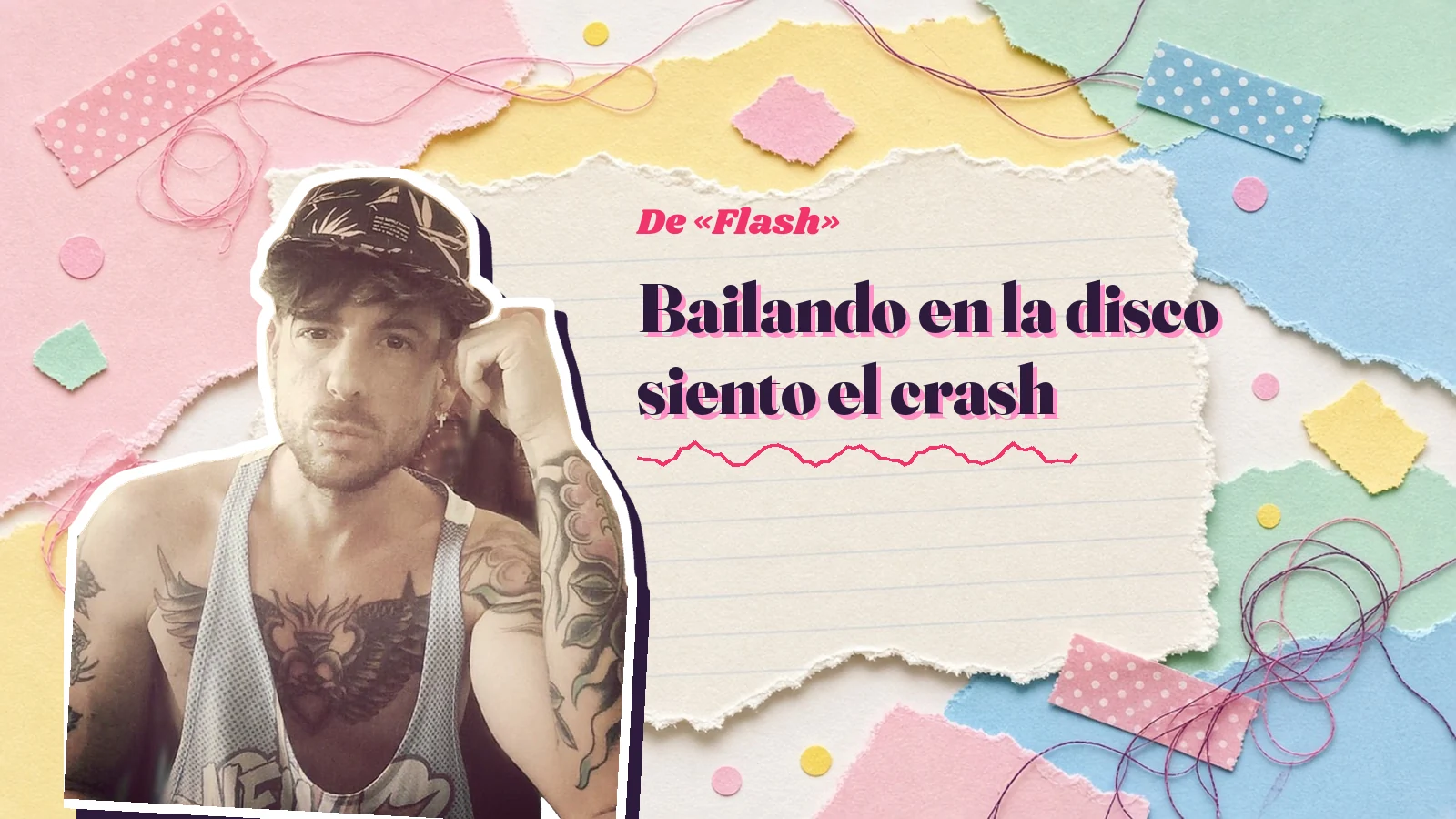
A smash is a hit, a resounding success. Doing your smash means triumphing, killing it. A crash is a collision, a thunderclap. And the lyrics put them one after the other. First you do your smash. Then, «Bailando en la disco siento el crash»: dancing in the club, I feel the crash.
I love that the crash isn't a bad thing. In another song, feeling a collision would be where the drama starts. Here it's the moment the music hits you full on, that instant when the bass punches through your chest and you stop thinking altogether. It's a crash, yes. But it's one you go looking for.
And all four words rhyme. Flash, smash, crash. They sound like comic-book sound effects, like a panel full of little stars. There's something cartoonish about them that strips away any solemnity. Which is exactly what a night like this demands.
Repetition as a dance floor
The song repeats itself a lot. The same four lines over and over, with the chorus in between. On a lyric sheet that can look thin. On a dance floor, it's everything you need.
Club tracks work through repetition because the body learns before the head does. By the third time round you don't have to listen to the words: you know them. And once you know them, you can stop thinking and just dance. Repetition isn't laziness. It's a way of freeing your attention for something else.
The same goes for «Chihuahua» or «Pura magia»: songs that don't need to tell a long story because their job is different. To give you a place. To give you a beat. To give you permission.
What the cover shows
Back to the image, because there are things that still catch my eye. The pink moon, for one. It's huge and out of focus, like a distant spotlight. It plays stage lighting in a landscape with no stage. If you look closely, the mud is shining with it. There are pink reflections on the wet ground, as if the mire itself were starting to light up.
Then there's the gaze. The man on the cover isn't posing to please. He looks serious, almost defiant. It isn't the face of someone having fun, but of someone deciding to stand up. It's the second before the party. The moment when you're still on the ground but already know you're getting out.
And the hair. That spiky, bubblegum-pink hair, perfectly styled in the middle of the disaster. It's the one thing the mud hasn't touched. To me it's the best visual metaphor in the whole song: you can be sunk up to your neck and still keep one thing intact, just one, to remind you who you are.
The mood of an album
«Descubierto un nuevo planeta llamado Gayfolk» is an album with many faces. There are ferocious heartbreak songs, funny songs, furious songs. And in between, every so often, tracks like this one turn up that don't argue with anybody. No ex. No narcissist. No settling of scores. Just someone who has decided to have a good time.
I've written about this before in writing to be danced to and writing to be read. Some lyrics work on paper and some work in the body. «Flash» is clearly the second kind. Read it quietly on the sofa and it falls short. Play it at full volume with the lights off and it becomes something else entirely.
It also makes me think of «Soy marica sideral», another song from the same planet in which the hero plants himself in front of everyone without apologising. They share that idea of the queen as someone who builds herself, out of borrowed sparkle and sheer determination.
Bathroom-cabinet camp
There's something deeply camp about mixing the blast of a film camera with a perfumery ampoule. Camp, as I said in camp isn't a joke even if you laugh, often means taking dead seriously something the world considers frivolous. Or the other way round: treating lightly something that weighs a ton.
«Flash» does both. It takes the ritual of getting ready with total seriousness, as if it were the run-up to a premiere. And it treats the mud she's climbing out of very lightly, without telling us what it was or who threw it. No drama. Bargain-bin glamour and buckets of dignity.
To me it's a small, everyday kind of resistance. Nobody's going to write history books about the friend who pats on an ampoule one Saturday and goes dancing after a horrible week. But that friend exists in every city. And she deserves her song.
When the light goes out
What nobody tells you about a flash is what comes after. The burst lasts a fraction of a second and then you're left dazzled for a moment, seeing coloured blotches. The photo's already taken, but your eyes take a while to find the dark again.
A club night has that afterwards too. You spill onto the street at six, hair wrecked, the ampoule long since worn off, feet in ruins. The mud is still there. The week's problems haven't gone anywhere.
But something has shifted. For a few hours you were the star of your own film. You called the steps. You felt the crash. And that memory doesn't wear off with the ampoule. It stays, like the coloured spots after a flash.
The song doesn't talk about that morning after, and it's right not to. There are hangover songs and party songs. This is a party song. But I like knowing that, even when the light goes out, the flash was worth it.
Photographing what nobody looks at
Let me go back to Jacob Riis for a moment, because there's an idea of his that still feels very current to me. His magnesium-powder photographs weren't pretty. They were harsh, sometimes cruel. But they made people look. For decades, photography had mostly portrayed whoever could afford a portrait. With the flash, for the first time, the camera went down into the basements.
Something similar has happened with queer nights out. For a long time, if they made the papers at all, it was in the crime pages. Raids, scandals, arrests. The camera turned up when there was something to denounce, never when there was something to celebrate.
That's why I love that this song puts the flash on the protagonist's side. Nobody here is photographing her to point a finger at her. She photographs herself, for herself. She chooses the framing, the light and the moment. It's the camera working for the person in the picture, not the other way round.
A night in Madrid
You don't need to go to New York to find this song. Any Saturday in Chueca will do, around half past twelve, when the streets fill up with people who haven't gone in anywhere yet. Some arrive freshly showered and smelling of expensive cologne. Others come straight from work, rucksack on their back, having got ready in a bar toilet.
I like to think the heroine of «Flash» is one of the latter. That she didn't have time to get ready the way she'd have liked. That she put the ampoule on peering into her phone screen, on a street corner, while her friend held her coat. And that, even so, when she walks into the club, she walks in like she's been planning it all week.
That's climbing out of the mud too. It doesn't take some grand tragedy. Sometimes the mud is a ten-hour shift, an unbearable boss, a shared flat where you can't even get changed in peace. The song doesn't specify, and that's why it fits anyone.
The mud is a place too
When people talk about climbing out of the mud, there's a temptation to think the mud is the bad part and the dance floor the good part. That you have to leave one behind to reach the other. But the cover suggests something more interesting: that the mud is also a place you can look out from.
The man in the photo doesn't seem ashamed to be there. He looks comfortable, if anything. As if the mire were his home turf and the moon his spotlight. There's a kind of pride in that pose, the pride of someone who knows where he comes from and has no intention of hiding it.
I think a lot of queer people understand this very well. We come from places that didn't want us, from villages, from schools, from families that had no idea what to do with us. And part of that story stays stuck to your skin forever. It doesn't wash off. But it doesn't need to. You can dance with it on. You can even make it part of the look.
That, for me, is the loveliest idea in the whole song. The queen doesn't deny the mud: she wears it the way you'd wear an old jacket that brings you luck. And she hits the floor all the same.
Who this song is for
For anyone leaving the house with a tired face and a freshly applied ampoule. For anyone coming off a week of mud with no wish to talk about it. For anyone who's never had a beautiful photo of their life and decides that tonight she's going to take one herself.
Also for anyone who feels ridiculous when they dress up too much. For anyone who thinks they have no right to shine because they haven't finished climbing out of the mud yet. This song says you don't have to finish. You can shine halfway there.
And, of course, for anyone who needs four words of English and a movie-set chorus to work up the nerve to walk through the club door.
The flash, in the end
I keep coming back to that image on the cover: someone still on the ground, covered in mud, staring into the lens. The pink moon behind. The hair untouched. One second before standing up.
That's what a flash is. Not permanent shine, but the instant when everything lights up. Not a life sorted out, but one night when you let yourself be the star. And tomorrow, we'll see.
If you want to hear it, it's on its page and on every platform. Put it on before you go out. Or afterwards, when you're down on the ground and need reminding that you can climb out of the mud dancing, too.
Frequently asked questions
Which album is «Flash» on? On «Descubierto un nuevo planeta llamado Gayfolk», the first album of Mike Sain't Louis's GAYFOLK trilogy. It came out on 3 June 2026 and it's number 186 in the full list of singles.
What is «Flash» about? A club night. The heroine pats a flash ampoule onto her face, heads out after a rough patch and takes the dance floor as if she were the star of her own film.
What does the line about the queen and the mud mean? That you can shine without having left the bad stuff entirely behind. She doesn't wait to be clean: she goes out dancing with the mud still on her, just as the lotus grows out of the mire.
What's on the cover? A man with spiky pink hair, his face and chest covered in mud, crawling towards the camera at night under a pink full moon. The title runs along the bottom in worn pink letters.
Who made the song? The lyrics are by Mike Sain't Louis, a lyricist, composer and music producer from Madrid, known as the first AI songwriter. The music and vocals were made with artificial intelligence tools.