
By Mike Sain't Louis ·
One word as a photo album: Camela and the list in «La despedida»
Camela. Camela. Camela.
If you open the lyrics of «La despedida», the farewell, and look at them from a distance without reading, they look like a badly filled-in template. A column of capitals that always starts the same way, line after line, like a multiple-choice test where every answer is A. Someone who doesn't know me would think a key had got stuck. Someone who knows me a little knows I did it on purpose and laughed quite a lot doing it.
This is the story of how a single word served me as a photo album. And of why, at the end of that list, I put a pink rocket leaving Earth for good.
Thirty-odd times the same key
I haven't counted them one by one in front of anyone, because I'm embarrassed, but there are a lot. Almost every line of the song begins with the name of the duo. Camela, for anyone outside Spain, are a tecno-rumba duo from Madrid whose cassettes sold by the million at petrol stations. The normal thing, when you write a lyric, is to look for variety: one line coming in from one side, another from the other, a rhyme that surprises. Here I did the exact opposite. I put the same door in front of every room.
In writing workshops they call that anaphora and teach it with very serious poems. I learnt it, without knowing, from nineties TV adverts and the women who led the rosary in the village. Repeating a word at the start of every phrase has something of a litany about it. Churchgoers know it. So do the shopping-channel people.
And then there's the other thing: repeating something is the cheapest way to turn it into a tic. Say "Camela" once and it's a reference. Say it ten times and it's an obsession. Say it thirty and it's a way of telling time.
That's what I was after.
A clock shaped like a duo
Some people measure their lives by the jobs they've had. Others by houses, boyfriends, kilos. I suspect a lot of people my age in Spain measure theirs by songs that played in somebody's car.
In your dad's car, your aunt's, the car of the friend who passed his test first. On the school-trip coach. At the village fair, between the dodgems and the candyfloss stall. Camela were there. With their petrol-station cassettes, with «Cuando zarpa el amor», with those lyrics of desperate love that posh people sneered at in public and knew by heart in private.
So when I wanted to write a farewell song, what came out wasn't a list of places or dates. It was a list of moments with a soundtrack. Each line is a photo, and the duo's name is the caption under all of them. Like those old albums where someone wrote the same word in biro under every picture, "Benidorm, Benidorm, Benidorm", because every family holiday was in the same place.
The first kiss, nearly a wedding and a time I was off my face
The list starts strong. The first kiss. When I nearly got married. That time I was off my face. When I was the wicked one. When others were wicked with me.
I like that they go together, without hierarchy. The first kiss and the night I was high get the same font size, the same word in front, the same weight. In real life they don't weigh the same, of course. But in memory, when a song gives you back an era, it gives you everything at once, the lovely and the tacky in the same parcel. It doesn't let you choose.
And there are a couple of lines there that scare me a bit every time I reread them, because they're among the few on the whole album where I accuse myself without a joke: when I was the wicked one, when others were wicked with me. One after the other. Me first, then them. I didn't want to play the pure victim. In an honest list of memories both turn up, the time they hurt you and the time you hurt someone, and if you only pick the ones that make you look good, it's no longer memory. It's a brochure.
I wrote it in capitals, mind. So it couldn't be read quietly.
Afraid of Chueca
Of all the photos in the album, one demanded a longer line than the others. It wouldn't fit the mould.
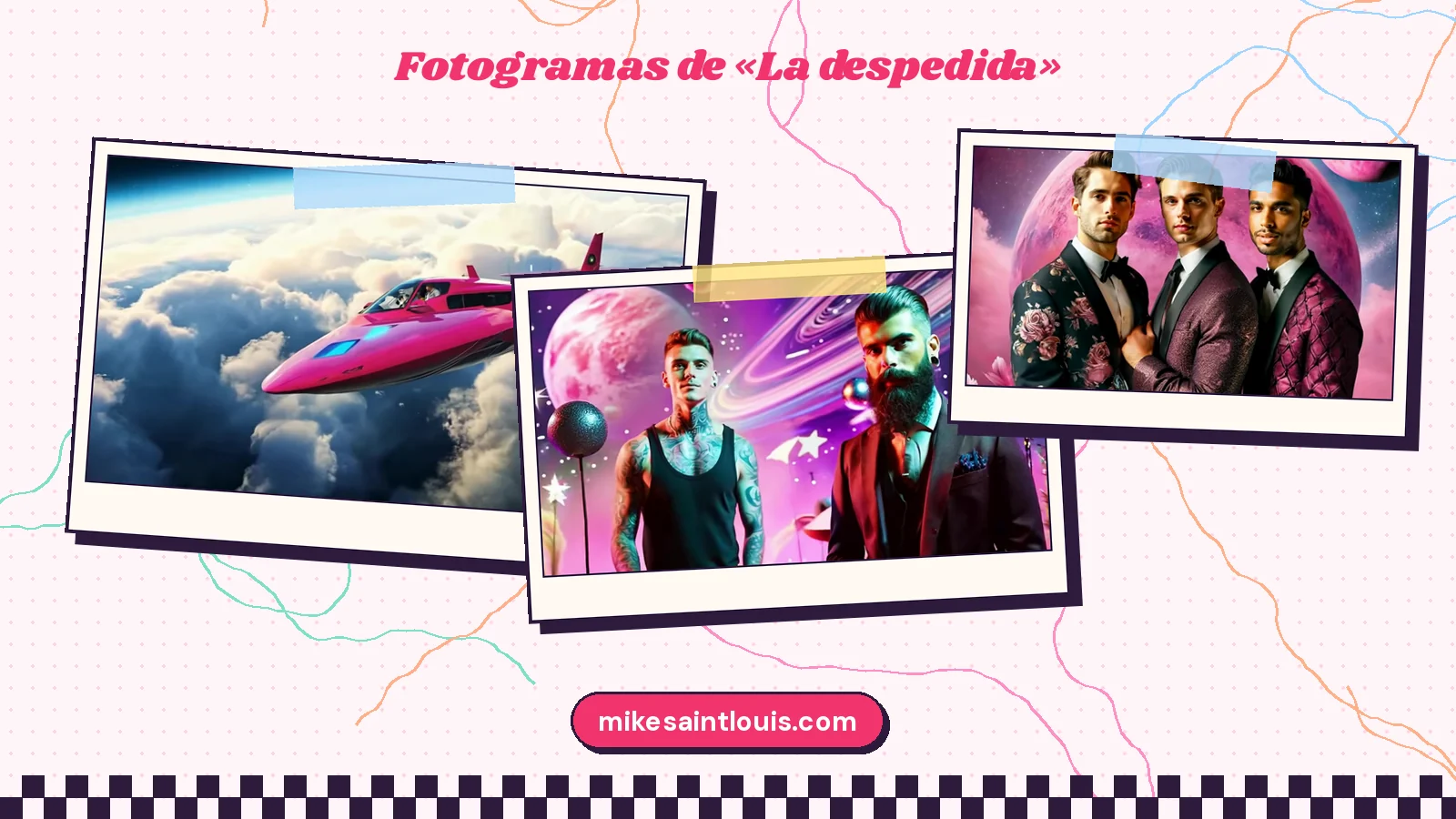
«CAMELA, LA PRIMERA VEZ QUE FUI YO SOLO CON MIEDO A CHUECA PENSANDO QUE ME IBAN A PEGAR» ("CAMELA, THE FIRST TIME I WENT TO CHUECA ALONE, SCARED, THINKING I'D GET BEATEN UP")
Look at the sentence. It's badly broken, it overflows, it runs out of line and has to carry on into the next. It happened while I was writing and I left it that way because it seemed fair. That memory doesn't fit the mould of the other lines. It's too big for a short verse.
What it says is very simple. The first time I went to the neighbourhood alone, I was afraid I'd get beaten up. Not inside, but for going. For being seen going in. For the look people on the metro give you when you get off at that stop and don't look like you're going to work in a shop.
Today Chueca is an expensive neighbourhood, with avocado brunches, designer underwear shops and tourists taking photos on the rainbow zebra crossings. It's easy to forget that for many people it was, before anything else, the place you were afraid to go alone. The song doesn't explain it or turn it into a speech. It puts it in the middle of the list, between a party night and a threesome in the sauna, just as big as the rest.
And that, for me, is the closest thing to the truth I know how to write. In queer memory, fear and partying share the same page. Take one away and the other loses its meaning.
If you're interested in how I use the city in other lyrics, I went into it more slowly in Madrid without the postcard. Here Madrid appears in a single word, heart in mouth.
The L'Oréal hairspray
Now one of the photos that never makes the documentaries.
«CAMELA CUANDO TE ACERCABAS A MERCADONA A COMPRARME LA LACA DE L'ORÉAL PORQUE SABÍAS QUE SI NO, EL PELO TODA LA NOCHE NO ME IBA A AGUANTAR» ("CAMELA WHEN YOU POPPED TO MERCADONA TO BUY ME THE L'ORÉAL HAIRSPRAY BECAUSE YOU KNEW THAT OTHERWISE MY HAIR WOULDN'T LAST THE NIGHT")
This is probably the most romantic line I've ever written. And it's about a can of hairspray.
No moon, no sunset, no sea. A supermarket aisle, a spray can and a person who knew, without being told, that my quiff couldn't make it through a whole night without help. That's love. The real thing, the kind that never appears in films because it doesn't look pretty on screen. Someone who remembers your hairspray.
I spend half my life writing about narcissists, punishments, people who leave you on read to measure how much you'll take. And then suddenly, in the middle of a rocket song, this slips in: a small memory of being cared for. A few lines further down comes a similar one, about when you'd straighten and comb my quiff. The same tenderness, hairdresser's edition again.
I didn't put it there to make anyone feel sorry for me. I put it there because if you list what you take away from a relationship, it isn't the anniversaries. It's the cans of hairspray.
Pelahustán, the sauna and the whole menagerie
Not everything is tender, mind. This is a GAYFOLK album.
The same list has a threesome in the sauna, a beach day with the whole menagerie, summers of partying and a village in Toledo with a joke of a name that appears twice: Pelahustán. I won't explain why Pelahustán. Some things lose their charm if you explain them, and the name does all the work. Say it out loud and it sounds made up. It isn't.
What I can tell you is why I put it all together. Because that's how people remember their lives, people like me at least. Not in tidy chapters, first childhood, then adolescence, then first job. In leaps. The sauna and the first kiss are two lines apart, even if fifteen years separate them. The song ignores chronology because the head ignores it too.
And there's a pet. When we adopted Kas. That line comes almost at the end, just before everything goes into space, and I put it there on purpose. If you're leaving Earth for ever, the last thing you think about isn't your records or your clothes. You think about who's coming with you.
A pink dodgem
So much for the album part. But the song has another layer, and it's the one that plants it firmly on the planet.

From the first verse, the list of memories is set inside a journey. The songs play in the car, the car is heading to a space base, there's a vertical route, a pink rocket, a pink dodgem from an ideal planet. All of that mixed in with the first kiss and the hairspray, without asking permission.
I love the dodgem. It's the most fairground image on the album. An ideal planet, yes, but one you reach in a dodgem car, the fairground kind, the metal pole throwing sparks overhead and a fifteen-year-old collecting tokens. That's the GAYFOLK utopia. Not a Hollywood spaceship. A village ride painted pink.
Later the lyric changes the rocket's colour. Now the pink becomes bubblegum. It's a silly thing, a tiny adjective. But I like to think that, second time round, the rocket has got a bit tackier, as happens with everything you love.
If you don't know the planet I'm talking about, start with the first album's page. That's the map, so to speak. This song is the one that shuts the door on the way out.
The pink ship that won't come back
In the long chorus there's a phrase that repeats with a very blunt ending: the pink ship moving away from Earth, never to return.
Never to return. I say it just like that, in so many words.
Many people, hearing the word farewell in the title, expect a break-up song. Someone leaving, someone left crying on the platform. Not here. Here they both leave. They leave together. The farewell isn't from one to the other: it's from both of them to Earth.
That was the first thing I was sure of, before writing a single line. I wanted a song where saying goodbye wasn't losing someone but taking them with you. Where the drama wasn't loneliness but the return ticket that doesn't exist. A couple's goodbye, not a goodbye to the couple.
Which, if you think about it, is much rarer in a song. Couples' farewells are usually deathbed stuff, like films about old people holding hands in a hospital bed. This one's for flying off to another planet in a bubblegum rocket. A much better plan.
Goodbyeee
And then the real goodbye comes, and there I took a liberty I almost never take: stretching the vowels.
The lyric says «adiós planeta Tierra», goodbye planet Earth, with an endless final a, and then «adiós, adiós», with three o's each. I know it looks ridiculous written down. In a song, though, it's the only thing you can do when words have run out. You stretch what you've got. Like someone stretching a hug at the airport because they don't want to let go.
In other songs I use that trick for laughs. Not here. Here it's the only time in the whole lyric I stop listing. After thirty-odd lines of list, the list falls silent and only the word goodbye is left, alone, stretched. It's the moment the photo album closes.
No arguments, no disappointments
After the goodbye comes a stretch that seems to belong to another song. The register drops suddenly from capitals to the tone of an advert for a coastal housing development. This is the farewell, today was our last day on Earth, on the planet we're going to a new life begins.
And then the brochure: no arguments, no disappointments. Where we're going there's no inequality.
I know perfectly well how it sounds. It sounds like a cult's promise, a cruise advert, a space shopping channel. I wrote it with that smile. GAYFOLK has always been a planet half serious, half joke, a utopia that knows it's tacky. There's nowhere without arguments. We all know that. But I liked the idea that, after a list so full of real things, saunas and hairspray and fear of being beaten up, the song allowed itself a minute of brochure.
And here comes what I really wanted to say.
That's no coincidence
The song ends with three sentences that begin the same and end the same. It's the song's second anaphora, the one that answers the first.
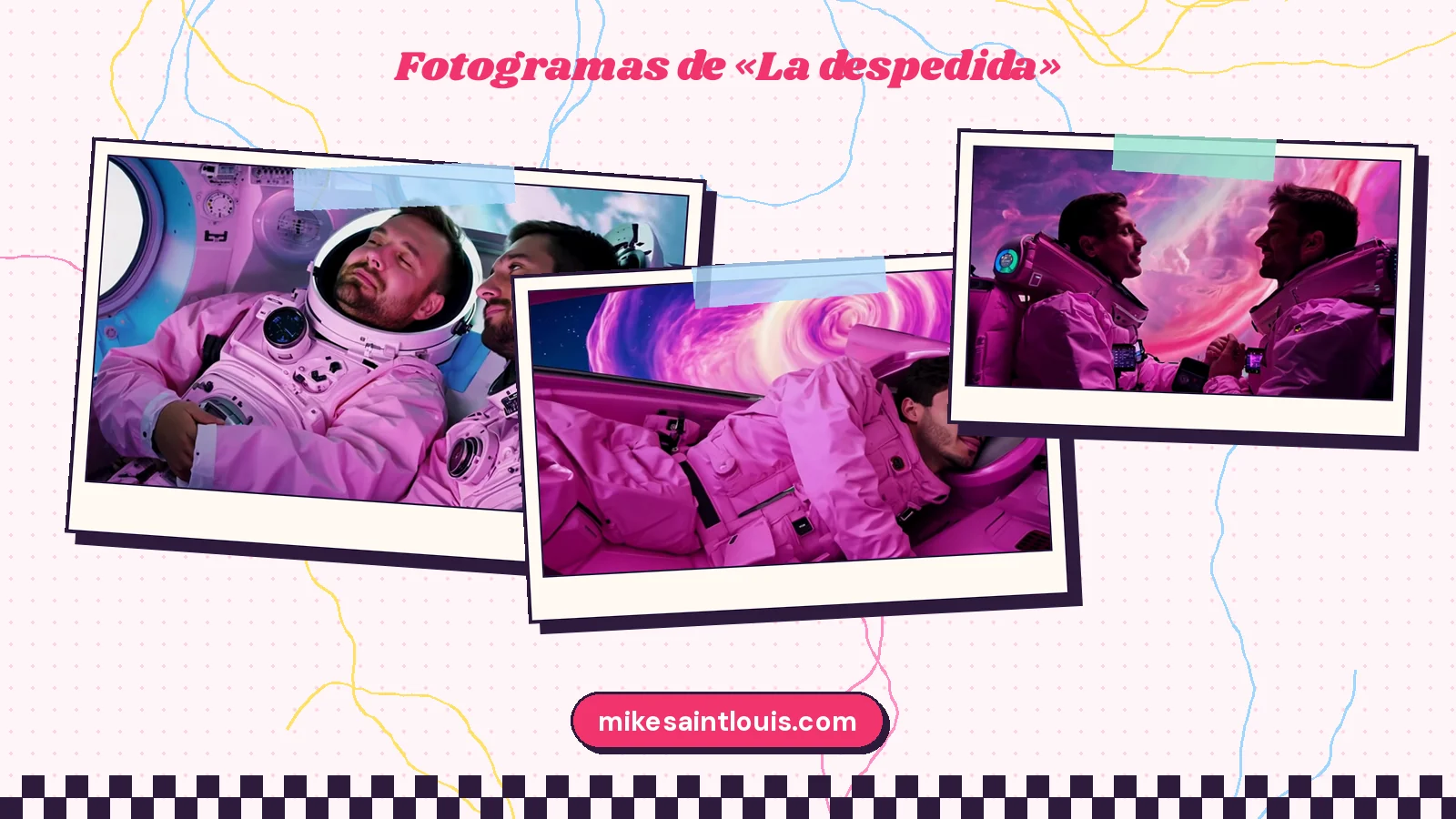
«HACÍA TIEMPO QUE NO TE REÍAS DE MIS BROMAS ASÍ, Y ESO NO ES CASUALIDAD.» ("IT'S BEEN A WHILE SINCE YOU LAUGHED AT MY JOKES LIKE THAT, AND THAT'S NO COINCIDENCE.")
It's been a while since we looked at each other like that. It's been a while since you laughed at my jokes like that. It's been a while since your face lit up like that. And all three times, the same punchline: that's no coincidence.
That "it's been a while" is the saddest line on the album, and it's hidden at the end of the most party-minded song. Because it says, without saying it, that for a spell we didn't look at each other, you didn't laugh at my jokes, your face was dimmed. That we were in a bad way. And that it took leaving for another planet to be all right again.
I'm not making anything up when I say that's the part I wrote most carefully. The jokes in the list come by themselves; this didn't. I had to clean it up a lot, strip the trimmings, leave it almost bare bones. Three identical sentences and a "that's no coincidence" that at first sounds like a horoscope and in the end sounds like a diagnosis.
What it means is simple: if you're laughing again, it's because we've left. Because we've left something behind. Because the problem was the planet, or the life we had on it, and not us.
Or so we want to believe. That counts too.
One anaphora answers another
Back to the craft for a moment, because people sometimes ask and here it's very clear.
The song has two lists facing each other. The first, the long one, the Camela one, looks back: everything we've lived. The second, the short one, the "it's been a while" one, looks at the present: what's come back. One is a photo album. The other is a new photo.
I noticed that after writing it, not before. I'm not one of those who plans the structure on a whiteboard. I write, I laugh, I turn serious without meaning to, and then I read it and see the shape that's come out. Here the shape came out by itself: one repetition to remember, another repetition to breathe.
If you like this kind of thing, «Me rindo», I give up, which comes just before it in the site's discography, has a different kind of list, angrier, the kind that tells things that can't be forgiven. And just after comes «Madrid to Benidorm», which is also about hitting the road and clearing off. I like that they've ended up that way, one on each side, as if the pink ship were passing between them.
What Camela does to a sentence
Let me explain with a bar-counter example.
If I tell you "the first time I went to Chueca I was scared", it's a confession. You turn serious, look at me with pity, maybe give me a pat. If I tell you "Camela, the first time I went to Chueca I was scared", that's something else. Now there's background music. Now there's a car, an era, shoulder pads. The sentence stops being a therapist's-couch confession and becomes a memory smelling of pine air freshener.
That's what the duo's name does to every line: takes it out of the consulting room and puts it in the car. Gives it context without explaining it. And takes away a little of the drama too, because it's very hard to go tragic with the word Camela in front. You try and a smile comes out.
It's a trick I use a lot: putting something tacky next to something that hurts so the pain doesn't get too grand. On the page for «Camela», my other song with their name, I did it differently, more as a tribute. Here the duo isn't the subject. It's the frame for every photo.
Why capitals
The lyric is all in capitals. All of it. From the first line to the last "that's no coincidence".
It isn't a formatting error, nor did I forget to switch off caps lock, though I admit that's happened more than once writing emails. It's a decision. Online, capitals read as shouting, and this song is a shout. A happy one, a fairground one, a stag-do-in-Benidorm one. But a shout.
And then something curious happens: when everything is shouted, nothing stands out. Capitals level things. The first kiss, the sauna threesome, the fear of Chueca and the L'Oréal hairspray all get the same volume. It's the same thing I told you earlier about the repeated word. Everything at the same level, like an album where all the photos are the same size even if some are from your First Communion and others from the worst hangover of your life.
I laughed a lot imagining someone reading it on the site with a startled face, thinking the page was broken. It isn't broken. It's shouting.
The cover, again
I described on the song's page what's on the artwork: a huge pink planet, two astronauts in metallic pink suits, jagged rocks tinged magenta. There I wondered who was saying goodbye to whom. Now that I've told you the lyric, I'll tell you what I think, which is what the list shows.
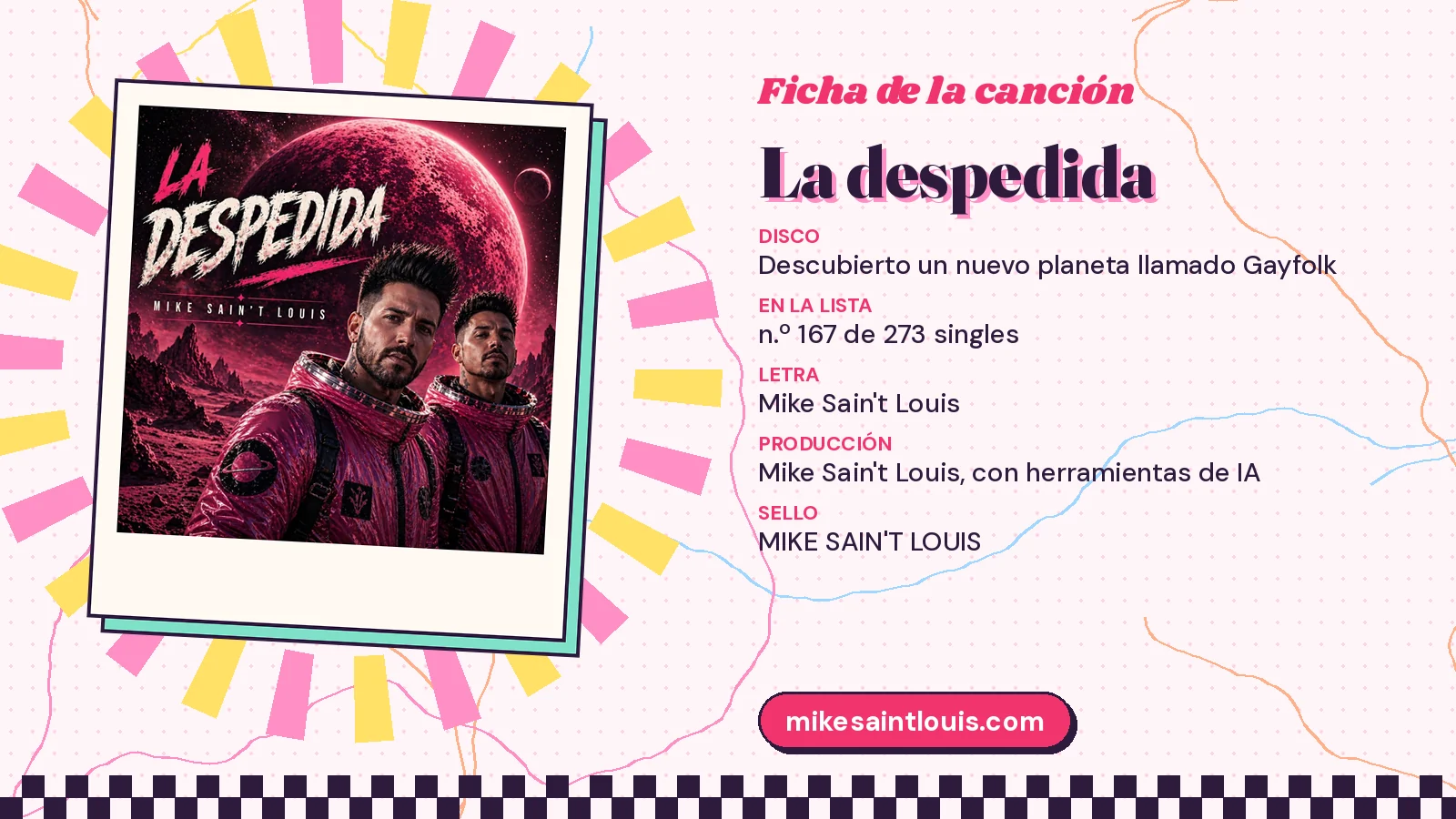
Nobody is saying goodbye to anybody. The two astronauts are dressed the same because they're together. The one behind isn't left behind: he's behind because someone has to be behind in a photo. What's left behind is Earth. With its Mercadona, its petrol stations, its cassettes, its fear of walking into a neighbourhood.
And if you look closely, the cover isn't a ship taking off. It's the after. They've arrived. They're on the planet. They're laughing at the jokes again, even if you can't see it from here.
Made with AI, written by hand
I say it in every piece because people keep asking. The lyrics are mine, written without artificial intelligence, with my wonky punctuation and my queenly capitals. I make the music and vocals with AI tools, Suno among them. I'm not on vocals. I bring the words, the idea of the song and the production.
In this one that shows in a curious way. When you give a machine a lyric with thirty-odd lines that all start the same, the machine doesn't get bored. It doesn't complain, doesn't tell you it's repetitive, doesn't suggest changing the chorus to make it more commercial. It just does it. And there the repetition, which on paper might look like a whim, starts to sound like a village-fair litany, which is exactly what I had in my head.
What the machine doesn't know is why the hairspray is there. I know. I wrote it. And if anyone ever tells me my songs are made by a button, I'll send him this lyric and ask which button remembers who used to buy you hairspray.
If you want to know more about how I work, I tell it without frills in About me. The house rules are there.
Who I wrote it for
I won't name names. There's no need, and it's nobody's business.
I'll tell you who I think it's for, which is something else. It's for people who've been in a long relationship and one day, on a weekend away or at dinner or in a car, realised it had been a while since they looked at each other like that. It's for people who have a tacky song tied to every important moment of their lives and are embarrassed to admit it. It's for the lad who today, in some village, thinks that if he gets off at that metro stop he'll be beaten up.
To him I'd say the song is for him too. That the first time is frightening. That later, over the years, that same time becomes just another line on the list, as big as the first kiss. And that one day someone will buy him hairspray.
Play it in the car
My only recommendation is this: listen to it in a car. Not at home, not on headphones on the sofa. In a car, even if it's on the way to Mercadona, even if it's in a jam on the M-30 on a Tuesday afternoon. It's a road song dressed up as a space song.
And if you're with someone, see if they laugh at your jokes. If they laugh like they used to, you know.
That's no coincidence.
If you want more, they're all in the singles list, and in Lyrics you can read the ones I've already uploaded. This one, with its capitals and its pink ship, is still one of my favourites to end a night with. Or a life on Earth.
Frequently asked questions
What is Mike Sain't Louis's «La despedida» about? It's a list of a couple's memories, each headed by the word Camela, ending with the two protagonists boarding a pink ship and leaving Earth for ever. It closes with three sentences about looking at each other and laughing like they used to.
Why is the word Camela repeated so much? Because it works as the caption for each memory. The tecno-rumba duo played in cars, at fairs and on school trips, and their name turns every line into a moment with a soundtrack.
Which album is it on? «Descubierto un nuevo planeta llamado GAYFOLK», the first album of the Planeta Gayfolk trilogy.
Is Mike Sain't Louis on vocals in the song? No. Mike writes the lyrics without AI and is the composer and producer. The music and vocals are made with artificial intelligence tools such as Suno.
Where can I read the full lyrics? On the gayfolkplanet.com lyrics page, at gayfolkplanet.com/letras/la-despedida.