
By Mike Sain't Louis ·
Sofa therapy: «Judith Bécker», the fictional psychologist and the telly that takes care of you
A room straight out of the seventies. Wallpaper in orange and pink waves, a three-globe floor lamp, a red chest of drawers with a plant on it and a rotary phone, also red, on the side table. Stretched out on a teal sofa, a man in a purple suit with a geometric print, pink shirt open at the neck, wearing the face of someone who has had a dreadful day. With her back to us, sitting opposite him, a red-haired woman dressed in red jots something in a notebook. At the top, in pink letters, the title.
That's the cover of «Judith Bécker», and it's a psychologist's consulting room. No doubt about it. The couch, the notebook, the patient's slump, the therapist listening without looking at the camera. All the set dressing of every film about psychoanalysis, run through a colour filter that would delight the director of any Spanish sitcom.
The song is on «Descubierto un nuevo planeta llamado Gayfolk», the first album of the trilogy. It came out on 28 May 2026, and it's number 221 in the full list of singles, between «Zee-Zee» and «Si Don Aussiebum hablase». Its page on the blog already covers the comfort show, the chorus that stretches every vowel and the praise of staying in. Here I want to pull on the thread of the cover: the idea that a TV series can play therapist on a bad night, how much truth there is in that, and where it stops.
Who Judith Bécker is
For anyone who doesn't live in Spain or hasn't seen the show, a little context. La que se avecina is a Telecinco sitcom that premiered in 2007, created by the siblings Alberto and Laura Caballero, and it has spent many years chronicling the misfortunes of the residents of a housing estate on the edge of town, Mirador de Montepinar. It's one of those shows that, whether you watch it or not, is part of the national conversation. Its catchphrases turn up in WhatsApp groups, in memes and at bar counters.
Judith Bécker is one of its characters: a psychologist, played by the Galician actress Cristina Castaño. And that's the joke on the cover. The redhead in red with the notebook isn't just anyone. She's the therapist. The patient lying on the sofa is us.
I love that twist. The lyrics are about watching the show to forget a bad day. The cover turns that plan into a session. As if putting on an episode were, in some way, booking an appointment.
One of those days
The song opens with a line anyone will recognise: today is one of those days. No need to say which. Everyone has their own collection. The days you wake up tired and go to bed more tired still. The days when something breaks and you're not quite sure what.
And the lyrics pin it down with an exaggerated, perfect image: «me llegan las ojeras al suelo de tanto llorar», my eye bags reach the floor from crying so much. It's a very Spanish hyperbole, the sort we use without thinking. I'm dying of hunger. My feet are wrecked. My eye bags are on the floor. Nobody takes it literally, but everybody grasps the exact measure of the exhaustion.
Then comes the detail I find most honest in the whole song: after work. Crying doesn't stop anyone going to the office. You cry before, you cry after, you cry in the work toilets if you must. But you work. And when you finally get home, all that's left is the sofa.
Booking an appointment with the telly
There's something that feels very real to me, something the song doesn't say but the cover suggests: for a lot of people, television has been the therapy they could afford. Seeing a psychologist costs money and time. It also takes courage. Switching on the telly costs nothing.

I'm not saying that to play down real therapy, which matters, enormously. I'm saying it because that's how a lot of people's lives work. When the day has been a nightmare and there's nobody to ring, you sit on the sofa and put something on to keep you company. Something that talks while you've no strength left to talk.
And not just anything. Not a new series that makes you learn names and follow plots. One you already know. One where you know where every neighbour lives and what each of them will say. One that takes you back somewhere you've already been.
Rewatching what you know the ending of
The lyrics make it crystal clear: «Solo me apetece ver la temporada enterita», all I feel like doing is watching the whole season. Not a single episode. The whole season. And not just any season, but the one with the most scenes of a favourite character.
Loads of people do this, and I understand it completely. Rewatching a series you know by heart has something ritual about it. No surprises. Nothing will catch you off guard. You know that one character will put their foot in it, another will shout, and everything will be sorted with a slammed door and a laugh track. That predictability, which would bore you any other time, is exactly what you need on a bad night.
It's the opposite of life, which never warns you. In life you don't know when you'll be lied to, or by whom, or how the season will end. In the show, you do. Watching something whose ending you know is giving yourself an hour of a world in order. An hour in which nothing depends on you.
Why her and not someone else
The song's page already points this out: the lyrics don't explain why Judith and not any other resident of Montepinar. And I'm glad they don't. Everyone has their comfort character, and we hardly ever know why.
But the cover drops a hint. If, out of all the characters in a sitcom, you pick the psychologist, you're asking for something. Spending the night with the neighbour who always causes chaos isn't the same as spending it with the one who, in theory at least, listens to other people's problems for a living.
I love the thought that the song's narrator has, without saying so, found himself a fictional therapist. One who doesn't charge, doesn't need booking, doesn't ask about his childhood. Who's simply there, on the screen, for a whole season.
The technicolour couch
Back to the cover, because it's packed with detail. The patient is in a purple suit with a geometric print, pink shirt open, a tattoo peeking out across his chest. He isn't dressed for therapy. He's dressed for a party. Or he's just come from one. It's the picture of someone who made a real effort and still ended up flat out on a couch looking like he can't take any more.
The therapist, by contrast, has her back to us. All we see is her red hair, her red dress, the notebook and the pen. We don't know what she's writing. We don't know what she thinks. She's a figure who listens. And there's the red rotary phone in the foreground, as if it might ring at any moment with bad news.
The whole scene has the air of a seventies comedy, with its impossible colours. That feels just right, because the song has something of the comedy about it too, even though it's about crying. Drama and gag share the same sofa.
A chorus that moans
The chorus stretches its vowels into infinity. Enteriiiita. Avecinaaaa. The song's page talks about that, about how it sounds like someone grumbling, sprawled on the sofa. But with the cover in front of me it sounds like something else too: a patient letting it all out.
There's a moment in therapy sessions, or so everyone who's been tells me, when you stop speaking in tidy sentences and just start unloading. Repeating yourself. Dragging words out. Complaining without arguments. And that's fine, because that's what the couch is for.
The song's chorus has exactly that shape. It isn't reasoning. It's a lament. And there's no logic to look for beyond the logic of exhaustion.
Fake partners
Then comes the part that gives the whole thing depth. «parejas farsantes que siempre te engañan», fake partners who always cheat on you. That's when we realise the bad day is a lot more than a bad day. There's a story behind it. Or several. An accumulated weariness of lies.
I'm fascinated by the word farsante. It doesn't say liar, or cheat, or bastard. It says farsante, which is a theatre word: the player in a farce, the one putting on an act. And that ties in beautifully with the cover and with the show: a world of fiction, of characters, of people playing a part.
There's a lovely irony in that. The narrator is fed up with people who pretend. And his refuge is a show full of actors who pretend. The difference is that the ones on telly tell you up front. You know it's fiction. Fake partners never tell you anything.
Animals don't lie
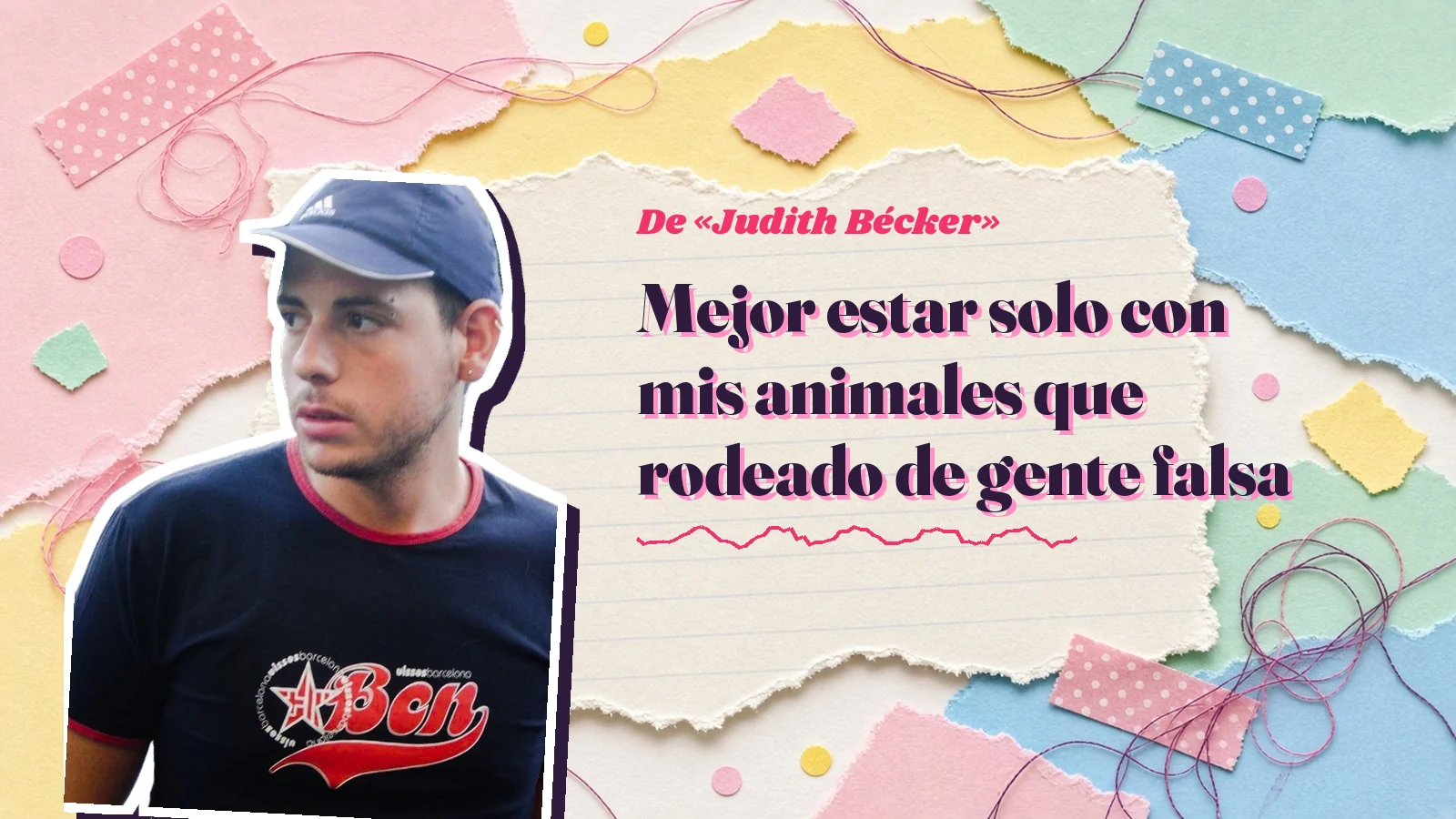
The song's moral is the kind of line you could put on a kitchen tile: «Mejor estar solo con mis animales que rodeado de gente falsa», better alone with my animals than surrounded by fake people. I adore it because it sounds like an old village proverb. Better alone than in bad company, but with a dog.
Anyone who has animals at home knows what it means. A dog doesn't deceive you. Nor does a cat, though it may ignore you with tremendous style. Animals don't fake interest to get something out of you. If they come over, it's because they want to. If they leave, they leave. No double talk.
I've written about animals in other songs, like «Chihuahua» or «Como a mi chihuahua». And I think that's how animals tend to appear in my lyrics: as the only company you can trust completely. It's not that I prefer animals to people. It's that with animals I know where I stand.
A lyric with your and my
There's a small detail in the lyrics that tickles me. The first time round, the moral says your animals. Later, my animals. Then back to your. The published lyrics keep switching between the two.
I won't pretend there's a grand plan behind it, because I don't know. But I like how it sounds. As if the advice started out aimed at someone else, better alone with your animals, and at some point turned round and became a confession. Better alone with mine. Like the advice you give your friends that you're really giving yourself.
Comedy as a painkiller
I find it telling that the chosen show is a comedy. When you're sad you could reach for a drama to keep you company in your grief, a film for a good cry. But no. The song goes straight for comedy, and a shouty, chaotic one at that, with neighbours fighting over the lift.

I think there's real folk wisdom in that. Laughter doesn't fix anything, but it eases things. It gets you out of your head for a while. And laughing at a show you know by heart has an added bonus: you laugh before the joke arrives, because you're waiting for it. It's the laughter of recognition, like the one you get from a story your friend has told you a hundred times that still makes you giggle.
In Spain we have a long habit of laughing at what hurts. The satirical carnival bands of Cádiz, stand-up, the endless chat at the bar. Laughing doesn't belittle the sadness. It's a way of putting a little distance between you and it so you can look at it without being knocked flat.
That's why the song mixes the two so naturally. First the tears, then the comedy. First the eye bags, then the remote. No contradiction. That's how a bad day gets survived in countless homes.
The phone that doesn't ring
There's one object on the cover I don't want to skip: the red rotary phone in the foreground, on the side table. It's the closest thing to us in the whole picture. And it's silent.
I like reading it as a small joke about what the song is asking for. The narrator doesn't want the phone to ring. He doesn't want anyone calling, least of all one of those fake partners. He wants his show, his animals and his silence. The red phone sits there as a reminder of the outside world, the one that could barge in at any moment.
And also, why not, as a reminder that there's someone to call if you need to. A phone is both things at once: the threat of being disturbed and the chance to ask for help. On this cover, for now, it's still.
What the telly can't do
Now for the serious part, because the cover asks for it. A series can keep you company on a bad night. It can even keep you company on many. But there comes a point when sadness stops being a bad day and turns into something else. When your eye bags have been on the floor for months. When you can't remember the last time you didn't cry after work.
At that point, the fictional psychologist isn't enough. You need a real one, with a real appointment, even if it's by video call. And if things get very dark, if at any point you think about hurting yourself, in Spain there's 024, the suicide-prevention helpline, which is free and open around the clock. If there's immediate danger, 112. And if you're outside Spain, call your local emergency number.
I'm not saying this to spoil the song, which is a comedy and should be heard as one. I'm saying it because the cover has a therapist on it. And it seems only fair to remember that flesh-and-blood ones exist too.
Chosen solitude
The song ends in solitude, but not an entirely sad one. It's solitude with a remote, a blanket, animals and a whole season ahead. I wrote about this when discussing «Antisocial»: there's a world of difference between being alone because nobody loves you and being alone because you've decided that tonight you don't want anybody else.
The narrator of «Judith Bécker» has chosen. Between going out with fake people and staying in with his show, he stays. And he doesn't apologise for it. To me it's a deeply unglamorous and deeply real way of looking after yourself.
Society sometimes sells us self-care as spa days, yoga or a retreat in Bali. For most people, self-care is this: pyjamas, the sofa and a good old sitcom.
Pop culture as family
I'm very interested in how certain shows become something like family. It's no accident that so many LGBTQ people have such an intense relationship with television. For years, when you couldn't be yourself at home, the telly was where the over-the-top characters showed up: queens, divas, flamboyant men, women with enormous personalities. People who didn't look like everyone else.
I've written about telly as a sentimental dictionary in other posts, and I said as much in «Ojalá hubiera tenido de suegra a Carmina Barrios», where the wish is quite literally for a public figure to join your family. Something similar happens here, only more modestly. You're not asking Judith to be your mother-in-law. You're asking her to keep you company for one night.
And shows are brilliant at that. They're there. Every time you need them. At three in the morning, on a Sunday, in August. They never get tired of you.
Crying without shame
There's something I find very valuable in this song: it cries without apologising. The narrator doesn't say I'm a bit down. He says he's been crying so long that his eye bags are on the floor. He puts it front and centre. He doesn't hide it.

I've given a whole song to the subject, «Llorar», and I think crying turns up in my lyrics far more than people expect from a pop record with a sense of humour. That's because it seems to me a normal part of life. You cry, you work, you cry again. And then you put the telly on.
What's lovely about «Judith Bécker» is that the tears don't have to justify themselves. We don't know exactly why he's crying. We know he's cried a lot, that he's exhausted, and that he'll look for comfort wherever he can find it. That's enough.
Music for the washing-up, telly for the tears
In songs to do the washing-up to I wrote about that domestic pop that deals in small lives: the kitchen, the supermarket, the sofa. This song is a perfect example. There's nothing epic about it. No road trip, no plane, no ex in another city. Just a flat, a remote control and some animals.
And yet it tells you something very big. It tells you how to survive a horrible day with nothing but the tools you have at home. To me that matters more than plenty of songs about great heroic deeds.
Who this song is for
For anyone who gets home from work with puffy eyes and only wants to lie down. For anyone with a comfort show and a favourite character, even if they can't explain why. For anyone sick of people who pretend and who'd rather have their dog for company.
Also for anyone who thinks staying in on a Saturday is a failure. It isn't. Sometimes it's the most sensible thing you can do.
And for anyone who needs a therapist tonight and doesn't have one yet. Let the telly keep you company today. And tomorrow, if you need to, book a real appointment.
The couch, in the end
I keep coming back to the image on the cover. A man in a party suit flat out on a sofa, a redhead listening, a phone that hasn't rung yet. It's a comedy scene, with its outrageous colours and impossible set. But inside the comedy is someone who needs to be heard.
I think that's what «Judith Bécker» is: a song that laughs at its own drama without ever stopping taking it seriously. A lament with a laugh track. A therapy session with a remote control.
Put the whole season on. Pull up the blanket. Let the cat climb on top of you. And may tomorrow be one fewer of those days.
If this subject hits close to home: in the series «Mental health without taboo» I talk openly about my mental health (narcissistic abuse, the bullying and abuse I suffered as a child, my diagnosis at 41, and therapy) and gather where to find help. If you're thinking about suicide, call 024 in Spain, or your local emergency number elsewhere.
Frequently asked questions
Which album is «Judith Bécker» on? On «Descubierto un nuevo planeta llamado Gayfolk», the first album of Mike Sain't Louis's GAYFOLK trilogy. It came out on 28 May 2026 and it's number 221 in the full list of singles.
Who is Judith Bécker? She's a fictional character from the Telecinco sitcom La que se avecina: a psychologist, played by the actress Cristina Castaño.
What is the song about? A horrible day, after work and a lot of crying, when all you feel like doing is watching a whole season of the show and staying in with your animals rather than with fake people.
What's on the cover? A seventies-style psychologist's office: a man in a purple suit stretched out on a teal sofa and, with her back to us, a red-haired woman in red taking notes in a notebook.
Who made the song? The lyrics are by Mike Sain't Louis, a lyricist, composer and music producer from Madrid, known as the first AI songwriter. The music and vocals were made with artificial intelligence tools.