
By Mike Sain't Louis ·
«Si yo hubiera sabido»: the fool's conditional and the bonfire of «Al fuego»
If only I'd known. «Si yo hubiera sabido». Four words in Spanish. Not one of them is any use.
There's no more pointless phrase in the whole language. It fixes nothing, returns nothing, changes nothing. It's a time machine that won't start. And yet it's the phrase we repeat most after a break-up: in the queue at Carrefour, on the sofa under a blanket, in the girls' WhatsApp group at two in the morning. If only I'd known.
That's how «Al fuego» begins ("Into the fire"), a song from the third album of the GAYFOLK trilogy that's short and says a lot. The song's page already walks through the lyric from top to bottom, with its bonfire and its grandmother's expressions. Here I want to do something else: talk about the past conditional as if it were a musical genre, about the feminine I use to insult myself, and about why, in the end, the only sensible thing to do with a memory like that is burn it.
The grammar of regret
Let me play the Spanish teacher for a moment, which hardly suits me, but today I'm in the mood.
The past conditional, "had I known", "had I listened", "I'd have sent", is the tense of things that never happened. It isn't the past, because the past did happen. It isn't the future, because it won't happen now. It's a ghost tense. A limbo. The place where every version of your life in which you were cleverer lives.
The song opens like this:
«Si yo hubiera sabido que te importaba un carajo / Te hubiera mandado con tu madre echando leches.»
(Roughly: "If I'd known you didn't give a damn / I'd have sent you packing back to your mother.")
And what I like about that sentence, now that I look at it calmly, is the contrast. The first half is heartbreaking: someone finds out that the person they loved didn't give a damn. The second half is pure market-stall bluntness: sending him back to his mother at full pelt. There's no transition between the two. No "and then I understood". It goes from wound to insult in the time it takes to draw breath.
That's how real regret works, the street kind, not the novel kind. It isn't elegant. It doesn't gaze at the rain through the window with a violin in the background. It cries for a minute and the next minute it's saying outrageous things out loud while scrubbing the frying pan.
And then the conditional's second lap: if I'd listened to that «ojalá le parta un rayo», "I hope lightning strikes him", I'd have written it down in my diary, cursing. Notice that this time it isn't about what the other person felt. It's about what the other person said, out loud, that I didn't want to hear. The «ojalá le parta un rayo» was there. He said it. And I let it slide, like someone who ignores the "lift out of order" notice and then gets stuck between the third and fourth floors.
A diary full of venom
The image of the diary tickles me, because it's so old-fashioned. So teenager-with-a-padlock. So nineties film where the heroine writes in glitter pen, "Dear diary, today Javi looked at me at break time."

In «Al fuego», the diary isn't for little hearts. It's for cursing. For noting the warning signs, one after another, like in a complaints book. The official complaints form of love, customer copy and all.
I have a close relationship with notebooks; I talk about it in my lyrics notebook. And one thing I've learned is that what doesn't get written down gets forgotten. Or worse: rewritten. The mind is a very generous editor towards whoever hurt you. Over the months it files down the edges, softens the sentences, turns "I hope lightning strikes him" into "well, he was angry, we all say things". If I'd written it down, says the song. If I'd had it on paper, with its date and time, there'd have been no way to soften it.
Sometimes I think all my lyrics are just that: a cursing diary that, instead of staying in the drawer, goes out into the street with a cover and a music video. I even once wrote a letter to myself from two years earlier, which you can read in letter to myself from two years ago, and it's basically a past conditional with a return address.
I say it half joking and half serious. If someone says something that leaves you cold, write it down. Not to use it against anyone. So that you, six months from now, can't tell yourself you imagined it.
Silly, an idiot and a failure
And then the chorus arrives, and it's an insult. Against me.
«Como soy tan tonta. He sido una gilipollas. Como soy tan fracasada.» ("I'm such a silly girl. I've been a total idiot. I'm such a failure.")
All in the feminine. And it isn't a misprint, or an invented character. It's how many of us queens talk when we're telling ourselves off in front of the bathroom mirror. «Hija, qué tonta eres», "Girl, you're so silly". «Mira que eres gilipollas, nena», "Honestly, you're such an idiot, babe". Among us, the feminine is a language of intimacy. Your best friend uses it when she sees you going back to the ex for the fourth time. You use it yourself when you see the message you sent him drunk.
I recognise myself in that chorus more than I'd like to admit. I have a track record of romantic blunders that would fill a Telecinco afternoon show, with Jorge Javier pulling a sympathetic face. And instead of hiding it, it seems healthier to let a song scream it for me, at full volume, with the window open and the woman from the fourth floor leaning out.
There's a very fine line between laughing at yourself and beating yourself up. The chorus of «Al fuego» walks right along that line and, I think, stays on the right side of it. Because it doesn't say "I'm stupid and I deserve what happened to me". It says "I've been an idiot, but I know the game now". The insult is in the past tense. The lesson is in the present. I was silly. Not any more.
That difference, between "I am" and "I have been", is the whole song.
It isn't the first time I've called myself a fool in a lyric. In «La casa de los mil cadáveres» I ask myself outright how I can be so stupid, such a failure. And I wrote it without any shame. Shame, in my line of work, is a tool: I explain that in cringe as a writing tool. My own shame too.
«No quiero ver tus fotopollas» (I don't want to see your dick pics)
And in the middle of the self-insults, a very specific request, very much of this century:
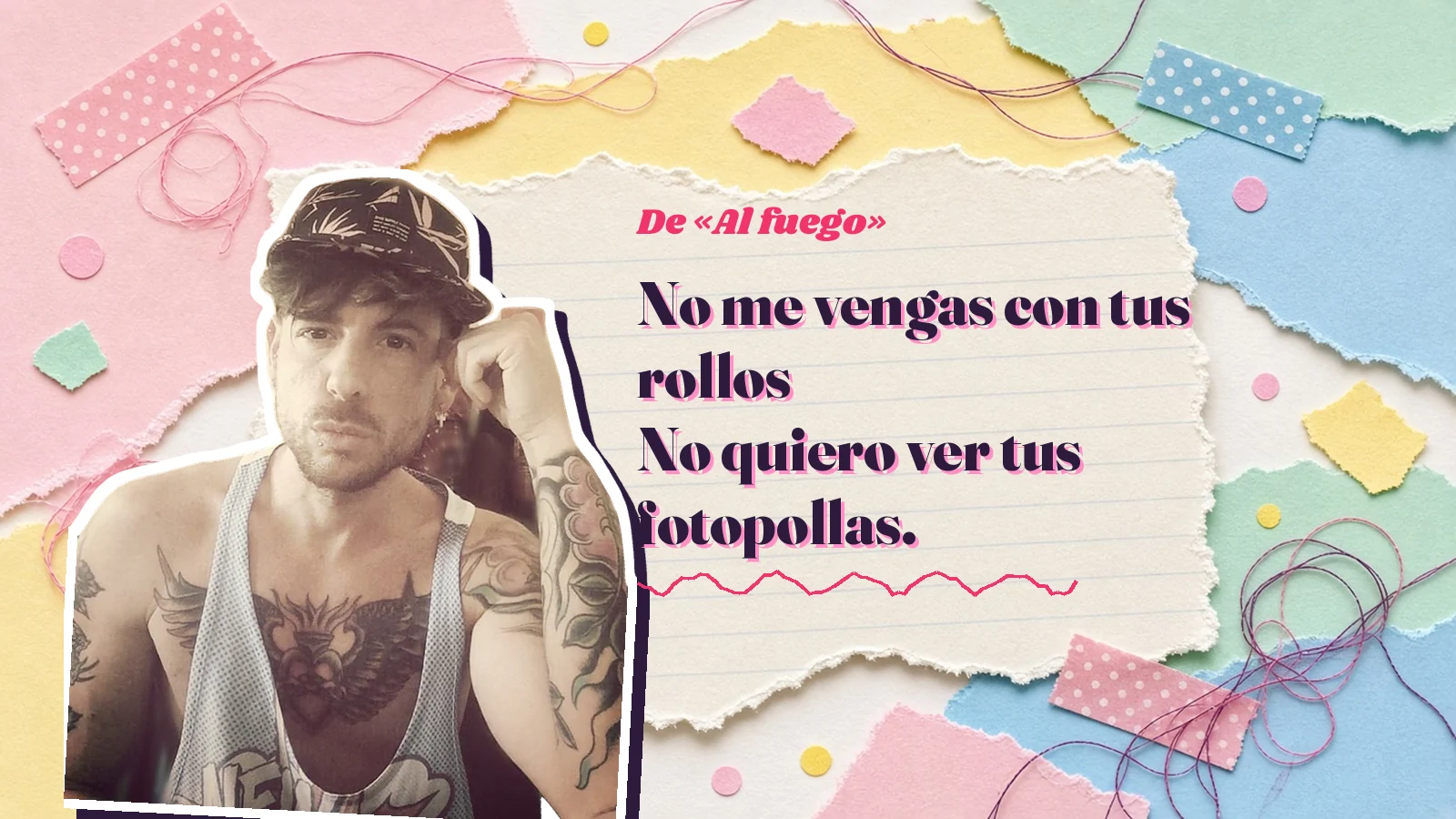
«No me vengas con tus rollos / No quiero ver tus fotopollas.»
(Roughly: "Spare me your stories / I don't want to see your dick pics.")
I laugh every time. And I laugh because it's true.
There's a type of man, and in the gay world he's practically a protected species, who, when he sees he's losing you, doesn't send you a poem. He doesn't send flowers. He doesn't write you a three-page letter by hand. He sends you a photo of his member. As if that were an argument. As if you'd look at the picture and say, "Oh, well, put like that, let's forget the two years of contempt."
It's the erotic equivalent of showing a debt collector your new car. It doesn't persuade. It irritates.
I have another whole song devoted to this photographic genre that's so very ours, «Tus fotopollas», and I don't rule out a third instalment, because the material never runs out. On Grindr, on Instagram, on Telegram, by AirDrop on the Madrid metro. There are people who, if they could, would send it by registered post.
In «Al fuego», the line works because it breaks the tone. We've had a while of sad conditionals, self-insults, diaries. And suddenly, bam, the dick pic. The everyday and the tacky dropped into the middle of the drama, like a Mercadona receipt in the pocket of a wedding suit. That's how I write. I don't know any other way, and frankly I don't want to learn.
«Echando leches, echando pestes» (in a mad rush, in a foul rage)
There's a small mechanism in the first verse that I love and that I think goes unnoticed. Both sentences end the same way: «echando leches», «echando pestes». It's a rhyme, yes, but it's something more fun than a rhyme. They're two age-old expressions that look alike on the surface and have nothing to do with each other underneath.
«Echando leches» means tearing off, in a mad rush, like a bat out of hell. Sending someone to his mother «echando leches» is throwing him out without giving him time to grab his jacket. «Echando pestes» means badmouthing someone, furiously, with a twisted mouth. One is speed. The other is venom. And together, one after the other, they paint the full picture of what I'd have liked to do: throw him out fast and then tear him to pieces at leisure.
I've had phrases like these stuck to me forever. They're the Spanish you hear in the greengrocer's queue, in set-menu bars, in aunties' conversations at weddings. Nobody invents them: they're inherited. And putting them in a song is a way of saying that ordinary people's emotions have their own vocabulary too, and that it's far richer than the vocabulary of self-help books. I wrote a whole piece about this, about how we Spaniards exaggerate when we talk and why that helps me write: I'm dying: exaggeration in everyday speech.
An «ojalá le parta un rayo» from a neighbour is worth more than three paragraphs from an Instagram psychologist. At least you can understand it.
I know the game now
There's a line that changes everything, and it comes just before the end of the chorus: «ya me conozco el juego», "I know the game now".
This is what separates the person who regrets from the person who breaks free. The one who regrets stays in the conditional: if only, if only, if only. The one who breaks free goes a step further and says: right, I know how this works now. I've seen the trick. I know where the card is hidden up the sleeve.
Knowing the game doesn't give you back what you lost. But it protects you in the next round.
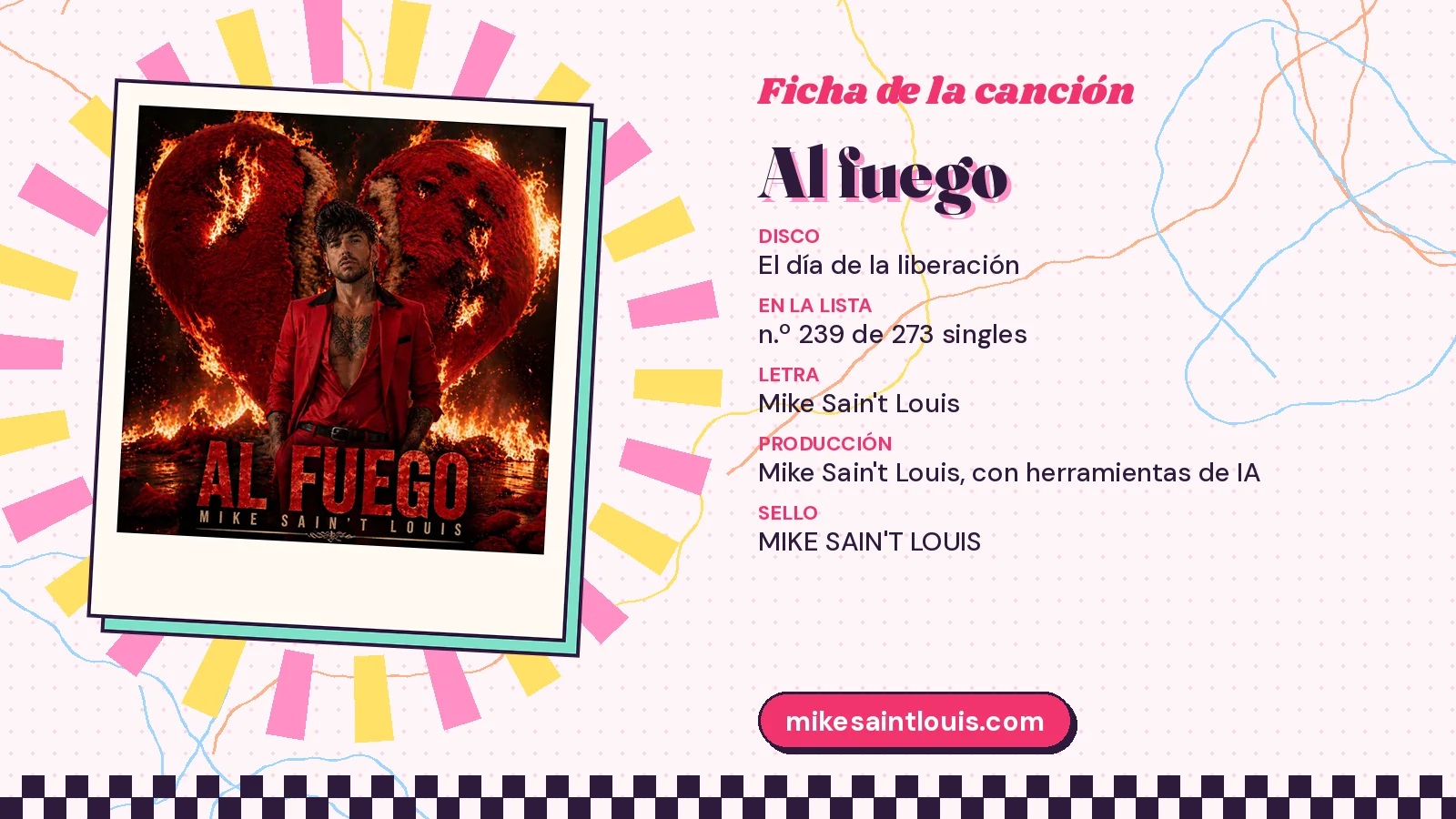
That's why the song is on the third album, El día de la liberación ("Liberation day"). Its business isn't crying. It's the day after, when you've done your crying and realised that if they deal you the same deck again, you'll say no. In the gayfolkplanet.com catalogue it's track 239 of 273, between «Toxina coreana» and «The Aftermath», which tells you by its very name that it's the hangover from something.
I've thrown it all into the fire
And the ending. The bonfire.
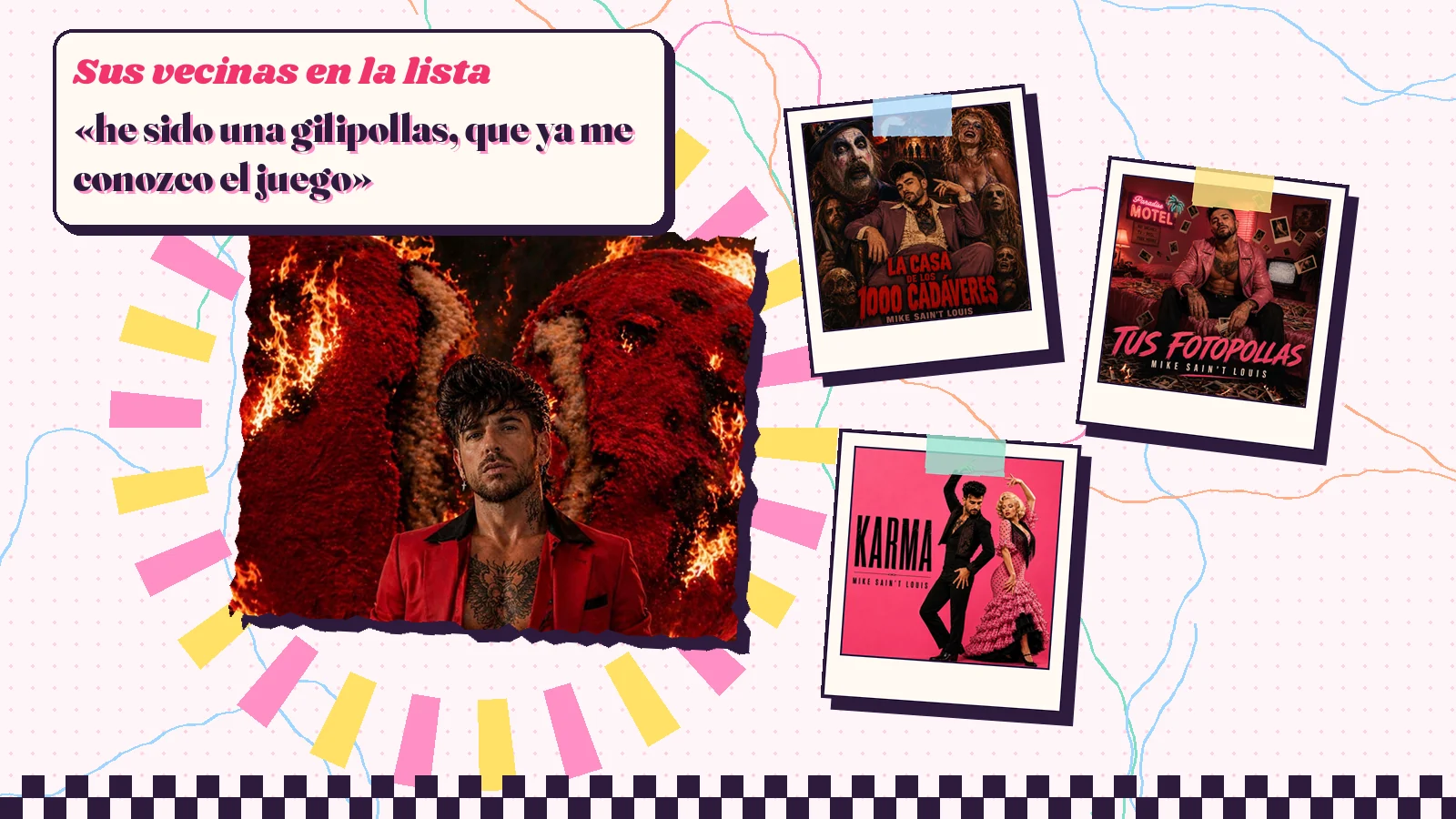
!Collage with a detail of the «Al fuego» cover art and the covers of «La Casa de los Mil CadáVeres», «Tus fotopollas» and «Karma» «He tirado todo al fuego», "I've thrown it all into the fire". It doesn't say what. It doesn't need to. Everyone knows what's in their drawer. The photos printed at Carrefour back when people still printed photos. The hoodie that smelled of him. The tickets from that concert. The Post-its on the fridge. The toothbrush he left behind and never came back for.
Into the fire.
It isn't revenge. Nobody gets hurt if you burn an old hoodie on the balcony (well, your neighbours, if the wind blows towards their washing line, but that's another matter). It's a ritual for yourself. To watch with your own eyes as something that weighed so much turns into ash, smoke, nothing. A strange smell that clings to your hair for two days.
And if you don't have a balcony, or you're worried the local police will turn up, the bin on your phone works too. Select all. Delete. Empty bin. Less poetic, but it has the advantage that you don't singe your eyebrows.
I'll take care of it, but only my own part
There's a difference between this song and others in my catalogue about exes and unsettled scores, and I think it's worth pointing out because it says a lot about how you change over time.
In «Karma», from the first album, I delegate the revenge. Everything comes around, and its name is karma: I sit back and wait and let the universe do it, since it has more free time. In other lyrics, the revenge fantasy is pure B-movie, explosions and shotguns. In «Al fuego» there's none of that. I don't wish anything on him. I don't expect anything to happen to him. No lightning, no punishment, no poetic justice.
All I do is take care of my own things. My drawer. My photos. My diary. My phone's bin. I burn it myself, with my own hands, and whatever happens to him afterwards I couldn't care less about.
It strikes me as a much more grown-up way to end something, and I say that quietly, because I'm hardly ever grown-up. But burning your own stuff, instead of trying to burn the other person, has one huge advantage: you don't need his cooperation. You don't have to wait for him to find out, or to suffer, or to apologise. A lighter and a free afternoon will do.
That's the journey from the first album to the third. From "he'll get what's coming" to "what do I care". And getting there takes a lot of songs in between. In between sits a whole album, the second, Ojalá se pudiera viajar a GAYFOLK ("If only you could travel to GAYFOLK"), with all its longing to run off to another planet.
The cover really is on fire
Look at the single's cover, because it says everything without saying anything. A man in a red suit with his shirt open, standing in front of a giant heart split in two and on fire, flames everywhere and the title in orange fire lettering below: AL FUEGO.
What I like about that image is that the heart is broken and burning, and the man is perfectly calm. He isn't running. He isn't screaming. He doesn't have a bucket of water. He's standing there in his suit, looking at the camera like someone posing at a photocall. To me it's the best possible illustration of "I know the game now": the blaze is behind you, and you're out in front, in one piece and well dressed.
None of my singles comes out without its cover and music video. You can see them all in the videos section, and you'll notice that fire, neon and red turn up far more than would be reasonable. That's just how I am. If I can fit a bonfire in, I fit a bonfire in.
Twice round and not once more
One last thing about form, because it's a decision I took seriously.
The song is very short: two verses and a chorus, and the whole thing repeats twice. No bridge. No third section that shifts tone. No grand finale with gospel choirs. It's said twice and it's over.
Twice because that's how spells work. The first time you say it to let it go. The second, to believe it. A third would be insisting, and insisting, in this business, is suspicious. If you need to tell everyone ten times that you're over it, you're not over it.
With many songs I'm tempted to stretch them out, add another verse, another image, another joke. And sometimes I do. But this one asked for the opposite: say just enough, burn it and leave the room before the smoke turns nasty.
If only you'd told me
Now I'm going to be serious for one paragraph, and then I'll go back to laughing.
The conditional is a trap, and it's worth knowing that. That "if only I'd known" assumes you could have known. That the signs were there, crystal clear, in neon lights with an arrow, and you didn't see them because you were silly. Sometimes that's true. But many other times it isn't. Many times the other person went to enormous lengths to make sure you didn't know. He lied well. He lied in detail. He lied with the face of an angel.
So if you're stuck in the conditional, try this: change the subject of the sentence. Instead of "if only I'd known", try "if only you'd told me". You'll see how quickly the blame gets shared out.
And now, yes, I'm laughing again.
What I don't throw on the fire
A bonfire has a dangerous side: you get carried away and burn everything. Even what you shouldn't.
So, to finish, my list of things that don't go into the fire, however much you might want them to. The friends who put up with you while you were stuck in the conditional, because none of this is their fault. The places: the bar where you met is still your bar, and the beach is still your beach, he didn't get them in the split. The songs you listened to together, because they were yours first. And what you learned, which is the only thing you take away free from the whole mess.
The rest, the hoodie, the photos and the dick pics, into the fire. No regrets.
And if there's some anger left after the bonfire, that's fine too. Anger burns out as well. It just burns slowly, like a birthday candle someone forgot to blow out.
What's left in the ashes
None of this is to say «Al fuego» is a profound song. It's a short, cheeky song with a dick pic in it. But I believe truths get told in small things too, and that camp, exaggeration and the everyday are serious ways of talking about life. It's the fourth house rule, written down on my About page, and this song follows it to the letter.
The lyrics are mine. The music and vocals are made with artificial intelligence tools, and I direct the whole thing under my own label. If you want the song on your phone without going through any platform, it's in downloads, free, like the rest of the catalogue.
Put it on one of those days. One of those days when you catch yourself thinking in the conditional. Turn it up, or just listen to it twice, as it asks.
And then, open the drawer.
Frequently asked questions
What is «Al fuego» about? About someone who realises, too late, that their partner didn't give a damn about them. They go over what they'd have done if they'd known, tell themselves off in the chorus and end up throwing everything into the fire.
Why is the chorus in the feminine? Because that's how many of us gay men talk to ourselves when we're telling ourselves off: «qué tonta eres», "you're so silly, girl", «he sido una gilipollas», "I've been such an idiot". It's a feminine of intimacy and self-parody.
Which album is it on? El día de la liberación, the third album of the GAYFOLK trilogy. In the gayfolkplanet.com catalogue it's track 239 of 273.
Who wrote it? The lyrics are by Mike Sain't Louis. The music and vocals were made with artificial intelligence tools, and the single is released on the MIKE SAIN'T LOUIS label.